The equation of Binet in classical and relativistic orbital mechanics
Pith reviewed 2026-05-17 00:56 UTC · model grok-4.3
The pith
Binet's equation is derived from infinitesimal displacements for both classical and relativistic central force problems in Schwarzschild-(anti-)de Sitter geometry.
A machine-rendered reading of the paper's core claim, the machinery that carries it, and where it could break.
Core claim
The central claim is that the relativistic version of Binet's equation for the Schwarzschild-(anti-)de Sitter metric can be derived by directly relating the coordinates involved through infinitesimal horizontal and vertical displacements, without needing potentials or Killing vectors.
What carries the argument
The infinitesimal horizontal and vertical displacement method applied to the metric to relate radial and angular changes in the orbit equation.
If this is right
- All conic curves arise as solutions for inverse-square force in Newtonian case.
- The equation applies directly to orbits in Schwarzschild-(anti-)de Sitter spacetime.
- Controversies about the cosmological constant's role in photon trajectories can be addressed.
- The derivation uses only elementary infinitesimal calculus concepts.
Where Pith is reading between the lines
- This displacement-based method could be applied to other spacetimes for simplified orbit calculations.
- It might offer an alternative way to compute perihelion precession without standard geodesic equations.
- Connections to the role of Lambda in black hole shadows or lensing could be explored further.
Load-bearing premise
The infinitesimal horizontal and vertical displacement method works in the curved Schwarzschild-(anti-)de Sitter geometry while keeping the same geometric meaning without extra curvature corrections.
What would settle it
Computing the orbit using the standard geodesic equation in Schwarzschild-de Sitter and checking if it satisfies the derived Binet equation.
Figures
read the original abstract
Binet's equation provides a direct way to obtain the geometric shape of orbits in a central force field. It is well known that in Newtonian gravitation Binet's equation leads to all the conic curves as solutions for an inverse-square force. In this work, we show how Binet's equation arises from the horizontal and vertical infinitesimal displacements of a body in free fall and in inertial motion. This derivation uses elementary concepts of infinitesimal calculus. Second, we derive the relativistic version of Binet's equation for the Schwarzschild-(anti-)de Sitter metric. This derivation, which is novel, directly relates the coordinates involved in Binet's equation without the need to introduce potentials or the use of Killing vectors. Finally, we tackle some controversies related to the role of the cosmological constant in the trajectory of photons in a Schwarzschild-(anti-)de Sitter or even in Reissner-Nordstr\"om-(anti-)de Sitter spacetimes.
Editorial analysis
A structured set of objections, weighed in public.
Referee Report
Summary. The manuscript derives Binet's equation from elementary infinitesimal horizontal and vertical displacements of a body in free fall and inertial motion using only basic calculus, first in the Newtonian inverse-square case and then for the relativistic Schwarzschild-(anti-)de Sitter metric. The relativistic derivation is presented as novel because it relates the relevant coordinates directly without introducing potentials or invoking Killing vectors. The paper concludes by addressing controversies concerning the cosmological constant's effect on photon trajectories in SdS and RNdS spacetimes.
Significance. If the central derivation holds, the work supplies an elementary, symmetry-independent route to the relativistic Binet equation that could simplify calculations of orbital shapes and light deflection while clarifying the explicit role of the cosmological constant; such an approach would be useful for pedagogical purposes and for exploring cosmological corrections in strong-field regimes.
major comments (2)
- [§3] §3 (relativistic derivation): the infinitesimal horizontal/vertical displacement procedure is transplanted from flat space, yet the text does not display the explicit inclusion of the non-zero Christoffel symbols of the SdS metric when differentiating the trajectory components; without these terms the resulting equation risks omitting curvature corrections that are required for consistency with the geodesic equation.
- [relativistic Binet equation] Eq. (relativistic Binet form): the final expression is stated to reduce to the Newtonian limit, but the manuscript does not show the intermediate steps that recover the standard 1/r^2 force term when the metric coefficients are expanded to first post-Newtonian order; this verification is load-bearing for the claim that the method preserves the correct Newtonian correspondence.
minor comments (2)
- [Abstract] The abstract would be strengthened by quoting the key relativistic Binet equation so that readers can immediately compare it with the standard form obtained via Killing vectors.
- [Notation] Notation for the angular coordinate and its derivative is introduced without a dedicated table or list; a short glossary would improve readability for readers unfamiliar with the displacement-based approach.
Simulated Author's Rebuttal
We thank the referee for their careful reading of the manuscript and for the constructive comments, which help strengthen the presentation of our derivation. We address each major comment below and indicate the changes we will make in the revised version.
read point-by-point responses
-
Referee: [§3] §3 (relativistic derivation): the infinitesimal horizontal/vertical displacement procedure is transplanted from flat space, yet the text does not display the explicit inclusion of the non-zero Christoffel symbols of the SdS metric when differentiating the trajectory components; without these terms the resulting equation risks omitting curvature corrections that are required for consistency with the geodesic equation.
Authors: We agree that an explicit display of the Christoffel symbols strengthens the connection to the geodesic equation. Although the derivation in §3 uses the metric to define the infinitesimal displacements in Schwarzschild-(anti-)de Sitter coordinates, the intermediate differentiation steps were not written out in full. In the revised manuscript we will add these steps, showing how the non-zero Christoffel symbols enter when differentiating the trajectory components and confirming that the curvature corrections are correctly incorporated. revision: yes
-
Referee: [relativistic Binet equation] Eq. (relativistic Binet form): the final expression is stated to reduce to the Newtonian limit, but the manuscript does not show the intermediate steps that recover the standard 1/r^2 force term when the metric coefficients are expanded to first post-Newtonian order; this verification is load-bearing for the claim that the method preserves the correct Newtonian correspondence.
Authors: We concur that the explicit recovery of the Newtonian limit is important for validating the correspondence. The manuscript states that the relativistic form reduces to the classical Binet equation but omits the intermediate algebra. In the revision we will insert the expansion of the SdS metric coefficients to first post-Newtonian order and demonstrate step by step how the standard 1/r² force term is recovered, thereby confirming the Newtonian correspondence. revision: yes
Circularity Check
Derivation from elementary displacements is self-contained with no reduction to inputs
full rationale
The paper starts from infinitesimal horizontal/vertical displacements in free fall and inertial motion, applies elementary calculus to obtain Binet's equation in the Newtonian case, then transplants the same displacement relations to the Schwarzschild-(anti-)de Sitter metric to obtain the relativistic form without potentials or Killing vectors. No step equates the final coordinate relation to a fitted parameter, a self-cited uniqueness theorem, or a renamed empirical pattern; the central result is generated from the metric coefficients and the displacement definitions themselves. The transplant assumption may raise correctness questions about omitted Christoffel terms, but that is external to circularity. No load-bearing self-citation chain or self-definitional loop is present.
Axiom & Free-Parameter Ledger
axioms (1)
- domain assumption The Schwarzschild-(anti-)de Sitter metric correctly describes spacetime around a spherical mass with a cosmological constant.
Lean theorems connected to this paper
-
IndisputableMonolith/Foundation/RealityFromDistinction.leanreality_from_one_distinction unclear?
unclearRelation between the paper passage and the cited Recognition theorem.
we derive the relativistic version of Binet's equation for the Schwarzschild-(anti-)de Sitter metric. This derivation, which is novel, directly relates the coordinates involved in Binet's equation without the need to introduce potentials or the use of Killing vectors.
What do these tags mean?
- matches
- The paper's claim is directly supported by a theorem in the formal canon.
- supports
- The theorem supports part of the paper's argument, but the paper may add assumptions or extra steps.
- extends
- The paper goes beyond the formal theorem; the theorem is a base layer rather than the whole result.
- uses
- The paper appears to rely on the theorem as machinery.
- contradicts
- The paper's claim conflicts with a theorem or certificate in the canon.
- unclear
- Pith found a possible connection, but the passage is too broad, indirect, or ambiguous to say the theorem truly supports the claim.
Reference graph
Works this paper leans on
-
[1]
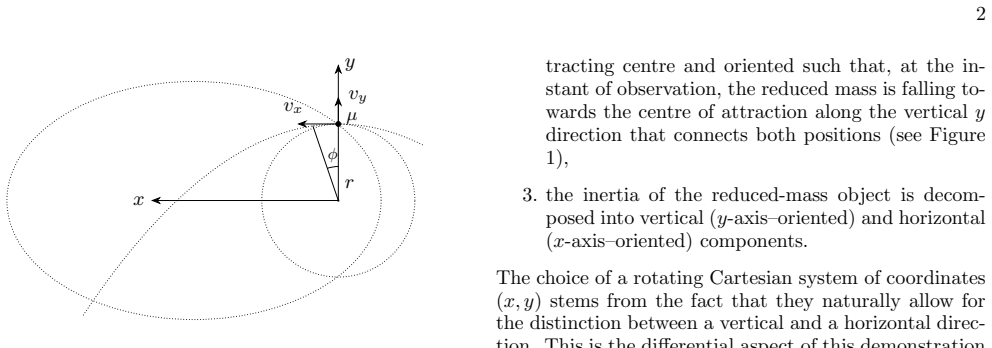
the equivalent one-body problem of a reduced mass placed in a central force field will be studied in a single, arbitrary instant and position of its trajec- tory; we will obtain Binet’s equation from the local behaviour of the reduced mass at such instant and point,
-
[2]
we will consider a reference frame defined by Carte- sian coordinates, centred at the position of the at- tracting centre and oriented such that, at the in- stant of observation, the reduced mass is falling to- wards the centre of attraction along the verticaly direction that connects both positions (see Figure 1),
-
[3]
the inertia of the reduced-mass object is decom- posed into vertical (y-axis–oriented) and horizontal (x-axis–oriented) components. The choice of a rotating Cartesian system of coordinates (x, y) stems from the fact that they naturally allow for the distinction between a vertical and a horizontal direc- tion. This is the differential aspect of this demons...
-
[4]
The termJ 2/r3 encodes the centrifugal force term in (16)
It is a linear ordinary differential equation (ODE), unlike the equation inr=r(t) resulting from (9) when introducing (7) and Newton’s gravitational force, ¨r−J 2 r3 =− GM r2 (16) In fact, the Newtonian central force is the only one that produces a linear ODE in (1). The termJ 2/r3 encodes the centrifugal force term in (16). The presence of a fictitious f...
-
[5]
The domain ofu= 1/ris the positive real semi-axis, which makes it a half-line harmonic oscillator
The problem has been reduced to a one- dimensional problem with respect to the azimuthal angle, specifically the one of a free, undamped har- monic oscillator. The domain ofu= 1/ris the positive real semi-axis, which makes it a half-line harmonic oscillator. If 0≤e <1, there is a pe- riodic oscillation aroundr=J 2/GM, whereas for e≥1 there is a single pas...
-
[6]
Treat fic- titious forces like real forces, and pretend that you are in an inertial frame
It can be further reduced to ˜u′′ + ˜u= 0 (17) after making the change of variables ˜u=u− GM/J 2. The only parameter in equation (17) is the angular frequency of the equivalent half-line simple harmonic oscillator, which is equal to one. This value of unity implies that the solution has a period of 2πinϕ. Otherwise, equation (17) does not contain any info...
work page 1983
-
[7]
They em- phasized the role of equation (F2) in showing the actual dependence of the trajectory on Λ
on the basis that the absence of Λ in the geodesic equation of light was a misleading statement. They em- phasized the role of equation (F2) in showing the actual dependence of the trajectory on Λ. As explained in Ap- pendix F, the solution of (31) is given by the classic for- mula [16, p. 87, eq. (54)] 13 r(ϕ) = rS 4℘(ϕ−ϕ in) + 1 3 (34) where℘(z) is the ...
-
[8]
Newton.Philosophiae Naturalis Principia Mathemat- ica
I. Newton.Philosophiae Naturalis Principia Mathemat- ica. University of California Press, Berkeley, 1687/1934. Translated by A. Motte in 1729; Revised and edited by 10 F. Cajori in 1934
work page 1934
-
[9]
Needham.Visual Differential Geometry and Forms: A Mathematical Drama in Five Acts
T. Needham.Visual Differential Geometry and Forms: A Mathematical Drama in Five Acts. Princeton University Press, Princeton, NJ, 2021
work page 2021
-
[10]
Gonz´ alez-L´ opez.Classical Mechanics
A. Gonz´ alez-L´ opez.Classical Mechanics. CRC Press, Taylor & Francis Group, Boca Raton, FL, 2025
work page 2025
-
[11]
K. R. Symon.Mechanics. Addison-Wesley, Reading, MA, 3rd edition, 1971
work page 1971
-
[12]
H. Goldstein, C. Poole, and J. Safko.Classical Mechan- ics. Addison-Wesley, San Francisco, 3rd edition, 2001
work page 2001
-
[13]
C. W. Misner, K. S. Thorne, , and J. A. Wheeler.Gravi- tation. Princeton University Press, Princeton, NJ, 2017
work page 2017
-
[14]
S. M. Carroll.Spacetime and Geometry: An Introduc- tion to General Relativity. Cambridge University Press, Cambridge; New York, 2019
work page 2019
-
[15]
Schutz.A First Course in General Relativity
B.F. Schutz.A First Course in General Relativity. Cam- bridge University Press, Cambridge, UK, 3rd edition, 2022
work page 2022
-
[16]
M. M. D’Eliseo. The first-order orbital equation.Am. J. Phys., 75(4):352–355, 2007
work page 2007
-
[17]
B. Temple and C. A. Tracy. From Newton to Einstein. Am. Math. Mon., 99(6):507–521, 1992
work page 1992
-
[18]
N. Samboy and J. Gallant. A modern interpretation of Newton’s theorem of revolving orbits.Am. J. Phys., 92(5):343–348, 05 2024
work page 2024
-
[19]
L.N. Hand and J.D. Finch.Analytical Mechanics. Cam- bridge University Press, Cambridge; New York, 1998
work page 1998
-
[20]
J. N. Islam. The cosmological constant and classical tests of general relativity.Phys. Lett. A, 97(6):239–241, 1983
work page 1983
-
[21]
W. Rindler and M. Ishak. Contribution of the cosmolog- ical constant to the relativistic bending of light revisited. Phys. Rev. D, 76:043006, Aug 2007
work page 2007
-
[22]
H. Arakida and M. Kasai. Effect of the cosmological constant on the bending of light and the cosmological lens equation.Phys. Rev. D, 85:023006, Jan 2012
work page 2012
- [23]
-
[24]
E. T. Whittaker.A Treatise on the Analytical Dynam- ics of Particles and Rigid Bodies: With an Introduction to the Problem of Three Bodies. Cambridge University Press, Cambridge, 2nd edition, 1917
work page 1917
-
[25]
E. Hackmann and C. L¨ ammerzahl. Geodesic equation in schwarzschild–(anti-)de sitter space–times: Analyti- cal solutions and applications.Phys. Rev. D, 78:024035, 2008
work page 2008
-
[26]
Hackmann.Geodesic Equations in Black Hole Space– Times with Cosmological Constant
E. Hackmann.Geodesic Equations in Black Hole Space– Times with Cosmological Constant. Doctoral disserta- tion, University of Bremen, Bremen, Germany., 2010. Dr. rer. nat. thesis
work page 2010
discussion (0)
Sign in with ORCID, Apple, or X to comment. Anyone can read and Pith papers without signing in.