REVIEW 2 major objections 4 minor 71 references
Two fixed-frequency superconducting qubits on separate chips exchanged quantum states through a microwave photon, at around 78% process fidelity.
Reviewed by Pith at T0; open to challenge. T0 means a machine referee read the full paper against a public rubric. the ladder, T0–T4 →
T0 review · deepseek-v4-flash
2026-08-03 17:46 UTC pith:MVXV4BYO
load-bearing objection A real first: deterministic inter-chip microwave quantum communication with only fixed-frequency qubits; the reported fidelities are qubit-subspace numbers that could be a few percent optimistic given unquantified receiver leakage. the 2 major comments →
Deterministic Quantum Communication Between Fixed-Frequency Superconducting Qubits via Broadband Resonators
The pith
A machine-rendered reading of the paper's core claim, the machinery that carries it, and where it could break.
Core claim
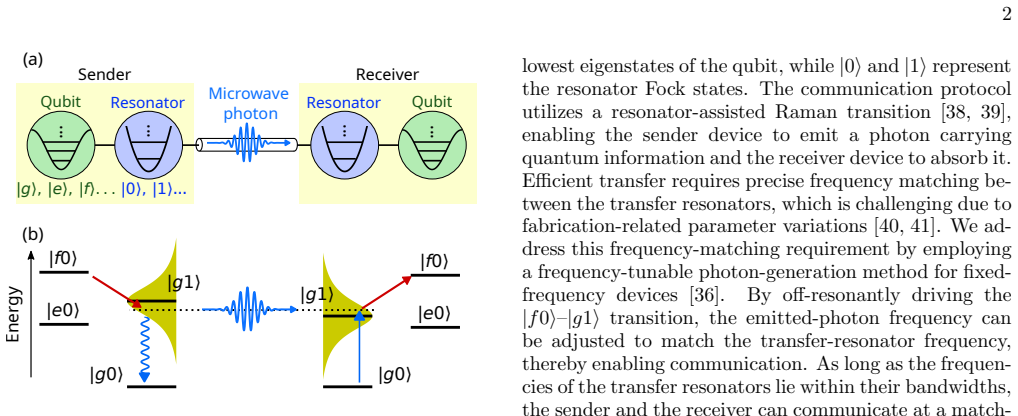
The central claim is that frequency mismatch between sender and receiver—here about 50 MHz—does not have to be engineered away by tunable qubits. Instead, the sender's photon-emission process is driven off-resonantly so the emitted photon's frequency can be tuned to a frequency where both broadband transfer resonators respond; the receiver, designed for a flat broad response, absorbs it. In the overlapped 30-MHz band the paper demonstrates both quantum state transfer and remote Bell-state generation, and numerical simulations reproduce the measured fidelities with photon loss during propagation (about 15%) as the dominant error source.
What carries the argument
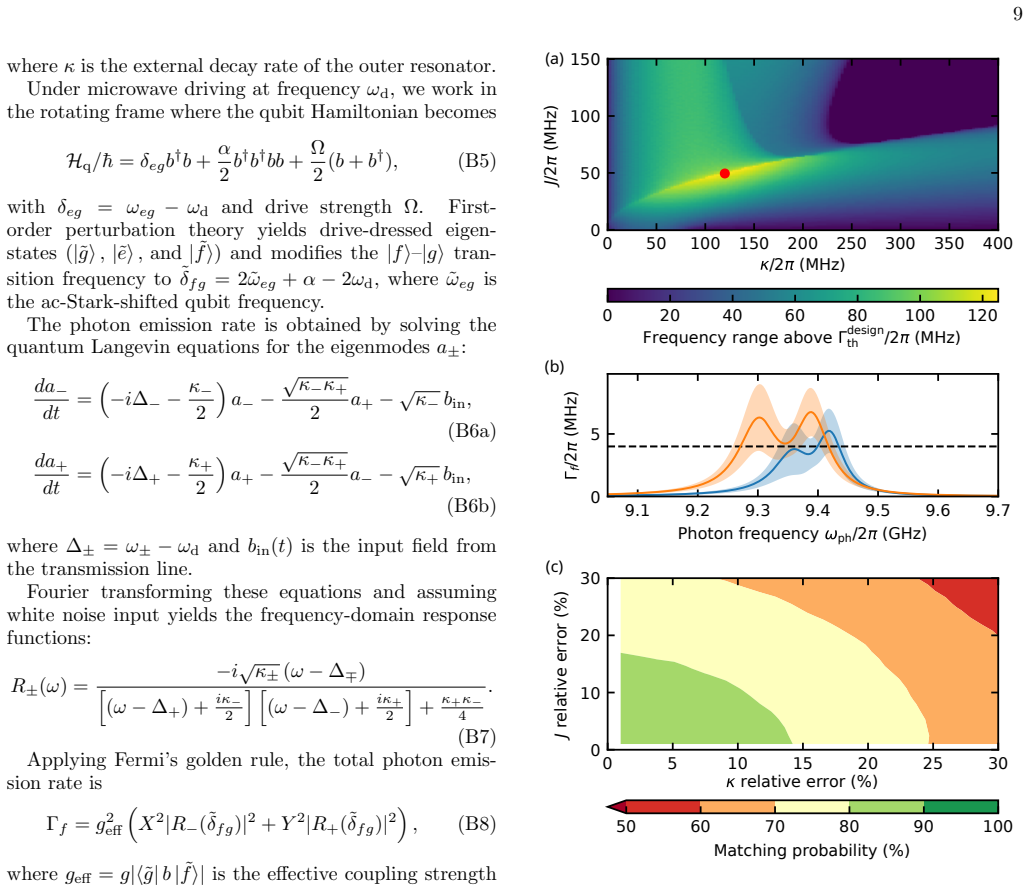
The carrying mechanism is a transfer resonator made of two coupled coplanar-waveguide resonators, giving two eigenmodes whose combined linewidth exceeds 100 MHz. On the sender side the two modes are placed to maximize the range where the photon-emission rate, computed from the two-mode response functions, stays above a design threshold; on the receiver side the modes are separated by roughly their linewidth to give a flat, wide absorption spectrum. Complementing this, a resonator-assisted Raman transition between the qubit's |f0> and |g1> states is driven off-resonantly, letting the photon frequency be chosen independently of the qubit's fixed transition frequency.
Load-bearing premise
The reported fidelities assume that the receiver's measured |g>-state population after an attempted emission equals the number of photons actually emitted; if leakage to states above |f> biases that correction, the inferred photon loss and the reported fidelities could be inflated.
What would settle it
Perform qudit-resolved single-shot readout on the receiver immediately after the emission pulse, resolving populations in |g>, |e>, |f>, and higher levels, and compare the |g> population with an independently calibrated average photon number; if they disagree beyond uncertainty, recompute the propagation loss from the waveform ratio and rerun the simulated fidelity budget.
If this is right
- Modular superconducting processors can be built from fixed-frequency qubits, eliminating flux-bias lines and the associated control complexity and noise channels.
- A fabrication offset of about 50 MHz between otherwise identical chips can be tolerated across a 30-MHz overlapping communication band; Monte Carlo modeling estimates a near-90% matching probability within a fabrication batch.
- The broad operational bandwidth supports frequency-division multiplexing, so several quantum channels could share one transmission line at different carrier frequencies simultaneously.
- Because the photon frequency is selectable in software, the protocol can avoid two-level-system defects by hopping to a cleaner frequency without hardware retuning.
- The infidelity budget is dominated by propagation loss, so improvements in cable loss or receiver absorption efficiency would directly raise both state-transfer and Bell-state fidelities.
Where Pith is reading between the lines
- The paper leaves implicit that the photon-emission-rate formula encodes a design continuum: adding more coupled resonators could further widen bandwidth or raise emission rate, though this is not demonstrated and would add engineering complexity.
- The practical value of the result hinges on whether the photon-loss correction via the measured |g>-state population holds under the receiver's unexplained leakage; an independent qudit-resolved measurement after emission would confirm or correct the reported fidelities.
- Combining frequency-tunable photon generation with non-adiabatic wave-packet shaping could remove the current 2-MHz photon-bandwidth limitation, making the protocol faster while keeping fixed-frequency hardware.
- If the two-resonator approach extends to more coupled resonators, each node's communication spectrum could be shaped independently, potentially improving multi-node network integration; this is an extrapolation from the paper's analysis.
Editorial analysis
A structured set of objections, weighed in public.
Referee Report
Summary. The paper reports deterministic quantum state transfer and remote Bell-state generation between fixed-frequency transmon qubits on separate chips, using itinerant microwave photons. A frequency-tunable photon-generation method from the authors' earlier work is combined with two-resonator broadband transfer resonators to compensate a ~50 MHz fabrication offset, yielding a 30 MHz operating range. Quantum process tomography yields state-transfer process fidelities around 78% and Bell-state fidelities around 73%. Photon propagation loss and receiver absorption efficiency are characterized separately, and a numerical cascaded-system simulation using measured parameters reproduces the reported fidelities.
Significance. If the reported fidelities can be taken at face value, this is an important experimental step: it removes flux-tunable elements from remote microwave quantum communication, with potential scalability benefits for modular superconducting processors. The two-resonator broadband design, the separate loss/absorption determination, and the Monte Carlo study of fabrication tolerance are concrete strengths. However, the unresolved receiver leakage documented in Appendix C2 bears directly on the headline quantitative claims, and the paper does not currently bound its effect. The central idea is sound and likely correct, but the fidelity numbers need to be placed on a firm footing before publication.
major comments (2)
- [Appendix C2/C3 and Sec. III B] The reported fidelities F_p≈0.78 and F_Bell≈0.73 are qubit-subspace fidelities: Appendix C3 states that qutrit tomograms are projected onto the qubit subspace. Appendix C2 reports an unresolved leakage of the receiver qubit to states above |f> during the |f0>–|g1> drive, with populations fluctuating between 0.03 and 0.1. The same drive is used in the communication protocols, but the simulation in Appendix C4 (Eqs. C1–C2) contains no higher-level leakage channel, and the error budget in Sec. III B lists only photon loss, absorption inefficiency, T1, and Tφ. The simulation/error-budget agreement therefore does not constrain the fidelity reduction from leakage. Because projecting and renormalizing the qubit block discards leakage events, the reported fidelities could overstate the actual process by up to ~0.1. The authors should extract the leakage population from the same qutrit tomograms
- [Sec. III A, Eq. (2), and Appendix C2] The photon-loss estimate L is obtained by comparing sender and receiver emission amplitudes after normalizing each waveform by sqrt(P_g), under the assumption that P_g equals the average emitted photon number. The receiver's P_g is degraded by the same unresolved leakage/decay mechanism described in Appendix C2. If the leakage channel contributes incoherently or modifies the waveform shape beyond a global efficiency factor, the extracted L≈29% could be biased. Since photon loss dominates the infidelity budget (≈15%), a sensitivity analysis of the sqrt(P_g) normalization would be needed to firmly support the quantitative fidelity claims.
minor comments (4)
- [Appendix C2] The text says 'Figure 7(a) shows the qubit population dynamics during the |f0>–|g1> photon-emission pulse', but the correct panel appears to be Fig. 7(c). Please fix the cross-reference.
- [Appendix B 2] The sentence 'One of the design strategies described in Sec. B 2 involves maximizing...' appears to be a self-reference; it should refer to the relevant section of the main text or Appendix.
- [Appendix C4] The text states that the measured absorption inefficiency is incorporated directly into η while also listing absorption inefficiency as a separate error contribution. Please clarify how the 1.5–3.0% absorption contribution is isolated from the combined η parameter in the simulations.
- [Sec. III B] The error-budget percentages are given without explicit uncertainty ranges. Given the observed coherence-time fluctuations (Appendix A) and the leakage fluctuations (Appendix C2), providing uncertainties on each contribution would make the budget more informative.
Circularity Check
No significant circularity: the design model and simulations use independently measured parameters; the only self-citation (Ref. [36]) is prior published work, and the flagged receiver-leakage issue is an accuracy concern, not a circular reduction.
full rationale
The paper's central claims—broadband two-resonator transfer resonators and deterministic communication between fixed-frequency qubits—are not derived from the quantities they are used to predict. Eq. (1) for the photon-emission rate is derived in Appendix B from a Hamiltonian model and is used to choose resonator parameters; it does not contain the measured process or Bell fidelities. The numerical simulations in Appendix C4 use independently measured inputs (photon loss from Eq. (2), absorption efficiency from Eq. (3), T1/Tφ from Table I) and are not fitted to the target fidelities. Ref. [36], cited for frequency-tunable photon generation, is a published prior result by overlapping authors; under the stated rules it counts as independent support because it is externally published and falsifiable, and the present paper extends rather than merely renames it. The one passage meriting attention is Appendix C2, which acknowledges receiver |f>-|e> decay and leakage beyond |f> during emission, with leakage population 0.03-0.1, and the Pg-normalization assumption used in loss estimation. Appendix C3 projects qutrit tomographic data onto the qubit subspace to report Fp≈0.78 and FBell≈0.73. These statements identify a potential systematic overestimate of fidelity and an omission of a leakage channel from the simulation, but they are not circular: the fidelities are not defined in terms of the loss estimate, and the loss estimate is not defined in terms of the reported fidelities. The concern belongs to correctness/robustness, not to circularity. Score 2 reflects one minor self-citation and the acknowledged leakage caveat, with no load-bearing circular step.
Axiom & Free-Parameter Ledger
free parameters (3)
- Design photon-emission-rate threshold Γ_design_th =
8 MHz (design), 4 MHz (Monte Carlo)
- Drive strength during design Ω =
1 GHz (design), 750 MHz (experiment)
- Target photon bandwidth κ_ph =
2 MHz
axioms (5)
- standard math Standard circuit-QED Hamiltonian with photon emission via |f0>–|g1> Raman transition
- standard math Fermi's golden rule for photon emission rate
- standard math Markovian cascaded-system master equation
- domain assumption Adiabatic approximation for the Raman drive
- ad hoc to paper Single-pole approximation for two-pole resonators in the numerical simulation
Cite this review
Pith. "Pith review of Deterministic Quantum Communication Between Fixed-Frequency Superconducting Qubits via Broadband Resonators." pith.science (2026). https://pith.science/paper/MVXV4BYO
@misc{pith2026251208328,
  author       = {Pith},
  title        = {Pith review of: Deterministic Quantum Communication Between Fixed-Frequency Superconducting Qubits via Broadband Resonators},
  year         = {2026},
  howpublished = {\url{https://pith.science/paper/MVXV4BYO}},
  note         = {Machine review of arXiv:2512.08328}
}
read the original abstract
Quantum communication between remote chips is essential for realizing large-scale superconducting quantum computers. For such communication, itinerant microwave photons propagating through transmission lines offer a promising approach. However, demonstrations to date have relied on frequency-tunable circuit elements to compensate for fabrication-related parameter variations between sender and receiver devices, introducing control complexity and limiting scalability. In this work, we demonstrate deterministic quantum state transfer and remote entanglement generation between fixed-frequency superconducting qubits on separate chips. To compensate for the sender-receiver mismatch, we employ a frequency-tunable photon-generation technique which enables us to adjust the photon frequency without modifying circuit parameters. To enhance the frequency tunability, we implement broadband transfer resonators composed of two coupled coplanar-waveguide resonators, achieving a bandwidth of more than 100 MHz. This broadband design enables successful quantum communication across a 30-MHz range of photon frequencies between the remote qubits. Quantum process tomography reveals state transfer fidelities of around 79% and Bell-state fidelities of around 73% across the full frequency range. Our approach avoids the complexity of the control lines and noise channels, providing a flexible pathway toward scalable quantum networks.
Figures



Reference graph
Works this paper leans on
-
[1]
The system Hamiltonian is H=H q +H r +H f +H b +H c qr +H c rf +H c fb,(B1) TABLE I
Derivation ofΓ f in case of two resonators We derive the photon emission rate Γ f for a transmon qubit coupled to two coplanar resonators connected to a transmission line. The system Hamiltonian is H=H q +H r +H f +H b +H c qr +H c rf +H c fb,(B1) TABLE I. Device parameters. Parameter Sender Receiver Qubit frequencyω eg/2π(GHz) 7.982 8.199 Qubit anharmoni...
-
[2]
We perform this measurement 2×10 5 times for each state and average the results to obtain the photon waveform [36]
The emitted microwave field is amplified using a flux-driven Josephson paramet- ric amplifier (JPA) [48]. We perform this measurement 2×10 5 times for each state and average the results to obtain the photon waveform [36]. This approach assumes that both devices emit pho- tons with equal efficiency. However, characterization of our devices reveals deviatio...
-
[3]
Quantum pro- cess tomography [49] is performed by preparing the input states at the sender and measuring the output states at the receiver
Following the state preparation, we transfer the quantum state from the sender to the receiver via a microwave photon at fre- quencyω ph, followed by an application of aπ ef pulse at the receiver to complete the protocol. Quantum pro- cess tomography [49] is performed by preparing the input states at the sender and measuring the output states at the recei...
-
[4]
B 2 in- volves maximizing the frequency range over which the photon-emission rate Γ f exceeds a specified threshold
Resonator design strategy including photon-emission rate One of the design strategies described in Sec. B 2 in- volves maximizing the frequency range over which the photon-emission rate Γ f exceeds a specified threshold. To implement this approach, we use Eq. (1) to search for optimal resonator parameters. We define the design objective as maximizing the ...
-
[5]
We model the com- plete system using the circuit model corresponding to the fabricated device and calculate the resonator spec- trum through electric circuit calculations
Monte Carlo simulation of parameter variations To evaluate the probability of successful frequency matching between independently fabricated sender and receiver devices, we perform Monte Carlo simulations of the transfer-resonator spectrum. We model the com- plete system using the circuit model corresponding to the fabricated device and calculate the reso...
2000
-
[6]
To improve the readout fidelity, we use JPA in the degenerate mode
Three-state readout We employ dispersive readout to distinguish the three lowest energy levels of the transmon qubit. To improve the readout fidelity, we use JPA in the degenerate mode. To establish the classification criteria for three-state readout, we first prepare the qubit in each of the three states (|g⟩,|e⟩,|f⟩) and perform single-shot measure- men...
-
[7]
We see that the final|g⟩-state populationP g differs be- tween devices: the sender reachesP g = 0.95–0.97, while the receiver achieves onlyP g = 0.85–0.9
Qubit population after photon emission Figure 7(a) shows the qubit population dynamics dur- ing the|f0⟩–|g1⟩photon-emission pulse for both devices. We see that the final|g⟩-state populationP g differs be- tween devices: the sender reachesP g = 0.95–0.97, while the receiver achieves onlyP g = 0.85–0.9. SinceP g corre- sponds to the photon-emission efficien...
-
[8]
We apply tomography gates prior to measurement and 12 reconstruct density matrices via maximum-likelihood es- timation [24]
State tomography Quantum state tomography is performed using the single-shot readout method described in Appendix C 1. We apply tomography gates prior to measurement and 12 reconstruct density matrices via maximum-likelihood es- timation [24]. For process tomography, qutrit-level measurements on both the sender and receiver are necessary to character- ize...
-
[9]
We approximate the two-pole transfer resonators as single-pole resonators for computational simplicity
Numerical simulation of quantum communication Numerical simulations are performed using the cascaded-system formalism [24]. We approximate the two-pole transfer resonators as single-pole resonators for computational simplicity. The effective Hamiltonian and master equation for the cascaded system are Heff =− αtx 2 b† txbtx + αtx 2 b† txb† txbtxbtx − αrx 2...
-
[10]
Google Quantum AI and Collaborators, Quantum error correction below the surface code threshold, Nature638, 920 (2025)
2025
-
[11]
Lacroix, A
N. Lacroix, A. Bourassa, F. J. H. Heras,et al., Scaling and logic in the colour code on a superconducting quan- tum processor, Nature645, 614 (2025)
2025
-
[12]
Webber, V
M. Webber, V. Elfving, S. Weidt, and W. K. Hensinger, The impact of hardware specifications on reaching quan- tum advantage in the fault tolerant regime, A VS Quan- tum Science4, 013801 (2022)
2022
-
[13]
Bravyi, O
S. Bravyi, O. Dial, J. M. Gambetta, D. Gil, and Z. Nazario, The future of quantum computing with su- perconducting qubits, Journal of Applied Physics132, 160902 (2022)
2022
-
[14]
M. Mohseni, A. Scherer, K. G. Johnson, O. Wertheim, M. Otten, N. A. Aadit, Y. Alexeev, K. M. Bresniker, K. Y. Camsari, B. Chapman, S. Chatterjee, G. A. Dag- new, A. Esposito, F. Fahim, M. Fiorentino, A. Gajjar, A. Khalid, X. Kong, B. Kulchytskyy, E. Kyoseva, R. Li, P. A. Lott, I. L. Markov, R. F. McDermott, G. Pe- dretti, P. Rao, E. Rieffel, A. Silva, J. ...
Pith/arXiv arXiv 2025
-
[15]
Raicu, T
N. Raicu, T. Hogan, X. Wu, M. Vahidpour, D. Snow, M. Hollister, and M. Field, Cryogenic thermal modeling of microwave high density signaling, EPJ Quantum Tech- nol.12, 124 (2025)
2025
-
[16]
Krinner, S
S. Krinner, S. Storz, P. Kurpiers, P. Magnard, J. Hein- soo, R. Keller, J. L¨ utolf, C. Eichler, and A. Wallraff, Engineering cryogenic setups for 100-qubit scale super- conducting circuit systems, EPJ Quantum Technol.6, 2 (2019)
2019
-
[17]
J. B. Hertzberg, E. J. Zhang, S. Rosenblatt, E. Mage- san, J. A. Smolin, J.-B. Yau, V. P. Adiga, M. Sandberg, M. Brink, J. M. Chow, and J. S. Orcutt, Laser-annealing Josephson junctions for yielding scaled-up superconduct- ing quantum processors, npj Quantum Inf.7, 129 (2021)
2021
-
[18]
J. Ang, G. Carini, Y. Chen, I. Chuang, M. Demarco, S. Economou, A. Eickbusch, A. Faraon, K.-M. Fu, S. Girvin, M. Hatridge, A. Houck, P. Hilaire, K. Krsulich, A. Li, C. Liu, Y. Liu, M. Martonosi, D. McKay, J. Mis- ewich, M. Ritter, R. Schoelkopf, S. Stein, S. Sussman, H. Tang, W. Tang, T. Tomesh, N. Tubman, C. Wang, N. Wiebe, Y. Yao, D. Yost, and Y. Zhou, ...
2024
-
[19]
Caleffi, M
M. Caleffi, M. Amoretti, D. Ferrari, J. Illiano, A. Man- zalini, and A. S. Cacciapuoti, Distributed quantum com- puting: A survey, Computer Networks254, 110672 (2024)
2024
-
[20]
J. I. Cirac, P. Zoller, H. J. Kimble, and H. Mabuchi, Quantum State Transfer and Entanglement Distribution among Distant Nodes in a Quantum Network, Phys. Rev. Lett.78, 3221 (1997)
1997
-
[21]
Y. P. Zhong, H.-S. Chang, K. J. Satzinger, M.-H. Chou, A. Bienfait, C. R. Conner, E. Dumur, J. Grebel, G. A. Peairs, R. G. Povey, D. I. Schuster, and A. N. Cleland, Violating Bell’s inequality with remotely connected su- perconducting qubits, Nat. Phys.15, 741 (2019)
2019
-
[22]
Leung, Y
N. Leung, Y. Lu, S. Chakram, R. K. Naik, N. Earnest, R. Ma, K. Jacobs, A. N. Cleland, and D. I. Schuster, De- terministic bidirectional communication and remote en- tanglement generation between superconducting qubits, npj Quantum Inf.5, 18 (2019)
2019
-
[23]
Chang, Y
H.-S. Chang, Y. Zhong, A. Bienfait, M.-H. Chou, C. Conner, E. Dumur, J. Grebel, G. Peairs, R. Povey, K. Satzinger, and A. Cleland, Remote Entanglement via Adiabatic Passage Using a Tunably Dissipative Quantum Communication System, Phys. Rev. Lett.124, 240502 (2020)
2020
-
[24]
L. D. Burkhart, J. D. Teoh, Y. Zhang, C. J. Ax- line, L. Frunzio, M. Devoret, L. Jiang, S. Girvin, and R. Schoelkopf, Error-Detected State Transfer and Entan- glement in a Superconducting Quantum Network, PRX Quantum2, 030321 (2021)
2021
-
[25]
Zhong, H.-S
Y. Zhong, H.-S. Chang, A. Bienfait, E. Dumur, M.-H. Chou, C. R. Conner, J. Grebel, R. G. Povey, H. Yan, D. I. Schuster, and A. N. Cleland, Deterministic multi- qubit entanglement in a quantum network, Nature590, 571 (2021)
2021
-
[26]
J. Niu, L. Zhang, Y. Liu, J. Qiu, W. Huang, J. Huang, H. Jia, J. Liu, Z. Tao, W. Wei, Y. Zhou, W. Zou, Y. Chen, X. Deng, X. Deng, C. Hu, L. Hu, J. Li, D. Tan, Y. Xu, F. Yan, T. Yan, S. Liu, Y. Zhong, A. N. Cleland, and D. Yu, Low-loss interconnects for modular superconduct- ing quantum processors, Nat Electron6, 10.1038/s41928- 023-00925-z (2023)
doi:10.1038/s41928- 2023
-
[27]
J. Qiu, Z. Zhang, Z. Wang, L. Zhang, Y. Zhou, X. Sun, J. Zhang, X. Linpeng, S. Liu, J. Niu, Y. Zhong, and D. Yu, A thermal-noise-resilient microwave quantum net- work traversing 4 K (2025), arXiv:2503.01133
arXiv 2025
-
[28]
K. Heya, T. Phung, M. Malekakhlagh, R. Steiner, M. Turchetti, W. Shanks, J. Mamin, W.-S. Lu, Y. P. Kandel, N. Sundaresan, and J. Orcutt, Randomized Benchmarking of a Remote cnot Gate Via a Meter-Scale Microwave Link, Phys. Rev. Lett.135, 200801 (2025)
2025
-
[29]
J. Song, S. Yang, P. Liu, H.-L. Zhang, G.-M. Xue, Z.-Y. Mi, W.-G. Zhang, F. Yan, Y.-R. Jin, and H.-F. Yu, Real- ization of High-Fidelity Perfect Entanglers between Re- mote Superconducting Quantum Processors, Phys. Rev. Lett.135, 050603 (2025)
2025
-
[30]
Mollenhauer, A
M. Mollenhauer, A. Irfan, X. Cao, S. Mandal, and W. Pfaff, A high-efficiency elementary network of inter- changeable superconducting qubit devices, Nat Electron 8, 610 (2025)
2025
-
[31]
Y. Li, X. Zhang, W. Zhang, R. Guo, Y. Zhang, X. Tan, and Y. Yu, Fast and Robust Remote Two-Qubit Gates on Distributed Qubits (2025), arXiv:2511.01418
arXiv 2025
-
[32]
Casariego, E
M. Casariego, E. Zambrini Cruzeiro, S. Gherardini, T. Gonzalez-Raya, R. Andr´ e, G. Fraz˜ ao, G. Catto, M. M¨ ott¨ onen, D. Datta, K. Viisanen, J. Govenius, M. Prunnila, K. Tuominen, M. Reichert, M. Renger, K. G. Fedorov, F. Deppe, H. Van Der Vliet, A. J. Matthews, Y. Fern´ andez, R. Assouly, R. Dassonneville, B. Huard, M. Sanz, and Y. Omar, Propagating q...
2023
-
[33]
Kurpiers, P
P. Kurpiers, P. Magnard, T. Walter, B. Royer, M. Pechal, 14 J. Heinsoo, Y. Salath´ e, A. Akin, S. Storz, J.-C. Besse, S. Gasparinetti, A. Blais, and A. Wallraff, Deterministic quantum state transfer and remote entanglement using microwave photons, Nature558, 264 (2018)
2018
-
[34]
Campagne-Ibarcq, E
P. Campagne-Ibarcq, E. Zalys-Geller, A. Narla, S. Shankar, P. Reinhold, L. Burkhart, C. Axline, W. Pfaff, L. Frunzio, R. Schoelkopf, and M. Devoret, Deterministic Remote Entanglement of Superconduct- ing Circuits through Microwave Two-Photon Transitions, Phys. Rev. Lett.120, 200501 (2018)
2018
-
[35]
C. J. Axline, L. D. Burkhart, W. Pfaff, M. Zhang, K. Chou, P. Campagne-Ibarcq, P. Reinhold, L. Frun- zio, S. M. Girvin, L. Jiang, M. H. Devoret, and R. J. Schoelkopf, On-demand quantum state transfer and en- tanglement between remote microwave cavity memories, Nature Phys14, 705 (2018)
2018
-
[36]
Magnard, S
P. Magnard, S. Storz, P. Kurpiers, J. Sch¨ ar, F. Marxer, J. L¨ utolf, T. Walter, J.-C. Besse, M. Gabureac, K. Reuer, A. Akin, B. Royer, A. Blais, and A. Wallraff, Mi- crowave Quantum Link between Superconducting Cir- cuits Housed in Spatially Separated Cryogenic Systems, Phys. Rev. Lett.125, 260502 (2020)
2020
-
[37]
Storz, J
S. Storz, J. Sch¨ ar, A. Kulikov, P. Magnard, P. Kurpiers, J. L¨ utolf, T. Walter, A. Copetudo, K. Reuer, A. Akin, J.- C. Besse, M. Gabureac, G. J. Norris, A. Rosario, F. Mar- tin, J. Martinez, W. Amaya, M. W. Mitchell, C. Abel- lan, J.-D. Bancal, N. Sangouard, B. Royer, A. Blais, and A. Wallraff, Loophole-free Bell inequality violation with superconducti...
2023
-
[38]
A. Kulikov, S. Storz, J. D. Sch¨ ar, M. Sandfuchs, R. Wolf, F. Berterotti` ere, C. Hellings, R. Renner, and A. Wallraff, Device-Independent Randomness Amplification (2024), arXiv:2412.17931
Pith/arXiv arXiv 2024
-
[39]
Storz, A
S. Storz, A. Kulikov, J. D. Sch¨ ar, V. Barizien, X. Val- carce, F. Berterotti` ere, N. Sangouard, J.-D. Bancal, and A. Wallraff, Complete Self-Testing of a System of Remote Superconducting Qubits, Phys. Rev. Lett.135, 030801 (2025)
2025
-
[40]
Narla, S
A. Narla, S. Shankar, M. Hatridge, Z. Leghtas, K. Sliwa, E. Zalys-Geller, S. Mundhada, W. Pfaff, L. Frunzio, R. Schoelkopf, and M. Devoret, Robust Concurrent Remote Entanglement Between Two Superconducting Qubits, Phys. Rev. X6, 031036 (2016)
2016
-
[41]
J. Qiu, Y. Liu, L. Hu, Y. Wu, J. Niu, L. Zhang, W. Huang, Y. Chen, J. Li, S. Liu, Y. Zhong, L. Duan, and D. Yu, Deterministic quantum state and gate tele- portation between distant superconducting chips, Science Bulletin70, 351 (2025)
2025
-
[42]
Grebel, H
J. Grebel, H. Yan, M.-H. Chou, G. Andersson, C. R. Conner, Y. J. Joshi, J. M. Miller, R. G. Povey, H. Qiao, X. Wu, and A. N. Cleland, Bidirectional Multipho- ton Communication between Remote Superconducting Nodes, Phys. Rev. Lett.132, 047001 (2024)
2024
-
[43]
Almanakly, B
A. Almanakly, B. Yankelevich, M. Hays, B. Kannan, R. Assouly, A. Greene, M. Gingras, B. M. Niedzielski, H. Stickler, M. E. Schwartz, K. Serniak, J. I.-j. Wang, T. P. Orlando, S. Gustavsson, J. A. Grover, and W. D. Oliver, Deterministic remote entanglement using a chiral quantum interconnect, Nat. Phys.21, 825 (2025)
2025
-
[44]
Krantz, M
P. Krantz, M. Kjaergaard, F. Yan, T. P. Orlando, S. Gus- tavsson, and W. D. Oliver, A quantum engineer’s guide to superconducting qubits, Applied Physics Reviews6, 021318 (2019)
2019
-
[45]
Miyamura, Y
T. Miyamura, Y. Sunada, Z. Wang, J. Ilves, K. Mat- suura, and Y. Nakamura, Generation of Frequency- Tunable Shaped Single Microwave Photons Using a Fixed-Frequency Superconducting Qubit, PRX Quantum 6, 020347 (2025)
2025
-
[46]
J. Koch, T. M. Yu, J. Gambetta, A. A. Houck, D. I. Schuster, J. Majer, A. Blais, M. H. Devoret, S. M. Girvin, and R. J. Schoelkopf, Charge-insensitive qubit design de- rived from the Cooper pair box, Phys. Rev. A76, 042319 (2007)
2007
-
[47]
Pechal, L
M. Pechal, L. Huthmacher, C. Eichler, S. Zeytino˘ glu, A. Abdumalikov, S. Berger, A. Wallraff, and S. Filipp, Microwave-Controlled Generation of Shaped Single Pho- tons in Circuit Quantum Electrodynamics, Phys. Rev. X 4, 041010 (2014)
2014
-
[48]
Zeytino˘ glu, M
S. Zeytino˘ glu, M. Pechal, S. Berger, A. A. Abduma- likov, A. Wallraff, and S. Filipp, Microwave-induced amplitude- and phase-tunable qubit-resonator coupling in circuit quantum electrodynamics, Phys. Rev. A91, 043846 (2015)
2015
-
[49]
Y. Li, T. Wang, J. Hu, D. Li, and S. An, Optimiz- ing Resonator Frequency Stability in Flip-Chip Architec- tures: A Novel Experimental Design Approach (2023), arXiv:2312.06405
Pith/arXiv arXiv 2023
-
[50]
Vall´ es-Sanclemente, S
S. Vall´ es-Sanclemente, S. L. M. Van Der Meer, M. Finkel, N. Muthusubramanian, M. Beekman, H. Ali, J. F. Mar- ques, C. Zachariadis, H. M. Veen, T. Stavenga, N. Haider, and L. DiCarlo, Post-fabrication frequency trimming of coplanar-waveguide resonators in circuit QED quantum processors, Applied Physics Letters123, 034004 (2023)
2023
-
[51]
T. Thorbeck, A. McDonald, O. Lanes, J. Blair, G. Keefe, A. A. Stabile, B. Royer, L. C. G. Govia, and A. Blais, High-fidelity gates in a transmon using bath engineering for passive leakage reset (2024), arXiv:2411.04101
Pith/arXiv arXiv 2024
-
[52]
E. A. Sete, J. M. Martinis, and A. N. Korotkov, Quan- tum theory of a bandpass Purcell filter for qubit readout, Phys. Rev. A92, 012325 (2015)
2015
-
[53]
Jeffrey, D
E. Jeffrey, D. Sank, J. Mutus, T. White, J. Kelly, R. Barends, Y. Chen, Z. Chen, B. Chiaro, A. Dunsworth, A. Megrant, P. O’Malley, C. Neill, P. Roushan, A. Vainsencher, J. Wenner, A. Cleland, and J. M. Mar- tinis, Fast Accurate State Measurement with Supercon- ducting Qubits, Phys. Rev. Lett.112, 190504 (2014)
2014
-
[54]
Sunada, S
Y. Sunada, S. Kono, J. Ilves, S. Tamate, T. Sugiyama, Y. Tabuchi, and Y. Nakamura, Fast Readout and Reset of a Superconducting Qubit Coupled to a Resonator with an Intrinsic Purcell Filter, Phys. Rev. Applied17, 044016 (2022)
2022
-
[55]
Sunada, K
Y. Sunada, K. Yuki, Z. Wang, T. Miyamura, J. Ilves, K. Matsuura, P. A. Spring, S. Tamate, S. Kono, and Y. Nakamura, Photon-Noise-Tolerant Dispersive Read- out of a Superconducting Qubit Using a Nonlinear Pur- cell Filter, PRX Quantum5, 010307 (2024)
2024
-
[56]
P. A. Spring, L. Milanovic, Y. Sunada, S. Wang, A. F. van Loo, S. Tamate, and Y. Nakamura, Fast Multi- plexed Superconducting-Qubit Readout with Intrinsic Purcell Filtering Using a Multiconductor Transmission Line, PRX Quantum6, 020345 (2025)
2025
-
[57]
Yamamoto, K
T. Yamamoto, K. Inomata, M. Watanabe, K. Matsuba, T. Miyazaki, W. D. Oliver, Y. Nakamura, and J. S. Tsai, Flux-driven Josephson parametric amplifier, Appl. Phys. Lett.93, 042510 (2008)
2008
-
[58]
I. L. Chuang and M. A. Nielsen, Prescription for ex- perimental determination of the dynamics of a quantum black box, Journal of Modern Optics44, 2455 (1997). 15
1997
-
[59]
M¨ uller, J
C. M¨ uller, J. Lisenfeld, A. Shnirman, and S. Poletto, In- teracting two-level defects as sources of fluctuating high- frequency noise in superconducting circuits, Phys. Rev. B92, 035442 (2015)
2015
-
[60]
Klimov, J
P. Klimov, J. Kelly, Z. Chen, M. Neeley, A. Megrant, B. Burkett, R. Barends, K. Arya, B. Chiaro, Y. Chen, A. Dunsworth, A. Fowler, B. Foxen, C. Gidney, M. Giustina, R. Graff, T. Huang, E. Jeffrey, E. Lucero, J. Mutus, O. Naaman, C. Neill, C. Quintana, P. Roushan, D. Sank, A. Vainsencher, J. Wenner, T. White, S. Boixo, R. Babbush, V. Smelyanskiy, H. Neven,...
2018
-
[61]
Thorbeck, A
T. Thorbeck, A. Eddins, I. Lauer, D. T. McClure, and M. Carroll, Two-Level-System Dynamics in a Supercon- ducting Qubit Due to Background Ionizing Radiation, PRX Quantum4, 020356 (2023)
2023
-
[62]
Gargiulo, S
O. Gargiulo, S. Oleschko, J. Prat-Camps, M. Zanner, and G. Kirchmair, Fast flux control of 3D transmon qubits us- ing a magnetic hose, Applied Physics Letters118, 012601 (2021)
2021
-
[63]
Krasnok, P
A. Krasnok, P. Dhakal, A. Fedorov, P. Frigola, M. Kelly, and S. Kutsaev, Superconducting microwave cavities and qubits for quantum information systems, Applied Physics Reviews11, 011302 (2024)
2024
-
[64]
G. F. Pe˜ nas, R. Puebla, and J. J. Garc ´ ıa-Ripoll, Multi- plexed quantum state transfer in waveguides, Phys. Rev. Research6, 033294 (2024)
2024
-
[65]
J. Yang, M. Khanahmadi, I. Strandberg, A. Gaikwad, C. Castillo-Moreno, A. F. Kockum, M. A. Ullah, G. Jo- hansson, A. M. Eriksson, and S. Gasparinetti, Determin- istic Generation of Frequency-Bin-Encoded Microwave Photons, Phys. Rev. Lett.134, 240803 (2025)
2025
-
[66]
O’Sullivan, K
J. O’Sullivan, K. Reuer, A. Grigorev, X. Dai, A. Hern´ andez-Ant´ on, M. H. Mu˜ noz-Arias, C. Hellings, A. Flasby, D. Colao Zanuz, J.-C. Besse, A. Blais, D. Malz, C. Eichler, and A. Wallraff, Deterministic generation of two-dimensional multi-photon cluster states, Nat Com- mun16, 5505 (2025)
2025
-
[67]
Z. Wang, T. Miyamura, Y. Sunada, K. Sunada, J. Ilves, K. Matsuura, and Y. Nakamura, Generation of frequency-bin-encoded dual-rail cluster states via time- frequency multiplexing of microwave photonic qubits (2025), arXiv:2508.10990
arXiv 2025
-
[68]
M¨ uller, J
C. M¨ uller, J. H. Cole, and J. Lisenfeld, Towards under- standing two-level-systems in amorphous solids: insights from quantum circuits, Rep. Prog. Phys.82, 124501 (2019)
2019
-
[69]
Ilves, S
J. Ilves, S. Kono, Y. Sunada, S. Yamazaki, M. Kim, K. Koshino, and Y. Nakamura, On-demand generation and characterization of a microwave time-bin qubit, npj Quantum Inf.6, 34 (2020)
2020
-
[70]
Magnard, P
P. Magnard, P. Kurpiers, B. Royer, T. Walter, J.-C. Besse, S. Gasparinetti, M. Pechal, J. Heinsoo, S. Storz, A. Blais, and A. Wallraff, Fast and Unconditional All- Microwave Reset of a Superconducting Qubit, Phys. Rev. Lett.121, 060502 (2018)
2018
-
[71]
W. Dai, S. Hazra, D. K. Weiss, P. D. Kurilovich, T. Connolly, H. K. Babla, S. Singh, V. R. Joshi, A. Z. Ding, P. D. Parakh, J. Venkatraman, X. Xiao, L. Frun- zio, and M. H. Devoret, Spectroscopy of drive-induced unwanted state transitions in superconducting circuits (2025), arXiv:2506.24070
arXiv 2025
discussion (0)
Sign in with ORCID, Apple, or X to comment. Anyone can read and Pith papers without signing in.