REVIEW 3 major objections 5 minor 87 references
Solving Semi-Supervised Few-Shot Learning from an Auto-Annotation Perspective
T0 review · 3 major / 5 minor · reviewed 2026-08-03 · deepseek-v4-flash
Pith's one-line read Vision-language models output near-uniform softmax scores, so SSL finetuning ignores unlabeled data; two temperatures restore it, gaining ~5 points across five benchmarks.
desk verdict Genuinely useful diagnosis and a simple fix that mostly works, but the universal temperature story does not survive EuroSAT; still deserves a real review. read the letter →
The pith
A machine-rendered reading of the paper's core claim, the machinery that carries it, and where it could break.
The reading
What carries the argument
Temperature Tuning (TT): a fixed confidence temperature Tconf=0.01 applied to the softmax of weakly augmented unlabeled images, lifting pseudo-label confidence above the selection threshold, plus a learnable loss temperature Tloss initialized to 0.07 that scales logits in all cross-entropy losses, amplifying the otherwise weak supervision. The supporting devices are classifier initialization (seeding the classifier head with the VLM's text embeddings of class names) and a stage-wise schedule: finetune the classifier on labeled data, run SSL finetuning with labeled, unlabeled, and retrieved data, then finetune again on labeled data only to correct domain gaps and noise.
What would settle it
Run the full SWIFT pipeline on five to ten additional fine-grained datasets spanning class counts from 2 to 1000, comparing fixed Tconf=0.01 against a per-task tuned Tconf; if the fixed value fails to beat or match the tuned value on datasets with very few or very many classes, the universal-temperature claim collapses. A cheaper check: rerun FixMatch+TT on EuroSAT at 4-shot with several seeds and confirm the 11.9-point drop is stable.
Extended reading notes
Core claim
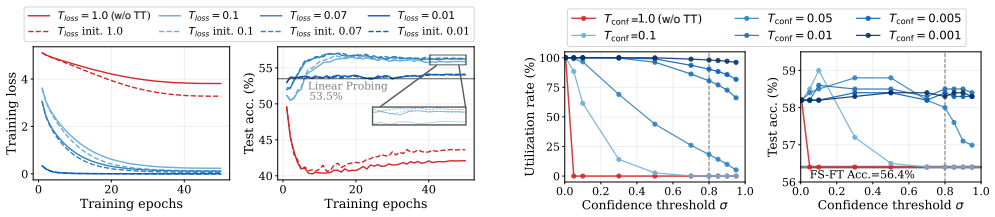
Working from an auto-annotation perspective, the paper contends that semi-supervised few-shot learning should exploit open-source vision-language models and their pretraining data, and that the reason SSL methods cannot finetune these models is the VLMs' flat softmax outputs. Two temperatures address this: Tconf=0.01 sharpens the confidence distribution so pseudo-labels exceed the threshold, and a learnable Tloss initialized to 0.07 amplifies the supervision signal in the loss. On top of this, classifier initialization with text embeddings and retrieval augmentation from the VLM's own pretraining set contribute further gains, and the three-stage schedule yields the final SWIFT method, which
Load-bearing premise
The load-bearing premise is that one fixed confidence temperature (0.01) and a learnable loss temperature initialized to 0.07, tuned once on semi-Aves and then frozen, sharpen VLM softmax outputs uniformly across class counts and datasets — yet the paper's own ablation shows the same Tconf hurts EuroSAT, the only 10-class dataset, by 11.9 points at 4-shot.
Editorial extensions
If this is right
- Adding TT to standard SSL methods such as FixMatch or DebiasPL improves their accuracy by 14–20 points when finetuning a VLM, showing the failure is in the VLM's output distribution, not the SSL recipe.
- Retrieving task-relevant images from the VLM's public pretraining set adds 6–11 points on top of TT, and is the component that lets SWIFT surpass the strongest FSL baseline (SWAT).
- SWIFT rivals a fully supervised reference that uses ground-truth labels on the unlabeled data, implying that, in the low-label regime, unlabeled data plus a VLM can substitute for labels.
- Because the temperature terms add negligible compute, the recipe can be applied to future, stronger SSL methods without architectural changes.
Reading between the lines
- If the flat-softmax diagnosis is correct, the same two-temperature fix should transfer to other contrastively pretrained encoders and to other pseudo-labeling losses, though optimal temperature values may need re-tuning per model family and class count.
- The paper fixes Tconf=0.01 for all datasets; an adaptive Tconf that scales with the number of classes could potentially recover the EuroSAT loss (11.9 points at 4-shot when Tconf is applied) while keeping gains elsewhere — a testable variant not explored in the paper.
- A natural stress test is to run the same pipeline on a VLM whose logits are already sharp (e.g., after a small amount of supervised finetuning); if gains persist, the root-cause story is incomplete, whereas if they vanish, the flatness explanation is strengthened.
Editorial analysis
A structured set of objections, weighed in public.
Referee Report
Summary. The paper studies semi-supervised few-shot learning (SSFSL) in a realistic auto-annotation setup where the learner has access to a pretrained VLM, a small labeled set, an abundant unlabeled set, and task-relevant data retrieved from the VLM's pretraining corpus. The authors first show that directly applying standard SSL methods (FixMatch, DebiasPL) to finetune an OpenCLIP VLM substantially underperforms few-shot finetuning. They diagnose the cause as the 'flat' softmax distributions produced by contrastively pretrained VLMs, which lead to zero selection of pseudo-labels at the default confidence threshold and weak supervision for the CE loss. To address this, they propose classifier initialization from text embeddings and two temperature mechanisms: a fixed confidence temperature Tconf for pseudo-label selection, and a learnable loss temperature Tloss for strengthening supervision. Under the name SWIFT, they combine these with retrieval augmentation from LAION-400M and a three-stage training procedure (classifier init, semi-supervised finetuning with SSL loss, and final few-shot finetuning). Across five fine-grained benchmarks they report gains of about 5 accuracy points over the prior FSL state of the art (SWAT) and results rivaling fully supervised finetuning. The supplementary material contains per-dataset tables, ablations, additional backbone experiments (DINOv2, ImageNet-pretrained models), and pseudo-code.
Significance. If the claims hold, the paper makes a useful empirical and conceptual contribution: it identifies a simple, actionable cause for why conventional SSL training fails when finetuning contrastively pretrained VLMs, and it demonstrates a lightweight fix that delivers large gains. The strengths of the manuscript include extensive and mostly honest ablations (Table 3, Table 9), replication of the mechanism with two SSL methods and two backbones, per-dataset reporting, release of code, and a clear stage-wise pipeline. The central claim, however, is broader than the evidence, and the paper contains a protocol inconsistency regarding validation-set usage. Because the claimed 'root cause' and the universal temperature prescription are load-bearing for the paper's framing, these issues need to be addressed before the contribution can be fully accepted.
major comments (3)
- [Sec. 4.1 / Tab. 2] The paper's 'no validation set' claim is contradicted by its own tuning protocol. In Sec. 4.1, after stating that the setup 'eschews a validation set', the authors write: 'we follow [56] to carry out cross-dataset tuning. Specifically, we tune the temperature on semi-Aves (Fig. 6) and apply it to other datasets.' semi-Aves is one of the five benchmark datasets, and Fig. 6 reports test accuracy on it. Therefore the headline average in Tab. 2 includes the dataset used to select Tconf, Tloss init, and the confidence threshold. The claimed advantage of being validation-free and ready for real-world auto-annotation is not established by the current experiments. The limitation in Sec. 5 mentions this only as a possible future extension. Please retune on a genuine held-out validation split, or at minimum report results with semi-Aves excluded and acknowledge that the current protocol involves t
- [Tab. 9 / Tab. 8] EuroSAT is a direct counterexample to the central claim that Tconf=0.01 fixes the flat-softmax failure. In Table 9, 4-shot: adding Tconf to the retrieved-data run drops EuroSAT from 83.9 to 72.0 (-11.9), and the final SWIFT (75.0) is below the no-Tconf configuration (83.9). At 8-shot, SWIFT (87.1) is again below the no-Tconf row (88.0). EuroSAT is the only 10-class dataset in the benchmark, suggesting that class count or initial logit sharpness modulates whether Tconf helps. Because the protocol eschews a validation set, a practitioner applying the prescribed Tconf to a new low-class dataset cannot detect this harmful regime. The root-cause claim is therefore not uniform across the paper's own benchmarks. The paper should either provide a rule for setting Tconf (e.g., based on class count or logit statistics) or substantially temper the universality of the temperature prescription; Tab.
- [Sec. 3.2 / Eq. (3)] The causal attribution of Tloss to 'strengthening supervision' is confounded with loss scaling. Eq. (3) divides logits by Tloss before the cross-entropy, which is mathematically equivalent to scaling the CE loss by 1/Tloss (up to a constant shift in the log-sum-exp term). The paper compares Tloss=1.0 against Tloss=0.07 or a learnable Tloss, but does not compare against simply increasing the learning rate or the loss weight at Tloss=1.0, nor against a fixed small Tloss with a re-tuned LR. Figure 6's convergence plots are consistent with a learning-rate/loss-magnitude effect. Since the central claim is that the flat softmax weakens supervision in a way that temperature specifically fixes, please add a control that decouples loss temperature from loss magnitude, or at least acknowledge this alternative explanation.
minor comments (5)
- [Sec. 3.2 / Eq. (3) text] Typo: 'incorporating both Tconf and Tconf' should read 'Tconf and Tloss'.
- [Sec. 3.3] Typo: 'all the data in L, U, and U' should be 'L, U, and R'.
- [Tab. 2 caption / text] The fully supervised reference row is labeled 'w/ RAFT' in the main text; this looks like a typo for 'w/ RA'.
- [Supp. Tab. 9] In the 4-shot block, the SWIFT row reads '63.571.5' with no delimiter; please insert a space.
- [General] Main tables report no variance or number of seeds. Fig. 11 gives standard deviations only for semi-Aves. Adding per-dataset standard deviations over at least three seeds would strengthen the benchmarking claims.
Circularity Check
No significant circularity: evaluation is held-out and temperatures are anchored to CLIP pretraining conventions, not fitted to the reported benchmarks.
full rationale
SWIFT's headline numbers are measured on held-out test sets against standard baselines; no equation in the paper defines a predicted quantity in terms of a fitted parameter. The two temperatures are anchored to CLIP's pretraining conventions (Tconf=0.01, 'the final temperature used in CLIP's pretraining'; Tloss initialized to 0.07, 'consistent with the setting in CLIP's pretraining'), and the confidence threshold 0.8 comes from [56], not from the target datasets. The cross-dataset tuning on semi-Aves is disclosed ('we tune the temperature on semi-Aves (Fig. 6) and apply it to other datasets'), and the paper explicitly lists as a limitation that unlabeled/retrieved data 'could potentially be leveraged for tuning hyperparameters and temperature.' The self-citations to [41] provide baselines, retrieval procedure, and hyperparameters; they are not invoked as a uniqueness theorem or as proof of the flat-softmax mechanism, which is demonstrated directly in Figs. 3, 6 and 7. Tab. 9's EuroSAT degradation (83.9→72.0 with Tconf; final SWIFT 75.0 below the no-Tconf 83.9) indicates the temperature prescription is not universally safe, and Tab. 4's DINOv2 result limits the universality of the 'root cause' story, but these are empirical robustness/correctness concerns, not circular derivation. No circular step is identifiable.
Assumptions & free parameters
free parameters (4)
- Tconf (confidence temperature) =
0.01
- Tloss (learnable loss temperature, init) =
0.07
- sigma (confidence threshold) =
0.8
- Retrieved data size per class =
500
assumptions (5)
- domain assumption VLM logits are cosine similarities of normalized embeddings, so with tau=1 softmax is flat for large C (e.g., max prob ~ 1/200)
- domain assumption String-matching retrieval from LAION-400M yields task-relevant examples with useful (noisy) labels and no test-set leakage
- domain assumption Text-embedding classifier initialization transfers task knowledge from the VLM
- domain assumption High-confidence pseudo-labels (above 0.8 after Tconf=0.01) are accurate enough to improve finetuning
- domain assumption Hyperparameters from prior work transfer across datasets without a validation set
Cite this review
Pith. "Pith review of Solving Semi-Supervised Few-Shot Learning from an Auto-Annotation Perspective." pith.science (2026). https://pith.science/paper/E6OJEEFU
@misc{pith2026251210244,
  author       = {Pith},
  title        = {Pith review of: Solving Semi-Supervised Few-Shot Learning from an Auto-Annotation Perspective},
  year         = {2026},
  howpublished = {\url{https://pith.science/paper/E6OJEEFU}},
  note         = {Machine review of arXiv:2512.10244}
}
abstract
Semi-supervised few-shot learning (SSFSL) resembles real-world applications such as auto-annotation, as it aims to learn a model from a few labeled and abundant unlabeled task-specific examples to annotate the unlabeled ones. Despite the availability of powerful open-source Vision-Language Models (VLMs) and open-world data, existing SSFSL literature largely neglects these resources. In contrast, the related area few-shot learning (FSL) has already exploited them to boost performance. Arguably, to solve real-world auto-annotation, SSFSL should leverage such open resources. To bridge this gap, we explore established SSL methods to finetune a VLM. Unexpectedly, they significantly underperform FSL baselines that do not use unlabeled data. Our in-depth analysis reveals the root cause of failure: VLMs produce flat distributions of softmax probabilities, resulting in zero utilization of unlabeled data and weak supervision signals. To address this challenge, we propose an embarrassingly simple solution that uses temperatures to sharpen the softmax output, which not only increases the confidence scores of pseudo-labels to improve the utilization of unlabeled data, but also strengthens training supervision for effective finetuning. Furthermore, we exploit task-relevant open data, e.g., those retrieved from VLMs' publicly available pretraining set. To mitigate the imbalance and domain gaps in retrieved data, we employ a stage-wise training strategy. Building on the successful finetuning of VLMs and the exploitation of open data, we present a simple yet effective SSFSL method, Stage-Wise Finetuning with Temperatures (SWIFT). Across five benchmarks, SWIFT outperforms recent FSL and SSL methods by $\sim$5 accuracy points. SWIFT even rivals supervised learning, which finetunes a VLM assuming unlabeled data having ground-truth labels!
Figures


Figures from the paper (6 more)



Reference graph
Works this paper leans on
-
[81]
Revisiting semi-supervised learning in the era of foun- dation models.Advances in Neural Information Processing Systems (NeurIPS), 2025
Ping Zhang, Zheda Mai, Quang-Huy Nguyen, and Wei-Lun Chao. Revisiting semi-supervised learning in the era of foun- dation models.Advances in Neural Information Processing Systems (NeurIPS), 2025. 2, 3, 4, 5, 7
2025
-
[56]
A real- istic evaluation of semi-supervised learning for fine-grained classification
Jong-Chyi Su, Zezhou Cheng, and Subhransu Maji. A real- istic evaluation of semi-supervised learning for fine-grained classification. InProceedings of the IEEE/CVF Conference on Computer Vision and Pattern Recognition (CVPR), 2021. 1, 3, 4, 6, 7, 18
2021
-
[1]
Pseudo-labeling and confirmation bias in deep semi-supervised learning
Eric Arazo, Diego Ortego, Paul Albert, Noel E O’Connor, and Kevin McGuinness. Pseudo-labeling and confirmation bias in deep semi-supervised learning. In2020 International Joint Conference on Neural Networks (IJCNN), 2020. 2
2020
-
[2]
Mixmatch: A holistic approach to semi-supervised learning.Advances in Neural Information Processing Systems (NeurIPS), 32, 2019
David Berthelot, Nicholas Carlini, Ian Goodfellow, Nicolas Papernot, Avital Oliver, and Colin A Raffel. Mixmatch: A holistic approach to semi-supervised learning.Advances in Neural Information Processing Systems (NeurIPS), 32, 2019. 1
2019
-
[3]
Cubuk, Alex Ku- rakin, Kihyuk Sohn, Han Zhang, and Colin Raffel
David Berthelot, Nicholas Carlini, Ekin D. Cubuk, Alex Ku- rakin, Kihyuk Sohn, Han Zhang, and Colin Raffel. Remix- match: Semi-supervised learning with distribution matching and augmentation anchoring. InInternational Conference on Learning Representations (ICLR), 2020. 1
2020
-
[4]
Adamatch: A unified approach to semi-supervised learning and domain adaptation
David Berthelot, Rebecca Roelofs, Kihyuk Sohn, Nicholas Carlini, and Alex Kurakin. Adamatch: A unified approach to semi-supervised learning and domain adaptation. 2022. 2
2022
-
[5]
Exponential moving average normalization for self-supervised and semi- supervised learning
Zhaowei Cai, Avinash Ravichandran, Subhransu Maji, Char- less Fowlkes, Zhuowen Tu, and Stefano Soatto. Exponential moving average normalization for self-supervised and semi- supervised learning. InProceedings of the IEEE/CVF Confer- ence on Computer Vision and Pattern Recognition (CVPR),
-
[6]
Curriculum labeling: Revisiting pseudo-labeling for semi-supervised learning
Paola Cascante-Bonilla, Fuwen Tan, Yanjun Qi, and Vicente Ordonez. Curriculum labeling: Revisiting pseudo-labeling for semi-supervised learning. InProceedings of the AAAI Conference on Artificial Intelligence (AAAI), 2021. 2
2021
Show all 87 references
-
[7]
Semi-supervised learning (chapelle, o
Olivier Chapelle, Bernhard Scholkopf, and Alexander Zien. Semi-supervised learning (chapelle, o. et al., eds.; 2006)[book reviews].IEEE Transactions on Neural Networks, 20(3):542– 542, 2009. 2
2006
-
[8]
Plot: Prompt learning with optimal transport for vision-language models
Guangyi Chen, Weiran Yao, Xiangchen Song, Xinyue Li, Yongming Rao, and Kun Zhang. Plot: Prompt learning with optimal transport for vision-language models. InInternational Conference on Learning Representations (ICLR), 2023. 6, 15
2023
-
[9]
Softmatch: Addressing the quantity-quality tradeoff in semi- supervised learning
Hao Chen, Ran Tao, Yue Fan, Yidong Wang, Jindong Wang, Bernt Schiele, Xing Xie, Bhiksha Raj, and Marios Savvides. Softmatch: Addressing the quantity-quality tradeoff in semi- supervised learning. InThe Eleventh International Confer- ence on Learning Representations (ICLR), 2023. 1, 2
2023
-
[10]
A simple framework for contrastive learning of visual representations
Ting Chen, Simon Kornblith, Mohammad Norouzi, and Ge- offrey Hinton. A simple framework for contrastive learning of visual representations. InInternational Conference on Machine Learning (ICML), 2020. 3, 4
2020
-
[11]
Big self-supervised models are strong semi-supervised learners.Advances in Neural Information Processing Systems (NeurIPS), 2020
Ting Chen, Simon Kornblith, Kevin Swersky, Mohammad Norouzi, and Geoffrey E Hinton. Big self-supervised models are strong semi-supervised learners.Advances in Neural Information Processing Systems (NeurIPS), 2020. 2
2020
-
[12]
Reproducible scaling laws for contrastive language-image learning
Mehdi Cherti, Romain Beaumont, Ross Wightman, Mitchell Wortsman, Gabriel Ilharco, Cade Gordon, Christoph Schuh- mann, Ludwig Schmidt, and Jenia Jitsev. Reproducible scaling laws for contrastive language-image learning. In IEEE/CVF Conference on Computer Vision and Pattern Reco...
2023
-
[13]
Enhancing semi-supervised learning with zero-shot pseudolabels.arXiv preprint arXiv:2502.12584, 2025
Jichan Chung and Irene Y Chen. Enhancing semi-supervised learning with zero-shot pseudolabels.arXiv preprint arXiv:2502.12584, 2025. 2
2025 arXiv
-
[14]
Describing textures in the wild
Mircea Cimpoi, Subhransu Maji, Iasonas Kokkinos, Sammy Mohamed, and Andrea Vedaldi. Describing textures in the wild. InIEEE Conference on Computer Vision and Pattern Recognition (CVPR), 2014. 5, 13
2014
-
[15]
Imagenet: A large-scale hierarchical image database
Jia Deng, Wei Dong, Richard Socher, Li-Jia Li, Kai Li, and Li Fei-Fei. Imagenet: A large-scale hierarchical image database. InProceedings of the IEEE/CVF Computer Society Confer- ence on Computer Vision and Pattern Recognition (CVPR),
-
[16]
Pseudo-labeling based practical semi-supervised meta-training for few-shot learning.IEEE Transactions on Image Processing (TIP), 2024
Xingping Dong, Tianran Ouyang, Shengcai Liao, Bo Du, and Ling Shao. Pseudo-labeling based practical semi-supervised meta-training for few-shot learning.IEEE Transactions on Image Processing (TIP), 2024. 1, 2
2024
-
[17]
An image is worth 16x16 words: Transform- ers for image recognition at scale
Alexey Dosovitskiy, Lucas Beyer, Alexander Kolesnikov, Dirk Weissenborn, Xiaohua Zhai, Thomas Unterthiner, Mostafa Dehghani, Matthias Minderer, Georg Heigold, Syl- vain Gelly, et al. An image is worth 16x16 words: Transform- ers for image recognition at scale. InThe Eleventh I...
2021
-
[18]
Simpro: A simple probabilistic framework towards realistic long-tailed semi- supervised learning.arXiv preprint arXiv:2402.13505, 2024
Chaoqun Du, Yizeng Han, and Gao Huang. Simpro: A simple probabilistic framework towards realistic long-tailed semi- supervised learning.arXiv preprint arXiv:2402.13505, 2024. 2
2024 arXiv
-
[19]
Erasing the bias: Fine-tuning founda- tion models for semi-supervised learning.Forty-first Interna- tional Conference on Machine Learning (ICML), 2024
Kai Gan and Tong Wei. Erasing the bias: Fine-tuning founda- tion models for semi-supervised learning.Forty-first Interna- tional Conference on Machine Learning (ICML), 2024. 1, 2, 6, 13, 15, 16
2024
-
[20]
Clip- adapter: Better vision-language models with feature adapters
Peng Gao, Shijie Geng, Renrui Zhang, Teli Ma, Rongyao Fang, Yongfeng Zhang, Hongsheng Li, and Yu Qiao. Clip- adapter: Better vision-language models with feature adapters. International Journal of Computer Vision (IJCV), 132(2): 581–595, 2024. 2, 3, 6, 15
2024
-
[21]
On calibration of modern neural networks
Chuan Guo, Geoff Pleiss, Yu Sun, and Kilian Q Weinberger. On calibration of modern neural networks. InInternational Conference on Machine Learning (ICML), 2017. 3
2017
-
[22]
Class-imbalanced semi- supervised learning with adaptive thresholding
Lan-Zhe Guo and Yu-Feng Li. Class-imbalanced semi- supervised learning with adaptive thresholding. InInterna- tional Conference on Machine Learning (ICML), 2022. 2
2022
-
[23]
Deep residual learning for image recognition
Kaiming He, Xiangyu Zhang, Shaoqing Ren, and Jian Sun. Deep residual learning for image recognition. InIEEE/CVF Conference on Computer Vision and Pattern Recognition (CVPR), 2016. 1, 16, 17, 18 9
2016
-
[24]
Momentum contrast for unsupervised visual repre- sentation learning
Kaiming He, Haoqi Fan, Yuxin Wu, Saining Xie, and Ross Girshick. Momentum contrast for unsupervised visual repre- sentation learning. InProceedings of the IEEE/CVF Confer- ence on Computer Vision and Pattern Recognition (CVPR),
-
[25]
Introducing eurosat: A novel dataset and deep learning benchmark for land use and land cover clas- sification
Patrick Helber, Benjamin Bischke, Andreas Dengel, and Damian Borth. Introducing eurosat: A novel dataset and deep learning benchmark for land use and land cover clas- sification. InIEEE International Geoscience and Remote Sensing Symposium (IGARSS). IEEE, 2018. 5, 13
2018
-
[26]
Deep anomaly detection with outlier exposure
Dan Hendrycks, Mantas Mazeika, and Thomas Dietterich. Deep anomaly detection with outlier exposure. InICLR,
-
[27]
Distill- ing the knowledge in a neural network.arXiv preprint arXiv:1503.02531, 2015
Geoffrey Hinton, Oriol Vinyals, and Jeff Dean. Distill- ing the knowledge in a neural network.arXiv preprint arXiv:1503.02531, 2015. 3
2015 arXiv
-
[28]
The curious case of neural text degeneration
Ari Holtzman, Jan Buys, Li Du, Maxwell Forbes, and Yejin Choi. The curious case of neural text degeneration. InThe Eleventh International Conference on Learning Representa- tions (ICLR), 2020. 3
2020
-
[29]
Pseudo-loss confidence metric for semi-supervised few- shot learning
Kai Huang, Jie Geng, Wen Jiang, Xinyang Deng, and Zhe Xu. Pseudo-loss confidence metric for semi-supervised few- shot learning. InProceedings of the IEEE/CVF International Conference on Computer Vision (ICCV), 2021. 2
2021
-
[30]
Retrieval-enhanced contrastive vision-text models
Ahmet Iscen, Mathilde Caron, Alireza Fathi, and Cordelia Schmid. Retrieval-enhanced contrastive vision-text models. InInternational Conference on Learning Representations (ICLR), 2024. 2, 5
2024
-
[31]
Categorical reparam- eterization with gumbel-softmax
Eric Jang, Shixiang Gu, and Ben Poole. Categorical reparam- eterization with gumbel-softmax. InICLR, 2017. 3
2017
-
[32]
Scaling up visual and vision-language representa- tion learning with noisy text supervision
Chao Jia, Yinfei Yang, Ye Xia, Yi-Ting Chen, Zarana Parekh, Hieu Pham, Quoc Le, Yun-Hsuan Sung, Zhen Li, and Tom Duerig. Scaling up visual and vision-language representa- tion learning with noisy text supervision. InInternational Conference on Machine Learning (ICML), 2021. 2
2021
-
[33]
Opengan: Open-set recog- nition via open data generation
Shu Kong and Deva Ramanan. Opengan: Open-set recog- nition via open data generation. InProceedings of the IEEE/CVF international conference on computer vision, pages 813–822, 2021. 2
2021
-
[34]
3d object representations for fine-grained categorization
Jonathan Krause, Michael Stark, Jia Deng, and Li Fei-Fei. 3d object representations for fine-grained categorization. In IEEE International Conference on Computer Vision (ICCV) Workshops, 2013. 5, 13
2013
-
[35]
Temporal ensembling for semi- supervised learning
Samuli Laine and Timo Aila. Temporal ensembling for semi- supervised learning. 2017. 2
2017
-
[36]
Pseudo-label: The simple and efficient semi-supervised learning method for deep neural networks
Dong-Hyun Lee. Pseudo-label: The simple and efficient semi-supervised learning method for deep neural networks. InWorkshop on challenges in representation learning, In- ternational Conference on Machine Learning (ICML), 2013. 2
2013
-
[37]
Learning to self-train for semi-supervised few-shot classification.Advances in Neural Information Processing Systems (NeurIPS), 2019
Xinzhe Li, Qianru Sun, Yaoyao Liu, Qin Zhou, Shibao Zheng, Tat-Seng Chua, and Bernt Schiele. Learning to self-train for semi-supervised few-shot classification.Advances in Neural Information Processing Systems (NeurIPS), 2019. 1, 2, 6
2019
-
[38]
Multimodality helps unimodality: Cross- modal few-shot learning with multimodal models
Zhiqiu Lin, Samuel Yu, Zhiyi Kuang, Deepak Pathak, and Deva Ramanan. Multimodality helps unimodality: Cross- modal few-shot learning with multimodal models. InPro- ceedings of the IEEE/CVF Conference on Computer Vision and Pattern Recognition (CVPR), 2023. 1, 2, 3, 4, 6, 8, 15
2023
-
[39]
Semi- supervised few-shot learning via multi-factor clustering
Jie Ling, Lei Liao, Meng Yang, and Jia Shuai. Semi- supervised few-shot learning via multi-factor clustering. In Proceedings of the IEEE/CVF Conference on Computer Vi- sion and Pattern Recognition (CVPR), 2022. 1, 2
2022
-
[40]
Learning customized visual models with retrieval-augmented knowledge
Haotian Liu, Kilho Son, Jianwei Yang, Ce Liu, Jianfeng Gao, Yong Jae Lee, and Chunyuan Li. Learning customized visual models with retrieval-augmented knowledge. InProceedings of the IEEE/CVF Conference on Computer Vision and Pattern Recognition (CVPR), 2023. 2, 5
2023
-
[41]
Few-shot recognition via stage-wise retrieval-augmented fine- tuning
Tian Liu, Huixin Zhang, Shubham Parashar, and Shu Kong. Few-shot recognition via stage-wise retrieval-augmented fine- tuning. InProceedings of the IEEE/CVF Conference on Computer Vision and Pattern Recognition (CVPR), 2025. 1, 2, 3, 4, 5, 6, 13, 14, 15, 16, 17, 18
2025
-
[42]
Tenet: Beyond pseudo-labeling for semi-supervised few-shot learn- ing.Machine Intelligence Research, pages 1–13, 2025
Chengcheng Ma, Weiming Dong, and Changsheng Xu. Tenet: Beyond pseudo-labeling for semi-supervised few-shot learn- ing.Machine Intelligence Research, pages 1–13, 2025. 2
2025
-
[43]
Revisiting few-shot object detection with vision-language models
Anish Madan, Neehar Peri, Shu Kong, and Deva Ramanan. Revisiting few-shot object detection with vision-language models. InAdvances in Neural Information Processing Sys- tems (NeurIPS) Datasets & Benchmark Track, 2024. 1, 2
2024
-
[44]
Fine-grained visual clas- sification of aircraft.arXiv:1306.5151, 2013
Subhransu Maji, Esa Rahtu, Juho Kannala, Matthew Blaschko, and Andrea Vedaldi. Fine-grained visual clas- sification of aircraft.arXiv:1306.5151, 2013. 5, 13
2013 arXiv
-
[45]
En- hancing clip with clip: Exploring pseudolabeling for limited- label prompt tuning.Advances in Neural Information Pro- cessing Systems (NeurIPS), 2023
Cristina Menghini, Andrew Delworth, and Stephen Bach. En- hancing clip with clip: Exploring pseudolabeling for limited- label prompt tuning.Advances in Neural Information Pro- cessing Systems (NeurIPS), 2023. 2
2023
-
[46]
Long-tail learning via logit adjustment
Aditya Krishna Menon, Sadeep Jayasumana, Ankit Singh Rawat, Himanshu Jain, Andreas Veit, and Sanjiv Kumar. Long-tail learning via logit adjustment. InInternational Con- ference on Learning Representations (ICLR), 2021. 2
2021
-
[47]
Maxime Oquab, Timothée Darcet, Théo Moutakanni, Huy V . V o, Marc Szafraniec, Vasil Khalidov, Pierre Fernandez, Daniel HAZIZA, Francisco Massa, Alaaeldin El-Nouby, Mido Assran, Nicolas Ballas, Wojciech Galuba, Russell Howes, Po-Yao Huang, Shang-Wen Li, Ishan Misra, Michael Rab...
2024
-
[48]
The neglected tails in vision-language models
Shubham Parashar, Zhiqiu Lin, Tian Liu, Xiangjue Dong, Yanan Li, Deva Ramanan, James Caverlee, and Shu Kong. The neglected tails in vision-language models. InProceedings of the IEEE/CVF Conference on Computer Vision and Pattern Recognition (CVPR), 2024. 1, 2, 3, 4, 6, 8, 13, 16
2024
-
[49]
Learning transferable visual models from natural language supervision
Alec Radford, Jong Wook Kim, Chris Hallacy, Aditya Ramesh, Gabriel Goh, Sandhini Agarwal, Girish Sastry, Amanda Askell, Pamela Mishkin, Jack Clark, et al. Learning transferable visual models from natural language supervision. InInternational Conference on Machine Learning (ICM...
2021
-
[50]
Im- proved zero-shot classification by adapting vlms with text 10 descriptions
Oindrila Saha, Grant Van Horn, and Subhransu Maji. Im- proved zero-shot classification by adapting vlms with text 10 descriptions. InIEEE/CVF Conference on Computer Vision and Pattern Recognition (CVPR), 2024. 2, 5
2024
-
[51]
Laion-400m: Open dataset of clip-filtered 400 million image-text pairs
Christoph Schuhmann, Richard Vencu, Romain Beaumont, Robert Kaczmarczyk, Clayton Mullis, Aarush Katta, Theo Coombes, Jenia Jitsev, and Aran Komatsuzaki. Laion-400m: Open dataset of clip-filtered 400 million image-text pairs. arXiv preprint arXiv:2111.02114, 2021. 2, 5, 6, 13, 16
2021 arXiv
-
[52]
Laion-5b: An open large-scale dataset for training next gen- eration image-text models.Advances in Neural Information Processing Systems (NeurIPS), 2022
Christoph Schuhmann, Romain Beaumont, Richard Vencu, Cade Gordon, Ross Wightman, Mehdi Cherti, Theo Coombes, Aarush Katta, Clayton Mullis, Mitchell Wortsman, et al. Laion-5b: An open large-scale dataset for training next gen- eration image-text models.Advances in Neural Inform...
2022
-
[53]
A closer look at the few-shot adaptation of large vision-language models
Julio Silva-Rodriguez, Sina Hajimiri, Ismail Ben Ayed, and Jose Dolz. A closer look at the few-shot adaptation of large vision-language models. InProceedings of the IEEE/CVF Conference on Computer Vision and Pattern Recognition (CVPR), 2024. 1, 2, 3, 4, 6, 13, 15
2024
-
[54]
Fixmatch: Simpli- fying semi-supervised learning with consistency and confi- dence.Advances in Neural Information Processing Systems (NeurIPS), 2020
Kihyuk Sohn, David Berthelot, Nicholas Carlini, Zizhao Zhang, Han Zhang, Colin A Raffel, Ekin Dogus Cubuk, Alexey Kurakin, and Chun-Liang Li. Fixmatch: Simpli- fying semi-supervised learning with consistency and confi- dence.Advances in Neural Information Processing Systems (N...
2020
-
[55]
The semi- supervised inaturalist-aves challenge at fgvc7 workshop
Jong-Chyi Su and Subhransu Maji. The semi- supervised inaturalist-aves challenge at fgvc7 workshop. arXiv:2103.06937, 2021. 5, 6, 7, 13, 16, 17, 18
2021 arXiv
-
[57]
Antti Tarvainen and Harri Valpola. Mean teachers are better role models: Weight-averaged consistency targets improve semi-supervised deep learning results.Advances in Neural Information Processing Systems (NeurIPS), 2017. 2
2017
-
[58]
A closer look at the robustness of contrastive language-image pre-training (clip)
Weijie Tu, Weijian Deng, and Tom Gedeon. A closer look at the robustness of contrastive language-image pre-training (clip). InAdvances in Neural Information Processing Systems (NeurIPS), 2023. 3
2023
-
[59]
An empirical study into what matters for calibrating vision-language models
Weijie Tu, Weijian Deng, Dylan Campbell, Stephen Gould, and Tom Gedeon. An empirical study into what matters for calibrating vision-language models. InInternational Confer- ence on Machine Learning (ICML), 2024. 3
2024
-
[60]
Neural priming for sample-efficient adaptation
Matthew Wallingford, Vivek Ramanujan, Alex Fang, Aditya Kusupati, Roozbeh Mottaghi, Aniruddha Kembhavi, Ludwig Schmidt, and Ali Farhadi. Neural priming for sample-efficient adaptation. InAdvances in Neural Information Processing Systems (NeurIPS), 2023. 2, 5
2023
-
[61]
Normface: L2 hypersphere embedding for face verifi- cation
Feng Wang, Xiang Xiang, Jian Cheng, and Alan Loddon Yuille. Normface: L2 hypersphere embedding for face verifi- cation. InProceedings of the 25th ACM International Confer- ence on Multimedia, 2017. 3
2017
-
[62]
Enabling val- idation for robust few-shot recognition.arXiv preprint arXiv:2506.04713, 2025
Hanxin Wang, Tian Liu, and Shu Kong. Enabling val- idation for robust few-shot recognition.arXiv preprint arXiv:2506.04713, 2025. 2
2025
-
[63]
Debiased learning from naturally imbalanced pseudo-labels
Xudong Wang, Zhirong Wu, Long Lian, and Stella X Yu. Debiased learning from naturally imbalanced pseudo-labels. InProceedings of the IEEE/CVF Conference on Computer Vision and Pattern Recognition (CVPR), 2022. 1, 2, 3, 4, 6, 7, 8, 13, 15, 16
2022
-
[64]
USB: A unified semi-supervised learning benchmark for classification
Yidong Wang, Hao Chen, Yue Fan, Wang SUN, Ran Tao, Wenxin Hou, Renjie Wang, Linyi Yang, Zhi Zhou, Lan-Zhe Guo, Heli Qi, Zhen Wu, Yu-Feng Li, Satoshi Nakamura, Wei Ye, Marios Savvides, Bhiksha Raj, Takahiro Shinozaki, Bernt Schiele, Jindong Wang, Xing Xie, and Yue Zhang. USB: A...
2022
-
[65]
Freematch: Self-adaptive thresholding for semi-supervised learning
Yidong Wang, Hao Chen, Qiang Heng, Wenxin Hou, Yue Fan, Zhen Wu, Jindong Wang, Marios Savvides, Takahiro Shi- nozaki, Bhiksha Raj, Bernt Schiele, and Xing Xie. Freematch: Self-adaptive thresholding for semi-supervised learning. In The Eleventh International Conference on Learn...
2023
-
[66]
Towards realistic long-tailed semi- supervised learning: Consistency is all you need
Tong Wei and Kai Gan. Towards realistic long-tailed semi- supervised learning: Consistency is all you need. InProceed- ings of the IEEE/CVF Conference on Computer Vision and Pattern Recognition (CVPR), 2023. 2
2023
-
[67]
An embarrassingly simple approach to semi-supervised few-shot learning.Advances in Neural Information Process- ing Systems (NeurIPS), 2022
Xiu-Shen Wei, H-Y Xu, Faen Zhang, Yuxin Peng, and Wei Zhou. An embarrassingly simple approach to semi-supervised few-shot learning.Advances in Neural Information Process- ing Systems (NeurIPS), 2022. 1, 2
2022
-
[68]
Robust fine-tuning of zero-shot models
Mitchell Wortsman, Gabriel Ilharco, Jong Wook Kim, Mike Li, Simon Kornblith, Rebecca Roelofs, Raphael Gon- tijo Lopes, Hannaneh Hajishirzi, Ali Farhadi, Hongseok Namkoong, and Ludwig Schmidt. Robust fine-tuning of zero-shot models. InIEEE/CVF Conference on Computer Vision and ...
2022
-
[69]
Unsupervised feature learning via non-parametric instance discrimination
Zhirong Wu, Yuanjun Xiong, Stella X Yu, and Dahua Lin. Unsupervised feature learning via non-parametric instance discrimination. InProceedings of the IEEE Conference on Computer Vision and Pattern Recognition (CVPR), 2018. 3, 7
2018
-
[70]
Self-training with noisy student improves imagenet clas- sification
Qizhe Xie, Minh-Thang Luong, Eduard Hovy, and Quoc V Le. Self-training with noisy student improves imagenet clas- sification. InProceedings of the IEEE/CVF Conference on Computer Vision and Pattern Recognition (CVPR), 2020. 2
2020
-
[71]
Demysti- fying clip data
Hu Xu, Saining Xie, Xiaoqing Ellen Tan, Po-Yao Huang, Russell Howes, Vasu Sharma, Shang-Wen Li, Gargi Ghosh, Luke Zettlemoyer, and Christoph Feichtenhofer. Demysti- fying clip data. InInternational Conference on Learning Representations (ICLR), 2024. 2, 3, 7
2024
-
[72]
Dash: Semi-supervised learning with dynamic thresholding
Yi Xu, Lei Shang, Jinxing Ye, Qi Qian, Yu-Feng Li, Baigui Sun, Hao Li, and Rong Jin. Dash: Semi-supervised learning with dynamic thresholding. InInternational Conference on Machine Learning (ICML). PMLR, 2021. 2
2021
-
[73]
Unimatch v2: Pushing the limit of semi-supervised semantic segmenta- tion
Lihe Yang, Zhen Zhao, and Hengshuang Zhao. Unimatch v2: Pushing the limit of semi-supervised semantic segmenta- tion. InIEEE Transactions on Pattern Analysis and Machine Intelligence (TPAMI). IEEE, 2025. 2
2025
-
[74]
Task residual for tuning vision-language models
Tao Yu, Zhihe Lu, Xin Jin, Zhibo Chen, and Xinchao Wang. Task residual for tuning vision-language models. InIEEE/CVF Conference on Computer Vision and Pattern Recognition (CVPR), 2023. 6
2023
-
[75]
Task residual for tuning vision-language models
Tao Yu, Zhihe Lu, Xin Jin, Zhibo Chen, and Xinchao Wang. Task residual for tuning vision-language models. 11 InIEEE/CVF Conference on Computer Vision and Pattern Recognition (CVPR), 2023. 6, 15
2023
-
[76]
Flexmatch: Boosting semi-supervised learning with curriculum pseudo labeling.Advances in Neural Information Processing Systems (NeurIPS), 2021
Bowen Zhang, Yidong Wang, Wenxin Hou, Hao Wu, Jindong Wang, Manabu Okumura, and Takahiro Shinozaki. Flexmatch: Boosting semi-supervised learning with curriculum pseudo labeling.Advances in Neural Information Processing Systems (NeurIPS), 2021. 1, 2
2021
-
[77]
En- hancing vision-language few-shot adaptation with negative learning
Ce Zhang, Simon Stepputtis, Katia Sycara, and Yaqi Xie. En- hancing vision-language few-shot adaptation with negative learning. In2025 IEEE/CVF Winter Conference on Applica- tions of Computer Vision (WACV), 2025. 2
2025
-
[78]
Candidate pseudolabel learning: Enhancing vision-language models by prompt tuning with unlabeled data.Forty-first International Conference on Machine Learning (ICML), 2024
Jiahan Zhang, Qi Wei, Feng Liu, and Lei Feng. Candidate pseudolabel learning: Enhancing vision-language models by prompt tuning with unlabeled data.Forty-first International Conference on Machine Learning (ICML), 2024. 2, 3
2024
-
[79]
Revisiting semi-supervised learning in the era of foundation models
Ping Zhang, Zheda Mai, Quang-Huy Nguyen, and Wei-Lun Chao. Revisiting semi-supervised learning in the era of foundation models. https : / / github . com / OSU - MLB / SSL - Foundation - Models / blob / 3b4eb48d4986456b6f3c6c5576ff25aff781026f/ semilearn/core/criterions/cross_e...
2025
-
[80]
Revisiting semi-supervised learning in the era of foundation models
Ping Zhang, Zheda Mai, Quang-Huy Nguyen, and Wei-Lun Chao. Revisiting semi-supervised learning in the era of foundation models. https : / / github . com / OSU - MLB / SSL - Foundation - Models / blob / 3b4eb48d4986456b6f3c6c5576ff25aff781026f/ semilearn/nets/vit_petl/vit.py#L2...
2025
-
[82]
Tip- adapter: Training-free adaptation of clip for few-shot classifi- cation
Renrui Zhang, Rongyao Fang, Peng Gao, Wei Zhang, Kun- chang Li, Jifeng Dai, Yu Qiao, and Hongsheng Li. Tip- adapter: Training-free adaptation of clip for few-shot classifi- cation. InEuropean Conference on Computer Vision (ECCV),
-
[83]
Simmatch: Semi-supervised learning with similarity matching
Mingkai Zheng, Shan You, Lang Huang, Fei Wang, Chen Qian, and Chang Xu. Simmatch: Semi-supervised learning with similarity matching. InProceedings of the IEEE/CVF Conference on Computer Vision and Pattern Recognition (CVPR), 2022. 2
2022
-
[84]
string- matching
Kaiyang Zhou, Jingkang Yang, Chen Change Loy, and Ziwei Liu. Learning to prompt for vision-language models.In- ternational Journal of Computer Vision (IJCV), 2022. 3, 6, 15 12 Solving Semi-Supervised Few-Shot Learning from an Auto-Annotation Perspective Supplementary Material ...
2022
-
[85]
flat softmax probabilities
to use a learning rate of 1e-4 to update the classifier, and a smaller learning rate of 1e-6 to update the visual encoder to preserve the pretrained features, with a cosine annealing learning rate scheduler. The weight decay is set to 1e-2 with theAdamWoptimizer. For FixMatch ...
2012
-
[86]
Specifically, for both FSL and SSL, we initialize the classifier via linear probing on few-shot data per Tab
models and the VLM CLIP [12, 49] of ResNet-50 [23] and ViT-B/32 [17] architectures under different temperature settings. Specifically, for both FSL and SSL, we initialize the classifier via linear probing on few-shot data per Tab. 10. Then, for FSL, we finetune a pretrained vi...
-
[87]
We compare the performance with finetuning DINOv2 directly using few-shot data (FS-FT) following [41]
with 4-, 8-, and 16-shot labeled data. We compare the performance with finetuning DINOv2 directly using few-shot data (FS-FT) following [41]. Results show that each component yields significant gains, especially the retrieval augmentation (RA), validating that SWIFT effectivel...
Reviewed August 3, 2026 · model on record in the stance chip above.
Discussion (0). Continue with ORCID to comment.