REVIEW 4 major objections 5 minor 44 references
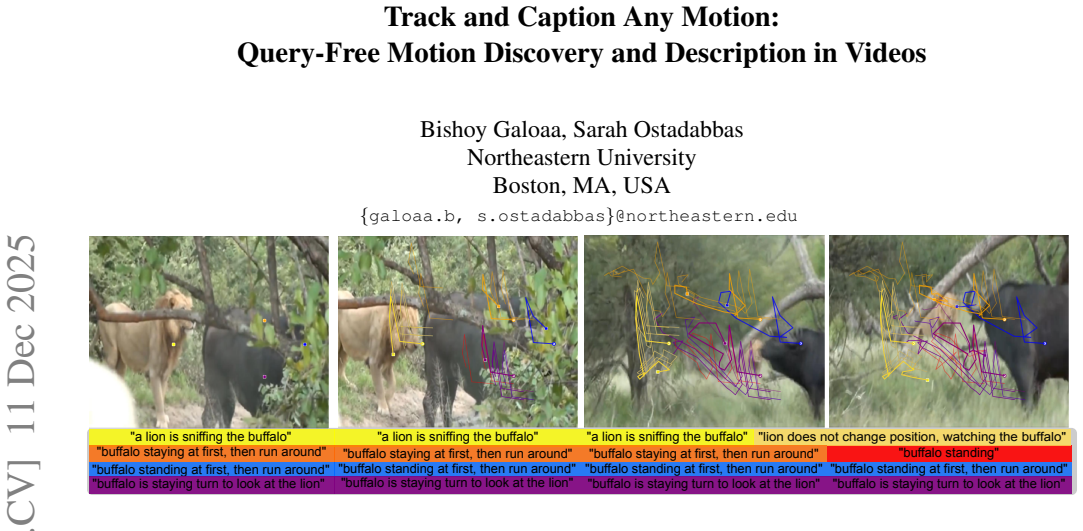
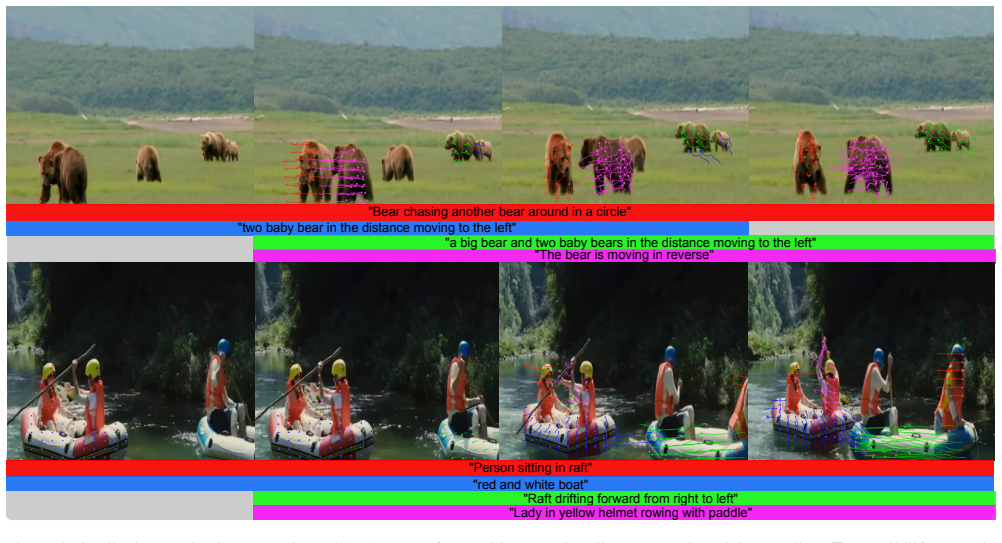
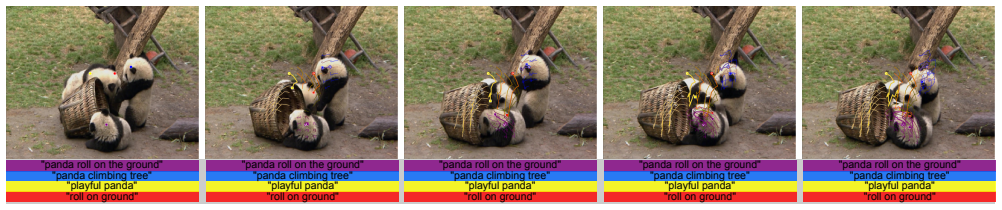
Trajectory geometry alone — positions, velocities, visibility — can say what moves, when, and where in a video, with no text query: TCAM retrieves and grounds multiple descriptions directly from dense point tracks.
Reviewed by Pith at T0; open to challenge. T0 means a machine referee read the full paper against a public rubric. the ladder, T0–T4 →
T0 review · deepseek-v4-flash
2026-08-03 17:04 UTC pith:NQKTODVE
load-bearing objection The paper's actual contribution—query-free multi-expression retrieval with trajectory grounding—is new and mostly solid; the arXiv title/abstract promise open-vocabulary generation that the method does not implement. the 4 major comments →
Track and Caption Any Motion: Open-Vocabulary Spatiotemporal Captioning via Trajectory-Conditioned Generation
The pith
A machine-rendered reading of the paper's core claim, the machinery that carries it, and where it could break.
Core claim
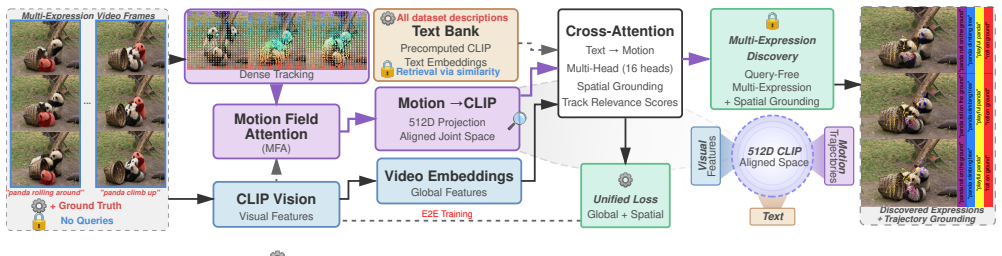
TCAM's central discovery is that a set of dense point trajectories, after projection into the semantic space of a frozen vision–language model, can act as the bridge between motion and meaning. The tracker's raw outputs — positions, velocities, and visibility flags — are processed by motion-field attention into 512-dimensional motion descriptors that are directly comparable to text embeddings. At inference, the video's global embedding is matched against a precomputed bank of text descriptions, so multiple relevant expressions are retrieved without any query; a cross-attention step then scores each track against each expression, grounding language to motion. Training jointly optimizes global
What carries the argument
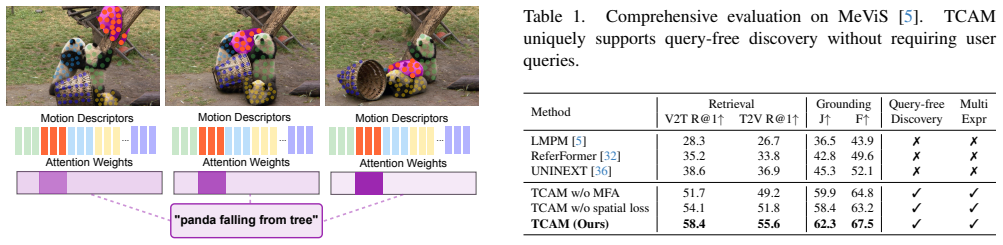
Motion Field Attention (MFA): a mechanism that converts each dense point trajectory — position, velocity, and visibility per frame — plus frozen vision features, into a 512-dimensional motion descriptor aligned to a contrastive vision–language space. Dual transformer encoders split spatial and temporal patterns, and a projection layer makes trajectories and text mutually comparable. MFA carries the argument: it is what turns movement geometry into semantics, enabling retrieval (via global video–text similarity) and grounding (via track–text cross-attention) from the same representation.
Load-bearing premise
The whole scheme stands or falls on whether a tracked point's position, velocity, and visibility, once projected into a vision-language embedding space, carry enough meaning to tell one action from another — and on whether retrieving from the dataset's own set of ground-truth phrases can count as open-vocabulary description.
What would settle it
Build a held-out test in which every expression in the evaluation videos is removed from the text bank; if discovery coverage drops toward the random baseline, the system is a lookup, not an open-vocabulary describer. Separately, measure grounding precision on a stress set of videos with frequent scene cuts: a sharp drop would confirm that track identity, not semantics, is the limiting factor.
If this is right
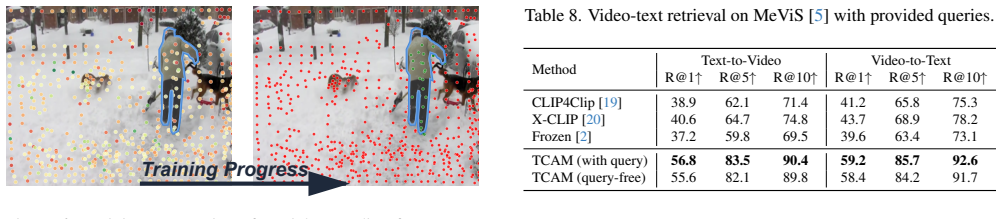
- Query-free discovery becomes practical: a single pass over a video yields several concurrent activity descriptions with reported 84.7% precision, so users can explore footage without knowing what to look for.
- Motion descriptors act as a task-agnostic intermediate: the same learned representation decodes into segmentation masks or bounding boxes, so spatial grounding transfers across output formats.
- Appearance becomes optional: trajectory dynamics alone carry enough semantics to describe actions under occlusion, camouflage, and fast motion where detectors fail.
- Motion-centric retrieval is competitive with query-based pipelines: TCAM matches or exceeds dedicated grounding methods without being told what to describe.
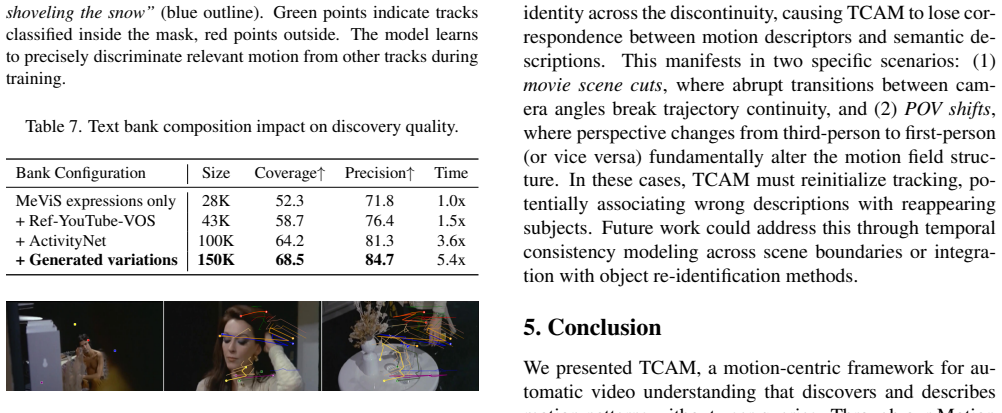
- Failure is bounded by track identity: scene cuts and viewpoint changes break trajectory continuity, so semantic grounding degrades exactly when the upstream tracker loses the points.
Where Pith is reading between the lines
- The abstract's 'generative open-vocabulary' framing overstates the implemented system: inference retrieves from a precomputed bank of the dataset's own ground-truth expressions, so nothing is generated outside that vocabulary. A testable extension is to rebuild the bank from a large external caption corpus; the paper's bank-composition table suggests coverage and precision would keep climbing with
- If MFA descriptors really are semantically discriminative, they could feed a language decoder directly instead of a retrieval step — turning TCAM into the generative captioner the abstract describes. That is a natural next experiment: replace the text-bank similarity with a small autoregressive head conditioned on the motion context.
- Track identity is the weak point, not semantics. Fusing the trajectory stream with an object re-identification module, or adding temporal consistency across cuts, is a concrete fix that the paper names as future work; if it succeeds, the approach should extend from continuous wildlife or rafting scenes to cinematic content.
- Because the representation is shared across tasks, the same motion descriptors could be probed for action-count estimation or anomaly detection without retraining, though the paper does not report such probes.
Editorial analysis
A structured set of objections, weighed in public.
Referee Report
Summary. TCAM is proposed as a query-free framework for video understanding that combines dense point trajectories (CoTracker3) with CLIP-based visual and text embeddings. The method consists of: (1) a Motion Field Attention module that encodes trajectory position/velocity/visibility and projects motion descriptors into a 512-D CLIP-aligned space; (2) a cross-attention mechanism that scores trajectory relevance for a text expression, used for spatial grounding; and (3) a query-free discovery mechanism that retrieves multiple expressions from a precomputed text bank by cosine similarity with a temporally pooled global video embedding. Training uses a global InfoNCE loss plus a spatial loss composed of diversity, sparsity, and ranking terms. The paper reports experiments on MeViS for retrieval, segmentation-based grounding, and multi-expression discovery, plus a cross-dataset grounding result on HC-STVG, and an extensive set of ablations. The title and metadata abstract advertise open-vocabulary generative spatiotemporal captioning, but the full text describes and evaluates a retrieval-and-grounding system with a fixed text bank.
Significance. If reframed accurately, TCAM addresses an interesting and relatively unexplored problem: discovering and spatially grounding multiple motion-related expressions in a video without requiring a user query. The use of dense trajectories as a spatial grounding medium, combined with a fixed text bank, is a plausible retrieval-based approach, and the reported gains over adapted dense-captioning baselines suggest the pipeline has merit. The paper also provides useful ablations (Tables 5–7) and releases code. However, the significance as stated is undermined by a mismatch between the advertised generative/open-vocabulary capability and the actual retrieval implementation, by the fact that the discovery pathway in Eq. (3) uses only global CLIP features rather than the motion descriptors, and by ambiguities in the text-bank construction and the HC-STVG protocol. These issues must be resolved before the contribution can be assessed at face value.
major comments (4)
- [Abstract / §3.3 / §5] The title and metadata abstract describe a "generative framework" that "describes each motion in open vocabulary" through a "language decoder." The actual method in §3.3 does not generate language: Eq. (3) retrieves expressions from a precomputed text bank B by cosine similarity, and the conclusion explicitly defers "open-vocabulary generalization" to future work. All evaluations (Tables 1, 2, 8) are retrieval-based. This is a load-bearing mismatch: the paper should either implement and evaluate a generative decoder or be reframed as a query-free retrieval-and-grounding system. The claims in the title/abstract must be revised to match the implemented system.
- [§3.3, Eq. (3), Figure 2] The query-free discovery similarity s_k in Eq. (3) is computed by temporally pooling the frame-level CLIP features {f_vis_t}. The MFA motion descriptors m_j do not enter this equation; they are used only in the spatial-grounding cross-attention of Eq. (2). The central claim that TCAM "decides what is moving" from trajectory dynamics is therefore not supported by the discovery pathway: retrieval is appearance-based via frozen CLIP features. This also makes the MFA ablation on V2T R@1 in Table 5 (51.7 vs 58.4) difficult to explain. Please clarify whether MFA influences e_video or correct the description/claims; otherwise restrict the motion-centric claim to spatial grounding.
- [§3.3, §4.3, Table 7] The construction of the text bank is underspecified. The text says "all unique descriptions in the dataset" (§3.3), which is ambiguous about whether validation/test expressions are included. If the bank includes the ground-truth expressions used to compute coverage and precision in Table 2 and Table 7, those numbers are inflated by exposing the answer key. The bank must be restricted to training-split expressions (or another clearly disjoint source), and the paper should state this explicitly. Additionally, because discovery is retrieval from a fixed bank, the system cannot caption an expression not present in the bank; this makes the "open-vocabulary" claim in the abstract even more problematic.
- [§4.1, Table 3] The HC-STVG transfer protocol is not described. It is unclear whether TCAM is fine-tuned on HC-STVG training splits or tested zero-shot after MeViS training, and how mask-based relevance scores are converted to bounding boxes for IoU metrics. Without this information, the cross-task generalization claim in Table 3 cannot be interpreted. Please provide the exact training/evaluation protocol for HC-STVG, including which splits are used and how the point/track relevance maps are turned into boxes.
minor comments (5)
- [Throughout] All tables report single point estimates without error bars or multiple-seed statistics. Given the relatively small MeViS set (2,006 videos) and the use of a pretrained tracker, the reported improvements should be accompanied by variance estimates or significance tests.
- [Abstract / §4.1] The metadata abstract states "On over 50K clips," but the body reports MeViS as containing 2,006 videos. This factual discrepancy should be reconciled.
- [Figure 1, §2] Typos: "chhallenging" in the Figure 1 caption, and "with with" in the Related Works section (in the description of spatio-temporal grounding methods). There are also several missing punctuation and spacing issues throughout.
- [Table 7] The "+ Generated variations" row does not specify how the variations are generated or whether they overlap with the ground-truth expressions. Provide details on the generation procedure and ensure no test-expression leakage.
- [References] References [4] and [5] both describe MeViS; one is an ICCV paper and the other is an arXiv preprint. This appears to be a duplicate or incorrect citation and should be cleaned up.
Circularity Check
No circularity: TCAM is a supervised retrieval-and-grounding system; the abstract's 'generative open-vocabulary' phrasing is unsupported by the body, but that is a claim-vs-implementation mismatch, not a derivation that reduces to its inputs.
full rationale
The paper's actual derivation chain is: dense trajectories (CoTracker3) plus frozen CLIP visual features are encoded by MFA into 512D motion descriptors; global video-text alignment (Eq. 5) trains pooled video features to match CLIP text embeddings; query-free output is produced by cosine retrieval from a precomputed text bank (Eq. 3); spatial grounding is supervised with ground-truth masks via a ranking loss (Eq. 7). Each component is trained or externally provided, and no output quantity is defined in terms of the target metric. The text bank is an explicit design input, not a fitted parameter masquerading as a prediction; evaluating retrieval coverage against the same expression set is a benchmark choice, and the paper openly frames the task as retrieval ('retrieves relevant expressions from a precomputed text bank'). The abstract's claim of a 'generative framework' with a 'language decoder' and 'open vocabulary' is not implemented in §3.3, and §5 concedes that open-vocabulary generalization is future work; this is a correctness/claim-support weakness, not circularity. §4.7 likewise states an inherited tracking limitation, which narrows but does not circularize the method. There are no self-citations used as load-bearing evidence and no uniqueness theorem invoked. The central mechanism is therefore independent of its conclusions; score 0.
Axiom & Free-Parameter Ledger
free parameters (5)
- spatial loss weight λ =
0.1
- InfoNCE temperature τ =
0.1
- ranking loss margin γ =
0.2
- discovery threshold / percentile =
top 70th percentile; 'adaptive' variant
- track grid density =
24×24 = 576 tracks
axioms (4)
- domain assumption CoTracker3 trajectory estimates preserve identity and capture action-relevant motion in continuous scenes.
- domain assumption Frozen CLIP embeddings provide a semantic space in which trajectory-derived motion descriptors can be aligned by cosine similarity.
- domain assumption MeViS ground-truth masks and expressions are sufficient supervision for generic motion semantics.
- ad hoc to paper The precomputed text bank B contains all expressions needed for inference.
Cite this review
Pith. "Pith review of Track and Caption Any Motion: Open-Vocabulary Spatiotemporal Captioning via Trajectory-Conditioned Generation." pith.science (2026). https://pith.science/paper/NQKTODVE
@misc{pith2026251210607,
  author       = {Pith},
  title        = {Pith review of: Track and Caption Any Motion: Open-Vocabulary Spatiotemporal Captioning via Trajectory-Conditioned Generation},
  year         = {2026},
  howpublished = {\url{https://pith.science/paper/NQKTODVE}},
  note         = {Machine review of arXiv:2512.10607}
}
read the original abstract
We present TCAM (Track and Caption Any Motion), a generative framework that watches a video and with no text query and no region prompt decides what is moving, describes each motion in open vocabulary, locates it in time, and points to the exact trajectories that carry it. Two mature lines of work make this possible yet leave it unsolved: dense point trackers follow pixels with sub-object precision but emit no language, while video-language models produce fluent descriptions only when handed a query and only from clip-level features that cannot resolve which pixels move. Object-level captioners narrow the gap but still reason over detector boxes or masks, never reaching individual trajectories. TCAM couples tracking and language at point granularity through a Caption-Aware Resampler, where a small set of learnable queries cross-attends to dense point trajectory tokens and distills them into a fixed-length motion context that conditions a language decoder. The decoder generates an entire video's events in a single pass, each with a free-form caption, a start and end time, and a pointer to the trajectories it refers to, for sequential events and several subjects active at once. Training uses only existing segmentation annotations, with no extra event labeling, to supervise caption quality, pointer-mask alignment, and pointer diversity. On over 50K clips, TCAM outperforms dense video captioning baselines and matches dedicated, query-based grounding and point-tracking methods despite using no query, showing that trajectory-conditioned generation is a direct route to motion-driven video understanding.
Figures
Reference graph
Works this paper leans on
-
[1]
Mido Assran, Adrien Bardes, David Fan, Quentin Garrido, Russell Howes, Matthew Muckley, Ammar Rizvi, Claire Roberts, Koustuv Sinha, Artem Zholus, et al. V-jepa 2: Self- supervised video models enable understanding, prediction and planning.arXiv preprint arXiv:2506.09985, 2025. 2
Pith/arXiv arXiv 2025
-
[2]
Frozen in time: A joint video and image encoder for end-to-end retrieval
Max Bain, Arsha Nagrani, G ¨ul Varol, and Andrew Zisser- man. Frozen in time: A joint video and image encoder for end-to-end retrieval. InICCV, 2021. 2, 8
2021
-
[3]
Object segmentation by long term analysis of point trajectories
Thomas Brox and Jitendra Malik. Object segmentation by long term analysis of point trajectories. InECCV, 2010. 3
2010
-
[4]
Mevis: A large-scale bench- mark for video segmentation with motion expressions.arXiv preprint, 2024
Henghui Chen, Tsun-Hsuan Liu, Yutong Hu, Kuanchih Lin, Xiao Liu, and Peng Gao. Mevis: A large-scale bench- mark for video segmentation with motion expressions.arXiv preprint, 2024. 2
2024
-
[5]
Mevis: A large-scale benchmark for video segmentation with motion expressions
Henghui Ding, Chang Liu, Shuting He, Xudong Jiang, and Chen Change Loy. Mevis: A large-scale benchmark for video segmentation with motion expressions. InICCV, 2023. 5, 6, 7, 8
2023
-
[6]
Tap-vid: A benchmark for tracking any point in a video
Carl Doersch, Ankush Gupta, Larisa Markeeva, Adri `a Re- casens, Lucas Smaira, Yusuf Aytar, Jo ˜ao Carreira, Andrew Zisserman, and Yi Yang. Tap-vid: A benchmark for tracking any point in a video. InNeurIPS, 2022. 3
2022
-
[7]
Tapir: Tracking any point with per-frame initialization and temporal refinement
Carl Doersch, Yi Yang, Mel Vecerik, Dilara Gokay, Ankush Gupta, Yusuf Aytar, Joao Carreira, and Andrew Zisserman. Tapir: Tracking any point with per-frame initialization and temporal refinement. InICCV, 2023. 2, 3
2023
-
[8]
Step- former: Self-supervised step discovery and localization in instructional videos
Nikita Dvornik, Isma Hadji, Ran Zhang, Konstantinos G Derpanis, Richard P Wildes, and Allan D Jepson. Step- former: Self-supervised step discovery and localization in instructional videos. InProceedings of the IEEE/CVF Con- ference on Computer Vision and Pattern Recognition, pages 18952–18961, 2023. 2
2023
-
[9]
Context-guided spatio-temporal video grounding
Xin Gu, Heng Lan, and Jianzhuang Ma. Context-guided spatio-temporal video grounding. InCVPR, 2024. 3, 7
2024
-
[10]
Harley, Zhaoyuan Fang, and Katerina Fragkiadaki
Adam W. Harley, Zhaoyuan Fang, and Katerina Fragkiadaki. Particle video revisited: Tracking through occlusions using point trajectories. InECCV, 2022. 2, 3
2022
-
[11]
Pips++: Improved tracking through occlusions via extended point trajectories
Adam W Harley, Zhaoyuan Fang, and Katerina Fragkiadaki. Pips++: Improved tracking through occlusions via extended point trajectories. InICCV, 2023. 3
2023
-
[12]
A better use of audio-visual cues: Dense video captioning with bi-modal transformer
Vladimir Iashin and Esa Rahtu. A better use of audio-visual cues: Dense video captioning with bi-modal transformer. In BMVC, 2020. 3
2020
-
[13]
Videorag: Retrieval-augmented generation over video corpus.arXiv preprint arXiv:2501.05874, 2025
Soyeong Jeong, Kangsan Kim, Jinheon Baek, and Sung Ju Hwang. Videorag: Retrieval-augmented generation over video corpus.arXiv preprint arXiv:2501.05874, 2025. 2
Pith/arXiv arXiv 2025
-
[14]
Embracing consistency: A one-stage approach for spatio- temporal video grounding
Rui Jin, Wenjun Zhao, Zhedong Zheng, and Yang Wu. Embracing consistency: A one-stage approach for spatio- temporal video grounding. InNeurIPS, 2022. 2, 3, 7
2022
-
[15]
Co- tracker: It is better to track together
Nikita Karaev, Ignacio Rocco, Benjamin Graham, Natalia Neverova, Andrea Vedaldi, and Christian Rupprecht. Co- tracker: It is better to track together. InECCV, 2023. 2, 3
2023
-
[16]
Co- tracker3: Simpler and better point tracking by pseudo- labelling real videos
Nikita Karaev, Ignacio Rocco, Benjamin Graham, Natalia Neverova, Andrea Vedaldi, and Christian Rupprecht. Co- tracker3: Simpler and better point tracking by pseudo- labelling real videos. InICCV, 2024. 2, 3
2024
-
[17]
Cospal: Co-optimizing spatio-temporal context prompting and adapt- ing for weakly supervised video grounding.arXiv preprint,
Sachit Kumar, Haochen Wang, and Ming Tang. Cospal: Co-optimizing spatio-temporal context prompting and adapt- ing for weakly supervised video grounding.arXiv preprint,
-
[18]
Unsupervised object discovery and track- ing in video collections
Suha Kwak, Minsu Cho, Ivan Laptev, Jean Ponce, and Cordelia Schmid. Unsupervised object discovery and track- ing in video collections. InICCV, 2015. 3
2015
-
[19]
Clip4clip: An empirical study of clip for end to end video clip retrieval and captioning.Neu- rocomputing, 508:293–304, 2022
Huaishao Luo, Lei Ji, Ming Zhong, Yang Chen, Wen Lei, Nan Duan, and Tianrui Li. Clip4clip: An empirical study of clip for end to end video clip retrieval and captioning.Neu- rocomputing, 508:293–304, 2022. 1, 2, 3, 8
2022
-
[20]
X-clip: End-to-end multi-grained con- trastive learning for video-text retrieval
Yiwei Ma, Guohai Xu, Xiaoshuai Sun, Ming Yan, Ji Zhang, and Rongrong Ji. X-clip: End-to-end multi-grained con- trastive learning for video-text retrieval. InACM Interna- tional Conference on Multimedia, pages 638–647, 2022. 1, 2, 3, 8
2022
-
[21]
Delta: Dense efficient long-range 3d tracking for any video
Tuan Duc Ngo, Peiye Hua, Shangzhe Xue, Yunzhi Zhang, and Xiaoke Zhang. Delta: Dense efficient long-range 3d tracking for any video. InICLR, 2025. 2, 3
2025
-
[22]
Unsupervised discovery of actions in in- structional videos
AJ Piergiovanni, Anelia Angelova, Alexander Toshev, and Michael S Ryoo. Unsupervised discovery of actions in in- structional videos. InBMVC, 2021. 3
2021
-
[23]
Learn- ing transferable visual models from natural language super- vision
Alec Radford, Jong Wook Kim, Chris Hallacy, Aditya Ramesh, Gabriel Goh, Sandhini Agarwal, Girish Sastry, Amanda Askell, Pamela Mishkin, Jack Clark, et al. Learn- ing transferable visual models from natural language super- vision. InICML, 2021. 3
2021
-
[24]
Two-stream con- volutional networks for action recognition in videos
Karen Simonyan and Andrew Zisserman. Two-stream con- volutional networks for action recognition in videos. In NeurIPS, 2014. 3
2014
-
[25]
Human-centric spatio-temporal video grounding with visual transformers
Zongheng Tang, Yue Liao, Si Liu, Guanbin Li, Xiaojie Jin, Hongxu Jiang, Qian Yu, and Dong Xu. Human-centric spatio-temporal video grounding with visual transformers. In TCSVT, 2021. 5, 6, 7
2021
-
[26]
Human-centric spatio-temporal video grounding with visual transformers
Zongheng Tang, Yue Liao, Si Liu, Guanbin Li, Xiaojie Jin, Hongxu Jiang, Qian Yu, and Dong Xu. Human-centric spatio-temporal video grounding with visual transformers. IEEE Transactions on Circuits and Systems for Video Tech- nology, 32(12):8238–8249, 2021. 2
2021
-
[27]
Repre- sentation learning with contrastive predictive coding, 2018
Aaron van den Oord, Yazhe Li, and Oriol Vinyals. Repre- sentation learning with contrastive predictive coding, 2018. 4
2018
-
[28]
Action recognition with trajectories
Heng Wang and Cordelia Schmid. Action recognition with trajectories. InCVPR, 2013. 3
2013
-
[29]
Actionclip: A new paradigm for video action recognition.arXiv preprint arXiv:2109.08472, 2021
Mengmeng Wang, Jiazheng Xing, and Yong Liu. Actionclip: A new paradigm for video action recognition.arXiv preprint arXiv:2109.08472, 2021. 1, 3
Pith/arXiv arXiv 2021
-
[30]
Tracking everything everywhere all at once
Qianqian Wang, Yen-Yu Chang, Ruojin Cai, Zhengqi Li, Bharath Hariharan, Aleksander Holynski, and Noah Snavely. Tracking everything everywhere all at once. InICCV, 2023. 2, 3
2023
-
[31]
End-to-end dense video captioning with parallel decoding
Teng Wang, Ruimao Zhang, Zhichao Lu, Feng Zheng, Ran Cheng, and Ping Luo. End-to-end dense video captioning with parallel decoding. InICCV, 2021. 2, 3, 7 9
2021
-
[32]
Language as queries for referring video object segmen- tation
Jiannan Wu, Yi Jiang, Peize Sun, Zehuan Yuan, and Ping Luo. Language as queries for referring video object segmen- tation. InCVPR, 2022. 3, 5, 7
2022
-
[33]
Spatialtracker: Tracking any 2d pixels in 3d space
Yuxi Xiao, Qianqian Wang, Shangzhan Zhang, Nan Xue, Sida Peng, Yujun Shen, and Xiaowei Zhou. Spatialtracker: Tracking any 2d pixels in 3d space. InProceedings of the IEEE/CVF Conference on Computer Vision and Pattern Recognition, pages 20406–20417, 2024. 2
2024
-
[34]
Spatialtrackerv2: 3d point tracking made easy.arXiv preprint arXiv:2507.12462, 2025
Yuxi Xiao, Jianyuan Wang, Nan Xue, Nikita Karaev, Yuri Makarov, Bingyi Kang, Xing Zhu, Hujun Bao, Yujun Shen, and Xiaowei Zhou. Spatialtrackerv2: 3d point tracking made easy.arXiv preprint arXiv:2507.12462, 2025. 2
Pith/arXiv arXiv 2025
-
[35]
Videoclip: Contrastive pre-training for zero-shot video-text understanding
Hu Xu, Gargi Ghosh, Po-Yao Huang, Dmytro Okhonko, Armen Aghajanyan, Florian Metze, Luke Zettlemoyer, and Christoph Feichtenhofer. Videoclip: Contrastive pre-training for zero-shot video-text understanding. InEMNLP, 2021. 1, 3
2021
-
[36]
Universal instance perception as object discovery and retrieval
Bin Yan, Yi Jiang, Jiannan Wu, Dong Wang, Ping Luo, Ze- huan Yuan, and Huchuan Lu. Universal instance perception as object discovery and retrieval. InCVPR, 2023. 3, 5, 7
2023
-
[37]
Tubedetr: Spatio-temporal video ground- ing with transformers
Antoine Yang, Antoine Miech, Josef Sivic, Ivan Laptev, and Cordelia Schmid. Tubedetr: Spatio-temporal video ground- ing with transformers. InCVPR, 2022. 2, 3, 7
2022
-
[38]
Vid2seq: Large-scale pretraining of a vi- sual language model for dense video captioning
Antoine Yang, Arsha Nagrani, Paul Hongsuck Seo, An- toine Miech, Jordi Pont-Tuset, Ivan Laptev, Josef Sivic, and Cordelia Schmid. Vid2seq: Large-scale pretraining of a vi- sual language model for dense video captioning. InCVPR,
-
[39]
Tapip3d: Tracking any point in persistent 3d geome- try.arXiv preprint arXiv:2504.14717, 2025
Bowei Zhang, Lei Ke, Adam W Harley, and Katerina Fragki- adaki. Tapip3d: Tracking any point in persistent 3d geome- try.arXiv preprint arXiv:2504.14717, 2025. 2
arXiv 2025
-
[40]
Where does it exist: Spatio-temporal video grounding for multi-form sentences
Zhu Zhang, Zhou Zhao, Yang Zhao, Qi Wang, Huasheng Liu, and Lianli Gao. Where does it exist: Spatio-temporal video grounding for multi-form sentences. InProceedings of the IEEE/CVF Conference on Computer Vision and Pat- tern Recognition, pages 10668–10677, 2020. 2
2020
-
[41]
Video- text prompting for weakly supervised spatio-temporal video grounding
Mengyao Zhao, Yiming Li, and Zhenlin Zhang. Video- text prompting for weakly supervised spatio-temporal video grounding. InEMNLP, 2024. 3
2024
-
[42]
Unsupervised learning from video to detect foreground objects in single images
Nannan Zhao, Xuesheng Wen, and Jie Yang. Unsupervised learning from video to detect foreground objects in single images. InSymmetry, 2021. 3
2021
-
[43]
Tapnext: Tracking any point as next token predic- tion.arXiv preprint arXiv:2504.05579, 2025
Ivan Zholus, Jia-Bin Yang, Tsung-Han Xue, and Yung-Yu Chuang. Tapnext: Tracking any point as next token predic- tion.arXiv preprint arXiv:2504.05579, 2025. 3
Pith/arXiv arXiv 2025
-
[44]
Dense video object captioning from disjoint super- vision
Xingyi Zhou, Anurag Arnab, Chen Sun, and Cordelia Schmid. Dense video object captioning from disjoint super- vision. InInternational Conference on Learning Represen- tations (ICLR), 2025. 3 10
2025
discussion (0)
Sign in with ORCID, Apple, or X to comment. Anyone can read and Pith papers without signing in.