REVIEW 2 major objections 5 minor 3 cited by
A motion LLM that critiques its own drafts lands closer to the prompt.
Reviewed by Pith at T0; open to challenge. T0 means a machine referee read the full paper against a public rubric. the ladder, T0–T4 →
T0 review · deepseek-v4-flash
2026-08-03 17:02 UTC pith:2VMVLI4M
load-bearing objection Interleaved generation, assessment, and refinement is a real, well-ablated step forward for motion LLMs; the main caveat is that the assessment bridge is trained from text captions rather than from the motion itself. the 2 major comments →
IRG-MotionLLM: Interleaving Motion Generation, Assessment and Refinement for Text-to-Motion Generation
The pith
A machine-rendered reading of the paper's core claim, the machinery that carries it, and where it could break.
Core claim
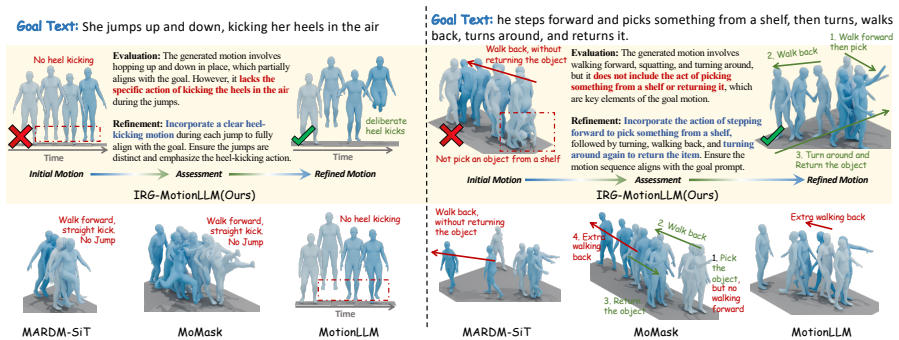
The central claim is that motion assessment and refinement tasks act as bridges that let understanding knowledge flow into generation. When the model is trained on these 'improving' tasks alongside basic motion captioning and generation, and then explicitly trained to interleave generation, assessment, and refinement in a single reasoning trajectory, the final generated motion aligns better with the goal text than the initial generation and than motions from baseline models. The paper also reports that this interleaved ability emerges even at Stage-1 before explicit chain-of-thought training, and that GRPO-based reinforcement learning pushes the model to perform more rounds of refinement, ea
What carries the argument
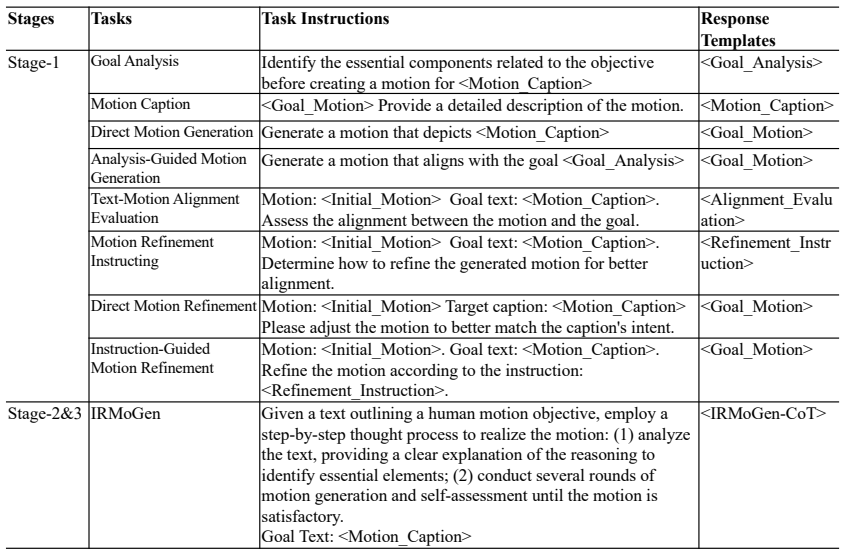
IRMoGen, the Interleaved Reasoning for Motion Generation paradigm, is the central object: a structured loop in which the model alternates between producing motion tokens, writing an alignment assessment and refinement instruction, and generating a revised motion, guided by a chain-of-thought template with plan tokens. The three-stage training scheme (task initialization, CoT learning with an 'Ignore Incorrect' loss mask for intermediate motions, and GRPO reinforcement with text-motion and motion-motion alignment rewards) carries the argument, supported by a data engine that samples negative motions at varying alignment levels and uses an LLM to synthesize evaluation and refinement annotation
Load-bearing premise
The model's assessment and refinement supervision comes from an LLM judging text descriptions of motions, not from actual motion content, so the model may learn to critique captions rather than the real generated motion.
What would settle it
Construct a test set where the text description of a generated motion is intentionally misleading (e.g., caption says 'walking forward' but the actual motion walks backward), and check whether IRG-MotionLLM's assessment flags the true motion error; if it consistently passes misleading captions, the text-based annotation proxy has failed.
If this is right
- If correct, unified motion LLMs can self-correct through internal text-motion dialogue, removing the need for external modules or human intervention during inference.
- Training on assessment and refinement tasks also improves the model's motion-to-text captioning, suggesting bidirectional knowledge flow between understanding and generation.
- Reinforcement learning that rewards text-motion alignment lengthens the reasoning trajectory, and more rounds of refinement monotonically improve alignment.
- The trained model can be repurposed as a text-motion reward model, boosting a separate motion generator's performance under an RLAIF framework.
- The gains hold across two datasets (HumanML3D, KIT-ML) and two evaluators, indicating the effect is not tied to one benchmark's quirks.
Where Pith is reading between the lines
- Because the synthetic assessment and refinement annotations are produced from text captions of negative motions rather than from the motions themselves, the model's critique skill is only as faithful as the LLM that wrote those captions; an editor might test whether the loop still helps when assessments are grounded in actual motion features.
- The interleaved self-correction loop resembles recent 'thinking with generated images' ideas, suggesting the paradigm may transfer to other continuous generative modalities such as audio, video, or robotic trajectories where a model can evaluate and refine its own output in a closed loop.
- The paper's focus is text-motion alignment; an obvious extension is to add physical plausibility or smoothness assessment into the loop, which could fix unnatural intermediate poses rather than only semantic mismatches.
- Since longer reasoning trajectories emerge only after reinforcement learning, one can hypothesize that scaling up the base LLM and training data (larger motion datasets, more diverse captions) would further amplify the benefit of interleaving.
Editorial analysis
A structured set of objections, weighed in public.
Referee Report
Summary. The paper proposes IRG-MotionLLM, a motion-aware LLM that interleaves text-to-motion generation with assessment and refinement in an iterative reasoning loop (IRMoGen). Training is done in three stages: (1) supervised fine-tuning on eight atomic tasks, including assessment and refinement; (2) supervised learning on IRMoGen-CoT trajectories generated by an automated GPT-4o-based data engine; (3) GRPO reinforcement learning with format, text-motion alignment, and motion-motion alignment rewards. Experiments on HumanML3D and KIT-ML report consistent gains in R-Precision and MM-Dist over the base model and prior unified motion LLMs, supported by per-stage ablations, cross-evaluator validation, and robustness tests.
Significance. If the findings hold, the paper offers a practical way to make motion-understanding tasks improve motion generation within a single LLM, a timely and non-obvious contribution. The evidence is unusually extensive: stage-wise ablations (Table 1), initial-vs-final generation comparisons (Table 3), cross-evaluator results (Table 5), perturbation robustness (Table 9), and a transfer experiment using IRG-MotionLLM as a reward model (Table 10). The release of code and data is a further strength. The main reservations are the unvalidated text-only annotation proxy used to train assessment/refinement and the overlap between the Stage-3 reward and the benchmark evaluator; both are load-bearing for the central claim and need additional experiments, but they are fixable within the scope of a revision.
major comments (2)
- [Sec. 4, Fig. 9, Sec. 10.1] The data engine constructs assessment and refinement supervision from text only. GPT-4o receives the goal text and the 'Text Description for Generated Motions' — the caption paired with the negative motion — not motion tokens, coordinates, or any motion-derived representation. The prompt tells the model to 'assume that you are watching the motion,' but the actual input is a caption. No validation is reported that the GPT-4o evaluations and refinement instructions are faithful to the true motion content; Sec. 10.1 filters only invalid responses. Because these labels train the improving tasks in Stage-1 and the full IRMoGen-CoT trajectories in Stage-2, the central claim that assessment/refinement bridges motion understanding and generation rests on an unvalidated proxy. If the captions are not reliable descriptions of the negative motions, the model may learn to critique/edit captions rath
- [Sec. 3.3, Eq. (2); Sec. 11.2] The Stage-3 text-motion alignment reward in Eq. (2) uses the paired text and motion encoders from the HumanML3D evaluator [13] — the same encoders used to compute R-Precision and MM-Dist in the benchmark (Sec. 11.2). The Stage-3 gains in Tables 1, 3, and 4 may therefore partly reflect direct optimization of the evaluation metrics. The cross-evaluator results in Table 5 and the discussion in Sec. 12.4 mitigate this concern, but MARDM [49] is still a text-motion embedding-distance metric very similar in form to the reward, so the issue is reduced but not eliminated. A cleaner test would be to train Stage-3 with a held-out evaluator (e.g., MARDM) as the reward, or to ablate the r_tm term, and then compare on the original benchmark. This would separate 'unleashing reasoning capacity' from 'tuning the evaluator.'
minor comments (5)
- [Figs. 1-2] The text contains non-English placeholder strings '无法显示该图片。' interspersed in the figure captions. These are presumably rendering artifacts and should be removed before submission.
- [Table 4] The base model row 'MotionLLM*' reports Top-1 R-Precision 0.496, while the published MotionLLM row reports 0.515. The paper should explain this discrepancy (evaluation protocol, checkpoint differences) so readers can assess the improvement from the training scheme rather than from a weaker base checkpoint.
- [Sec. 3.2] There is a typo/formatting error: 'we note{m 1, .., mn−1}asintermediate motions' should read 'we denote {m_1, ..., m_{n-1}} as intermediate motions.'
- [Sec. 10.1 / Sec. 9.2] The hyperparameters p, N_neg, N_max, G, and beta_kl are set without sensitivity analysis. Given that several are non-standard (e.g., p=90%), at least one ablation or a brief justification would help.
- [App. Eq. (4)] The notation in Eq. (4) is inconsistent: 'πbold' should be 'π_{θ_old}' and the ratio/objective would benefit from the standard clipping notation to avoid ambiguity.
Circularity Check
Stage-3 GRPO reward duplicates the HumanML3D evaluation metric, so part of the reported Stage-3 alignment gain is metric-tuning; Stage-1/2 and cross-evaluator results provide independent grounding.
specific steps
-
fitted input called prediction
[Sec. 3.3 (Eq. 2), Sec. 11.2 (Eq. 6), Sec. 12.4]
"rtm(t,m_final,i) = −∥E_t(t)−E_m(m_final,i)∥2, (2) ... E_t and E_m are chosen from paired text and motion encoders in [13]. ... Multimodal Distance (MM-Dist) ... MM-Dist= 1/N Σ ||f_pred,i − f_text,i|| ... However, as we use the official evaluator [13] as the reward model, an extreme question may be raised: Does GRPO-based RL tuning in Stage-3 unleash the potential capacity or simply hack the evaluator?"
The Stage-3 Text-Motion Alignment Reward in Eq. 2 is the negative of the sample-level MM-Dist computed from the same paired [13] text/motion encoders used by the official HumanML3D evaluator, and R-Precision ranks motions by those same distances. Maximizing this reward during GRPO therefore directly optimizes the reported MM-Dist/R-Precision metrics, so the Stage-3 improvement on the HumanML3D benchmark is at least partly enforced by construction rather than by an independent alignment signal. The paper itself acknowledges this 'hack the evaluator' concern and mitigates it with the MARDM [49] cross-evaluator and the non-RL Stage-1/2 results, which is why the circularity is partial rather than total.
full rationale
The derivation chain is largely self-contained: the IRMoGen paradigm, the three-stage training scheme, and the data engine are defined from external text-motion datasets and pre-trained encoders, and no load-bearing self-citation chain is used (the MotionLLM base is an external work; the authors' own related citation is not load-bearing). Stage-1 and Stage-2 gains come from supervised tasks and CoT trajectories whose intermediate motions are sampled by a separate TMR-based [54] ranking, not from the evaluation metric, and the final-motion targets are ground-truth motions. The main identifiable circular step is in Stage-3: the RL reward (Eq. 2) is the negative of the same [13] encoder distance that defines HumanML3D MM-Dist (Eq. 6) and R-Precision, so the main-benchmark Stage-3 alignment gain is partly metric-optimization. The paper explicitly raises this concern and supplies an independent MARDM [49] evaluator plus non-RL stage improvements, preventing the entire central claim from collapsing into the metric. The GPT-4o caption-based annotation pipeline is a fidelity/correctness risk (annotations are generated from text descriptions, not motion tokens), but it is not a circular reduction by construction and is therefore not scored as circularity here.
Axiom & Free-Parameter Ledger
free parameters (4)
- Maximum refinement rounds N_max =
4
- Negative sampling fraction p =
90% HumanML3D, 87.5% KIT-ML
- Number of negative samples N_neg =
4
- GRPO group size G and KL weight beta_kl =
G=4, beta_kl=0.01
axioms (6)
- domain assumption Motion VQ-VAE tokens preserve enough detail for assessment and refinement.
- domain assumption HumanML3D/KIT-ML paired captions accurately describe their motions.
- ad hoc to paper GPT-4o-generated goal analyses, evaluations, and refinement instructions are sufficiently faithful for training.
- ad hoc to paper Embedding-distance ranking with a pre-trained motion encoder yields meaningful progressive alignment levels.
- domain assumption Official HumanML3D text/motion encoders are valid proxies for text-motion alignment, and the MARDM evaluator is an independent check.
- standard math GRPO is a valid optimization procedure for this tokenized motion LLM.
read the original abstract
Recent advances in motion-aware large language models have shown remarkable promise for jointly learning motion understanding and generation knowledge. However, these models typically treat understanding and generation separately, limiting the mutual benefits that could arise from interactive feedback between tasks. In this work, we reveal that motion assessment and refinement tasks can act as crucial bridges to enable knowledge flow from motion understanding to generation. Specifically, we propose Interleaved Reasoning for Motion Generation (IRMoGen), a novel paradigm that tightly couples motion generation with assessment and refinement through iterative text-motion dialogue. To realize this, we introduce IRG-MotionLLM, the first model that seamlessly interleaves motion generation, assessment, and refinement to improve the alignment between generated motion and goal text. IRG-MotionLLM is developed progressively with a novel three-stage training scheme, initializing and subsequently enhancing native IRMoGen capabilities. To facilitate this development, we construct an automated data engine to synthesize interleaved reasoning annotations from existing text-motion datasets. Extensive experiments demonstrate the properties brought by IRMoGen training, and the advanced cross-benchmark and cross-evaluator performance of IRG-MotionLLM. Code and models are available at https://github.com/HumanMLLM/IRG-MotionLLM.
Figures







Forward citations
Cited by 3 Pith papers
-
MoGeFlow: Flowing Through Motion Codebook Geometry for Text-to-Motion Generation
MoGeFlow learns text-conditioned flows over PartVQ group-specific code embeddings to generate motions, achieving SOTA R-Precision on HumanML3D and KIT-ML while preserving discrete token validity.
-
PhysiGen: Integrating Collision-Aware Physical Constraints for High-Fidelity Human-Human Interaction Generation
PhysiGen reduces interpenetration in text-driven 3D human interaction generation by simplifying meshes to geometric primitives for fast collision detection and guiding optimization with collision regions.
-
MotionHiFlow: Text-to-motion via hierarchical flow matching
MotionHiFlow generates text-aligned 3D human motions using hierarchical flow matching across temporal scales, cross-scale transitions, a Text-Motion Diffusion Transformer, and a topology-aware Motion VAE, achieving st...
Reference graph
Works this paper leans on
-
[1]
interleaving reasoning: Next-generation reasoning systems for agi
Wenxuan huang. interleaving reasoning: Next-generation reasoning systems for agi. github repository, 2025. 3
2025
-
[2]
introducing openai o3 and o4-mini
Openai. introducing openai o3 and o4-mini. openai blog, 2025b. 3
-
[3]
Bin Cao, Sipeng Zheng, Ye Wang, Lujie Xia, Qianshan Wei, Qin Jin, Jing Liu, and Zongqing Lu. Being-m0. 5: A real-time controllable vision-language-motion model.arXiv preprint arXiv:2508.07863, 2025. 3, 6, 7
Pith/arXiv arXiv 2025
-
[4]
Executing your commands via motion diffusion in latent space
Xin Chen, Biao Jiang, Wen Liu, Zilong Huang, Bin Fu, Tao Chen, and Gang Yu. Executing your commands via motion diffusion in latent space. InProceedings of the IEEE/CVF conference on computer vision and pattern recognition, pages 18000–18010, 2023. 3, 8, 6
2023
-
[5]
Thinking with gen- erated images.arXiv preprint arXiv:2505.22525, 2025
Ethan Chern, Zhulin Hu, Steffi Chern, Siqi Kou, Jiadi Su, Yan Ma, Zhijie Deng, and Pengfei Liu. Thinking with gen- erated images.arXiv preprint arXiv:2505.22525, 2025. 1, 3
Pith/arXiv arXiv 2025
-
[6]
Emerging properties in unified multimodal pretraining.arXiv preprint arXiv:2505.14683, 2025
Chaorui Deng, Deyao Zhu, Kunchang Li, Chenhui Gou, Feng Li, Zeyu Wang, Shu Zhong, Weihao Yu, Xiaonan Nie, Ziang Song, et al. Emerging properties in unified multimodal pretraining.arXiv preprint arXiv:2505.14683, 2025. 3
Pith/arXiv arXiv 2025
-
[7]
Go to zero: Towards zero-shot motion generation with million-scale data
Ke Fan, Shunlin Lu, Minyue Dai, Runyi Yu, Lixing Xiao, Zhiyang Dou, Junting Dong, Lizhuang Ma, and Jingbo Wang. Go to zero: Towards zero-shot motion generation with million-scale data. InProceedings of the IEEE/CVF In- ternational Conference on Computer Vision, pages 13336– 13348, 2025. 3, 9
2025
-
[8]
Rongyao Fang, Chengqi Duan, Kun Wang, Linjiang Huang, Hao Li, Shilin Yan, Hao Tian, Xingyu Zeng, Rui Zhao, Jifeng Dai, et al. Got: Unleashing reasoning capability of multimodal large language model for visual generation and editing.arXiv preprint arXiv:2503.10639, 2025. 3
Pith/arXiv arXiv 2025
-
[9]
Shenghao Fu, Qize Yang, Yuan-Ming Li, Xihan Wei, Xi- aohua Xie, and Wei-Shi Zheng. Love-r1: Advancing long video understanding with an adaptive zoom-in mechanism via multi-step reasoning.arXiv preprint arXiv:2509.24786,
-
[10]
Reasoning robustness of llms to adversar- ial typographical errors
Esther Gan, Yiran Zhao, Liying Cheng, Mao Yancan, Anirudh Goyal, Kenji Kawaguchi, Min-Yen Kan, and Michael Shieh. Reasoning robustness of llms to adversar- ial typographical errors. InProceedings of the 2024 Confer- ence on Empirical Methods in Natural Language Processing, pages 10449–10459, 2024. 7
2024
-
[11]
Jiawei Gu, Yunzhuo Hao, Huichen Will Wang, Linjie Li, Michael Qizhe Shieh, Yejin Choi, Ranjay Krishna, and Yu Cheng. Thinkmorph: Emergent properties in multimodal interleaved chain-of-thought reasoning.arXiv preprint arXiv:2510.27492, 2025. 3
arXiv 2025
-
[12]
Ac- tion2motion: Conditioned generation of 3d human motions
Chuan Guo, Xinxin Zuo, Sen Wang, Shihao Zou, Qingyao Sun, Annan Deng, Minglun Gong, and Li Cheng. Ac- tion2motion: Conditioned generation of 3d human motions. InProceedings of the 28th ACM International Conference on Multimedia, pages 2021–2029, 2020. 3
2021
-
[13]
Generating diverse and natural 3d human motions from text
Chuan Guo, Shihao Zou, Xinxin Zuo, Sen Wang, Wei Ji, Xingyu Li, and Li Cheng. Generating diverse and natural 3d human motions from text. InProceedings of the IEEE/CVF Conference on Computer Vision and Pattern Recognition (CVPR), pages 5152–5161, 2022. 1, 2, 5, 6, 3, 7, 9
2022
-
[14]
Tm2t: Stochastic and tokenized modeling for the reciprocal genera- tion of 3d human motions and texts
Chuan Guo, Xinxin Zuo, Sen Wang, and Li Cheng. Tm2t: Stochastic and tokenized modeling for the reciprocal genera- tion of 3d human motions and texts. InEuropean Conference on Computer Vision, pages 580–597. Springer, 2022. 7
2022
-
[15]
Momask: Generative masked model- ing of 3d human motions
Chuan Guo, Yuxuan Mu, Muhammad Gohar Javed, Sen Wang, and Li Cheng. Momask: Generative masked model- ing of 3d human motions. InProceedings of the IEEE/CVF Conference on Computer Vision and Pattern Recognition, pages 1900–1910, 2024. 1, 3, 8, 6, 9, 12
1900
-
[16]
Daya Guo, Dejian Yang, Haowei Zhang, Junxiao Song, Ruoyu Zhang, Runxin Xu, Qihao Zhu, Shirong Ma, Peiyi Wang, Xiao Bi, et al. Deepseek-r1: Incentivizing reasoning capability in llms via reinforcement learning.arXiv preprint arXiv:2501.12948, 2025. 2, 3, 5
Pith/arXiv arXiv 2025
-
[17]
Atom: Aligning text-to-motion model at event-level with gpt-4vision reward
Haonan Han, Xiangzuo Wu, Huan Liao, Zunnan Xu, Zhongyuan Hu, Ronghui Li, Yachao Zhang, and Xiu Li. Atom: Aligning text-to-motion model at event-level with gpt-4vision reward. InProceedings of the Computer Vision and Pattern Recognition Conference, pages 22746–22755,
-
[18]
Xin He, Shaoli Huang, Xiaohang Zhan, Chao Weng, and Ying Shan. Semanticboost: Elevating motion gen- eration with augmented textual cues.arXiv preprint arXiv:2310.20323, 2023. 3
Pith/arXiv arXiv 2023
-
[19]
Egolm: Multi-modal language model of egocentric motions
Fangzhou Hong, Vladimir Guzov, Hyo Jin Kim, Yuting Ye, Richard Newcombe, Ziwei Liu, and Lingni Ma. Egolm: Multi-modal language model of egocentric motions. InPro- ceedings of the Computer Vision and Pattern Recognition Conference, pages 5344–5354, 2025. 3
2025
-
[20]
Ruibing Hou, Mingshuang Luo, Hongyu Pan, Hong Chang, and Shiguang Shan. Motionverse: A unified multimodal framework for motion comprehension, generation and edit- ing.arXiv preprint arXiv:2509.23635, 2025. 3
arXiv 2025
-
[21]
Language is not all you need: Aligning perception with language mod- els.Advances in Neural Information Processing Systems, 36:72096–72109, 2023
Shaohan Huang, Li Dong, Wenhui Wang, Yaru Hao, Saksham Singhal, Shuming Ma, Tengchao Lv, Lei Cui, Owais Khan Mohammed, Barun Patra, et al. Language is not all you need: Aligning perception with language mod- els.Advances in Neural Information Processing Systems, 36:72096–72109, 2023. 1
2023
-
[22]
Interleaving rea- soning for better text-to-image generation.arXiv preprint arXiv:2509.06945, 2025
Wenxuan Huang, Shuang Chen, Zheyong Xie, Shaosheng Cao, Shixiang Tang, Yufan Shen, Qingyu Yin, Wenbo Hu, Xiaoman Wang, Yuntian Tang, et al. Interleaving rea- soning for better text-to-image generation.arXiv preprint arXiv:2509.06945, 2025. 1, 3
Pith/arXiv arXiv 2025
-
[23]
Wenxuan Huang, Bohan Jia, Zijie Zhai, Shaosheng Cao, Zheyu Ye, Fei Zhao, Zhe Xu, Yao Hu, and Shaohui Lin. Vision-r1: Incentivizing reasoning capability in multimodal large language models.arXiv preprint arXiv:2503.06749,
-
[24]
Aaron Hurst, Adam Lerer, Adam P Goucher, Adam Perel- man, Aditya Ramesh, Aidan Clark, AJ Ostrow, Akila Weli- hinda, Alan Hayes, Alec Radford, et al. Gpt-4o system card. arXiv preprint arXiv:2410.21276, 2024. 5, 9
Pith/arXiv arXiv 2024
-
[25]
Muhammad Islam, Tao Huang, Euijoon Ahn, and Usman Naseem. Multimodal generative ai with autoregressive llms for human motion understanding and generation: A way for- ward.arXiv preprint arXiv:2506.03191, 2025. 1
Pith/arXiv arXiv 2025
-
[26]
Openai o1 system card.arXiv preprint arXiv:2412.16720, 2024
Aaron Jaech, Adam Kalai, Adam Lerer, Adam Richard- son, Ahmed El-Kishky, Aiden Low, Alec Helyar, Aleksander Madry, Alex Beutel, Alex Carney, et al. Openai o1 system card.arXiv preprint arXiv:2412.16720, 2024. 3
Pith/arXiv arXiv 2024
-
[27]
Motiongpt: Human motion as a foreign lan- guage.Advances in Neural Information Processing Systems, 36:20067–20079, 2023
Biao Jiang, Xin Chen, Wen Liu, Jingyi Yu, Gang Yu, and Tao Chen. Motiongpt: Human motion as a foreign lan- guage.Advances in Neural Information Processing Systems, 36:20067–20079, 2023. 1, 3, 6, 7, 8, 4, 9
2023
-
[28]
Motionchain: Conversational motion controllers via multimodal prompts
Biao Jiang, Xin Chen, Chi Zhang, Fukun Yin, Zhuoyuan Li, Gang Yu, and Jiayuan Fan. Motionchain: Conversational motion controllers via multimodal prompts. InEuropean Conference on Computer Vision, pages 54–74. Springer,
-
[29]
Causal motion tokenizer for streaming motion generation
Biao Jiang, Xin Chen, Ailing Zeng, Xinru Sun, Fukun Yin, Xianfang Zeng, Xuanyang Zhang, Gang Yu, and Tao Chen. Causal motion tokenizer for streaming motion generation. In Proceedings of the IEEE/CVF International Conference on Computer Vision, pages 2024–2034, 2025. 3
2024
-
[30]
Dongzhi Jiang, Ziyu Guo, Renrui Zhang, Zhuofan Zong, Hao Li, Le Zhuo, Shilin Yan, Pheng-Ann Heng, and Hong- sheng Li. T2i-r1: Reinforcing image generation with col- laborative semantic-level and token-level cot.arXiv preprint arXiv:2505.00703, 2025. 3, 2
Pith/arXiv arXiv 2025
-
[31]
Unitoken: Harmonizing multimodal understanding and generation through unified vi- sual encoding
Yang Jiao, Haibo Qiu, Zequn Jie, Shaoxiang Chen, Jingjing Chen, Lin Ma, and Yu-Gang Jiang. Unitoken: Harmonizing multimodal understanding and generation through unified vi- sual encoding. InProceedings of the Computer Vision and Pattern Recognition Conference, pages 3600–3610, 2025. 7
2025
-
[32]
Aliasghar Khani, Arianna Rampini, Bruno Roy, Larasika Nadela, Noa Kaplan, Evan Atherton, Derek Cheung, and Jacky Bibliowicz. Motion generation: A survey of generative approaches and benchmarks.arXiv preprint arXiv:2507.05419, 2025. 1
Pith/arXiv arXiv 2025
-
[33]
Man Ho Lam, Chaozheng Wang, Jen-tse Huang, and Michael R. Lyu. Codecrash: Exposing llm fragility to mis- leading natural language in code reasoning.In Advances in Neural Information Processing Systems, 38, 2025. 7
2025
-
[34]
Blip: Bootstrapping language-image pre-training for unified vision-language understanding and generation
Junnan Li, Dongxu Li, Caiming Xiong, and Steven Hoi. Blip: Bootstrapping language-image pre-training for unified vision-language understanding and generation. InInterna- tional conference on machine learning, pages 12888–12900. PMLR, 2022. 1
2022
-
[35]
Blip-2: Bootstrapping language-image pre-training with frozen image encoders and large language models
Junnan Li, Dongxu Li, Silvio Savarese, and Steven Hoi. Blip-2: Bootstrapping language-image pre-training with frozen image encoders and large language models. InIn- ternational conference on machine learning, pages 19730– 19742. PMLR, 2023. 1
2023
-
[36]
Lamp: Language-motion pretraining for motion generation, retrieval, and captioning
Zhe Li, Weihao Yuan, Yisheng He, Lingteng Qiu, Shen- hao Zhu, Xiaodong Gu, Weichao Shen, Yuan Dong, Zi- long Dong, and Laurence T Yang. Lamp: Language-motion pretraining for motion generation, retrieval, and captioning. arXiv preprint arXiv:2410.07093, 2024. 3, 6, 7
Pith/arXiv arXiv 2024
-
[37]
Re- momask: Retrieval-augmented masked motion generation
Zhengdao Li, Siheng Wang, Zeyu Zhang, and Hao Tang. Re- momask: Retrieval-augmented masked motion generation. arXiv preprint arXiv:2508.02605, 2025. 3
arXiv 2025
-
[38]
Mixture-of- transformers: A sparse and scalable architecture for multi- modal foundation models.Transactions on Machine Learn- ing Research, 2025
Weixin Liang, LILI YU, Liang Luo, Srini Iyer, Ning Dong, Chunting Zhou, Gargi Ghosh, Mike Lewis, Wen tau Yih, Luke Zettlemoyer, and Xi Victoria Lin. Mixture-of- transformers: A sparse and scalable architecture for multi- modal foundation models.Transactions on Machine Learn- ing Research, 2025. 9
2025
-
[39]
Zhouyingcheng Liao, Mingyuan Zhang, Wenjia Wang, Lei Yang, and Taku Komura. Rmd: A simple baseline for more general human motion generation via training- free retrieval-augmented motion diffuse.arXiv preprint arXiv:2412.04343, 2024. 3
Pith/arXiv arXiv 2024
-
[40]
Rouge: A package for automatic evaluation of summaries
Chin-Yew Lin. Rouge: A package for automatic evaluation of summaries. InText summarization branches out, pages 74–81, 2004. 6, 4, 5
2004
-
[41]
Jing Lin, Ruisi Wang, Junzhe Lu, Ziqi Huang, Guorui Song, Ailing Zeng, Xian Liu, Chen Wei, Wanqi Yin, Qingping Sun, et al. The quest for generalizable motion generation: Data, model, and evaluation.arXiv preprint arXiv:2510.26794,
-
[42]
Panoptic captioning: An equivalence bridge for image and text
Kun-Yu Lin, Hongjun Wang, Weining Ren, and Kai Han. Panoptic captioning: An equivalence bridge for image and text. 2025. 1
2025
-
[43]
Evaluating text-to-visual generation with image-to-text gen- eration
Zhiqiu Lin, Deepak Pathak, Baiqi Li, Jiayao Li, Xide Xia, Graham Neubig, Pengchuan Zhang, and Deva Ramanan. Evaluating text-to-visual generation with image-to-text gen- eration. InEuropean Conference on Computer Vision, pages 366–384. Springer, 2024. 8
2024
-
[44]
Xiaoyang Liu, Yunyao Mao, Wengang Zhou, and Houqiang Li. Motionrl: Align text-to-motion generation to human preferences with multi-reward reinforcement learning.arXiv preprint arXiv:2410.06513, 2024. 5, 2
Pith/arXiv arXiv 2024
-
[45]
Scamo: Exploring the scaling law in au- toregressive motion generation model
Shunlin Lu, Jingbo Wang, Zeyu Lu, Ling-Hao Chen, Wenxun Dai, Junting Dong, Zhiyang Dou, Bo Dai, and Ruimao Zhang. Scamo: Exploring the scaling law in au- toregressive motion generation model. InProceedings of the Computer Vision and Pattern Recognition Conference, pages 27872–27882, 2025. 3
2025
-
[46]
M3gpt: An ad- vanced multimodal, multitask framework for motion com- prehension and generation.Advances in Neural Information Processing Systems, 37:28051–28077, 2024
Mingshuang Luo, Ruibing Hou, Zhuo Li, Hong Chang, Zimo Liu, Yaowei Wang, and Shiguang Shan. M3gpt: An ad- vanced multimodal, multitask framework for motion com- prehension and generation.Advances in Neural Information Processing Systems, 37:28051–28077, 2024. 3
2024
-
[47]
Troje, Ger- ard Pons-Moll, and Michael J
Naureen Mahmood, Nima Ghorbani, Nikolaus F. Troje, Ger- ard Pons-Moll, and Michael J. Black. Amass: Archive of motion capture as surface shapes. InThe IEEE International Conference on Computer Vision (ICCV), 2019. 3
2019
-
[48]
Yunyao Mao, Xiaoyang Liu, Wengang Zhou, Zhenbo Lu, and Houqiang Li. Learning generalizable human mo- tion generator with reinforcement learning.arXiv preprint arXiv:2405.15541, 2024. 5, 6, 7
Pith/arXiv arXiv 2024
-
[49]
Rethinking diffusion for text-driven human motion generation.arXiv preprint arXiv:2411.16575, 2024
Zichong Meng, Yiming Xie, Xiaogang Peng, Zeyu Han, and Huaizu Jiang. Rethinking diffusion for text-driven human motion generation.arXiv preprint arXiv:2411.16575, 2024. 2, 3, 6, 8, 4, 7, 9, 12
Pith/arXiv arXiv 2024
-
[50]
Absolute coordinates make motion generation easy.arXiv preprint arXiv:2505.19377, 2025
Zichong Meng, Zeyu Han, Xiaogang Peng, Yiming Xie, and Huaizu Jiang. Absolute coordinates make motion generation easy.arXiv preprint arXiv:2505.19377, 2025. 3
Pith/arXiv arXiv 2025
-
[51]
Runqi Ouyang, Haoyun Li, Zhenyuan Zhang, Xiaofeng Wang, Zheng Zhu, Guan Huang, and Xingang Wang. Motion-r1: Chain-of-thought reasoning and reinforcement learning for human motion generation.arXiv preprint arXiv:2506.10353, 2025. 3, 5, 8, 2, 6, 7
arXiv 2025
-
[52]
Bleu: a method for automatic evaluation of machine translation
Kishore Papineni, Salim Roukos, Todd Ward, and Wei-Jing Zhu. Bleu: a method for automatic evaluation of machine translation. InProceedings of the 40th annual meeting of the Association for Computational Linguistics, pages 311–318,
-
[53]
Massimiliano Pappa, Luca Collorone, Giovanni Ficarra, In- dro Spinelli, and Fabio Galasso. Modipo: text-to-motion alignment via ai-feedback-driven direct preference optimiza- tion.arXiv preprint arXiv:2405.03803, 2024. 2, 8
Pith/arXiv arXiv 2024
-
[54]
Black, and G ¨ul Varol
Mathis Petrovich, Michael J. Black, and G ¨ul Varol. TMR: Text-to-motion retrieval using contrastive 3D human motion synthesis. InInternational Conference on Computer Vision (ICCV), 2023. 5
2023
-
[55]
Bamm: Bidirectional autoregressive motion model
Ekkasit Pinyoanuntapong, Muhammad Usama Saleem, Pu Wang, Minwoo Lee, Srijan Das, and Chen Chen. Bamm: Bidirectional autoregressive motion model. InEuropean Conference on Computer Vision, pages 172–190. Springer,
-
[56]
Mmm: Generative masked motion model
Ekkasit Pinyoanuntapong, Pu Wang, Minwoo Lee, and Chen Chen. Mmm: Generative masked motion model. InPro- ceedings of the IEEE/CVF Conference on Computer Vision and Pattern Recognition, pages 1546–1555, 2024. 3, 8, 6
2024
-
[57]
The kit motion-language dataset.Big data, 4(4):236–252,
Matthias Plappert, Christian Mandery, and Tamim Asfour. The kit motion-language dataset.Big data, 4(4):236–252,
-
[58]
Luozheng Qin, Jia Gong, Yuqing Sun, Tianjiao Li, Meng- ping Yang, Xiaomeng Yang, Chao Qu, Zhiyu Tan, and Hao Li. Uni-cot: Towards unified chain-of-thought reasoning across text and vision.arXiv preprint arXiv:2508.05606,
-
[59]
Direct preference optimization: Your language model is secretly a reward model.Advances in neural information processing systems, 36:53728–53741, 2023
Rafael Rafailov, Archit Sharma, Eric Mitchell, Christo- pher D Manning, Stefano Ermon, and Chelsea Finn. Direct preference optimization: Your language model is secretly a reward model.Advances in neural information processing systems, 36:53728–53741, 2023. 2
2023
-
[60]
BREAK-THE-CHAIN: Adversarial Prompting in Code Generation, 2025
Jaechul Roh, Varun Gandhi, Shivani Anilkumar, and Arin Garg. BREAK-THE-CHAIN: Adversarial Prompting in Code Generation, 2025. UMass Amherst CS685 Advanced NLP Project. 7
2025
-
[61]
Proximal policy optimization algo- rithms.arXiv preprint arXiv:1707.06347, 2017
John Schulman, Filip Wolski, Prafulla Dhariwal, Alec Rad- ford, and Oleg Klimov. Proximal policy optimization algo- rithms.arXiv preprint arXiv:1707.06347, 2017. 2
Pith/arXiv arXiv 2017
-
[62]
Zhihong Shao, Peiyi Wang, Qihao Zhu, Runxin Xu, Junxiao Song, Xiao Bi, Haowei Zhang, Mingchuan Zhang, YK Li, Yang Wu, et al. Deepseekmath: Pushing the limits of math- ematical reasoning in open language models.arXiv preprint arXiv:2402.03300, 2024. 2, 5
Pith/arXiv arXiv 2024
-
[63]
Shinichi Tanaka, Zhao Wang, Yoichi Kato, and Jun Ohya. Unlocking pretrained llms for motion-related multimodal generation: A fine-tuning approach to unify diffusion and next-token prediction.arXiv preprint arXiv:2503.06119,
-
[64]
Gemma 2: Improving open language models at a practical size.arXiv preprint arXiv:2408.00118,
Gemma Team, Morgane Riviere, Shreya Pathak, Pier Giuseppe Sessa, Cassidy Hardin, Surya Bhupati- raju, L´eonard Hussenot, Thomas Mesnard, Bobak Shahriari, Alexandre Ram´e, et al. Gemma 2: Improving open language models at a practical size.arXiv preprint arXiv:2408.00118,
-
[65]
Human motion dif- fusion model.arXiv preprint arXiv:2209.14916, 2022
Guy Tevet, Sigal Raab, Brian Gordon, Yonatan Shafir, Daniel Cohen-Or, and Amit H Bermano. Human motion dif- fusion model.arXiv preprint arXiv:2209.14916, 2022. 1, 3, 8, 6
Pith/arXiv arXiv 2022
-
[66]
Cider: Consensus-based image description evalua- tion
Ramakrishna Vedantam, C Lawrence Zitnick, and Devi Parikh. Cider: Consensus-based image description evalua- tion. InProceedings of the IEEE conference on computer vision and pattern recognition, pages 4566–4575, 2015. 6, 4, 5
2015
-
[67]
Aligning human mo- tion generation with human perceptions.arXiv preprint arXiv:2407.02272, 2024
Haoru Wang, Wentao Zhu, Luyi Miao, Yishu Xu, Feng Gao, Qi Tian, and Yizhou Wang. Aligning human mo- tion generation with human perceptions.arXiv preprint arXiv:2407.02272, 2024. 9
Pith/arXiv arXiv 2024
-
[68]
Image as a foreign language: Beit pretraining for vision and vision- language tasks
Wenhui Wang, Hangbo Bao, Li Dong, Johan Bjorck, Zhil- iang Peng, Qiang Liu, Kriti Aggarwal, Owais Khan Mo- hammed, Saksham Singhal, Subhojit Som, et al. Image as a foreign language: Beit pretraining for vision and vision- language tasks. InProceedings of the IEEE/CVF Conference on Computer Vision and Pattern Recognition, pages 19175– 19186, 2023. 1
2023
-
[69]
Motiongpt-2: A general-purpose motion- language model for motion generation and understanding
Yuan Wang, Di Huang, Yaqi Zhang, Wanli Ouyang, Jile Jiao, Xuetao Feng, Yan Zhou, Pengfei Wan, Shixiang Tang, and Dan Xu. Motiongpt-2: A general-purpose motion- language model for motion generation and understanding. arXiv preprint arXiv:2410.21747, 2024. 1, 3, 8, 6, 7
Pith/arXiv arXiv 2024
-
[70]
Scaling large motion models with million-level human motions.arXiv preprint arXiv:2410.03311, 2024
Ye Wang, Sipeng Zheng, Bin Cao, Qianshan Wei, Weishuai Zeng, Qin Jin, and Zongqing Lu. Scaling large motion models with million-level human motions.arXiv preprint arXiv:2410.03311, 2024. 3, 6, 7
Pith/arXiv arXiv 2024
-
[71]
Mg-motionllm: A unified framework for motion comprehension and gener- ation across multiple granularities
Bizhu Wu, Jinheng Xie, Keming Shen, Zhe Kong, Jianfeng Ren, Ruibin Bai, Rong Qu, and Linlin Shen. Mg-motionllm: A unified framework for motion comprehension and gener- ation across multiple granularities. InProceedings of the Computer Vision and Pattern Recognition Conference, pages 27849–27858, 2025. 1, 3, 6, 7, 8
2025
-
[72]
Omnigen2: Exploration to advanced multimodal generation.arXiv preprint arXiv:2506.18871, 2025
Chenyuan Wu, Pengfei Zheng, Ruiran Yan, Shitao Xiao, Xin Luo, Yueze Wang, Wanli Li, Xiyan Jiang, Yexin Liu, Junjie Zhou, et al. Omnigen2: Exploration to advanced multimodal generation.arXiv preprint arXiv:2506.18871, 2025. 3
Pith/arXiv arXiv 2025
-
[73]
Qi Wu, Yubo Zhao, Yifan Wang, Xinhang Liu, Yu-Wing Tai, and Chi-Keung Tang. Motion-agent: A conversational framework for human motion generation with llms.arXiv preprint arXiv:2405.17013, 2024. 2, 3, 6, 7, 8, 1, 4, 5, 9, 12
Pith/arXiv arXiv 2024
-
[74]
Yiming Wu, Wei Ji, Kecheng Zheng, Zicheng Wang, and Dong Xu. Mote: Learning motion-text diffusion model for multiple generation tasks.arXiv preprint arXiv:2411.19786,
-
[75]
Haidong Xu, Guangwei Xu, Zhedong Zheng, Xiatian Zhu, Wei Ji, Xiangtai Li, Ruijie Guo, Meishan Zhang, Hao Fei, et al. Vimorag: Video-based retrieval-augmented 3d mo- tion generation for motion language models.arXiv preprint arXiv:2508.12081, 2025. 8, 6
arXiv 2025
-
[76]
Cross-modal retrieval for motion and text via droptriple loss
Sheng Yan, Yang Liu, Haoqiang Wang, Xin Du, Mengyuan Liu, and Hong Liu. Cross-modal retrieval for motion and text via droptriple loss. InProceedings of the 5th ACM Interna- tional Conference on Multimedia in Asia, pages 1–7, 2023. 3
2023
-
[77]
Motionscript: Nat- ural language descriptions for expressive 3d human motions
Payam Jome Yazdian, Eric Liu, Rachel Lagasse, Hamid Mo- hammadi, Li Cheng, and Angelica Lim. Motionscript: Nat- ural language descriptions for expressive 3d human motions. arXiv preprint arXiv:2312.12634, 2023. 3
arXiv 2023
-
[78]
Exploring vision transformers for 3d human motion-language models with motion patches
Qing Yu, Mikihiro Tanaka, and Kent Fujiwara. Exploring vision transformers for 3d human motion-language models with motion patches. InProceedings of the IEEE/CVF Con- ference on Computer Vision and Pattern Recognition, pages 937–946, 2024. 9
2024
-
[79]
Remogpt: Part-level retrieval-augmented motion-language models
Qing Yu, Mikihiro Tanaka, and Kent Fujiwara. Remogpt: Part-level retrieval-augmented motion-language models. In Proceedings of the AAAI Conference on Artificial Intelli- gence, pages 9635–9643, 2025. 3
2025
-
[80]
Mogents: Motion generation based on spatial-temporal joint modeling.Neural Information Processing Systems (NeurIPS), 2024
Weihao Yuan, Weichao Shen, Yisheng HE, Yuan Dong, Xi- aodong Gu, Zilong Dong, Liefeng Bo, and Qixing Huang. Mogents: Motion generation based on spatial-temporal joint modeling.Neural Information Processing Systems (NeurIPS), 2024. 6, 7
2024
discussion (0)
Sign in with ORCID, Apple, or X to comment. Anyone can read and Pith papers without signing in.