Recognition: no theorem link
Network-Irreducible Multiparty Entanglement in Quantum Matter
Pith reviewed 2026-05-16 22:33 UTC · model grok-4.3
The pith
Genuine network multiparty entanglement peaks sharply at the critical point of the transverse-field Ising model.
A machine-rendered reading of the paper's core claim, the machinery that carries it, and where it could break.
Core claim
The paper establishes that genuine network multiparty entanglement (GNME) isolates the collective contribution to entanglement that cannot be explained by networks of fewer-party states. Applied to the 1d transverse field Ising model, GNME exhibits a sharp peak near the critical phase transition and is rapidly suppressed away from criticality or at nonzero temperature. In contrast, certain 2d quantum spin liquids display strong genuine multiparty entanglement but no GNME within microscopic subregions.
What carries the argument
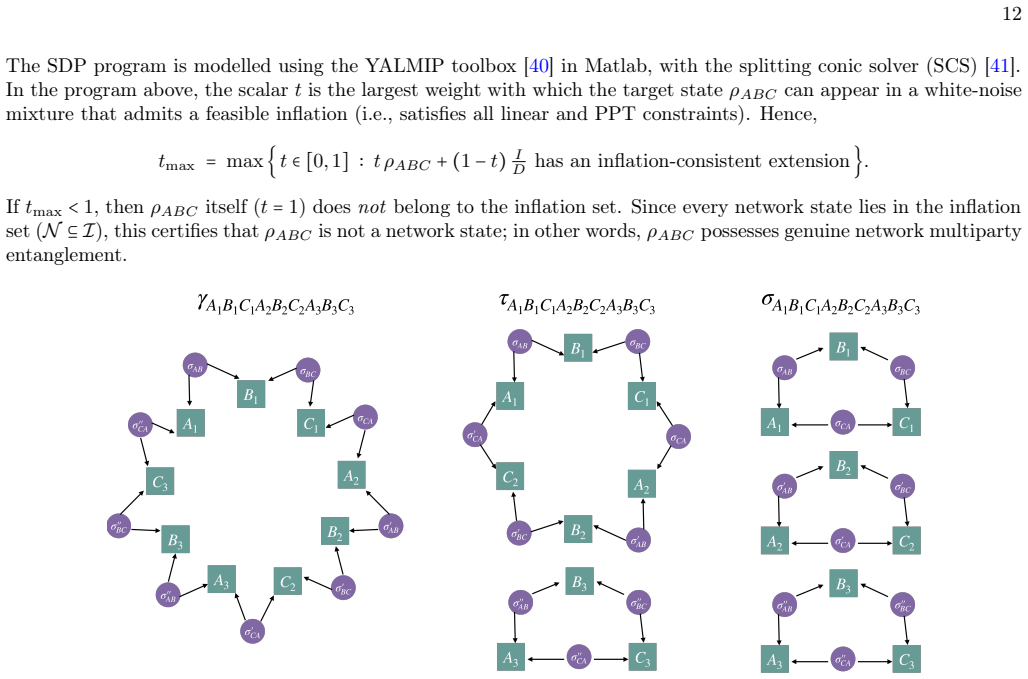
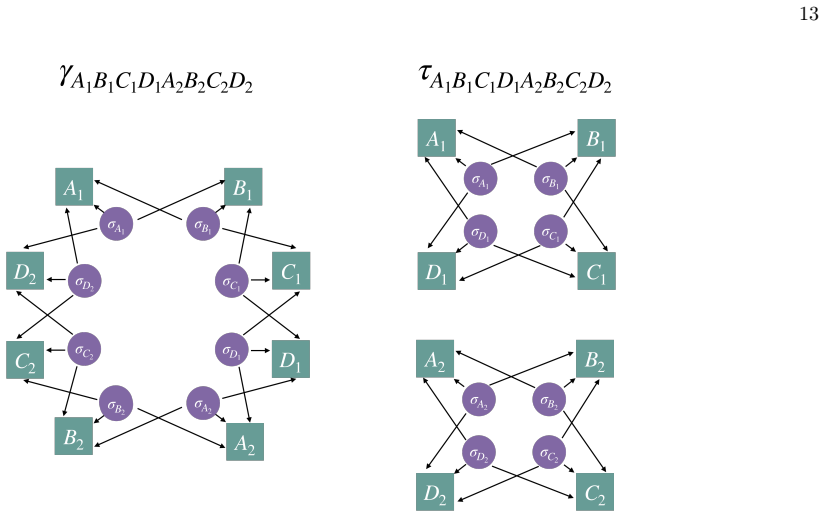
Genuine network multiparty entanglement (GNME), defined by whether a k-party state can be prepared using a quantum network of only (k-1)-partite resources.
If this is right
- GNME distinguishes collective entanglement that exceeds area-law scaling from interface contributions in local ground states.
- In the Ising model GNME reaches its maximum at the quantum critical point where correlations become longest ranged.
- Finite temperature destroys GNME more rapidly than standard GME, tightening the thermal requirements for maintaining collective resources.
- The absence of GNME in spin-liquid subregions shows that their entanglement remains reducible to lower-party networks even when conventional GME is present.
Where Pith is reading between the lines
- GNME may identify resource states for quantum communication protocols that require correlations irreducible to bipartite or lower-party building blocks.
- Applying the network test to driven or dissipative systems could uncover dynamical regimes in which collective entanglement is stabilized or amplified.
- The network-irreducible criterion may link to topological order or other nonlocal structures in higher-dimensional systems where standard area-law measures are insufficient.
Load-bearing premise
The quantum-network definition of GNME correctly isolates the irreducible collective contribution beyond the area-law interface terms without further assumptions on the form of the Hamiltonian.
What would settle it
Numerical computation or experiment on the transverse-field Ising chain showing that GNME stays flat or decreases monotonically through the critical field strength h equals J would falsify the reported peak.
Figures




read the original abstract
We show that the standard approach to characterize collective entanglement via genuine multiparty entanglement (GME) leads to an area law in ground and thermal Gibbs states of local Hamiltonians. To capture the truly collective part one needs to go beyond this short-range contribution tied to interfaces between subregions. Genuine network multiparty entanglement (GNME) achieves a systematic resolution of this goal by analyzing whether a $k$-party state can be prepared by a quantum network consisting of $(k-1)$-partite resources. We develop tools to certify and quantify GNME, and benchmark them for GHZ, W and Dicke states. We then study the 1d transverse field Ising model, where we find a sharp peak of GNME near the critical phase transition, and rapid suppression elsewhere. Finite temperature leads to a faster death of GNME compared to GME. Furthermore, certain 2d quantum spin liquids do not have GNME in microscopic subregions while possessing strong GME. This approach will allow to chart truly collective entanglement in quantum matter both in and out of equilibrium.
Editorial analysis
A structured set of objections, weighed in public.
Referee Report
Summary. The manuscript introduces genuine network multiparty entanglement (GNME) to isolate the truly collective contribution to multiparty entanglement in quantum many-body systems, beyond the area-law short-range part captured by standard genuine multiparty entanglement (GME) in ground and thermal states of local Hamiltonians. GNME is defined via whether a k-party state can be prepared by a quantum network of (k-1)-partite resources; the authors develop certification and quantification tools, benchmark them on GHZ, W and Dicke states, and apply them to the 1D transverse-field Ising model (sharp peak near criticality, rapid suppression elsewhere and at finite temperature) and certain 2D spin liquids (strong GME but no GNME in microscopic subregions).
Significance. If the central distinction holds, the work supplies a new, systematic tool for charting collective entanglement in quantum matter both in and out of equilibrium, with concrete benchmarks and model applications that could guide studies of criticality and exotic phases. The explicit comparison of GME area laws versus GNME peaks at the TFIM transition is a clear strength.
major comments (2)
- [Abstract] Abstract: the claim that GNME 'achieves a systematic resolution' by isolating the truly collective part assumes that (k-1)-partite network resources fully capture all interface and area-law entanglement even when reduced states exhibit power-law decay at criticality; the abstract supplies no explicit verification that the chosen network resources respect the Hamiltonian locality or that the certification tools remain valid under long-range correlations.
- [TFIM application] TFIM results: the reported sharp peak of GNME near the critical point is load-bearing for the central claim, yet the abstract (and available details) omit the numerical method, system sizes, finite-size scaling, or error analysis needed to confirm the peak is not an artifact of the chosen bipartition or approximation.
minor comments (1)
- [Abstract] Abstract: the phrase 'certain 2d quantum spin liquids' is vague; specifying the models (e.g., toric code or Kitaev honeycomb) and citing prior GME calculations would improve clarity.
Simulated Author's Rebuttal
We thank the referee for the constructive feedback and positive assessment of the significance of our work. We address each major comment below and indicate the corresponding revisions.
read point-by-point responses
-
Referee: [Abstract] Abstract: the claim that GNME 'achieves a systematic resolution' by isolating the truly collective part assumes that (k-1)-partite network resources fully capture all interface and area-law entanglement even when reduced states exhibit power-law decay at criticality; the abstract supplies no explicit verification that the chosen network resources respect the Hamiltonian locality or that the certification tools remain valid under long-range correlations.
Authors: The GNME definition is state-based and asks whether a k-party state can be generated by a network of arbitrary (k-1)-partite resources; these resources are not restricted to short-range or area-law states and may themselves carry power-law correlations. Consequently, any interface or area-law contribution that can be reproduced by (k-1)-party entanglement is already subtracted by construction. The certification witnesses follow directly from the network definition and hold for general states, independent of the underlying Hamiltonian. We will revise the abstract to state explicitly that the (k-1)-partite resources are general (including long-range) and that the tools remain valid under power-law correlations. revision: yes
-
Referee: [TFIM application] TFIM results: the reported sharp peak of GNME near the critical point is load-bearing for the central claim, yet the abstract (and available details) omit the numerical method, system sizes, finite-size scaling, or error analysis needed to confirm the peak is not an artifact of the chosen bipartition or approximation.
Authors: The abstract is intentionally concise. The full numerical details—methods, system sizes, finite-size scaling, error analysis, and bipartition choices—are provided in the main text. We will revise the abstract to include a brief summary of the numerical approach and the scaling analysis that confirms the robustness of the peak. revision: yes
Circularity Check
No significant circularity: GNME is introduced as an independent definitional primitive
full rationale
The paper defines GNME directly as the property that a k-party state cannot be prepared by any quantum network using only (k-1)-partite resources. This definition is not obtained by fitting parameters to data, nor does it reduce to a prior result by self-citation or ansatz. The subsequent claims (area law for ordinary GME, peak of GNME at the TFIM critical point, suppression at finite temperature, absence in certain 2D spin liquids) are presented as consequences of applying this definition to concrete states and Hamiltonians. No equation or step equates the output quantity to the input by construction, and no load-bearing uniqueness theorem is imported from the authors' prior work. The derivation chain is therefore self-contained against external benchmarks.
Axiom & Free-Parameter Ledger
Reference graph
Works this paper leans on
-
[1]
The table compares the geometric distance to the unitary network setDand the genuine multiparty negativityN. agonalization (ED). For 3 adjacent pairs of spins forming a3×2rectangle, we find a finite but reducedDin agree- ment with heuristic expectations from monogamy: the higher connectivity distributes entanglement (including the network-irreducible type...
- [2]
- [3]
-
[4]
M. Hofmann, A. Osterloh, and O. Gühne, Scaling of gen- uinemultiparticleentanglementclosetoaquantumphase transition, Phys. Rev. B89, 134101 (2014)
work page 2014
-
[5]
S. M. Giampaolo and B. C. Hiesmayr, Genuine multi- partite entanglement in theXYmodel, Phys. Rev. A 88, 052305 (2013)
work page 2013
-
[6]
S. M. Giampaolo and B. C. Hiesmayr, Genuine multipar- titeentanglementinthecluster-Isingmodel,NewJournal of Physics16, 093033 (2014)
work page 2014
-
[7]
G. Parez and W. Witczak-Krempa, The fate of entangle- ment, Preprint at https://doi. org/10.48550/arXiv2402 (2024)
-
[8]
T.-T. Wang, M. Song, L. Lyu, W. Witczak-Krempa, and Z. Y. Meng, Entanglement microscopy and tomography in many-body systems, Nature Communications16, 96 (2025)
work page 2025
-
[9]
L. Lyu, M. Song, T.-T. Wang, Z. Y. Meng, and W. Witczak-Krempa, Multiparty entanglement mi- croscopy of quantum Ising models in one, two, and three dimensions, Phys. Rev. B111, 245108 (2025)
work page 2025
- [10]
-
[11]
F. Garcia-Gaitan and B. K. Nikolic, Fate of entangle- ment in open quantum spin liquid: Time evolution of its genuine multipartite negativity upon sudden cou- plingtoadissipativebosonicenvironment,arXivpreprint arXiv:2510.02256 (2025)
work page internal anchor Pith review Pith/arXiv arXiv 2025
- [12]
-
[13]
B. Jungnitsch, T. Moroder, and O. Gühne, Taming Mul- tiparticle Entanglement, Physical Review Letters106, 190502 (2011)
work page 2011
-
[14]
M. Hofmann, T. Moroder, and O. Gühne, Analytical characterization of the genuine multiparticle negativity, Journal of Physics A: Mathematical and Theoretical47, 155301 (2014)
work page 2014
-
[15]
M. Navascués, E. Wolfe, D. Rosset, and A. Pozas- Kerstjens, Genuine network multipartite entanglement, Physical Review Letters125, 240505 (2020)
work page 2020
- [16]
-
[17]
Luo, New genuinely multipartite entanglement, Advanced Quantum Technologies4, 2000123 (2021)
M.-X. Luo, New genuinely multipartite entanglement, Advanced Quantum Technologies4, 2000123 (2021)
work page 2021
-
[18]
A. Kitaev, Anyons in an exactly solved model and be- yond, Annals of Physics321, 2 (2006), january Special Issue
work page 2006
- [19]
-
[20]
M.B.Plenio,Logarithmicnegativity: afullentanglement monotone that is not convex, Physical review letters95, 090503 (2005)
work page 2005
-
[21]
Peres, Separability Criterion for Density Matrices, Phys
A. Peres, Separability Criterion for Density Matrices, Phys. Rev. Lett.77, 1413 (1996)
work page 1996
-
[22]
G. Giudici, T. Mendes-Santos, P. Calabrese, and M. Dal- monte, Entanglement Hamiltonians of lattice models via the Bisognano-Wichmann theorem, Phys. Rev. B98, 134403 (2018)
work page 2018
-
[23]
M. Dalmonte, V. Eisler, M. Falconi, and B. Vermersch, Entanglement Hamiltonians: From Field Theory to Lat- tice Models and Experiments, Annalen der Physik534, 2200064 (2022)
work page 2022
- [24]
- [25]
-
[26]
K. Hansenne, Z.-P. Xu, T. Kraft, and O. Gühne, Sym- metries in quantum networks lead to no-go theorems for entanglement distribution and to verification techniques, Nature Communications13, 496 (2022)
work page 2022
-
[27]
Xu, Characterizing arbitrary quantum networks in the noisy intermediate-scale quantum era, Phys
Z.-P. Xu, Characterizing arbitrary quantum networks in the noisy intermediate-scale quantum era, Phys. Rev. A 108, L040201 (2023)
work page 2023
- [29]
-
[30]
E. G. Gilbert, An Iterative Procedure for Computing the Minimum of a Quadratic Form on a Convex Set, SIAM Journal on Control4, 61 (1966)
work page 1966
-
[31]
J. Shang and O. Gühne, Convex Optimization over Classes of Multiparticle Entanglement, Phys. Rev. Lett. 120, 050506 (2018)
work page 2018
-
[32]
Pfeuty, The one-dimensional Ising model with a trans- verse field, Annals of Physics57, 79 (1970)
P. Pfeuty, The one-dimensional Ising model with a trans- verse field, Annals of Physics57, 79 (1970)
work page 1970
-
[33]
M. Fagotti and F. H. L. Essler, Reduced density matrix after a quantum quench, Phys. Rev. B87, 245107 (2013)
work page 2013
- [34]
- [35]
-
[36]
Convex separation from convex optimization for large-scale problems
S. Brierley, M. Navascués, and T. Vértesi, Convex sepa- ration from convex optimization for large-scale problems, arXiv preprint arXiv:1609.05011 (2016)
work page internal anchor Pith review Pith/arXiv arXiv 2016
-
[37]
L. Gurvits and H. Barnum, Separable balls around the maximally mixed multipartite quantum states, Phys. Rev. A68, 042312 (2003)
work page 2003
- [38]
- [39]
-
[40]
A. C. Doherty, P. A. Parrilo, and F. M. Spedalieri, Dis- tinguishing Separable and Entangled States, Phys. Rev. 7 Lett.88, 187904 (2002)
work page 2002
-
[41]
Löfberg, inIn Proceedings of the CACSD Conference (Taipei, Taiwan, 2004)
J. Löfberg, inIn Proceedings of the CACSD Conference (Taipei, Taiwan, 2004)
work page 2004
-
[42]
B. O’Donoghue, E. Chu, N. Parikh, and S. Boyd, Conic Optimization via Operator Splitting and Homogeneous Self-Dual Embedding, Journal of Optimization Theory and Applications169, 1042 (2016)
work page 2016
-
[43]
L. Novo, T. Moroder, and O. Gühne, Genuine multipar- ticle entanglement of permutationally invariant states, Phys. Rev. A88, 012305 (2013), for permutationally in- variant three-qubit states, vanishing GMN is both neces- sary and sufficient for biseparability. [43]MOSEK Optimization Toolbox for MATLAB 10.2.17, MOSEK ApS (2024)
work page 2013
-
[44]
G. Vidal and R. F. Werner, Computable measure of en- tanglement, Phys. Rev. A65, 032314 (2002). 8 Supplemental Materials for Network-Irreducible Multiparty Entanglement in Quantum Matter A. Algorithms for Genuine Network Multiparty entanglement This section introduces algorithms used to quantify genuine network multiparty entanglement. We will discuss the...
work page 2002
-
[45]
Geometric Distance Here, we define the geometric distance to the set of network states and describe how it is estimated using the Gilbert algorithm. The geometric entanglement is defined as [34] Dnet =min σ∈net d(ρ, σ)(7) whered(ρ, σ)= √ Tr[(ρ−σ)2]is the Hilbert-Schmidt distance between two quantum states. A direct evaluation of this distance is difficult...
-
[46]
go to step 2 and repeat, until the distanceD(ρ, ρ1)converges. An additional improvement on the Gilbert algorithm can be made by recording the pure states generated in step 2 (Gilbert with Memory [35]). LetAdenote the aD2×(M+1)matrix whose columns are vectorized RDMs, at thekth iteration, A=[vec(ρ (k) 1 ),vec(∣ψk−M+1⟩⟨ψk−M+1∣), ... ,vec(∣ψk−1⟩⟨ψk−1∣),vec(∣...
-
[47]
The criterion introduced in Ref
Certifying Network States In this section, we outline the constructive algorithms used to certify whether a given mixed state lies inside the network set. The criterion introduced in Ref. [30], which we call theGilbert criterion, converts the geometric distance in the Gilbert algorithm into a threshold for white noise robustness. A geometric illustration ...
-
[48]
Certifying Genuine network multiparty entanglement To certify GNME, we employ the inflation technique [37, 38], which provides an outer approximation to the network set given by a semidefinite program (SDP). To certify that a state lies outside the set of network states, a general strategy is to work with a tractableinflation, i.e. a tractable outer appro...
-
[49]
Proof that theh=0andh→∞limits lie on the boundary of network states In the main text (see Fig. 4), we utilized the inflation technique to certify the presence of Genuine Network Multiparty Entanglement (GNME) for a subregion of 6 consecutive spins in the 1d Transverse Field Ising Model (TFIM). Specifically, we achieved certification within the windowh∈[0....
-
[50]
GNME for Three qubit states We first describe how we estimate GNME for three-qubit states. Given a three-qubit stateρ, we construct the extended stateρ ext =ρ⊗I/D, where the ancilla is a three-qubit maximally mixed state withD=8. We then apply the six-qubit Gilbert algorithm to find the closest network stateρ1,ext toρ ext. Since the set of network states ...
-
[51]
Comparison with Previous Best Bounds for GNME 16 GeometricDistanceD 0 0.1 0.2 0.3 0.4 0.5 0.6 GMNN 0 0.1 0.2 0.3 0.4 0.5 GHZ3 GNMEGMN Noisep0 0.1 0.2 0.3 0.4 0.5 0.6 GeometricDistanceD 0 0.1 0.2 0.3 0.4 0.5 GMNN 0 0.1 0.2 0.3 0.4 W3 GNMEGMN 0.4 0.45 0.5 0.55 0.60 0.05 0.1 0.15 pc=0:57 0.45 0.46 0.47 0.48 0.490 0.01 0.02 0.03 0.04 pc=0:481 FIG. 11.GNME and...
-
[52]
We consider the transformed quantity D−Dc h−hc , which approaches the derivativedD/dhash→h c
Scaling of the geometric distance with field nearhc =1 In this subsection, we analyze how the geometric distanceDvaries with the transverse field near the quantum critical pointh c =1. We consider the transformed quantity D−Dc h−hc , which approaches the derivativedD/dhash→h c. Plotting this ratio againstlog∣h−hc∣isolates the critical behaviour and separa...
-
[53]
Semidefinite program for Genuine multiparty negativity Here, we present the semidefinite-program formulation of the genuine multiparty negativity (GMN), which we use as a GME measure, used to compare with GNME measures. To quantify Genuine multiparty entanglement (GME), 18 0.2 0.3 0.4 0.6 0.8 1 1.2 1.5 2 3 4 h 0.005 0.01 0.05 0.1 0.2 NgorNmin h2 h!1 GMNNm...
-
[54]
Recall that by definition, GMN is always upper-bounded byNmin
Genuine multiparty Entanglement and Minimal bipartite negativity in the quantum Ising model In this subsection, we compare the genuine multiparty negativity (GMN) with the minimal bipartite negativity Nmin in the 1d quantum Ising model. Recall that by definition, GMN is always upper-bounded byNmin. For six consecutive spins divided into three parties,Nmin...
-
[55]
it isfaithful(E≥0, zero if and only if the state is separable),
-
[56]
it is invariant under local unitary (LU) transformations, and
-
[57]
it is non-increasing on average under local operations and classical communication (LOCC). We define the minimal bipartite entanglement of a stateρas Emin(ρ)=min m Em(ρ),(28) wheremruns over all possible bipartitions of the system. Since eachE m satisfies the properties above,E min is also faithful on biseparable states, LU-invariant, and LOCC monotonic. ...
discussion (0)
Sign in with ORCID, Apple, or X to comment. Anyone can read and Pith papers without signing in.