Determination of B-meson distribution amplitudes from Bto π,K,D transition form factors
Pith reviewed 2026-05-21 18:02 UTC · model grok-4.3
The pith
A global fit of B to pi, K, D form factors determines the B-meson inverse moment lambda_B to be 217 MeV.
A machine-rendered reading of the paper's core claim, the machinery that carries it, and where it could break.
Core claim
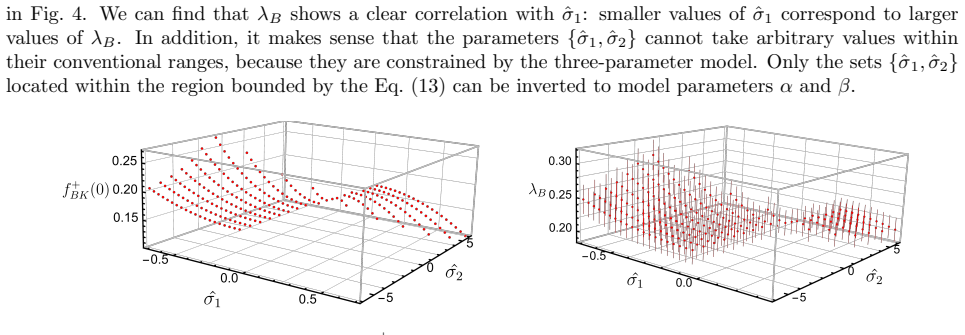
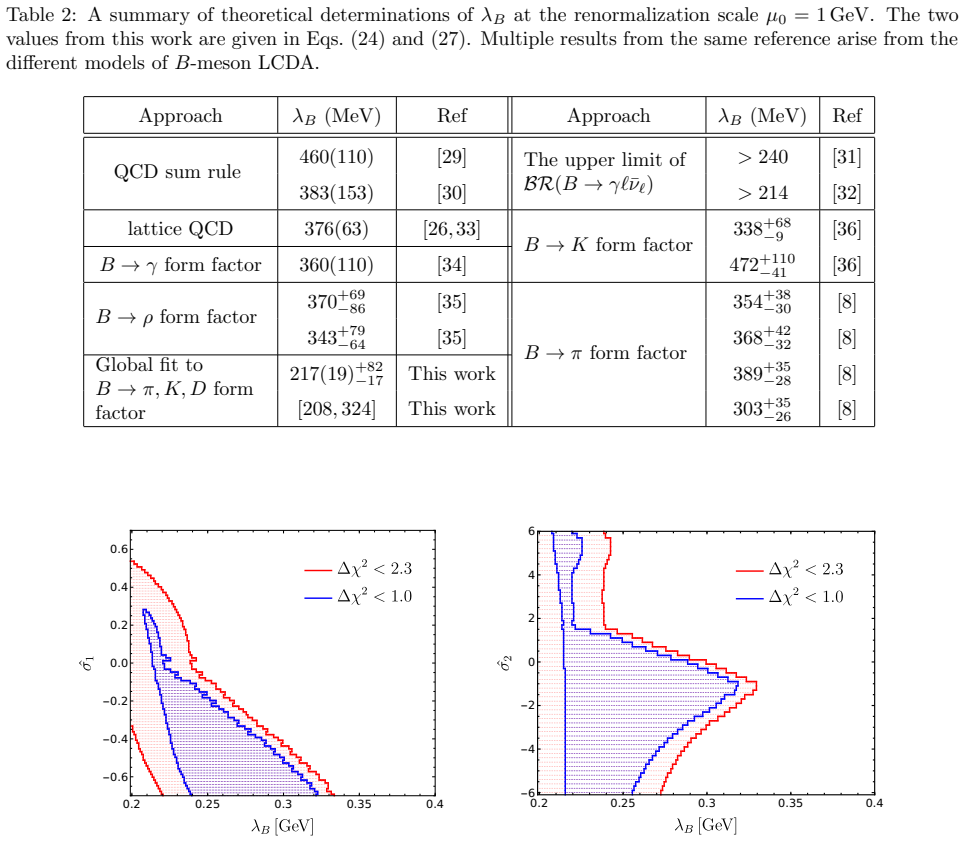
By compiling lattice QCD form factors at large q^2, expressing the light-cone sum rule form factors at q^2=0 through a three-parameter ansatz for the B-meson light-cone distribution amplitudes, and including experimental B to pi l nu data, a global fit yields lambda_B = 217(19)_{-17}^{+82} MeV together with |V_ub| = 3.68(13)_{-1}^{+0} x 10^{-3}. The second error band arises from the constraint lambda_B > 200 MeV and the variation of the inverse logarithmic moments sigma1 in [-0.7, 0.7] and sigma2 in [-6, 6]. Simultaneous fitting of lambda_B and sigma1 produces allowed intervals lambda_B in [208, 324] MeV and sigma1 in [-0.7, 0.27].
What carries the argument
The three-parameter ansatz for the B-meson light-cone distribution amplitudes, which converts light-cone sum rule expressions for the B to pi, K, D form factors at q^2 = 0 into explicit functions of the inverse moment lambda_B of the leading-twist distribution amplitude.
If this is right
- The extracted lambda_B supplies a calibrated input for predicting rates and distributions in other exclusive B decays that depend on the same distribution amplitudes.
- The |V_ub| value obtained here can be compared directly with results from inclusive semileptonic B decays to test consistency of the two methods.
- The allowed ranges for sigma1 and sigma2 quantify the residual model uncertainty that remains after the global fit.
- When lambda_B and sigma1 are fitted together, the resulting intervals lambda_B = [208, 324] MeV and sigma1 = [-0.7, 0.27] define the region still compatible with all included data.
Where Pith is reading between the lines
- High-precision lattice calculations that reach down to small q^2 could test the light-cone sum rule expressions without any reference to the three-parameter ansatz.
- The same matching procedure could be applied to B to vector-meson transitions to obtain additional constraints on the distribution amplitudes.
- Any persistent tension between this |V_ub| and other determinations might indicate either underestimated uncertainties in the distribution amplitudes or contributions beyond the Standard Model.
- Relaxing the lower bound lambda_B > 200 MeV with a better theoretical understanding of the distribution amplitude at large momentum fractions would widen the final uncertainty bands.
Load-bearing premise
The three-parameter ansatz for the B-meson light-cone distribution amplitudes together with the chosen ranges for the inverse logarithmic moments sigma1 and sigma2 is sufficient to capture the dominant model dependence when relating light-cone sum rule form factors at q^2=0 to the inverse moment lambda_B.
What would settle it
A lattice QCD evaluation of any of the B to pi, K or D form factors at q^2 = 0 lying well outside the interval predicted by the light-cone sum rules with lambda_B near 217 MeV and the quoted uncertainties would falsify the extracted value.
Figures


read the original abstract
Recent work on $B \to \pi$, $K$ and $B\to D$ form factors from lattice QCD and light-cone sum rules has made it possible to constrain the inverse moment $\lambda_B$ of the $B$-meson light-cone distribution amplitudes by performing a global fit of $B\to \pi,K,D$ form factors. We have compiled the $B\to \pi,K,D$ form factors calculated by the HPQCD, MILC, and RBC/UKQCD collaborations in the large $q^2$ region. By employing an three-parameter ansatz of the $B$-meson light-cone distribution amplitudes, we express the $B\to \pi,K,D$ form factors at $q^2=0$ that are calculated from light-cone sum rules, in terms of the inverse moment $\lambda_B$ of the leading-twist $B$-meson light-cone distribution amplitude. In the $B \to \pi \ell \nu$ channel, we also include the available $q^2$-binned experimental data from the BaBar, Belle, and Belle~II collaborations. Using the Bourrely-Caprini-Lellouch parametrization, we perform a global fit and obtain $\lambda_B=217(19)_{-17}^{+82}$~MeV and $|V_{\text{ub}}|=3.68(13)_{-1}^{+0}\times10^{-3}$. The second uncertainty is obtained by constraining $\lambda_B>200$ MeV and varying the inverse logarithmic moments $\hat{\sigma}_1\in[-0.7,0.7]$ and $\hat{\sigma}_2\in[-6,6]$, which represents the model-dependent uncertainty from the $B$-meson light-cone distribution amplitudes. When taking into account $\lambda_B$ and $\hat{\sigma}_1$ as fitting parameters simultaneously, the intervals of our preditions are $\lambda_B=[208, 324]$~MeV and $\hat{\sigma}_1=[-0.7, 0.27]$.
Editorial analysis
A structured set of objections, weighed in public.
Referee Report
Summary. The manuscript compiles lattice QCD results for B→π, K, D form factors at large q² from HPQCD, MILC and RBC/UKQCD, matches them to light-cone sum rule expressions at q²=0 via a three-parameter ansatz for the B-meson LCDAs, and performs a global fit that also incorporates binned experimental data for B→πℓν. The fit yields λ_B = 217(19) MeV with an additional asymmetric model uncertainty obtained by imposing λ_B > 200 MeV and scanning σ̂1 ∈ [-0.7, 0.7], σ̂2 ∈ [-6, 6]; the same procedure gives |V_ub| = 3.68(13)×10^{-3}. A simultaneous fit floating λ_B and σ̂1 produces the intervals λ_B ∈ [208, 324] MeV and σ̂1 ∈ [-0.7, 0.27].
Significance. If the central numerical results hold, the work supplies a competitive, multi-channel determination of the B-meson inverse moment λ_B together with an updated |V_ub| that incorporates both lattice and experimental information. The global-fit strategy that links large-q² lattice points to q²=0 LCSR expressions through a controlled LCDA parametrization is a useful addition to the existing literature on B-meson distribution amplitudes.
major comments (2)
- [Abstract] Abstract and global-fit section: the second (asymmetric) uncertainty on λ_B and |V_ub| is obtained by varying σ̂1 and σ̂2 inside the stated intervals while constraining λ_B > 200 MeV. The manuscript must demonstrate that these particular intervals, together with the three-parameter ansatz, encompass the dominant LCDA shape uncertainty; the simultaneous-fit result that σ̂1 reaches only 0.27 and that σ̂2 is not floated suggests the quoted model error may be incomplete.
- [Abstract] Abstract: the central claim that the form factors at q²=0 can be expressed in terms of λ_B rests on the explicit three-parameter LCDA ansatz and the matching between large-q² lattice data and the LCSR expressions. Without the explicit functional form of the ansatz and the precise matching relations, the numerical extraction cannot be fully verified.
minor comments (1)
- Ensure consistent use of the hat notation on σ̂1 and σ̂2 throughout the text and tables.
Simulated Author's Rebuttal
We thank the referee for the careful reading of our manuscript and the constructive comments. We address each major point below, providing clarifications and indicating where revisions will be made to improve the presentation and justification of our results.
read point-by-point responses
-
Referee: [Abstract] Abstract and global-fit section: the second (asymmetric) uncertainty on λ_B and |V_ub| is obtained by varying σ̂1 and σ̂2 inside the stated intervals while constraining λ_B > 200 MeV. The manuscript must demonstrate that these particular intervals, together with the three-parameter ansatz, encompass the dominant LCDA shape uncertainty; the simultaneous-fit result that σ̂1 reaches only 0.27 and that σ̂2 is not floated suggests the quoted model error may be incomplete.
Authors: The ranges σ̂1 ∈ [-0.7, 0.7] and σ̂2 ∈ [-6, 6] are selected from the range of values explored in prior LCDA model studies that respect positivity, normalization, and other theoretical constraints (as referenced in the manuscript). The λ_B > 200 MeV cut excludes unphysical regimes inconsistent with known bounds. The simultaneous fit is data-constrained and therefore yields a narrower interval for σ̂1; it does not explore the full model space. The quoted asymmetric uncertainty is instead a conservative envelope over the allowed model variations. We will add a new paragraph in the global-fit section that explicitly justifies these intervals, compares them to the simultaneous-fit results, and discusses why σ̂2 has limited impact in the present channels. This will demonstrate that the model error encompasses the dominant LCDA shape uncertainty. revision: yes
-
Referee: [Abstract] Abstract: the central claim that the form factors at q²=0 can be expressed in terms of λ_B rests on the explicit three-parameter LCDA ansatz and the matching between large-q² lattice data and the LCSR expressions. Without the explicit functional form of the ansatz and the precise matching relations, the numerical extraction cannot be fully verified.
Authors: The three-parameter ansatz is defined explicitly in Section 2 of the manuscript (Eqs. (2)–(4)), where the leading-twist LCDA is parametrized in terms of λ_B, σ̂1 and σ̂2. The matching relations that express the q²=0 form factors from LCSR in terms of these parameters, using the lattice results at large q², are derived in Section 3. To make the abstract self-contained, we will revise it to include a short parenthetical reference to the ansatz and the matching procedure, and we will add a footnote directing readers to the relevant equations. This will allow independent verification without lengthening the abstract beyond its limit. revision: yes
Circularity Check
No significant circularity: λ_B extracted via global fit to independent lattice and experimental data
full rationale
The paper adopts a three-parameter ansatz for the B-meson LCDAs as an explicit input assumption, then uses it to express LCSR form factors at q²=0 as functions of λ_B. These LCSR expressions are combined with lattice QCD form factors (large q², from HPQCD/MILC/RBC-UKQCD) and experimental binned data via the BCL parametrization in a global fit that determines the central value of λ_B=217(19) MeV and |V_ub|. The quoted second uncertainty arises from varying the ansatz parameters σ̂1 and σ̂2 inside stated intervals plus the λ_B>200 MeV cut; this is model-dependence quantification, not a reduction of the output to the input by construction. No self-definitional loop, fitted-input-called-prediction, or load-bearing self-citation chain is present in the described chain. The result remains falsifiable against external lattice and branching-fraction data outside the fitted ansatz ranges.
Axiom & Free-Parameter Ledger
free parameters (3)
- lambda_B =
217(19) MeV
- sigma1 =
[-0.7, 0.27]
- sigma2 =
[-6, 6]
axioms (2)
- domain assumption A three-parameter ansatz is adequate to represent the leading-twist B-meson light-cone distribution amplitude for the purpose of relating LCSR form factors at q^2=0 to lambda_B.
- domain assumption Lattice QCD form factors computed at large q^2 can be reliably combined with LCSR results at q^2=0 through a common parametrization of q^2 dependence.
Forward citations
Cited by 2 Pith papers
-
Continuum-Limit HQET LCDAs from Lattice QCD for Tightening B Decay Uncertainties
Lattice QCD yields continuum-limit HQET LCDA parameters λ_B = 0.340(20) GeV and σ_B^(1) = 1.685(63) at 1 GeV, reducing total uncertainty by a factor of three.
-
Determination of heavy meson light-cone distribution amplitudes: theoretical framework and lattice simulations
Continuum-extrapolated lattice QCD yields heavy-meson LCDAs with D-meson peak at y≈0.2-0.3 and HQET inverse moment λ_B=0.340(20) GeV at 1 GeV, consistent with other determinations.
Reference graph
Works this paper leans on
-
[1]
G. P. Lepage and S. J. Brodsky, Phys. Lett. B87(1979), 359-365 doi:10.1016/0370-2693(79)90554-9
-
[2]
A. V. Efremov and A. V. Radyushkin, Phys. Lett. B94(1980), 245-250 doi:10.1016/0370-2693(80)90869-2
-
[3]
A. G. Grozin and M. Neubert, Phys. Rev. D55(1997), 272-290 doi:10.1103/PhysRevD.55.272 [arXiv:hep- ph/9607366 [hep-ph]]
-
[4]
QCD Factorization for $B\to\pi\pi$ Decays: Strong Phases and CP Violation in the Heavy Quark Limit
M. Beneke, G. Buchalla, M. Neubert and C. T. Sachrajda, Phys. Rev. Lett.83(1999), 1914-1917 doi:10.1103/PhysRevLett.83.1914 [arXiv:hep-ph/9905312 [hep-ph]]
work page internal anchor Pith review Pith/arXiv arXiv doi:10.1103/physrevlett.83.1914 1999
-
[5]
Y. Y. Keum, T. Kurimoto, H. N. Li, C. D. Lu and A. I. Sanda, Phys. Rev. D69(2004), 094018 doi:10.1103/PhysRevD.69.094018 [arXiv:hep-ph/0305335 [hep-ph]]
work page internal anchor Pith review Pith/arXiv arXiv doi:10.1103/physrevd.69.094018 2004
-
[6]
$B$-Meson Distribution Amplitude from the $B\to \pi$ Form Factor
A. Khodjamirian, T. Mannel and N. Offen, Phys. Lett. B620(2005), 52-60 doi:10.1016/j.physletb.2005.06.021 [arXiv:hep-ph/0504091 [hep-ph]]
work page internal anchor Pith review Pith/arXiv arXiv doi:10.1016/j.physletb.2005.06.021 2005
-
[7]
V. M. Braun and A. Khodjamirian, Phys. Lett. B718(2013), 1014-1019 doi:10.1016/j.physletb.2012.11.047 [arXiv:1210.4453 [hep-ph]]
work page internal anchor Pith review Pith/arXiv arXiv doi:10.1016/j.physletb.2012.11.047 2013
-
[8]
Y. M. Wang and Y. L. Shen, Nucl. Phys. B898(2015), 563-604 doi:10.1016/j.nuclphysb.2015.07.016 [arXiv:1506.00667 [hep-ph]]
work page internal anchor Pith review Pith/arXiv arXiv doi:10.1016/j.nuclphysb.2015.07.016 2015
-
[9]
M. Beneke, C. Bobeth and Y. M. Wang, JHEP12(2020), 148 doi:10.1007/JHEP12(2020)148 [arXiv:2008.12494 [hep-ph]]
-
[10]
B. Y. Cui, Y. K. Huang, Y. M. Wang and X. C. Zhao, Phys. Rev. D108(2023) no.7, L071504 doi:10.1103/PhysRevD.108.L071504 [arXiv:2301.12391 [hep-ph]]
-
[11]
Y. L. Shen, Y. M. Wang and Y. B. Wei, JHEP12(2020), 169 doi:10.1007/JHEP12(2020)169 [arXiv:2009.02723 [hep-ph]]
-
[12]
J. Gao, U. G. Meißner, Y. L. Shen and D. H. Li, Phys. Rev. D112(2025) no.1, 1 doi:10.1103/yvjd-2ymn [arXiv:2412.13084 [hep-ph]]
-
[13]
Y. K. Huang, Y. L. Shen, C. Wang and Y. M. Wang, Phys. Rev. Lett.134(2025) no.9, 091901 doi:10.1103/PhysRevLett.134.091901 [arXiv:2403.11258 [hep-ph]]
-
[14]
B. O. Lange and M. Neubert, Phys. Rev. Lett.91(2003), 102001 doi:10.1103/PhysRevLett.91.102001 [arXiv:hep-ph/0303082 [hep-ph]]
work page internal anchor Pith review Pith/arXiv arXiv doi:10.1103/physrevlett.91.102001 2003
-
[15]
G. Bell, T. Feldmann, Y. M. Wang and M. W. Y. Yip, JHEP11(2013), 191 doi:10.1007/JHEP11(2013)191 [arXiv:1308.6114 [hep-ph]]
work page internal anchor Pith review Pith/arXiv arXiv doi:10.1007/jhep11(2013)191 2013
-
[16]
V. M. Braun and A. N. Manashov, Phys. Lett. B731(2014), 316-319 doi:10.1016/j.physletb.2014.02.051 [arXiv:1402.5822 [hep-ph]]
work page internal anchor Pith review Pith/arXiv arXiv doi:10.1016/j.physletb.2014.02.051 2014
-
[17]
A. M. Galda and M. Neubert, Phys. Rev. D102(2020), 071501 doi:10.1103/PhysRevD.102.071501 [arXiv:2006.05428 [hep-ph]]. 12
-
[18]
Y. K. Huang, Y. Ji, Y. L. Shen, C. Wang, Y. M. Wang and X. C. Zhao, Phys. Rev. Lett.133(2024) no.17, 171901 doi:10.1103/PhysRevLett.133.171901 [arXiv:2312.15439 [hep-ph]]
-
[19]
T. Feldmann, P. L¨ ughausen and D. van Dyk, JHEP10(2022), 162 doi:10.1007/JHEP10(2022)162 [arXiv:2203.15679 [hep-ph]]
-
[20]
S. J. Lee and M. Neubert, Phys. Rev. D72(2005), 094028 doi:10.1103/PhysRevD.72.094028 [arXiv:hep- ph/0509350 [hep-ph]]
-
[21]
T. Feldmann, B. O. Lange and Y. M. Wang, Phys. Rev. D89(2014) no.11, 114001 doi:10.1103/PhysRevD.89.114001 [arXiv:1404.1343 [hep-ph]]
work page internal anchor Pith review Pith/arXiv arXiv doi:10.1103/physrevd.89.114001 2014
-
[22]
M. Beneke, G. Finauri, K. K. Vos and Y. Wei, JHEP09(2023), 066 doi:10.1007/JHEP09(2023)066 [arXiv:2305.06401 [hep-ph]]
-
[23]
W. Wang, J. H. Zhang, S. Zhao and R. Zhu, Phys. Rev. D100(2019) no.7, 074509 doi:10.1103/PhysRevD.100.074509 [arXiv:1904.00978 [hep-ph]]
-
[24]
W. Wang, Y. M. Wang, J. Xu and S. Zhao, Phys. Rev. D102(2020) no.1, 011502 doi:10.1103/PhysRevD.102.011502 [arXiv:1908.09933 [hep-ph]]
- [25]
-
[26]
X. Y. Hanet al.[Lattice Parton], Phys. Rev. D111(2025) no.3, 034503 doi:10.1103/PhysRevD.111.034503 [arXiv:2410.18654 [hep-lat]]
-
[27]
V. M. Braun, Y. Ji and A. N. Manashov, JHEP05(2017), 022 doi:10.1007/JHEP05(2017)022 [arXiv:1703.02446 [hep-ph]]
work page internal anchor Pith review Pith/arXiv arXiv doi:10.1007/jhep05(2017)022 2017
-
[28]
Radiative leptonic decay $B\to \gamma \ell \nu_\ell$ with subleading power corrections
M. Beneke, V. M. Braun, Y. Ji and Y. B. Wei, JHEP07(2018), 154 doi:10.1007/JHEP07(2018)154 [arXiv:1804.04962 [hep-ph]]
work page internal anchor Pith review Pith/arXiv arXiv doi:10.1007/jhep07(2018)154 2018
-
[29]
V. M. Braun, D. Y. Ivanov and G. P. Korchemsky, Phys. Rev. D69(2004), 034014 doi:10.1103/PhysRevD.69.034014 [arXiv:hep-ph/0309330 [hep-ph]]
work page internal anchor Pith review Pith/arXiv arXiv doi:10.1103/physrevd.69.034014 2004
-
[30]
A. Khodjamirian, R. Mandal and T. Mannel, JHEP10(2020), 043 doi:10.1007/JHEP10(2020)043 [arXiv:2008.03935 [hep-ph]]
-
[31]
Search for the rare decay of $B^+ \to \ell^{\,+} \nu_{\ell} \gamma$ with improved hadronic tagging
M. Gelbet al.[Belle], Phys. Rev. D98(2018) no.11, 112016 doi:10.1103/PhysRevD.98.112016 [arXiv:1810.12976 [hep-ex]]
work page internal anchor Pith review Pith/arXiv arXiv doi:10.1103/physrevd.98.112016 2018
-
[32]
Y. M. Wang, JHEP09(2016), 159 doi:10.1007/JHEP09(2016)159 [arXiv:1606.03080 [hep-ph]]
work page internal anchor Pith review Pith/arXiv arXiv doi:10.1007/jhep09(2016)159 2016
-
[33]
X. Y. Han, J. Hua, X. Ji, C. D. L¨ u, W. Wang, J. Xu, Q. A. Zhang and S. Zhao, Phys. Rev. D111(2025) no.11, L111503 doi:10.1103/2t8s-w8t6 [arXiv:2403.17492 [hep-ph]]
-
[34]
T. Janowski, B. Pullin and R. Zwicky, JHEP12(2021), 008 doi:10.1007/JHEP12(2021)008 [arXiv:2106.13616 [hep-ph]]
-
[35]
J. Gao, C. D. L¨ u, Y. L. Shen, Y. M. Wang and Y. B. Wei, Phys. Rev. D101(2020) no.7, 074035 doi:10.1103/PhysRevD.101.074035 [arXiv:1907.11092 [hep-ph]]
-
[36]
R. Mandal, S. Nandi and I. Ray, Phys. Lett. B848(2024), 138345 doi:10.1016/j.physletb.2023.138345 [arXiv:2308.07033 [hep-ph]]
-
[37]
Model-independent description of $B\to \pi l\nu$ decays and a determination of $|V_{ub}|$
C. Bourrely, I. Caprini and L. Lellouch, Phys. Rev. D79(2009), 013008 [erratum: Phys. Rev. D82 (2010), 099902] doi:10.1103/PhysRevD.82.099902 [arXiv:0807.2722 [hep-ph]]
work page internal anchor Pith review Pith/arXiv arXiv doi:10.1103/physrevd.82.099902 2009
-
[38]
J. Chai, S. Cheng and J. Hua, Eur. Phys. J. C83(2023) no.7, 556 doi:10.1140/epjc/s10052-023-11725-2 [arXiv:2209.13312 [hep-ph]]. 13
-
[39]
J. Hua, H. n. Li, C. D. Lu, W. Wang and Z. P. Xing, Phys. Rev. D104(2021) no.1, 016025 doi:10.1103/PhysRevD.104.016025 [arXiv:2012.15074 [hep-ph]]
-
[40]
S. Cheng, A. Khodjamirian and A. V. Rusov, Phys. Rev. D102(2020) no.7, 074022 doi:10.1103/PhysRevD.102.074022 [arXiv:2007.05550 [hep-ph]]
-
[41]
S. Gonz` alez-Sol´ ıs, P. Masjuan and C. Rojas, Phys. Rev. D104(2021) no.11, 114041 doi:10.1103/PhysRevD.104.114041 [arXiv:2110.06153 [hep-ph]]
-
[42]
J. M. Flynn, T. Izubuchi, T. Kawanai, C. Lehner, A. Soni, R. S. Van de Water and O. Witzel, Phys. Rev. D91(2015) no.7, 074510 doi:10.1103/PhysRevD.91.074510 [arXiv:1501.05373 [hep-lat]]
work page internal anchor Pith review Pith/arXiv arXiv doi:10.1103/physrevd.91.074510 2015
-
[43]
J. A. Baileyet al.[Fermilab Lattice and MILC], Phys. Rev. D92(2015) no.1, 014024 doi:10.1103/PhysRevD.92.014024 [arXiv:1503.07839 [hep-lat]]
work page internal anchor Pith review Pith/arXiv arXiv doi:10.1103/physrevd.92.014024 2015
-
[44]
J. A. Bailey, A. Bazavov, C. Bernard, C. M. Bouchard, C. DeTar, D. Du, A. X. El-Khadra, J. Foley, E. D. Freeland and E. G´ amiz,et al.Phys. Rev. D93(2016) no.2, 025026 doi:10.1103/PhysRevD.93.025026 [arXiv:1509.06235 [hep-lat]]
work page internal anchor Pith review Pith/arXiv arXiv doi:10.1103/physrevd.93.025026 2016
-
[45]
J. A. Baileyet al.[Fermilab Lattice and MILC], Phys. Rev. D92(2015) no.3, 034506 doi:10.1103/PhysRevD.92.034506 [arXiv:1503.07237 [hep-lat]]
work page internal anchor Pith review Pith/arXiv arXiv doi:10.1103/physrevd.92.034506 2015
-
[46]
W. G. Parrottet al.[(HPQCD collaboration)§and HPQCD], Phys. Rev. D107(2023) no.1, 014510 doi:10.1103/PhysRevD.107.014510 [arXiv:2207.12468 [hep-lat]]
-
[47]
$B \rightarrow D l \nu$ Form Factors at Non-Zero Recoil and Extraction of $|V_{cb}|$
H. Naet al.[HPQCD], Phys. Rev. D92(2015) no.5, 054510 [erratum: Phys. Rev. D93(2016) no.11, 119906] doi:10.1103/PhysRevD.93.119906 [arXiv:1505.03925 [hep-lat]]
work page internal anchor Pith review Pith/arXiv arXiv doi:10.1103/physrevd.93.119906 2015
-
[48]
Study of B --> pi l nu and B --> rho l nu Decays and Determination of |V_ub|
P. del Amo Sanchezet al.[BaBar], Phys. Rev. D83(2011), 032007 doi:10.1103/PhysRevD.83.032007 [arXiv:1005.3288 [hep-ex]]
work page internal anchor Pith review Pith/arXiv arXiv doi:10.1103/physrevd.83.032007 2011
-
[49]
J. P. Leeset al.[BaBar], Phys. Rev. D86(2012), 092004 doi:10.1103/PhysRevD.86.092004 [arXiv:1208.1253 [hep-ex]]
work page internal anchor Pith review Pith/arXiv arXiv doi:10.1103/physrevd.86.092004 2012
-
[50]
Measurement of the decay $B^0\to\pi^-\ell^+\nu$ and determination of $|V_{ub}|$
H. Haet al.[Belle], Phys. Rev. D83(2011), 071101 doi:10.1103/PhysRevD.83.071101 [arXiv:1012.0090 [hep-ex]]
work page internal anchor Pith review Pith/arXiv arXiv doi:10.1103/physrevd.83.071101 2011
-
[51]
A. Sibidanovet al.[Belle], Phys. Rev. D88(2013) no.3, 032005 doi:10.1103/PhysRevD.88.032005 [arXiv:1306.2781 [hep-ex]]
work page internal anchor Pith review Pith/arXiv arXiv doi:10.1103/physrevd.88.032005 2013
-
[52]
Adamczyket al.[Belle-II], [arXiv:2210.04224 [hep-ex]]
K. Adamczyket al.[Belle-II], [arXiv:2210.04224 [hep-ex]]
-
[53]
B. Y. Cui, Y. K. Huang, Y. L. Shen, C. Wang and Y. M. Wang, JHEP03(2023), 140 doi:10.1007/JHEP03(2023)140 [arXiv:2212.11624 [hep-ph]]
-
[54]
J. Gao, T. Huber, Y. Ji, C. Wang, Y. M. Wang and Y. B. Wei, JHEP05(2022), 024 doi:10.1007/JHEP05(2022)024 [arXiv:2112.12674 [hep-ph]]
-
[56]
I. I. Balitsky, V. M. Braun and A. V. Kolesnichenko, Sov. J. Nucl. Phys.44(1986), 1028
work page 1986
-
[57]
V. L. Chernyak and I. R. Zhitnitsky, Nucl. Phys. B345(1990), 137-172 doi:10.1016/0550-3213(90)90612-H
-
[58]
V. M. Belyaev, A. Khodjamirian and R. Ruckl, Z. Phys. C60(1993), 349-356 doi:10.1007/BF01474633 [arXiv:hep-ph/9305348 [hep-ph]]
-
[59]
P. Ball and V. M. Braun, Phys. Rev. D55(1997), 5561-5576 doi:10.1103/PhysRevD.55.5561 [arXiv:hep- ph/9701238 [hep-ph]]. 14
-
[60]
Form Factors from Light-Cone Sum Rules with B-Meson Distribution Amplitudes
A. Khodjamirian, T. Mannel and N. Offen, Phys. Rev. D75(2007), 054013 doi:10.1103/PhysRevD.75.054013 [arXiv:hep-ph/0611193 [hep-ph]]
work page internal anchor Pith review Pith/arXiv arXiv doi:10.1103/physrevd.75.054013 2007
-
[61]
A. Khodjamirian, B. Meli´ c and Y. M. Wang, Eur. Phys. J. ST233(2024) no.2, 271-298 doi:10.1140/epjs/s11734-023-01046-6 [arXiv:2311.08700 [hep-ph]]
-
[62]
Y. M. Wang, Y. B. Wei, Y. L. Shen and C. D. L¨ u, JHEP06(2017), 062 doi:10.1007/JHEP06(2017)062 [arXiv:1701.06810 [hep-ph]]
work page internal anchor Pith review Pith/arXiv arXiv doi:10.1007/jhep06(2017)062 2017
-
[63]
N. Gubernari, A. Kokulu and D. van Dyk, JHEP01(2019), 150 doi:10.1007/JHEP01(2019)150 [arXiv:1811.00983 [hep-ph]]
-
[64]
Y. M. Wang and Y. L. Shen, JHEP05(2018), 184 doi:10.1007/JHEP05(2018)184 [arXiv:1803.06667 [hep-ph]]
work page internal anchor Pith review Pith/arXiv arXiv doi:10.1007/jhep05(2018)184 2018
-
[65]
Y. Aokiet al.[Flavour Lattice Averaging Group (FLAG)], [arXiv:2411.04268 [hep-lat]]
work page internal anchor Pith review Pith/arXiv arXiv
-
[66]
Navaset al.[Particle Data Group], Phys
S. Navaset al.[Particle Data Group], Phys. Rev. D110(2024) no.3, 030001 doi:10.1103/PhysRevD.110.030001
-
[67]
R. J. Dowdall, C. T. H. Davies, T. C. Hammant and R. R. Horgan, Phys. Rev. D86(2012), 094510 doi:10.1103/PhysRevD.86.094510 [arXiv:1207.5149 [hep-lat]]
work page internal anchor Pith review Pith/arXiv arXiv doi:10.1103/physrevd.86.094510 2012
-
[68]
Precise predictions of charmed-bottom hadrons from lattice QCD
N. Mathur, M. Padmanath and S. Mondal, Phys. Rev. Lett.121(2018) no.20, 202002 doi:10.1103/PhysRevLett.121.202002 [arXiv:1806.04151 [hep-lat]]
work page internal anchor Pith review Pith/arXiv arXiv doi:10.1103/physrevlett.121.202002 2018
-
[69]
W. A. Bardeen, E. J. Eichten and C. T. Hill, Phys. Rev. D68(2003), 054024 doi:10.1103/PhysRevD.68.054024 [arXiv:hep-ph/0305049 [hep-ph]]
work page internal anchor Pith review Pith/arXiv arXiv doi:10.1103/physrevd.68.054024 2003
-
[70]
C. G. Boyd, B. Grinstein and R. F. Lebed, Phys. Rev. Lett.74(1995), 4603-4606 doi:10.1103/PhysRevLett.74.4603 [arXiv:hep-ph/9412324 [hep-ph]]
work page internal anchor Pith review Pith/arXiv arXiv doi:10.1103/physrevlett.74.4603 1995
-
[71]
C. G. Boyd, B. Grinstein and R. F. Lebed, Nucl. Phys. B461(1996), 493-511 doi:10.1016/0550- 3213(95)00653-2 [arXiv:hep-ph/9508211 [hep-ph]]
work page internal anchor Pith review Pith/arXiv arXiv doi:10.1016/0550- 1996
-
[72]
C. G. Boyd, B. Grinstein and R. F. Lebed, Phys. Rev. D56(1997), 6895-6911 doi:10.1103/PhysRevD.56.6895 [arXiv:hep-ph/9705252 [hep-ph]]. 15
work page internal anchor Pith review Pith/arXiv arXiv doi:10.1103/physrevd.56.6895 1997
discussion (0)
Sign in with ORCID, Apple, or X to comment. Anyone can read and Pith papers without signing in.