Recognition: 2 theorem links
· Lean TheoremHolographic Representation of One-Dimensional Many-Body Quantum States via Isometric Tensor Networks
Pith reviewed 2026-05-16 22:40 UTC · model grok-4.3
The pith
Holographic isometric tensor networks represent highly entangled quantum states in one dimension at fixed bond dimension.
A machine-rendered reading of the paper's core claim, the machinery that carries it, and where it could break.
Core claim
Holographic isoTNS use (D+1)-dimensional isometric tensor networks to represent D-dimensional quantum states. In one dimension, they exhibit volume-law entanglement when randomly initialized and can faithfully represent a broad class of highly entangled low-complexity states including fermionic Gaussian states, Clifford states, extensions of rainbow states, and certain short-time evolved states.
What carries the argument
Holographic isometric tensor network states, consisting of isometric tensors arranged in an additional spatial dimension to simulate the target quantum system while preserving efficient contractibility through isometry constraints.
If this is right
- Random holographic isoTNS display volume-law entanglement at fixed bond dimension.
- The ansatz exactly represents arbitrary fermionic Gaussian states, Clifford states, rainbow extensions, and short-time local evolutions.
- A scalable TEBD algorithm can be run on these networks for time evolution.
- Error accumulation in TEBD suggests need for algorithmic refinements.
Where Pith is reading between the lines
- Such networks may allow efficient simulation of dynamics in volume-law entangled phases.
- The holographic structure could link to ideas for quantum many-body systems with extra dimensions.
- Generalization to higher dimensions might yield similar expressivity gains.
- Optimization landscapes for these states could differ from standard MPS due to the enlarged manifold.
Load-bearing premise
Isometric constraints keep tensor contractions efficient even as the extra dimension captures the increased entanglement entropy.
What would settle it
Demonstrating a low-complexity high-entanglement state that requires bond dimension scaling exponentially with system size for exact representation in holographic isoTNS, or measuring contraction costs that grow exponentially.
Figures
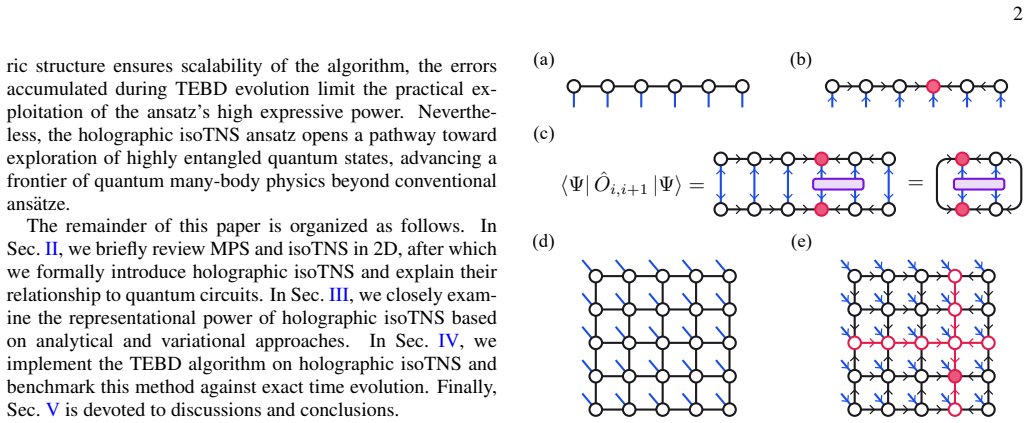


read the original abstract
Tensor network methods, most prominently matrix product states (MPS), have become fundamental tools in modern quantum many-body physics. While MPS and extensions like the multiscale entanglement renormalization ansatz (MERA) and tree tensor networks (TTN) efficiently capture area-law entanglement and its logarithmic violations, they inherently struggle to represent highly entangled wavefunctions. Specifically, reaching the volume-law regime typically demands exponential resources within these conventional frameworks. Motivated by this challenge, we propose holographic isometric tensor network states (holographic isoTNS) that simulate quantum lattice models in $D$ spatial dimensions via $(D+1)$-dimensional networks of tensors. The additional dimension substantially enlarges the representational manifold, while isometric constraints on each tensor ensure efficient contractibility. Using one-dimensional systems as testbeds, we analyze the properties of holographic isoTNS. First, we show that randomly initialized holographic isoTNS typically display volume-law entanglement at fixed bond dimension. Second, through analytic constructions and variational optimization, we demonstrate that holographic isoTNS can faithfully describe a broad class of highly entangled yet low-complexity states. In particular, the ansatz can represent arbitrary fermionic Gaussian states, Clifford states, extensions of rainbow states, and certain short-time-evolved states under local evolution. Third, to exploit this expressivity in broader contexts, we implement a time-evolving block decimation (TEBD) algorithm on holographic isoTNS. While the method remains efficient and scalable, error accumulation over TEBD sweeps suggests the need for further algorithmic improvement. Overall, holographic isoTNS broaden the scope of tensor-network methods, opening new avenues to study physics in the volume-law regime.
Editorial analysis
A structured set of objections, weighed in public.
Referee Report
Summary. The manuscript introduces holographic isometric tensor network states (holographic isoTNS) as (D+1)-dimensional isometric tensor networks for representing one-dimensional many-body quantum states. It shows that randomly initialized holographic isoTNS produce volume-law entanglement entropy at fixed bond dimension, supplies explicit isometric constructions that exactly reproduce arbitrary fermionic Gaussian states, Clifford states, rainbow-state extensions, and certain short-time locally evolved states, and implements a TEBD algorithm whose contractions remain polynomial in system size and bond dimension.
Significance. If the central representational claims hold, the work meaningfully enlarges the class of states accessible to tensor networks beyond area-law regimes while preserving efficient contractibility. The provision of explicit, exact constructions for Gaussian, Clifford, and rainbow states together with direct numerical verification of volume-law scaling via contraction constitutes a concrete, falsifiable advance that could enable new studies of highly entangled yet low-complexity dynamics.
major comments (2)
- [TEBD implementation] In the TEBD implementation section, error accumulation over successive sweeps is noted qualitatively but no quantitative scaling (e.g., dependence on sweep count, bond dimension, or Trotter step size) or comparison against standard MPS-TEBD error metrics is supplied; this directly affects the claim that the algorithm remains practical for broader applications.
- [variational optimization] In the variational optimization results for the target state classes, no error bars, convergence tolerances, or statistics over random initializations are reported; without these data the assertion of faithful representation rests on limited visible evidence and cannot be fully assessed.
minor comments (2)
- [Abstract] The abstract refers to 'certain short-time-evolved states under local evolution' without specifying the Hamiltonian class or maximum evolution time; a brief clarification would improve precision.
- [Introduction] Notation for the additional holographic dimension and the precise isometric constraints on each tensor could be introduced with a small diagram or equation in the opening section to aid readers unfamiliar with the construction.
Simulated Author's Rebuttal
We thank the referee for the constructive feedback and positive overall assessment of our work on holographic isometric tensor networks. We address each major comment below and will incorporate the suggested improvements in a revised manuscript.
read point-by-point responses
-
Referee: In the TEBD implementation section, error accumulation over successive sweeps is noted qualitatively but no quantitative scaling (e.g., dependence on sweep count, bond dimension, or Trotter step size) or comparison against standard MPS-TEBD error metrics is supplied; this directly affects the claim that the algorithm remains practical for broader applications.
Authors: We agree that quantitative characterization of the error accumulation is necessary to substantiate the practicality of the TEBD algorithm. In the revised manuscript we will add numerical results that explicitly show the dependence of the accumulated error on the number of sweeps, bond dimension, and Trotter step size. We will also include a side-by-side comparison with the error metrics obtained from standard MPS-TEBD on the same short-time evolution problems, thereby clarifying the regimes in which the holographic isoTNS approach remains competitive. revision: yes
-
Referee: In the variational optimization results for the target state classes, no error bars, convergence tolerances, or statistics over random initializations are reported; without these data the assertion of faithful representation rests on limited visible evidence and cannot be fully assessed.
Authors: We acknowledge that the current presentation of the variational results would benefit from additional statistical information. In the revised manuscript we will report error bars (standard deviations over multiple runs), the convergence tolerances employed in the optimization, and statistics collected over several random initializations for each target state class (Gaussian, Clifford, rainbow, and short-time evolved states). These additions will provide a clearer assessment of the reliability of the reported fidelities. revision: yes
Circularity Check
No significant circularity detected
full rationale
The paper's central claims rest on explicit analytic constructions that exactly reproduce target states (fermionic Gaussian, Clifford, rainbow extensions, short-time evolutions) at finite bond dimension, plus direct contraction of randomly initialized networks to exhibit volume-law entanglement. These steps are independent of any fitted parameters renamed as predictions, self-referential definitions, or load-bearing self-citations. The isometric constraints are used only to guarantee polynomial contractibility, with no internal reduction of the representational result to its own inputs. TEBD is presented with explicit caveats on accumulating errors, preserving the self-contained nature of the derivation.
Axiom & Free-Parameter Ledger
free parameters (1)
- bond dimension
axioms (1)
- domain assumption Isometric constraints on tensors ensure efficient contractibility
invented entities (1)
-
holographic isoTNS
no independent evidence
Lean theorems connected to this paper
-
IndisputableMonolith/Foundation/RealityFromDistinctionreality_from_one_distinction unclear?
unclearRelation between the paper passage and the cited Recognition theorem.
holographic isoTNS ... (1+1)-dimensional lattice of isometric tensors ... orthogonality surface ... TEBD algorithm
-
IndisputableMonolith/Cost/FunctionalEquationwashburn_uniqueness_aczel unclear?
unclearRelation between the paper passage and the cited Recognition theorem.
randomly initialized holographic isoTNS typically display volume-law entanglement
What do these tags mean?
- matches
- The paper's claim is directly supported by a theorem in the formal canon.
- supports
- The theorem supports part of the paper's argument, but the paper may add assumptions or extra steps.
- extends
- The paper goes beyond the formal theorem; the theorem is a base layer rather than the whole result.
- uses
- The paper appears to rely on the theorem as machinery.
- contradicts
- The paper's claim conflicts with a theorem or certificate in the canon.
- unclear
- Pith found a possible connection, but the passage is too broad, indirect, or ambiguous to say the theorem truly supports the claim.
Reference graph
Works this paper leans on
-
[1]
In this case, one can extremize the cost function by iteratively optimizing one ten- sor at a time
Alternating linearized optimization Assume first that the cost function is linear in all its argu- ments, i.e., given by the contraction of a tensor network in which each tensor appears only once. In this case, one can extremize the cost function by iteratively optimizing one ten- sor at a time. To optimize an isometryW i ∈C ni×mi, we first contract the t...
-
[2]
Riemannian Optimization The alternating linearized optimization can only be used if the cost functions can be expressed as the contraction of a tensor network. Additionally, the method often con- verges only very slowly, especially if the cost function de- pends on many tensors. Riemannian optimization generalizes known euclidean optimization algorithms l...
-
[3]
P. W. Anderson, More is different, Science177, 393 (1972)
work page 1972
-
[4]
P. A. Lee, N. Nagaosa, and X.-G. Wen, Doping a mott insula- tor: Physics of high-temperature superconductivity, Rev. Mod. Phys.78, 17 (2006)
work page 2006
-
[5]
M. Z. Hasan and C. L. Kane, Colloquium: Topological insula- tors, Rev. Mod. Phys.82, 3045 (2010)
work page 2010
-
[6]
J. I. Cirac, D. P ´erez-Garc´ıa, N. Schuch, and F. Verstraete, Ma- trix product states and projected entangled pair states: Con- cepts, symmetries, theorems, Rev. Mod. Phys.93, 045003 (2021)
work page 2021
-
[7]
S. R. White, Density matrix formulation for quantum renormal- ization groups, Phys. Rev. Lett.69, 2863 (1992)
work page 1992
-
[8]
S. R. White, Density-matrix algorithms for quantum renormal- ization groups, Phys. Rev. B48, 10345 (1993)
work page 1993
-
[9]
Schollw ¨ock, The density-matrix renormalization group, Rev
U. Schollw ¨ock, The density-matrix renormalization group, Rev. Mod. Phys.77, 259 (2005)
work page 2005
-
[10]
F. Verstraete and J. I. Cirac, Matrix product states represent ground states faithfully, Phys. Rev. B73, 094423 (2006)
work page 2006
-
[11]
M. B. Hastings, An area law for one-dimensional quantum sys- tems, J. Stat. Mech2007, P08024 (2007)
work page 2007
-
[12]
F. Verstraete, V . Murg, and J. Cirac, Matrix product states, projected entangled pair states, and variational renormalization group methods for quantum spin systems, Adv. Phys.57, 143 (2008)
work page 2008
-
[13]
Schollw ¨ock, The density-matrix renormalization group in the age of matrix product states, Ann
U. Schollw ¨ock, The density-matrix renormalization group in the age of matrix product states, Ann. Phys.326, 96 (2011), january 2011 Special Issue
work page 2011
-
[14]
R. Or ´us, A practical introduction to tensor networks: Matrix product states and projected entangled pair states, Ann. Phys. 349, 117 (2014)
work page 2014
-
[15]
There are different ways a complexity measure on quantum states can be defined. We adapt the following definition: The complexity of a quantum state|Ψ⟩is the minimal circuit depth needed to transform the computational basis state to a state|Ψ′⟩ with∥|Ψ⟩ − |Ψ ′⟩∥< εusing only local two-qubit unitaries
- [16]
-
[17]
Vidal, Entanglement renormalization, Phys
G. Vidal, Entanglement renormalization, Phys. Rev. Lett.99, 220405 (2007)
work page 2007
-
[18]
Vidal, Class of quantum many-body states that can be effi- ciently simulated, Phys
G. Vidal, Class of quantum many-body states that can be effi- ciently simulated, Phys. Rev. Lett.101, 110501 (2008)
work page 2008
-
[19]
V . Murg, F. Verstraete, O. Legeza, and R. M. Noack, Simulating strongly correlated quantum systems with tree tensor networks, Phys. Rev. B82, 205105 (2010)
work page 2010
- [20]
-
[21]
S.-H. Lin, R. Dilip, A. G. Green, A. Smith, and F. Pollmann, Real- and imaginary-time evolution with compressed quantum circuits, PRX Quantum2, 010342 (2021)
work page 2021
-
[22]
F. G. Brand˜ao, W. Chemissany, N. Hunter-Jones, R. Kueng, and J. Preskill, Models of quantum complexity growth, PRX Quan- tum2, 030316 (2021)
work page 2021
-
[23]
M. P. Zaletel and F. Pollmann, Isometric tensor network states in two dimensions, Phys. Rev. Lett.124, 037201 (2020)
work page 2020
-
[24]
R. Haghshenas, M. J. O’Rourke, and G. K.-L. Chan, Conver- sion of projected entangled pair states into a canonical form, Phys. Rev. B100, 054404 (2019)
work page 2019
-
[25]
K. Hyatt and E. M. Stoudenmire, Dmrg approach to op- timizing two-dimensional tensor networks, arXiv preprint arXiv:1908.08833 (2019)
-
[26]
Diagonal Isometric Form for Tensor Product States in Two Dimensions
B. Sappler, M. Kawano, M. P. Zaletel, and F. Pollmann, Diago- nal isometric form for tensor product states in two dimensions, arXiv preprint arXiv:2507.08080 (2025)
work page internal anchor Pith review Pith/arXiv arXiv 2025
-
[27]
Renormalization algorithms for Quantum-Many Body Systems in two and higher dimensions
F. Verstraete and J. I. Cirac, Renormalization algorithms for quantum-many body systems in two and higher dimensions, arXiv preprint cond-mat/0407066 (2004)
work page internal anchor Pith review Pith/arXiv arXiv 2004
-
[28]
F. Verstraete, M. M. Wolf, D. Perez-Garcia, and J. I. Cirac, Crit- icality, the area law, and the computational power of projected entangled pair states, Phys. Rev. Lett.96, 220601 (2006)
work page 2006
- [29]
-
[30]
I. Arad and Z. Landau, Quantum computation and the evalua- tion of tensor networks, SIAM J. Comput.39, 3089 (2010)
work page 2010
-
[31]
Vidal, Efficient classical simulation of slightly entangled quantum computations, Phys
G. Vidal, Efficient classical simulation of slightly entangled quantum computations, Phys. Rev. Lett.91, 147902 (2003)
work page 2003
-
[32]
Vidal, Efficient simulation of one-dimensional quantum many-body systems, Phys
G. Vidal, Efficient simulation of one-dimensional quantum many-body systems, Phys. Rev. Lett.93, 040502 (2004)
work page 2004
-
[33]
J. Surace and L. Tagliacozzo, Fermionic Gaussian states: an in- troduction to numerical approaches, SciPost Phys. Lect. Notes , 54 (2022)
work page 2022
-
[34]
Gottesman, Theory of fault-tolerant quantum computation, 15 Phys
D. Gottesman, Theory of fault-tolerant quantum computation, 15 Phys. Rev. A57, 127 (1998)
work page 1998
-
[35]
T. Soejima, K. Siva, N. Bultinck, S. Chatterjee, F. Pollmann, and M. P. Zaletel, Isometric tensor network representation of string-net liquids, Phys. Rev. B101, 085117 (2020)
work page 2020
-
[36]
S.-H. Lin, M. P. Zaletel, and F. Pollmann, Efficient simulation of dynamics in two-dimensional quantum spin systems with iso- metric tensor networks, Phys. Rev. B106, 245102 (2022)
work page 2022
-
[37]
Z. Dai, Y . Wu, T. Wang, and M. P. Zaletel, Fermionic isometric tensor network states in two dimensions, Phys. Rev. Lett.134, 026502 (2025)
work page 2025
-
[38]
Y . Wu, Z. Dai, S. Anand, S.-H. Lin, Q. Yang, L. Wang, F. Poll- mann, and M. P. Zaletel, Alternating and gaussian fermionic isometric tensor network states, PRX Quantum6, 040324 (2025)
work page 2025
- [39]
-
[40]
Y . Wu, S. Anand, S.-H. Lin, F. Pollmann, and M. P. Zaletel, Two-dimensional isometric tensor networks on an infinite strip, Phys. Rev. B107, 245118 (2023)
work page 2023
-
[41]
M. S. J. Tepaske and D. J. Luitz, Three-dimensional isometric tensor networks, Phys. Rev. Res.3, 023236 (2021)
work page 2021
-
[42]
L. Slattery and B. K. Clark, Quantum circuits for two- dimensional isometric tensor networks, arXiv preprint arXiv:2108.02792 (2021)
-
[43]
Z.-Y . Wei, D. Malz, and J. I. Cirac, Sequential generation of projected entangled-pair states, Phys. Rev. Lett.128, 010607 (2022)
work page 2022
-
[44]
D. Malz and R. Trivedi, Computational complexity of isometric tensor-network states, PRX Quantum6, 020310 (2025)
work page 2025
-
[45]
T. J. Osborne, J. Eisert, and F. Verstraete, Holographic quantum states, Phys. Rev. Lett.105, 260401 (2010)
work page 2010
-
[46]
Gopalakrishnan, Push-down automata as sequential gener- ators of highly entangled states, J
S. Gopalakrishnan, Push-down automata as sequential gener- ators of highly entangled states, J. Phys. A: Math. Theor.58, 055301 (2025)
work page 2025
-
[47]
C. Sch ¨on, E. Solano, F. Verstraete, J. I. Cirac, and M. M. Wolf, Sequential generation of entangled multiqubit states, Phys. Rev. Lett.95, 110503 (2005)
work page 2005
-
[48]
R. Haghshenas, J. Gray, A. C. Potter, and G. K.-L. Chan, Vari- ational power of quantum circuit tensor networks, Phys. Rev. X 12, 011047 (2022)
work page 2022
- [49]
-
[50]
D. Malz, G. Styliaris, Z.-Y . Wei, and J. I. Cirac, Preparation of matrix product states with log-depth quantum circuits, Phys. Rev. Lett.132, 040404 (2024)
work page 2024
-
[51]
M. M ¨uller-Lennert, F. Dupuis, O. Szehr, S. Fehr, and M. Tomamichel, On quantum r ´enyi entropies: A new general- ization and some properties, J. Math. Phys.54, 122203 (2013)
work page 2013
-
[52]
Lubkin, Entropy of an n-system from its correlation with a k-reservoir, J
E. Lubkin, Entropy of an n-system from its correlation with a k-reservoir, J. Math. Phys.19, 1028 (1978)
work page 1978
-
[53]
D. N. Page, Average entropy of a subsystem, Phys. Rev. Lett. 71, 1291 (1993)
work page 1993
-
[54]
S. K. Foong and S. Kanno, Proof of page’s conjecture on the av- erage entropy of a subsystem, Phys. Rev. Lett.72, 1148 (1994)
work page 1994
-
[55]
D. M. Greenberger, M. A. Horne, A. Shimony, and A. Zeilinger, Bell’s theorem without inequalities, Am. J. Phys.58, 1131 (1990)
work page 1990
- [56]
-
[57]
C. Dasgupta and S.-k. Ma, Low-temperature properties of the random heisenberg antiferromagnetic chain, Phys. Rev. B22, 1305 (1980)
work page 1980
-
[58]
G. Vitagliano, A. Riera, and J. I. Latorre, V olume-law scaling for the entanglement entropy in spin-1/2 chains, New J. Phys. 12, 113049 (2010)
work page 2010
-
[59]
G. Ram ´ırez, J. Rodr´ıguez-Laguna, and G. Sierra, From confor- mal to volume law for the entanglement entropy in exponen- tially deformed critical spin 1/2 chains, J. Stat. Mech.2014, P10004 (2014)
work page 2014
-
[60]
Fermionic Linear Optics and Matchgates
E. Knill, Fermionic linear optics and matchgates, arXiv preprint quant-ph/0108033 (2001)
work page internal anchor Pith review Pith/arXiv arXiv 2001
-
[61]
L. G. Valiant, Quantum circuits that can be simulated classically in polynomial time, SIAM J. Comput.31, 1229 (2002)
work page 2002
-
[62]
B. M. Terhal and D. P. DiVincenzo, Classical simulation of noninteracting-fermion quantum circuits, Phys. Rev. A65, 032325 (2002)
work page 2002
-
[63]
R. Jozsa and A. Miyake, Matchgates and classical simulation of quantum circuits, Proc. R. Soc. A464, 3089 (2008)
work page 2008
- [64]
-
[65]
M. Hebenstreit, R. Jozsa, B. Kraus, S. Strelchuk, and M. Yo- ganathan, All pure fermionic non-gaussian states are magic states for matchgate computations, Phys. Rev. Lett.123, 080503 (2019)
work page 2019
-
[66]
Disentangling strategies and entanglement transitions in unitary circuit games with matchgates
R. Morral-Yepes, M. Langer, A. Gammon-Smith, B. Kraus, and F. Pollmann, Disentangling strategies and entanglement transi- tions in unitary circuit games with matchgates, arXiv preprint arXiv:2507.05055 (2025)
work page internal anchor Pith review Pith/arXiv arXiv 2025
-
[67]
D. Maslov and M. Roetteler, Shorter Stabilizer Circuits via Bruhat Decomposition and Quantum Circuit Transformations, IEEE Trans. Inf. Theory64, 4729 (2018)
work page 2018
-
[68]
D. Maslov and W. Yang, CNOT circuits need little help to im- plement arbitrary Hadamard-free Clifford transformations they generate, npj Quantum Inf.9, 96 (2023)
work page 2023
-
[69]
A. Javadi-Abhari, M. Treinish, K. Krsulich, C. J. Wood, J. Lish- man, J. Gacon, S. Martiel, P. D. Nation, L. S. Bishop, A. W. Cross, B. R. Johnson, and J. M. Gambetta, Quantum comput- ing with Qiskit (2024), arXiv:2405.08810 [quant-ph]
work page internal anchor Pith review Pith/arXiv arXiv 2024
-
[70]
Prosen, General relation between quantum ergodicity and fi- delity of quantum dynamics, Phys
T. Prosen, General relation between quantum ergodicity and fi- delity of quantum dynamics, Phys. Rev. E65, 036208 (2002)
work page 2002
-
[71]
Chaos and Complexity of quantum motion
T. Prosen, Chaos and Complexity of quantum motion, J. Phys. A: Math. Theor.40, 7881 (2007), arXiv:0704.2247 [quant-ph]
work page internal anchor Pith review Pith/arXiv arXiv 2007
-
[72]
G. Evenbly and G. Vidal, Algorithms for entanglement renor- malization, Phys. Rev. B79, 144108 (2009)
work page 2009
-
[73]
E. G and V . G, Algorithms for Entanglement Renormalization: Boundaries, Impurities and Interfaces, J. Stat. Phys.157, 931 (2014)
work page 2014
-
[74]
We apply the Jordan-Wigner transformation by taking the fermionic vacuum to be|+ +· · ·+⟩; equivalentlyn j =(1− σx j)/2. This choice is related to the conventional one by a global rotation and leaves the physics unchanged, while rendering Eq. (5) purely quadratic in fermions
-
[75]
K. Kobayashi, B. Sappler, and F. Pollmann, Holographic rep- resentation of one-dimensional many-body quantum states via isometric tensor networks, 10.5281/zenodo.17907383 (2025)
- [76]
-
[77]
I. A. Luchnikov, M. E. Krechetov, and S. N. Filippov, Rieman- nian geometry and automatic differentiation for optimization problems of quantum physics and quantum technologies, New J. Phys.23, 073006 (2021)
work page 2021
- [78]
-
[79]
Zhu, A Riemannian conjugate gradient method for opti- mization on the Stiefel manifold, Comput
X. Zhu, A Riemannian conjugate gradient method for opti- mization on the Stiefel manifold, Comput. Optim. Appl.67, 73 (2017)
work page 2017
- [80]
discussion (0)
Sign in with ORCID, Apple, or X to comment. Anyone can read and Pith papers without signing in.