REVIEW 3 major objections 7 minor 134 references
BokehDepth claims that synthetic defocus, generated as a calibrated bokeh stack from a single sharp image, can serve as a supervision-free geometric cue that consistently improves the metric accuracy and robustness of strong monocular depth
Reviewed by Pith at T0; open to challenge. T0 means a machine referee read the full paper against a public rubric. the ladder, T0–T4 →
2026-08-03 16:38 UTC pith:ZNXASQJO
load-bearing objection The defocus-to-depth idea is worth taking seriously, but the headline zero-shot gains are untested because every BokehDepth variant gets Hypersim fine-tuning that the baselines don't get. the 3 major comments →
Boosting Monocular Metric Depth Estimation via Bokeh Rendering
The pith
A machine-rendered reading of the paper's core claim, the machinery that carries it, and where it could break.
Core claim
The central claim is that defocus blur, synthesized without depth, provides a geometrically meaningful and supervision-free signal for monocular metric depth estimation. The paper proves, under thin-lens optics, that sweeping a calibrated bokeh strength K at fixed viewpoint and focus distance produces, at each pixel, bokeh radii exactly proportional to the pixel's inverse-depth offset from the focal plane. The ordinary least-squares slope of radius versus K is an unbiased and consistent estimator of that offset, and the authors use this physical law to design a plug-in encoder module that compares blur changes across the stack. Across diverse indoor and outdoor benchmarks, the resulting Boke
What carries the argument
The key machinery is the calibrated bokeh stack, indexed by a thin-lens-derived scalar K that controls blur strength, paired with the Divided Space Focus Attention module. The module first performs spatial attention within each bokeh frame, then runs focus attention across frames at aligned spatial locations, using FiLM conditioning keyed to K. This exposes depth-from-defocus variations in the encoder while leaving the decoder and metric head unchanged. The underlying identity is r_i(x) = K_i * inverse-depth-offset(x), which turns a stack of bokeh images into a per-pixel linear regression problem whose slope recovers metric depth.
Load-bearing premise
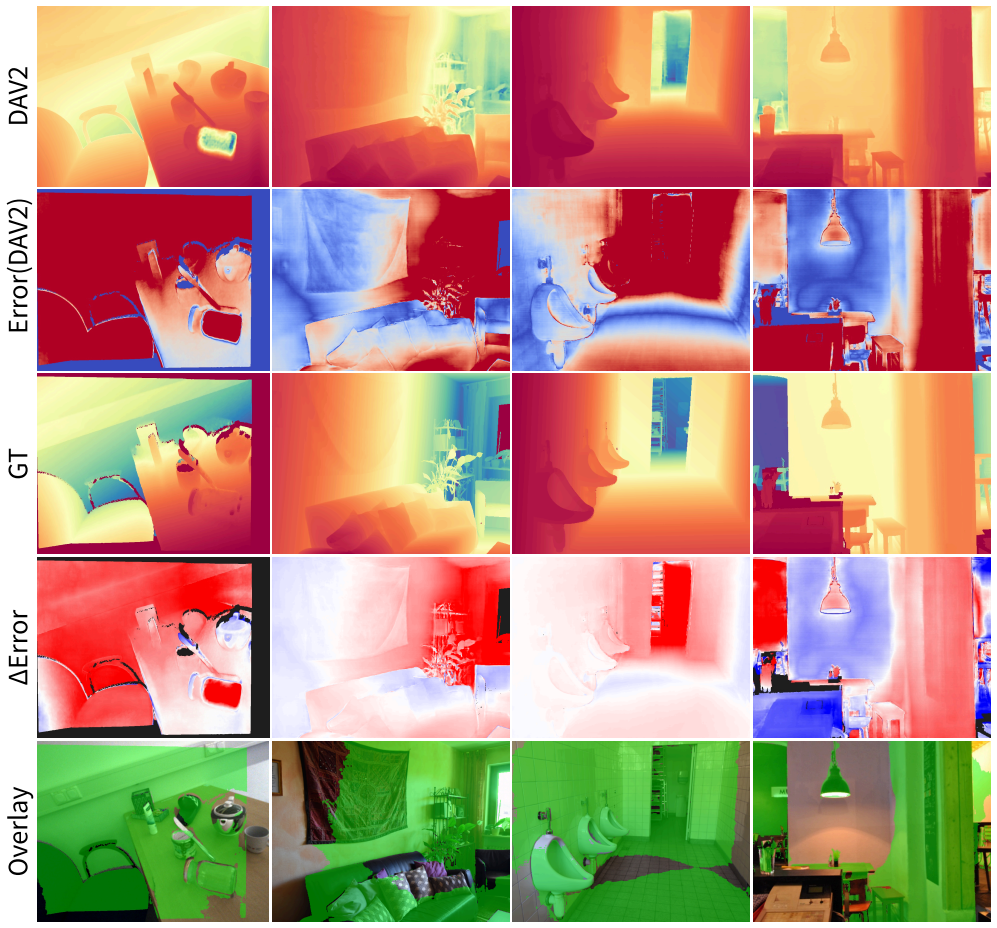
The zero-shot depth improvements are attributed to defocus cues, but every BokehDepth variant is fine-tuned on Hypersim while the compared baselines are released checkpoints without that same fine-tuning, so the specific benefit of the bokeh stacks is not isolated.
What would settle it
Run the exact BokehDepth Stage-2 training recipe on Hypersim but replace the Stage-1 bokeh stack with repeated all-in-focus frames at K=0; if the resulting zero-shot AbsRel and delta-1 values on HAMMER, ETH3D, and Sintel do not drop to near-baseline levels, then the reported gains would not be attributable to the defocus cue.
If this is right
- Adding BokehDepth to existing metric depth foundations improves zero-shot accuracy on diverse indoor and outdoor datasets, not just on the training distribution.
- The depth-free bokeh generator breaks the classic error-amplification loop where noisy depth maps corrupt rendered blur.
- Defocus cues produce gains in exactly the regions where single-frame depth models are weakest: textureless walls, distant backgrounds, and geometrically flat surfaces.
- Because the decoder and loss are unchanged, the approach can be applied to strong existing encoder-decoder depth models as a plug-in module.
- The unified K scalar aligns real photographs, synthetic renders, and captured focus-aperture pairs, making the defocus cue domain-consistent.
Where Pith is reading between the lines
- The same bokeh-stack fusion idea could plausibly transfer to other dense prediction tasks, such as surface normal estimation or semantic segmentation, wherever defocus variation carries geometric information.
- A direct control experiment—fine-tuning the same backbone on Hypersim with a K=0 stack (no defocus variation)—would isolate whether the reported zero-shot gains come from the defocus cue or from the additional fine-tuning protocol itself.
- The linear defocus law suggests one could train an explicit, calibration-free depth-from-defocus head on Stage-1 stacks rather than relying on the implicit fusion, potentially yielding even more interpretable depth estimates.
- Using only ten diffusion steps for Stage-1 stack generation, the framework may be practical enough for real-time or near-real-time use, though the paper does not measure full pipeline latency.
Editorial analysis
A structured set of objections, weighed in public.
Referee Report
Summary. The paper proposes BokehDepth, a two-stage framework for monocular metric depth estimation. Stage-1 builds a bokeh generator on the FLUX-Kontext image-editing backbone, conditioned on a scalar bokeh strength K derived from the thin-lens circle-of-confusion model, and produces multi-strength bokeh stacks from a single sharp image without requiring a depth map at inference. Stage-2 inserts a Divided Space Focus Attention (DSFA) module into the ViT encoder of an existing monocular depth model, fusing features along the defocus axis while leaving the decoder unchanged. Experiments compare Stage-1 against depth-based bokeh renderers and Stage-2 against strong zero-shot metric depth baselines on HAMMER, IBims-1, Middlebury, Make3D, Sintel, and ETH3D, plus an in-domain NYUv2 evaluation. The paper claims that BokehDepth consistently improves the metric accuracy and robustness of strong monocular depth foundation models and achieves state-of-the-art in-domain results on NYUv2.
Significance. The central idea is interesting and potentially useful: synthetic defocus, generated without explicit depth input, could act as a supervision-free geometric cue for monocular metric depth. The modular design, where the decoder and metric head are unchanged, is attractive, and the Stage-1 training recipe that unifies real and synthetic defocus through a single scalar K is a reasonable engineering contribution. The supplementary material includes a formal derivation of a depth-from-bokeh sweep relation and detailed dataset-construction documentation. However, the main experimental evidence for the headline claim is currently confounded: the zero-shot BokehDepth variants receive additional Hypersim fine-tuning that the baseline checkpoints do not receive, so the observed gains cannot be attributed to the bokeh stacks. The reported NYUv2 RMS value also appears inconsistent with standard evaluation. If these issues are resolved with proper controls and a protocol audit, the paper could be a meaningful contribution; as it stands, the central claim is not supported.
major comments (3)
- [§5.1, Table 2] The central zero-shot claim is confounded by an unequal training protocol. Section 5.1 states that for cross-domain zero-shot MMDE, the BokehDepth models are initialized from official checkpoints and then 'fine-tune only on Hypersim', pairing each sharp frame with its synthetic bokeh stack. The baselines in Table 2 are released checkpoints with no indication that they received the same additional Hypersim fine-tuning. Consequently, the large gains shown in Table 2 (e.g., UDv2 HAMMER δ1 from 0.645 to 0.895, Sintel δ1 from 0.344 to 0.671) could be due to domain adaptation to Hypersim rather than to the defocus stacks. Table 4 is not a substitute: it is performed on VKITTI2/KITTI, and the K=0 'w/o Bokeh' variant (δ1=0.855) falls below the untouched base model (δ1=0.914), indicating that the module is not a clean plug-in. The authors must add a same-protocol control: each backbone fine-tuned
- [Table 3, §5.2.2] The NYUv2 RMS of 0.043 reported for BokehDepth is implausible relative to all compared methods, which range from 0.180 (UniDepthV2) to 0.278 (ZoeDepth). On a metric-depth benchmark with depth values up to several meters, an RMS of 0.043 is also surprisingly close to the reported AbsRel of 0.039. This inconsistency strongly suggests an evaluation-protocol mismatch, such as a different valid-depth mask, scale normalization, or test split. The authors should report the exact evaluation code, valid-depth ranges, and split used, and rerun all baselines under the identical protocol. If the number is correct, they should provide additional evidence (e.g., error distributions or qualitative error maps). This issue is load-bearing because the paper presents Table 3 as evidence of state-of-the-art in-domain performance.
- [§4.1.1, Proposition 1] The theoretical grounding is overclaimed. Proposition 1 is a direct algebraic consequence of the same thin-lens relation used to define K in Eq. (1), so it does not independently establish that Stage-1 stacks carry calibrated depth information. More substantively, the proposition's assumptions — a true aperture sweep and per-pixel measured blur radii — do not match the actual Stage-2 mechanism, which feeds generated images through learned cross-frame attention and never estimates or regresses blur radii. Thus the paper's language about an 'unbiased and consistent' estimator applies to a different pipeline than the one evaluated. The proposition may still be a useful motivation, but it should be re-framed as such, or supplemented by an experiment verifying the predicted linear radius-vs-K relation on Stage-1 outputs.
minor comments (7)
- [§5.1 vs Table 3 caption] Section 5.1 says the in-domain evaluation uses the NYUv2 'official test split', while Table 3's caption says 'NYUv2 validation set'. Please clarify which split is used.
- [§9 Supplementary] The supplementary section header 'Mathmatical Proofs' contains a typo; it should be 'Mathematical Proofs'. There are also missing spaces in Table 1's caption ('Boldfacedenotes').
- [§5.1] Stage-2 training details are thin: the paper only says 'each base model’s published training pipeline' was used, without reporting optimizer, learning rate, number of fine-tuning epochs, or number of stack frames used in training. These details are necessary for reproducibility, especially given the new experimental protocol.
- [General terminology] The term 'zero-shot' is misleading in Table 2 because the BokehDepth models are fine-tuned on Hypersim before evaluation, even though the evaluation datasets are unseen. Consider describing this as 'cross-dataset evaluation after Hypersim fine-tuning' or adding an explicit qualifier.
- [Figure 3 / §4.2] The module is called 'Divided Space Focus Attention (DSFA)' in the text but 'Divided Space Focus (DSF) Attention' in the Figure 3 caption. Please unify the notation.
- [§3.2 and §8] Stage-1 is described as 'depth-free', but its training uses depth maps for BokehMe renders and estimated depth from DepthPro for EXIF images. This is acceptable, but the term should be qualified as 'no depth at inference' to avoid confusion.
- [Reproducibility] No code or model release is mentioned. Given the complexity of the pipeline and the protocol concerns above, releasing code and evaluation scripts would substantially strengthen the paper.
Circularity Check
Zero-shot Table 2 gains conflate Hypersim fine-tuning with bokeh injection; Proposition 1 restates the K definition.
specific steps
-
fitted input called prediction
[Sec. 5.1 (Implementation Details) and Sec. 5.2.2, Table 2]
"For cross-domain zero-shot MMDE, we fine-tune only on Hypersim [82], where each sharp frame is paired with its synthetic bokeh stack, and evaluate alongside strong baselines on diverse indoor and outdoor benchmarks ... Table 2: Zero-shot metric-depth comparison ... Our method consistently improves accuracy over each corresponding base model."
The Table 2 gain of '+BokehDepth' over 'DAv2'/'UDv2' is the joint effect of Hypersim fine-tuning plus bokeh-stack injection. The base rows are released checkpoints with no stated Hypersim fine-tuning, and no same-protocol, no-bokeh control is reported. The observed boost therefore cannot be assigned to defocus cues; as presented, the 'consistent improvement' is statistically indistinguishable from the effect of the extra supervised fit on Hypersim. The Table 4 VKITTI2/KITTI ablation uses a different protocol and does not control this comparison.
-
self definitional
[Sec. 3.1 Eq. (1); Sec. 4.1.1 Proposition 1; Supp. Sec. 9 Eqs. (25)-(26)]
"We instantiate K(f, N, S1) = f 2S1 / 2N(S1 −f) · pixel ratio, (1) ... Proposition 1 ... At every pixel, the measured bokeh radius is exactly proportional to that pixel’s inverse-depth offset from the focal plane. The slope of this proportionality ... is an unbiased and consistent estimate of that offset."
The proposition's key identity r_i(x)=K_i Δ(x) (Supp. Eq. 26) is exactly the thin-lens circle-of-confusion relation used to define K in Eq. (1)/(15)/(17); the OLS slope being Δ(x) follows directly from this definition. Thus the 'first-principles' result is a restatement of the input relation rather than an independent grounding of metric-depth recovery from bokeh. It is not implemented by the learned DSFA module, so this tautology is secondary to the experimental claim.
full rationale
The central empirical claim is that Stage-1 bokeh stacks consistently boost strong monocular depth models. The headline evidence (Table 2) is confounded: BokehDepth variants are fine-tuned on Hypersim, while the baseline rows are released checkpoints without that fine-tuning, and no same-protocol no-bokeh control is provided for those benchmarks. This is a serious attribution gap, though not a definitional circularity, since the DSFA module is learned rather than derived from the bokeh input. The theoretical Proposition 1 is a correct but tautological restatement of the thin-lens relation used to define K. Self-citations to Bokeh Diffusion [25] supply the bokeh-conditioning recipe but are not load-bearing for the depth-improvement claim; they are technical inheritance, not a uniqueness argument. The Table 4 VKITTI2/KITTI ablation gives some independent evidence that defocus variation matters in one protocol, which keeps the paper from fully reducing to a fit. Overall: partial circularity / attribution confound, score 4.
Axiom & Free-Parameter Ledger
free parameters (4)
- Bokeh strength K values for Stage-2 stack =
10.0, 20.0, 30.0
- Focus distance S1 for real photos =
median DepthPro depth of salient foreground
- Pixel ratio / sensor width conversion =
estimated via EXIF fallback or camera-model heuristics
- Reference width 512 normalization =
512
axioms (6)
- domain assumption Thin-lens circle-of-confusion relation d = f^2/(N(S1-f)) * |S2-S1|/S2
- domain assumption Defocus can be locally modeled as convolution with a disk (pillbox) PSF
- standard math OLS slope estimator is unbiased/consistent under independent, finite-variance radius estimates
- ad hoc to paper Stage-1 bokeh stacks preserve scene geometry and identity across K
- domain assumption FLUX-Kontext provides a strong image-editing prior
- domain assumption DepthPro estimates used for K calibration are sufficiently accurate
read the original abstract
Bokeh rendering and depth estimation share a fundamental optical connection, yet existing methods fail to fully exploit this reciprocity. Conventional bokeh pipelines rely heavily on noisy depth maps that inevitably introduce visual artifacts. Conversely, existing monocular depth models typically follow two flawed paradigms. Generative diffusion-based frameworks often lack consistent metric scale. Meanwhile, feed-forward metric depth models frequently fail in textureless or distant regions where defocus blur can provide geometric information. We propose BokehDepth, a two-stage framework that treats synthetic defocus as a supervision-free geometric signal. In the first stage, a physically grounded generative model produces calibrated bokeh stacks from a single sharp input without requiring prior depth input. Subsequently, a lightweight defocus-aware aggregation module integrates these stacks into the encoder of a depth estimation framework. This mechanism allows the model to extract consistent geometric features from the defocus dimension while keeping the decoder architecture unchanged. Experiments demonstrate that BokehDepth achieves superior visual bokeh fidelity compared to depth-dependent rendering baselines and consistently enhances the metric accuracy of state-of-the-art monocular depth models.
Figures


Reference graph
Works this paper leans on
-
[1]
Defocus de- blurring using dual-pixel data
Abdullah Abuolaim and Michael S Brown. Defocus de- blurring using dual-pixel data. InEuropean conference on computer vision, pages 111–126. Springer, 2020. 2, 4
2020
-
[2]
Single lens stereo with a plenoptic camera.IEEE transactions on pattern analysis and machine intelligence, 14(2):99–106, 1992
Edward H Adelson and John Y A Wang. Single lens stereo with a plenoptic camera.IEEE transactions on pattern analysis and machine intelligence, 14(2):99–106, 1992. 2
1992
-
[3]
Fast bilateral-space stereo for synthetic defocus
Jonathan T Barron, Andrew Adams, YiChang Shih, and Carlos Hern´andez. Fast bilateral-space stereo for synthetic defocus. InProceedings of the IEEE conference on com- puter vision and pattern recognition, pages 4466–4474,
-
[4]
Stephen Batifol, Andreas Blattmann, Frederic Boesel, Sak- sham Consul, Cyril Diagne, Tim Dockhorn, Jack English, Zion English, Patrick Esser, Sumith Kulal, et al. Flux. 1 kontext: Flow matching for in-context image generation and editing in latent space.arXiv e-prints, pages arXiv– 2506, 2025. 2, 3, 6, 7, 8, 1, 4, 5
2025
-
[5]
Adabins: Depth estimation using adaptive bins
Shariq Farooq Bhat, Ibraheem Alhashim, and Peter Wonka. Adabins: Depth estimation using adaptive bins. InPro- ceedings of the IEEE/CVF conference on computer vision and pattern recognition, pages 4009–4018, 2021. 3
2021
-
[6]
Shariq Farooq Bhat, Reiner Birkl, Diana Wofk, Peter Wonka, and Matthias M ¨uller. Zoedepth: Zero-shot trans- fer by combining relative and metric depth.arXiv preprint arXiv:2302.12288, 2023. 3, 8
Pith/arXiv arXiv 2023
-
[7]
Role of optics in the accuracy of depth-from-defocus systems.Journal of the Optical Society of America A, 24(4):967–972, 2007
Ilya Blayvas, Ron Kimmel, and Ehud Rivlin. Role of optics in the accuracy of depth-from-defocus systems.Journal of the Optical Society of America A, 24(4):967–972, 2007. 2
2007
-
[8]
Depth pro: Sharp monocular metric depth in less than a second.arXiv preprint arXiv:2410.02073,
Aleksei Bochkovskii, Ama ˜AG ¸ l Delaunoy, Hugo Germain, Marcel Santos, Yichao Zhou, Stephan R Richter, and Vladlen Koltun. Depth pro: Sharp monocular metric depth in less than a second.arXiv preprint arXiv:2410.02073,
-
[9]
Instructpix2pix: Learning to follow image editing instruc- tions
Tim Brooks, Aleksander Holynski, and Alexei A Efros. Instructpix2pix: Learning to follow image editing instruc- tions. InProceedings of the IEEE/CVF conference on com- puter vision and pattern recognition, pages 18392–18402,
-
[10]
A naturalistic open source movie for op- tical flow evaluation
Daniel J Butler, Jonas Wulff, Garrett B Stanley, and Michael J Black. A naturalistic open source movie for op- tical flow evaluation. InEuropean conference on computer vision, pages 611–625. Springer, 2012. 8
2012
-
[11]
Virtual kitti 2.arXiv preprint arXiv:2001.10773, 2020
Yohann Cabon, Naila Murray, and Martin Humenberger. Virtual kitti 2.arXiv preprint arXiv:2001.10773, 2020. 8
Pith/arXiv arXiv 2001
-
[12]
Depth from defocus: a real aperture imaging approach
Subhasis Chaudhuri and Ambasamudram N Rajagopalan. Depth from defocus: a real aperture imaging approach. Springer Science & Business Media, 1999. 2
1999
-
[13]
Pixart-α: Fast training of diffu- sion transformer for photorealistic text-to-image synthesis
Junsong Chen, Jincheng Yu, Chongjian Ge, Lewei Yao, Enze Xie, Yue Wu, Zhongdao Wang, James Kwok, Ping Luo, Huchuan Lu, et al. Pixart-α: Fast training of diffu- sion transformer for photorealistic text-to-image synthesis. arXiv preprint arXiv:2310.00426, 2023. 1
Pith/arXiv arXiv 2023
-
[14]
Pixart-σ: Weak-to-strong training of diffusion transformer for 4k text-to-image generation
Junsong Chen, Chongjian Ge, Enze Xie, Yue Wu, Lewei Yao, Xiaozhe Ren, Zhongdao Wang, Ping Luo, Huchuan Lu, and Zhenguo Li. Pixart-σ: Weak-to-strong training of diffusion transformer for 4k text-to-image generation. In European Conference on Computer Vision, pages 74–91. Springer, 2024. 1
2024
-
[15]
Vision transformers need registers, 2023
Timoth ´ee Darcet, Maxime Oquab, Julien Mairal, and Piotr Bojanowski. Vision transformers need registers, 2023. 5
2023
-
[16]
Image quality assessment: Unifying structure and texture similarity.IEEE transactions on pattern analysis and ma- chine intelligence, 44(5):2567–2581, 2020
Keyan Ding, Kede Ma, Shiqi Wang, and Eero P Simoncelli. Image quality assessment: Unifying structure and texture similarity.IEEE transactions on pattern analysis and ma- chine intelligence, 44(5):2567–2581, 2020. 6, 7
2020
-
[17]
Diffusion- depth: Diffusion denoising approach for monocular depth estimation
Yiquan Duan, Xianda Guo, and Zheng Zhu. Diffusion- depth: Diffusion denoising approach for monocular depth estimation. InEuropean Conference on Computer Vision, pages 432–449. Springer, 2024. 3
2024
-
[18]
Feature-wise transformations.Distill, 3(7):e11, 2018
Vincent Dumoulin, Ethan Perez, Nathan Schucher, Florian Strub, Harm de Vries, Aaron Courville, and Yoshua Ben- gio. Feature-wise transformations.Distill, 3(7):e11, 2018. 5
2018
-
[19]
Depth map prediction from a single image using a multi-scale deep network.Advances in neural information processing systems, 27, 2014
David Eigen, Christian Puhrsch, and Rob Fergus. Depth map prediction from a single image using a multi-scale deep network.Advances in neural information processing systems, 27, 2014. 1, 3, 6
2014
-
[20]
An investigation of methods for determining depth from focus.IEEE Transactions on pattern analysis and machine intelligence, 15(2):97–108,
John Ens and Peter Lawrence. An investigation of methods for determining depth from focus.IEEE Transactions on pattern analysis and machine intelligence, 15(2):97–108,
-
[21]
Scaling recti- fied flow transformers for high-resolution image synthesis
Patrick Esser, Sumith Kulal, Andreas Blattmann, Rahim Entezari, Jonas M ¨uller, Harry Saini, Yam Levi, Dominik Lorenz, Axel Sauer, Frederic Boesel, et al. Scaling recti- fied flow transformers for high-resolution image synthesis. InForty-first international conference on machine learning,
-
[22]
Cam- convs: Camera-aware multi-scale convolutions for single- view depth
Jose M Facil, Benjamin Ummenhofer, Huizhong Zhou, Luis Montesano, Thomas Brox, and Javier Civera. Cam- convs: Camera-aware multi-scale convolutions for single- view depth. InProceedings of the IEEE/CVF conference on computer vision and pattern recognition, pages 11826– 11835, 2019. 3
2019
-
[23]
A geometric approach to shape from defocus.IEEE Transactions on Pattern Analysis and Machine Intelligence, 27(3):406–417, 2005
Paolo Favaro and Stefano Soatto. A geometric approach to shape from defocus.IEEE Transactions on Pattern Analysis and Machine Intelligence, 27(3):406–417, 2005. 2
2005
-
[24]
Shape from defocus via diffusion.IEEE transac- tions on pattern analysis and machine intelligence, 30(3): 518–531, 2008
Paolo Favaro, Stefano Soatto, Martin Burger, and Stanley J Osher. Shape from defocus via diffusion.IEEE transac- tions on pattern analysis and machine intelligence, 30(3): 518–531, 2008. 2
2008
-
[25]
Armando Fortes, Tianyi Wei, Shangchen Zhou, and Xin- gang Pan. Bokeh diffusion: Defocus blur control in text-to- image diffusion models.arXiv preprint arXiv:2503.08434,
-
[26]
Deep ordinal regression network for monocular depth estimation
Huan Fu, Mingming Gong, Chaohui Wang, Kayhan Bat- manghelich, and Dacheng Tao. Deep ordinal regression network for monocular depth estimation. InProceedings of the IEEE conference on computer vision and pattern recog- nition, pages 2002–2011, 2018. 3
2002
-
[27]
Deep depth from focal stack with de- focus model for camera-setting invariance.International Journal of Computer Vision, 132(6):1970–1985, 2024
Yuki Fujimura, Masaaki Iiyama, Takuya Funatomi, and Ya- suhiro Mukaigawa. Deep depth from focal stack with de- focus model for camera-setting invariance.International Journal of Computer Vision, 132(6):1970–1985, 2024. 4
1970
-
[28]
Robust monocular depth 9 estimation under challenging conditions
Stefano Gasperini, Nils Morbitzer, HyunJun Jung, Nassir Navab, and Federico Tombari. Robust monocular depth 9 estimation under challenging conditions. InProceedings of the IEEE/CVF international conference on computer vi- sion, pages 8177–8186, 2023. 2
2023
-
[29]
Are we ready for autonomous driving? the kitti vision benchmark suite
Andreas Geiger, Philip Lenz, and Raquel Urtasun. Are we ready for autonomous driving? the kitti vision benchmark suite. In2012 IEEE conference on computer vision and pattern recognition, pages 3354–3361. IEEE, 2012. 8
2012
-
[30]
Pearson ed- ucation india, 2009
Rafael C Gonzalez.Digital image processing. Pearson ed- ucation india, 2009. 6
2009
-
[31]
Depth any camera: Zero-shot met- ric depth estimation from any camera
Yuliang Guo, Sparsh Garg, S Mahdi H Miangoleh, Xinyu Huang, and Liu Ren. Depth any camera: Zero-shot met- ric depth estimation from any camera. InProceedings of the Computer Vision and Pattern Recognition Conference, pages 26996–27006, 2025. 2
2025
-
[32]
Deep depth from focus
Caner Hazirbas, Sebastian Georg Soyer, Maximilian Chris- tian Staab, Laura Leal-Taix ´e, and Daniel Cremers. Deep depth from focus. InAsian conference on computer vision, pages 525–541. Springer, 2018. 4
2018
-
[33]
Denoising dif- fusion probabilistic models.Advances in neural informa- tion processing systems, 33:6840–6851, 2020
Jonathan Ho, Ajay Jain, and Pieter Abbeel. Denoising dif- fusion probabilistic models.Advances in neural informa- tion processing systems, 33:6840–6851, 2020. 1
2020
-
[34]
Mu Hu, Wei Yin, Chi Zhang, Zhipeng Cai, Xiaoxiao Long, Hao Chen, Kaixuan Wang, Gang Yu, Chunhua Shen, and Shaojie Shen. Metric3d v2: A versatile monocular geomet- ric foundation model for zero-shot metric depth and surface normal estimation.IEEE Transactions on Pattern Analysis and Machine Intelligence, 2024. 8
2024
-
[35]
Mu Hu, Wei Yin, Chi Zhang, Zhipeng Cai, Xiaoxiao Long, Hao Chen, Kaixuan Wang, Gang Yu, Chunhua Shen, and Shaojie Shen. Metric3d v2: A versatile monocular geomet- ric foundation model for zero-shot metric depth and surface normal estimation.IEEE Transactions on Pattern Analysis and Machine Intelligence, 2024. 3, 6, 8
2024
-
[36]
Attention in diffusion model: A survey.arXiv preprint arXiv:2504.03738, 2025
Litao Hua, Fan Liu, Jie Su, Xingyu Miao, Zizhou Ouyang, Zeyu Wang, Runze Hu, Zhenyu Wen, Bing Zhai, Yang Long, et al. Attention in diffusion model: A survey.arXiv preprint arXiv:2504.03738, 2025. 4
Pith/arXiv arXiv 2025
-
[37]
A systematic review of monocular depth es- timation for autonomous driving: Methods and dataset benchmarking.Results in Engineering, page 105359, 2025
Zhiwei Huang, Mohammed AH Ali, Yusoff Nukman, Hai Lu Xu, Shikai Zhang, Hui Chen, and Mohammad Alkhedher. A systematic review of monocular depth es- timation for autonomous driving: Methods and dataset benchmarking.Results in Engineering, page 105359, 2025. 2
2025
-
[38]
Render- ing natural camera bokeh effect with deep learning
Andrey Ignatov, Jagruti Patel, and Radu Timofte. Render- ing natural camera bokeh effect with deep learning. InPro- ceedings of the IEEE/CVF Conference on Computer Vision and Pattern Recognition Workshops, pages 418–419, 2020. 3, 6, 8, 5
2020
-
[39]
Depth from defo- cus with learned optics for imaging and occlusion-aware depth estimation
Hayato Ikoma, Cindy M Nguyen, Christopher A Metzler, Yifan Peng, and Gordon Wetzstein. Depth from defo- cus with learned optics for imaging and occlusion-aware depth estimation. In2021 IEEE International Conference on Computational Photography (ICCP), pages 1–12. IEEE,
-
[40]
A variational approach to shape from defocus
Hailin Jin and Paolo Favaro. A variational approach to shape from defocus. InEuropean Conference on Computer Vision, pages 18–30. Springer, 2002. 5
2002
-
[41]
V o, Patrick Labatut, and Piotr Bo- janowski
Cijo Jose, Th ´eo Moutakanni, Dahyun Kang, Federico Baldassarre, Timoth ´ee Darcet, Hu Xu, Daniel Li, Marc Szafraniec, Micha ¨el Ramamonjisoa, Maxime Oquab, Ori- ane Sim ´eoni, Huy V . V o, Patrick Labatut, and Piotr Bo- janowski. Dinov2 meets text: A unified framework for image- and pixel-level vision-language alignment, 2024. 5
2024
-
[42]
HyunJun Jung, Patrick Ruhkamp, Guangyao Zhai, Niko- las Brasch, Yitong Li, Yannick Verdie, Jifei Song, Yiren Zhou, Anil Armagan, Slobodan Ilic, et al. Is my depth ground-truth good enough? hammer–highly accurate multi- modal dataset for dense 3d scene regression.arXiv preprint arXiv:2205.04565, 2022. 8
Pith/arXiv arXiv 2022
-
[43]
Re- purposing diffusion-based image generators for monocular depth estimation
Bingxin Ke, Anton Obukhov, Shengyu Huang, Nando Met- zger, Rodrigo Caye Daudt, and Konrad Schindler. Re- purposing diffusion-based image generators for monocular depth estimation. InProceedings of the IEEE/CVF con- ference on computer vision and pattern recognition, pages 9492–9502, 2024. 3
2024
-
[44]
Evaluation of cnn-based single-image depth estimation methods
Tobias Koch, Lukas Liebel, Friedrich Fraundorfer, and Marco Korner. Evaluation of cnn-based single-image depth estimation methods. InProceedings of the European Con- ference on Computer Vision (ECCV) Workshops, pages 0–0,
-
[45]
Depth-of-field render- ing by pyramidal image processing
Martin Kraus and Magnus Strengert. Depth-of-field render- ing by pyramidal image processing. InComputer graphics forum, pages 645–654. Wiley Online Library, 2007. 2
2007
-
[46]
Basic methods for image restoration and identification
Reginald L Lagendijk and Jan Biemond. Basic methods for image restoration and identification. InThe essential guide to image processing, pages 323–348. Elsevier, 2009. 3, 1, 2
2009
-
[47]
Iterative filter adaptive network for single image defocus deblurring
Junyong Lee, Hyeongseok Son, Jaesung Rim, Sunghyun Cho, and Seungyong Lee. Iterative filter adaptive network for single image defocus deblurring. InProceedings of the IEEE/CVF conference on computer vision and pattern recognition, pages 2034–2042, 2021. 2
2034
-
[48]
Real-time depth-of-field rendering using point splat- ting on per-pixel layers
Sungkil Lee, Gerard Jounghyun Kim, and Seungmoon Choi. Real-time depth-of-field rendering using point splat- ting on per-pixel layers. InComputer Graphics Forum, pages 1955–1962. Wiley Online Library, 2008. 2
1955
-
[49]
Real-time lens blur effects and focus control.ACM Trans- actions on Graphics (TOG), 29(4):1–7, 2010
Sungkil Lee, Elmar Eisemann, and Hans-Peter Seidel. Real-time lens blur effects and focus control.ACM Trans- actions on Graphics (TOG), 29(4):1–7, 2010. 2
2010
-
[50]
Megadepth: Learning single-view depth prediction from internet photos
Zhengqi Li and Noah Snavely. Megadepth: Learning single-view depth prediction from internet photos. InPro- ceedings of the IEEE conference on computer vision and pattern recognition, pages 2041–2050, 2018. 3
2041
-
[51]
Patch- fusion: An end-to-end tile-based framework for high- resolution monocular metric depth estimation
Zhenyu Li, Shariq Farooq Bhat, and Peter Wonka. Patch- fusion: An end-to-end tile-based framework for high- resolution monocular metric depth estimation. InProceed- ings of the IEEE/CVF Conference on Computer Vision and Pattern Recognition, pages 10016–10025, 2024. 3
2024
-
[52]
Zhenyu Li, Haotong Lin, Jiashi Feng, Peter Wonka, and Bingyi Kang. Benchdepth: Are we on the right way to evaluate depth foundation models?arXiv preprint arXiv:2507.15321, 2025. 6
Pith/arXiv arXiv 2025
-
[53]
Real-time high-resolution background mat- 10 ting
Shanchuan Lin, Andrey Ryabtsev, Soumyadip Sengupta, Brian L Curless, Steven M Seitz, and Ira Kemelmacher- Shlizerman. Real-time high-resolution background mat- 10 ting. InProceedings of the IEEE/CVF Conference on Com- puter Vision and Pattern Recognition, pages 8762–8771,
-
[54]
Flow matching for generative modeling.arXiv preprint arXiv:2210.02747, 2022
Yaron Lipman, Ricky TQ Chen, Heli Ben-Hamu, Maxim- ilian Nickel, and Matt Le. Flow matching for generative modeling.arXiv preprint arXiv:2210.02747, 2022. 3
Pith/arXiv arXiv 2022
-
[55]
Towards understanding cross and self-attention in stable diffusion for text-guided image editing
Bingyan Liu, Chengyu Wang, Tingfeng Cao, Kui Jia, and Jun Huang. Towards understanding cross and self-attention in stable diffusion for text-guided image editing. InPro- ceedings of the IEEE/CVF conference on computer vision and pattern recognition, pages 7817–7826, 2024. 4
2024
-
[56]
Xingchao Liu, Chengyue Gong, and Qiang Liu. Flow straight and fast: Learning to generate and transfer data with rectified flow.arXiv preprint arXiv:2209.03003, 2022. 3, 1
Pith/arXiv arXiv 2022
-
[57]
Defocus to focus: Photo-realistic bokeh rendering by fusing defocus and radiance priors.Information Fusion, 89: 320–335, 2023
Xianrui Luo, Juewen Peng, Ke Xian, Zijin Wu, and Zhiguo Cao. Defocus to focus: Photo-realistic bokeh rendering by fusing defocus and radiance priors.Information Fusion, 89: 320–335, 2023. 2
2023
-
[58]
Neural bokeh: Learning lens blur for computational videography and out-of-focus mixed reality
David Mandl, Shohei Mori, Peter Mohr, Yifan Peng, Tobias Langlotz, Dieter Schmalstieg, and Denis Kalkofen. Neural bokeh: Learning lens blur for computational videography and out-of-focus mixed reality. In2024 IEEE Conference Virtual Reality and 3D User Interfaces (VR), pages 870–
-
[59]
Fo- cus on defocus: bridging the synthetic to real domain gap for depth estimation
Maxim Maximov, Kevin Galim, and Laura Leal-Taix ´e. Fo- cus on defocus: bridging the synthetic to real domain gap for depth estimation. InProceedings of the IEEE/CVF con- ference on computer vision and pattern recognition, pages 1071–1080, 2020. 4
2020
-
[60]
Chenlin Meng, Yutong He, Yang Song, Jiaming Song, Jia- jun Wu, Jun-Yan Zhu, and Stefano Ermon. Sdedit: Guided image synthesis and editing with stochastic differential equations.arXiv preprint arXiv:2108.01073, 2021. 3
Pith/arXiv arXiv 2021
-
[61]
Real-time focus range sensor.IEEE Transactions on Pat- tern Analysis and Machine Intelligence, 18(12):1186–1198,
Shree K Nayar, Masahiro Watanabe, and Minori Noguchi. Real-time focus range sensor.IEEE Transactions on Pat- tern Analysis and Machine Intelligence, 18(12):1186–1198,
-
[62]
The fourth monocular depth estimation challenge
Anton Obukhov, Matteo Poggi, Fabio Tosi, Ripu- daman Singh Arora, Jaime Spencer, Chris Russel, Simon Hadfield, Richard Bowden, Shuaihang Wang, Zhenxin Ma, et al. The fourth monocular depth estimation challenge. In Proceedings of the Computer Vision and Pattern Recogni- tion Conference, pages 6182–6195, 2025. 6
2025
-
[63]
Maxime Oquab, Timoth ´ee Darcet, Theo Moutakanni, Huy V . V o, Marc Szafraniec, Vasil Khalidov, Pierre Fernan- dez, Daniel Haziza, Francisco Massa, Alaaeldin El-Nouby, Russell Howes, Po-Yao Huang, Hu Xu, Vasu Sharma, Shang-Wen Li, Wojciech Galuba, Mike Rabbat, Mido Ass- ran, Nicolas Ballas, Gabriel Synnaeve, Ishan Misra, Herve Jegou, Julien Mairal, Patric...
2023
-
[64]
In- teractive portrait bokeh rendering system
Juewen Peng, Xianrui Luo, Ke Xian, and Zhiguo Cao. In- teractive portrait bokeh rendering system. In2021 IEEE In- ternational Conference on Image Processing (ICIP), pages 2923–2927. IEEE, 2021. 2
2021
-
[65]
Bokehme: When neural rendering meets classical rendering
Juewen Peng, Zhiguo Cao, Xianrui Luo, Hao Lu, Ke Xian, and Jianming Zhang. Bokehme: When neural rendering meets classical rendering. InProceedings of the IEEE/CVF conference on computer vision and pattern recognition, pages 16283–16292, 2022. 2, 3, 4, 6, 7, 8, 1, 5
2022
-
[66]
Mpib: An mpi-based bokeh ren- dering framework for realistic partial occlusion effects
Juewen Peng, Jianming Zhang, Xianrui Luo, Hao Lu, Ke Xian, and Zhiguo Cao. Mpib: An mpi-based bokeh ren- dering framework for realistic partial occlusion effects. In Computer Vision – ECCV 2022. Springer, 2022. 2, 3
2022
-
[67]
Se- lective bokeh effect transformation
Juewen Peng, Zhiyu Pan, Chengxin Liu, Xianrui Luo, Huiqiang Sun, Liao Shen, Ke Xian, and Zhiguo Cao. Se- lective bokeh effect transformation. InProceedings of the IEEE/CVF conference on computer vision and pattern recognition, pages 1456–1464, 2023. 6, 8, 5
2023
-
[68]
A new sense for depth of field.IEEE transactions on pattern analysis and machine intelligence, 11(4):523–531, 1987
Alex Paul Pentland. A new sense for depth of field.IEEE transactions on pattern analysis and machine intelligence, 11(4):523–531, 1987. 2, 4
1987
-
[69]
Film: Visual reasoning with a general conditioning layer
Ethan Perez, Florian Strub, Harm De Vries, Vincent Du- moulin, and Aaron Courville. Film: Visual reasoning with a general conditioning layer. InProceedings of the AAAI conference on artificial intelligence, 2018. 5
2018
-
[70]
Introducing more physics into varia- tional depth–from–defocus
Nico Persch, Christopher Schroers, Simon Setzer, and Joachim Weickert. Introducing more physics into varia- tional depth–from–defocus. InGerman Conference on Pat- tern Recognition, pages 15–27. Springer, 2014. 5
2014
-
[71]
Sharpdepth: Sharpen- ing metric depth predictions using diffusion distillation
Duc-Hai Pham, Tung Do, Phong Nguyen, Binh-Son Hua, Khoi Nguyen, and Rang Nguyen. Sharpdepth: Sharpen- ing metric depth predictions using diffusion distillation. In Proceedings of the Computer Vision and Pattern Recogni- tion Conference, pages 17060–17069, 2025. 6
2025
-
[72]
idisc: Internal discretization for monocular depth estimation
Luigi Piccinelli, Christos Sakaridis, and Fisher Yu. idisc: Internal discretization for monocular depth estimation. In Proceedings of the IEEE/CVF Conference on Computer Vi- sion and Pattern Recognition, pages 21477–21487, 2023. 3
2023
-
[73]
Unidepth: Universal monocular metric depth estimation
Luigi Piccinelli, Yung-Hsu Yang, Christos Sakaridis, Mat- tia Segu, Siyuan Li, Luc Van Gool, and Fisher Yu. Unidepth: Universal monocular metric depth estimation. In Proceedings of the IEEE/CVF Conference on Computer Vi- sion and Pattern Recognition, pages 10106–10116, 2024. 3
2024
-
[74]
Luigi Piccinelli, Christos Sakaridis, Yung-Hsu Yang, Mat- tia Segu, Siyuan Li, Wim Abbeloos, and Luc Van Gool. Unidepthv2: Universal monocular metric depth estimation made simpler.arXiv preprint arXiv:2502.20110, 2025. 1, 2, 3, 5, 6, 8
Pith/arXiv arXiv 2025
-
[75]
Dustin Podell, Zion English, Kyle Lacey, Andreas Blattmann, Tim Dockhorn, Jonas M ¨uller, Joe Penna, and Robin Rombach. Sdxl: Improving latent diffusion mod- els for high-resolution image synthesis.arXiv preprint arXiv:2307.01952, 2023. 1
Pith/arXiv arXiv 2023
-
[76]
A lens and aperture camera model for synthetic image generation
Michael Potmesil and Indranil Chakravarty. A lens and aperture camera model for synthetic image generation. ACM SIGGRAPH Computer Graphics, 15(3):297–305,
-
[77]
Bggan: Bokeh- glass generative adversarial network for rendering realistic 11 bokeh
Ming Qian, Congyu Qiao, Jiamin Lin, Zhenyu Guo, Chenghua Li, Cong Leng, and Jian Cheng. Bggan: Bokeh- glass generative adversarial network for rendering realistic 11 bokeh. InEuropean Conference on Computer Vision, pages 229–244. Springer, 2020. 3
2020
-
[78]
Camedit: Continuous camera parameter control for photorealistic image editing
Xinran Qin, Zhixin Wang, Fan Li, Haoyu Chen, Renjing Pei, Wenbo Li, and Xiaochun Cao. Camedit: Continuous camera parameter control for photorealistic image editing. InThe Thirty-ninth Annual Conference on Neural Informa- tion Processing Systems, 2025. 3
2025
-
[79]
A variational approach to recovering depth from defocused images.IEEE transactions on pattern analysis and machine intelligence, 19(10):1158–1164, 2002
AN Rajagopalan and Subhasis Chaudhuri. A variational approach to recovering depth from defocused images.IEEE transactions on pattern analysis and machine intelligence, 19(10):1158–1164, 2002. 5
2002
-
[80]
Ren ´e Ranftl, Katrin Lasinger, David Hafner, Konrad Schindler, and Vladlen Koltun. Towards robust monocu- lar depth estimation: Mixing datasets for zero-shot cross- dataset transfer.IEEE transactions on pattern analysis and machine intelligence, 44(3):1623–1637, 2020. 1, 2, 3
2020
This paper was first reviewed by deepseek-v4-flash on August 3, 2026.
discussion (0)
Sign in with ORCID, Apple, or X to comment. Anyone can read and Pith papers without signing in.