Recognition: no theorem link
Probabilistic Predictions of Process-Induced Deformation in Carbon/Epoxy Composites Using a Deep Operator Network
Pith reviewed 2026-05-16 22:39 UTC · model grok-4.3
The pith
A FiLM DeepONet pretrained on simulations and fine-tuned via transfer learning on final deformation measurements predicts time histories of cure state, viscosity, and process-induced deformation in carbon-epoxy composites while quantifying,
A machine-rendered reading of the paper's core claim, the machinery that carries it, and where it could break.
Core claim
The central claim is that a FiLM DeepONet whose trunk and branch networks are trained on high-fidelity simulations of thermal and cure shrinkage can be adapted, by updating only the final layer with measured final deformation, to deliver accurate time-dependent predictions of degree of cure, viscosity, and deformation for arbitrary non-isothermal cure cycles; the same architecture combined with Ensemble Kalman Inversion further supplies probabilistic uncertainty estimates that support optimization of manufacturing schedules to minimize process-induced deformation.
What carries the argument
The FiLM DeepONet with transfer learning, in which external parameters modulate branch features and only the final layer is retrained on limited experimental final-deformation data.
If this is right
- Time-history predictions allow virtual screening of cure cycles to identify schedules that keep final deformation below acceptable thresholds.
- Uncertainty estimates from Ensemble Kalman Inversion enable robust optimization that accounts for variability in material response.
- The transfer-learning step reduces the number of physical experiments needed to calibrate the model for new initial conditions or resin batches.
- Probabilistic outputs support statistical process control and risk assessment during composite part manufacturing.
Where Pith is reading between the lines
- The same architecture could be retrained on data from other fiber-matrix systems to test whether the two-mechanism model remains sufficient across different resin chemistries.
- Coupling the surrogate with in-situ sensor readings could enable real-time adjustment of cure temperature to steer deformation toward a target value.
- The approach suggests a general template for hybrid modeling in materials processing where full experimental time series are expensive but endpoint measurements are cheap.
Load-bearing premise
The two-mechanism physics model generates simulation data whose statistical distribution is close enough to real manufacturing conditions that transfer learning from those simulations to sparse final-deformation measurements will generalize to new cure cycles.
What would settle it
Direct comparison of the model's predicted final deformations and uncertainty intervals against measurements collected from a fresh set of cure cycles withheld from the transfer-learning step would falsify the claim if the observed errors systematically exceed the reported uncertainty bounds.
Figures




read the original abstract
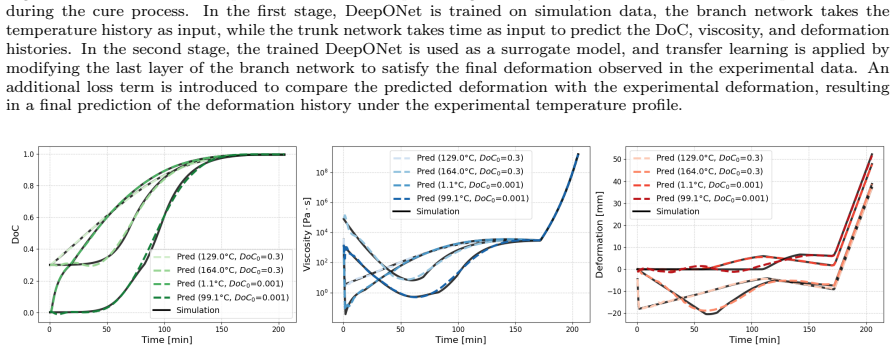
Fiber reinforcement and polymer matrix respond differently to manufacturing conditions due to mismatch in coefficient of thermal expansion and matrix shrinkage during curing of thermosets. These heterogeneities generate residual stresses over multiple length scales, whose partial release leads to process-induced deformation (PID), requiring accurate prediction and mitigation via optimized non-isothermal cure cycles. This study considers a unidirectional AS4 carbon fiber/amine bi-functional epoxy prepreg and models PID using a two-mechanism framework that accounts for thermal expansion/shrinkage and cure shrinkage. The model is validated against manufacturing trials to identify initial and boundary conditions, then used to generate PID responses for a diverse set of non-isothermal cure cycles (time-temperature profiles). Building on this physics-based foundation, we develop a data-driven surrogate based on Deep Operator Networks (DeepONets). A DeepONet is trained on a dataset combining high-fidelity simulations with targeted experimental measurements of PID. We extend this to a Feature-wise Linear Modulation (FiLM) DeepONet, where branch-network features are modulated by external parameters, including the initial degree of cure, enabling prediction of time histories of degree of cure, viscosity, and deformation. Because experimental data are available only at limited time instances (for example, final deformation), we use transfer learning: simulation-trained trunk and branch networks are fixed and only the final layer is updated using measured final deformation. Finally, we augment the framework with Ensemble Kalman Inversion (EKI) to quantify uncertainty under experimental conditions and to support optimization of cure schedules for reduced PID in composites.
Editorial analysis
A structured set of objections, weighed in public.
Referee Report
Summary. The manuscript develops a FiLM DeepONet surrogate trained on high-fidelity simulations from a two-mechanism physics model (thermal expansion/shrinkage plus cure shrinkage) of process-induced deformation in AS4 carbon/epoxy prepreg. Simulation-trained trunk and branch networks are fixed while only the final layer is updated via transfer learning on limited experimental final-deformation measurements; Ensemble Kalman Inversion then provides uncertainty quantification to support cure-schedule optimization for reduced PID.
Significance. If the transfer-learning step demonstrably preserves temporal fidelity, the approach would offer a practical route to fast, uncertainty-aware surrogates for composite manufacturing, combining physics-generated training data with sparse experimental calibration. The combination of operator networks, FiLM modulation by initial degree of cure, and EKI is a coherent methodological contribution to process modeling.
major comments (2)
- [Transfer learning and surrogate architecture] Transfer-learning procedure (abstract and § on surrogate construction): fixing the simulation-trained trunk and branch while retraining only the final layer on final-deformation scalars assumes that the learned features remain aligned with experimental dynamics. The two-mechanism model omits viscoelastic relaxation, resin flow, and fiber-bed compaction; any mismatch in these omitted mechanisms will propagate unchanged into the predicted degree-of-cure and viscosity trajectories, undermining the subsequent EKI uncertainty bands and cure optimization. Quantitative checks of intermediate time histories against any available experimental data or physics-based baselines are required to substantiate the claim.
- [Validation and results] Validation and results sections: the abstract states that the model is validated against manufacturing trials and that transfer learning is used, yet no error metrics (RMSE, MAE on time histories), data-split protocol, or comparison against simpler baselines (e.g., physics-only or standard DeepONet) are reported. Without these, the central assertion that the surrogate “accurately predicts time histories” cannot be assessed and remains the load-bearing gap identified in the stress-test.
minor comments (2)
- [Experimental data description] Clarify the precise experimental data points used for the final-layer update (number of specimens, cure cycles, measurement uncertainty) so readers can judge the information content available to the transfer step.
- [Figures] Figure captions should explicitly state whether plotted curves are simulation, surrogate, or post-transfer predictions to avoid ambiguity when comparing time histories.
Simulated Author's Rebuttal
We thank the referee for the constructive feedback. We address the major comments below and have updated the manuscript with additional metrics, comparisons, and discussion to strengthen the validation of the surrogate model.
read point-by-point responses
-
Referee: [Transfer learning and surrogate architecture] Transfer-learning procedure (abstract and § on surrogate construction): fixing the simulation-trained trunk and branch while retraining only the final layer on final-deformation scalars assumes that the learned features remain aligned with experimental dynamics. The two-mechanism model omits viscoelastic relaxation, resin flow, and fiber-bed compaction; any mismatch in these omitted mechanisms will propagate unchanged into the predicted degree-of-cure and viscosity trajectories, undermining the subsequent EKI uncertainty bands and cure optimization. Quantitative checks of intermediate time histories against any available experimental data or physics-based baselines are required to substantiate the claim.
Authors: We agree that the two-mechanism model has limitations by omitting viscoelastic relaxation, resin flow, and fiber-bed compaction, which is a common simplification in such process models. The high-fidelity simulations were validated against manufacturing trials for final deformation, and the transfer learning calibrates the output to match experimental final values. To substantiate the temporal fidelity, we have added quantitative comparisons of the predicted degree-of-cure and viscosity time histories against the original physics-based simulations (used as baselines) in the revised validation section. Since intermediate experimental time histories are not available, we cannot provide direct experimental checks for those; however, the EKI uncertainty quantification accounts for discrepancies by incorporating the experimental final deformation. We have also added a discussion on these model assumptions and their potential impact. revision: partial
-
Referee: [Validation and results] Validation and results sections: the abstract states that the model is validated against manufacturing trials and that transfer learning is used, yet no error metrics (RMSE, MAE on time histories), data-split protocol, or comparison against simpler baselines (e.g., physics-only or standard DeepONet) are reported. Without these, the central assertion that the surrogate “accurately predicts time histories” cannot be assessed and remains the load-bearing gap identified in the stress-test.
Authors: We have revised the results section to include RMSE and MAE metrics for the predicted time histories of degree of cure, viscosity, and deformation, both for the simulation test set and the transfer-learned experimental cases. The data-split protocol is now detailed: 80% of the simulation dataset for training the DeepONet, 20% for testing, with the experimental final deformation used solely for the transfer learning step on the final layer. Additionally, we have included comparisons to a physics-only model and a standard DeepONet without FiLM conditioning, demonstrating the improvements from our approach. These additions allow assessment of the surrogate's accuracy. revision: yes
- Direct quantitative validation of intermediate time histories against experimental data, as only final deformation measurements are available from the manufacturing trials.
Circularity Check
Minor self-citation to DeepONet method; central predictions remain independent of fitted inputs
full rationale
The derivation trains a FiLM DeepONet on high-fidelity simulations from the two-mechanism physics model (thermal + cure shrinkage), fixes trunk/branch layers, and updates only the final layer via transfer learning on measured final-deformation scalars. Time-history outputs for degree of cure, viscosity, and deformation are generated by the fixed feature extractors rather than being algebraically identical to the scalar endpoint data. No equation reduces the predicted trajectories to the transfer-learning inputs by construction. Self-citation to the original DeepONet architecture (Karniadakis et al.) is present but not load-bearing; the paper supplies independent simulation data, experimental validation of the physics model, and EKI uncertainty quantification outside the fitted layer. This yields a low circularity score consistent with normal methodological reuse.
Axiom & Free-Parameter Ledger
free parameters (1)
- initial degree of cure
axioms (1)
- domain assumption The two-mechanism framework (thermal expansion/shrinkage plus cure shrinkage) sufficiently captures process-induced deformation for the AS4/amine epoxy system.
Forward citations
Cited by 2 Pith papers
-
Multi-Head Residual-Gated DeepONet for Coherent Nonlinear Wave Dynamics
MH-RG DeepONet adds parallel residual-gated conditioning pathways to DeepONet to achieve lower error and better phase coherence on nonlinear wave benchmarks by modulating state predictions with physical descriptors.
-
Multi-fidelity surrogates for mechanics of composites: from co-kriging to multi-fidelity neural networks
A review of multi-fidelity surrogates from co-kriging to neural networks for composite mechanics, with applications in prediction, optimization, and workflow integration.
Reference graph
Works this paper leans on
-
[1]
A. U. Sudhin, M. Remanan, G. Ajeesh, K. Jayanarayanan, Comparison of properties of carbon fiber reinforced thermoplastic and thermosetting composites for aerospace applications, Materials Today: Proceedings 24 (2020) 453–462.doi:10.1016/J.MATPR.2020.04.297
-
[2]
R. E. Murray, R. Beach, D. Barnes, D. Snowberg, D. Berry, S. Rooney, M. Jenks, B. Gage, T. Boro, S. Wallen, et al., Structural validation of a thermoplastic composite wind turbine blade with comparison to a thermoset composite blade, Renewable Energy 164 (2021) 1100–1107
work page 2021
-
[3]
A. M. Deshpande, R. R. Sadiwala, N. Brown, S. A. Pradeep, L. M. Headings, N. Zhao, B. Losey, R. Hahnlen, M. J. Dapino, G. Li, et al., Design and development of a multi-material, cost- competitive, lightweight mid-size sports utility vehicle’s body-in-white, CAMX 2022 (2022) 1–18
work page 2022
-
[4]
A. M. Deshpande, R. Sadiwala, N. Brown, P.-Y. Lavertu, S. A. Pradeep, L. M. Headings, N. Zhao, B. Losey, R. Hahnlen, M. J. Dapino, G. Li, S. Pilla, Design optimization of a multi-material, fiber-reinforced composite-intensive body-in-white of a mid-size suv, in: CAMX 2023 Conference Proceedings, 2023, pp. 1–19.doi:10.33599/NASAMPE/C.23.0169
-
[5]
S.A.Pradeep, A.M.Deshpande, M.Limaye, R.K.Iyer, H.Kazan, G.Li, S.Pilla, Aperspectiveon the evolution of plastics and composites in the automotive industry, Applied Plastics Engineering Handbook (2024).doi:10.1016/B978-0-323-88667-3.00016-3
-
[6]
S. R. White, H. T. Hahn, Cure cycle optimization for the reduction of processing-induced residual stresses in composite materials, http://dx.doi.org/10.1177/002199839302701402 27 (1993) 1352– 1378.doi:10.1177/002199839302701402
-
[7]
C. Li, N. Zobeiry, K. Keil, S. Chatterjee, A. Poursartip, Advances in the characterization of residual stress in composite structures, International SAMPE Technical Conference (01 2014)
work page 2014
-
[8]
L. G. Zhao, N. A. Warrior, A. C. Long, A micromechanical study of residual stress and its effect on transverse failure in polymer–matrix composites, International Journal of Solids and Structures 43 (2006) 5449–5467.doi:10.1016/J.IJSOLSTR.2005.08.012
-
[9]
S. L. Agius, M. Joosten, B. Trippit, C. H. Wang, T. Hilditch, Rapidly cured epoxy/anhydride composites: Effect of residual stress on laminate shear strength, Composites Part A: Applied Science and Manufacturing 90 (2016) 125–136.doi:10.1016/J.COMPOSITESA.2016.06.013
-
[10]
H. T. Hahn, Residual stresses in polymer matrix composite laminates, Journal of Composite Materials 10 (1976) 266–278.doi:10.1177/002199837601000401
-
[11]
S. R. White, C. Kim, A simultaneous lay-up and in situ cure process for thick com- posites, http://dx.doi.org/10.1177/073168449301200503 12 (1993) 520–535.doi:10.1177/ 073168449301200503
-
[12]
D. Li, X. Li, J. Dai, S. Xi, A comparison of curing process-induced residual stresses and cure shrinkage in micro-scale composite structures with different constitutive laws, Applied Composite Materials 25 (2018) 67–84.doi:10.1007/S10443-017-9608-6. 17
-
[13]
A. Ding, S. Li, J. Wang, A. Ni, L. Sun, L. Chang, Prediction of process-induced distortions in l-shaped composite profiles using path-dependent constitutive law, Applied Composite Materials 23 (2016) 1027–1045.doi:10.1007/S10443-016-9501-8
-
[14]
X. Liu, Z. Guan, X. Wang, T. Jiang, K. Geng, Z. Li, Study on cure-induced residual stresses and spring-in deformation of l-shaped composite laminates using a simplified constitutive model con- sidering stress relaxation, Composite Structures 272 (2021) 114203.doi:10.1016/J.COMPSTRUCT. 2021.114203
-
[15]
N. Zobeiry, R. Vaziri, A. Poursartip, Computationally efficient pseudo-viscoelastic models for evaluation of residual stresses in thermoset polymer composites during cure, Composites Part A: Applied Science and Manufacturing 41 (2010) 247–256.doi:10.1016/J.COMPOSITESA.2009.10. 009
-
[16]
X. Li, X. Han, S. Duan, G. R. Liu, A two-stage genetic algorithm for molding parameters opti- mization for minimized residual stresses in composite laminates during curing, Applied Composite Materials 28 (2021) 1315–1334.doi:10.1007/S10443-021-09912-Z/TABLES/10
-
[17]
Q. Wang, X. Yang, X. Zhang, X. Chang, M. Yap, Z. Chen, M. Ren, Effect of cure cycles on residual stressesinthickcompositesusingmulti-physicscoupledanalysiswithmultipleconstitutivemodels, Materials Today Communications 32 (2022) 104094.doi:10.1016/J.MTCOMM.2022.104094
-
[18]
X. Hui, Y. Xu, W. Zhang, W. Zhang, Multiscale collaborative optimization for the thermochem- ical and thermomechanical cure process during composite manufacture, Composites Science and Technology 224 (2022) 109455.doi:10.1016/J.COMPSCITECH.2022.109455
-
[19]
R. Behbahani, H. Y. Sarvestani, E. Fatehi, E. Kiyani, B. Ashrafi, M. Karttunen, M. Rahmat, Machine learning-driven process of alumina ceramics laser machining, Physica Scripta 98 (1) (2022) 015834
work page 2022
-
[20]
T. T. Ademujimi, M. P. Brundage, V. V. Prabhu, A review of current machine learning techniques used in manufacturing diagnosis, in: IFIP International Conference on Advances in Production Management Systems, Springer, 2017, pp. 407–415
work page 2017
-
[21]
S. Y. Park, D. Kang, S. Y. On, S. S. Kim, Machine learning-driven optimization of the cure cycles of self-polymerizing epoxy molding compounds for semiconductor packaging applications, Composite Structures (2025) 119795
work page 2025
-
[22]
E. Kiyani, H. Y. Sarvestani, H. Ravanbakhsh, R. Behbahani, B. Ashrafi, M. Rahmat, M. Kart- tunen, Designing architectured ceramics for transient thermal applications using finite element and deep learning, Modelling and Simulation in Materials Science and Engineering 32 (1) (2023) 015001
work page 2023
-
[23]
Y. Lin, Z. Guan, The use of machine learning for the prediction of the uniformity of the degree of cure of a composite in an autoclave, Aerospace 8 (5) (2021) 130
work page 2021
-
[24]
S. Fan, J. Zhang, B. Wang, J. Chen, W. Yang, W. Liu, Y. Li, A deep learning method for fast predicting curing process-induced deformation of aeronautical composite structures, Composites Science and Technology 232 (2023) 109844
work page 2023
-
[25]
C. Schoenholz, N. Zobeiry, An accelerated process optimization method to minimize deformations in composites using theory-guided probabilistic machine learning, Composites Part A: Applied Science and Manufacturing 176 (2024) 107842
work page 2024
-
[26]
T. Lavaggi, M. Samizadeh, N. Niknafs Kermani, M. M. Khalili, S. G. Advani, Theory-guided ma- chine learning for optimal autoclave co-curing of sandwich composite structures, Polymer Com- posites 43 (8) (2022) 5319–5331.doi:https://doi.org/10.1002/pc.26829
-
[27]
M. Limaye, D. Morgan, A. M. Deshpande, S. A. Pradeep, S. Pilla, G. Li, Use of non-isothermal cure cycles for reducing cure induced deformation in laminated composites, Manufacturing Letters (4 2024).doi:10.1016/J.MFGLET.2024.03.016. 18
-
[28]
Q. Liu, X. Wang, Z. Guan, Z. Li, Rapid prediction and parameter evaluation of process-induced deformation in l-shape structures based on feature selection and artificial neural networks, Journal of Composites Science 8 (11) (2024) 455
work page 2024
- [29]
-
[30]
L. Lu, P. Jin, G. Pang, Z. Zhang, G. E. Karniadakis, Learning nonlinear operators via DeepONet based on the universal approximation theorem of operators, Nature Machine Intelligence (2021) 218–229
work page 2021
-
[31]
M. Lu, C. Lin, M. Maxey, G. E. Karniadakis, Z. Li, Bridging scales in multiscale bubble growth dynamics with correlated fluctuations using neural operator learning, International Journal of Multiphase Flow 180 (2024) 104959
work page 2024
-
[32]
B. Shih, A. Peyvan, Z. Zhang, G. E. Karniadakis, Transformers as neural operators for solu- tions of differential equations with finite regularity, Computer Methods in Applied Mechanics and Engineering 434 (2025) 117560
work page 2025
-
[33]
N. Kovachki, Z. Li, B. Liu, K. Azizzadenesheli, K. Bhattacharya, A. Stuart, A. Anandkumar, Neural operator: Learning maps between function spaces with applications to pdes, Journal of Machine Learning Research 24 (89) (2023) 1–97
work page 2023
-
[34]
L. Liu, K. Nath, W. Cai, A causality-deeponet for causal responses of linear dynamical systems, Communications in Computational Physics (2024) 1194–1228
work page 2024
- [35]
- [36]
-
[37]
Z. Li, N. Kovachki, K. Azizzadenesheli, B. Liu, K. Bhattacharya, A. Stuart, A. Anand- kumar, Fourier neural operator for parametric partial differential equations, arXiv preprint arXiv:2010.08895 (2020)
work page internal anchor Pith review Pith/arXiv arXiv 2010
-
[38]
O. Ronneberger, P. Fischer, T. Brox, U-net: Convolutional networks for biomedical image seg- mentation, in: Medical image computing and computer-assisted intervention–MICCAI 2015: 18th international conference, Munich, Germany, October 5-9, 2015, proceedings, part III 18, Springer, 2015, pp. 234–241
work page 2015
-
[39]
S. Wang, H. Wang, P. Perdikaris, Learning the solution operator of parametric partial differential equations with physics-informed deeponets, Science Advances (2021) eabi8605
work page 2021
- [40]
-
[41]
S. Lee, Y. Shin, On the training and generalization of deep operator networks, SIAM Journal on Scientific Computing 46 (4) (2024) C273–C296
work page 2024
- [42]
- [43]
-
[44]
M. Brockschmidt, Gnn-film: Graph neural networks with feature-wise linear modulation, in: International Conference on Machine Learning, PMLR, 2020, pp. 1144–1152
work page 2020
-
[45]
S. J. Pan, Transfer learning, Learning 21 (2020) 1–2
work page 2020
-
[46]
R. M. Neal, Bayesian learning for neural networks, Vol. 118, Springer Science & Business Media, 2012
work page 2012
-
[47]
D. J. MacKay, A practical bayesian framework for backpropagation networks, Neural computation 4 (3) (1992) 448–472
work page 1992
-
[48]
B. Lakshminarayanan, A. Pritzel, C. Blundell, Simple and scalable predictive uncertainty estima- tion using deep ensembles, Advances in neural information processing systems 30 (2017)
work page 2017
-
[49]
A. G. Wilson, P. Izmailov, M. D. Hoffman, Y. Gal, Y. Li, M. F. Pradier, S. Vikram, A. Foong, S. Lotfi, S. Farquhar, Evaluating approximate inference in bayesian deep learning, in: NeurIPS 2021 Competitions and Demonstrations Track, PMLR, 2022, pp. 113–124
work page 2021
-
[50]
S. Reich, A nonparametric ensemble transform method for bayesian inference, SIAM Journal on Scientific Computing 35 (4) (2013) A2013–A2024
work page 2013
- [51]
- [52]
-
[53]
Z. Gao, G. E. Karniadakis, Scalable bayesian physics-informed kolmogorov-arnold networks, SIAM/ASA Journal on Uncertainty Quantification 13 (3) (2025) 1543–1577
work page 2025
-
[54]
A. Pensoneault, X. Zhu, Uncertainty quantification for deeponets with ensemble kalman inversion, Journal of computational physics 523 (2025) 113670
work page 2025
-
[55]
Z. Liu, Y. Wang, S. Vaidya, F. Ruehle, J. Halverson, M. Soljačić, T. Y. Hou, M. Tegmark, Kan: Kolmogorov-Arnold Networks, arXiv preprint arXiv:2404.19756 (2024)
work page internal anchor Pith review Pith/arXiv arXiv 2024
- [56]
- [57]
-
[58]
D. A. Sprecher, S. Draghici, Space-filling curves and Kolmogorov superposition-based neural net- works, Neural Networks (2002) 57–67
work page 2002
-
[59]
M. Köppen, On the training of a kolmogorov network, in: Artificial Neural Networks—ICANN 2002: International Conference, Madrid, Spain, August 28–30, 2002, 2022, pp. 474–479
work page 2002
-
[60]
L. Sun, S. S. Pang, A. M. Sterling, I. I. Negulescu, M. A. Stubblefield, Thermal analysis of curing process of epoxy prepreg, Journal of Applied Polymer Science 83 (2002) 1074–1083.doi: 10.1002/APP.10053
-
[61]
M. Hargis, B. P. Grady, L. Aktas, K. R. Bomireddy, S. Howsman, M. C. Altan, T. Rose, H. Rose, Calorimetric and rheological measurements of three commercial thermosetting prepreg epoxies, Journal of Composite Materials 40 (2006) 873–897.doi:10.1177/0021998305056380
-
[62]
J. Kim, T. J. Moon, J. R. Howell, Cure kinetic model, heat of reaction, and glass transition tem- peratureofas4/3501-6graphite–epoxyprepregs, http://dx.doi.org/10.1177/0021998302036021712 36 (2002) 2479–2498.doi:10.1177/0021998302036021712. 20
-
[63]
W. I. Lee, A. C. Loos, G. S. Springer, Heat of reaction, degree of cure, and viscosity of hercules 3501-6 resin, http://dx.doi.org/10.1177/002199838201600605 16 (1982) 510–520.doi:10.1177/ 002199838201600605
-
[64]
B. C. Chern, T. J. Moon, J. R. Howell, W. Tan, New experimental data for enthalpy of reaction and temperature- and degree-of-cure-dependent specific heat and thermal conductivity of the hercules 3501-6 epoxy system, http://dx.doi.org/10.1177/0021998302036017238 36 (2002) 2061– 2072.doi:10.1177/0021998302036017238
-
[65]
T. H. Hou, J. M. Bai, A semi-empirical approach for the chemoviscosity modeling of reactive resin system, SAMPE Journal 24 (1988)
work page 1988
-
[66]
M. A. Iglesias, K. J. Law, A. M. Stuart, Ensemble kalman methods for inverse problems, Inverse Problems 29 (4) (2013) 045001
work page 2013
-
[67]
G. Evensen, Sequential data assimilation with a nonlinear quasi-geostrophic model using monte carlo methods to forecast error statistics, Journal of Geophysical Research: Oceans 99 (C5) (1994) 10143–10162. 21
work page 1994
discussion (0)
Sign in with ORCID, Apple, or X to comment. Anyone can read and Pith papers without signing in.