REVIEW 5 major objections 6 minor 59 references
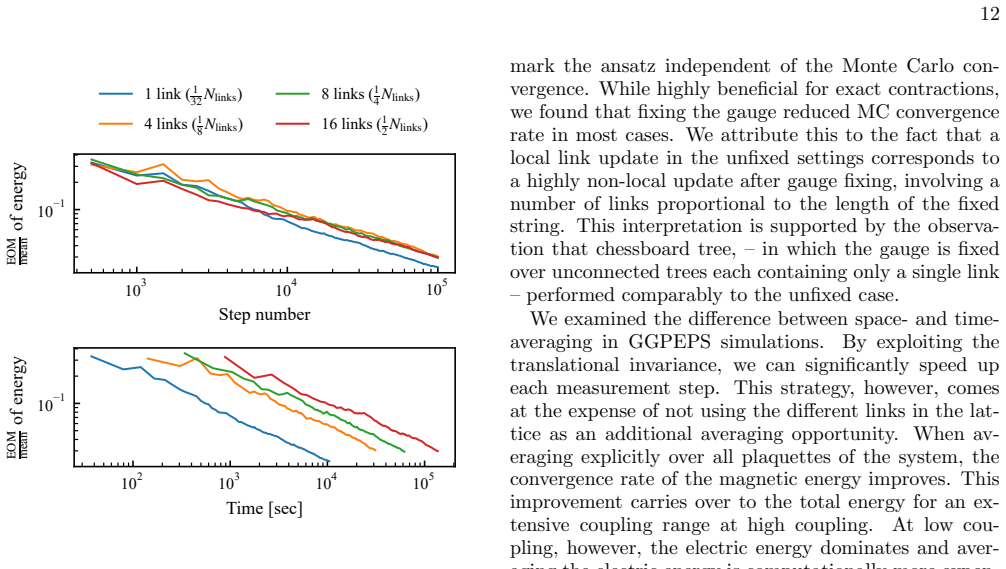
For GGFPEPS variational Monte Carlo on Z2 lattice gauge theory in 2+1 dimensions, the fastest wall-clock convergence comes from updating roughly a quarter to half of the links per MC step, while gauge fixing that reduces exact-contraction c
Reviewed by Pith at T0; open to challenge. T0 means a machine referee read the full paper against a public rubric. the ladder, T0–T4 →
T0 review · deepseek-v4-flash
2026-08-03 16:20 UTC pith:54FF2ZMK
load-bearing objection Useful algorithmic study of GGFPEPS Monte Carlo; the gauge-fixing and exact-contraction results are solid, but the update-size recommendation rests on a narrow parameter scan and EOM curves without error bars. the 5 major comments →
Algorithmic Aspects of Gauged Gaussian Fermionic PEPS: Gauge Fixing and Translation Invariance
The pith
A machine-rendered reading of the paper's core claim, the machinery that carries it, and where it could break.
Core claim
On its own terms, the paper claims that three algorithmic choices control the efficiency of GGFPEPS variational Monte Carlo for a Z2 lattice gauge theory with dynamical fermions in 2+1 dimensions. First, there is an optimal update size: updating 1/4 to 1/2 of the links per step balances reduced autocorrelation against the sequential cost of local updates, giving the fastest decay of the error on the mean in wall-clock time. Second, gauge fixing over trees is a valid reduction because both the weight and the observables are pure-gauge invariant; it reduces exact-contraction cost from O(|G|^N_links) to O(|G|^(N_links/2+1)), enabling exact 4x4 Z2 contraction, but it generally slows MC convergen
What carries the argument
The machinery is the GGFPEPS representation, in which the state is expanded as a sum or integral over gauge configurations, |Psi> = Integral DG |G>|psi(G)>, so the weight p(G) = <psi(G)|psi(G)>/Z is non-negative and can be computed efficiently from fermionic covariance matrices. Monte Carlo updates are made affordable by the Woodbury matrix identity and the matrix determinant lemma, which update the weight and inverse covariance after a local link change in O(N^2) instead of O(N^3). Gauge fixing works through a pure-gauge transformation h(x) that pins tree links to the identity, removing roughly half the links from the configuration sum. The central mechanism behind the gauge-fixing slowdown
Load-bearing premise
The paper's recommendations assume that the tested settings—Z2 gauge group, 2+1D square lattice with periodic boundaries, couplings g_int=g_mass=1 and g_E=1/g_B in roughly 0.39–1.25, and the specific ansatz parameters—are representative enough that the observed rankings (update-size optimum of 1/4 to 1/2 of links, gauge fixing slowing MC, single-link electric-energy averaging winning) are general GGFPEPS properties rather than artifacts of these runs.
What would settle it
Run the same update-size scan on a 6x6 Z2 GGFPEPS at g_E=1/g_B=0.39, measuring error-on-the-mean versus wall time for 1/8, 1/4, 1/2, and 3/4-of-links updates: if the fastest fraction leaves the 1/4–1/2 window, the headline recipe fails. For gauge fixing, compare exact-contraction wall time at 4x4 and 6x6 with and without maximal-tree fixing to test the claimed square-root scaling, and for a fixed-row tree verify directly that a one-link flip in the unfixed space requires a row-length number of link changes in the fixed space.
If this is right
- Future GGFPEPS ground-state searches can use 1/4 to 1/2 link updates per step as a default starting point, the update range that won the wall-clock error-on-the-mean comparison across tested lattice sizes and couplings.
- Gauge fixing makes exact contraction of 4x4 Z2 systems feasible, providing an MC-independent benchmark for the ansatz and a debugging tool that does not suffer from sampling errors.
- The gauge-fixing slowdown can be largely avoided by fixing disconnected single-link trees (the chessboard pattern), which nearly matches unfixed MC convergence while still reducing the configuration count.
- The paper's recipe for total-energy sampling is to average the magnetic energy over all plaquettes and the electric energy over a single link, combining the better convergence behavior of each.
- Together these choices shift the practical scale limit of GGFPEPS variational studies, potentially enabling larger lattices and, later, extensions to higher dimensions or non-Abelian gauge groups.
Where Pith is reading between the lines
- If the update-size optimum is controlled by the ratio of per-link update cost to per-step autocorrelation decay rather than by the gauge group itself, then for larger bond dimensions or non-Abelian groups the same wall-clock analysis is the right way to pick the fraction, even if the numerical optimum shifts.
- The results suggest a two-track workflow: gauge-fixed exact contraction for benchmarking and debugging, and unfixed or chessboard-fixed Monte Carlo for production runs, so that the two techniques complement rather than compete.
- The electric-energy result hints that observables whose evaluation is not memory-bound should be spatially averaged only when per-site cost is negligible; otherwise single-site sampling wins, so future implementations should optimize observable evaluation before adding averaging.
- Because the connected-tree gauge-fixing penalty grows linearly with the length of the fixed string, its Monte Carlo slowdown likely worsens with system size; testing this scaling explicitly would sharpen the practical recommendation.
Editorial analysis
A structured set of objections, weighed in public.
Referee Report
Summary. The paper studies algorithmic choices in variational Monte Carlo simulations with gauged Gaussian fermionic projected entangled pair states (GGFPEPS), for the Z2 lattice gauge theory in 2+1 dimensions. It develops a gauge-fixing construction over trees, claims a reduction of exact-contraction cost from O(|G|^{N_links}) to O(|G|^{N_links/2+1}), and reports numerical experiments on update-step size, gauge-fixed sampling, and spatial averaging of energy observables. The main reported findings are: an optimal update size of roughly 1/4 to 1/2 of the lattice links per step in wall-clock time; gauge fixing generally slows Monte Carlo convergence; and not exploiting translation invariance for electric-energy measurement can improve time-to-error in some cases.
Significance. If the numerical conclusions hold, the paper provides practical recipes for making GGFPEPS variational searches more efficient and larger-scale, a direction that is relevant to the field. The gauge-fixing construction in Appendices A and B is coherent: the transformation of |ψ(G)⟩ under pure gauge transformations is derived explicitly, and the square-root reduction in exact-contraction complexity is concrete and plausible. The 'chessboard' tree idea is a useful insight, and the paper correctly identifies a trade-off between per-step decorrelation and per-step cost. The main weakness is that the numerical support for the headline recommendations is narrow and lacks statistical characterization; the general claims in the abstract and conclusions are stronger than the evidence presented.
major comments (5)
- [§VI, Fig. 3] The central recommendation of an 'optimal update size' of 1/4 to 1/2 of links per step is based on a single setting: g_int = g_mass = 1, g_E = 1/g_B = 1.25, and unspecified ansatz parameters/bond dimension. No scan over λ or bond dimension is reported, although the per-step cost, autocorrelation time, and EOM all depend on these. The EOM curves are single-chain point estimates (based on Eq. (30) with an autocorrelation cutoff of 10^-2), and differences between 1/4, 1/2, and 3/4 of links are not shown to be statistically significant. This does not yet establish a general property of GGFPEPS MC; it establishes a property of the tested runs. The abstract should be correspondingly qualified, or additional scans and error bars should be provided.
- [§V, Eq. (30)] The entire numerical comparison relies on the EOM estimator defined by rebinning with a decay-time cutoff of 10^-2. The autocorrelation often only decays to the 10^-2 to 10^-3 level before fluctuating, so the estimated τ and hence the rebinned EOM are sensitive to this ad hoc cutoff. No error bars on the EOM values are given, and no multiple independent chains are reported. The ordering of curves in Figs. 3, 6, 7, 8, 12, and 13 may therefore not be statistically robust. This issue is load-bearing because the paper's practical recommendations are all derived from these orderings.
- [§VII, Figs. 5–8] The claim that 'gauge fixing generally slows MC convergence' is stronger than the data support. The tested trees are a maximal tree, fixed rows, and a chessboard tree. Fig. 7 shows that for many λ values the chessboard tree is comparable to or slightly better than no gauge fixing, and the EOM values have no error bars. The qualitative explanation in terms of non-local updates after fixing is plausible and supported by Fig. 9, but the quantitative claim of a 'general' slowdown needs either a more systematic parameter scan or a more cautious wording ('in the settings studied here').
- [§VI–§VIII, numerical setup] The paper does not specify the bond dimension (number of virtual copies μ per leg), the ansatz parameter values at which the simulations are run, or the exact warm-up and measurement protocols beyond '10^5 warmup steps and 10^5 measurement steps'. These details are essential for assessing the transferability of the update-size and averaging recommendations, and for reproducibility. Citations to Refs. [42,44] are not sufficient, since the algorithmic conclusions depend on these implementation choices.
- [§VII, exact contraction] The paper claims that gauge fixing 'makes it possible' to run 4×4 Z2 exact-contraction ground-state searches, but no exact-contraction results, timings, or demonstration are reported. The complexity reduction from O(|G|^{N_links}) to O(|G|^{N_links/2+1}) is a solid theoretical statement, but the practical feasibility claim would benefit from at least one actual 4×4 exact-contraction computation or timing benchmark.
minor comments (6)
- [Eq. (37)] The denominator in F_Mf(G) is written as '⟨ψ(G)|ψ(G)|ψ(G)|ψ(G)⟩' and should be '⟨ψ(G)|ψ(G)⟩'.
- [§IX] Typo: 'Monte Calro' should be 'Monte Carlo'.
- [Fig. 8 caption] 'The last data point of maximal tree for λ=2 was committed for clarity' should presumably read 'omitted'.
- [Fig. 10 caption] Typo: 'couplindsg' and 'plaquttes' should be 'couplings' and 'plaquettes'.
- [Fig. 15 caption] The sentence 'The colors indicate which link each operator acts on.' is repeated twice.
- [§V] Typo: 'samples samples' should be 'samples'.
Circularity Check
No significant circularity: the main claims are empirical measurements, not derived quantities; self-citations supply background and implementation, not the conclusions.
full rationale
The paper's central claims are empirical observations about Monte Carlo convergence: the optimal update size is read off from EOM-versus-time scans (Figs. 2–3, 10–13), gauge-fixing slowdown is quantified by direct autocorrelation and EOM comparisons (Figs. 5–8), and the translation-invariance trade-off is measured in the same way. None of these conclusions is a fitted input renamed as a prediction, and none is forced by the definition of the estimator. The exact-contraction speedup is a counting argument: fixing a maximal tree leaves about N_links/2 + 1 links to sum over, giving O(|G|^{N_links/2+1}) (Sec. VII). The gauge-fixing validity proof is essentially self-contained (Appendices A–B; Eqs. 33–38). The paper does rely on the same group's earlier GGFPEPS papers [40–44] for the ansatz and covariance-matrix formalism, but this is background/implementation, not the load-bearing step for the new algorithmic conclusions. No uniqueness theorem is invoked, and no ansatz is smuggled in to force the measured rankings. The main limitations—single gauge group, restricted coupling range, and the absence of error bars on EOM figures—are external-validity or estimation concerns, not circularity under the stated criteria. Therefore no circular step can be exhibited, and the appropriate score is 0.
Axiom & Free-Parameter Ledger
free parameters (4)
- Autocorrelation decay factor defining tau =
10^-2
- Warmup and measurement phase lengths =
10^5 warmup, 10^5 measurement (Section VII); other runs use variable lengths
- Hamiltonian coupling set =
g_int=1, g_mass=1, g_E=1/g_B=0.39 and 1.25; lambda=g_E^2=2/g_B scanned up to 2
- Error estimator rebinning =
n_B=floor(N/tau)
axioms (6)
- domain assumption GGFPEPS ansatz construction and covariance-matrix evaluation of weights/observables (Eqs. (13)-(25)) are correct.
- domain assumption p(G)=<psi(G)|psi(G)>/Z is a real positive normalized probability distribution for all G.
- standard math Standard matrix determinant lemma and Woodbury identity can be applied sequentially for local updates without numerical instability.
- domain assumption The Metropolis-Hastings chain over link configurations is ergodic and satisfies detailed balance for arbitrary update block sizes.
- domain assumption Pure gauge transformations map |psi(G)> to U-hat|psi(G)> with U-hat the product of local matter rotations (Eq. (B2)).
- domain assumption A maximal tree on the periodic lattice leaves exactly the holonomy degrees unfixed, giving the stated square-root reduction.
read the original abstract
Lattice gauge theories (LGTs) provide a powerful framework for studying non-perturbative phenomena in gauge theories. However, conventional approaches such as Monte Carlo (MC) simulations in imaginary time are limited, as they do not allow real time evolution and suffer from a sign problem in many important cases. Using Gauged Gaussian fermionic projected entangled pair states (GGFPEPS) as a variational ground state ansatz offers an alternative for studying LGTs through a sign-problem-free variational MC. As this method is extended to larger and more complex systems, understanding its numerical behavior becomes essential. While conventional action based MC has been extensively studied, the performance and characteristics of non-action-based MC within the GGFPEPS framework are far less explored. In this work, we investigate these algorithmic aspects, identifying an optimal update size for GGFPEPS-based MC simulations for $\mathbb{Z}_2$ in $2+1$ dimensions. We show that gauge fixing generally slows convergence, and demonstrate that not exploiting the translation-invariance can, in some cases, improve the computational time scaling of error convergence. We expect that these improvements will allow advancing the simulation to larger and more complex systems.
Figures




Reference graph
Works this paper leans on
-
[1]
When moving along the linkg(x, i) in the positive direction, +ˆei, we set h(x+ˆei) =g −1 (x, i)h(x).(A4)
-
[2]
When moving along the same link in the negative direction,−ˆei, we set h(x−ˆei) =g(x, i)h(x).(A5) This process is demonstrated in Fig. 14. This recursive process ensures that all links along the tree are eventually fixed to the identity. The specific structure of the tree ensures that we can choose paths in such a way that no two different paths arrive at...
-
[3]
M. E. Peskin and D. V. Schroeder,An Introduction to Quantum Field Theory(Addison-Wesley Pub. Co, Read- ing, Mass, 1995)
1995
-
[4]
Fradkin,Field Theories of Condensed Matter Physics, Field Theories of Condensed Matter Physics (Cambridge University Press, 2013)
E. Fradkin,Field Theories of Condensed Matter Physics, Field Theories of Condensed Matter Physics (Cambridge University Press, 2013)
2013
-
[5]
Savary and L
L. Savary and L. Balents, Quantum spin liquids: A re- view, Reports on Progress in Physics80, 016502 (2016)
2016
-
[6]
D. J. Gross and F. Wilczek, Asymptotically Free Gauge Theories. I, Physical Review D8, 3633 (1973)
1973
-
[7]
K. G. Wilson, Confinement of quarks, Phys. Rev. D10, 2445 (1974)
1974
-
[8]
Greensite, The confinement problem in lattice gauge theory, Progress in Particle and Nuclear Physics51, 1 (2003)
J. Greensite, The confinement problem in lattice gauge theory, Progress in Particle and Nuclear Physics51, 1 (2003)
2003
-
[9]
K. G. Wilson, Confinement of quarks, Physical Review D10, 2445 (1974)
1974
-
[10]
Kogut and L
J. Kogut and L. Susskind, Hamiltonian formulation of Wilson’s lattice gauge theories, Physical Review D11, 395 (1975)
1975
-
[11]
J. B. Kogut, An introduction to lattice gauge theory and spin systems, Reviews of Modern Physics51, 659 (1979)
1979
-
[12]
Creutz, Monte Carlo study of quantized SU(2) gauge theory, Physical Review D21, 2308 (1980)
M. Creutz, Monte Carlo study of quantized SU(2) gauge theory, Physical Review D21, 2308 (1980)
1980
-
[13]
Creutz, L
M. Creutz, L. Jacobs, and C. Rebbi, Monte Carlo com- putations in lattice gauge theories, Physics Reports95, 201 (1983)
1983
-
[14]
J. I. Cirac and F. Verstraete, Renormalization and ten- sor product states in spin chains and lattices, Journal of Physics A: Mathematical and Theoretical42, 504004 (2009)
2009
-
[15]
Or´ us, A practical introduction to tensor networks: Matrix product states and projected entangled pair states, Annals of Physics349, 117 (2014)
R. Or´ us, A practical introduction to tensor networks: Matrix product states and projected entangled pair states, Annals of Physics349, 117 (2014)
2014
-
[16]
J. I. Cirac, D. P´ erez-Garc ´ ıa, N. Schuch, and F. Ver- straete, Matrix product states and projected entangled pair states: Concepts, symmetries, theorems, Rev. Mod. Phys.93, 045003 (2021)
2021
-
[17]
M. B. Hastings, An area law for one-dimensional quan- tum systems, Journal of Statistical Mechanics: Theory and Experiment2007, P08024 (2007), arxiv:0705.2024 [cond-mat, physics:math-ph, physics:quant-ph]
Pith/arXiv arXiv 2007
-
[18]
S. R. White, Density matrix formulation for quantum renormalization groups, Physical Review Letters69, 2863 (1992)
1992
-
[19]
Fannes, B
M. Fannes, B. Nachtergaele, and R. F. Werner, Finitely correlated states on quantum spin chains, Communica- tions in Mathematical Physics144, 443 (1992)
1992
-
[20]
Eisert, M
J. Eisert, M. Cramer, and M. B. Plenio, Colloquium: Area laws for the entanglement entropy, Rev. Mod. Phys. 82, 277 (2010)
2010
-
[21]
Schollw¨ ock, The density-matrix renormalization group in the age of matrix product states, Annals of Physics 326, 96 (2011)
U. Schollw¨ ock, The density-matrix renormalization group in the age of matrix product states, Annals of Physics 326, 96 (2011)
2011
-
[22]
M. Ba˜ nuls, K. Cichy, J. Cirac, and K. Jansen, The mass spectrum of the Schwinger model with matrix product states, Journal of High Energy Physics2013, 10.1007/JHEP11(2013)158 (2013)
-
[23]
B. Buyens, J. Haegeman, K. Van Acoleyen, H. Ver- schelde, and F. Verstraete, Matrix Product States for Gauge Field Theories, Physical Review Letters113, 10.1103/PhysRevLett.113.091601 (2014)
-
[24]
E. Rico, T. Pichler, M. Dalmonte, P. Zoller, and S. Mon- tangero, Tensor Networks for Lattice Gauge Theories and Atomic Quantum Simulation, Physical Review Letters 112, 10.1103/PhysRevLett.112.201601 (2014)
-
[25]
S. K¨ uhn, E. Zohar, J. I. Cirac, and M. C. Ba˜ nuls, Non- Abelian string breaking phenomena with matrix product states, Journal of High Energy Physics2015, 130 (2015), arxiv:1505.04441
Pith/arXiv arXiv 2015
-
[26]
M. C. Ba˜ nuls, K. Cichy, J. I. Cirac, K. Jansen, and H. Saito, Thermal evolution of the Schwinger model with matrix product operators, Physical Review D92, 034519 (2015), arxiv:1505.00279 [hep-lat]
Pith/arXiv arXiv 2015
-
[27]
Pichler, M
T. Pichler, M. Dalmonte, E. Rico, P. Zoller, and S. Mon- tangero, Real-Time Dynamics in U(1) Lattice Gauge Theories with Tensor Networks, Phys. Rev. X6, 011023 (2016)
2016
-
[28]
B. Buyens, F. Verstraete, and K. Van Acoleyen, Hamil- tonian simulation of the Schwinger model at finite temperature, Physical Review D94, 10.1103/Phys- RevD.94.085018 (2016)
doi:10.1103/phys- 2016
-
[29]
Dalmonte and S
M. Dalmonte and S. Montangero, Lattice gauge theory simulations in the quantum information era, Contempo- rary Physics57, 388 (2016)
2016
-
[30]
M. C. Ba˜ nuls, R. Blatt, J. Catani, A. Celi, J. I. Cirac, M. Dalmonte, L. Fallani, K. Jansen, M. Lewenstein, S. Montangero, C. A. Muschik, B. Reznik, E. Rico, 15 Even Odd Odd EvenOdd Odd Even Odd Odd a) Even Even OddEven OddEven Even OddEven Even b) Odd FIG. 15. Illustration of the transformation of|ψ(G)⟩under a gauge transformation as defined by Eq. (33...
2020
-
[31]
M. C. Ba˜ nuls and K. Cichy, Review on novel methods for lattice gauge theories, Reports on Progress in Physics 83, 024401 (2020)
2020
-
[32]
N. Schuch, M. M. Wolf, F. Verstraete, and J. I. Cirac, Computational Complexity of Projected Entangled Pair States, Physical Review Letters98, 140506 (2007), arxiv:quant-ph/0611050
Pith/arXiv arXiv 2007
-
[33]
Tagliacozzo and G
L. Tagliacozzo and G. Vidal, Entanglement renormaliza- tion and gauge symmetry, Physical Review B83, 115127 (2011)
2011
-
[34]
Tagliacozzo, A
L. Tagliacozzo, A. Celi, and M. Lewenstein, Tensor Networks for Lattice Gauge Theories with Continuous Groups, Phys. Rev. X4, 041024 (2014)
2014
-
[35]
S. P. G. Crone and P. Corboz, Detecting aZ 2 topo- logically ordered phase from unbiased infinite projected entangled-pair state simulations, Physical Review B101, 115143 (2020)
2020
-
[36]
Robaina, M
D. Robaina, M. C. Ba˜ nuls, and J. I. Cirac, Simulating 2 + 1 D Z 3 Lattice Gauge Theory with an Infinite Projected Entangled-Pair State, Physical Review Letters 126, 050401 (2021)
2021
-
[37]
Felser, P
T. Felser, P. Silvi, M. Collura, and S. Montangero, Two- Dimensional Quantum-Link Lattice Quantum Electrody- namics at Finite Density, Physical Review X10, 041040 (2020)
2020
-
[38]
Magnifico, T
G. Magnifico, T. Felser, P. Silvi, and S. Montangero, Lat- tice quantum electrodynamics in (3+1)-dimensions at fi- nite density with tensor networks, Nature Communica- tions12, 3600 (2021)
2021
-
[39]
Montangero, E
S. Montangero, E. Rico, and P. Silvi, Loop-free tensor networks for high-energy physics, Philosophical Transac- tions of the Royal Society A: Mathematical, Physical and Engineering Sciences380, 20210065 (2022)
2022
-
[40]
Cataldi, G
G. Cataldi, G. Magnifico, P. Silvi, and S. Montangero, Simulating (2 + 1)D su(2) yang-mills lattice gauge theory at finite density with tensor networks, Phys. Rev. Res.6, 033057 (2024)
2024
-
[41]
T. Spriggs, E. Greplova, J. Carrasquilla, and J. Nys, Accurate ground states ofsu(2) lattice gauge theory in 2+1d and 3+1d (2025), arXiv:2509.12323 [hep-lat]
arXiv 2025
-
[42]
Zohar and J
E. Zohar and J. I. Cirac, Combining tensor networks with monte carlo methods for lattice gauge theories, Phys. Rev. D97, 034510 (2018)
2018
-
[43]
Emonts, M
P. Emonts, M. C. Ba˜ nuls, I. Cirac, and E. Zohar, Vari- ational monte carlo simulation with tensor networks of a pure𭟋 3 gauge theory in (2 + 1)D, Phys. Rev. D102, 074501 (2020)
2020
-
[44]
Emonts, A
P. Emonts, A. Kelman, U. Borla, S. Moroz, S. Gazit, and E. Zohar, Finding the ground state of a lattice gauge the- ory with fermionic tensor networks: A 2 + 1D𭟋 2 demon- stration, Phys. Rev. D107, 014505 (2023)
2023
-
[45]
Kelman, U
A. Kelman, U. Borla, I. Gomelski, J. Elyovich, G. Roose, 16 P. Emonts, and E. Zohar, Gauged gaussian projected en- tangled pair states: A high dimensional tensor network formulation for lattice gauge theories, Phys. Rev. D110, 054511 (2024)
2024
-
[46]
A. Kelman, U. Borla, P. Emonts, and E. Zohar, Projected entangled pair states for lattice gauge theories with dy- namical fermions (2024), arXiv:2412.16951 [hep-lat]
Pith/arXiv arXiv 2024
-
[47]
Bravyi, Lagrangian representation for fermionic linear optics, Quantum Info
S. Bravyi, Lagrangian representation for fermionic linear optics, Quantum Info. Comput.5, 216–238 (2005)
2005
-
[48]
Susskind, Lattice fermions, Phys
L. Susskind, Lattice fermions, Phys. Rev. D16, 3031 (1977)
1977
-
[49]
Kogut and L
J. Kogut and L. Susskind, Hamiltonian formulation of wilson’s lattice gauge theories, Phys. Rev. D11, 395 (1975)
1975
-
[50]
Metropolis, A
N. Metropolis, A. W. Rosenbluth, M. N. Rosenbluth, A. H. Teller, and E. Teller, Equation of State Calculations by Fast Computing Machines, The Journal of Chemical Physics21, 1087 (1953)
1953
-
[51]
M. E. J. Newman and G. T. Barkema,Monte Carlo Meth- ods in Statistical Physics(Oxford University Press, Ox- ford, 1999)
1999
-
[52]
W. Janke, Statistical analysis of simulations: Data cor- relations and error estimation, inQuantum Simulations of Complex Many-Body Systems: From Theory to Algo- rithms, NIC Series, Vol. 10, edited by J. Grotendorst, D. Marx, and A. Muramatsu (John von Neumann Insti- tute for Computing, J¨ ulich, 2002) pp. 423–445
2002
-
[53]
A. W. Sandvik, Computational studies of quantum spin systems, AIP Conference Proceedings1297, 135 (2010), https://pubs.aip.org/aip/acp/article- pdf/1297/1/135/11407753/135 1 online.pdf
2010
-
[54]
Wolff, Collective Monte Carlo updating for spin sys- tems, Phys
U. Wolff, Collective Monte Carlo updating for spin sys- tems, Phys. Rev. Lett.62, 361 (1989)
1989
-
[55]
R. H. Swendsen and J.-S. Wang, Nonuniversal critical dynamics in Monte Carlo simulations, Phys. Rev. Lett. 58, 86 (1987)
1987
-
[56]
N. J. Higham,Accuracy and Stability of Numerical Algo- rithms, 2nd ed. (Society for Industrial and Applied Math- ematics, Philadelphia, 2002)
2002
-
[57]
D. A. Harville,Matrix Algebra from a Statistician ’s Per- spective(Springer, New York, 1997)
1997
-
[58]
Vladikas, Monte carlo simulations and gauge fixing, Physics Letters B169, 93 (1986)
A. Vladikas, Monte carlo simulations and gauge fixing, Physics Letters B169, 93 (1986)
1986
-
[59]
Lautrup, M
B. Lautrup, M. Lavelle, M. Tuite, and A. Vladikas, Stochastic quantisation and gauge fixing in lattice gauge theories, Nuclear Physics B290, 188 (1987)
1987
discussion (0)
Sign in with ORCID, Apple, or X to comment. Anyone can read and Pith papers without signing in.