REVIEW 3 major objections 6 minor 5 cited by
Sparse-LaViDa claims that masked discrete diffusion models can be accelerated about 2x by truncating masked tokens at each sampling step, using 64 register tokens to stand in for dropped positions and a step-causal attention mask to keep tr
Reviewed by Pith at T0; open to challenge. T0 means a machine referee read the full paper against a public rubric. the ladder, T0–T4 →
T0 review · deepseek-v4-flash
2026-08-03 16:16 UTC pith:EXSBQNCL
load-bearing objection Solid efficiency work on masked diffusion acceleration, but the 'equivalent parameterization' claim is undercut by the authors' own no-training ablation. the 3 major comments →
Sparse-LaViDa: Sparse Multimodal Discrete Diffusion Language Models
The pith
A machine-rendered reading of the paper's core claim, the machinery that carries it, and where it could break.
Core claim
The paper claims that masked discrete diffusion sampling can be made sparse without changing the underlying diffusion objective. Since a masked token only signals 'this position is not yet revealed,' a partially masked sequence can be written as the clean tokens with their positional embeddings plus the total sequence length, which implicitly fixes all masked locations. Truncating masked tokens outright hurts image quality, so Sparse-LaViDa appends 64 register tokens—special vocabulary entries at fixed positions after the sequence—as compact learned surrogates for the removed masked tokens. The model is fine-tuned with a step-causal attention mask that mirrors the KV-cached inference procedu
What carries the argument
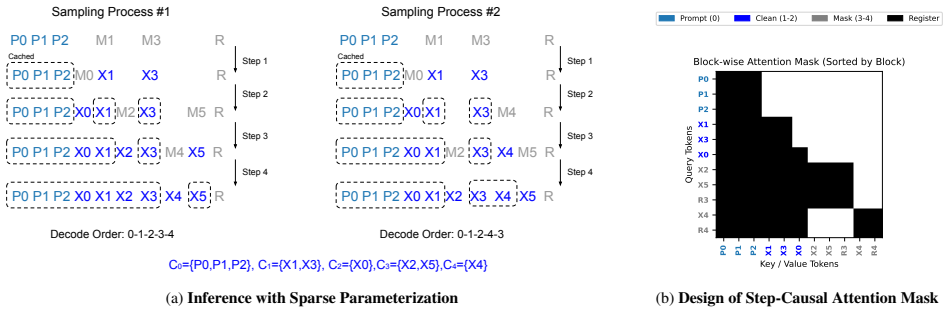
Three components carry the argument. (1) Sparse parameterization: at each sampling step only the prompt, cached decoded tokens, and the subset of masked tokens to decode are fed to the network; other masked positions are dropped. (2) Register tokens: 64 special tokens with distinct positional embeddings appended after the sequence serve as compressed representations of the truncated masked tokens; they attend to everything, while decode tokens and other registers attend to them. (3) Step-causal attention mask: during training the sequence is partitioned into prompt/clean/masked blocks with block-wise attention rules that simulate arbitrary KV-cache sampling paths in a single pass, closing th
Load-bearing premise
The load-bearing premise, stated in Sec. 3.1, is that masked tokens carry no information beyond marking a position as masked, so 64 fixed register tokens can stand in for any number of truncated masked tokens without losing needed context; the paper's own ablations show this premise only holds after fine-tuning (without it, GenEval collapses from 0.77 to 0.24) and that understanding quality still drops on MME (488 to 450) after fine-tuning.
What would settle it
The paper's Table 8 nearly falsifies the central premise at initialization: running the sparse pipeline on the pretrained dense base model without fine-tuning collapses GenEval from 0.77 to 0.24, so 'masked tokens carry no substantive information' is only true after step-causal fine-tuning re-learns the representation. A decisive experiment would be to take the fine-tuned Sparse-LaViDa and, on a fixed prompt set, swap the 64 register tokens for the actual truncated masked tokens at a mid-sampling step; if outputs change measurably (e.g., GenEval or DPG shifts beyond noise), then registers are
If this is right
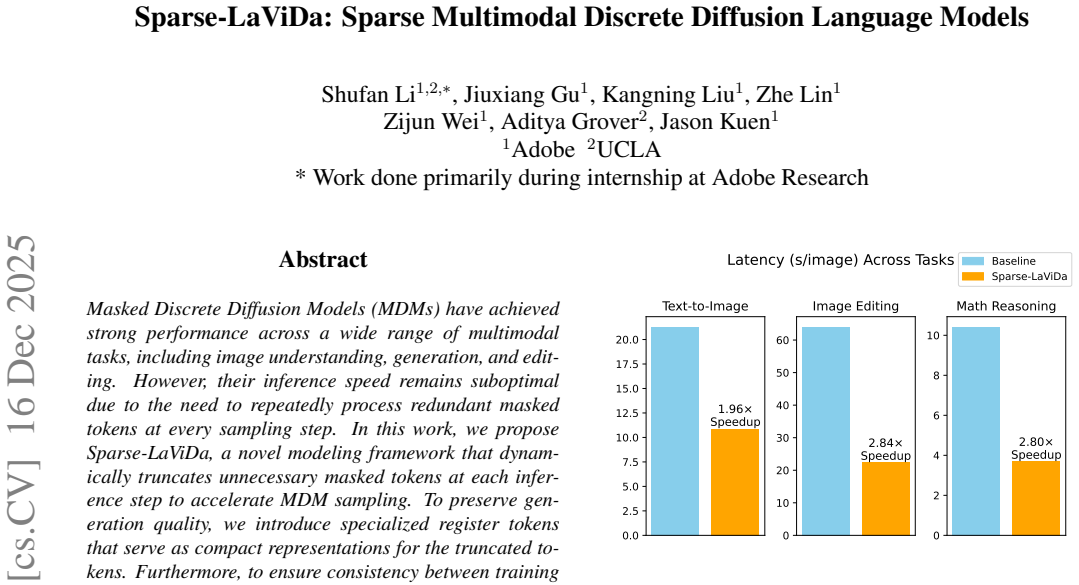
- Latency for text-to-image generation drops from 21.27s to 10.86s (1.95x), image editing from 63.98s to 22.55s (2.83x), and MathVista reasoning from 10.41s to 3.72s (2.80x) on a single A100.
- Generation quality is preserved or slightly improved: GenEval 0.78 vs 0.77, DPG 82.4 vs 81.8, and ImgEdit 3.79 vs 3.71.
- Because decoding order is no longer constrained to left-to-right, the model keeps bidirectional context and can still perform inpainting/outpainting, parallel grounding, and constrained captioning, unlike block-causal diffusion approaches.
- The method is a generalization of the standard MDM: if no masked tokens are truncated, Sparse-LaViDa reduces to the dense parameterization.
- Speedup applies mainly to long generations such as 1024-token reasoning or 4096-token images; short-answer tasks gain little because their output fits in a single block.
Where Pith is reading between the lines
- The paper only fine-tunes an existing dense model, but if the sparse parameterization holds when trained from scratch, it would likely also reduce pretraining cost, not just inference cost.
- Register tokens can be read as a learned summary of the context that truncated masked tokens would have supplied; a natural extension is to let the number or placement of registers adapt per step or per task rather than fixing 64 at the end of the sequence.
- Because decoding order is arbitrary, the approach could combine with confidence-based dynamic unmasking for text generation, potentially removing the block-size constraint of semi-autoregressive sampling.
- A testable extension is to apply the same truncation idea to video or higher-resolution images, where per-frame masked-token overhead is even larger.
Editorial analysis
A structured set of objections, weighed in public.
Referee Report
Summary. Masked diffusion models (MDMs) must process all masked tokens at every sampling step, limiting inference speed. Sparse-LaViDa addresses this by truncating masked tokens, introducing 64 register tokens as compressed placeholders, and training with a step-causal attention mask that enables KV caching while preserving bidirectional context and arbitrary unmasking order. Built on the 10.4B LaViDa-O, the method reports end-to-end speedups of 1.95x on text-to-image generation (21.27s→10.86s), 2.83x on image editing (63.98s→22.55s), and 2.80x on MathVista (10.41s→3.72s), with maintained/slightly improved generation quality on GenEval, DPG, MJHQ-30k, and ImgEdit. The authors also report competitive results on image understanding, object grounding, and bidirectional-context tasks. The method requires supervised fine-tuning (100k steps, 64 H100 GPUs) and is positioned as a post-training acceleration of LaViDa-O.
Significance. If the reported results hold, the paper makes a practically significant contribution: it demonstrates that MDM sampling can be accelerated by truncating masked tokens without imposing a left-to-right block-causal order, thus retaining the bidirectional-context advantages that are essential for image generation, editing, and infilling. The speedups are large (1.95–2.84x), measured end-to-end, and the generation-quality evidence is reasonably strong: multiple benchmarks, multiple metrics, and a same-data comparison (LaViDa-O* FID 8.11 vs. Sparse-LaViDa 7.63) support the empirical claim. The ablations in Tables 6–8 are well designed and isolate the contributions of caching, truncation, registers, and the step-causal mask. The main weaknesses are overstated equivalence and unaddressed understanding-quality regressions, which are fixable in revision.
major comments (3)
- [Sec. 3.1, Sec. 2.2, Table 8] The paper's central premise is that masked tokens 'carry no substantive information beyond indicating that a position was masked,' and that Sparse-LaViDa is 'an alternative parameterization' that preserves MDM properties 'without any quality compromise or training–inference gap.' The 'No Training' row in Table 8 contradicts this: applying the sparse pipeline to pretrained LaViDa-O without SFT collapses GenEval from 0.77 to 0.24 and DPG from 81.8 to 47.9. An information-equivalent reparameterization would not require fine-tuning to avoid catastrophic degradation. The recovery after SFT shows learned adaptation, not equivalence. Sec. 7.2 only proves reduction to the dense case when C=B, not equivalence for C⊂B. Please provide a formal equivalence condition or reframe the method as a trained sparse approximation.
- [Table 5, Sec. 4.4/5] The claim of maintaining quality 'without any quality compromise' is not supported by the understanding benchmarks. Relative to LaViDa-O, Sparse-LaViDa drops on MME (488→450), MMMU (45.1→43.6), and MMB (76.4→75.0), while improving ChartQA, DocVQA, and MathVerse. The text calls these results 'competitive' but does not discuss the systematic drop on three general-purpose suites. Since Sec. 4.4 and the Limitations acknowledge that speedups are minimal for short QA outputs, this regression is not offset by a latency gain in those settings. Please provide error bars/significance, explain the likely cause, or restrict the 'no quality compromise' claim to the text-to-image and editing tasks for which the data are positive.
- [Sec. 3.3, Algorithm 1] The step-causal mask is stated to 'faithfully match' the truncated sampling procedure, but the match is not demonstrated. During inference, the partition C_k is determined by confidence-based or stratified-random unmasking that depends on the model's current predictions (Sec. 3.2); in training, clean and masked tokens are randomly assigned to M and N blocks (Sec. 3.3). These are different stochastic processes, and the hyperparameters M,N are not justified or ablated. The 'No Step-Causal Attention Mask' and 'No Training' rows in Table 8 show that both components are needed to recover quality, but they do not establish that the random block assignment covers the inference-time distribution. A distributional argument or an ablation over M,N and masking schedules would substantiate the faithfulness claim.
minor comments (6)
- [Abstract/Intro] The abstract reports 'up to a 2× speedup' while Tables 3 and 4 show 2.83× and 2.80×; use consistent speedup numbers.
- [Throughout] Typos: 'Quantative' (Table 4 caption), 'key deigns' (Table 6 caption), 'beahvior' (Sec. 7.2), 'Future works' (Sec. 5).
- [Sec. 8.1] The data-pipeline section cites [20] for UniWorld-V1; the reference list suggests [34] is the correct citation. Please verify.
- [Tables 1/3/4] Please report exact inference configurations (number of diffusion steps, block size S, truncation criterion, batch size, GPU details) so the latency comparisons can be reproduced.
- [Table 5] The understanding benchmark table does not report latency; adding a latency column or an explicit 'no speedup' note would make the trade-off transparent.
- [Reproducibility] No code or model release is mentioned; making the inference code available would materially aid reproducibility of a systems-oriented paper.
Circularity Check
No significant circularity: the speedup is measured latency, quality is evaluated on external benchmarks, and no fitted quantity is renamed as a prediction.
full rationale
The paper's load-bearing claims do not reduce to their own inputs. The speedup (Sec. 4.2-4.4, Tables 1, 3, 4) is directly measured end-to-end latency against a fixed baseline, not a number predicted from the sparse parameterization. The quality claims are checked on external benchmarks (GenEval, DPG, MJHQ, ImgEdit, MME, MathVista, etc.) and against external models, so no fitted parameter is passed off as a prediction. The register count (64) and the step-causal mask are selected and validated by ablations (Tables 7-8), not derived from a self-cited uniqueness theorem or borrowed ansatz. Citations to LaViDa-O [32] supply the base model and a baseline, but the sparse representation and its training are the paper's own construction. The paper even reports evidence against its ideal equivalence claim—Table 8 shows GenEval collapsing from 0.77 to 0.24 without fine-tuning, and Table 5 shows understanding drops (MME 488->450)—which is a limitation of the method's assumptions, not a circular derivation. Section 9 explicitly acknowledges that speedups do not apply to short QA/grounding tasks. Thus there is no step where an output is equivalent by definition to an input; at most there is self-benchmarking against the authors' own baseline, which is not circularity.
Axiom & Free-Parameter Ledger
free parameters (3)
- register token count (m) =
64
- clean/masked block counts (M, N) in step-causal mask =
not reported
- text generation block size S =
32
axioms (5)
- standard math pθ(X0|Xt) factorizes as ∏_i pθ(X_i0|Xt)
- ad hoc to paper Masked tokens carry no substantive information beyond indicating a position is masked, so they can be compressed into register tokens.
- ad hoc to paper Random block assignment during training covers the inference-time unmasking paths.
- domain assumption Pretrained LaViDa-O weights provide a sufficient initialization for SFT to the sparse parameterization.
- domain assumption Latency measurements are representative of end-to-end inference under identical hardware/settings.
invented entities (1)
-
register token ([reg]) with 64 positional instantiations
no independent evidence
read the original abstract
Masked Discrete Diffusion Models (MDMs) have achieved strong performance across a wide range of multimodal tasks, including image understanding, generation, and editing. However, their inference speed remains suboptimal due to the need to repeatedly process redundant masked tokens at every sampling step. In this work, we propose Sparse-LaViDa, a novel modeling framework that dynamically truncates unnecessary masked tokens at each inference step to accelerate MDM sampling. To preserve generation quality, we introduce specialized register tokens that serve as compact representations for the truncated tokens. Furthermore, to ensure consistency between training and inference, we design a specialized attention mask that faithfully matches the truncated sampling procedure during training. Built upon the state-of-the-art unified MDM LaViDa-O, Sparse-LaViDa achieves up to a 2x speedup across diverse tasks including text-to-image generation, image editing, and mathematical reasoning, while maintaining generation quality.
Figures



Forward citations
Cited by 5 Pith papers
-
Set Diffusion: Interpolating Token Orderings Between Autoregression and Diffusion for Fast and Flexible Decoding
Set diffusion factorizes likelihood over arbitrary token sets and uses a set-causal diffusion architecture to support KV caching and any-order decoding, yielding improved speed-quality tradeoffs versus prior diffusion LMs.
-
Seeing the End at Step Zero: Accelerating Diffusion MLLMs via MLP Sparsity-Aware Truncation
A diffusion multimodal LLM's early-layer MLP sparsity at denoising step 0 pinpoints the semantic boundary, enabling one-shot suffix truncation that raises throughput up to ~31x.
-
Nemotron-Labs-Diffusion-Image: Advancing Masked Discrete Diffusion for High-Resolution Image Synthesis
A masked discrete diffusion model adds token editing at inference and grouped cross-entropy training to reach 0.90 GenEval, 86.9 DPG, and 10.76 HPSv3 scores.
-
Nemotron-Labs-Diffusion-Image: Advancing Masked Discrete Diffusion for High-Resolution Image Synthesis
Masked discrete diffusion with token editing and grouped cross-entropy reaches strong text-to-image generation scores in an 8B decoder-only model, reporting GenEval 0.90, DPG 86.9, HPSv3 10.76.
-
Visual-Redundancy-Controlled Parallel Decoding for Diffusion-Based Multimodal Large Language Models
VRCD prioritizes visually complementary positions during parallel decoding in dMLLMs by measuring attention overlap with the new Visual Redundancy Index, yielding accuracy gains over confidence-based baselines on M^3C...
Reference graph
Works this paper leans on
-
[1]
Marianne Arriola, Aaron Gokaslan, Justin T Chiu, Zhihan Yang, Zhixuan Qi, Jiaqi Han, Subham Sekhar Sahoo, and V olodymyr Kuleshov. Block diffusion: Interpolating be- tween autoregressive and diffusion language models.arXiv preprint arXiv:2503.09573, 2025. 2, 3
Pith/arXiv arXiv 2025
-
[2]
Structured denoising dif- fusion models in discrete state-spaces.Advances in neural information processing systems, 34:17981–17993, 2021
Jacob Austin, Daniel D Johnson, Jonathan Ho, Daniel Tar- low, and Rianne Van Den Berg. Structured denoising dif- fusion models in discrete state-spaces.Advances in neural information processing systems, 34:17981–17993, 2021. 3
2021
-
[3]
Shuai Bai, Keqin Chen, Xuejing Liu, Jialin Wang, Wenbin Ge, Sibo Song, Kai Dang, Peng Wang, Shijie Wang, Jun Tang, et al. Qwen2. 5-vl technical report.arXiv preprint arXiv:2502.13923, 2025. 5
Pith/arXiv arXiv 2025
-
[4]
Halton scheduler for masked gen- erative image transformer.arXiv preprint arXiv:2503.17076,
Victor Besnier, Mickael Chen, David Hurych, Eduardo Valle, and Matthieu Cord. Halton scheduler for masked gen- erative image transformer.arXiv preprint arXiv:2503.17076,
-
[5]
In- structpix2pix: Learning to follow image editing instructions
Tim Brooks, Aleksander Holynski, and Alexei A Efros. In- structpix2pix: Learning to follow image editing instructions. InProceedings of the IEEE/CVF conference on computer vi- sion and pattern recognition, pages 18392–18402, 2023. 7
2023
-
[6]
Coyo-700m: Image-text pair dataset.https : / / github
Minwoo Byeon, Beomhee Park, Haecheon Kim, Sungjun Lee, Woonhyuk Baek, and Saehoon Kim. Coyo-700m: Image-text pair dataset.https : / / github . com / kakaobrain/coyo-dataset, 2022. 6, 4
2022
-
[7]
Maskgit: Masked generative image transformer
Huiwen Chang, Han Zhang, Lu Jiang, Ce Liu, and William T Freeman. Maskgit: Masked generative image transformer. InProceedings of the IEEE/CVF conference on computer vi- sion and pattern recognition, pages 11315–11325, 2022. 2
2022
-
[8]
Huiwen Chang, Han Zhang, Jarred Barber, AJ Maschinot, Jose Lezama, Lu Jiang, Ming-Hsuan Yang, Kevin Mur- phy, William T Freeman, Michael Rubinstein, et al. Muse: Text-to-image generation via masked generative transform- ers.arXiv preprint arXiv:2301.00704, 2023. 2
Pith/arXiv arXiv 2023
-
[9]
Junying Chen, Zhenyang Cai, Pengcheng Chen, Shunian Chen, Ke Ji, Xidong Wang, Yunjin Yang, and Benyou Wang. Sharegpt-4o-image: Aligning multimodal mod- els with gpt-4o-level image generation.arXiv preprint arXiv:2506.18095, 2025. 6, 4
Pith/arXiv arXiv 2025
-
[10]
Jiuhai Chen, Zhiyang Xu, Xichen Pan, Yushi Hu, Can Qin, Tom Goldstein, Lifu Huang, Tianyi Zhou, Saining Xie, Sil- vio Savarese, et al. Blip3-o: A family of fully open unified multimodal models-architecture, training and dataset.arXiv preprint arXiv:2505.09568, 2025. 6, 4
Pith/arXiv arXiv 2025
-
[11]
Shuang Cheng, Yihan Bian, Dawei Liu, Yuhua Jiang, Yihao Liu, Linfeng Zhang, Wenhai Wang, Qipeng Guo, Kai Chen, Biqing Qi, et al. Sdar: A synergistic diffusion-autoregression paradigm for scalable sequence generation.arXiv preprint arXiv:2510.06303, 2025. 3
arXiv 2025
-
[12]
Emerging properties in unified multimodal pretraining.arXiv preprint arXiv:2505.14683, 2025
Chaorui Deng, Deyao Zhu, Kunchang Li, Chenhui Gou, Feng Li, Zeyu Wang, Shu Zhong, Weihao Yu, Xiaonan Nie, Ziang Song, et al. Emerging properties in unified multimodal pretraining.arXiv preprint arXiv:2505.14683, 2025. 1, 6, 7
Pith/arXiv arXiv 2025
-
[13]
Bert: Pre-training of deep bidirectional trans- formers for language understanding
Jacob Devlin, Ming-Wei Chang, Kenton Lee, and Kristina Toutanova. Bert: Pre-training of deep bidirectional trans- formers for language understanding. InProceedings of the 2019 conference of the North American chapter of the asso- ciation for computational linguistics: human language tech- nologies, volume 1 (long and short papers), pages 4171– 4186, 2019. 2
2019
-
[14]
Taming transformers for high-resolution image synthesis
Patrick Esser, Robin Rombach, and Bjorn Ommer. Taming transformers for high-resolution image synthesis. InPro- ceedings of the IEEE/CVF conference on computer vision and pattern recognition, pages 12873–12883, 2021. 2
2021
-
[15]
Scaling recti- fied flow transformers for high-resolution image synthesis
Patrick Esser, Sumith Kulal, Andreas Blattmann, Rahim Entezari, Jonas M ¨uller, Harry Saini, Yam Levi, Dominik Lorenz, Axel Sauer, Frederic Boesel, et al. Scaling recti- fied flow transformers for high-resolution image synthesis. InForty-first international conference on machine learning,
-
[16]
Chaoyou Fu, Peixian Chen, Yunhang Shen, Yulei Qin, Mengdan Zhang, Xu Lin, Jinrui Yang, Xiawu Zheng, Ke Li, Xing Sun, et al. Mme: A comprehensive evaluation bench- mark for multimodal large language models.arXiv preprint arXiv:2306.13394, 2023. 6, 7
Pith/arXiv arXiv 2023
-
[17]
Geneval: An object-focused framework for evaluating text- to-image alignment.Advances in Neural Information Pro- cessing Systems, 36:52132–52152, 2023
Dhruba Ghosh, Hannaneh Hajishirzi, and Ludwig Schmidt. Geneval: An object-focused framework for evaluating text- to-image alignment.Advances in Neural Information Pro- cessing Systems, 36:52132–52152, 2023. 6
2023
-
[18]
Jarvis Guo, Tuney Zheng, Yuelin Bai, Bo Li, Yubo Wang, King Zhu, Yizhi Li, Graham Neubig, Wenhu Chen, and Xi- ang Yue. Mammoth-vl: Eliciting multimodal reasoning with instruction tuning at scale.arXiv preprint arXiv:2412.05237,
-
[19]
Masked autoencoders are scalable vision learners
Kaiming He, Xinlei Chen, Saining Xie, Yanghao Li, Piotr Doll´ar, and Ross Girshick. Masked autoencoders are scalable vision learners. InProceedings of the IEEE/CVF conference on computer vision and pattern recognition, pages 16000– 16009, 2022. 2
2022
-
[20]
Unified discrete diffusion for si- multaneous vision-language generation.arXiv, 2022
Minghui Hu, Chuanxia Zheng, Heliang Zheng, Tat-Jen Cham, Chaoyue Wang, Zuopeng Yang, Dacheng Tao, and Ponnuthurai N Suganthan. Unified discrete diffusion for si- multaneous vision-language generation.arXiv, 2022. 4
2022
-
[21]
Xiwei Hu, Rui Wang, Yixiao Fang, Bin Fu, Pei Cheng, and Gang Yu Ella. Equip diffusion models with llm for enhanced semantic alignment.arXiv preprint arXiv:2403.05135, 5(7): 16, 2024. 6
Pith/arXiv arXiv 2024
-
[22]
Yiming Jia, Jiachen Li, Xiang Yue, Bo Li, Ping Nie, Kai Zou, and Wenhu Chen. Visualwebinstruct: Scaling up mul- timodal instruction data through web search.arXiv preprint arXiv:2503.10582, 2025. 6, 4
Pith/arXiv arXiv 2025
-
[23]
Referitgame: Referring to objects in pho- 9 tographs of natural scenes
Sahar Kazemzadeh, Vicente Ordonez, Mark Matten, and Tamara Berg. Referitgame: Referring to objects in pho- 9 tographs of natural scenes. InProceedings of the 2014 con- ference on empirical methods in natural language processing (EMNLP), pages 787–798, 2014. 4
2014
-
[24]
Mer- cury: Ultra-fast language models based on diffusion.arXiv preprint arXiv:2506.17298, 2025
Samar Khanna, Siddhant Kharbanda, Shufan Li, Harshit Varma, Eric Wang, Sawyer Birnbaum, Ziyang Luo, Ya- nis Miraoui, Akash Palrecha, Stefano Ermon, et al. Mer- cury: Ultra-fast language models based on diffusion.arXiv preprint arXiv:2506.17298, 2025. 3
Pith/arXiv arXiv 2025
-
[25]
Segment any- thing
Alexander Kirillov, Eric Mintun, Nikhila Ravi, Hanzi Mao, Chloe Rolland, Laura Gustafson, Tete Xiao, Spencer White- head, Alexander C Berg, Wan-Yen Lo, et al. Segment any- thing. InProceedings of the IEEE/CVF international confer- ence on computer vision, pages 4015–4026, 2023. 6, 4
2023
-
[26]
Pick-a-pic: An open dataset of user preferences for text-to-image generation.Ad- vances in neural information processing systems, 36:36652– 36663, 2023
Yuval Kirstain, Adam Polyak, Uriel Singer, Shahbuland Ma- tiana, Joe Penna, and Omer Levy. Pick-a-pic: An open dataset of user preferences for text-to-image generation.Ad- vances in neural information processing systems, 36:36652– 36663, 2023. 7
2023
-
[27]
Flux.https://github.com/ black-forest-labs/flux, 2024
Black Forest Labs. Flux.https://github.com/ black-forest-labs/flux, 2024. 6
2024
-
[28]
Flux.1 kontext: Flow matching for in-context image generation and editing in latent space,
Black Forest Labs, Stephen Batifol, Andreas Blattmann, Frederic Boesel, Saksham Consul, Cyril Diagne, Tim Dock- horn, Jack English, Zion English, Patrick Esser, Sumith Ku- lal, Kyle Lacey, Yam Levi, Cheng Li, Dominik Lorenz, Jonas M¨uller, Dustin Podell, Robin Rombach, Harry Saini, Axel Sauer, and Luke Smith. Flux.1 kontext: Flow matching for in-context i...
-
[29]
Blip-diffusion: Pre- trained subject representation for controllable text-to-image generation and editing
Dongxu Li, Junnan Li, and Steven Hoi. Blip-diffusion: Pre- trained subject representation for controllable text-to-image generation and editing. InAdvances in Neural Information Processing Systems, pages 30146–30166. Curran Associates, Inc., 2023. 4
2023
-
[30]
Playground v2.5: Three insights towards enhancing aesthetic quality in text-to-image genera- tion, 2024
Daiqing Li, Aleks Kamko, Ehsan Akhgari, Ali Sabet, Lin- miao Xu, and Suhail Doshi. Playground v2.5: Three insights towards enhancing aesthetic quality in text-to-image genera- tion, 2024. 6
2024
-
[31]
Shufan Li, Harkanwar Singh, and Aditya Grover. Instruc- tany2pix: Flexible visual editing via multimodal instruction following.arXiv preprint arXiv:2312.06738, 2023. 7
Pith/arXiv arXiv 2023
-
[32]
Shufan Li, Jiuxiang Gu, Kangning Liu, Zhe Lin, Zijun Wei, Aditya Grover, and Jason Kuen. Lavida-o: Elastic masked diffusion models for unified multimodal understanding and generation.arXiv preprint arXiv:2509.19244, 2025. 1, 2, 3, 4, 6, 7, 8
Pith/arXiv arXiv 2025
-
[33]
Shufan Li, Konstantinos Kallidromitis, Hritik Bansal, Akash Gokul, Yusuke Kato, Kazuki Kozuka, Jason Kuen, Zhe Lin, Kai-Wei Chang, and Aditya Grover. Lavida: A large diffu- sion language model for multimodal understanding.arXiv preprint arXiv:2505.16839, 2025. 1, 3
Pith/arXiv arXiv 2025
-
[34]
Bin Lin, Zongjian Li, Xinhua Cheng, Yuwei Niu, Yang Ye, Xianyi He, Shenghai Yuan, Wangbo Yu, Shaodong Wang, Yunyang Ge, et al. Uniworld: High-resolution semantic en- coders for unified visual understanding and generation.arXiv preprint arXiv:2506.03147, 2025. 7
Pith/arXiv arXiv 2025
-
[35]
Grounding dino: Marrying dino with grounded pre-training for open-set object detection
Shilong Liu, Zhaoyang Zeng, Tianhe Ren, Feng Li, Hao Zhang, Jie Yang, Qing Jiang, Chunyuan Li, Jianwei Yang, Hang Su, et al. Grounding dino: Marrying dino with grounded pre-training for open-set object detection. InEuro- pean conference on computer vision, pages 38–55. Springer,
-
[36]
Step1x-edit: A practical framework for general image editing.arXiv preprint arXiv:2504.17761, 2025
Shiyu Liu, Yucheng Han, Peng Xing, Fukun Yin, Rui Wang, Wei Cheng, Jiaqi Liao, Yingming Wang, Honghao Fu, Chun- rui Han, et al. Step1x-edit: A practical framework for general image editing.arXiv preprint arXiv:2504.17761, 2025. 7
Pith/arXiv arXiv 2025
-
[37]
Mmbench: Is your multi-modal model an all-around player? InEuropean conference on computer vi- sion, pages 216–233
Yuan Liu, Haodong Duan, Yuanhan Zhang, Bo Li, Songyang Zhang, Wangbo Zhao, Yike Yuan, Jiaqi Wang, Conghui He, Ziwei Liu, et al. Mmbench: Is your multi-modal model an all-around player? InEuropean conference on computer vi- sion, pages 216–233. Springer, 2024. 6
2024
-
[38]
Aaron Lou, Chenlin Meng, and Stefano Ermon. Discrete diffusion modeling by estimating the ratios of the data distri- bution.arXiv preprint arXiv:2310.16834, 2023. 3, 1
Pith/arXiv arXiv 2023
-
[39]
Pan Lu, Hritik Bansal, Tony Xia, Jiacheng Liu, Chunyuan Li, Hannaneh Hajishirzi, Hao Cheng, Kai-Wei Chang, Michel Galley, and Jianfeng Gao. Mathvista: Evaluating mathemat- ical reasoning of foundation models in visual contexts.arXiv preprint arXiv:2310.02255, 2023. 6
Pith/arXiv arXiv 2023
-
[40]
Unitok: a unified tokenizer for visual generation and understanding
Chuofan Ma, Yi Jiang, Junfeng Wu, Jihan Yang, Xin Yu, Ze- huan Yuan, BINGYUE PENG, and XIAOJUAN QI. Unitok: a unified tokenizer for visual generation and understanding. InThe Thirty-ninth Annual Conference on Neural Informa- tion Processing Systems, 2025. 1
2025
-
[41]
dkv-cache: The cache for diffusion language models.arXiv preprint arXiv:2505.15781, 2025
Xinyin Ma, Runpeng Yu, Gongfan Fang, and Xinchao Wang. dkv-cache: The cache for diffusion language models.arXiv preprint arXiv:2505.15781, 2025. 3
Pith/arXiv arXiv 2025
-
[42]
Hpsv3: Towards wide-spectrum human preference score
Yuhang Ma, Xiaoshi Wu, Keqiang Sun, and Hongsheng Li. Hpsv3: Towards wide-spectrum human preference score. In Proceedings of the IEEE/CVF International Conference on Computer Vision, pages 15086–15095, 2025. 7
2025
-
[43]
ChartQA: A benchmark for question answer- ing about charts with visual and logical reasoning
Ahmed Masry, Do Long, Jia Qing Tan, Shafiq Joty, and Ena- mul Hoque. ChartQA: A benchmark for question answer- ing about charts with visual and logical reasoning. InFind- ings of the Association for Computational Linguistics: ACL 2022, pages 2263–2279, Dublin, Ireland, 2022. Association for Computational Linguistics. 6, 7
2022
-
[44]
Docvqa: A dataset for vqa on document images
Minesh Mathew, Dimosthenis Karatzas, and CV Jawahar. Docvqa: A dataset for vqa on document images. InProceed- ings of the IEEE/CVF winter conference on applications of computer vision, pages 2200–2209, 2021. 6, 7
2021
-
[45]
Large language diffusion models.arXiv preprint arXiv:2502.09992, 2025
Shen Nie, Fengqi Zhu, Zebin You, Xiaolu Zhang, Jingyang Ou, Jun Hu, Jun Zhou, Yankai Lin, Ji-Rong Wen, and Chongxuan Li. Large language diffusion models.arXiv preprint arXiv:2502.09992, 2025. 3, 1
Pith/arXiv arXiv 2025
-
[46]
Dall·e 3.https://openai.com/index/ dall-e-3/, 2023
OpenAI. Dall·e 3.https://openai.com/index/ dall-e-3/, 2023. 6
2023
-
[47]
Gpt-4o system card.arXiv preprint arXiv:2410.21276, 2024
OpenAI. Gpt-4o system card.arXiv preprint arXiv:2410.21276, 2024. 7
Pith/arXiv arXiv 2024
-
[48]
Dustin Podell, Zion English, Kyle Lacey, Andreas Blattmann, Tim Dockhorn, Jonas M ¨uller, Joe Penna, and Robin Rombach. Sdxl: Improving latent diffusion mod- els for high-resolution image synthesis.arXiv preprint arXiv:2307.01952, 2023. 6
Pith/arXiv arXiv 2023
-
[49]
Learning transferable visual models from natural language supervi- sion
Alec Radford, Jong Wook Kim, Chris Hallacy, Aditya Ramesh, Gabriel Goh, Sandhini Agarwal, Girish Sastry, 10 Amanda Askell, Pamela Mishkin, Jack Clark, et al. Learning transferable visual models from natural language supervi- sion. InInternational conference on machine learning, pages 8748–8763. PmLR, 2021. 4
2021
-
[50]
Anwer, Eric Xing, Ming-Hsuan Yang, and Fahad S
Hanoona Rasheed, Muhammad Maaz, Sahal Shaji, Abdel- rahman Shaker, Salman Khan, Hisham Cholakkal, Rao M. Anwer, Eric Xing, Ming-Hsuan Yang, and Fahad S. Khan. Glamm: Pixel grounding large multimodal model.The IEEE/CVF Conference on Computer Vision and Pattern Recognition, 2024. 4
2024
-
[51]
Simple and effective masked dif- fusion language models.Advances in Neural Information Processing Systems, 37:130136–130184, 2024
Subham Sahoo, Marianne Arriola, Yair Schiff, Aaron Gokaslan, Edgar Marroquin, Justin Chiu, Alexander Rush, and V olodymyr Kuleshov. Simple and effective masked dif- fusion language models.Advances in Neural Information Processing Systems, 37:130136–130184, 2024. 3, 1
2024
-
[52]
Laion-aesthetics.https : / / laion.ai/blog/laion- aesthetics/, 2022
Christoph Schuhmann. Laion-aesthetics.https : / / laion.ai/blog/laion- aesthetics/, 2022. Ac- cessed: 2024 - 03 - 06. 4
2022
-
[53]
Laion-5b: An open large-scale dataset for training next generation image-text models.Advances in neural in- formation processing systems, 35:25278–25294, 2022
Christoph Schuhmann, Romain Beaumont, Richard Vencu, Cade Gordon, Ross Wightman, Mehdi Cherti, Theo Coombes, Aarush Katta, Clayton Mullis, Mitchell Worts- man, et al. Laion-5b: An open large-scale dataset for training next generation image-text models.Advances in neural in- formation processing systems, 35:25278–25294, 2022. 6, 4
2022
-
[54]
Qingyu Shi, Jinbin Bai, Zhuoran Zhao, Wenhao Chai, Kaidong Yu, Jianzong Wu, Shuangyong Song, Yunhai Tong, Xiangtai Li, Xuelong Li, et al. Muddit: Liberating gener- ation beyond text-to-image with a unified discrete diffusion model.arXiv preprint arXiv:2505.23606, 2025. 1, 3
Pith/arXiv arXiv 2025
-
[55]
Yuerong Song, Xiaoran Liu, Ruixiao Li, Zhigeng Liu, Zengfeng Huang, Qipeng Guo, Ziwei He, and Xipeng Qiu. Sparse-dllm: Accelerating diffusion llms with dynamic cache eviction.arXiv preprint arXiv:2508.02558, 2025. 3
arXiv 2025
-
[56]
Journeydb: A benchmark for generative im- age understanding.Advances in neural information process- ing systems, 36:49659–49678, 2023
Keqiang Sun, Junting Pan, Yuying Ge, Hao Li, Haodong Duan, Xiaoshi Wu, Renrui Zhang, Aojun Zhou, Zipeng Qin, Yi Wang, et al. Journeydb: A benchmark for generative im- age understanding.Advances in neural information process- ing systems, 36:49659–49678, 2023. 6, 4
2023
-
[57]
Xu Wang, Chenkai Xu, Yijie Jin, Jiachun Jin, Hao Zhang, and Zhijie Deng. Diffusion llms can do faster-than-ar inference via discrete diffusion forcing.arXiv preprint arXiv:2508.09192, 2025. 3, 6
Pith/arXiv arXiv 2025
-
[58]
Segllm: Multi-round reasoning segmentation with large language models
XuDong Wang, Shaolun Zhang, Shufan Li, Kehan Li, Kon- stantinos Kallidromitis, Yusuke Kato, Kazuki Kozuka, and Trevor Darrell. Segllm: Multi-round reasoning segmentation with large language models. InThe Thirteenth International Conference on Learning Representations, 2025. 5
2025
-
[59]
Yuhan Wang, Siwei Yang, Bingchen Zhao, Letian Zhang, Qing Liu, Yuyin Zhou, and Cihang Xie. Gpt-image-edit- 1.5 m: A million-scale, gpt-generated image dataset.arXiv preprint arXiv:2507.21033, 2025. 6, 7, 4
Pith/arXiv arXiv 2025
-
[60]
Chengyue Wu, Hao Zhang, Shuchen Xue, Zhijian Liu, Shizhe Diao, Ligeng Zhu, Ping Luo, Song Han, and Enze Xie. Fast-dllm: Training-free acceleration of diffusion llm by enabling kv cache and parallel decoding.arXiv preprint arXiv:2505.22618, 2025. 3, 7
Pith/arXiv arXiv 2025
-
[61]
Omnigen2: Exploration to advanced multimodal generation.arXiv preprint arXiv:2506.18871, 2025
Chenyuan Wu, Pengfei Zheng, Ruiran Yan, Shitao Xiao, Xin Luo, Yueze Wang, Wanli Li, Xiyan Jiang, Yexin Liu, Junjie Zhou, et al. Omnigen2: Exploration to advanced multimodal generation.arXiv preprint arXiv:2506.18871, 2025. 7
Pith/arXiv arXiv 2025
-
[62]
Xiaoshi Wu, Yiming Hao, Keqiang Sun, Yixiong Chen, Feng Zhu, Rui Zhao, and Hongsheng Li. Human preference score v2: A solid benchmark for evaluating human preferences of text-to-image synthesis.arXiv preprint arXiv:2306.09341,
-
[63]
VILA-u: a unified foun- dation model integrating visual understanding and genera- tion
Yecheng Wu, Zhuoyang Zhang, Junyu Chen, Haotian Tang, Dacheng Li, Yunhao Fang, Ligeng Zhu, Enze Xie, Hongxu Yin, Li Yi, Song Han, and Yao Lu. VILA-u: a unified foun- dation model integrating visual understanding and genera- tion. InThe Thirteenth International Conference on Learn- ing Representations, 2025. 1
2025
-
[64]
Omnigen: Unified image genera- tion
Shitao Xiao, Yueze Wang, Junjie Zhou, Huaying Yuan, Xin- grun Xing, Ruiran Yan, Chaofan Li, Shuting Wang, Tiejun Huang, and Zheng Liu. Omnigen: Unified image genera- tion. InProceedings of the Computer Vision and Pattern Recognition Conference, pages 13294–13304, 2025. 7
2025
-
[65]
Jinheng Xie, Weijia Mao, Zechen Bai, David Junhao Zhang, Weihao Wang, Kevin Qinghong Lin, Yuchao Gu, Zhijie Chen, Zhenheng Yang, and Mike Zheng Shou. Show-o: One single transformer to unify multimodal understanding and generation.arXiv preprint arXiv:2408.12528, 2024. 6
Pith/arXiv arXiv 2024
-
[66]
Multimodal large diffusion language models.arXiv preprint arXiv:2505.15809, 2025
Ling Yang, Ye Tian, Bowen Li, Xinchen Zhang, Ke Shen, Yunhai Tong, and Mengdi Wang. Multimodal large diffusion language models.arXiv preprint arXiv:2505.15809, 2025. 1, 3, 6
Pith/arXiv arXiv 2025
-
[67]
Dream 7b,
Jiacheng Ye, Zhihui Xie, Lin Zheng, Jiahui Gao, Zirui Wu, Xin Jiang, Zhenguo Li, and Lingpeng Kong. Dream 7b,
-
[68]
Imgedit: A uni- fied image editing dataset and benchmark.arXiv preprint arXiv:2505.20275, 2025
Yang Ye, Xianyi He, Zongjian Li, Bin Lin, Shenghai Yuan, Zhiyuan Yan, Bohan Hou, and Li Yuan. Imgedit: A uni- fied image editing dataset and benchmark.arXiv preprint arXiv:2505.20275, 2025. 6, 7
Pith/arXiv arXiv 2025
-
[69]
Llada-v: Large language diffusion models with visual instruction tuning
Zebin You, Shen Nie, Xiaolu Zhang, Jun Hu, Jun Zhou, Zhiwu Lu, Ji-Rong Wen, and Chongxuan Li. Llada-v: Large language diffusion models with visual instruction tuning. arXiv preprint arXiv:2505.16933, 2025. 1
Pith/arXiv arXiv 2025
-
[70]
Anyedit: Mastering unified high-quality image editing for any idea
Qifan Yu, Wei Chow, Zhongqi Yue, Kaihang Pan, Yang Wu, Xiaoyang Wan, Juncheng Li, Siliang Tang, Hanwang Zhang, and Yueting Zhuang. Anyedit: Mastering unified high-quality image editing for any idea. InProceedings of the Computer Vision and Pattern Recognition Conference, pages 26125–26135, 2025. 7
2025
-
[71]
Runpeng Yu, Xinyin Ma, and Xinchao Wang. Dimple: Dis- crete diffusion multimodal large language model with par- allel decoding.arXiv preprint arXiv:2505.16990, 2025. 1, 3
Pith/arXiv arXiv 2025
-
[72]
Mmmu: A massive multi-discipline multimodal understand- ing and reasoning benchmark for expert agi
Xiang Yue, Yuansheng Ni, Kai Zhang, Tianyu Zheng, Ruoqi Liu, Ge Zhang, Samuel Stevens, Dongfu Jiang, Weiming Ren, Yuxuan Sun, Cong Wei, Botao Yu, Ruibin Yuan, Ren- liang Sun, Ming Yin, Boyuan Zheng, Zhenzhu Yang, Yibo Liu, Wenhao Huang, Huan Sun, Yu Su, and Wenhu Chen. Mmmu: A massive multi-discipline multimodal understand- ing and reasoning benchmark for...
2024
-
[73]
Magicbrush: A manually annotated dataset for instruction- 11 guided image editing.Advances in Neural Information Pro- cessing Systems, 36:31428–31449, 2023
Kai Zhang, Lingbo Mo, Wenhu Chen, Huan Sun, and Yu Su. Magicbrush: A manually annotated dataset for instruction- 11 guided image editing.Advances in Neural Information Pro- cessing Systems, 36:31428–31449, 2023. 7
2023
-
[74]
Renrui Zhang, Dongzhi Jiang, Yichi Zhang, Haokun Lin, Ziyu Guo, Pengshuo Qiu, Aojun Zhou, Pan Lu, Kai-Wei Chang, Peng Gao, et al. Mathverse: Does your multi-modal llm truly see the diagrams in visual math problems?arXiv preprint arXiv:2403.14624, 2024. 6, 7
Pith/arXiv arXiv 2024
-
[75]
Ultraedit: Instruction-based fine-grained image editing at scale.Advances in Neural Information Pro- cessing Systems, 37:3058–3093, 2024
Haozhe Zhao, Xiaojian Shawn Ma, Liang Chen, Shuzheng Si, Rujie Wu, Kaikai An, Peiyu Yu, Minjia Zhang, Qing Li, and Baobao Chang. Ultraedit: Instruction-based fine-grained image editing at scale.Advances in Neural Information Pro- cessing Systems, 37:3058–3093, 2024. 7
2024
-
[76]
Chunting Zhou, Lili Yu, Arun Babu, Kushal Tirumala, Michihiro Yasunaga, Leonid Shamis, Jacob Kahn, Xuezhe Ma, Luke Zettlemoyer, and Omer Levy. Transfusion: Pre- dict the next token and diffuse images with one multi-modal model.arXiv preprint arXiv:2408.11039, 2024. 1
Pith/arXiv arXiv 2024
-
[77]
Jinguo Zhu, Weiyun Wang, Zhe Chen, Zhaoyang Liu, Shen- glong Ye, Lixin Gu, Yuchen Duan, Hao Tian, Weijie Su, Jie Shao, et al. Internvl3: Exploring advanced training and test-time recipes for open-source multimodal models.arXiv preprint arXiv:2504.10479, 2025. 5 12 Sparse-LaViDa: Sparse Multimodal Discrete Diffusion Language Models Supplementary Material
Pith/arXiv arXiv 2025
-
[78]
Additional Technical Details 7.1. Formulation of Discrete Diffusion Models In this section, we include an overview of the standard formulation of Masked Diffusion Models (MDMs) that are widely adopted by literature [32, 33, 38, 51, 69]. Given a sequenceX 0 consisting of discrete tokens[X 1 0 , X2 0 , . . . , XL 0 ], whereLis the sequence length, the forwa...
-
[79]
=Cat(X i t ; (1−t)Xi 0 +tM).(3) Prior works [51] show that the posterior of the reverse processp(X s|Xt, X0)has the following form: p(X i s|X i t , Xi
-
[80]
[reg]” that is similar to mask token “[M]
= ( Cat(X i s;X i t),ifX i s ̸= [M] Cat(X i s; t−s t Xi 0 + s t M),ifX i s = [M]. (4) At inference,X 0 is not known, so we replaceXi 0 with the neural network predictionpθ(X i 0|Xt), which gives the following emprical sampling process: pθ(X i s|Xt) = ( Cat(X i s;X i t),ifX i s ̸= [M] Cat(X i s; t−s t pθ(X i 0|Xt) +s t M),ifX i s = [M]. (5) Sampling proces...
discussion (0)
Sign in with ORCID, Apple, or X to comment. Anyone can read and Pith papers without signing in.