REVIEW 3 major objections 5 minor 21 references
Step-Tagging: Toward controlling the generation of Language Reasoning Models through step monitoring
T0 review · 3 major / 5 minor · reviewed 2026-08-03 · deepseek-v4-flash
Pith's one-line read Monitoring how often a reasoning model emits a given step type yields an interpretable early-stopping signal that cuts token use by 20-50% at comparable accuracy.
desk verdict Novel and plausible idea for interpretable early stopping, but the reported numbers may come from the GPT-4o-mini oracle rather than the deployed BERT taggers — that gap needs fixing before I trust the savings. read the letter →
The pith
A machine-rendered reading of the paper's core claim, the machinery that carries it, and where it could break.
The reading
What carries the argument
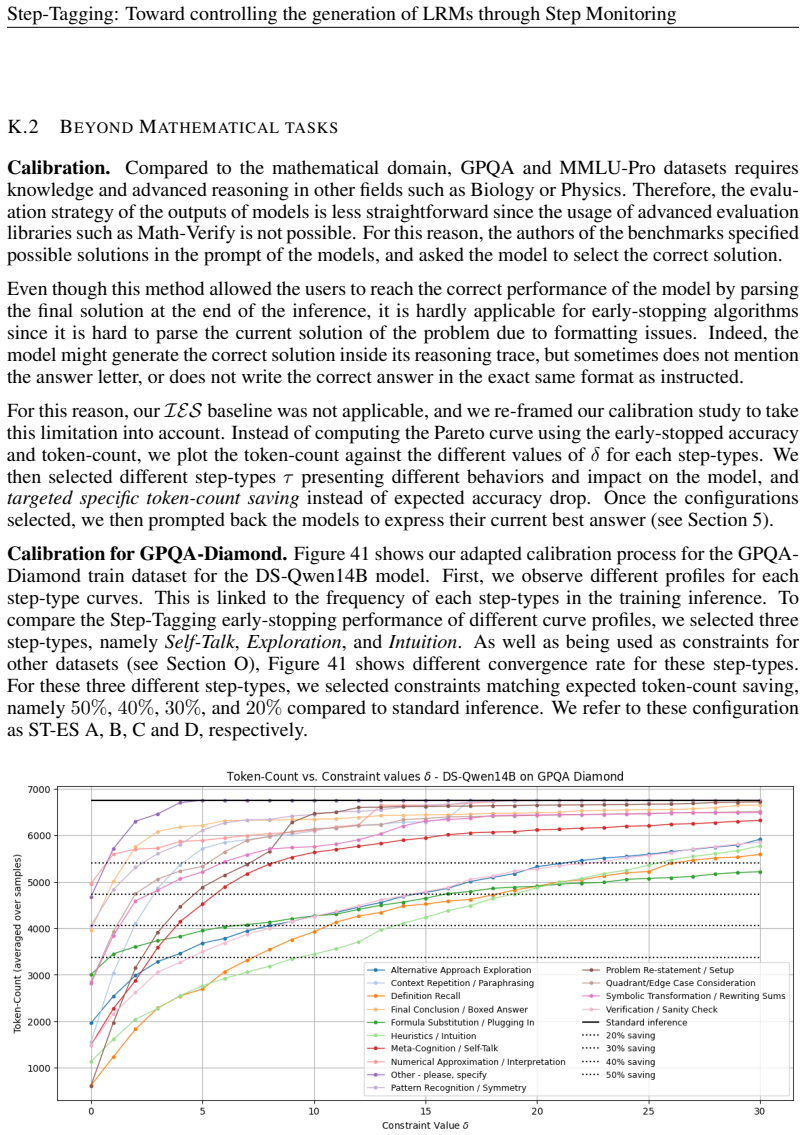
The load-bearing object is the step-frequency constraint cτ*(Srunning, δ): while generating, the framework counts how many completed steps have been tagged with a chosen type τ*; when that count exceeds δ, generation stops and the model is prompted to give its current best answer. Around this sits the ReasonType taxonomy (13 step types), a model-agnostic step segmentation using the model's '. ' paragraph delimiter with a minimum token length k, and lightweight binary classifiers trained per step type so that rare tags remain detectable. The stopping rule is calibrated by tracing a Pareto curve of token count versus accuracy across tag types and thresholds, with a separate router deciding an
What would settle it
On the MATH500 and GSM8K test traces, count the chosen stopping tag (e.g. Context Repetition, Self-Talk, or Final Answer) with the deployed binary taggers, compare those counts with the GPT-4o-mini labels, and recompute the token-accuracy frontier; if tagger errors shift the frontier enough that the reported 20-50% savings no longer hold at comparable accuracy, the central claim is falsified.
Extended reading notes
Core claim
The central claim is that online monitoring of the count of specific reasoning-step types can yield effective, interpretable early-stopping criteria for language reasoning models. The paper formalizes a reasoning step as text delimited by the model's own paragraph breaks with a minimum token length, defines the ReasonType taxonomy of thirteen step types (from Problem Re-statement and Formula Substitution to Verification and Final Conclusion), and trains separate binary sentence classifiers to tag each step online. Calibrated on training traces, a constraint of the form 'stop when the count of tag τ exceeds δ' is shown on test sets to reduce tokens by 20-50% at comparable accuracy, and to bea
Load-bearing premise
The load-bearing premise is that the lightweight taggers, trained on labels produced by a stronger model, recognize the step type used for stopping well enough that thresholds calibrated on oracle labels stay near-optimal when the imperfect tagger runs online.
Editorial extensions
If this is right
- A deployer can choose an operating point on the token-accuracy frontier before inference—saving roughly 34% of tokens at a small accuracy cost, or closer to 10% with almost no cost—instead of committing to a fixed budget.
- Stopping decisions become auditable: the model is halted because, for example, the 'Verification' step occurred δ times, a statement a human can inspect rather than a black-box scalar.
- Because constraints are calibrated per model and per problem-complexity cluster, savings carry across MATH500, GSM8K, AIME, GPQA-Diamond, and MMLU-Pro, with harder and more verbose tasks yielding the largest reductions.
- Step-type-based stopping outperforms simple step-count stopping in the paper's calibration experiments, meaning the semantic label, not just the step number, carries information about when the answer is settled.
- On models that draft correct answers early and then overwrite them, early stopping can preserve accuracy; on more conservative models like QwQ-32B, the same tag threshold buys less, so per-model calibration matters.
Reading between the lines
- Editorial extension: the same online tags could drive a guardrail rather than a stop—for example, alerting when a model enters long Verification or Self-Talk loops, or measuring how much of a trace is redundant before any threshold is applied.
- Editorial extension: if the ReasonType classes transfer across model families as the paper's generalization results suggest, a single shared tagger suite might monitor many models, and the expensive oracle-labeling step would be paid once rather than per model.
- Editorial extension: combining the step-count signal with token-level entropy or confidence (which the paper lists as future work) would likely yield a safer controller—one that stops only when both the semantic stage and the model's uncertainty agree.
Editorial analysis
A structured set of objections, weighed in public.
Referee Report
Summary. The paper proposes Step-Tagging, a framework that segments an LRM's reasoning trace into steps and labels each step with a type from a new 13-category taxonomy (ReasonType). A lightweight BERT-based binary classifier is trained per step type to enable online monitoring. Using this monitor, the authors define early-stopping criteria based on the frequency of a chosen step type, with thresholds calibrated on training data. They evaluate on three open-source reasoning models (DS-Llama-8B, DS-Qwen-14B, QwQ-32B) across five datasets, reporting 20-50% token reduction with 'comparable accuracy' to standard generation. The paper also includes ablations on the step-size parameter k, taxonomy granularity, and a BERT router for complexity-dependent constraints.
Significance. If the claims hold, this is a useful contribution: it provides an interpretable, dynamic early-stopping method for LRMs and a reusable step-type taxonomy. The evaluation is broad and mostly careful, including three models, five datasets, five seeds, and several ablations (k, taxonomy granularity, router robustness). The latency and cost analysis in Appendix J is a strength, as is the honest reporting of classifier F1 scores. However, the central validation has a gap: calibration is done on oracle GPT-4o-mini tags, while the deployed algorithm uses BERT classifiers, and the paper never establishes that the imperfect classifiers preserve the calibrated token-accuracy trade-off. This gap is load-bearing for the headline claim that a lightweight monitor can replace expensive annotation.
major comments (3)
- [Section 5.3 and Section 7 / Table 22] The early-stopping thresholds (τ*, δ) in Section 5.3 are selected using 'synthetic generated tags' from GPT-4o-mini, but Algorithm 2 executes with a 'Binary Step-Tagger' (BERT). The paper never states whether the ST-ES results in Table 22 were produced with BERT tags or with oracle GPT-4o-mini tags. If Table 22 uses oracle tags, the paper does not validate the lightweight-classifier claim. If it uses BERT tags, the effect of classifier error on the calibrated thresholds is unquantified. This is not a minor technicality: several selected constraints in Appendix O use rare tags with δ=0 (e.g., Context Repetition/0, Self-Talk/0, Exploration/0), and the reported Macro-F1 for Context Repetition is 0.65. A single false positive at δ=0 triggers early stopping, so classifier errors can systematically shift the operating point. The authors should clarify the tag source and report an end-to-end co
- [Abstract and Section 7] The claim of 'maintaining comparable accuracy' is overstated. In Table 22, at token savings of ~30-50%, accuracy drops are substantial in several cases. For DS-8B on MATH500, ST-ES 85% gives Avg@5 0.801 vs. standard 0.878; for DS-14B on GSM8K, ST-ES 85% gives 0.754 vs. 0.910; for QwQ-32B on MATH500, ST-ES 85% gives 0.878 vs. 0.954. The '20-50% token reduction' range also includes ST-ES 95% configurations with only 8-17% savings (e.g., DS-14B MATH500 ST-ES 95% saves 8.13%). The authors should present the full trade-off and qualify the headline claim to acknowledge that 'comparable accuracy' holds only for the more conservative criteria.
- [Section 6 and Appendix Q] The reported Micro-F1 values (0.89-0.97) are dominated by frequent step types and do not characterize the rare types that are actually used for early stopping. The paper does not report precision/recall or false-positive rates for the specific selected tags (e.g., Context Repetition, Self-Talk, Exploration) in the deployment setting. Since the early-stopping decision is binary (trigger on a single occurrence when δ=0), the relevant metric is the tagger's precision on those rare classes, not the macro-averaged F1. The authors should report per-tag precision/recall on the test set and, if possible, the distribution of early-stopping decisions made by BERT vs. oracle tags.
minor comments (5)
- [Section 4 / Figure 2] The text says the taxonomy has 13 categories, but Figure 2 lists 14 entries when including 'Other' (the 14th). Clarify whether 'Other' is a placeholder or a category.
- [Section 5 metrics] The metrics Avg@5, Pass@5, and Cons@5 are used, but only Pass@k and Cons@k are defined. Add a formula or description for Avg@k.
- [Equation 5 and Algorithm 2] The constraint c_{τ*}(S, δ) is defined as 1[f ≤ δ], so it returns 1 (true) when the constraint is satisfied. The while loop in Algorithm 2 is correct, but the wording 'while the constraint is satisfied' could be simplified to make the stopping condition clearer.
- [Section 2] The dynamic early-stopping baselines DEER (Yang et al. 2025) and EAT (Wang et al. 2025) are mentioned in related work but are not included in the experimental comparison. The authors should either add them or explicitly state why a direct comparison is not feasible.
- [Appendix J.1] The latency analysis uses a linear runtime-token assumption and offline estimates. The paper acknowledges the online implementation may add pauses. Consider moving this caveat to Section 5 for readers who skip appendices.
Circularity Check
Taxonomy validation is self-referential, but central early-stopping results are not circular.
-
other
[Section 4 (ReasonType taxonomy), Section 5.1 (Training data generation), Section 6 (Performance of step monitoring)]
"Given that our reasoning step taxonomy was created using GPT-4o-mini ... instead, we used GPT-4o-mini to label a dataset of reasoning traces with the labels from the taxonomy that we use to train lighter weight reasoning step classifiers. ... We interpret the strong performance of the classifiers as validating our reasoning step taxonomy in the sense that it indicates that the step types are distinct."
The ReasonType taxonomy and the training/test labels for the BERT step-taggers both come from the same annotator, GPT-4o-mini. Therefore the reported Macro-F1/Micro-F1 measures how well BERT reproduces GPT-4o-mini's label choices, and calling this 'validating the taxonomy' reduces the validation to self-consistency with the model that defined the label space. It does not independently confirm that the step types are real or semantically meaningful. This circularity is contained: the central early-stopping claim is not derived from this taxonomy-validation argument, so it does not by itself force the 20-50% token-reduction result.
full rationale
No equation in the paper reduces a prediction to a fitted input by construction. The early-stopping thresholds {tau*, delta} are empirical hyperparameters calibrated on the training set (Section 5.3) and the test results in Table 22 are reported honestly rather than being defined by the calibration. There is no load-bearing self-citation chain: the paper's references to prior work are external, and no uniqueness theorem is imported from the authors' own prior work. The main self-reference is the taxonomy/annotation loop: ReasonType is generated by GPT-4o-mini, training labels are produced by GPT-4o-mini, and the taxonomy is then 'validated' by showing that classifiers trained on those same labels can predict them. That is a genuine self-referential validation, but it does not establish the main efficiency claim, which is supported by independent benchmark evaluations. The additional gap concerning whether ST-ES test results were produced with oracle tags or BERT taggers is a limitation and a potential threat to the lightweight-classifier claim, but the paper does not state which was used, so it cannot be identified as a circular reduction on the available text. Overall, the central derivation is self-contained, with one minor self-referential validation, warranting a score of 2 rather than 0.
Assumptions & free parameters
free parameters (4)
- minimal step size k per model =
60 (DS-Llama8B), 30 (DS-Qwen14B), 100 (QwQ-32B)
- early-stopping constraint (tag type τ* and threshold δ) =
Varies per model, dataset, and complexity; e.g., DS-Llama8B MATH500 level 1 ST-ES 95%: Context Repetition/0; see Table 2
- BERT complexity-router =
Micro-F1 0.784 on validation/test
- early-exit token budget =
100 tokens
assumptions (5)
- domain assumption Reasoning steps are self-contained units delimited by '.\n\n' with a minimum token threshold k.
- domain assumption GPT-4o-mini annotation is a valid ground truth for reasoning step types.
- domain assumption BERT classifiers can tag steps online accurately enough for early stopping.
- domain assumption Training-set calibration transfers to test-time distribution.
- domain assumption LRM runtime scales linearly with token count.
invented entities (1)
-
ReasonType taxonomy (13 reasoning-step categories)
independent evidence
Cite this review
Pith. "Pith review of Step-Tagging: Toward controlling the generation of Language Reasoning Models through step monitoring." pith.science (2026). https://pith.science/paper/H6A7SG6S
@misc{pith2026251214332,
  author       = {Pith},
  title        = {Pith review of: Step-Tagging: Toward controlling the generation of Language Reasoning Models through step monitoring},
  year         = {2026},
  howpublished = {\url{https://pith.science/paper/H6A7SG6S}},
  note         = {Machine review of arXiv:2512.14332}
}
read the original abstract
The field of Language Reasoning Models (LRMs) has been very active over the past few years with advances in training and inference techniques enabling LRMs to reason longer, and more accurately. However, a growing body of studies show that LRMs are still inefficient, over-generating verification and reflection steps. To address this challenge, we introduce the Step-Tagging framework, a lightweight sentence-classifier enabling real-time annotation of the type of reasoning steps that an LRM is generating. To monitor reasoning behaviors, we introduced ReasonType: a novel taxonomy of reasoning steps. Building on this framework, we demonstrated that online monitoring of the count of specific steps can produce effective interpretable early stopping criteria of LRM inferences. We evaluate the Step-tagging framework on three open-source reasoning models across standard benchmark datasets: MATH500, GSM8K, AIME and non-mathematical tasks (GPQA and MMLU-Pro). We achieve 20 to 50% token reduction while maintaining comparable accuracy to standard generation, with largest gains observed on more computation-heavy tasks. This work offers a novel way to increase control over the generation of LRMs, and a new tool to study behaviors of LRMs.
Figures


Figures from the paper (58 more)










Reference graph
Works this paper leans on
-
[1]
We demonstrate that certain values of k enhance the semantic meaning of individual steps, mak- ing them more self-contained and interpretable,
-
[2]
URL https://arxiv.org/abs/2203.11171. 14 Step-Tagging: Toward controlling the generation of LRMs through Step Monitoring Yubo Wang, Xueguang Ma, Ge Zhang, Yuansheng Ni, Abhranil Chandra, Shiguang Guo, Weiming Ren, Aaran Arulraj, Xuan He, Ziyan Jiang, Tianle Li, Max Ku, Kai Wang, Alex Zhuang, Rongqi Fan, Xiang Yue, and Wenhu Chen. Mmlu-pro: A more robust a...
arXiv 2024
-
[3]
Sean Welleck, Ximing Lu, Peter West, Faeze Brahman, Tianxiao Shen, Daniel Khashabi, and Yejin Choi
URL https://arxiv.org/abs/2201.11903. Sean Welleck, Ximing Lu, Peter West, Faeze Brahman, Tianxiao Shen, Daniel Khashabi, and Yejin Choi. Generating sequences by learning to self-correct, 2022. URL https://arxiv.org/ abs/2211.00053. Sean Williams and James Huckle. Easy problems that llms get wrong, 2024. URL https:// arxiv.org/abs/2405.19616. Heming Xia, ...
arXiv 2022
-
[4]
Our framework seems to be robust with regards to the taxonomy selected. Nevertheless, fine-grained taxonomies - such as ReasonType - seems to lead to better performance for higher degree of complexity of questions, while simpler taxonomies might be more adapted to simpler problems (i.e. less verbose inferences). 37 Step-Tagging: Toward controlling the gen...
2025
-
[7]
Methodology
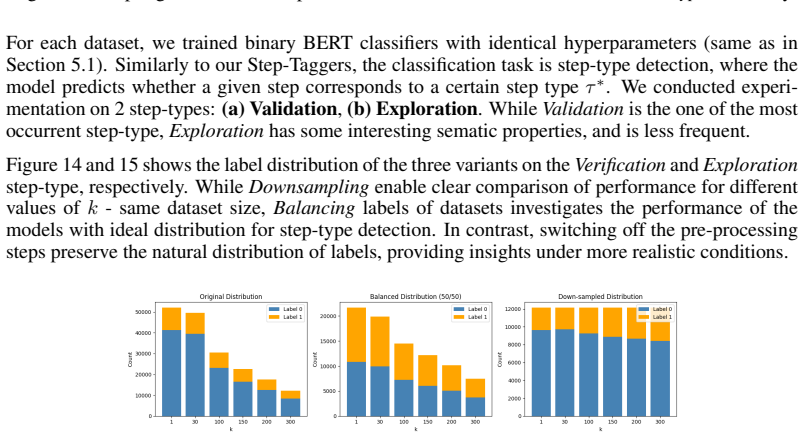
An appropriate value of k improves the accuracy of our step-tagger, since the semantic coherence impact the detection performance of step types using text classifiers. Methodology. To address these objectives, we selected different values of k, namely: 1, 30, 100, 150, 200, 300. We then constructed their corresponding datasets by segmenting the same reaso...
-
[8]
We applied this method and compared early-stopped traces from different values of k
The Ideal-Early Stopping ( IES ) criteria seems to be a good signal for selecting the segmentation parameter k. We applied this method and compared early-stopped traces from different values of k. For the three LRMs that we selected, we observe that the IES accuracy drops when values of k increase. Lower values of k seems to result in steps being more sel...
-
[9]
Similarly, small values of k implies noise in the step segmentation - which could perturb the monitoring analysis of the reasoning
Based on the performance of sentence classifier trained on datasets with different values of k, we found that higher values of k lead to a loss of semantic meaning of the steps. Similarly, small values of k implies noise in the step segmentation - which could perturb the monitoring analysis of the reasoning
-
[10]
An ablation study on the calibration process - to find the most efficient constraints per dataset and models - shows that higher values of k tends to decrease the performance and controllability of the inference using our framework. For our reasoning step definition, these takeaways confirms that users needs to carefully select op- timal value of k, since...
Show all 21 references
-
[11]
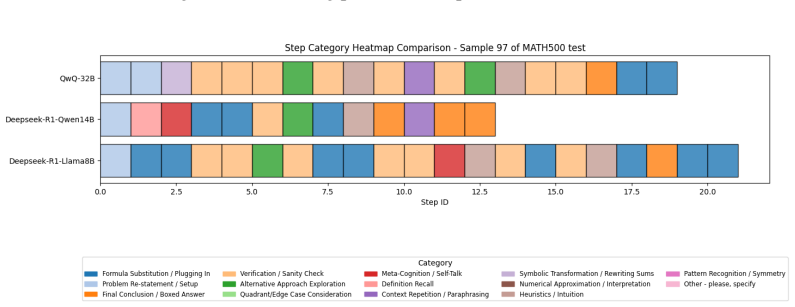
The ReasonType taxonomy enable semantic distinction of the type of reasoning
-
[12]
Methodology
Our annotation method with the GPT-4o-mini model, coupled with the ReasonType taxon- omy, is a robust method to access to the ground-truth labels of the reasoning steps. Methodology. To address our objective, we compare the performance of BERT classifiers across Original label...
-
[13]
The ReasonType taxonomy labels enable annotation methods to results in reasoning steps carrying semantic meaning
-
[14]
Beyond interpretability, tracking the types of steps using the ReasonType taxonomy yields to better performance than an early-stopping criterion based on simple step-count
-
[15]
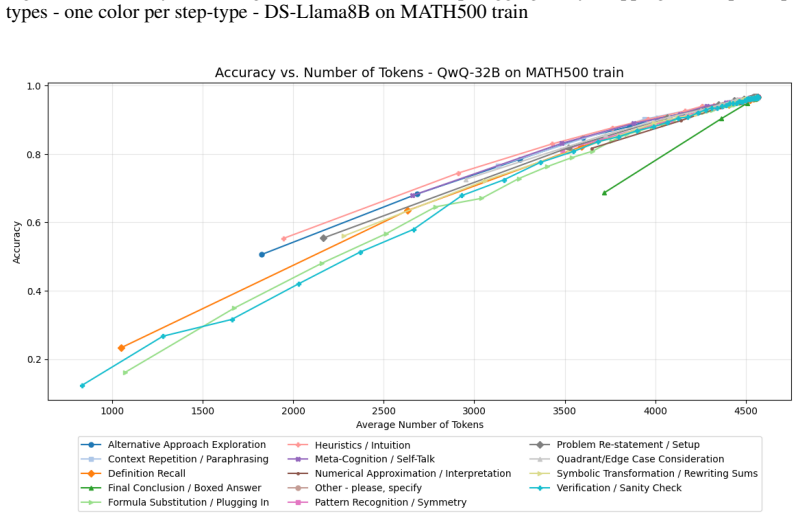
The ReasonType taxonomy coupled to our methodology allows us to demonstrate that all reasoning step types are not equally contributing to the reasoning progression
-
[17]
10%, 20%,
Prune the reasoning trace to a fixed percentage (e.g. 10%, 20%, . . ., 90%) of its full length
-
[18]
Evaluate whether this truncated trace already contains a correct answer
-
[19]
Filter the reasoning traces to retain the samples that are correct at this checkpoint
-
[20]
Specifically, we measure how frequently a model produces a correct intermediate answer, and sub- sequently destroys it later in the reasoning
Iteratively continue the trace from the checkpoint to 100% and check whether the final output preserves or overwrites the earlier correct answer. Specifically, we measure how frequently a model produces a correct intermediate answer, and sub- sequently destroys it later in the...
-
[53]
each reasoning step ei represents a single piece of evidence contributing toward the social inference to select an answer Aa from A
Correct. \n\n f(0): \n\n 3*0 is 0, minus 2 is -2. Denominator: 0 -2 is -2. -2 divided by -2 is 1. Correct.\n\n Adding them up: 2 + 53 + 1. \n\n Converting to thirds: 2 is 63, 1 is 33, so 63 + 53 + 33 = 143. Yep, that seems right. \n\n So, I think I did everything correctly. I ...
2025
-
[96]
Subtracting, 132 - 96 is 36
96 goes into 132 once, which is 96. Subtracting, 132 - 96 is 36. So, the remainder is 36. \n\n Step 5 - Next step, find the GCF of 96 and 36. Dividing 96 by 36. 36 times 2 is 72, which is less than 96. Subtracting 72 from 96 gives 24. So, the remainder is 24.\n\n Step 6 - Now,...
1916
-
[2023]
Tingxu Han, Zhenting Wang, Chunrong Fang, Shiyu Zhao, Shiqing Ma, and Zhenyu Chen
URL https://arxiv.org/abs/2212.07919. Tingxu Han, Zhenting Wang, Chunrong Fang, Shiyu Zhao, Shiqing Ma, and Zhenyu Chen. Token- budget-aware llm reasoning, 2025. URL https://arxiv.org/abs/2412.18547. Dan Hendrycks, Collin Burns, Saurav Kadavath, Akul Arora, Steven Basart, Eric...
2025 arXiv
-
[2024]
introduced the Group Relative Policy Optimization (GRPO). Unlike the classic Proximal Policy Optimization (PPO) (Schulman et al., 2017), GRPO estimates the reward using group scores, which naturally enhances model’s capability to generate reasoning traces. Nevertheless, this p...
2017
Reviewed August 3, 2026 · model on record in the stance chip above.
Discussion (0). Continue with ORCID to comment.