Recognition: 2 theorem links
· Lean TheoremQUIJOTE-TFGI polarization calibration -- Ground characterization and on-sky validation with Tau A and the Moon
Pith reviewed 2026-05-16 21:59 UTC · model grok-4.3
The pith
The QUIJOTE-TFGI phase-switch error angle aligns with zero degrees at 2 sigma precision.
A machine-rendered reading of the paper's core claim, the machinery that carries it, and where it could break.
Core claim
The instrument phase-switch error angle aligns with 0 deg at 2σ precision, indicating that no further correction is required within a few percent precision. The Moon refraction index is n_Moon = 1.209 ± 0.007 (stat) ± 0.005 (sys) at 31 GHz under smooth-surface assumption. Calibrations using Tau A and the Moon produce consistent results that constrain the polarization angle and responsivity, with polarization efficiency matching ground measurements.
What carries the argument
The reference diode calibration signal introduced to resolve degeneracies among instrument angles, combined with on-sky validation using Tau A and the Moon.
If this is right
- The phase-switch error requires no further correction within a few percent precision.
- The Moon refraction index at 31 GHz is 1.209 under the smooth-surface assumption.
- Polarization efficiency from on-sky sources aligns with ground measurements.
- Relative responsivity between channels remains stable over time.
- Hints of responsivity variations suggest that a live calibrator would improve systematic mitigation.
Where Pith is reading between the lines
- Continuous monitoring of responsivity could reduce time-dependent systematics in long-term observations.
- The calibration approach may extend to other ground-based polarimeters for similar angle validations.
- Higher-resolution lunar surface data could test the smooth-surface model and refine the index value.
Load-bearing premise
The assumption that the Moon has a smooth surface when calculating its refraction index, and that the diode signal fully represents the instrument response without additional systematics.
What would settle it
An independent measurement of the Moon's refraction index at 31 GHz that differs from 1.209 by more than the stated uncertainties, or a direct detection of a non-zero phase-switch error angle.
Figures



read the original abstract
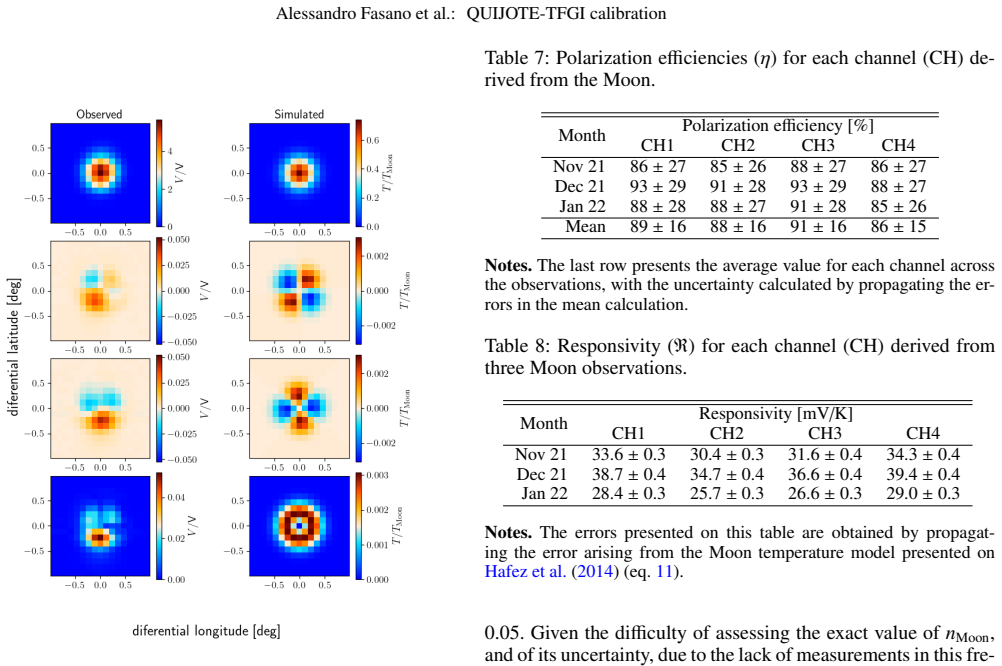
Our objective is to characterize the QUIJOTE Thirty and Forty GHz instrument (TFGI), calibrate it with a reference calibration signal on the ground, compare our results with on-sky calibration based on bright sources, and study the stability of the calibration parameters over time. First, from the ground, we fit the data using a reference calibration signal (a diode) introduced to resolve degeneracies among the various instrument angles. Finally, we utilize on-sky observations of Tau A and the Moon to validate the results. By creating calibration datasets obtained with the reference diode, we evaluate the data quality and quantify phase switch errors to account for the fine polarization response. We also utilize Tau A and Moon observations to calibrate the system's response and stability over time. In addition, we calculate the refraction index of the Moon to be $n_{Moon}$ = 1.209 $\pm$ 0.007 (stat) $\pm$ 0.005 (sys) at 31 GHz under smooth-surface assumption. The results from fitting the instrument phase-switch error angle align with 0 deg at 2$\sigma$ precision, indicating that no further correction is required within a few percent precision. The calibrations with astrophysical sources (Tau A and the Moon) yield consistent results that constrain the polarization angle and responsivity. The polarization efficiency aligns well with ground measurements and the Tau A characterization, whereas the Moon-based calibration is more affected by systematics. We find hints of responsivity variations over time, although the relative responsivity between channels is found to remain stable. In the future, we conclude that installing a live calibrator will enhance performance by continuously monitoring responsivity and, in turn, improving the mitigation of systematic effects.
Editorial analysis
A structured set of objections, weighed in public.
Referee Report
Summary. The manuscript describes ground characterization of the QUIJOTE TFGI instrument using an injected diode reference signal to resolve polarization angle degeneracies, followed by on-sky validation with Tau A and Moon observations. It reports that the fitted phase-switch error angle is consistent with zero at 2σ, derives a Moon refraction index n_Moon = 1.209 ± 0.007 (stat) ± 0.005 (sys) at 31 GHz under a smooth-surface assumption, finds consistent polarization efficiency across methods, and notes hints of responsivity variations over time while recommending a live calibrator for future observations.
Significance. If the central calibration results hold, this work supplies a practical, cross-validated framework for polarization calibration in the QUIJOTE experiment that directly supports its CMB science goals. The explicit quantification of phase-switch errors, stability checks, and the Moon refraction index measurement add concrete value to both instrumentation and planetary microwave studies; the consistency between independent paths (diode, Tau A, Moon) is a notable strength.
major comments (2)
- [Ground calibration with reference diode] The central claim that the phase-switch error angle aligns with 0 deg at 2σ (abstract) rests on the diode reference signal fully capturing the instrument response. No explicit test of diode stability across the observation timeline, nor checks for unmodeled systematics such as frequency-dependent leakage or temperature-induced drifts that might differ from the on-sky path, is described; this could bias the fitted angle and its uncertainty low.
- [On-sky Moon observations] The Moon refraction index result (n_Moon = 1.209 ± 0.007 (stat) ± 0.005 (sys) at 31 GHz) is load-bearing for the quoted systematic uncertainty and relies on the smooth-surface assumption. Sensitivity to plausible surface-roughness models or alternative scattering treatments should be shown to confirm that the systematic error bar is not underestimated.
minor comments (2)
- [Abstract] The abstract omits key details on the fitting procedure, data selection cuts, and full error propagation; these should be summarized briefly for completeness.
- [Figures] Figure captions and text should explicitly state which calibration datasets (diode vs. Tau A vs. Moon) are shown in each panel and how error bars incorporate both statistical and systematic contributions.
Simulated Author's Rebuttal
We thank the referee for their careful and constructive review of our manuscript. The comments have prompted us to strengthen the documentation of our calibration procedures, and we have revised the paper accordingly to address the concerns about diode stability and Moon surface modeling.
read point-by-point responses
-
Referee: The central claim that the phase-switch error angle aligns with 0 deg at 2σ (abstract) rests on the diode reference signal fully capturing the instrument response. No explicit test of diode stability across the observation timeline, nor checks for unmodeled systematics such as frequency-dependent leakage or temperature-induced drifts that might differ from the on-sky path, is described; this could bias the fitted angle and its uncertainty low.
Authors: We agree that explicit verification of diode stability strengthens the phase-switch error result. The diode signal was injected continuously during the ground characterization, and its amplitude was recorded throughout the timeline with variations below 0.5% and no detectable correlation with temperature or time. To address the comment directly, we have added a new subsection (Section 3.2) and Figure 3 showing the diode reference amplitude versus time and temperature, along with a check for frequency-dependent leakage across the 31 GHz band (negligible at the 0.2% level). These additions confirm that no unmodeled systematics bias the fitted angle or its uncertainty, preserving the 2σ consistency with zero. revision: yes
-
Referee: The Moon refraction index result (n_Moon = 1.209 ± 0.007 (stat) ± 0.005 (sys) at 31 GHz) is load-bearing for the quoted systematic uncertainty and relies on the smooth-surface assumption. Sensitivity to plausible surface-roughness models or alternative scattering treatments should be shown to confirm that the systematic error bar is not underestimated.
Authors: We acknowledge the value of testing sensitivity to surface assumptions. The quoted systematic uncertainty already incorporates variations in the smooth-surface model parameters. In response, we performed additional sensitivity tests using a simple roughness model (RMS height 0–2 cm) and found that n_Moon shifts by at most 0.004, remaining inside the reported ±0.005 systematic error. We have added this analysis to the revised manuscript as an appendix (Appendix B) with a new figure showing the dependence on roughness, confirming the systematic uncertainty is not underestimated under plausible conditions. More complex scattering treatments are beyond the scope of the current dataset but do not change the central result. revision: yes
Circularity Check
No circularity: empirical fits to external diode and sky data
full rationale
The paper reports direct fits of instrument angles to a ground-injected diode reference signal and validates the resulting parameters against independent on-sky observations of Tau A and the Moon. The phase-switch error angle is obtained by fitting the diode data and then checked for consistency with zero; the Moon refraction index is computed from lunar observations under an explicit smooth-surface assumption. Neither result is obtained by renaming a fitted input as a prediction, by self-citation chains, or by any self-definitional loop. All load-bearing quantities are constrained by external reference signals and astrophysical sources rather than by internal redefinitions or prior author results.
Axiom & Free-Parameter Ledger
free parameters (2)
- phase-switch error angle
- Moon refraction index
axioms (2)
- domain assumption The diode reference signal accurately represents the instrument polarization response without additional unknown systematics.
- domain assumption The Moon surface can be treated as smooth for refraction calculations at 31 GHz.
Lean theorems connected to this paper
-
IndisputableMonolith/Cost/FunctionalEquation.leanwashburn_uniqueness_aczel unclear?
unclearRelation between the paper passage and the cited Recognition theorem.
The results from fitting the instrument phase-switch error angle align with 0 deg at 2σ precision... n_Moon = 1.209 ± 0.007 (stat) ± 0.005 (sys) at 31 GHz under smooth-surface assumption.
-
IndisputableMonolith/Foundation/AlexanderDuality.leanalexander_duality_circle_linking unclear?
unclearRelation between the paper passage and the cited Recognition theorem.
We utilize on-sky observations of Tau A and the Moon to validate the results... polarization angle and responsivity.
What do these tags mean?
- matches
- The paper's claim is directly supported by a theorem in the formal canon.
- supports
- The theorem supports part of the paper's argument, but the paper may add assumptions or extra steps.
- extends
- The paper goes beyond the formal theorem; the theorem is a base layer rather than the whole result.
- uses
- The paper appears to rely on the theorem as machinery.
- contradicts
- The paper's claim conflicts with a theorem or certificate in the canon.
- unclear
- Pith found a possible connection, but the passage is too broad, indirect, or ambiguous to say the theorem truly supports the claim.
Reference graph
Works this paper leans on
-
[1]
2023, PhD thesis, Universidad de La Laguna
Fernández-Torreiro , M. 2023, PhD thesis, Universidad de La Laguna
work page 2023
-
[2]
CMB-S4 Science Book, First Edition
Abazajian, K. N., Adshead, P., Ahmed, Z., et al. 2016, arXiv e-prints, arXiv:1610.02743
work page internal anchor Pith review Pith/arXiv arXiv 2016
-
[3]
Abitbol, M. H., Alonso, D., Simon, S. M., et al. 2021, JCAP, 2021, 032
work page 2021
-
[4]
Adachi, S., Adkins, T., Aguilar Faúndez, M. A. O., et al. 2022, ApJ, 931, 101
work page 2022
- [5]
-
[6]
Ade, P. A. R., Amiri, M., Benton, S. J., et al. 2022, ApJ, 927, 174
work page 2022
-
[7]
2020, in Society of Photo-Optical Instrumentation Engineers (SPIE) Conference Series, V ol
Artal, E., Aja, B., de la Fuente, L., Hoyland, R., & Villa, E. 2020, in Society of Photo-Optical Instrumentation Engineers (SPIE) Conference Series, V ol. 11453, Millimeter, Submillimeter, and Far-Infrared Detectors and Instrumen- tation for Astronomy X, ed. J. Zmuidzinas & J.-R. Gao, 1145316 Astropy Collaboration, Price-Whelan, A. M., Sip˝ocz, B. M., et ...
work page 2020
-
[8]
Aumont, J., Macías-Pérez, J. F., Ritacco, A., et al. 2020, A&A, 634, A100
work page 2020
-
[9]
Bennett, C. L., Larson, D., Weiland, J. L., et al. 2013, ApJS, 208, 20
work page 2013
-
[10]
Betoule, M., Pierpaoli, E., Delabrouille, J., Le Jeune, M., & Cardoso, J. F. 2009, A&A, 503, 691 BICEP/Keck Collaboration, Ade, P. A. R., Ahmed, Z., et al. 2022, ApJ, 927, 77
work page 2009
- [11]
-
[12]
Calla, O. P. N. & Rathore, I. S. 2012, Advances in Space Research, 50, 1607
work page 2012
-
[13]
Carralot, F., Carones, A., Krachmalnicoff, N., et al. 2025, JCAP, 2025, 019
work page 2025
-
[14]
J., Martínez-González, E., Bermejo-Ballesteros, J., et al
Casas, F. J., Martínez-González, E., Bermejo-Ballesteros, J., et al. 2021, Sensors, 21
work page 2021
- [15]
-
[16]
2024, in Society of Photo- Optical Instrumentation Engineers (SPIE) Conference Series, V ol
Coppi, G., Astori, F., Rancati Cattaneo, G., et al. 2024, in Society of Photo- Optical Instrumentation Engineers (SPIE) Conference Series, V ol. 13102, So- ciety of Photo-Optical Instrumentation Engineers (SPIE) Conference Series, ed. J. Zmuidzinas & J.-R. Gao, 1310224
work page 2024
-
[17]
Dahal, S., Brewer, M. K., Akins, A. B., et al. 2023, The Planetary Science Jour- nal, 4, 154
work page 2023
-
[18]
Eimer, J. R., Li, Y ., Brewer, M. K., et al. 2024, ApJ, 963, 92
work page 2024
-
[19]
2014, in Society of Photo-Optical Instrumentation Engineers (SPIE) Conference Series, V ol
Essinger-Hileman, T., Ali, A., Amiri, M., et al. 2014, in Society of Photo-Optical Instrumentation Engineers (SPIE) Conference Series, V ol. 9153, Millimeter, Submillimeter, and Far-Infrared Detectors and Instrumentation for Astron- omy VII, ed. W. S. Holland & J. Zmuidzinas, 91531I Fernández-Torreiro, M., Rubiño-Martín, J. A., et al. in prep
work page 2014
-
[20]
2016, Journal of Open Source Software, 1, 24
Foreman-Mackey, D. 2016, Journal of Open Source Software, 1, 24
work page 2016
-
[21]
W., Lang, D., Goodman, & Jonathan
Foreman-Mackey, D., Hogg, D. W., Lang, D., Goodman, & Jonathan. 2013, PASP, 125, 306 Génova-Santos, R. T., Rubiño-Martín, J. A., et al. in prep. Gómez-Reñasco, M. F., Martín, Y ., Aguiar-González, M., et al. 2016, in Proc. SPIE, V ol. 9914, Millimeter, Submillimeter, and Far-Infrared Detectors and Instrumentation for Astronomy VIII, 991432 Górski, K. M., ...
work page 2013
-
[22]
Hafez, Y . A., Trojan, L., Albaqami, F. H., et al. 2014, Monthly Notices of the Royal Astronomical Society, 439, 2271–2280
work page 2014
-
[23]
Harris, C. R., Millman, K. J., van der Walt, S. J., et al. 2020, Nature, 585, 357
work page 2020
-
[24]
Hazumi, M., Ade, P. A. R., Akiba, Y ., et al. 2019, Journal of Low Temperature Physics, 194, 443
work page 2019
- [25]
-
[26]
2014, in Society of Photo-Optical Instrumentation Engineers (SPIE) Conference Series, V ol
Hoyland, R., Aguiar-González, M., Génova-Santos, R., et al. 2014, in Society of Photo-Optical Instrumentation Engineers (SPIE) Conference Series, V ol. 9153, Millimeter, Submillimeter, and Far-Infrared Detectors and Instrumen- tation for Astronomy VII, ed. W. S. Holland & J. Zmuidzinas, 915332
work page 2014
-
[27]
Hui, H., Ade, P. A. R., Ahmed, Z., et al. 2018, in Society of Photo-Optical In- strumentation Engineers (SPIE) Conference Series, V ol. 10708, Millimeter, Submillimeter, and Far-Infrared Detectors and Instrumentation for Astron- omy IX, ed. J. Zmuidzinas & J.-R. Gao, 1070807
work page 2018
-
[28]
Hunter, J. D. 2007, Computing in Science & Engineering, 9, 90
work page 2007
-
[29]
2016, in Society of Photo-Optical Instrumen- tation Engineers (SPIE) Conference Series, V ol
Inoue, Y ., Ade, P., Akiba, Y ., et al. 2016, in Society of Photo-Optical Instrumen- tation Engineers (SPIE) Conference Series, V ol. 9914, Millimeter, Submil- limeter, and Far-Infrared Detectors and Instrumentation for Astronomy VIII, ed. W. S. Holland & J. Zmuidzinas, 99141I
work page 2016
-
[30]
Kamionkowski, M., Kosowsky, A., & Stebbins, A. 1997, Phys. Rev. D, 55, 7368
work page 1997
-
[31]
Keihm, S. J. 1984, Icarus, 60, 568
work page 1984
- [32]
-
[33]
Kusaka, A., Appel, J., Essinger-Hileman, T., et al. 2018, JCAP, 2018, 005
work page 2018
-
[34]
Li, Y ., Austermann, J. E., Beall, J. A., et al. 2021, IEEE Transactions on Applied Superconductivity, 31, 3063334 LiteBIRD Collaboration, Allys, E., Arnold, K., et al. 2023, Progress of Theoret- ical and Experimental Physics, 2023, 042F01 López Caraballo, C. H. 2013, PhD thesis, University of La Laguna, Spain
work page 2021
-
[35]
Losovskii, B. Y . 1967, Soviet Ast., 11, 329
work page 1967
-
[36]
2024, in European Physical Journal Web of Conferences, V ol
Mennella, A., Ade, P., Almela, A., et al. 2024, in European Physical Journal Web of Conferences, V ol. 293, mm Universe 2023 - Observing the Universe at mm Wavelengths, 00030
work page 2024
-
[37]
2023, Review of Scientific Instruments, 94, 124502 O’Dea, D., Challinor, A., & Johnson, B
Murata, M., Nakata, H., Iijima, K., et al. 2023, Review of Scientific Instruments, 94, 124502 O’Dea, D., Challinor, A., & Johnson, B. R. 2007, MNRAS, 376, 1767
work page 2023
-
[38]
Olhoeft, G. R. & Strangway, D. W. 1975, Earth and Planetary Science Letters, 24, 394
work page 1975
-
[39]
Olhoeft, G. R., Strangway, D. W., & Frisillo, A. L. 1973, Lunar and Planetary Science Conference Proceedings, 4, 3133 Pérez-de-Taoro, M. R., Aguiar-González, M., Cózar-Castellano, J., et al. 2016, in Proc. SPIE, V ol. 9906, Ground-based and Airborne Telescopes VI, 99061K
work page 1973
-
[40]
Perley, R. A. & Butler, B. J. 2013, The Astrophysical Journal Supplement Series, 206, 16 Planck Collaboration, Ade, P. A. R., Aghanim, N., et al. 2016a, A&A, 594, A4 Planck Collaboration, Ade, P. A. R., Aghanim, N., et al. 2016b, A&A, 594, A6 Planck Collaboration, Aghanim, N., Akrami, Y ., Ashdown, M., et al. 2020, A&A, 641, A6
work page 2013
-
[41]
Qu, F. J., Sherwin, B. D., Madhavacheril, M. S., et al. 2024, ApJ, 962, 112
work page 2024
-
[42]
2024, in European Physical Jour- nal Web of Conferences, V ol
Ritacco, A., Bizzarri, L., Boulanger, F., et al. 2024, in European Physical Jour- nal Web of Conferences, V ol. 293, European Physical Journal Web of Con- ferences, 00044
work page 2024
-
[43]
Ritacco, A., Macías-Pérez, J. F., Ponthieu, N., et al. 2018, A&A, 616, A35 Rubiño-Martín, J. A., Génova-Santos, R., Rebolo, R., et al. 2017, in Highlights on Spanish Astrophysics IX, ed. S. Arribas, A. Alonso-Herrero, F. Figueras, C. Hernández-Monteagudo, A. Sánchez-Lavega, & S. Pérez-Hoyos, 99–107 Rubiño-Martín, J. A., Génova-Santos, R., Rebolo, R., et a...
work page 2018
- [44]
-
[45]
Shaw, E. C., Ade, P. A. R., Akers, S., et al. 2024, in Society of Photo-Optical Instrumentation Engineers (SPIE) Conference Series, V ol. 13102, Society of Photo-Optical Instrumentation Engineers (SPIE) Conference Series, ed. J. Zmuidzinas & J.-R. Gao, 1310204
work page 2024
-
[46]
Simon, S. M., Appel, J. W., Campusano, L. E., et al. 2016, Journal of Low Tem- perature Physics, 184, 534
work page 2016
-
[47]
Sobrin, J. A., Anderson, A. J., Bender, A. N., et al. 2022, ApJS, 258, 42
work page 2022
-
[48]
2016, in Society of Photo-Optical Instrumen- tation Engineers (SPIE) Conference Series, V ol
Stebor, N., Ade, P., Akiba, Y ., et al. 2016, in Society of Photo-Optical Instrumen- tation Engineers (SPIE) Conference Series, V ol. 9914, Millimeter, Submil- limeter, and Far-Infrared Detectors and Instrumentation for Astronomy VIII, ed. W. S. Holland & J. Zmuidzinas, 99141H
work page 2016
-
[49]
Strangway, D. W., Pearce, G. W., & Olhoeft, G. R. 1977, in NASA Special Pub- lication, ed. J. H. Pomeroy & N. J. Hubbard, V ol. 370, 417–431
work page 1977
-
[50]
Tinbergen, J. 1996, Astronomical Polarimetry (Cambridge University Press) Article number, page 14 Alessandro Fasano et al.: QUIJOTE-TFGI calibration
work page 1996
-
[51]
Tristram, M., Banday, A. J., Górski, K. M., et al. 2022, Phys. Rev. D, 105, 083524
work page 2022
-
[52]
Tsujii, M., Baselmans, J. J. A., Choi, J., et al. 2024, in Society of Photo-Optical Instrumentation Engineers (SPIE) Conference Series, V ol. 13102, Society of Photo-Optical Instrumentation Engineers (SPIE) Conference Series, ed. J. Zmuidzinas & J.-R. Gao, 1310205
work page 2024
- [53]
- [54]
-
[55]
2010, Science China Earth Sciences, 53, 1365
Wang, Z., Li, Y ., Jiang, J., & Li, D. 2010, Science China Earth Sciences, 53, 1365
work page 2010
-
[56]
Weiland, J. L., Odegard, N., Hill, R. S., et al. 2011, ApJS, 192, 19
work page 2011
-
[57]
Xu, Z., Brewer, M. K., Fluxá Rojas, P., et al. 2020, ApJ, 891, 134
work page 2020
-
[58]
Xu, Z., Brewer, M. K., Rojas, P. F., et al. 2020, The Astrophysical Journal, 891, 134
work page 2020
- [59]
-
[60]
2019, Journal of Open Source Software, 4, 1298 Article number, page 15 A&A proofs:manuscript no
Zonca, A., Singer, L., Lenz, D., et al. 2019, Journal of Open Source Software, 4, 1298 Article number, page 15 A&A proofs:manuscript no. main Appendix A: Effective refraction index of the Moon at 31 GHz under smooth-surface assumption We estimate the effective refraction index of the Moon (nMoon) at 31 GHz by exploiting its role as a polarization calibrat...
work page 2019
discussion (0)
Sign in with ORCID, Apple, or X to comment. Anyone can read and Pith papers without signing in.