REVIEW 4 major objections 7 minor 74 references
FADTI: Fourier and Attention Driven Diffusion for Multivariate Time Series Imputation
T0 review · 4 major / 7 minor · reviewed 2026-08-03 · deepseek-v4-flash
Pith's one-line read A diffusion imputer that learns a Fourier bias projection in the frequency domain consistently outperforms prior state-of-the-art multivariate time series imputation methods across benchmarks and missing rates.
desk verdict The SOTA claim in this paper is not pinned to a reproducible model: the main tables never specify which FADTI variant produced the numbers, and the paper's own ablation gives better results for a different variant. read the letter →
The pith
A machine-rendered reading of the paper's core claim, the machinery that carries it, and where it could break.
The reading
What carries the argument
The Fourier Bias Projection (FBP) module: a frequency-aware normalization layer maps input features to a spectral representation; the real and imaginary parts are projected onto fixed orthogonal cosine and sine bases to form a bias-enhanced frequency representation; and a learnable linear layer maps this to the feature dimension. FBP can be instantiated with DFT, STFT, or Fourier Synchrosqueezed Transform, and its low-frequency parameterization acts as a smooth global trend prior during denoising. Around it, the architecture stacks residual blocks with temporal self-attention, feature-level attention, and a gated TCN, trained with a masked denoising objective.
What would settle it
Rerun the ETT point-0.5 experiment with the DFT-Attn variant from Table VII using the same seeds and report the MAE; if it reproduces 0.283 (Table III) rather than 0.221 (Table VII), the claim that the paper's described FADTI is the best configuration fails.
Extended reading notes
Core claim
In the paper's own terms, FADTI is a conditional diffusion imputer whose denoising blocks receive a frequency-informed feature modulation: each residual block decomposes the input into trend and residual, projects both through fixed cosine and sine Fourier bases with learnable linear weights, and feeds the result alongside self-attention over time or features and a gated temporal convolution. The central claim is that this design yields state-of-the-art imputation accuracy: best MAE in 10 of 12 dataset-pattern-rate settings, best or top-3 CRPS, and top-3 RMSE in 10 of 12 settings, with ablated no-frequency variants always worse. The ablation identifies the Fourier module as the main driver,
Load-bearing premise
The headline accuracy claim depends on the reported FADTI results being produced by a single, fully specified configuration and evaluation protocol that matches the best-performing ablated variant, so that the comparison against baselines is fair and reproducible.
Editorial extensions
If this is right
- FADTI sets a new state of the art for point-wise and time-wise missingness up to 50% on ETT, Weather, and METR-LA, and on the new Yeast benchmark.
- The frequency-domain inductive bias, not the temporal backbone, is the main driver of imputation accuracy according to the ablation study.
- STFT- and FrSST-based instantiations of FBP are viable for multivariate imputation, extending time-frequency analysis into generative imputation.
- The model is sample-efficient: with fewer reverse diffusion steps it matches or beats baselines that use many more steps.
- The new Yeast single-cell dataset provides a non-periodic, noisy biological benchmark for future imputation research.
Reading between the lines
- FBP is a generic module: the same bias-projection idea could be dropped into any diffusion or even non-generative imputer, since it only adds a learnable linear layer over fixed spectral bases.
- The assumption of smooth or periodic trend structure means FADTI's advantage should be smallest on event-driven or bursty series; the paper itself concedes this, and a direct test on such a dataset would bound the scope.
- The reported best ablated variant (DFT-Attn) outperforming the headline FADTI numbers suggests the paper has not pinned down which instantiation is canonical; a reader should treat the architecture as a family rather than a single model.
- The Yeast dataset's introduction may be as valuable as the method itself for benchmarking robustness in non-stationary biological signals.
Editorial analysis
A structured set of objections, weighed in public.
Referee Report
Summary. The paper proposes FADTI, a conditional diffusion framework for multivariate time series imputation. Its main novelty is a Fourier Bias Projection (FBP) module that injects frequency-domain inductive biases into the denoising process, with instantiations based on DFT, STFT, and FrSST, combined with self-attention or gated-convolution temporal backbones. The method is evaluated on ETT, Weather, METR-LA, and a newly introduced Yeast dataset under point- and time-wise missingness at 10% and 50% rates. The central claim is that FADTI consistently outperforms state-of-the-art imputation methods, particularly at high missing rates, and that the frequency module is the main driver of the gains, supported by an eight-variant ablation.
Significance. If the stated results hold, the paper makes a useful contribution: it demonstrates a principled way to combine spectral inductive biases with diffusion-based imputation, provides the first application of STFT/FrSST-based modules to MTSI, contributes a new biological time-series benchmark, and ships code. The ablation design is clear and the comparison set is representative. However, the headline SOTA claim is currently not attached to a fully specified model configuration, and several internal inconsistencies in the experimental reporting prevent the reader from verifying that the claimed gains are real rather than artifacts of protocol differences.
major comments (4)
- [§IV, Tables III and VII] The exact FADTI configuration used for Tables III–VI is never specified. Section IV describes a modular architecture with three FBP instantiations (DFT/STFT/FrSST) and two temporal backbones (attention/convolution), but none of the main tables state which variant is 'FADTI'. This is not merely a presentation gap: Table VII, run on the same datasets, patterns, and rates, reports variants that beat the main-table FADTI numbers. For example, DFT-Attn achieves ETT point-0.5 MAE 0.221 versus FADTI's 0.283, and Weather point-0.1 MAE 4.182 versus FADTI's 6.946. Since FADTI should be one of the eight ablated variants, the main-table results are either produced by a different protocol or by a deliberately suboptimal configuration. The central claim 'consistently outperforms state-of-the-art methods' therefore cannot be attributed to a well-defined model as written.
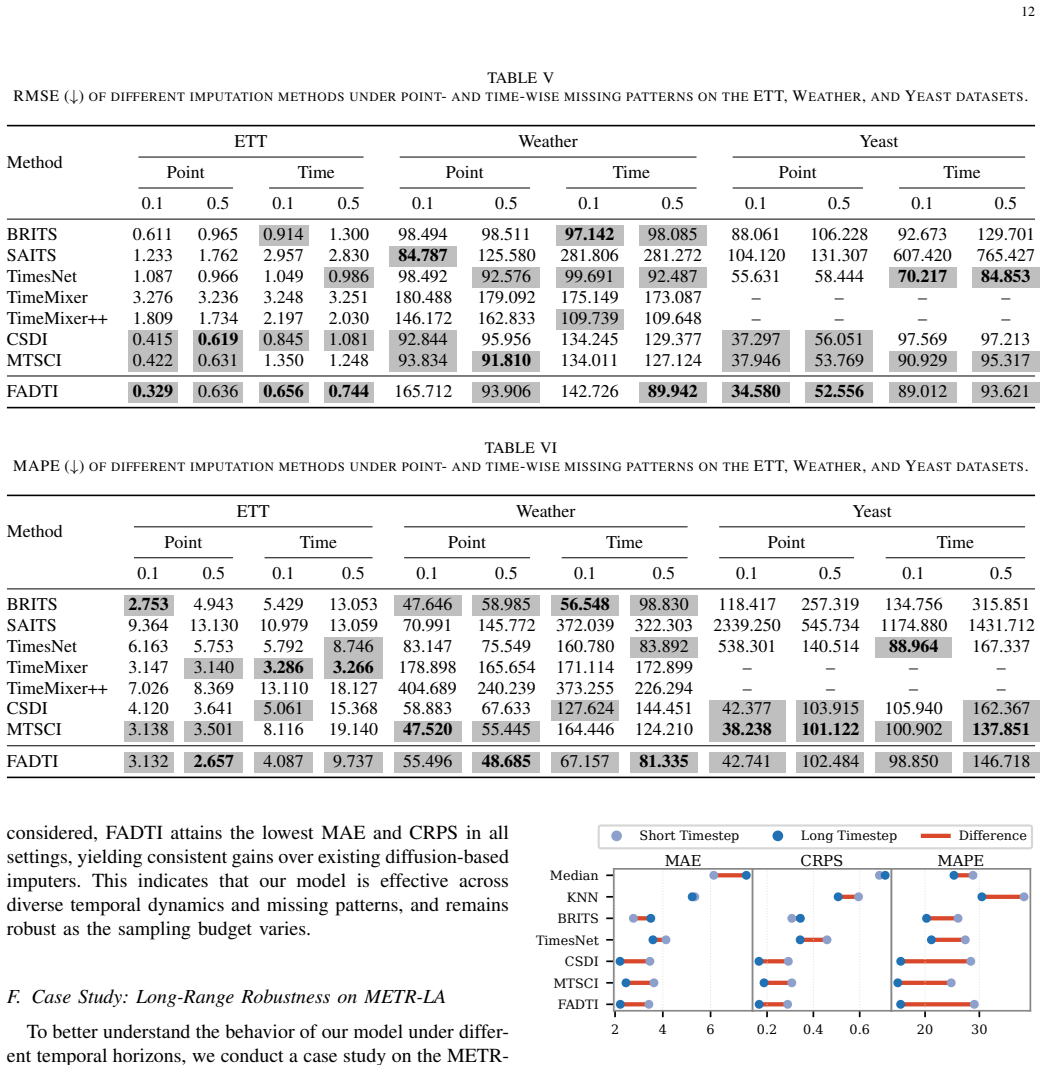
- [Table V, Weather point-0.1] The Weather point-0.1 RMSE for FADTI is 165.712, whereas CSDI's is 92.844 and MTSCI's is 93.834, despite nearly equal MAE (FADTI 6.946 vs CSDI 6.347). This is a large, unexplained outlier that contradicts the paper's claim (Section V.C.2) that FADTI is 'among the top three' in 10 of 12 RMSE settings and its broader robustness narrative. A single extreme error or a normalization/evaluation inconsistency is plausible; the paper should explain this entry or correct it, and report per-seed behavior to show it is not a fluke.
- [§V.C.1 and Table IV] CRPS is reported for deterministic baselines (BRITS, SAITS, TimesNet, TimeMixer, TimeMixer++) without any stated distributional procedure. CRPS is only defined for a predictive distribution; deterministic models require an explicit assumption such as a Dirac delta, a Gaussian with fixed predictive variance, or an empirical noise distribution. No such procedure is given, so Table IV's probabilistic comparison is not reproducible and may not be comparable across methods. Since the paper claims 'calibrated and sharper predictive distributions', this is a load-bearing missing detail.
- [§V.A.4 and Tables III–VI] All accuracy results are averages over five random seeds with different missing masks, but no standard deviations, confidence intervals, or per-seed results are reported. The headline margins over the strongest diffusion baselines are small (typically 0.02–0.04 MAE, e.g., ETT point-0.1 0.197 vs CSDI 0.240 and MTSCI 0.248), and without variance information the reader cannot judge whether these differences are consistent across seeds and masks. The paper should report variances or per-seed numbers, and ideally a simple significance test, for the main tables.
minor comments (7)
- [§V.C.1] The sentence 'Our model achieves the lowest CRPS in most cases and is consistently among the top three elsewhere' is repeated verbatim in the same paragraph.
- [§IV.F.1] The sentence defining \bar{\alpha}_s and the noise schedule appears twice in consecutive lines.
- [Table VII] The heading 'Metr LA' is inconsistent with 'METR-LA' used elsewhere.
- [Figures 5 and 6] In Figure 5 the x-axis is labeled 'inference time (seconds)' while the text discusses n_sample; Figure 6 uses n_sample on the x-axis. Please unify the notation and axes.
- [Table VI] In the TimesNet row, the Yeast time-wise MAPE entries appear as '88.964167.337', likely two concatenated numbers; please fix the formatting.
- [Algorithm 3 and Eq. (24)] Algorithm 3 declares the output shape as B×D×C×T, while Eq. (24) defines the projected representation as B×D×C×F×L. Clarify how the flattening/Linear layer maps between these shapes.
- [§IV and abstract] The acronym FrSST is spelled inconsistently: 'Fourier Synchro-squeezed Transform' in the introduction and 'Fourier-based Synchrosqueezing Transform' in Section IV. Please use one name.
Circularity Check
No circular derivation: FBP is a fixed-basis learnable projection and the headline claims rest on empirical comparisons to external baselines.
full rationale
The paper contains no load-bearing step in which a prediction is equivalent to its own input by construction. The Fourier Bias Projection is explicitly defined with fixed orthogonal cosine/sine bases and non-trainable spectral operators, with learnable parameters confined to linear projection layers (Eqs. 23-24, Algorithm 3, Section IV-C). There is no fitted parameter that is later renamed as a prediction; the training objective (Eq. 31) is the standard masked epsilon-prediction loss against injected Gaussian noise, not against the reported MAE/CRPS metrics. The claimed performance improvements are empirical comparisons against external baselines (CSDI, MTSCI, BRITS, SAITS, TimesNet, TimeMixer++), not deductions from a self-citation or from an assumed uniqueness theorem. No load-bearing result is imported solely from the authors' prior work; references to Fourier/STFT/FrSST tools are standard signal-processing citations. The observed inconsistency between the main-table FADTI row and the Table VII ablation variants, and the unspecified exact FBP/temporal instantiation used for the headline SOTA claim, are reproducibility and protocol-specification concerns rather than circular-reasoning defects. They do not show that any claimed result is true by definition or forced by a self-citation chain. Therefore the appropriate circularity finding is a clean non-finding.
Assumptions & free parameters
free parameters (6)
- Diffusion schedule endpoints and step count =
beta_start=1e-4, beta_end=0.5, S=50
- Decomposition kernel size K_d =
not reported per dataset
- STFT window length K_f =
K_f = 2T/3
- Number of frequency bins F =
not reported
- Aggregation sample count K =
not reported
- Network hyperparameters (layers, dims, heads, lr, batch) =
not reported
assumptions (5)
- standard math DDPM forward/reverse Gaussian process with a fixed noise schedule (Eqs. 2-8)
- domain assumption Time series imputation benefits from a smoothness/periodicity inductive bias
- standard math Fixed cosine/sine bases in Eq. (23) are orthogonal Fourier bases and the projection preserves magnitude and phase
- domain assumption CRPS is a meaningful comparison across deterministic and probabilistic models under an unstated distributional assumption for the former
- domain assumption Applying identical masks across methods and averaging over five seeds yields a fair comparison
Cite this review
Pith. "Pith review of FADTI: Fourier and Attention Driven Diffusion for Multivariate Time Series Imputation." pith.science (2026). https://pith.science/paper/HHUYZFKE
@misc{pith2026251215116,
  author       = {Pith},
  title        = {Pith review of: FADTI: Fourier and Attention Driven Diffusion for Multivariate Time Series Imputation},
  year         = {2026},
  howpublished = {\url{https://pith.science/paper/HHUYZFKE}},
  note         = {Machine review of arXiv:2512.15116}
}
read the original abstract
Multivariate time series imputation is fundamental in applications such as healthcare, traffic forecasting, and biological modeling, where sensor failures and irregular sampling lead to pervasive missing values. However, existing Transformer- and diffusion-based models lack explicit inductive biases and frequency awareness, limiting their generalization under structured missing patterns and distribution shifts. We propose FADTI, a diffusion-based framework that injects frequency-informed feature modulation via a learnable Fourier Bias Projection (FBP) module and combines it with temporal modeling through self-attention and gated convolution. FBP supports multiple spectral bases, enabling adaptive encoding of both stationary and non-stationary patterns. This design injects frequency-domain inductive bias into the generative imputation process. Experiments on multiple benchmarks, including a newly introduced biological time series dataset, show that FADTI consistently outperforms state-of-the-art methods, particularly under high missing rates. Code is available at https://anonymous.4open.science/r/TimeSeriesImputation-52BF
Figures


Figures from the paper (4 more)



Reference graph
Works this paper leans on
-
[1]
Recurrent neural networks for multivariate time series with missing values,
Z. Che, S. Purushotham, K. Cho, D. A. Sontag, and Y . Liu, “Recurrent neural networks for multivariate time series with missing values,”Sci. Rep., vol. 8, no. 1, p. 6085, 2018
2018
-
[2]
Temporal belief memory: Imputing missing data during RNN training,
Y . Kim and M. Chi, “Temporal belief memory: Imputing missing data during RNN training,” inProc. Int. Joint Conf. Artif. Intell. (IJCAI), 2018, pp. 2326–2332
2018
-
[3]
Predicting in-hospital mortality of icu patients: The physionet/computing in car- diology challenge 2012,
I. Silva, G. Moody, D. J. Scott, L. A. Celi, and R. G. Mark, “Predicting in-hospital mortality of icu patients: The physionet/computing in car- diology challenge 2012,” inComput. Cardiol. Conf. (CinC), 2012, pp. 245–248
2012
-
[4]
Forecasting economic time series using targeted predictors,
J. Bai and S. Ng, “Forecasting economic time series using targeted predictors,”J. Econometrics, vol. 146, no. 2, pp. 304–317, 2008
2008
-
[5]
Data imputation for sparse radio maps in indoor positioning,
X. Li, H. Li, H. K. Chan, H. Lu, and C. S. Jensen, “Data imputation for sparse radio maps in indoor positioning,” inIEEE Int. Conf. Data Eng. (ICDE), 2023, pp. 2235–2248
2023
-
[6]
Missing value imputation for multi-view urban statistical data via spatial correlation learning,
Y . Gong, Z. Li, J. Zhang, W. Liu, Y . Yin, and Y . Zheng, “Missing value imputation for multi-view urban statistical data via spatial correlation learning,”IEEE Trans. Knowl. Data Eng., vol. 35, no. 1, pp. 686–698, 2023
2023
-
[7]
Missing data in clinical studies: issues and methods,
J. G. Ibrahim, H. Chu, and M.-H. Chen, “Missing data in clinical studies: issues and methods,”J. Clin. Oncol., vol. 30, no. 26, pp. 3297–3303, 2012. 14
2012
-
[8]
Real-valued (medical) time series generation with recurrent conditional gans,
C. Esteban, S. L. Hyland, and G. R ¨atsch, “Real-valued (medical) time series generation with recurrent conditional gans,”CoRR, vol. abs/1706.02633, 2017
arXiv 2017
Show all 74 references
-
[9]
How deep is your guess? A fresh perspective on deep learning for medical time-series imputation,
L. Qian, T. Wang, J. Wang, H. L. Ellis, R. Mitra, R. J. B. Dobson, and Z. M. Ibrahim, “How deep is your guess? A fresh perspective on deep learning for medical time-series imputation,”IEEE J. Biomed. Health Inform., 2025
2025
-
[10]
SAITS: self-attention-based imputation for time series,
W. Du, D. C ˆot´e, and Y . Liu, “SAITS: self-attention-based imputation for time series,”Expert Syst. Appl., vol. 219, p. 119619, 2023
2023
-
[11]
Cross-modal missing time-series imputation using dense spatio-temporal transformer nets,
X. Qian, T. Zhang, M. Miao, G. Xu, X. Zhang, W. Yu, and D. Chen, “Cross-modal missing time-series imputation using dense spatio-temporal transformer nets,”Math. Biosci. Eng., vol. 21, no. 4, pp. 4989–5006, 2024
2024
-
[12]
Timer: Generative pre-trained transformers are large time series models,
Y . Liu, H. Zhang, C. Li, X. Huang, J. Wang, and M. Long, “Timer: Generative pre-trained transformers are large time series models,” in Proc. Int. Conf. Mach. Learn. (ICML), 2024
2024
-
[13]
Heterogeneous multivariate time series imputation by transformer model with missing position encoding,
C. Liu, Z. Zhu, W. Hao, and G. Sun, “Heterogeneous multivariate time series imputation by transformer model with missing position encoding,” Expert Syst. Appl., vol. 271, p. 126435, 2025
2025
-
[14]
Timesnet: Temporal 2d-variation modeling for general time series analysis,
H. Wu, T. Hu, Y . Liu, H. Zhou, J. Wang, and M. Long, “Timesnet: Temporal 2d-variation modeling for general time series analysis,” in Int. Conf. Learn. Represent. (ICLR), 2023
2023
-
[15]
LSCD: lomb-scargle conditioned diffusion for time series imputation,
E. Fons, A. Sztrajman, Y . El-Laham, L. Ferrer, S. Vyetrenko, and M. Veloso, “LSCD: lomb-scargle conditioned diffusion for time series imputation,”CoRR, vol. abs/2506.17039, 2025
2025 arXiv
-
[16]
Conditional time series diffusion model for high-speed train multi-sensor signals imputation,
Z. Yang, H. Dong, H. Zhang, and R. Wang, “Conditional time series diffusion model for high-speed train multi-sensor signals imputation,” IEEE Trans. Intell. Transp. Syst., 2025
2025
-
[17]
A diffusion model for traffic data imputation,
B. Lu, Q. Miao, Y . Liu, T. S. Tamir, H. Zhao, X. Zhang, Y . Lv, and F. Wang, “A diffusion model for traffic data imputation,”IEEE CAA J. Autom. Sinica, vol. 12, no. 3, pp. 606–617, 2025
2025
-
[18]
Conditional information bottleneck approach for time series imputation,
M. Choi and C. Lee, “Conditional information bottleneck approach for time series imputation,” inInt. Conf. Learn. Represent. (ICLR), 2024
2024
-
[19]
CSDI: conditional score- based diffusion models for probabilistic time series imputation,
Y . Tashiro, J. Song, Y . Song, and S. Ermon, “CSDI: conditional score- based diffusion models for probabilistic time series imputation,” inAdv. Neural Inf. Process. Syst. (NeurIPS), 2021, pp. 24 804–24 816
2021
-
[20]
MTSCI: A conditional diffusion model for multivariate time series consistent imputation,
J. Zhou, J. Li, G. Zheng, X. Wang, and C. Zhou, “MTSCI: A conditional diffusion model for multivariate time series consistent imputation,” in Proc. ACM Int. Conf. Inf. Knowl. Manag. (CIKM), 2024, pp. 3474–3483
2024
-
[21]
Provably convergent schr ¨odinger bridge with applications to probabilistic time series imputation,
Y . Chen, W. Deng, S. Fang, F. Li, N. T. Yang, Y . Zhang, K. Rasul, S. Zhe, A. Schneider, and Y . Nevmyvaka, “Provably convergent schr ¨odinger bridge with applications to probabilistic time series imputation,” inProc. Int. Conf. Mach. Learn. (ICML), vol. 202, 2023, pp. 4485–4513
2023
-
[22]
Frequency-aware generative models for multivariate time series imputation,
X. Yang, Y . Sun, X. Yuan, and X. Chen, “Frequency-aware generative models for multivariate time series imputation,” inAdv. Neural Inf. Process. Syst. (NeurIPS), 2024
2024
-
[23]
Optimal transport for time series imputation,
H. Wang, H. Li, X. Chen, M. Gong, Z. Chenet al., “Optimal transport for time series imputation,” inInt. Conf. Learn. Represent. (ICLR), 2025
2025
-
[24]
Tslanet: Rethinking transformers for time series representation learning,
E. Eldele, M. Ragab, Z. Chen, M. Wu, and X. Li, “Tslanet: Rethinking transformers for time series representation learning,” inProc. Int. Conf. Mach. Learn. (ICML), 2024
2024
-
[25]
Rethinking fourier transform from A basis functions perspective for long-term time series forecasting,
R. Yang, L. Cao, J. Yang, and J. Li, “Rethinking fourier transform from A basis functions perspective for long-term time series forecasting,” in Adv. Neural Inf. Process. Syst. (NeurIPS), 2024
2024
-
[26]
An algorithm for the machine calculation of complex fourier series,
J. W. Cooley and J. W. Tukey, “An algorithm for the machine calculation of complex fourier series,”Math. Comput., vol. 19, pp. 297–301, 1965
1965
-
[27]
Depthwise spatio-temporal STFT convolutional neural networks for human action recognition,
S. Kumawat, M. Verma, Y . Nakashima, and S. Raman, “Depthwise spatio-temporal STFT convolutional neural networks for human action recognition,”IEEE Trans. Pattern Anal. Mach. Intell., vol. 44, no. 9, pp. 4839–4851, 2022
2022
-
[28]
Synchrosqueezing-based short-time fractional fourier transform,
Z. Zhao and G. Li, “Synchrosqueezing-based short-time fractional fourier transform,”IEEE Trans. Signal Process., vol. 71, pp. 279–294, 2023
2023
-
[29]
Time series analysis: Forecasting and control,
G. E. P. Box, G. M. Jenkins, G. C. Reinsel, and G. M. Ljung, “Time series analysis: Forecasting and control,”The Statistician, vol. 27, pp. 265–265, 1978
1978
-
[30]
Improving artificial neural networks’ performance in seasonal time series forecasting,
C. Hamzac ¸ebi, “Improving artificial neural networks’ performance in seasonal time series forecasting,”Inf. Sci., vol. 178, no. 23, pp. 4550– 4559, 2008
2008
-
[31]
Mice: Multivariate imputation by chained equations in r,
S. van Buuren and K. G. M. Groothuis-Oudshoorn, “Mice: Multivariate imputation by chained equations in r,”J. Stat. Softw., vol. 45, pp. 1–67, 2011
2011
-
[32]
A novel purity-based k nearest neighbors imputation method and its application in financial distress prediction,
C. Cheng, C. Chan, and Y . Sheu, “A novel purity-based k nearest neighbors imputation method and its application in financial distress prediction,”Eng. Appl. Artif. Intell., vol. 81, pp. 283–299, 2019
2019
-
[33]
A hybrid method for imputation of missing values using optimized fuzzy c-means with support vector regression and a genetic algorithm,
I. B. Aydilek and A. Arslan, “A hybrid method for imputation of missing values using optimized fuzzy c-means with support vector regression and a genetic algorithm,”Inf. Sci., vol. 233, pp. 25–35, 2013
2013
-
[34]
Missforest - non-parametric missing value imputation for mixed-type data,
D. J. Stekhoven and P. B ¨uhlmann, “Missforest - non-parametric missing value imputation for mixed-type data,”Bioinform., vol. 28, no. 1, pp. 112–118, 2012
2012
-
[35]
Deep learning for multivariate time series imputation: A survey,
J. Wang, W. Du, W. Cao, K. Zhang, W. Wang, Y . Liang, and Q. Wen, “Deep learning for multivariate time series imputation: A survey,”CoRR, vol. abs/2402.04059, 2024
2024 arXiv
-
[36]
Estimating missing data in temporal data streams using multi-directional recurrent neural networks,
J. Yoon, W. R. Zame, and M. van der Schaar, “Estimating missing data in temporal data streams using multi-directional recurrent neural networks,” IEEE Trans. Biomed. Eng., vol. 66, no. 5, pp. 1477–1490, 2019
2019
-
[37]
BRITS: bidirectional recurrent imputation for time series,
W. Cao, D. Wang, J. Li, H. Zhou, L. Li, and Y . Li, “BRITS: bidirectional recurrent imputation for time series,” inAdv. Neural Inf. Process. Syst. (NeurIPS), 2018, pp. 6776–6786
2018
-
[38]
Multivariate time series imputation with generative adversarial networks,
Y . Luo, X. Cai, Y . Zhang, J. Xu, and X. Yuan, “Multivariate time series imputation with generative adversarial networks,” inAdv. Neural Inf. Process. Syst. (NeurIPS), 2018, pp. 1603–1614
2018
-
[39]
Mind the gap: An experimental evaluation of imputation of missing values techniques in time series,
M. Khayati, A. Lerner, Z. Tymchenko, and P. Cudr ´e-Mauroux, “Mind the gap: An experimental evaluation of imputation of missing values techniques in time series,”Proc. VLDB Endow., vol. 13, no. 5, pp. 768– 782, 2020
2020
-
[40]
GP-V AE: deep probabilistic time series imputation,
V . Fortuin, D. Baranchuk, G. R ¨atsch, and S. Mandt, “GP-V AE: deep probabilistic time series imputation,” inInt. Conf. Artif. Intell. Stat. (AISTATS), vol. 108, 2020, pp. 1651–1661
2020
-
[41]
Graph wavenet for deep spatial-temporal graph modeling,
Z. Wu, S. Pan, G. Long, J. Jiang, and C. Zhang, “Graph wavenet for deep spatial-temporal graph modeling,” inProc. Int. Joint Conf. Artif. Intell. (IJCAI), 2019, pp. 1907–1913
2019
-
[42]
Missing value imputation on multidimensional time series,
P. Bansal, P. Deshpande, and S. Sarawagi, “Missing value imputation on multidimensional time series,”Proc. VLDB Endow., vol. 14, no. 11, pp. 2533–2545, 2021
2021
-
[43]
Filling the g ap s: Multivariate time series imputation by graph neural networks,
A. Cini, I. Marisca, and C. Alippi, “Filling the g ap s: Multivariate time series imputation by graph neural networks,” inInt. Conf. Learn. Represent. (ICLR), 2022
2022
-
[44]
Learning to reconstruct missing data from spatiotemporal graphs with sparse observations,
I. Marisca, A. Cini, and C. Alippi, “Learning to reconstruct missing data from spatiotemporal graphs with sparse observations,” inAdv. Neural Inf. Process. Syst. (NeurIPS), 2022
2022
-
[45]
Attention is all you need,
A. Vaswani, N. Shazeer, N. Parmar, J. Uszkoreit, L. Jones, A. N. Gomez, L. Kaiser, and I. Polosukhin, “Attention is all you need,” inAdv. Neural Inf. Process. Syst. (NeurIPS), 2017, pp. 5998–6008
2017
-
[46]
Transformers in time series: A survey,
Q. Wen, T. Zhou, C. Zhang, W. Chen, Z. Ma, J. Yan, and L. Sun, “Transformers in time series: A survey,” inProc. Int. Joint Conf. Artif. Intell. (IJCAI), 2023, pp. 6778–6786
2023
-
[47]
Multivariate time-series imputation with disentangled temporal representations,
S. Liu, X. Li, G. Cong, Y . Chen, and Y . Jiang, “Multivariate time-series imputation with disentangled temporal representations,” inInt. Conf. Learn. Represent. (ICLR), 2023
2023
-
[48]
Imputeformer: Low rankness-induced transformers for generalizable spatiotemporal impu- tation,
T. Nie, G. Qin, W. Ma, Y . Mei, and J. Sun, “Imputeformer: Low rankness-induced transformers for generalizable spatiotemporal impu- tation,” inProc. ACM SIGKDD Int. Conf. Knowl. Discov. Data Min. (KDD), 2024, pp. 2260–2271
2024
-
[49]
Causality-aware spatiotemporal graph neural networks for spatiotemporal time series imputation,
B. Jing, D. Zhou, K. Ren, and C. Yang, “Causality-aware spatiotemporal graph neural networks for spatiotemporal time series imputation,” in Proc. ACM Int. Conf. Inf. Knowl. Manag. (CIKM), 2024, pp. 1027– 1037
2024
-
[50]
Higher-order spatio- temporal physics-incorporated graph neural network for multivariate time series imputation,
G. Liang, P. Tiwari, S. Nowaczyk, and S. Byttner, “Higher-order spatio- temporal physics-incorporated graph neural network for multivariate time series imputation,” inProc. ACM Int. Conf. Inf. Knowl. Manag. (CIKM), 2024, pp. 1356–1366
2024
-
[51]
An observed value consistent diffusion model for imputing missing values in multivariate time series,
X. Wang, H. Zhang, P. Wang, Y . Zhang, B. Wang, Z. Zhou, and Y . Wang, “An observed value consistent diffusion model for imputing missing values in multivariate time series,” inProc. ACM SIGKDD Int. Conf. Knowl. Discov. Data Min. (KDD), 2023, pp. 2409–2418
2023
-
[52]
Diffusion-ts: Interpretable diffusion for general time series generation,
X. Yuan and Y . Qiao, “Diffusion-ts: Interpretable diffusion for general time series generation,” inInt. Conf. Learn. Represent. (ICLR), 2024
2024
-
[53]
Pristi: A conditional diffusion framework for spatiotemporal imputation,
M. Liu, H. Huang, H. Feng, L. Sun, B. Du, and Y . Fu, “Pristi: A conditional diffusion framework for spatiotemporal imputation,” inIEEE Int. Conf. Data Eng. (ICDE), 2023, pp. 1927–1939
2023
-
[54]
Uncertainty-aware variational- recurrent imputation network for clinical time series,
A. W. Mulyadi, E. Jun, and H. Suk, “Uncertainty-aware variational- recurrent imputation network for clinical time series,”IEEE Trans. Cybern., vol. 52, no. 9, pp. 9684–9694, 2022
2022
-
[55]
Probabilistic imputation for time-series classification with missing data,
S. Kim, H. Kim, E. Yun, H. Lee, J. Lee, and J. Lee, “Probabilistic imputation for time-series classification with missing data,” inProc. Int. Conf. Mach. Learn. (ICML), vol. 202, 2023, pp. 16 654–16 667
2023
-
[56]
NAOMI: non- autoregressive multiresolution sequence imputation,
Y . Liu, R. Yu, S. Zheng, E. Zhan, and Y . Yue, “NAOMI: non- autoregressive multiresolution sequence imputation,” inAdv. Neural Inf. Process. Syst. (NeurIPS), 2019, pp. 11 236–11 246. 15
2019
-
[57]
Generative semi- supervised learning for multivariate time series imputation,
X. Miao, Y . Wu, J. Wang, Y . Gao, X. Mao, and J. Yin, “Generative semi- supervised learning for multivariate time series imputation,” inAAAI Conf. Artif. Intell. (AAAI), 2021, pp. 8983–8991
2021
-
[58]
A survey on diffusion models for time series and spatio-temporal data,
Y . Yang, M. Jin, H. Wen, C. Zhang, Y . Liang, L. Ma, Y . Wang, C. Liu, B. Yang, Z. Xu, J. Bian, S. Pan, and Q. Wen, “A survey on diffusion models for time series and spatio-temporal data,”CoRR, vol. abs/2404.18886, 2024
2024
-
[59]
Diffusion-based time series impu- tation and forecasting with structured state space models,
J. M. L. Alcaraz and N. Strodthoff, “Diffusion-based time series impu- tation and forecasting with structured state space models,”Trans. Mach. Learn. Res., vol. 2023, 2023
2023
-
[60]
SADI: similarity-aware diffusion model-based imputation for incomplete temporal EHR data,
Z. Dai, E. J. Getzen, and Q. Long, “SADI: similarity-aware diffusion model-based imputation for incomplete temporal EHR data,” inInt. Conf. Artif. Intell. Stat. (AISTATS), vol. 238, 2024, pp. 4195–4203
2024
-
[61]
A unified approach to short-time fourier analysis and synthesis,
J. B. Allen and L. R. Rabiner, “A unified approach to short-time fourier analysis and synthesis,”Proc. IEEE, vol. 65, no. 11, pp. 1558–1564, 1977
1977
-
[62]
Novel short-time fractional fourier transform: Theory, implementation, and applications,
J. Shi, J. Zheng, X. Liu, W. Xiang, and Q. Zhang, “Novel short-time fractional fourier transform: Theory, implementation, and applications,” IEEE Trans. Signal Process., vol. 68, pp. 3280–3295, 2020
2020
-
[63]
The fractional order fourier transform and its application to quantum mechanics,
V . Namias, “The fractional order fourier transform and its application to quantum mechanics,”IMA J. Appl. Math., vol. 25, no. 3, pp. 241–265, 1980
1980
-
[64]
Synchrosqueezed wavelet transforms: An empirical mode decomposition-like tool,
I. Daubechies, J. Lu, and H. Wu, “Synchrosqueezed wavelet transforms: An empirical mode decomposition-like tool,”Appl. Comput. Harmon. Anal., vol. 30, no. 2, pp. 243–261, 2011
2011
-
[65]
Deep unsupervised learning using nonequilibrium thermodynamics,
J. Sohl-Dickstein, E. A. Weiss, N. Maheswaranathan, and S. Ganguli, “Deep unsupervised learning using nonequilibrium thermodynamics,” in Proc. Int. Conf. Mach. Learn. (ICML), vol. 37, 2015, pp. 2256–2265
2015
-
[66]
Denoising diffusion probabilistic models,
J. Ho, A. Jain, and P. Abbeel, “Denoising diffusion probabilistic models,” inAdv. Neural Inf. Process. Syst. (NeurIPS), 2020
2020
-
[67]
Informer: Beyond efficient transformer for long sequence time-series forecasting,
H. Zhou, S. Zhang, J. Peng, S. Zhang, J. Li, H. Xiong, and W. Zhang, “Informer: Beyond efficient transformer for long sequence time-series forecasting,” inAAAI Conf. Artif. Intell. (AAAI), 2021, pp. 11 106– 11 115
2021
-
[68]
Diffusion convolutional recurrent neural network: Data-driven traffic forecasting,
Y . Li, R. Yu, C. Shahabi, and Y . Liu, “Diffusion convolutional recurrent neural network: Data-driven traffic forecasting,” inInt. Conf. Learn. Represent. (ICLR), 2018
2018
-
[69]
Deep model predictive control of gene expression in thousands of single cells,
J.-B. Lugagne, C. M. Blassick, and M. J. Dunlop, “Deep model predictive control of gene expression in thousands of single cells,”Nat. Commun., vol. 15, no. 1, p. 2148, 2024
2024
-
[70]
Another look at measures of forecast accuracy,
R. J. Hyndman and A. B. Koehler, “Another look at measures of forecast accuracy,”Int. J. Forecast., vol. 22, no. 4, pp. 679–688, 2006
2006
-
[71]
Accuracy measures: theoretical and practical concerns,
S. Makridakis, “Accuracy measures: theoretical and practical concerns,” Int. J. Forecast., vol. 9, no. 4, pp. 527–529, 1993
1993
-
[72]
Strictly proper scoring rules, prediction, and estimation,
T. Gneiting and A. E. Raftery, “Strictly proper scoring rules, prediction, and estimation,”J. Am. Stat. Assoc., vol. 102, no. 477, pp. 359–378, 2007
2007
-
[73]
Timemixer: Decomposable multiscale mixing for time series forecasting,
S. Wang, H. Wu, X. Shi, T. Hu, H. Luo, L. Ma, J. Y . Zhang, and J. Zhou, “Timemixer: Decomposable multiscale mixing for time series forecasting,” inInt. Conf. Learn. Represent. (ICLR), 2024
2024
-
[74]
Timemixer++: A general time series pattern machine for universal predictive analysis,
S. Wang, J. Li, X. Shi, Z. Ye, B. Mo, W. Lin, S. Ju, Z. Chu, and M. Jin, “Timemixer++: A general time series pattern machine for universal predictive analysis,” inInt. Conf. Learn. Represent. (ICLR), 2025
2025
Reviewed August 3, 2026 · model on record in the stance chip above.
Discussion (0). Sign in to comment.