REVIEW 3 major objections 6 minor 1 cited by
An exact, closed-form solution to the inverse parametric problem: from a desired scattering matrix, the pump waveform that realizes it is obtained by projecting the target equation-of-motion matrix onto an orthogonal basis of coupling matri
Reviewed by Pith at T0; open to challenge. T0 means a machine referee read the full paper against a public rubric. the ladder, T0–T4 →
T0 review · deepseek-v4-flash
2026-08-03 15:46 UTC pith:LHWEBNND
load-bearing objection A useful closed-form inverse for single-pole parametric oscillators, with a load-bearing sign typo in the central equation that must be fixed before the exactness claim holds. the 3 major comments →
Solving the inverse parametric problem
The pith
A machine-rendered reading of the paper's core claim, the machinery that carries it, and where it could break.
Core claim
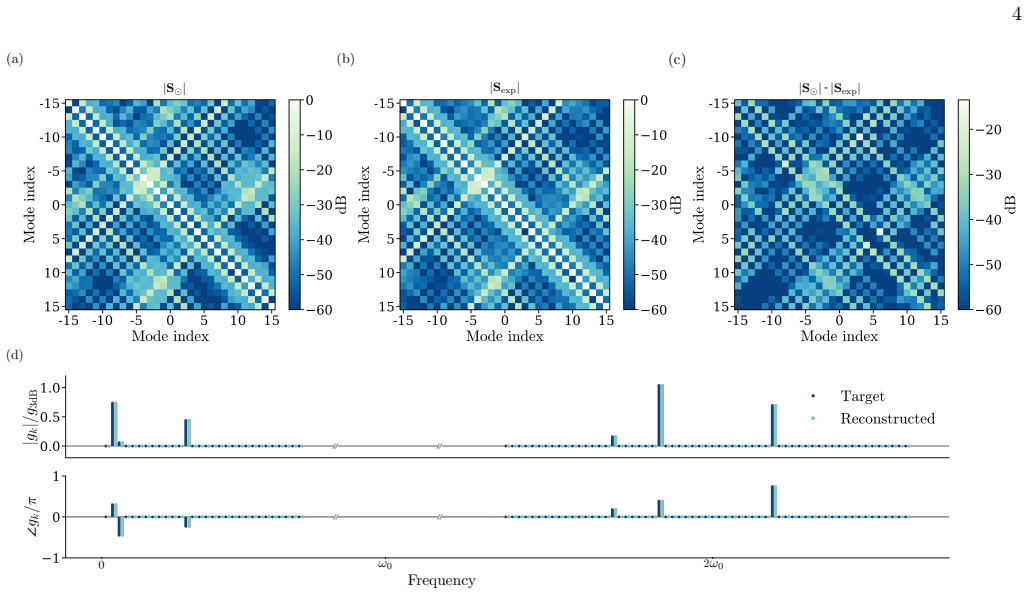
For a single-pole parametric oscillator whose pump has N−1 low-frequency tones and 2N−1 high-frequency tones, the off-diagonal part ΔM of the equation-of-motion matrix decomposes into pump-coupling matrices L±_k and H±_k′ that are orthogonal under the Frobenius inner product. The complex pump amplitudes are therefore exact expansion coefficients, obtained by projection: l_k=(ΔM,L±_k)/∥L±_k∥, h_k′=(ΔM,H±_k′)/∥H±_k′∥. Inverting the input–output relation S=iM−1−1 gives ΔM from any target S, so the pump is recovered in one closed-form step. The authors show numerically that reconstruction is exact up to numerical precision and degrades linearly with noise, and experimentally that the recovered p
What carries the argument
The central object is the orthogonal basis of pump-coupling matrices L±_k and H±_k′: constant 2N×2N matrices with entries in {−1,0,1} that encode how one unit of a low-frequency (beam-splitter) or high-frequency (squeezing) pump tone couples every pair of modes separated by that tone's index. The Frobenius inner product (A,B)=Tr(A B^T) makes these matrices orthogonal, so the off-diagonal part of the equation-of-motion matrix M expands uniquely in this basis. The normalized inner products are exactly the complex pump amplitudes. This identity is what converts the inverse parametric problem from a hard deconvolution into a direct projection.
Load-bearing premise
The load-bearing premise is that the real circuit is exactly captured by the single-mode Hamiltonian with uniform coupling g_mn=g_k δ_{m,n±k} per pump tone, and that the target satisfies the invertibility and span conditions; if couplings are mode-dependent, the projection returns a pump that misses the target.
What would settle it
Apply a single pump tone of index k to the device and measure the scattering between all mode pairs separated by k. If the inferred coupling magnitudes g_mn are not equal across those pairs (beyond small boundary effects), the orthogonal-basis assumption is violated and the exactness of the PPM fails. A second test: feed the PPM a target with plausible magnitudes but randomly chosen phases; the realized scattering will deviate exactly to the extent that those phases are not realizable, quantifying the phase limitation.
If this is right
- Any target scattering matrix consistent with the single-pole model is realizable with at most 3N−2 pump tones, and the pump is found in one projection, eliminating iterative search.
- Because the output covariance matrix of a Gaussian state is V=(ℏ/2) S S^T, the method gives a direct recipe: choose a covariance matrix, get S, project to find the pump, and the device produces that Gaussian state.
- Multi-mode non-reciprocal devices such as circulators can be designed by specifying a target S and letting the projection return the required tones; the authors demonstrate thirteen-mode circulation with unwanted channels suppressed by more than 20 dB.
- The noise sensitivity result means that approximate or partially characterized targets still yield usable pumps, with error growing only linearly with the mismatch.
- The dynamic-control variant allows rapid reprogramming of scattering on the timescale of the measurement window, demonstrated by encoding an image in the scattered output modes.
Where Pith is reading between the lines
- The same projection structure should extend to devices with mode-dependent couplings by replacing the constant basis matrices with weighted variants; the inverse problem would then involve a generalized inner product, but the closed-form character could survive.
- The phase-realizability obstacle suggests a crisp mathematical question the paper leaves open: characterize the submanifold of scattering matrices reachable by the PPM, and develop an algorithm that, given only magnitudes, finds the nearest realizable phase pattern.
- With faster electronics, the dynamic-control demonstration at 50 ms per frame could be pushed to much shorter reconfiguration times, turning a single parametric device into a fast frequency-multiplexed router for quantum or classical signals.
- If the model is approximate, a feedback loop that measures the realized S, computes the residual, and applies PPM corrections could iteratively reach targets beyond the strict model assumptions.
Editorial analysis
A structured set of objections, weighed in public.
Referee Report
Summary. The paper introduces the Pump Projection Method (PPM) for the inverse parametric problem: given a target scattering matrix S⊙ for a multi-mode parametric oscillator described by the coupled-mode equation of motion, it computes the complex amplitudes and phases of the 3N−2 pump tones by inverting S = iM^{-1} − 1 and projecting ΔM = M − M_d onto a set of structured matrices L±_k and H±_k'. The method is validated numerically in round-trip tests with randomly generated targets, tested experimentally on a Josephson parametric amplifier (reported relative deviation 3.7%), and applied to design a 13-mode circulator and to dynamically encode an image in the output modes. The central claim is that PPM is an exact, closed-form solution to the inverse problem within the single-pole parametric oscillator model.
Significance. If the algebraic formulas are corrected, PPM would be a valuable contribution: it replaces iterative optimization with a direct projection for a broad class of multimode parametric scattering problems. The numerical round-trip validation is a useful consistency check, and the experimental demonstrations on a JPA, including the 13-mode circulator and dynamic routing, provide independent support that the method works in practice. The paper is clearly written and the method is likely to be useful for microwave-frequency multimode Gaussian-state engineering. However, the printed derivation contains load-bearing sign and normalization errors that must be fixed before the exactness claim is coherent.
major comments (3)
- [Eq. (14), §II A] Eq. (14) is inconsistent with Eq. (8). From S = iM^{-1} − 1, one has S+1 = iM^{-1}, hence M = i(S+1)^{-1} and therefore ΔM = i(S⊙+1)^{-1} − M_d^⊙. The manuscript instead writes ΔM⊙ = −i(S⊙+1)^{-1} − M_d^⊙. For a zero-pump target S⊙ = iM_d^{-1} − 1, the printed formula gives ΔM = −2M_d rather than zero, so the inversion is wrong as written. The subsequent numerical round-trip results imply the implementation uses the opposite sign; Eq. (14) must be corrected.
- [Eq. (13), §II A] The projection formula is missing the squared norm. Since the normalization is defined as ∥A∥ = √(A,A), the coefficient for l_k should be (ΔM, L±_k)/(L±_k, L±_k) = (ΔM, L±_k)/∥L±_k∥^2. As printed, the denominator is ∥L±_k∥, so a pure L+_k target would be reconstructed with amplitude 1/√(2(N−k)), not unity. The same issue affects h_k'. This is a load-bearing error for the recovery of pump amplitudes and must be corrected.
- [Eq. (11) and text after it, §II A] The statement that {L±_k, H±_k'} form 'an orthogonal basis in the space of complex 2N×2N matrices' is too strong. There are 6N−4 such matrices, while the space of all complex 2N×2N matrices has dimension 4N², so this set spans only the subspace of pump-generated coupling matrices ΔM. The PPM is exact only for targets whose ΔM lies in this span and for which S⊙+1 is invertible. The authors acknowledge phase realizability in §II C, but the exactness claim in §II A should be explicitly scoped to this subspace.
minor comments (6)
- [Eq. (11), Appendix A] The orthogonality relations (11) are asserted without proof. They are straightforward to verify from the definitions in Appendix A, but a short derivation or an explicit statement of the verification would improve the presentation.
- [§II B and Figs. 3–4] The experimental validation reports a single relative deviation value (0.037) and no error bars or repeated measurements. Please state the measurement uncertainty and, if possible, show statistics over several target matrices.
- [§II C] The iterative procedure for the 13-mode circulator (maximizing nonreciprocity) is described only qualitatively. Please specify the number of iterations, the convergence criterion, and the range of off-diagonal magnitudes explored.
- [§II D] The claim that random phases on the HF pumps 'facilitate average cancellation of the higher order mixing processes' is plausible but not derived. A brief analytical or numerical justification would strengthen the approximate dynamic-control method.
- [Online material] The Data Availability statement contains an empty placeholder '[]'. Please provide the actual Zenodo link.
- [Eq. (10)] Calling Tr(A B^T) a Frobenius/Hilbert–Schmidt inner product is nonstandard for complex matrices; the usual Hilbert–Schmidt inner product involves B^†. If the bilinear form with transpose is intended, please define it explicitly as a bilinear form on the real span of the basis matrices, and note that it is not a positive-definite Hermitian inner product on all complex matrices.
Circularity Check
No significant circularity: the inverse result is an algebraic inversion of the forward model, and the experimental JPA test provides independent support. The Eq. (14) sign error is a correctness issue, not a circular reduction.
full rationale
Walking the derivation chain: Eqs. (1)-(4) define the forward model; Eq. (8) defines the scattering matrix; Eq. (14) is intended as the algebraic inversion S -> M; Eqs. (12)-(13) project the off-diagonal part of M onto the L/H basis, whose expansion coefficients are the pump amplitudes by construction of Eqs. (5), (9), and (12). This is an exact linear inversion of the forward map, not a circular argument: the pump coefficients are not fitted to the target and the target is not used to define the basis. The numerical validation in Sec. II B generates targets from the same forward model, so it is a consistency check rather than an independent test, but no parameter is fitted and the physical JPA experiment (Sec. II B, Fig. 3) provides external falsifiability with a 3.7% measured deviation. The only self-citations (e.g., Ref. [25] for the EOM derivation, Refs. [17] and [27] for context) are background and are not used to assume the inverse result, so they are not load-bearing circularity. One non-circular defect must be flagged: as printed, Eq. (14) states ΔM⊙ = -i(S⊙+1)^{-1} - M⊙d, whereas inverting Eq. (8), S = iM^{-1}-1, gives M = i(S+1)^{-1}, so the sign in Eq. (14) is inconsistent. This is a load-bearing algebraic error in the exactness claim as written, likely correctable by a sign change, but it is not a reduction of the result to its inputs; hence the circularity score remains low.
Axiom & Free-Parameter Ledger
axioms (4)
- domain assumption The parametric oscillator is described by Hamiltonian (1) and EOM (3) with uniform mode coupling g_mn = Σ g_k δ_{m,n±k}.
- domain assumption The scattering matrix is related to M by S = iM^{-1} - I (Eq. 8), with no internal loss or additional ports.
- standard math The basis matrices L±_k, H±_k' are orthogonal with respect to the transpose inner product (Eq. 11).
- domain assumption For a given target S_⊙, (S_⊙+I) is invertible and ΔM_⊙ lies in the span of the basis.
read the original abstract
We present a method to calculate the frequency components of a pump waveform driving a parametric oscillator, which realizes a desired frequency mixing or scattering between modes. The method is validated by numerical analysis and we study its sensitivity to added Gaussian noise. A series of experiments apply the method and demonstrate its ability to realize complex scattering processes involving many modes at microwave frequencies, including non-reciprocal mode circulation. We also present an approximate method to dynamically control mode scattering, capable of rapidly routing signals between modes in a prescribed manner. These methods are useful tools for encoding and manipulating continuous variable quantum information with multi-modal Gaussian states.
Figures




Forward citations
Cited by 1 Pith paper
-
Continuous-variable two-dimensional cluster states in the microwave domain
Experimental realization of 2D CV cluster states with 191 modes and -1.2 dB nullifier squeezing in the microwave domain using multi-tone parametric amplification.
Reference graph
Works this paper leans on
-
[1]
Caves, Joshua Combes, Zhang Jiang, and Shashank Pandey
Carlton M. Caves, Joshua Combes, Zhang Jiang, and Shashank Pandey. Quantum limits on phase-preserving linear amplifiers.Physical Review A, 86(6):063802, De- cember 2012
2012
-
[2]
P. Bertet. Parametric coupling for superconducting qubits.Physical Review B, 73(6), 2006
2006
-
[3]
B. Yurke. Squeezed-state generation using a Josephson parametric amplifier.JOSA B, Vol. 4, Issue 10, pp. 1551-1557, October 1987. Publisher: Optica Publishing Group
1987
-
[4]
Yurke, M
B. Yurke, M. L. Roukes, R. Movshovich, and A. N. Pargellis. A low-noise series-array Josephson junc- tion parametric amplifier.Applied Physics Letters, 69(20):3078–3080, November 1996
1996
-
[5]
M. A. Castellanos-Beltran and K. W. Lehnert. Widely tunable parametric amplifier based on a superconduct- ing quantum interference device array resonator.Applied Physics Letters, 91(8):083509, August 2007
2007
-
[6]
M. A. Castellanos-Beltran, K. D. Irwin, G. C. Hilton, L. R. Vale, and K. W. Lehnert. Amplification and squeez- ing of quantum noise with a tunable Josephson metama- terial.Nature Physics, 4(12):929–931, December 2008
2008
-
[7]
F. Mallet. Quantum State Tomography of an Itiner- ant Squeezed Microwave Field.Physical Review Letters, 106(22), 2011
2011
-
[8]
Malnou, D.A
M. Malnou, D.A. Palken, Leila R. Vale, Gene C. Hilton, and K.W. Lehnert. Optimal Operation of a Josephson Parametric Amplifier for Vacuum Squeezing.Physical Review Applied, 9(4):044023, April 2018
2018
-
[9]
Superconducting Parametric Ampli- fiers: The State of the Art in Josephson Parametric Am- plifiers.IEEE Microwave Magazine, 21(8):45–59, August 2020
Jose Aumentado. Superconducting Parametric Ampli- fiers: The State of the Art in Josephson Parametric Am- plifiers.IEEE Microwave Magazine, 21(8):45–59, August 2020
2020
-
[10]
Jie-Qiao Liao and C. K. Law. Parametric generation of quadrature squeezing of mirrors in cavity optomechanics. Physical Review A, 83(3):033820, March 2011
2011
-
[11]
Multipartite continuous-variable entanglement from concurrent nonlinearities.Physical Review A, 70(2):020302, August 2004
Olivier Pfister, Sheng Feng, Gregory Jennings, Raphael Pooser, and Daruo Xie. Multipartite continuous-variable entanglement from concurrent nonlinearities.Physical Review A, 70(2):020302, August 2004
2004
-
[12]
C. Eichler. Observation of Two-Mode Squeezing in the Microwave Frequency Domain.Physical Review Letters, 107(11), 2011
2011
-
[13]
Squeezing and Multimode Entangle- ment of Surface Acoustic Wave Phonons.PRX Quantum, 3(1), 2022
Gustav Andersson. Squeezing and Multimode Entangle- ment of Surface Acoustic Wave Phonons.PRX Quantum, 3(1), 2022
2022
-
[14]
Observation of Two-Mode Squeezing in a Traveling Wave Parametric Amplifier.Physical Review Letters, 128(15):153603, April 2022
Martina Esposito, Arpit Ranadive, Luca Planat, S´ ebastien Leger, Dorian Fraudet, Vincent Jouanny, 9 Olivier Buisson, Wiebke Guichard, C´ ecile Naud, Jos´ e Au- mentado, Florent Lecocq, and Nicolas Roch. Observation of Two-Mode Squeezing in a Traveling Wave Parametric Amplifier.Physical Review Letters, 128(15):153603, April 2022
2022
-
[15]
Jolin, Gustav Andersson, J.C
Shan W. Jolin, Gustav Andersson, J.C. Rivera Hern´ andez, Ingrid Strandberg, Fernando Quijandr ´ ıa, Jos´ e Aumentado, Riccardo Borgani, Mats O. Thol´ en, and David B. Haviland. Multipartite Entanglement in a Microwave Frequency Comb.Physical Review Letters, 130(12):120601, March 2023
2023
-
[16]
Generation and Structuring of Multipartite Entan- glement in a Josephson Parametric System.Advanced Quantum Technologies, 6(1):2200031, 2023
Kirill Viktorovich Petrovnin, Michael Romanovich Perelshtein, Tero Korkalainen, Visa Vesterinen, Ilari Lilja, Gheorghe Sorin Paraoanu, and Pertti Juhani Hako- nen. Generation and Structuring of Multipartite Entan- glement in a Josephson Parametric System.Advanced Quantum Technologies, 6(1):2200031, 2023
2023
-
[17]
Rivera Hern´ andez, Michele Cortino- vis, and David B
Fabio Lingua, J.C. Rivera Hern´ andez, Michele Cortino- vis, and David B. Haviland. Continuous-Variable Square- Ladder Cluster States in a Microwave Frequency Comb. Physical Review Letters, 134(18):183602, May 2025. Pub- lisher: American Physical Society
2025
-
[18]
Ultrafast optical parametric amplifiers.Review of Scientific Instruments, 74(1):1–18, January 2003
Giulio Cerullo and Sandro De Silvestri. Ultrafast optical parametric amplifiers.Review of Scientific Instruments, 74(1):1–18, January 2003
2003
-
[19]
Armstrong, Chanond Sornphiphatphong, Toshiyuki Kaji, Shigenari Suzuki, Jun-ichi Yoshikawa, Hidehiro Yonezawa, Nico- las C
Shota Yokoyama, Ryuji Ukai, Seiji C. Armstrong, Chanond Sornphiphatphong, Toshiyuki Kaji, Shigenari Suzuki, Jun-ichi Yoshikawa, Hidehiro Yonezawa, Nico- las C. Menicucci, and Akira Furusawa. Ultra-large-scale continuous-variable cluster states multiplexed in the time domain.Nature Photonics, 7(12):982–986, December 2013
2013
-
[20]
Menicucci, and Olivier Pfister
Moran Chen, Nicolas C. Menicucci, and Olivier Pfister. Experimental Realization of Multipartite Entanglement of 60 Modes of a Quantum Optical Frequency Comb. Physical Review Letters, 112(12):120505, March 2014
2014
-
[21]
C. W. Gardiner and M. J. Collett. Input and output in damped quantum systems: Quantum stochastic differ- ential equations and the master equation.Physical Re- view A, 31(6):3761–3774, June 1985. Publisher: Ameri- can Physical Society
1985
-
[22]
Synthesis of Parametrically Coupled Networks.PRX Quantum, 3(2):020201, May 2022
Ofer Naaman and Jos´ e Aumentado. Synthesis of Parametrically Coupled Networks.PRX Quantum, 3(2):020201, May 2022. Publisher: American Physical Society
2022
-
[23]
B. R. Mollow. Quantum Theory of Parametric Amplifi- cation. I.Physical Review, 160(5):1076–1096, 1967
1967
-
[24]
Graph-based analysis of nonreciprocity in coupled-mode systems.New Journal of Physics, 17(2):023024, February 2015
Leonardo Ranzani and Jos´ e Aumentado. Graph-based analysis of nonreciprocity in coupled-mode systems.New Journal of Physics, 17(2):023024, February 2015. Pub- lisher: IOP Publishing
2015
-
[25]
J. C. Rivera Hern´ andez, Fabio Lingua, Shan W. Jolin, and David B. Haviland. Control of multi-modal scat- tering in a microwave frequency comb.APL Quantum, 1(3):036101, September 2024. arXiv:2402.09068 [quant- ph]
Pith/arXiv arXiv 2024
-
[26]
Lecocq, L
F. Lecocq, L. Ranzani, G.A. Peterson, K. Cicak, R.W. Simmonds, J.D. Teufel, and J. Aumentado. Non- reciprocal Microwave Signal Processing with a Field- Programmable Josephson Amplifier.Physical Review Ap- plied, 7(2):024028, February 2017
2017
-
[27]
Bock, J.C
Christoph L. Bock, J.C. Rivera Hern´ andez, Fabio Lin- gua, and David B. Haviland. Nonreciprocal scattering in a microwave frequency comb.Physical Review Applied, 24(1):014027, July 2025. Publisher: American Physical Society
2025
-
[28]
Versatile engineering of multimode squeezed states by optimizing the pump spectral profile in sponta- neous parametric down-conversion.Physical Review A, 97(3):033808, March 2018
Francesco Arzani, Claude Fabre, and Nicolas Treps. Versatile engineering of multimode squeezed states by optimizing the pump spectral profile in sponta- neous parametric down-conversion.Physical Review A, 97(3):033808, March 2018. Publisher: American Physical Society
2018
-
[29]
Automated Discovery of Coupled-Mode Setups.Physical Review X, 15(2):021038, May 2025
Jonas Landgraf, Vittorio Peano, and Florian Marquardt. Automated Discovery of Coupled-Mode Setups.Physical Review X, 15(2):021038, May 2025. Publisher: American Physical Society
2025
-
[30]
Lopetegui, Silia Babel, Benjamin Brecht, Christine Silberhorn, and Valentina Parigi
Peter Namdar, Patrick Folge, Carlos E. Lopetegui, Silia Babel, Benjamin Brecht, Christine Silberhorn, and Valentina Parigi. Spectro-temporally tailored Non- Gaussian Quantum Operations in Thin-Film Waveg- uides, August 2025. arXiv:2508.04578 [quant-ph]
arXiv 2025
-
[31]
Cerf, Timothy C
Christian Weedbrook, Stefano Pirandola, Ra´ ul Garc ´ ıa- Patr´ on, Nicolas J. Cerf, Timothy C. Ralph, Jeffrey H. Shapiro, and Seth Lloyd. Gaussian quantum information. Reviews of Modern Physics, 84(2):621–669, May 2012. Publisher: American Physical Society
2012
discussion (0)
Sign in with ORCID, Apple, or X to comment. Anyone can read and Pith papers without signing in.