Recognition: 2 theorem links
· Lean TheoremEfficient Simulation of Sparse, Non-Local Fermion Models
Pith reviewed 2026-05-16 21:21 UTC · model grok-4.3
The pith
An auxiliary-fermion encoding removes Jordan-Wigner strings from sparse models, allowing qubit simulations to achieve optimal circuit depth.
A machine-rendered reading of the paper's core claim, the machinery that carries it, and where it could break.
Core claim
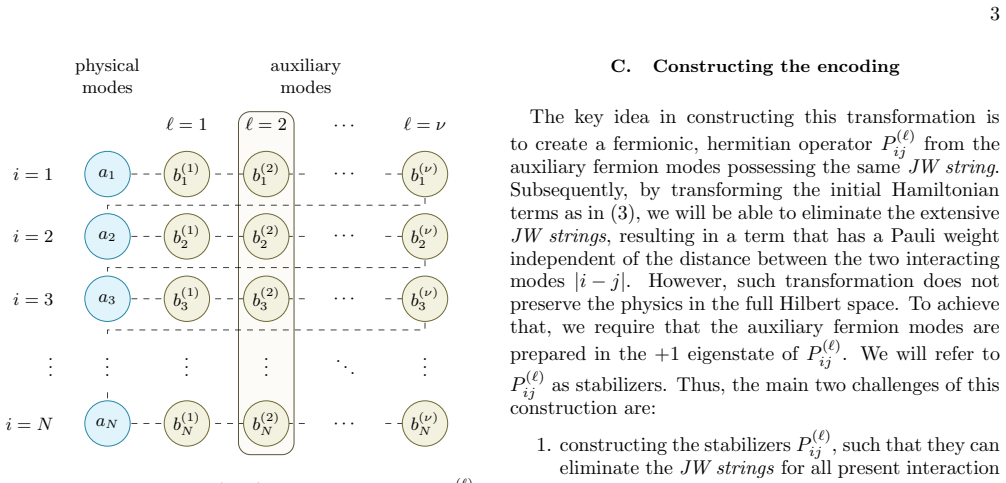
The authors introduce an encoding that augments each physical fermionic mode with a small number of auxiliary fermions. This removes Jordan-Wigner strings for all interactions in the sparse model. The auxiliary state is invariant under the time evolution, so after initial preparation the long-time evolution circuit depth is asymptotically optimal, matching ideal fermionic hardware up to constant factors with O(dN) ancillas.
What carries the argument
The auxiliary-fermion encoding that augments each of the N modes with a constant number of auxiliaries to cancel all Jordan-Wigner strings while preserving invariance of the auxiliary state under evolution.
Load-bearing premise
The auxiliary fermions remain in their prepared state throughout the entire time evolution without being affected by the dynamics.
What would settle it
Measuring whether the auxiliary state changes after a long sequence of Trotter steps in a concrete sparse model such as a 2D lattice with nearest and next-nearest neighbor interactions.
Figures

read the original abstract
Efficient simulation of interacting fermionic systems is a key application of near-term quantum computers, but is hindered by the overhead required to encode fermionic operators on qubit hardware. Here, we consider models with $N$ fermionic modes in which each participates in at most a constant number $d$ of interactions and study the circuit depth required to implement the Trotterized time evolution on qubit hardware with all-to-all connectivity. We introduce an encoding that augments each physical fermionic mode with a small number of auxiliary fermions, enabling the removal of Jordan--Wigner strings. Although the preparation of the auxiliary fermion state incurs an initial overhead, this state remains invariant under time evolution. As a result, long-time evolution can be implemented with asymptotically optimal circuit depth, reducing a previously multiplicative $O(\log N)$ overhead to an additive overhead. Our results thus establish that the simulation of sparse fermionic models on qubit hardware matches the performance achievable on ideal fermionic hardware up to constant factors and $O(dN)$ ancillary qubits.
Editorial analysis
A structured set of objections, weighed in public.
Referee Report
Summary. The manuscript introduces an encoding that augments each of the N fermionic modes with auxiliary fermions to eliminate Jordan-Wigner strings in Trotterized time evolution for sparse models where each mode participates in at most d interactions. The auxiliary state is prepared once and claimed to remain invariant under the evolution, enabling circuit depths that are asymptotically optimal on qubit hardware with all-to-all connectivity, matching ideal fermionic hardware up to constant factors with an additive O(dN) ancillary qubit overhead.
Significance. If the invariance holds rigorously, this would eliminate the typical multiplicative logarithmic overhead of standard Jordan-Wigner encodings for sparse non-local models, making qubit simulations competitive with ideal fermionic hardware up to constants. The auxiliary-fermion construction for string cancellation while preserving the state could influence algorithm design for near-term devices in quantum chemistry and condensed-matter simulation.
major comments (2)
- [Encoding construction and invariance argument] The central claim that the auxiliary fermion state remains invariant under every encoded Trotter term for arbitrary d-regular graphs lacks an explicit subspace-closure argument (e.g., a projector onto the auxiliary subspace or direct verification that each encoded operator maps the subspace to itself). This invariance is load-bearing for removing the O(log N) overhead; without it, leakage would restore multiplicative cost after O(1) steps. (Encoding section and invariance proof)
- [Circuit depth and complexity analysis] The abstract asserts asymptotic optimality and reduction to additive overhead, yet supplies no derivation, error analysis, or explicit circuit-depth expressions comparing the encoded Trotter steps (including preparation cost) to prior JW results for sparse graphs. The full depth bound and its dependence on d and N must be derived. (Circuit complexity section)
minor comments (1)
- [Abstract] Clarify the exact number of auxiliary fermions per mode and whether it scales with d; the O(dN) total is stated but the per-mode count is not derived in the abstract.
Simulated Author's Rebuttal
We thank the referee for their careful reading and constructive comments, which have improved the rigor and clarity of the manuscript. We address each major comment below and have revised the paper to incorporate explicit arguments and derivations where needed.
read point-by-point responses
-
Referee: [Encoding construction and invariance argument] The central claim that the auxiliary fermion state remains invariant under every encoded Trotter term for arbitrary d-regular graphs lacks an explicit subspace-closure argument (e.g., a projector onto the auxiliary subspace or direct verification that each encoded operator maps the subspace to itself). This invariance is load-bearing for removing the O(log N) overhead; without it, leakage would restore multiplicative cost after O(1) steps. (Encoding section and invariance proof)
Authors: We agree that an explicit subspace-closure argument strengthens the presentation. In the revised manuscript, we have added a dedicated subsection in the Encoding section that defines the auxiliary subspace via a projector and verifies by direct computation that each encoded Trotter term maps the subspace to itself for any interaction graph of maximum degree d. This confirms invariance holds for the full evolution with no leakage, justifying the additive overhead. revision: yes
-
Referee: [Circuit depth and complexity analysis] The abstract asserts asymptotic optimality and reduction to additive overhead, yet supplies no derivation, error analysis, or explicit circuit-depth expressions comparing the encoded Trotter steps (including preparation cost) to prior JW results for sparse graphs. The full depth bound and its dependence on d and N must be derived. (Circuit complexity section)
Authors: We have expanded the Circuit complexity section with a full derivation. Each encoded Trotter step has depth O(d) on all-to-all connectivity after one-time preparation of O(dN) ancillas (depth O(dN)). For K Trotter steps with error epsilon the total depth is O(dK + dN), which is asymptotically optimal and reduces the prior multiplicative O(log N) factor to additive O(dN). We include error analysis showing preparation is amortized for long times and explicit comparisons to standard Jordan-Wigner results for sparse graphs. revision: yes
Circularity Check
No significant circularity in auxiliary-fermion encoding derivation
full rationale
The paper introduces a new encoding that augments each of the N fermionic modes with auxiliary fermions to cancel Jordan-Wigner strings for d-regular sparse interactions. The central claim—that the auxiliary state remains invariant under encoded Trotter steps, converting a multiplicative O(log N) overhead into an additive O(dN) cost—follows directly from the explicit construction of the encoding operators rather than from any fitted parameter, self-referential definition, or load-bearing self-citation. No step in the provided abstract reduces the target performance metric to an input by construction; the invariance is presented as a verifiable algebraic property of the chosen auxiliary subspace for arbitrary sparse graphs. The derivation is therefore self-contained against external benchmarks of circuit depth for fermionic simulation.
Axiom & Free-Parameter Ledger
axioms (1)
- domain assumption Trotterized time evolution accurately approximates the continuous dynamics for the models considered
invented entities (1)
-
Auxiliary fermions
no independent evidence
Lean theorems connected to this paper
-
IndisputableMonolith/Cost/FunctionalEquation.leanwashburn_uniqueness_aczel (J(x) = ½(x + x⁻¹) − 1 is the unique calibrated reciprocal cost) unclear?
unclearRelation between the paper passage and the cited Recognition theorem.
the auxiliary fermion state remains invariant under time evolution... P^(ℓ)_ij |Ψ_aux⟩ = + |Ψ_aux⟩ for every relevant stabilizer
-
IndisputableMonolith/Foundation/DimensionForcing.leanalexander_duality_circle_linking (D=3 forced by linking) unclear?
unclearRelation between the paper passage and the cited Recognition theorem.
Depth(W^M) = O(χ log χ + χ log N + M χ log χ) ... matches fermionic hardware up to constant factors
What do these tags mean?
- matches
- The paper's claim is directly supported by a theorem in the formal canon.
- supports
- The theorem supports part of the paper's argument, but the paper may add assumptions or extra steps.
- extends
- The paper goes beyond the formal theorem; the theorem is a base layer rather than the whole result.
- uses
- The paper appears to rely on the theorem as machinery.
- contradicts
- The paper's claim conflicts with a theorem or certificate in the canon.
- unclear
- Pith found a possible connection, but the passage is too broad, indirect, or ambiguous to say the theorem truly supports the claim.
Reference graph
Works this paper leans on
-
[1]
constructing the stabilizers P (ℓ) ij , such that they can eliminate the JW strings for all present interaction terms in the initial Hamiltonian,
-
[2]
efficiently preparing the initial state on the auxil- iary modes |Ψaux⟩, such that: P (ℓ) ij |Ψaux⟩ = + |Ψaux⟩ (10) for every relevant stabilizer P (ℓ) ij . The condition Eq. (10) asserts that the physics of the initial Hamiltonian remain unchanged, and the auxiliary state remains invariant: e−iτ hij P (ℓ) ij |Ψaux⟩ |Ψphys⟩ = |Ψaux⟩ e−iτ hij |Ψphys⟩ . (11...
-
[3]
Olson, Matthias Degroote, Peter D
Yudong Cao, Jonathan Romero, Jonathan P. Olson, Matthias Degroote, Peter D. Johnson, M´ aria Kieferov´ a, Ian D. Kivlichan, Tim Menke, Borja Peropadre, Nicolas P. D. Sawaya, Sukin Sim, Libor Veis, and Al´ an Aspuru- Guzik. Quantum chemistry in the age of quantum com- puting. Chemical Reviews, 119(19):10856–10915, August
-
[4]
doi:10.1021/acs.chemrev.8b00803
ISSN 1520-6890. doi:10.1021/acs.chemrev.8b00803
-
[5]
Sam McArdle, Suguru Endo, Al´ an Aspuru-Guzik, Si- mon C. Benjamin, and Xiao Yuan. Quantum computa- tional chemistry. Rev. Mod. Phys., 92:015003, Mar 2020. doi:10.1103/RevModPhys.92.015003
-
[6]
Laura Clinton, Toby Cubitt, Brian Flynn, Filippo Maria Gambetta, Joel Klassen, Ashley Montanaro, Stephen Piddock, Raul A. Santos, and Evan Sheridan. Towards near-term quantum simulation of materials.Nature Com- munications, 15(1), January 2024. ISSN 2041-1723. doi: 10.1038/s41467-023-43479-6
-
[7]
Interacting electrons and quantum mag- netism
Assa Auerbach. Interacting electrons and quantum mag- netism. Springer Science & Business Media, 2012
work page 2012
-
[8]
The Hubbard Model: A Computational Perspective
Mingpu Qin, Thomas Sch¨ afer, Sabine Andergassen, Philippe Corboz, and Emanuel Gull. The hubbard model: A computational perspective. Annual Review of Con- densed Matter Physics, 13(1):275–302, March 2022. ISSN 1947-5462. doi:10.1146/annurev-conmatphys-090921- 033948
-
[9]
Cooling in strongly corre- lated optical lattices: prospects and challenges
D C McKay and B DeMarco. Cooling in strongly corre- lated optical lattices: prospects and challenges. Reports on Progress in Physics , 74(5):054401, April 2011. ISSN 1361-6633. doi:10.1088/0034-4885/74/5/054401
-
[10]
Brown, Giuseppe Carleo, Lin- coln D
Ehud Altman, Kenneth R. Brown, Giuseppe Carleo, Lin- coln D. Carr, Eugene Demler, Cheng Chin, Brian De- Marco, Sophia E. Economou, Mark A. Eriksson, Fu, et al. Quantum simulators: Architectures and opportunities. PRX Quantum , 2(1), February 2021. ISSN 2691-3399. doi:10.1103/prxquantum.2.017003
-
[11]
Young, Martin Lebrat, and Markus Greiner
Muqing Xu, Lev Haldar Kendrick, Anant Kale, Youqi Gang, Chunhan Feng, Shiwei Zhang, Aaron W. Young, Martin Lebrat, and Markus Greiner. A neutral-atom hubbard quantum simulator in the cryogenic regime. Na- ture, 642(8069):909–915, 2025. doi:10.1038/s41586-025- 09112-w
-
[12]
Abanin, Laleh Aghababaie- Beni, et al
Rajeev Acharya, Dmitry A. Abanin, Laleh Aghababaie- Beni, et al. Quantum error correction below the surface code threshold. Nature, 638(8052):920–926, December
-
[13]
doi:10.1038/s41586-024-08449-y
ISSN 1476-4687. doi:10.1038/s41586-024-08449-y
-
[14]
Anthony Ransford, M. S. Allman, Jake Arkinstall, J. P. Campora III, Samuel F. Cooper, Robert D. Delaney, Joan M. Dreiling, Brian Estey, Caroline Figgatt, Alex Hall, Ali A. Husain, Akhil Isanaka, Colin J. Kennedy, Nikhil Kotibhaskar, et al. Helios: A 98-qubit trapped- ion quantum computer, 2025. URL https://arxiv.org/ abs/2511.05465
work page internal anchor Pith review Pith/arXiv arXiv 2025
-
[15]
Faisal Alam, Jan Lukas Bosse, Ieva ˇCepait˙ e, Adrian Chapman, Laura Clinton, Marcos Crichigno, Elizabeth 7 Crosson, Toby Cubitt, Charles Derby, et al. Pro- grammable digital quantum simulation of 2d fermi- hubbard dynamics using 72 superconducting qubits,
- [16]
-
[17]
Andr´ as Gily´ en, Yuan Su, Guang Hao Low, and Nathan Wiebe. Quantum singular value transformation and be- yond: exponential improvements for quantum matrix arithmetics. In Proceedings of the 51st Annual ACM SIGACT Symposium on Theory of Computing , STOC 2019, page 193–204, New York, NY, USA, 2019. Asso- ciation for Computing Machinery. ISBN 9781450367059...
-
[18]
Andrew M. Childs, Yuan Su, Minh C. Tran, Nathan Wiebe, and Shuchen Zhu. Theory of trotter error with commutator scaling. Phys. Rev. X, 11:011020, Feb 2021. doi:10.1103/PhysRevX.11.011020
-
[19]
Bela Bauer, Dave Wecker, Andrew J. Millis, Matthew B. Hastings, and Matthias Troyer. Hybrid quantum- classical approach to correlated materials. Phys. Rev. X, 6:031045, Sep 2016. doi:10.1103/PhysRevX.6.031045
-
[20]
J. M. Kreula, S. R. Clark, and D. Jaksch. Non-linear quantum-classical scheme to simulate non-equilibrium strongly correlated fermionic many-body dynamics. Sci- entific Reports, 6(1):1–7, 2016. ISSN 20452322. doi: 10.1038/srep32940
-
[21]
Construction of Green’s functions on a quantum computer: Quasiparticle spectra of molecules
Taichi Kosugi and Yu Ichiro Matsushita. Construction of Green’s functions on a quantum computer: Quasiparticle spectra of molecules. Phys. Rev. A, 101(1):012330, 2020. ISSN 24699934. doi:10.1103/PhysRevA.101.012330
-
[22]
Wild, Mari Carmen Ba˜ nuls, and J
Esther Cruz, Dominik S. Wild, Mari Carmen Ba˜ nuls, and J. Ignacio Cirac. Quantum simulation of dynamical response functions of equilibrium states. Phys. Rev. A , 112:032610, Sep 2025. doi:10.1103/lpz2-j7vg
-
[23]
Sirui Lu, Mari Carmen Ba˜ nuls, and J. Ignacio Cirac. Algorithms for quantum simulation at finite ener- gies. PRX Quantum , 2:020321, May 2021. doi: 10.1103/PRXQuantum.2.020321
-
[24]
Quantum mechanics: two volumes bound as one
Albert Messiah. Quantum mechanics: two volumes bound as one. Dover Publications, Inc, Garden City, New York,
-
[25]
ISBN 978-0-486-78455-7
-
[26]
Bounds for the adiabatic approximation with applica- tions to quantum computation
Sabine Jansen, Mary-Beth Ruskai, and Ruedi Seiler. Bounds for the adiabatic approximation with applica- tions to quantum computation. Journal of Mathemat- ical Physics , 48(10):102111, 10 2007. ISSN 0022-2488. doi:10.1063/1.2798382
-
[27]
Tameem Albash and Daniel A. Lidar. Adiabatic quantum computation. Rev. Mod. Phys., 90:015002, Jan 2018. doi: 10.1103/RevModPhys.90.015002
-
[28]
Alberto Peruzzo, Jarrod McClean, Peter Shadbolt, Man- Hong Yung, Xiao-Qi Zhou, Peter J. Love, Al´ an Aspuru- Guzik, and Jeremy L. O’Brien. A variational eigen- value solver on a photonic quantum processor. Nature Communications, 5(1), July 2014. ISSN 2041-1723. doi: 10.1038/ncomms5213
-
[29]
Reports986, 1–128, DOI: 10.1016/j.physrep.2022.08.003 (2022)
Jules Tilly, Hongxiang Chen, Shuxiang Cao, Dario Pi- cozzi, Kanav Setia, Ying Li, Edward Grant, Leonard Wossnig, Ivan Rungger, George H. Booth, and Jonathan Tennyson. The variational quantum eigensolver: A review of methods and best practices. Physics Re- ports, 986:1–128, November 2022. ISSN 0370-1573. doi: 10.1016/j.physrep.2022.08.003
-
[30]
Stephen P. Jordan, Hari Krovi, Keith S. M. Lee, and John Preskill. BQP-completeness of scattering in scalar quan- tum field theory. Quantum, 2:44, January 2018. ISSN 2521-327X. doi:10.22331/q-2018-01-08-44
-
[31]
Sergey B. Bravyi and Alexei Yu. Kitaev. Fermionic quan- tum computation. Annals of Physics , 298(1):210–226, May 2002. ISSN 0003-4916. doi:10.1006/aphy.2002.6254
-
[32]
Robert Ott, Daniel Gonz´ alez-Cuadra, Torsten V. Zache, Peter Zoller, Adam M. Kaufman, and Hannes Pichler. Error-corrected fermionic quantum processors with neu- tral atoms, 2024. URL https://arxiv.org/abs/2412. 16081
work page 2024
-
[33]
Alexander Schuckert, Eleanor Crane, Alexey V. Gor- shkov, Mohammad Hafezi, and Michael J. Gullans. Fault- tolerant fermionic quantum computing, 2025. URL https://arxiv.org/abs/2411.08955
-
[34]
¨Uber das paulische ¨ aquivalenzverbot.Zeitschrift f¨ ur Physik, 47(9):631–651, 1928
Pascual Jordan and Eugene Wigner. ¨Uber das paulische ¨ aquivalenzverbot.Zeitschrift f¨ ur Physik, 47(9):631–651, 1928
work page 1928
-
[35]
On the locality of qubit encodings of local fermionic modes
Tommaso Guaita. On the locality of qubit encodings of local fermionic modes. Quantum, 9:1644, February 2025. ISSN 2521-327X. doi:10.22331/q-2025-02-25-1644
-
[36]
Low-depth quantum simulation of materials
Ryan Babbush, Nathan Wiebe, Jarrod McClean, James McClain, Hartmut Neven, and Garnet Kin-Lic Chan. Low-depth quantum simulation of materials. Physical Review X , 8(1), March 2018. ISSN 2160-3308. doi: 10.1103/physrevx.8.011044
-
[37]
Ian D. Kivlichan, Jarrod McClean, Nathan Wiebe, Craig Gidney, Al´ an Aspuru-Guzik, Garnet Kin-Lic Chan, and Ryan Babbush. Quantum simulation of electronic structure with linear depth and connectiv- ity. Phys. Rev. Lett. , 120:110501, Mar 2018. doi: 10.1103/PhysRevLett.120.110501
- [38]
-
[39]
Nathan Constantinides, Jeffery Yu, Dhruv Devulapalli, Ali Fahimniya, Andrew M. Childs, Michael J. Gullans, Alexander Schuckert, and Alexey V. Gorshkov. Simu- lating fermions with exponentially lower overhead, 2025. URL https://arxiv.org/abs/2510.05099
-
[40]
Mapping local hamiltonians of fermions to local hamiltonians of spins
F Verstraete and J I Cirac. Mapping local hamiltonians of fermions to local hamiltonians of spins. Journal of Statistical Mechanics: Theory and Experiment, 2005(09): P09012–P09012, September 2005. ISSN 1742-5468. doi: 10.1088/1742-5468/2005/09/p09012
-
[41]
Kanav Setia, Sergey Bravyi, Antonio Mezzacapo, and James D. Whitfield. Superfast encodings for fermionic quantum simulation. Physical Review Re- search, 1(3), October 2019. ISSN 2643-1564. doi: 10.1103/physrevresearch.1.033033
-
[42]
Majorana loop stabilizer codes for error mit- igation in fermionic quantum simulations
Zhang Jiang, Jarrod McClean, Ryan Babbush, and Hart- mut Neven. Majorana loop stabilizer codes for error mit- igation in fermionic quantum simulations. Physical Re- view Applied , 12(6), December 2019. ISSN 2331-7019. doi:10.1103/physrevapplied.12.064041
-
[43]
Charles Derby, Joel Klassen, Johannes Bausch, and Toby Cubitt. Compact fermion to qubit mappings. Physi- cal Review B , 104(3), July 2021. ISSN 2469-9969. doi: 10.1103/physrevb.104.035118
-
[44]
Chien, Kanav Setia, Xavier Bonet-Monroig, Mark Steudtner, and James D
Riley W. Chien, Kanav Setia, Xavier Bonet-Monroig, Mark Steudtner, and James D. Whitfield. Simulating quantum error mitigation in fermionic encodings, 2023. URL https://arxiv.org/abs/2303.02270
-
[45]
Andrew J. Landahl and Benjamin C. A. Morrison. Logi- cal fermions for fault-tolerant quantum simulation, 2023. 8 URL https://arxiv.org/abs/2110.10280
-
[46]
72.Yu, J., Liu, Y ., Sugiura, S., Van V oorhis, T
Teodor Parella-Dilm´ e, Korbinian Kottmann, Leonardo Zambrano, Luke Mortimer, Jakob S. Kottmann, and An- tonio Ac´ ın. Reducing entanglement with physically in- spired fermion-to-qubit mappings. PRX Quantum , 5: 030333, Aug 2024. doi:10.1103/PRXQuantum.5.030333
-
[47]
Ultrafast hybrid fermion-to-qubit mapping
Oliver O’Brien and Sergii Strelchuk. Ultrafast hybrid fermion-to-qubit mapping. Phys. Rev. B , 109:115149, Mar 2024. doi:10.1103/PhysRevB.109.115149
-
[48]
Manuel G. Algaba, P. V. Sriluckshmy, Martin Leib, and Fedor ˇSimkovic IV. Low-depth simulations of fermionic systems on square-grid quantum hardware. Quantum, 8: 1327, April 2024. ISSN 2521-327X. doi:10.22331/q-2024- 04-30-1327
-
[49]
K. S. Tikhonov and A. D. Mirlin. Statistics of eigen- states near the localization transition on random reg- ular graphs. Phys. Rev. B , 99:024202, Jan 2019. doi: 10.1103/PhysRevB.99.024202
-
[50]
Garc´ ıa-Garc´ ıa, Yiyang Jia, Dario Rosa, and Jacobus J
Antonio M. Garc´ ıa-Garc´ ıa, Yiyang Jia, Dario Rosa, and Jacobus J. M. Verbaarschot. Sparse sachdev- ye-kitaev model, quantum chaos, and gravity du- als. Phys. Rev. D , 103:106002, May 2021. doi: 10.1103/PhysRevD.103.106002
-
[51]
Optimizing sparse fermionic Hamil- tonians
Yaroslav Herasymenko, Maarten Stroeks, Jonas Helsen, and Barbara Terhal. Optimizing sparse fermionic Hamil- tonians. Quantum, 7:1081, August 2023. ISSN 2521- 327X. doi:10.22331/q-2023-08-10-1081
-
[52]
Jan-Niklas Herre, Jonas F. Karcher, Konstantin S. Tikhonov, and Alexander D. Mirlin. Ergodicity- to-localization transition on random regular graphs with large connectivity and in many-body quantum dots. Phys. Rev. B , 108:014203, Jul 2023. doi: 10.1103/PhysRevB.108.014203
-
[53]
Tsironis and Efthimios Kaxiras
G.P. Tsironis and Efthimios Kaxiras. Quantum dynam- ics on tight binding small world networks and flat band spectra. Physics Letters A, 497:129330, 2024. ISSN 0375-
work page 2024
-
[54]
doi:10.1016/j.physleta.2024.129330
-
[55]
Dalzell, Mario Berta, Fer- nando G
Chi-Fang Chen, Alexander M. Dalzell, Mario Berta, Fer- nando G. S. L. Brand˜ ao, and Joel A. Tropp. Sparse ran- dom hamiltonians are quantumly easy. Phys. Rev. X, 14: 011014, Feb 2024. doi:10.1103/PhysRevX.14.011014
-
[56]
Even though there are νN fermion modes, since the relative ordering of the modes on each site remains un- changed, we only require O(log N) staricase permuta- tions to permute them
-
[57]
The ancillas required for the fermion permutation can be reused during the preparation of C(ℓ) ord
-
[58]
Ancilla- Free Quantum Adder with Sublinear Depth , page 137–154
Maxime Remaud and Vivien Vandaele. Ancilla- Free Quantum Adder with Sublinear Depth , page 137–154. Springer Nature Switzerland, 2025. ISBN 9783031970634. doi:10.1007/978-3-031-97063-4˙11
-
[59]
On an estimate of the chromatic class of a p-graph
Vadim G Vizing. On an estimate of the chromatic class of a p-graph. Diskret analiz, 3:25–30, 1964
work page 1964
-
[60]
Quantum Circuits: Fanout, Parity, and Counting
Cristopher Moore. Quantum circuits: Fanout, par- ity, and counting, 1999. URL https://arxiv.org/abs/ quant-ph/9903046
work page internal anchor Pith review Pith/arXiv arXiv 1999
-
[61]
Quantum lower bounds for fanout, 2003
Maosen Fang, Stephen Fenner, Frederic Green, Steven Homer, and Yong Zhang. Quantum lower bounds for fanout, 2003. URL https://arxiv.org/abs/quant-ph/ 0312208
work page 2003
-
[62]
Juan Maldacena and Douglas Stanford. Remarks on the sachdev-ye-kitaev model. Physical Review D, 94(10), November 2016. ISSN 2470-0029. doi: 10.1103/physrevd.94.106002
-
[63]
Asymptotic be- havior of the chromatic index for hypergraphs
Nicholas Pippenger and Joel Spencer. Asymptotic be- havior of the chromatic index for hypergraphs. Journal of Combinatorial Theory, Series A , 51(1):24–42, 1989. ISSN 0097-3165. doi:10.1016/0097-3165(89)90074-5. Appendix A: Detailed JW transformations In this appendix we show how to use the stabilizers P (ℓ) ij to cancel the long JW strings of non-local h...
-
[64]
Hopping term We begin with the hopping term between two arbitrary sites i < j . Using (4) a† i aj + a† jai = j−1Y n=i νY k=0 Z(k) n ! 2X(0) i X(0) j + 2Y(0) i Y(0) j 4 = 1 2 X(0) i X(0) j + Y(0) i Y(0) j j−1Y n=i νY k=0 Z(k) n ! . (A1) This is the standard JW form of the hopping term: a two-qubit operator on the physical modes at sites i and j multiplied ...
-
[65]
For this term no transformation is necessary because ni is already local in the JW representation
Interaction terms Here we consider Fermi–Hubbard (FH) type density– density interaction ninj with ni = a† i ai. For this term no transformation is necessary because ni is already local in the JW representation. ni = a† i ai = 1 2(1 + Z(0) i ). (A5) The FH density–density term ninj is therefore a product of single-site operators in the JW representation an...
-
[66]
(A8) It will be the building block for transforming four-fermion (and higher) interaction terms
Identity for a† i P (ℓ) ij aj We consider the term a† i P (ℓ) ij aj a† i P (ℓ) ij aj = Si X(0) i + iY(0) i 2 ! −i SiZi,<ℓX(ℓ) i SjZj,<ℓY(ℓ) j × (A6) × Sj X(0) j − iY(0) j 2 ! = − i 4 SiSiSjSj(X(0) i + iY(0) i )Zi,<ℓX(ℓ) i × Zj,<ℓY(ℓ) j (X(0) j − iY(0) j ) (A7) = − i 4(Zi,<ℓZj,<ℓ)X(ℓ) i Y(ℓ) j × h X(0) i X(0) j + Y(0) i Y(0) j − i(X(0) i Y(0) j − Y(0) i X(...
-
[67]
T ransformation of four-fermion terms We now consider a generic chemistry-style four-fermion interaction term of the form hijkl = a† i a† jakal + a† l a† kajai. (A10) We assume that the indicesi, j, k, l are such that the pairs (i, k) and ( j, l) correspond to existing stabilizers (if they do not, we add the edges to the interaction graph). We transform h...
-
[68]
Arbitrary Interaction terms The same approach as in Appendix A 3 can further be used to eliminate the JW strings from any even fermion term by suitably introducing the stabilizers P (ℓ) ij . The terms do not necessarily need to be number preserving, the stabilizers allow to eliminate the JW strings in any case. By equivalent arguments as above, a general ...
-
[69]
Here each γ(0) i can be either the c(0) i or d(0) i Majorana operator
SYK terms A term that appears in the SYK model (see Appendix F 2) is the four-Majorana operator γ(0) i γ(0) j γ(0) k γ(0) l . Here each γ(0) i can be either the c(0) i or d(0) i Majorana operator. We show that it can be transformed to a constant-weight Pauli term by multi- plication with the stabilizers. We choose to transform it as: γ(0) i γ(0) j γ(0) k ...
-
[70]
Given a Hamiltonian Hhop on N modes we construct a graph G = ( V, E) with |V | = N
Constructing the interaction graph Firstly, it is trivial to generate a hopping Hamiltonian. Given a Hamiltonian Hhop on N modes we construct a graph G = ( V, E) with |V | = N. The graph G encodes the locality pattern: we assume that ( i, j) ∈ E exactly when the hopping term between sites i and j is present (tij ̸= 0). However, one might also be intereste...
-
[71]
pick one stabilizer configuration that simplifies the higher order terms
-
[72]
This strategy works for creating an appropriate (albeit not unique) interaction graph
for each stabilizer P (ℓ) ij that we require, we add an edge (i, j) to E, if it is not already present. This strategy works for creating an appropriate (albeit not unique) interaction graph. We do not concern our- selves with finding the best possible solution here. In the next section, we assume that we are given an instance of such an interaction graph ...
-
[73]
An edge coloring is a map col : E → {1,
Edge coloring and auxiliary layers To assign commuting stabilizers, we use a proper edge coloring of the graph G. An edge coloring is a map col : E → {1, . . . , χ} (C2) such that no two edges incident on the same vertex share the same color. The minimum number χ of colors for which such a coloring exists is the chromatic index (or edge chromatic number) ...
-
[74]
A graph G = (V, E) is d− regular if each v ∈ V belong to exactly d edges in E
Regular graph properties A relevant example of sparse interactions graphs are the d−regular graphs. A graph G = (V, E) is d− regular if each v ∈ V belong to exactly d edges in E. For regular graphs, it is possible to bound their chro- matic index χ using the Vizing’s theorem [52]: d ≤ χ ≤ d + 1. (C15) Appendix D: Ordered state circuit construction In Sect...
-
[75]
Mapping to a unitary First, note that the operation c(ℓ) i −id(ℓ) j√ 2 is not unitary. To embed it into a unitary we introduce an additional auxiliary qubit: U(ℓ) ij = |0⟩ ⟨0|anc ⊗ c(ℓ) i + |1⟩ ⟨1|anc ⊗ (−id(ℓ) j ). (D1) One can verify that U(ℓ)† ij U(ℓ) ij = U(ℓ) ij U(ℓ)† ij = = |0⟩ ⟨0|anc ⊗ c(ℓ)2 i + |1⟩ ⟨1|anc ⊗ d(ℓ)2 j = |0⟩ ⟨0|anc ⊗ 1 + |1⟩ ⟨1|anc ⊗ ...
-
[76]
To try that, let us first try to simplify C(ℓ) ord (Eq
Circuit decomposition of the ordered state preparation Having showed how we can initialize the respective state, let us show how we can prepare an efficient cir- cuit in the ordered case. To try that, let us first try to simplify C(ℓ) ord (Eq. (19)) in the qubit picture: 2 N 4 C(ℓ) ord = N/2Y k=1 (S2k−1Z2k−1,<ℓX(ℓ) 2k−1 + iS2kZ2k,<ℓY(ℓ) 2k ) = N/2Y k=1 S2...
-
[77]
This also straight- forwardly extends to higher order fermion interactions
Commutator bounds Consider the commutator bounds on the transformed Hamiltonian:h ˜hij, ˜hkl i = h hijP (ℓ) ij , hklP (ℓ′) kl i = [hij, hkl]P (ℓ) ij P (ℓ′) kl , (E1) 14 since the projectors commute with themselves (our con- struction) and the physical operators. This also straight- forwardly extends to higher order fermion interactions. Thus, h ˜hij, ˜hkl...
-
[78]
Implementing n−qubit evolution Consider an evolution of a Hamiltonian term sup- ported on n−qubits. Such an evolution can be imple- mented with a single qubit rotation, conjugated between a n−qubit CNOT staircase (Pauli gadget method). Such a CNOT ladder can be implemented with a O(log(n)) depth circuit without any ancillas [51]. Thus, any evolu- tion of ...
-
[79]
F ermi–Hubbard model Consider a Fermi–Hubbard model on a d−regular graph G = (V, E), meaning that each vertex v ∈ V has exactly d edges: HFH = Hhop + Hint = (F1) = X (i,j)∈E tij (a† i aj + a† jai) + X (i,j)∈E Vija† i aia† jaj. (F2) On a d−regular graph d ≤ χ ≤ d + 1 (see Appendix C 3), thus we need at most ν = ⌈(d + 1)/2⌉ ancillary fermions per site. Even...
-
[80]
No assumption is made on the dis- tribution of the couplings Je, which may be arbitrary
SYK model We consider a quartic Sachdev–Ye–Kitaev (SYK) type Hamiltonian [55] acting onN Majorana fermions {γi}N i=1, HSYK = X e∈E Je Y i∈e γi, (F6) where E denotes the edge set of a 4-uniform hypergraph, such that each interaction term involves exactly four fermionic operators. No assumption is made on the dis- tribution of the couplings Je, which may be...
discussion (0)
Sign in with ORCID, Apple, or X to comment. Anyone can read and Pith papers without signing in.