Time-Frequency Analysis for Neural Networks
Pith reviewed 2026-05-16 21:07 UTC · model grok-4.3
The pith
Shallow neural networks using time-frequency localized units achieve N^{-1/2} approximation rates in Sobolev norms for functions in modulation spaces.
A machine-rendered reading of the paper's core claim, the machinery that carries it, and where it could break.
Core claim
For any function f in the weighted modulation space M^{p,q}_m(R^d), there exist shallow neural networks f_N with N units such that the Sobolev norm error ||f - f_N||_{W^{n,r}(Ω)} is bounded by a constant multiple of N^{-1/2} times the modulation norm of f on bounded domains Ω. The units are built by pairing standard activations with localized time-frequency windows to form dictionaries that satisfy the covering and localization properties required in modulation space theory.
What carries the argument
Modulation space dictionaries formed by combining standard activations with localized time-frequency windows, which provide the covering and localization properties that deliver the N^{-1/2} rate.
If this is right
- Global approximation theorems hold on the whole space R^d using weighted modulation dictionaries.
- The results apply directly to Feichtinger's algebra, Fourier-Lebesgue spaces, and Barron spaces.
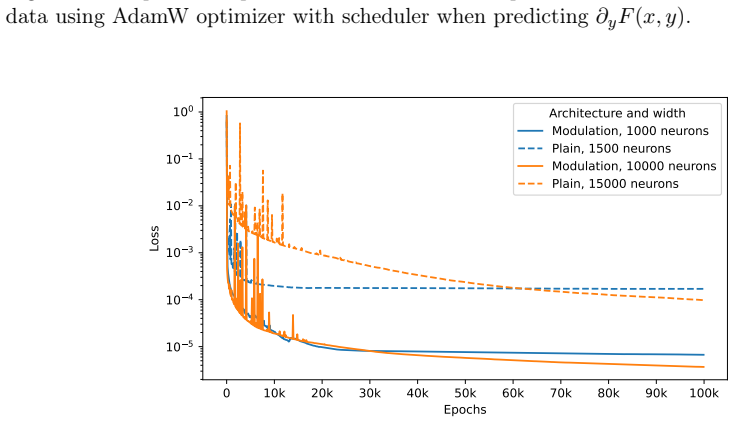
- Modulation-based networks achieve substantially better Sobolev approximation than standard ReLU networks in one- and two-dimensional numerical tests.
Where Pith is reading between the lines
- The same dictionary construction could be layered in deeper architectures to preserve the rate while increasing expressivity.
- Explicit constants in the bounds make it feasible to compare this construction against other function-space approaches to neural approximation.
- Higher-dimensional numerical tests would directly check whether the theoretical dimension independence appears in practice.
Load-bearing premise
The neural network units can be formed by combining standard activations with localized time-frequency windows such that the resulting dictionary satisfies the necessary covering and localization properties in the modulation space to deliver the stated rate.
What would settle it
A function in a modulation space for which the best approximation error by any network built from such time-frequency units remains larger than order N^{-1/2} in the target Sobolev norm on a bounded domain would falsify the main rate.
Figures


read the original abstract
We develop a quantitative approximation theory for shallow neural networks using tools from time-frequency analysis. Working in weighted modulation spaces $M^{p,q}_m(\mathbf{R}^{d})$, we prove dimension-independent approximation rates in Sobolev norms $W^{n,r}(\Omega)$ for networks whose units combine standard activations with localized time-frequency windows. Our main result shows that for $f \in M^{p,q}_m(\mathbf{R}^{d})$ one can achieve \[ \|f - f_N\|_{W^{n,r}(\Omega)} \lesssim N^{-1/2}\,\|f\|_{M^{p,q}_m(\mathbf{R}^{d})}, \] on bounded domains, with explicit control of all constants. We further obtain global approximation theorems on $\mathbf{R}^{d}$ using weighted modulation dictionaries, and derive consequences for Feichtinger's algebra, Fourier-Lebesgue spaces, and Barron spaces. Numerical experiments in one and two dimensions confirm that modulation-based networks achieve substantially better Sobolev approximation than standard ReLU networks, consistent with the theoretical estimates.
Editorial analysis
A structured set of objections, weighed in public.
Referee Report
Summary. The manuscript develops a quantitative approximation theory for shallow neural networks using tools from time-frequency analysis. Working in weighted modulation spaces M^{p,q}_m(R^d), it proves dimension-independent approximation rates of order N^{-1/2} in Sobolev norms W^{n,r}(Ω) on bounded domains, with explicit control of all constants, realized by combining standard activations with localized time-frequency windows. Additional results cover global approximation on R^d using weighted modulation dictionaries and consequences for Feichtinger's algebra, Fourier-Lebesgue spaces, and Barron spaces. Numerical experiments in one and two dimensions show that modulation-based networks outperform standard ReLU networks in Sobolev approximation, consistent with the theory.
Significance. If the central claims hold, the work is significant for establishing explicit, dimension-independent rates that connect time-frequency analysis directly to neural network approximation, avoiding hidden dimension dependence. The provision of explicit constants, atomic decomposition or greedy selection arguments, and reproducible numerical validation in 1D/2D are particular strengths that make the result falsifiable and practically relevant for high-dimensional settings.
minor comments (3)
- §3 (main theorem): the statement that constants are fully explicit would be strengthened by including a brief remark on their dependence (or independence) on the weight m and the parameters p,q,r,n; this is a local clarification rather than a load-bearing gap.
- Numerical experiments section: the description of how standard activations are combined with localized TF windows to form the dictionary could be expanded with one concrete example (e.g., the explicit form of a single unit) to aid reproducibility.
- Notation: the transition from the modulation-space norm on R^d to the Sobolev norm on bounded Ω is clear in the abstract but would benefit from an explicit statement of the restriction operator in the statement of Theorem 1.
Simulated Author's Rebuttal
We thank the referee for the positive assessment of our manuscript, the recognition of its significance in connecting time-frequency analysis to neural network approximation theory, and the recommendation for minor revision. No major comments were raised in the report, so we have no specific points requiring detailed rebuttal or revision at this stage. We remain available to address any minor suggestions or clarifications that may arise.
Circularity Check
No significant circularity detected
full rationale
The derivation proceeds from established atomic decompositions and covering properties of modulation spaces M^{p,q}_m to the stated Sobolev approximation rate via N-term selection of time-frequency atoms realized with standard activations. The main inequality follows directly from these independent space properties and greedy selection arguments without any step that defines the target rate in terms of itself or renames a fitted quantity as a prediction. No load-bearing self-citation chain is required for the central claim; the constants are stated to be explicit and controlled by the modulation norm alone. The construction on bounded domains and global extensions are self-contained against the cited time-frequency literature.
Axiom & Free-Parameter Ledger
axioms (2)
- standard math Standard properties of weighted modulation spaces M^{p,q}_m(R^d) and their embeddings into Sobolev spaces
- domain assumption Existence and approximation properties of dictionaries formed by combining standard activations with localized time-frequency windows
Lean theorems connected to this paper
-
IndisputableMonolith/Cost/FunctionalEquation.leanwashburn_uniqueness_aczel unclear?
unclearRelation between the paper passage and the cited Recognition theorem.
We develop a quantitative approximation theory for shallow neural networks using tools from time-frequency analysis. Working in weighted modulation spaces M^{p,q}_m(R^d), we prove dimension-independent approximation rates in Sobolev norms W^{n,r}(Ω) ... ||f - f_N||_{W^{n,r}(Ω)} ≲ N^{-1/2} ||f||_{M^{p,q}_m(R^d)}
-
IndisputableMonolith/Foundation/RealityFromDistinction.leanreality_from_one_distinction unclear?
unclearRelation between the paper passage and the cited Recognition theorem.
dictionary D = {x ↦ σ(η·x/τ + b) φ(η·x/τ + b - t) ϕ(x - y)} ... variation norm ||f||_K(D) ... Maurey sampling result
What do these tags mean?
- matches
- The paper's claim is directly supported by a theorem in the formal canon.
- supports
- The theorem supports part of the paper's argument, but the paper may add assumptions or extra steps.
- extends
- The paper goes beyond the formal theorem; the theorem is a base layer rather than the whole result.
- uses
- The paper appears to rely on the theorem as machinery.
- contradicts
- The paper's claim conflicts with a theorem or certificate in the canon.
- unclear
- Pith found a possible connection, but the passage is too broad, indirect, or ambiguous to say the theorem truly supports the claim.
Reference graph
Works this paper leans on
-
[1]
Uniform approximation with quadratic neural networks,
A. Abdeljawad, “Uniform approximation with quadratic neural networks,”Neural Net- works, vol. 192, p. 107742, Dec. 2025.doi:10.1016/j.neunet.2025.107742
-
[2]
A. Abdeljawad, S. Coriasco, and J. Toft, “Liftings for ultra-modulation spaces, and one-parameter groups of Gevrey-type pseudo-differential operators,”Analysis and Ap- plications, vol. 18, no. 04, pp. 523–583, Jul. 2020.doi:10.1142/S0219530519500143
-
[3]
A. Abdeljawad and T. Dittrich,Space-Time Approximation with Shallow Neural Net- works in Fourier Lebesgue Spaces, arXiv:2312.08461 [cs], Dec. 2023
-
[4]
A. Abdeljawad and T. Dittrich,Weighted Sobolev Approximation Rates for Neural Networks on Unbounded Domains, Version Number: 1, 2024.doi:10.48550/ARXIV. 2411.04108
work page internal anchor Pith review doi:10.48550/arxiv 2024
-
[5]
Approximations with deep neural networks in Sobolev time-space,
A. Abdeljawad and P. Grohs, “Approximations with deep neural networks in Sobolev time-space,”Analysis and Applications, vol. 20, no. 03, pp. 499–541, May 2022.doi: 10.1142/S0219530522500014
-
[6]
Barron, a.e.: Universal approximation bounds for superpositions of a sigmoidal function
A. Barron, “Universal approximation bounds for superpositions of a sigmoidal func- tion,”IEEE Transactions on Information Theory, vol. 39, no. 3, pp. 930–945, May 1993.doi:10.1109/18.256500
-
[7]
Subexponential decay and regularity estimates for eigenfunctions of localization operators,
F. Bastianoni and N. Teofanov, “Subexponential decay and regularity estimates for eigenfunctions of localization operators,”Journal of Pseudo-Differential Operators and Applications, vol. 12, no. 1, p. 19, Mar. 2021.doi:10.1007/s11868-021-00383-1
-
[8]
Fundamentals of Enzyme Kinetics: Michaelis-Menten and Non-Michaelis- Type (Atypical) Enzyme Kinetics
Á. Bényi and K. A. Okoudjou,Modulation Spaces: With Applications to Pseudod- ifferential Operators and Nonlinear Schrödinger Equations(Applied and Numerical Harmonic Analysis). New York, NY: Springer New York, 2020.doi:10.1007/978-1- 0716-0332-1
-
[9]
Generalized Anti-Wick Operators with Symbols in Distributional Sobolev spaces,
P. Boggiatto, E. Cordero, and K. Gröchenig, “Generalized Anti-Wick Operators with Symbols in Distributional Sobolev spaces,”Integral Equations and Operator Theory, vol. 48, no. 4, pp. 427–442, Apr. 2004, Publisher: Springer Science and Business Media LLC.doi:10.1007/s00020-003-1244-x
-
[10]
Stochastic partial differential equations in M-type 2 Banach spaces,
Z. Brzeźniak, “Stochastic partial differential equations in M-type 2 Banach spaces,” Potential Analysis, vol. 4, no. 1, pp. 1–45, Feb. 1995.doi:10.1007/BF01048965 40
-
[11]
A. Caragea, P. Petersen, and F. Voigtlaender, “Neural Network Approximation and Estimation of Classifiers with Classification Boundary in a Barron Class,”The Annals of Applied Probability, vol. 33, no. 4, Aug. 2023.doi:10.1214/22-AAP1884
-
[12]
Deep relaxation: Partial differential equations for optimizing deep neural networks,
P. Chaudhari, A. Oberman, S. Osher, S. Soatto, and G. Carlier, “Deep relaxation: Partial differential equations for optimizing deep neural networks,”Research in the Mathematical Sciences, vol. 5, no. 3, p. 30, Sep. 2018.doi:10.1007/s40687- 018- 0148-y
-
[13]
Neural ordinary differential equations,
R. T. Q. Chen, Y. Rubanova, J. Bettencourt, and D. K. Duvenaud, “Neural ordinary differential equations,” inAdvances in Neural Information Processing Systems, S. Ben- gio, H. Wallach, H. Larochelle, K. Grauman, N. Cesa-Bianchi, and R. Garnett, Eds., vol. 31, Curran Associates, Inc., 2018
work page 2018
-
[14]
A Regularity Theory for Static Schrödinger Equa- tions on{R} d in Spectral Barron Spaces,
Z. Chen, J. Lu, Y. Lu, and S. Zhou, “A Regularity Theory for Static Schrödinger Equa- tions on{R} d in Spectral Barron Spaces,”SIAM Journal on Mathematical Analysis, vol. 55, no. 1, pp. 557–570, Feb. 2023.doi:10.1137/22M1478719
-
[15]
Optimal Stable Nonlinear Approximation,
A. Cohen, R. DeVore, G. Petrova, and P. Wojtaszczyk, “Optimal Stable Nonlinear Approximation,”Foundations of Computational Mathematics, vol. 22, no. 3, pp. 607– 648, Jun. 2022.doi:10.1007/s10208-021-09494-z
-
[16]
Time–Frequency analysis of localization operators,
E. Cordero and K. Gröchenig, “Time–Frequency analysis of localization operators,” Journal of Functional Analysis, vol. 205, no. 1, pp. 107–131, Dec. 2003.doi:10.1016/ S0022-1236(03)00166-6
work page 2003
-
[17]
E. Cordero and L. Rodino,Time-Frequency Analysis of Operators. De Gruyter, Sep. 2020.doi:10.1515/9783110532456
-
[18]
G. Cybenko, “Approximation by Superpositions of a Sigmoidal Function,”Mathe- matics of Control, Signals, and Systems, vol. 2, no. 4, pp. 303–314, Dec. 1989.doi: 10.1007/BF02551274
-
[19]
Weighted variation spaces and approximation by shallow ReLU networks,
R. DeVore, R. D. Nowak, R. Parhi, and J. W. Siegel, “Weighted variation spaces and approximation by shallow ReLU networks,”Applied and Computational Harmonic Analysis, vol. 74, p. 101713, Jan. 2025.doi:10.1016/j.acha.2024.101713
-
[20]
R. A. DeVore, “Nonlinear Approximation,”Acta Numerica, vol. 7, pp. 51–150, Jan. 1998.doi:10.1017/S0962492900002816
-
[21]
The Barron Space and the Flow-Induced Function Spaces for Neural Network Models,
W. E, C. Ma, and L. Wu, “The Barron Space and the Flow-Induced Function Spaces for Neural Network Models,”Constructive Approximation, vol. 55, no. 1, pp. 369–406, Feb. 2022.doi:10.1007/s00365-021-09549-y
-
[22]
The Deep Ritz Method: A Deep Learning-Based Numerical Algo- rithm for Solving Variational Problems,
W. E and B. Yu, “The Deep Ritz Method: A Deep Learning-Based Numerical Algo- rithm for Solving Variational Problems,”Communications in Mathematics and Statis- tics, vol. 6, no. 1, pp. 1–12, Mar. 2018.doi:10.1007/s40304-018-0127-z
-
[23]
Deep Neural Network Approximation Theory,
D. Elbrachter, D. Perekrestenko, P. Grohs, and H. Bolcskei, “Deep Neural Network Approximation Theory,”IEEE Transactions on Information Theory, vol. 67, no. 5, pp. 2581–2623, May 2021.doi:10.1109/TIT.2021.3062161
-
[24]
Wilson Bases and Modulation Spaces,
H. G. Feichtinger, K. Gröchenig, and D. Walnut, “Wilson Bases and Modulation Spaces,”Mathematische Nachrichten, vol. 155, no. 1, pp. 7–17, Jan. 1992.doi:10. 1002/mana.19921550102 41
work page 1992
-
[25]
Atomic characterizations of modulation spaces through Gabor- type representations,
H. G. Feichtinger, “Atomic characterizations of modulation spaces through Gabor- type representations,”The Rocky Mountain Journal of Mathematics, vol. 19, no. 1, pp. 113–125, 1989, Publisher: Rocky Mountain Mathematics Consortium
work page 1989
-
[26]
Modulation spaces on locally compact abelian groups,
H. G. Feichtinger, “Modulation spaces on locally compact abelian groups,” inTechnical report, University of Vienna, 1983; also in Proceedings of the international conference on wavelets and applications, R. Radha, M. Krishna, and S. Thangavelu, Eds., New Delhi: Allied Publishers, 2003, pp. 1–56
work page 1983
-
[27]
Time-frequency analysis on modulation spacesMp,q m , 0<p, q≤ ∞,
Y. V. Galperin and S. Samarah, “Time-frequency analysis on modulation spacesMp,q m , 0<p, q≤ ∞,”Applied and Computational Harmonic Analysis, vol. 16, no. 1, pp. 1–18, Jan. 2004, Publisher: Elsevier BV.doi:10.1016/j.acha.2003.09.001
-
[28]
Nonlinear Approximation with Local Fourier Bases,
K. Gröchenig and S. Samarah, “Nonlinear Approximation with Local Fourier Bases,” Constructive Approximation, vol. 16, no. 3, pp. 317–331, Jul. 2000.doi:10. 1007 / s003659910014
work page 2000
-
[29]
Foundations of Time-Frequency Analysis
K. Gröchenig,Foundations of Time-Frequency Analysis(Applied and Numerical Har- monic Analysis), J. J. Benedetto, Ed. Boston, MA: Birkhäuser Boston, 2001.doi: 10.1007/978-1-4612-0003-1
-
[30]
P. Grohs and F. Voigtlaender, “Proof of the Theory-to-Practice Gap in Deep Learning Via Sampling Complexity Bounds for Neural Network Approximation Spaces,”Foun- dations of Computational Mathematics, Jul. 2023.doi:10.1007/s10208-023-09607- w
-
[31]
Sharp weighted convolution inequalities and some applications,
W. Guo, D. Fan, H. Wu, and G. Zhao, “Sharp weighted convolution inequalities and some applications,”Studia Mathematica, vol. 241, no. 3, pp. 201–239, 2018.doi:10. 4064/sm8583-5-2017
work page 2018
-
[32]
Inclusion relations between modulation and Triebel- Lizorkin spaces,
W. Guo, H. Wu, and G. Zhao, “Inclusion relations between modulation and Triebel- Lizorkin spaces,”Proceedings of the American Mathematical Society, vol. 145, no. 11, pp. 4807–4820, May 2017.doi:10.1090/proc/13614
-
[33]
Katznelson,An Introduction to Harmonic Analysis, 3rd ed
Y. Katznelson,An Introduction to Harmonic Analysis, 3rd ed. Cambridge University Press, Jan. 2004.doi:10.1017/CBO9781139165372
-
[34]
Approximation by Combinations of ReLU and Squared ReLU Ridge Functions withℓ1 andℓ 0 Controls,
J. M. Klusowski and A. R. Barron, “Approximation by Combinations of ReLU and Squared ReLU Ridge Functions withℓ1 andℓ 0 Controls,”IEEE Transactions on In- formation Theory, vol. 64, no. 12, pp. 7649–7656, Dec. 2018.doi:10.1109/TIT.2018. 2874447
-
[35]
The inclusion relation between Sobolev and modu- lation spaces,
M. Kobayashi and M. Sugimoto, “The inclusion relation between Sobolev and modu- lation spaces,”Journal of Functional Analysis, vol. 260, no. 11, pp. 3189–3208, Jun. 2011.doi:10.1016/j.jfa.2011.02.015
-
[36]
A Theoretical Analysis of Deep Neural Networks and Parametric PDEs,
G. Kutyniok, P. Petersen, M. Raslan, and R. Schneider, “A Theoretical Analysis of Deep Neural Networks and Parametric PDEs,”Constructive Approximation, vol. 55, no. 1, pp. 73–125, Feb. 2022.doi:10.1007/s00365-021-09551-4
-
[37]
Lagaris, Aristidis Likas, and Dimitrios I
I. Lagaris, A. Likas, and D. Fotiadis, “Artificial neural networks for solving ordinary and partial differential equations,”IEEE Transactions on Neural Networks, vol. 9, no. 5, pp. 987–1000, Sep. 1998.doi:10.1109/72.712178 42
-
[38]
Spectral Barron Space and Deep Neural Network Approxima- tion,
Y. Liao and P. Ming, “Spectral Barron Space and Deep Neural Network Approxima- tion,” 2023, Publisher: arXiv tex.version: 1.doi:10.48550/ARXIV.2309.00788
-
[39]
Neural network approximations of PDEs beyond linearity: A representational perspective,
T. Marwah, Z. C. Lipton, J. Lu, and A. Risteski, “Neural network approximations of PDEs beyond linearity: A representational perspective,” inProceedings of the 40th international conference on machine learning, A. Krause, E. Brunskill, K. Cho, B. Engelhardt, S. Sabato, and J. Scarlett, Eds., ser. Proceedings of machine learning research, vol. 202, PMLR, J...
work page 2023
-
[40]
Modulation Spaces and the Curse of Dimensionality,
R. Parhi and M. Unser, “Modulation Spaces and the Curse of Dimensionality,” in 2023 International Conference on Sampling Theory and Applications (SampTA), New Haven, CT, USA: IEEE, Jul. 10, 2023, pp. 1–5.doi:10.1109/SampTA59647.2023. 10301395
-
[41]
Optimal approximation of piecewise smooth func- tions using deep ReLU neural networks,
P. Petersen and F. Voigtlaender, “Optimal approximation of piecewise smooth func- tions using deep ReLU neural networks,”Neural Networks, vol. 108, pp. 296–330, 2018. doi:10.1016/j.neunet.2018.08.019
-
[42]
Micro-Local Analysis in Fourier Lebesgue and Modulation Spaces: Part II,
S. Pilipović, N. Teofanov, and J. Toft, “Micro-Local Analysis in Fourier Lebesgue and Modulation Spaces: Part II,”Journal of Pseudo-Differential Operators and Applica- tions, vol. 1, no. 3, pp. 341–376, Sep. 2010.doi:10.1007/s11868-010-0013-2
-
[43]
M. Raissi, P. Perdikaris, and G. Karniadakis, “Physics-informed neural networks: A deep learning framework for solving forward and inverse problems involving nonlinear partial differential equations,”Journal of Computational Physics, vol. 378, pp. 686– 707, Feb. 2019.doi:10.1016/j.jcp.2018.10.045
-
[44]
M. A. Shubin,Pseudodifferential Operators and Spectral Theory. Berlin, Heidelberg: Springer Berlin Heidelberg, 2001.doi:10.1007/978-3-642-56579-3
-
[45]
Approximation Rates for Neural Networks With General Activation Functions,
J. W. Siegel and J. Xu, “Approximation Rates for Neural Networks With General Activation Functions,”Neural Networks, vol. 128, pp. 313–321, Aug. 2020.doi:10. 1016/j.neunet.2020.05.019
work page 2020
-
[47]
Characterization of the Variation Spaces Corresponding to Shallow Neural Networks,
J. W. Siegel and J. Xu, “Characterization of the Variation Spaces Corresponding to Shallow Neural Networks,”Constructive Approximation, Feb. 2023.doi:10 . 1007 / s00365-023-09626-4
work page 2023
-
[48]
Sharp Bounds on the Approximation Rates, Metric Entropy, and n-Widths of Shallow Neural Networks,
J. W. Siegel and J. Xu, “Sharp Bounds on the Approximation Rates, Metric Entropy, and n-Widths of Shallow Neural Networks,”Foundations of Computational Mathemat- ics, vol. 24, no. 2, pp. 481–537, Apr. 2024.doi:10.1007/s10208-022-09595-3
-
[49]
An algebra of pseudodifferential operators,
J. Sjöstrand, “An algebra of pseudodifferential operators,”Mathematical Research Let- ters, vol. 1, no. 2, pp. 185–192, 1994, Publisher: International Press of Boston.doi: 10.4310/mrl.1994.v1.n2.a6
-
[50]
T. Suzuki, “Adaptivity of deep ReLU network for learning in Besov and mixed smooth Besov spaces: Optimal rate and curse of dimensionality,” inInternational Conference on Learning Representations, 2019. 43
work page 2019
-
[51]
L. Tartar,An Introduction to Sobolev Spaces and Interpolation Spaces(Lecture Notes of the Unione Matematica Italiana). Berlin, Heidelberg: Springer Berlin Heidelberg, 2007, vol. 3.doi:10.1007/978-3-540-71483-5
-
[52]
Modulation Spaces, Gelfand-Shilov Spaces and Pseudodifferential Op- erators,
N. Teofanov, “Modulation Spaces, Gelfand-Shilov Spaces and Pseudodifferential Op- erators,”Sampling Theory in Signal and Image Processing, vol. 5, no. 2, pp. 225–242, May 2006.doi:10.1007/BF03549452
-
[53]
Continuity Properties for Modulation Spaces, with Applications to Pseudo- Differential Calculus, II,
J. Toft, “Continuity Properties for Modulation Spaces, with Applications to Pseudo- Differential Calculus, II,”Annals of Global Analysis and Geometry, vol. 26, no. 1, pp. 73–106, Aug. 2004.doi:10.1023/B:AGAG.0000023261.94488.f4
-
[54]
Lp Sampling Numbers for the Fourier-Analytic Barron Space,
F. Voigtlaender, “Lp Sampling Numbers for the Fourier-Analytic Barron Space,”arXiv preprint arXiv:2208.07605, 2022, Publisher: arXiv tex.version: 1
-
[55]
Y. Yang and D.-X. Zhou, “Optimal Rates of Approximation by Shallow ReLUk Neural Networks and Applications to Nonparametric Regression,”Constructive Approxima- tion, vol. 62, no. 2, pp. 329–360, Oct. 2025.doi:10.1007/s00365-024-09679-z
-
[56]
Error Bounds for Approximations with Deep ReLU Networks,
D. Yarotsky, “Error Bounds for Approximations with Deep ReLU Networks,”Neural Networks, vol. 94, pp. 103–114, Oct. 2017.doi:10.1016/j.neunet.2017.07.002 44
discussion (0)
Sign in with ORCID, Apple, or X to comment. Anyone can read and Pith papers without signing in.