REVIEW 5 major objections 6 minor 2 cited by
This paper argues that the final refinement scales of visual autoregressive generation are semantically irrelevant and low-rank, allowing text conditioning to be dropped and the feature space cut to about 17.6% rank for a 3.4× speedup with
Reviewed by Pith at T0; open to challenge. T0 means a machine referee read the full paper against a public rubric. the ladder, T0–T4 →
Stage-aware pruning of late generation steps, using random projection and cached-feature restoration, speeds up VAR text-to-image models by up to 3.4x with minimal quality loss.
T0 review reviewed 2026-08-03 challenge →
load-bearing objection Useful training-free speedup for VAR, but the RTR token-mapping is under-specified and the appendix contradicts the main algorithm; this needs revision, not a desk reject. the 5 major comments →
FasterVAR: Plug-and-Play Acceleration for Visual Autoregressive Models
The pith
A machine-rendered reading of the paper's core claim, the machinery that carries it, and where it could break.
The reading
Core claim
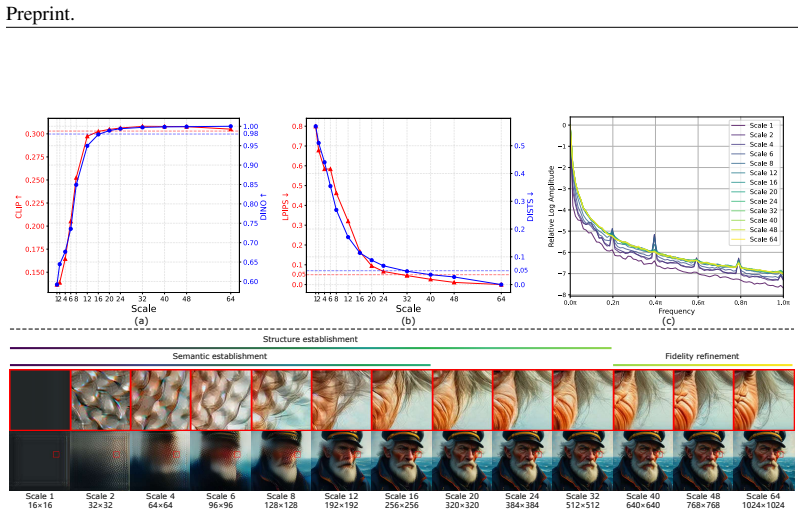
The paper's discovery is that next-scale prediction is not uniform across scales. Using semantic and structural consistency measurements, the authors observe that semantic alignment plateaus before structural alignment: the early scales establish meaning, the middle scales establish geometry, and the final scales (40, 48, and 64 in their test model) only refine fidelity. Two properties make those final scales cheap: semantic irrelevance—setting classifier-free guidance to zero there barely changes generated content—and a low-rank feature structure, with 96% of the feature energy carried by about 17.6% of the singular directions. StageVAR therefore keeps the early scales untouched, and in the
What carries the argument
The load-bearing machinery is the three-stage decomposition of VAR inference plus the random-projection and representative-token-restoration (RTR) pipeline. The paper separates inference into semantic establishment, structure establishment, and fidelity refinement stages by tracking how semantic and structural metrics converge across scales. In the fidelity-refinement stage, semantic irrelevance justifies replacing the text prompt with a null prompt (CFG=0), and the low-rank structure justifies projecting the M×d input feature down to an r×d random-projected feature before the transformer blocks. RTR then restores the M-dimensional output: it marks the r computed rows at indices I, selected
Load-bearing premise
The load-bearing premise is that the few rows sampled from the input feature—chosen with probability proportional to their squared norm—really are the tokens that still matter after the transformer transforms them, so all other output rows can be replaced with cached values from the previous scale; the cited row-sampling theorem guarantees reconstruction of the input matrix, not this output-token equivalence, and if that equivalence fails for other prompts or models the repor
What would settle it
Generate a fixed set of prompts with StageVAR using its importance-sampled index rule and again with uniformly random indices at the same rank; if the GenEval and FID scores are statistically identical, the representative-token assumption is not load-bearing, while a large gap confirms the method depends entirely on that sampling heuristic.
If this is right
- If the stage decomposition holds, VAR models showing the same convergence plateaus can be accelerated by preserving early scales and approximating only the final refinement scales; no retraining or architecture change is needed.
- If semantic irrelevance holds, classifier-free guidance can be switched off at late scales without regenerating text-conditioned features, and this saving stacks with token-pruning schemes (the paper reports a 3.14× combined speedup with an existing pruning baseline).
- If the low-rank property is stable across prompts, the predetermined rank r computed offline carries over to unseen prompts, eliminating per-image SVD or least-squares overhead during inference.
- The reported 3.4× speedup at a 0.01 benchmark drop is a concrete operational claim: for serving or interactive use of such models, the final refinement scales can be treated as a cheap post-processing stage.
Where Pith is reading between the lines
- Because the paper reports an inverted-U quality curve as rank decreases, the random projection plus restoration may be acting partly as a regularizer rather than as a purely lossy approximation; if so, optimal rank should be tuned per model from a speed-quality curve, not derived from an energy threshold alone.
- The step most worth probing is RTR's index selection: replacing the importance-sampled indices with uniformly random indices at the same rank would show whether the representative-token assumption is doing the work or whether the model simply tolerates corruption of most output rows.
- The same 'content is decided early' logic suggests a transferable test for other coarse-to-fine generators: if a diffusion or autoregressive model also shows semantic and structural plateaus, late-step conditioning could be dropped and late-step feature rank reduced, potentially yielding comparable speedups outside VAR.
- A practical extension is to automate the stage boundaries: instead of fixing them by inspecting metric curves, detect the plateaus online with the semantic and structure metrics and let the acceleration schedule adapt to each model and prompt.
Editorial analysis
A structured set of objections, weighed in public.
Referee Report
Summary. The paper studies the inference dynamics of text-to-image visual autoregressive (VAR) models and identifies three stages: semantic establishment, structure establishment, and fidelity refinement. For the fidelity-refinement stage (scales 40/48/64 in Infinity), it proposes a training-free acceleration that (i) sets CFG to 0 so that only the null text prompt is used, (ii) applies random projection to reduce the feature to a low-rank r-dimensional representation, and (iii) uses a Representative Token Restoration (RTR) step that fills the full-scale output from the r projected output rows plus cached previous-scale features. The method is evaluated on GenEval, DPG, COCO2014/2017, and a user study, reporting up to 3.4x speedup on Infinity-2B with a 0.01 GenEval drop and 0.26 DPG drop, 2.7x on Infinity-8B, and 1.74x on STAR-1.7B.
Significance. If the speedup/quality trade-off is robust beyond the tuned operating points, this is a practical contribution to efficient text-to-image generation. The paper's empirical observations that semantic and structural metrics saturate at early scales and that late-scale features are low-rank are useful and partially supported by cross-dataset rank statistics (App. A.1) and by comparisons with FastVAR/SkipVAR. The authors should be credited for reporting latency, including a user study, and for attempting a plug-and-play formulation. However, the central reconstruction step (RTR) is not theoretically justified as written, the algorithm description is internally inconsistent, and the headline operating point is selected on the evaluation benchmarks. These issues prevent the current manuscript from being accepted as a reliable acceleration method.
major comments (5)
- [§3.3, Eq. (8), Algorithm 1] The RTR row-index mapping is not justified. Because bF_r = Q^T eF_{k-1} with dense Gaussian Q, each row of bF_r is a random linear combination of all M rows. After a nonlinear transformer forward pass, there is no mechanism—permutation equivariance or row-sampling theory—by which the i-th row of F^o_r corresponds to the i-th sampled row of eF_{k-1}. Frieze et al. (2004) justifies low-rank approximation of the input matrix by its sampled rows, not the output-row substitution in Eq. (8). Please supply a proof or controlled experiments validating this token-restoration assumption, or replace RTR with a reconstruction that is actually justified (e.g., the W-based restoration in App. A.3).
- [Algorithm 1 / §3.3 vs App. A.3] The full-resolution reconstruction is specified in two incompatible ways. Eq. (8) and Algorithm 1 place the r output rows at sampled indices I and fill all other rows from F^{o,cache}_{k-1}. App. A.3 instead reconstructs F^o_k = W^o_r F^o_r with W^o_r ≈ cW_r + W^{o,cache}_r obtained from an LLS problem. These operations differ in both output and overhead; the manuscript does not say which one produced Tabs. 2–4. Please unify the description and state the exact implementation used for the reported latency and quality numbers.
- [§4.1, Tab. 1, Fig. 2] The operating points are selected on the evaluation benchmarks. α=0.96 is chosen from Tab. 1 to keep the GenEval drop below 0.01; the fidelity boundary {40,48,64} is justified via Fig. 2 using GenEval/CLIP curves; and the per-block ranks in App. A.1 are derived from GenEval prompts (with COCO cross-checks, which is a helpful robustness check). Because the headline 'negligible loss' is measured on the same benchmarks used for selection, the reported trade-off is partly fitted. Please add a validation protocol that avoids selection on the test set, or report held-out results and prompt-level variance.
- [§4.1, Tab. 6, Fig. 2] The α=0 entries for scales 48 and 64 skip the last two scales entirely, so the 3.4× speedup is a conjunction of CFG=0, low-rank RP at scale 40, and full step skipping. The ablation isolates CFG=0 and the full method, but not the marginal contribution or quality risk of each component. Please decompose the speedup/quality trade-off (e.g., CFG=0, +RP/RTR with all scales, +skip 48, +skip 64) to make clear which component drives the reported numbers.
- [Tabs. 3–4 and 6] No error bars or repeated-seed statistics are reported. Several headline differences (GenEval 0.726 vs 0.731, DPG 82.86 vs 83.12, FID 26.91 vs 26.64) are small relative to the expected prompt-level variance of these benchmarks. Without confidence intervals or bootstrap estimates, the 'negligible drop' claim is not statistically supported. Please add variance estimates over at least three runs or prompt-level bootstraps.
minor comments (6)
- [Title/Abstract] The paper is titled 'FasterVAR' in the arXiv metadata and abstract, but the body, figures, algorithm, and repo URL use 'StageVAR'. Please harmonize.
- [Eq. (8)] The notation {F^{o,r}^{(i)} | i∈I} is ambiguous because F^{o,r} has only r rows while I indexes the M-row input; define the indexing explicitly.
- [Tab. 2, rows 5–6] The labels 'w/ Eq. (6)' and 'w/o Eq. (6)' are unclear—Eq. (6) solves an input-reconstruction LLS problem, not an output-restoration problem; clarify which operation is used and where the 0.6 s additional latency comes from.
- [App. A.2] U^{o,cache}_r is obtained by SVD of the upsampled cached feature, which is not free; this seems to contradict the '≳0s' additional latency in Tab. 2 row 6. Please report the SVD cost separately.
- [App. A.1, Tabs. 7–9] The claim that the standard deviation is an order of magnitude smaller than the mean is not supported for several blocks at scale 64 (e.g., block chunks.4: 0.056±0.0146). Please qualify the claim or report per-block ratios.
- [Reproducibility] The statement says code will be released after peer review; for a plug-and-play acceleration paper, releasing the exact scripts, model versions, and prompt seeds is important for verifying the 3.4× speedup.
Circularity Check
Headline GenEval/DPG 'negligible loss' is selected on the same benchmarks used for evaluation; the RTR/Frieze issue is an under-specification, not circularity.
specific steps
-
fitted input called prediction
[Sec. 3.2 (Tab. 1); Sec. 4.3; Sec. 4.1; Abstract; Sec. A.1]
"As α decreases to 0.96, GenEval drops by <0.01. ... Therefore, based on both quantitative and qualitative results, we select a 17.6% rank (i.e., α=0.96) for our acceleration method StageVAR. ... For the threshold α, we set it to {0.96,0,0} in the fidelity refinement stage. ... a 0.01 reduction on GenEval and a 0.26 decrease on DPG."
The α=0.96 operating point is chosen because Table 1 shows that at 17.6% rank GenEval drops by <0.01 (0.731→0.726) and DPG drops to 82.86; those same two numbers are then reported in the abstract as the headline result ('0.01 reduction on GenEval and a 0.26 decrease on DPG'). The 'negligible-loss' claim on GenEval/DPG is therefore the selection criterion, not an independent validation of the low-rank method. The same holds for the CFG cutoff: Fig. 2 (Left) is used to decide that setting CFG=0 at scales below 40 degrades GenEval, and Sec. 4.1 then chooses the fidelity-refinement stage as {40,48,64} and reports GenEval on that choice. Sec. A.1 further fits the rank r on 553 GenEval prompts. No held-out split between the selection and the reported GenEval/DPG numbers is specified.
full rationale
The paper's stage analysis (CLIP/DINO/LPIPS/DISTS plateaus and frequency convergence) is an independent measurement, and its low-rank generalization is supported by COCO rank tables and by FID/user-study results that were not used for hyperparameter selection. I found no load-bearing self-citation or imported uniqueness theorem. The main circularity is narrower but real: the operating point α=0.96 and the fidelity-refinement cutoff {40,48,64} are chosen by inspecting GenEval/DPG (Tab. 1 and Fig. 2), the rank r is fitted on 553 GenEval prompts (Sec. A.1), and the same GenEval/DPG numbers then appear in the abstract as the evidence for 'negligible loss.' Thus the headline quality claim is partly a description of the selected operating point rather than an independent prediction. The RTR row-identity assumption and the discrepancy between Eq. (8) and Appendix A.3 are serious correctness/under-specification issues, but they are not circularity: Frieze et al. is an external, not self, citation, and the flaw is an unjustified mapping rather than an equivalence-by-construction.
Axiom & Free-Parameter Ledger
free parameters (4)
- α (energy threshold) =
0.96 for fidelity refinement (Infinity scales 40/48/64); 0 for skipped scales; 0.96 for STAR scale 64
- per-block rank r at scales 40/48/64 =
Fractions in Tab. 7 (e.g., block chunks.0: 0.016 at scale 40, etc.)
- stage boundaries (fidelity refinement stage scales) =
{40,48,64} for Infinity; {64} for STAR
- number of sampled rows r for RTR =
same as rank r
axioms (5)
- standard math Eckart-Young-Mirsky theorem: truncated SVD gives the optimal rank-r approximation
- standard math Frieze-Kannan-Vempala row-sampling theorem: sampling rows with probability proportional to squared norms yields a good low-rank approximation
- ad hoc to paper A random projection Q^T followed by a forward pass through the transformer can be substituted for the full feature and the output rows treated as representatives of the sampled original rows
- domain assumption CLIP/DINO/LPIPS/DISTS curves measured on a set of generated images indicate when semantics and structure are 'established', and this split transfers to the benchmark prompts
- domain assumption Setting CFG to 0 in the late stage does not harm text alignment because semantics are already established
Cite this review
Pith. "Pith review of FasterVAR: Plug-and-Play Acceleration for Visual Autoregressive Models." pith.science (2026). https://pith.science/paper/BED22ID6
@misc{pith2026251216483,
  author       = {Pith},
  title        = {Pith review of: FasterVAR: Plug-and-Play Acceleration for Visual Autoregressive Models},
  year         = {2026},
  howpublished = {\url{https://pith.science/paper/BED22ID6}},
  note         = {Machine review of arXiv:2512.16483}
}
read the original abstract
Visual Autoregressive (VAR) modeling departs from the next-token prediction paradigm of traditional Autoregressive (AR) models through next-scale prediction, enabling high-quality image generation. However, the VAR paradigm suffers from sharply increased computational complexity and running time at large-scale steps. Although existing acceleration methods reduce runtime for large-scale steps, but rely on manual step selection and overlook the varying importance of different stages in the generation process. To address this challenge, we present FasterVAR, a systematic study and plug-and-play acceleration framework for VAR models. Our analysis shows that early steps are critical for preserving semantic and structural consistency and should remain intact,while later steps mainly refine details and can be pruned or approximated for acceleration. Building on these insights, FasterVAR introduces a plug-and-play acceleration strategy that exploits semantic irrelevance and low-rank properties in late-stage computations, without requiring additional training. Our proposed FasterVAR achieves up to 3.4x speedup with almost no performance loss. consistently outperforming existing acceleration baselines.These results highlight stage-aware design as a powerful principle for efficient visual autoregressive image generation.
Figures


Forward citations
Cited by 2 Pith papers
-
Visual Implicit Autoregressive Modeling
VIAR embeds implicit equilibrium layers in visual autoregressive models to achieve ImageNet FID 2.16 with 38.4% of VAR parameters and controllable inference compute.
-
Visual Implicit Autoregressive Modeling
VIAR embeds an implicit equilibrium layer in next-scale AR image models, reporting FID 2.16 on ImageNet 256 with 38.4% of VAR’s parameters and a per-scale inference compute knob.
Reference graph
Works this paper leans on
-
[2]
Demystifying mmd gans.arXiv preprint arXiv:1801.01401,
Mikołaj Bi´nkowski, Danica J Sutherland, Michael Arbel, and Arthur Gretton. Demystifying mmd gans.arXiv preprint arXiv:1801.01401,
-
[9]
Skipvar: Ac- celerating visual autoregressive modeling via adaptive frequency-aware skipping, 2025a
Jiajun Li, Yue Ma, Xinyu Zhang, Qingyan Wei, Songhua Liu, and Linfeng Zhang. Skipvar: Ac- celerating visual autoregressive modeling via adaptive frequency-aware skipping, 2025a. URL https://arxiv.org/abs/2506.08908. Kunjun Li, Zigeng Chen, Cheng-Yen Yang, and Jenq-Neng Hwang. Memory-efficient visual au- toregressive modeling with scale-aware kv cache comp...
Pith/arXiv arXiv 2014
-
[10]
Xiaoxiao Ma, Mohan Zhou, Tao Liang, Yalong Bai, Tiejun Zhao, Huaian Chen, and Yi Jin. Star: Scale-wise text-to-image generation via auto-regressive representations.arXiv preprint arXiv:2406.10797, 2024a. Xinyin Ma, Gongfan Fang, and Xinchao Wang. Deepcache: Accelerating diffusion models for free. InProceedings of the IEEE Conference on Computer Vision and...
-
[12]
Weijia Shi, Xiaochuang Han, Chunting Zhou, Weixin Liang, Xi Victoria Lin, Luke Zettlemoyer, and Lili Yu. Lmfusion: Adapting pretrained language models for multimodal generation.arXiv preprint arXiv:2412.15188,
-
[13]
Peize Sun, Yi Jiang, Shoufa Chen, Shilong Zhang, Bingyue Peng, Ping Luo, and Zehuan Yuan. Autoregressive model beats diffusion: Llama for scalable image generation.arXiv preprint arXiv:2406.06525,
-
[15]
Training-free diffusion acceleration with bottleneck sampling.arXiv preprint arXiv:2503.18940,
Ye Tian, Xin Xia, Yuxi Ren, Shanchuan Lin, Xing Wang, Xuefeng Xiao, Yunhai Tong, Ling Yang, and Bin Cui. Training-free diffusion acceleration with bottleneck sampling.arXiv preprint arXiv:2503.18940,
-
[16]
Simplear: Pushing the frontier of autoregressive visual generation through pretraining, sft, and rl
Junke Wang, Zhi Tian, Xun Wang, Xinyu Zhang, Weilin Huang, Zuxuan Wu, and Yu-Gang Jiang. Simplear: Pushing the frontier of autoregressive visual generation through pretraining, sft, and rl. arXiv preprint arXiv:2504.11455,
-
[17]
Emu3: Next-token prediction is all you need
Xinlong Wang, Xiaosong Zhang, Zhengxiong Luo, Quan Sun, Yufeng Cui, Jinsheng Wang, Fan Zhang, Yueze Wang, Zhen Li, Qiying Yu, et al. Emu3: Next-token prediction is all you need. arXiv preprint arXiv:2409.18869,
-
[18]
Rui Xie, Tianchen Zhao, Zhihang Yuan, Rui Wan, Wenxi Gao, Zhenhua Zhu, Xuefei Ning, and Yu Wang. Litevar: Compressing visual autoregressive modelling with efficient attention and quantization.arXiv preprint arXiv:2411.17178,
-
[19]
Jiahui Yu, Yuanzhong Xu, Jing Yu Koh, Thang Luong, Gunjan Baid, Zirui Wang, Vijay Vasudevan, Alexander Ku, Yinfei Yang, Burcu Karagol Ayan, et al. Scaling autoregressive models for content- rich text-to-image generation.arXiv preprint arXiv:2206.10789, 2(3):5,
-
[21]
7 is negligible, confirming that the statistical rankrfor a givenαgeneralizes robustly across diverse text prompts
The deviation from the corresponding block and scale values reported in Tab. 7 is negligible, confirming that the statistical rankrfor a givenαgeneralizes robustly across diverse text prompts. Note that while collecting the statistical results on the benchmark is computationally expensive, it is an offline, one-time process. During inference, the pre-dete...
2025
-
[22]
on the COCO2017 dataset. block name k-th scale 40 48 64 block chunks.0 0.017±0.0004 0.013±0.0003 0.007±0.0002 block chunks.1 0.142±0.0090 0.121±0.0068 0.054±0.0057 block chunks.2 0.242±0.0174 0.213±0.0145 0.101±0.0167 block chunks.3 0.299±0.0190 0.256±0.0154 0.050±0.0181 block chunks.4 0.318±0.0193 0.279±0.0150 0.062±0.0167 block chunks.5 0.239±0.0138 0.2...
2025
-
[1998]
Jihun Park, Jongmin Gim, Kyoungmin Lee, Minseok Oh, Minwoo Choi, Jaeyeul Kim, Woo Chool Park, and Sunghoon Im. A training-free style-aligned image generation with scale-wise autore- gressive model.arXiv preprint arXiv:2504.06144,
-
[2001]
A note on the inception score.arXiv preprint arXiv:1801.01973,
Shane Barratt and Rishi Sharma. A note on the inception score.arXiv preprint arXiv:1801.01973,
-
[2017]
Classifier-free diffusion guidance.NeurIPS 2021 Workshop on Deep Generative Models and Downstream Applications,
Jonathan Ho and Tim Salimans. Classifier-free diffusion guidance.NeurIPS 2021 Workshop on Deep Generative Models and Downstream Applications,
2021
-
[2018]
APPENDIX A APPENDIX: IMPLEMENTATION DETAILS A.1 STATISTICALANALYSIS OF THERANK In order to determine the rankrcorresponding to a givenαsatisfying Eq
14 Preprint. APPENDIX A APPENDIX: IMPLEMENTATION DETAILS A.1 STATISTICALANALYSIS OF THERANK In order to determine the rankrcorresponding to a givenαsatisfying Eq. (4), it is necessary to perform an SVD decomposition of the original feature eFk−1 to obtain the energy ratioη r, where the SVD decomposition is time-consuming. In Sec. 3.3, to address the addit...
2023
-
[2020]
Zhenbang Du, Yonggan Fu, Lifu Wang, Jiayi Qian, Xiao Luo, and Yingyan (Celine) Lin
URLhttps://arxiv.org/abs/2004.07728. Zhenbang Du, Yonggan Fu, Lifu Wang, Jiayi Qian, Xiao Luo, and Yingyan (Celine) Lin. Early-bird diffusion: Investigating and leveraging timestep-aware early-bird tickets in diffusion models for efficient training. InInternational Conference on Computer Vision,
Pith/arXiv arXiv 2004
-
[2022]
Xiwei Hu, Rui Wang, Yixiao Fang, Bin Fu, Pei Cheng, and Gang Yu. Ella: Equip diffusion models with llm for enhanced semantic alignment.arXiv preprint arXiv:2403.05135,
-
[2023]
URL https://proceedings.neurips.cc/paper_files/paper/2023/file/ a3bf71c7c63f0c3bcb7ff67c67b1e7b1-Paper-Datasets_and_Benchmarks. pdf. Hang Guo, Yawei Li, Taolin Zhang, Jiangshan Wang, Tao Dai, Shu-Tao Xia, and Luca Benini. Fastvar: Linear visual autoregressive modeling via cached token pruning.Proceedings of the International Conference on Computer Vision,
2023
-
[2024]
Zhekai Chen, Ruihang Chu, Yukang Chen, Shiwei Zhang, Yujie Wei, Yingya Zhang, and Xihui Liu. Tts-var: A test-time scaling framework for visual auto-regressive generation.arXiv preprint arXiv:2507.18537, 2025a. Zhuokun Chen, Jugang Fan, Zhuowei Yu, Bohan Zhuang, and Mingkui Tan. Frequency- aware autoregressive modeling for efficient high-resolution image s...
-
[2025]
Chameleon: Mixed-modal early-fusion foundation models.arXiv preprint arXiv:2405.09818,
Chameleon Team. Chameleon: Mixed-modal early-fusion foundation models.arXiv preprint arXiv:2405.09818,
This paper was first reviewed by deepseek-v4-flash on August 3, 2026.
discussion (0)
Sign in with ORCID, Apple, or X to comment. Anyone can read and Pith papers without signing in.