REVIEW 3 major objections 6 minor 3 cited by
Conditioning both retrieval and generation on a hierarchical summary of a long document—a "mindscape"—lets a 14B RAG system surpass a vanilla 72B system on long-context benchmarks.
Reviewed by Pith at T0; open to challenge. T0 means a machine referee read the full paper against a public rubric. the ladder, T0–T4 →
T0 review · deepseek-v4-flash
2026-08-03 15:19 UTC pith:34UV2FHM
load-bearing objection The core conditioning recipe is coherent and the ablations are consistent, but the headline '14B beats 72B' claim is confounded by the 4-bit quantized 72B baseline, so the scaling conclusion is not established. the 3 major comments →
Mindscape-Aware Retrieval Augmented Generation for Improved Long Context Understanding
The pith
A machine-rendered reading of the paper's core claim, the machinery that carries it, and where it could break.
Core claim
Stated in Eq. (2), the central claim is that conditioning both retrieval and generation on a global semantic scaffold S—built by summarizing each chunk and then summarizing the concatenated summaries—situates local evidence in a global context, improving retrieval accuracy and reasoning consistency. Across five long-context benchmarks spanning English and Chinese, free-form QA, multiple-choice, and claim verification, the full MiA-RAG pipeline built on a 14B model attains the best overall results, with absolute gains of +16.18% over vanilla 14B RAG and +8.63% over vanilla 72B RAG. The paper's analyses of embedding geometry, layer-wise attention, and a new Mindscape-Coherent Evidence Alignmen
What carries the argument
The mindscape S is a document-level summary produced hierarchically: each chunk is summarized first, then the sequence of chunk summaries is summarized into one global representation (Eqs. 3–4). At retrieval time, the query is encoded together with S using task control tokens and a residual connection that balances local query intent with global guidance (Eqs. 5, 11), and the embedding model is trained contrastively on automatically constructed silver evidence at both chunk and entity-node levels. At generation time, S is prepended to the retrieved chunks and query, and the generator is fine-tuned on mixed relevant and noisy evidence (Eqs. 6–7). The MCEA metric provides a way to see the scaf
Load-bearing premise
The whole pipeline assumes one precomputed hierarchical summary can faithfully capture a document's global semantic structure; if that summary omits, distorts, or becomes outdated on information a query needs, both retrieval and generation are conditioned on a misleading mindscape.
What would settle it
Take a long narrative, build a summary that omits one key plot detail (for instance, a character's secret identity), then ask a question whose answer depends on that detail. If MiA-RAG fails to retrieve the right chunk or answers incorrectly while a vanilla RAG with oracle retrieval succeeds, the summary is a lossy bottleneck rather than a faithful scaffold.
If this is right
- Conditioning retrieval on a global summary improves retrieval recall on long narratives and out-of-domain bilingual tests; removing the summary causes substantial drops in both retriever and generator.
- The full 14B pipeline beats a vanilla 72B RAG system by 8.63 points on average, indicating global conditioning can partially substitute for model scale.
- Summary quality matters less than structure: summaries from a 32B open model perform close to those from a large commercial model, and even smaller summarizers still yield gains.
- Supplying the summary to a vanilla generator adds +3.79%, but fine-tuning the generator under the same conditioning yields +11.16%, so the benefit is not merely extra context.
- A Summary-Only generator underperforms vanilla RAG, confirming the mindscape's role is to guide evidence use, not to serve as evidence itself.
Where Pith is reading between the lines
- The same conditioning scheme could be tested on long-form dialogue or streaming documents if the mindscape is updated incrementally; the paper lists evolving content as an open limitation.
- Scale results suggest a deployment recipe—a 0.6B mindscape-aware retriever plus a 14B generator could replace much larger systems under cost or latency constraints—but the paper does not measure end-to-end inference cost.
- Because silver evidence is produced with commercial-LLM supervision, part of the measured gain could be annotation bias; a human-annotated evidence set on a small sample would separate the method's contribution from its training signal.
- MCEA could be reused as a faithfulness diagnostic for other RAG systems: if a generator's attention to chunks is not aligned with a global summary, its answers may lean on local snippets that contradict the document's overall meaning.
Editorial analysis
A structured set of objections, weighed in public.
Referee Report
Summary. The paper proposes Mindscape-Aware RAG (MiA-RAG), a long-context RAG framework that constructs a hierarchical, document-level summary ('mindscape') and conditions both the retriever and the generator on it. The retriever (MiA-Emb) is fine-tuned from Qwen3-Embedding-8B with a contrastive objective that incorporates the summary into the query representation; the generator (MiA-Gen) is fine-tuned from Qwen2.5-14B-Instruct on summary-conditioned QA and claim-verification data. The paper evaluates on NarrativeQA, ∞Bench-EN.MC, DetectiveQA (ZH/EN), and NoCha, reporting consistent improvements over vanilla RAG and GraphRAG baselines, and claims that a 14B MiA-RAG system beats a vanilla 72B system, suggesting global semantics matter more than model scale. The paper also includes geometric and attention-based analyses intended to show that the summary acts as a semantic scaffold rather than a superficial cue.
Significance. If the main results hold, the paper makes a useful and practical contribution: a simple, relatively low-cost way to inject global context into both retrieval and generation, with consistent ablations showing that the summary, rather than extra model capacity, drives the gains. The cross-lingual and cross-task evaluation, the controlled w/o-Summary ablations, and the released models are strengths. However, the headline cross-scale claim is currently undermined by a precision asymmetry in the 72B baselines, and the small evaluation sets make some fine-grained comparisons statistically fragile. The core matched-precision findings are plausible, but the paper's strongest advertised conclusion about scaling is not yet established.
major comments (3)
- [§5.2.1, §5.4, Appx. C] The central scale claim ('MiA-RAG gains +8.63% over the vanilla 72B'; 'incorporating global semantics is more effective than merely scaling model size') is confounded by an uncontrolled precision difference. Appx. C states that 'Qwen2.5-72B' denotes the 4-bit quantized variant, while MiA-Gen-14B is trained and evaluated in bf16. Table 2's 72B rows therefore combine model size with quantization effects, and 4-bit quantization is known to degrade long-context reasoning. The +8.63% gap and Figure 3's 'MiA-Gen-14B matches or exceeds the 72B model' do not establish the scaling conclusion. Please rerun the 72B baselines in bf16, or apply the same quantization to MiA-Gen-14B, before drawing the cross-scale conclusion.
- [§5.2.1, Table 3] The empirical claims rest on small test sets (NoCha: 126 queries; ∞Bench-EN.MC: 229) and no statistical significance tests or confidence intervals are reported. Several comparisons in Table 2 are within 1–3 points (e.g., MiA vs. MiA-Emb-Only on NarrativeQA at top-3; MiA vs. MiA-Gen-Only on DetectiveQA-EN). Given the noisy nature of pairwise accuracy and the small N, the claim of 'consistently surpasses' needs at least bootstrap confidence intervals or significance tests for the key aggregate comparisons.
- [§5.5, Limitations] The framework assumes that a single hierarchical summary can faithfully capture the document's global semantic structure. §5.5 varies the summarizer model, but all tested summaries are plausible narratives; the paper does not test summaries that omit entire plot threads, are outdated, or are adversarially wrong. The Limitations section itself concedes that evolving content is a limitation. A targeted stress test (e.g., truncated or deliberately corrupted summaries) would substantiate the robustness claim and help separate the benefit of a genuinely faithful mindscape from the benefit of any global prompt.
minor comments (6)
- [Algorithm 1, Appx. E] Algorithm 1 lists the mindscape summary S as an input, but the procedure never uses S. Please clarify whether S is used in silver-evidence construction. If it is not, remove it from the input; if it is, explain how, since the MCEA analysis in Appx. E could otherwise be seen as circular.
- [Table 2] Two rows are both labeled 'MiA (Gen-Only)' but they use different generators (Qwen2.5-14B with summary vs. MiA-Gen-14B). Rename for clarity, e.g., 'Vanilla-Gen +S' and 'MiA-Gen +S'.
- [Figure 3 and Table 2] The visual comparison of MiA-Gen-14B with the 72B model is misleading because the 72B point is the 4-bit quantized variant, but the figure and caption do not say so. Add a note, or fix the underlying precision issue.
- [General / 'Introduced models'] The paper says 'We have released our models on Hugging face' but does not give a URL or repository name. Please add the link.
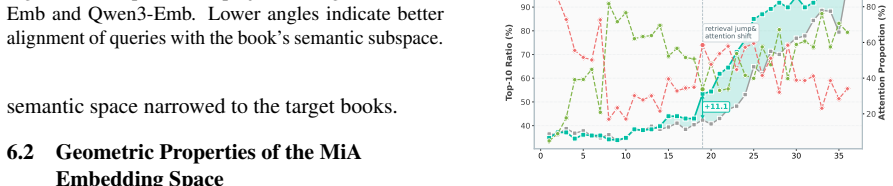
- [References and text] There are several typos/formatting artifacts: 'Vo yage-AI', 'V oyage', 'Hugging face' should be 'Hugging Face', and Figure 5's 'retrieval jump& attention shift' needs spacing.
- [Eq. (2) and Sec. 3.1] The arrow notation 'q, S → Cret,S → a' is nonstandard and a little confusing. Please define explicitly that both the retriever and generator condition on S.
Circularity Check
No significant circularity: the mindscape is constructed from the document alone, and the core retrieval/generation claims are evaluated on external benchmarks.
full rationale
MiA-RAG's central derivation is not circular. The mindscape S is produced from the document text alone via hierarchical summarization (Eqs. 3-4), with no query or answer input, and both retrieval and generation are trained and evaluated on external benchmarks (held-out NarrativeQA, ∞Bench-EN.MC, DetectiveQA, NoCha) using summaries computed independently of the target labels. The main performance comparison therefore does not reduce to its own inputs. The MiA-Emb supervision construction (Algorithm 1) does use LLM filtering with access to the answer to create silver labels, but this is standard supervised training followed by held-out evaluation, and the specific contribution of summary conditioning is isolated by the w/o Summary and SFT-Emb controls at matched training settings. The MCEA metric is an internal analysis tool rather than the source of the headline results. The scale claim comparing MiA-Gen-14B with vanilla 72B may be confounded because Appendix C states that Qwen2.5-72B is used as its 4-bit quantized variant while MiA-Gen is bf16; however, this is a validity/correctness concern about an uncontrolled precision asymmetry, not a circularity, since the 72B numbers are not constructed from the paper's equations. Self-citations to SitEmb and to the residual-stream analysis method are used as baselines or analysis techniques, not as load-bearing uniqueness arguments. No circular step satisfying the quoted-reduction standard was found.
Axiom & Free-Parameter Ledger
free parameters (4)
- Residual weight δ =
0.5
- Multi-task weight β =
0.5
- Contrastive temperature τ =
0.01
- Chunk size =
1200 (200 for NoCha)
axioms (4)
- domain assumption A hierarchical summary of a long document captures the global semantic structure needed for retrieval and generation.
- domain assumption Silver evidence labels produced by ensemble retrieval plus GPT-4o filtering with access to the correct answer are a reliable training signal.
- domain assumption GPT-4o summaries do not leak answer information in a way that inflates gains.
- domain assumption The Qwen embedding and instruction-tuned models can internalize summary conditioning during fine-tuning.
invented entities (1)
-
Mindscape (global summary S)
no independent evidence
read the original abstract
Humans understand long and complex texts by relying on a holistic semantic representation of the content. This global view helps organize prior knowledge, interpret new information, and integrate evidence dispersed across a document, as revealed by the Mindscape-Aware Capability of humans in psychology. Current Retrieval-Augmented Generation (RAG) systems lack such guidance and therefore struggle with long-context tasks. In this paper, we propose Mindscape-Aware RAG (MiA-RAG), the first framework to formulate mindscape-aware retrieval and generation as a unified conditioning paradigm for LLM-based RAG. MiA-RAG builds a mindscape through hierarchical summarization and conditions both retrieval and generation on this global semantic representation. This enables the retriever to form enriched query embeddings and the generator to reason over retrieved evidence within a coherent global context. We evaluate MiA-RAG across diverse long-context and bilingual benchmarks for evidence-based understanding and global sense-making. It consistently surpasses baselines, and further analysis shows that it aligns local details with a coherent global representation, enabling more human-like long-context retrieval and reasoning.
Figures




Forward citations
Cited by 3 Pith papers
-
A New Role for Relevance: Guiding Corpus Interaction in Agentic Search
Ordering ripgrep by embedding relevance, seeding entry paragraphs, and reranking matches yields higher accuracy with fewer tool calls than RISE, DCI, and retrieval agents.
-
Beyond Semantic Relevance: Counterfactual Risk Minimization for Robust Retrieval-Augmented Generation
CoRM-RAG uses a cognitive perturbation protocol to simulate biases and trains an Evidence Critic to retrieve documents that support correct decisions even under adversarial query changes.
-
MiA-Signature: Approximating Global Activation for Long-Context Understanding
MiA-Signature approximates the global activation state induced by a query via submodular concept selection to enable tractable long-context understanding in LLMs.
Reference graph
Works this paper leans on
-
[1]
Carefully analyze each chunk for narrative ele- ments such as characters, events, plot development, settings, and relationships
-
[2]
Select chunks that: – directly contain information needed to answer the question, – provide essential background context or character development, – describe events or situations relevant to the answer, – include dialogue, actions, or descriptions that in- form the question
-
[3]
Consider that narrative questions often require combining evidence from multiple parts of the story
-
[4]
Include chunks that provide supporting evidence even if they do not directly state the answer
-
[5]
Output Requirement Return only a JSON array of relevant chunk indices (e.g., [0,2,5])
For questions involving motivations, relationships, or plot reasoning, include chunks that illustrate these aspects. Output Requirement Return only a JSON array of relevant chunk indices (e.g., [0,2,5]). If none are relevant, return [-1]. No explanations or additional text. Figure 11: Prompt used to filter silver chunks. Prompt for Filtering Silver Nodes ...
-
[8]
Analyze each entity’s name, type, and description
-
[9]
Select entities that: – directly support the answer, – appear in or relate closely to the question/answer, – provide essential background or relational context
-
[10]
Include contextual entities even if not explicitly mentioned
-
[11]
Output Requirement Return only a JSON array of relevant entity indices (e.g., [0,2,5])
For relational or multi-hop questions, select all relevant linked entities. Output Requirement Return only a JSON array of relevant entity indices (e.g., [0,2,5]). If none are relevant, return [-1]. No explanations or additional text. Figure 12: Prompt used to filter silver nodes. 17 Prompt for Sense-making Question Generation You are an expert research a...
-
[12]
Don’t Merely Locate:Integrate multiple pieces of information rather than extract single facts
-
[13]
so what?
Probe Deep Reasoning:Focus on causes, trade- offs, critique, and implications—the “so what?”
-
[14]
Focused Inquiry:Each question must be concise
-
[15]
this method
Self-Contained Questions:Avoid vague refer- ences (“this method”); specify concrete names
-
[16]
questions
Professional & Diverse:Reflect expert-level rea- soning from multiple analytical angles. —Output Format— { "questions": [ "Question 1",... "Question 5" ] } If fewer than 3 valid questions can be generated, return an empty list. Figure 13: Prompt for sensemaking question generation. Prompt for Pairwise Evaluation You are an expert tasked with evaluating tw...
-
[17]
Comprehensiveness: Integrate all relevant infor- mation from the context, cover all aspects the con- text allows, and provide sufficient depth
-
[18]
Diversity of Insight: Bring in multiple perspec- tives, connect ideas across chunks, and go beyond listing facts by explaining relationships, patterns, or contrasts
-
[19]
x", reasoning:
Empowerment for the Reader: Use a clear struc- ture (brief introduction, organized body, concise synthesis), precise language, and help the reader form a coherent mental model. Critical Constraints • Evidence-based only: If the context is insufficient, explicitly state what is missing and do not invent information. • Source-grounded: Every claim must be t...
-
[2017]
Jianlv Chen, Shitao Xiao, Peitian Zhang, Kun Luo, Defu Lian, and Zheng Liu
Neural activation patterns during retrieval of schema-related memories: Differences and common- alities between children and adults.Developmental science, 20(6):e12475. Jianlv Chen, Shitao Xiao, Peitian Zhang, Kun Luo, Defu Lian, and Zheng Liu. 2024. Bge m3-embedding: Multi-lingual, multi-functionality, multi-granularity text embeddings through self-knowl...
Pith/arXiv arXiv 2024
-
[2025]
Sitemb-v1. 5: Improved context-aware dense retrieval for semantic association and long story com- prehension.arXiv preprint arXiv:2508.01959. Guangxuan Xiao, Yuandong Tian, Beidi Chen, Song Han, and Mike Lewis. 2023. Efficient streaming language models with attention sinks.arXiv preprint arXiv:2309.17453. Liyan Xu, Jiangnan Li, Mo Yu, and Jie Zhou. 2024. ...
Pith/arXiv arXiv 2023
discussion (0)
Sign in with ORCID, Apple, or X to comment. Anyone can read and Pith papers without signing in.