REVIEW 3 major objections 5 minor 86 references
At 1-loop order, the entire Zee-model neutrino mass matrix is generated by RG running inside the two-Higgs-doublet EFT, not by matching at the heavy scale, and percent-level UV rescaling moves predicted oscillation parameters beyond next-ge
Reviewed by Pith at T0; open to challenge. T0 means a machine referee read the full paper against a public rubric. the ladder, T0–T4 →
T0 review · deepseek-v4-flash
2026-08-03 15:20 UTC pith:EC6MGWUP
load-bearing objection A genuinely new 1-loop EFT treatment of the Zee model with reusable matching conditions; the JUNO-comparison plots should be read as sensitivity studies, since the central beta function comes with an uncorroborated unpublished correction. the 3 major comments →
Running of neutrino mass parameters in the Zee model
The pith
A machine-rendered reading of the paper's core claim, the machinery that carries it, and where it could break.
Core claim
Working in the hierarchy m_h > m_H2 ≫ EW scale, the paper matches the Zee model to the two-Higgs-doublet EFT at m_h and then to the SMEFT at m_H2, keeping 1-loop terms. The central observation is that the would-be direct contributions to the SMEFT Weinberg coefficient—κ11 at 1-loop and the tree-level κ12 term combined with charged-lepton Yukawas—cancel exactly at the matching scale, leaving only the log(m_H2^2/m_h^2) term, which is the resummed large logarithm of the full theory. Since the log can only be reproduced by running, the paper states that the entirety of the neutrino mass matrix is generated by RGE running in the 2HDM EFT. In four benchmarks, percent-level variations of UV paramet
What carries the argument
The central object is the set of dimension-5 Weinberg-like coefficients κij (i,j = 1,2 for the two Higgs doublets) in the 2HDM EFT; these are the coefficients of the operators (L Hi)(Hj† L) that after electroweak symmetry breaking become Majorana neutrino masses. The paper's argument is carried by the 1-loop β-function for κij (with gauge, Yukawa, and quartic terms), the derived matching conditions from Zee -> 2HDM and 2HDM -> SMEFT, and the cancellation between κ11 and the term κ12(0)Y1e†Y2e + Y2e†Y1eκ12(0) at the intermediate scale. The running of κ11 relative to κ12 is what produces the low-energy neutrino mass matrix.
Load-bearing premise
The load-bearing input is the 1-loop beta function for the dimension-5 coefficients κij in the general two-Higgs-doublet EFT, taken from the published literature as corrected by an unpublished thesis; the cancellation mechanism, the large-log resummation, and every benchmark sensitivity curve inherit this function, and if it is wrong the size of the running effects and the comparison to experimental precision would change.
What would settle it
Reproduce the paper's numerical procedure with an independent implementation of the 1-loop RGEs for the 2HDM EFT and the two matching steps, apply the same γ scalings of f, Y1_e and Y2_e that preserve the full-theory mass matrix, and compare the resulting displacements with the paper's current and projected experimental bands; a disagreement larger than those bands would indicate an error in the input β-function or matching conditions. A direct two-loop calculation of the Zee-model neutrino mass in the same scheme would settle whether the 1-loop running picture is quantitatively correct.
If this is right
- Precision fits of the Zee model should replace the one-loop full-theory formula with a sequential EFT calculation that includes 1-loop matching at m_h and m_H2 and 1-loop RG running between them.
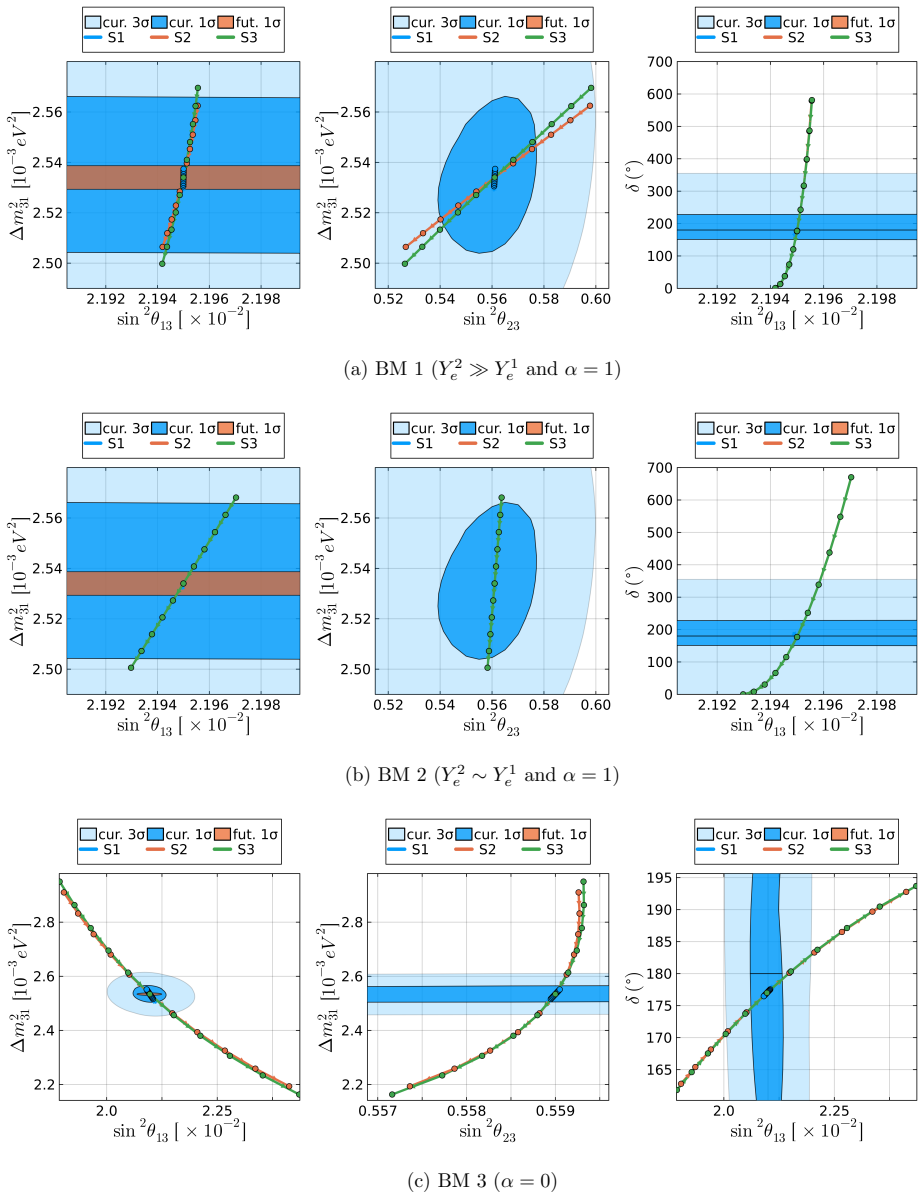
- Percent-level freedom in the fitted UV couplings—directions that the full theory does not constrain—changes the predicted neutrino observables by more than current and next-generation experimental errors, so RG corrections must be included when exploiting the new data.
- The corrections grow with large quartic coupling λ6, sizable second-doublet Yukawa couplings, and a large hierarchy between the charged singlet and second doublet masses; the same qualitative effect appears for a 1 TeV second doublet.
- The large-log approximation reproduces the full-theory formula at leading log, confirming that the running is the source of the logarithm, but in benchmark 1 the β-function varies enough that a constant-β large-log approximation is not quantitatively valid.
- The authors expect similarly sized RG corrections in other radiative neutrino mass models, since running enters at the same loop order as the radiative mass itself.
Where Pith is reading between the lines
- The split between matching and running is scheme- and matching-scale-dependent; in another scheme part of the effect could be shifted into the matching condition. The scheme-independent content is that a full one-loop EFT calculation, not the naive one-loop full-theory formula, is required for precision.
- A direct check of the quantitative claim would be an independent re-derivation of the 1-loop β-function for κij in the general 2HDM EFT; if the coefficients change, the γ-scaling shifts would change and the comparison to experimental precision would need revision.
- The flat directions that preserve the full-theory mass matrix could be used in future global fits as a diagnostic: any fitted point that ignores running sits on a degeneracy that the EFT running breaks, effectively constraining the UV parameters at the level of next-generation experiments.
- The same two-step EFT construction could be applied to other radiative models, such as Zee-Babu or the scotogenic model, to check whether their neutrino mass matrices likewise arise from running in the intermediate theory.
Editorial analysis
A structured set of objections, weighed in public.
Referee Report
Summary. The paper presents a two-step effective field theory (EFT) treatment of the Zee model for the hierarchy m_h ≫ m_H2 ≫ m_hSM. It derives 1-loop matching conditions for the Weinberg-like operators when integrating out the charged singlet to the 2HDM EFT and then the second doublet to SMEFT, and combines these with 1-loop RG running in the 2HDM EFT. The central claim is that, after the matching, the entire neutrino mass matrix is generated by the RG running that spoils a cancellation between κ11 and the κ12(0) Yukawa combination, and that percent-level changes in fitted high-scale parameters that leave the full-theory prediction invariant induce shifts in neutrino mass parameters exceeding current and JUNO-era projected uncertainties. Four benchmarks illustrate the effect. The paper does not perform a full parameter scan; the benchmarks are fitted to reproduce the low-energy oscillation data using the full-theory formula and then used to illustrate sensitivity of the EFT calculation.
Significance. If the central results hold, the paper makes a useful and timely point: for a radiative neutrino mass model, a naive 1-loop full-theory calculation may miss large logarithms that are properly resummed only by 1-loop matching plus 1-loop running, and this can affect phenomenological comparisons at the precision of JUNO and future experiments. The paper has several genuine strengths: the matching conditions are nontrivial, presented with diagrams, and stated to have been verified by hand; the two possible hierarchies are both discussed; the role of the charged-lepton Yukawa couplings and trace terms in the running of κ11 is analysed in detail; and the numerical setup includes consistency checks of perturbativity, stability, and the mass hierarchy. The comparison against current and projected JUNO sensitivities in Figs. 9 and 10 is a concrete falsifiable demonstration, even though it is sensitivity-based rather than a full statistical scan.
major comments (3)
- [§3.2, Eq. (31) / App. B.1, Eq. (72)] The engine of the quantitative claim is the 1-loop β-function for the dimension-five coefficients κij. It is taken from Ref. [40] as corrected by the unpublished Honours thesis [85]; no independent derivation, ancillary file, or machine-checkable calculation is provided. The hand-verification mentioned in Sec. 3.1 covers the matching conditions, not this RGE. An O(1) error in any trace or gauge term, e.g. the signs of Tkiκkj or the g2 terms, would change the relative running of κ11 and κ12 and hence the size and sign of the shifts in Figs. 9–10. Because the abstract and Sec. 5 make quantitative statements about exceeding JUNO-era uncertainties, the paper should make the derivation of Eq. (31) fully available, either by reproducing it in the paper or by including a public notebook/appendix that verifies it.
- [§3, paragraph after Eq. (40)] The authors note that 2-loop RGEs for the dimension-five operators in the general 2HDM EFT are not available and assert that they 'do not expect any issues' with scheme dependence. For a claim that running effects exceed percent-level experimental uncertainties, this expectation needs to be quantified. Concretely, the matching-scale dependence of the final prediction should be tested by varying ¯µ around m_h and m_H2 (e.g. by factors of e^{±1/2}) and showing that the shifts in Fig. 9 are stable, or by estimating the size of the missing 2-loop contributions. Without such a test, the percent-level statement is not established at the claimed precision.
- [§4.2–4.4, Figs. 9–10] The benchmark f and Y2 are fitted so that the full-theory tree-level formula reproduces the same low-energy neutrino parameters that the EFT calculation then shifts. The curves in Figs. 9–10 are therefore sensitivity illustrations along a particular high-scale parameter subspace, not evidence that realistic Zee-model parameter points actually produce these shifts. The text partly acknowledges this ('qualitatively demonstrate', 'will not reproduce quantitatively correct values'), but the abstract and Sec. 5 phrase the conclusion as 'quantum corrections have to be included'. The paper should separate these two statements more sharply and state explicitly that a full prior- or parameter-scan analysis is needed to establish whether the effect is generic in the allowed Zee-model parameter space.
minor comments (5)
- [Abstract / Sec. 5] The wording 'quantum corrections have to be included in studies of neutrino mass parameters' overstates what is demonstrated. The analysis shows that within the chosen benchmarks and fitted subspaces, running effects can exceed experimental uncertainties; it does not show that this happens for all viable Zee-model parameters. Consider phrasing the conclusion as 'can be important' rather than 'have to be included' unless a scan is performed.
- [Figure 9 caption] The caption says 'shaded regions represent current and future estimated experimental uncertainties' and that γ increases 'in the direction of the arrows marked', but the arrows are not visible in the arXiv text version and the distinction between current and JUNO-projected bands is not labelled. Please add explicit labels to the figure and mention the different shadings in the caption.
- [Table 1] The table lists m_t = 168.62 GeV while the caption says the inputs are at the scale of the top quark pole mass m_t = 172.4 GeV. The relationship between the two conventions should be stated explicitly to avoid confusion (probably m_t(MS-bar) at the pole-mass scale).
- [Reference [85] / footnote 3] The β-function correction is attributed to an unpublished Honours thesis. If this source remains the only reference for a load-bearing expression, please provide a web link, an institutional repository URL, or include the derivation as a supplementary appendix so that readers can check it.
- [General copy-editing] There are several typographical and grammatical slips, e.g. 'We will first in detail the matching procedure' (Sec. 3.1) and 'the hierarchy ... that we eluded to schematically' (Sec. 2.2, should be 'alluded to'). These do not affect the physics but should be corrected.
Circularity Check
No circularity in the central EFT derivation; benchmark sensitivity plots are demonstrations, not fitted predictions; self-citations are non-load-bearing.
full rationale
The derivation chain is self-contained conditional on external RGE literature. The matching conditions (Eqs. 23, 26, 53, 56) are derived from the Zee-model Lagrangian with Matchete and hand verification (footnote 1), and the κij RGE (Eq. 31) is attributed to Ref. [40] as corrected by Ref. [85] and cross-checked with RGBeta (Appendix B); no step is defined in terms of the target neutrino observables. The claim that the neutrino mass matrix is 'generated due to the running in the 2HDM EFT' (Sec. 3.1) is an EFT reorganization: Eq. (28) reproduces the full-theory logarithm of Eq. (20), and Eq. (39) resums the same logarithm from the RGEs, which is a consistency check rather than a reduction of the prediction to its input. The benchmark couplings are fitted to measured neutrino parameters using the full-theory formula (Eqs. 20, 46), but the paper explicitly labels this as a qualitative demonstration, stating 'we argue that this will not reproduce quantitatively correct values for the UV parameters' (Sec. 4.2); the γ-scalings (Eqs. 50-52) are constructed to leave the full-theory mass matrix invariant, so the plotted displacements are sensitivity diagnostics isolating running effects, not independent predictions that are then fitted. Self-citations [17,44,45,59,83,99] are contextual or motivational and are not load-bearing: e.g., [83] motivates the hierarchy but both hierarchies are derived and the qualitative conclusion is stated to apply to both. The main support gap is the reliance on the unpublished Honours thesis [85] for corrections to the κij β-function (Eq. 31, footnote 3); if that β-function is wrong, the numerical size of the running shifts changes. This is a correctness/verification risk, not circularity. Similarly, the assertion 'We verified the matching conditions in full by hand' (footnote 1) is an omitted proof but not a circular step. Overall, the central comparison (full theory vs. EFT) does not reduce to a fitted value or to a self-citation chain.
Axiom & Free-Parameter Ledger
free parameters (6)
- f (antisymmetric singlet Yukawa-like coupling) =
Table 3 (e.g., f_eμ ~ 7.2e-6 for BM1, 9.3e-3 for BM2)
- Y2_e (second Higgs doublet charged-lepton Yukawa) =
Table 3; complex 3x3 matrices with entries ~O(0.01-0.7)
- Quartic couplings λ1,...,λ7 =
BM1/2: λ1=λ2=0.25, λ3-7=0; BM3: λ6=-λ7=0.25; low-scale: λ1=λ2=λ6=λ7=0.2, λ4=λ5=0.4
- α (quark Yukawa alignment parameter) =
1 (BM1,2, low-scale) or 0 (BM3)
- Mass scales m_h, m_H2, μ_Zee =
m_h=μ_Zee=10^4 TeV, m_H2=10^2 TeV for BM1-3; 100 TeV/1 TeV for low-scale
- λ_h and λ8,9,10 =
λ_h=1e-4, λ8=λ9=λ10=0
axioms (6)
- domain assumption The 1-loop RGEs for the dimension-5 Weinberg-like coefficients κij in the general 2HDM EFT (Eq. 31/72) are correct as given by Ref. [40] as corrected by the unpublished Honours thesis [85].
- ad hoc to paper A 1-loop matching + 1-loop running calculation is scheme-independent even though 2-loop RGEs for the 2HDM Weinberg-like operators are not computed.
- domain assumption The hierarchy m_h >> m_H2 >> m_hSM is preserved under RG running and physical masses can be identified with Lagrangian mass parameters (alignment limit).
- domain assumption Perturbativity λ_i ≲ sqrt(4π) and stability conditions (Eqs. 6-7) hold at all scales.
- domain assumption The SMEFT RGEs and the SM input parameters from Ref. [100] are correct at the stated precision.
- ad hoc to paper Neglecting λ8=λ9=λ10=0 and λh=1e-4 does not change the qualitative conclusion about running.
read the original abstract
We analyse the size of quantum corrections in the Zee model using effective field theory techniques. We derive the relevant 1-loop matching conditions and use them together with the existing renormalisation group equations in the two Higgs doublet model to calculate quantum corrections to the neutrino mass squared differences, mixing angles, and phases. Using four benchmark scenarios, we demonstrate when quantum corrections have to be included in studies of neutrino mass parameters in the Zee model.
Figures


Reference graph
Works this paper leans on
-
[9]
A Theory of Lepton Number Violation, Neutrino Majorana Mass, and Oscillation,
A. Zee, “A Theory of Lepton Number Violation, Neutrino Majorana Mass, and Oscillation,” Phys. Lett. B93(1980) 389. [Erratum: Phys.Lett.B 95, 461 (1980)]
1980
-
[10]
A Theoretical Pattern for Neutrino Oscillations,
L. Wolfenstein, “A Theoretical Pattern for Neutrino Oscillations,”Nucl. Phys. B175(1980) 93–96
1980
-
[11]
Full parameter scan of the Zee model: exploring Higgs lepton flavor violation,
J. Herrero-Garc ´ ıa, T. Ohlsson, S. Riad, and J. Wir´ en, “Full parameter scan of the Zee model: exploring Higgs lepton flavor violation,”JHEP04(2017) 130,arXiv:1701.05345 [hep-ph]
Pith/arXiv arXiv 2017
-
[12]
Quantum Numbers of Majorana Neutrino Masses,
A. Zee, “Quantum Numbers of Majorana Neutrino Masses,”Nucl. Phys. B264(1986) 99–110
1986
-
[13]
Model of ’Calculable’ Majorana Neutrino Masses,
K. S. Babu, “Model of ’Calculable’ Majorana Neutrino Masses,”Phys. Lett. B203(1988) 132–136
1988
-
[14]
A Model for neutrino masses and dark matter,
L. M. Krauss, S. Nasri, and M. Trodden, “A Model for neutrino masses and dark matter,” Phys. Rev. D67(2003) 085002,arXiv:hep-ph/0210389
Pith/arXiv arXiv 2003
-
[15]
Radiative seesaw mechanism at weak scale,
Z.-j. Tao, “Radiative seesaw mechanism at weak scale,”Phys. Rev. D54(1996) 5693–5697, arXiv:hep-ph/9603309
Pith/arXiv arXiv 1996
-
[16]
Verifiable radiative seesaw mechanism of neutrino mass and dark matter,
E. Ma, “Verifiable radiative seesaw mechanism of neutrino mass and dark matter,”Phys. Rev. D73(2006) 077301,arXiv:hep-ph/0601225
Pith/arXiv arXiv 2006
-
[17]
From the trees to the forest: a review of radiative neutrino mass models,
Y. Cai, J. Herrero-Garc ´ ıa, M. A. Schmidt, A. Vicente, and R. R. Volkas, “From the trees to the forest: a review of radiative neutrino mass models,”Front. in Phys.5(2017) 63, arXiv:1706.08524 [hep-ph]. 37
Pith/arXiv arXiv 2017
-
[18]
Baryon and Lepton Nonconserving Processes,
S. Weinberg, “Baryon and Lepton Nonconserving Processes,”Phys. Rev. Lett.43(1979) 1566–1570
1979
-
[19]
Renormalization group equations for seesaw neutrino masses,
P. H. Chankowski and Z. Pluciennik, “Renormalization group equations for seesaw neutrino masses,”Phys. Lett. B316(1993) 312–317,arXiv:hep-ph/9306333
Pith/arXiv arXiv 1993
-
[20]
Renormalization of the neutrino mass operator,
K. S. Babu, C. N. Leung, and J. T. Pantaleone, “Renormalization of the neutrino mass operator,”Phys. Lett. B319(1993) 191–198,arXiv:hep-ph/9309223
Pith/arXiv arXiv 1993
-
[21]
Neutrino mass operator renormalization revisited,
S. Antusch, M. Drees, J. Kersten, M. Lindner, and M. Ratz, “Neutrino mass operator renormalization revisited,”Phys. Lett. B519(2001) 238–242,arXiv:hep-ph/0108005
Pith/arXiv arXiv 2001
-
[22]
Complete two-loop renormalization group equation of the Weinberg operator,
A. Ibarra, N. Leister, and D. Zhang, “Complete two-loop renormalization group equation of the Weinberg operator,”JHEP03(2025) 214,arXiv:2411.08011 [hep-ph]
Pith/arXiv arXiv 2025
-
[23]
Naturalness of nearly degenerate neutrinos,
J. A. Casas, J. R. Espinosa, A. Ibarra, and I. Navarro, “Naturalness of nearly degenerate neutrinos,”Nucl. Phys. B556(1999) 3–22,arXiv:hep-ph/9904395
Pith/arXiv arXiv 1999
-
[24]
Theoretical constraints on the vacuum oscillation solution to the solar neutrino problem,
J. A. Casas, J. R. Espinosa, A. Ibarra, and I. Navarro, “Theoretical constraints on the vacuum oscillation solution to the solar neutrino problem,”JHEP09(1999) 015, arXiv:hep-ph/9906281
Pith/arXiv arXiv 1999
-
[25]
General RG equations for physical neutrino parameters and their phenomenological implications,
J. A. Casas, J. R. Espinosa, A. Ibarra, and I. Navarro, “General RG equations for physical neutrino parameters and their phenomenological implications,”Nucl. Phys. B573(2000) 652–684,arXiv:hep-ph/9910420
Pith/arXiv arXiv 2000
-
[26]
Fixed points in the evolution of neutrino mixings,
P. H. Chankowski, W. Krolikowski, and S. Pokorski, “Fixed points in the evolution of neutrino mixings,”Phys. Lett. B473(2000) 109–117,arXiv:hep-ph/9910231
Pith/arXiv arXiv 2000
-
[27]
Energy scale dependence of the lepton flavor mixing matrix,
N. Haba, Y. Matsui, N. Okamura, and M. Sugiura, “Energy scale dependence of the lepton flavor mixing matrix,”Eur. Phys. J. C10(1999) 677–680,arXiv:hep-ph/9904292
Pith/arXiv arXiv 1999
-
[28]
S. Antusch, J. Kersten, M. Lindner, and M. Ratz, “Running neutrino masses, mixings and CP phases: Analytical results and phenomenological consequences,”Nucl. Phys. B674(2003) 401–433,arXiv:hep-ph/0305273
Pith/arXiv arXiv 2003
-
[29]
Renormalisation Group Corrections to Neutrino Mass Sum Rules,
J. Gehrlein, A. Merle, and M. Spinrath, “Renormalisation Group Corrections to Neutrino Mass Sum Rules,”JHEP09(2015) 066,arXiv:1506.06139 [hep-ph]
Pith/arXiv arXiv 2015
-
[30]
Scale-independent relations between neutrino mass parameters,
M.-C. Chen, S. Perez, and M. Ratz, “Scale-independent relations between neutrino mass parameters,”arXiv:2511.03974 [hep-ph]
-
[31]
µ→eγat a Rate of One Out of 10 9 Muon Decays?,
P. Minkowski, “µ→eγat a Rate of One Out of 10 9 Muon Decays?,”Phys. Lett. B67(1977) 421–428
1977
-
[32]
Horizontal gauge symmetry and masses of neutrinos,
T. Yanagida, “Horizontal gauge symmetry and masses of neutrinos,”Conf. Proc. C7902131 (1979) 95–99
1979
-
[33]
Complex Spinors and Unified Theories,
M. Gell-Mann, P. Ramond, and R. Slansky, “Complex Spinors and Unified Theories,”Conf. Proc. C790927(1979) 315–321,arXiv:1306.4669 [hep-th]
Pith/arXiv arXiv 1979
-
[34]
Neutrino Mass and Spontaneous Parity Nonconservation,
R. N. Mohapatra and G. Senjanovic, “Neutrino Mass and Spontaneous Parity Nonconservation,”Phys. Rev. Lett.44(1980) 912
1980
-
[35]
The Future of Elementary Particle Physics,
S. L. Glashow, “The Future of Elementary Particle Physics,”NATO Sci. Ser. B61(1980) 687. 38
1980
-
[36]
Running neutrino masses, leptonic mixing angles and CP-violating phases: From M(Z) to Lambda(GUT),
J.-w. Mei, “Running neutrino masses, leptonic mixing angles and CP-violating phases: From M(Z) to Lambda(GUT),”Phys. Rev. D71(2005) 073012,arXiv:hep-ph/0502015
Pith/arXiv arXiv 2005
-
[37]
Running neutrino mass parameters in see-saw scenarios,
S. Antusch, J. Kersten, M. Lindner, M. Ratz, and M. A. Schmidt, “Running neutrino mass parameters in see-saw scenarios,”JHEP03(2005) 024,arXiv:hep-ph/0501272
Pith/arXiv arXiv 2005
-
[38]
Neutrino mass operator renormalization in two Higgs doublet models and the MSSM,
S. Antusch, M. Drees, J. Kersten, M. Lindner, and M. Ratz, “Neutrino mass operator renormalization in two Higgs doublet models and the MSSM,”Phys. Lett. B525(2002) 130–134,arXiv:hep-ph/0110366
Pith/arXiv arXiv 2002
-
[39]
S. Antusch and M. Ratz, “Supergraph techniques and two loop beta functions for renormalizable and nonrenormalizable operators,”JHEP07(2002) 059, arXiv:hep-ph/0203027
Pith/arXiv arXiv 2002
-
[40]
Renormalization of the neutrino mass operators in the multi-Higgs-doublet standard model,
W. Grimus and L. Lavoura, “Renormalization of the neutrino mass operators in the multi-Higgs-doublet standard model,”Eur. Phys. J. C39(2005) 219–227, arXiv:hep-ph/0409231
Pith/arXiv arXiv 2005
-
[41]
Can neutrinos be degenerate in mass?,
J. R. Ellis and S. Lola, “Can neutrinos be degenerate in mass?,”Phys. Lett. B458(1999) 310–321,arXiv:hep-ph/9904279
Pith/arXiv arXiv 1999
-
[42]
Neutrino mass matrix running for nondegenerate seesaw scales,
S. Antusch, J. Kersten, M. Lindner, and M. Ratz, “Neutrino mass matrix running for nondegenerate seesaw scales,”Phys. Lett. B538(2002) 87–95,arXiv:hep-ph/0203233
Pith/arXiv arXiv 2002
-
[43]
J.-w. Mei and Z.-z. Xing, “Radiative corrections to neutrino mixing and CP violation in the minimal seesaw model with leptogenesis,”Phys. Rev. D69(2004) 073003, arXiv:hep-ph/0312167
Pith/arXiv arXiv 2004
-
[44]
Screening of Dirac flavor structure in the seesaw and neutrino mixing,
M. Lindner, M. A. Schmidt, and A. Y. Smirnov, “Screening of Dirac flavor structure in the seesaw and neutrino mixing,”JHEP07(2005) 048,arXiv:hep-ph/0505067
Pith/arXiv arXiv 2005
-
[45]
Quark Lepton Complementarity and Renormalization Group Effects,
M. A. Schmidt and A. Y. Smirnov, “Quark Lepton Complementarity and Renormalization Group Effects,”Phys. Rev. D74(2006) 113003,arXiv:hep-ph/0607232
Pith/arXiv arXiv 2006
-
[46]
Radiative decays of charged leptons in the seesaw effective field theory with one-loop matching,
D. Zhang and S. Zhou, “Radiative decays of charged leptons in the seesaw effective field theory with one-loop matching,”Phys. Lett. B819(2021) 136463,arXiv:2102.04954 [hep-ph]
Pith/arXiv arXiv 2021
-
[47]
D. Zhang and S. Zhou, “Complete one-loop matching of the type-I seesaw model onto the Standard Model effective field theory,”JHEP09(2021) 163,arXiv:2107.12133 [hep-ph]
Pith/arXiv arXiv 2021
-
[48]
One-loop matching conditions in neutrino effective theory,
T. Ohlsson and M. Pernow, “One-loop matching conditions in neutrino effective theory,”Nucl. Phys. B978(2022) 115729,arXiv:2201.00840 [hep-ph]
Pith/arXiv arXiv 2022
-
[49]
Neutrino seesaw models at one-loop matching: discrimination by effective operators,
Y. Du, X.-X. Li, and J.-H. Yu, “Neutrino seesaw models at one-loop matching: discrimination by effective operators,”JHEP09(2022) 207,arXiv:2201.04646 [hep-ph]
Pith/arXiv arXiv 2022
-
[50]
One-loop matching of the type-II seesaw model onto the Standard Model effective field theory,
X. Li, D. Zhang, and S. Zhou, “One-loop matching of the type-II seesaw model onto the Standard Model effective field theory,”JHEP04(2022) 038,arXiv:2201.05082 [hep-ph]
Pith/arXiv arXiv 2022
-
[51]
One-loop matching of the type-III seesaw model onto the Standard Model Effective Field Theory,
X. Li and S. Zhou, “One-loop matching of the type-III seesaw model onto the Standard Model Effective Field Theory,”JHEP05(2024) 169,arXiv:2309.14702 [hep-ph]
Pith/arXiv arXiv 2024
-
[52]
Neutrino Mass Problem and Gauge Hierarchy,
M. Magg and C. Wetterich, “Neutrino Mass Problem and Gauge Hierarchy,”Phys. Lett. B94 (1980) 61–64. 39
1980
-
[53]
Neutrino Masses in SU(2) x U(1) Theories,
J. Schechter and J. W. F. Valle, “Neutrino Masses in SU(2) x U(1) Theories,”Phys. Rev. D22 (1980) 2227
1980
-
[54]
Neutrino Masses, Mixings and Oscillations in SU(2) x U(1) Models of Electroweak Interactions,
T. P. Cheng and L.-F. Li, “Neutrino Masses, Mixings and Oscillations in SU(2) x U(1) Models of Electroweak Interactions,”Phys. Rev. D22(1980) 2860
1980
-
[55]
Proton Lifetime and Fermion Masses in an SO(10) Model,
G. Lazarides, Q. Shafi, and C. Wetterich, “Proton Lifetime and Fermion Masses in an SO(10) Model,”Nucl. Phys. B181(1981) 287–300
1981
-
[56]
Neutrino Masses and the Scale of B-L Violation,
C. Wetterich, “Neutrino Masses and the Scale of B-L Violation,”Nucl. Phys. B187(1981) 343–375
1981
-
[57]
Neutrino Masses and Mixings in Gauge Models with Spontaneous Parity Violation,
R. N. Mohapatra and G. Senjanovic, “Neutrino Masses and Mixings in Gauge Models with Spontaneous Parity Violation,”Phys. Rev. D23(1981) 165
1981
-
[58]
One-loop renormalization group equations of the neutrino mass matrix in the triplet seesaw model,
W. Chao and H. Zhang, “One-loop renormalization group equations of the neutrino mass matrix in the triplet seesaw model,”Phys. Rev. D75(2007) 033003,arXiv:hep-ph/0611323
Pith/arXiv arXiv 2007
-
[59]
Renormalization group evolution in the type I+ II seesaw model,
M. A. Schmidt, “Renormalization group evolution in the type I+ II seesaw model,”Phys. Rev. D76(2007) 073010,arXiv:0705.3841 [hep-ph]. [Erratum: Phys.Rev.D 85, 099903 (2012)]
Pith/arXiv arXiv 2007
-
[60]
Running effects on neutrino parameters andl(i)→l(j)γpredictions in the triplet-extended MSSM,
F. R. Joaquim, “Running effects on neutrino parameters andl(i)→l(j)γpredictions in the triplet-extended MSSM,”JHEP06(2010) 079,arXiv:0912.3427 [hep-ph]
Pith/arXiv arXiv 2010
-
[61]
Complete one-loop structure of the type-(I+II) seesaw effective field theory,
D. Zhang, “Complete one-loop structure of the type-(I+II) seesaw effective field theory,” JHEP03(2023) 217,arXiv:2208.07869 [hep-ph]
Pith/arXiv arXiv 2023
-
[62]
Complete one-loop renormalization-group equations in the seesaw effective field theories,
Y. Wang, D. Zhang, and S. Zhou, “Complete one-loop renormalization-group equations in the seesaw effective field theories,”JHEP05(2023) 044,arXiv:2302.08140 [hep-ph]
Pith/arXiv arXiv 2023
-
[63]
Threshold effects on the massless neutrino in the canonical seesaw mechanism,
D. Zhang, “Threshold effects on the massless neutrino in the canonical seesaw mechanism,” JHEP10(2024) 002,arXiv:2405.18017 [hep-ph]
Pith/arXiv arXiv 2024
-
[64]
Seesaw Neutrino Masses Induced by a Triplet of Leptons,
R. Foot, H. Lew, X. G. He, and G. C. Joshi, “Seesaw Neutrino Masses Induced by a Triplet of Leptons,”Z. Phys. C44(1989) 441
1989
-
[65]
Renormalization group evolution of neutrino masses and mixing in the Type-III seesaw mechanism,
J. Chakrabortty, A. Dighe, S. Goswami, and S. Ray, “Renormalization group evolution of neutrino masses and mixing in the Type-III seesaw mechanism,”Nucl. Phys. B820(2009) 116–147,arXiv:0812.2776 [hep-ph]
Pith/arXiv arXiv 2009
-
[66]
Running of Radiative Neutrino Masses: The Scotogenic Model,
R. Bouchand and A. Merle, “Running of Radiative Neutrino Masses: The Scotogenic Model,” JHEP07(2012) 084,arXiv:1205.0008 [hep-ph]
Pith/arXiv arXiv 2012
-
[67]
Running of radiative neutrino masses: the scotogenic model — revisited,
A. Merle and M. Platscher, “Running of radiative neutrino masses: the scotogenic model — revisited,”JHEP11(2015) 148,arXiv:1507.06314 [hep-ph]
Pith/arXiv arXiv 2015
-
[68]
One-loop matching of scotogenic model onto standard model effective field theory up to dimension 7,
Y. Liao and X.-D. Ma, “One-loop matching of scotogenic model onto standard model effective field theory up to dimension 7,”JHEP12(2022) 053,arXiv:2210.04270 [hep-ph]
Pith/arXiv arXiv 2022
-
[69]
Basis-independent methods for the two-Higgs-doublet model,
S. Davidson and H. E. Haber, “Basis-independent methods for the two-Higgs-doublet model,” Phys. Rev. D72(2005) 035004,arXiv:hep-ph/0504050. [Erratum: Phys.Rev.D 72, 099902 (2005)]
Pith/arXiv arXiv 2005
-
[70]
Thermal evolution of the ground state of the most general 2HDM,
I. P. Ivanov, “Thermal evolution of the ground state of the most general 2HDM,”Acta Phys. Polon. B40(2009) 2789–2807,arXiv:0812.4984 [hep-ph]. 40
Pith/arXiv arXiv 2009
-
[71]
Bounds on scalar masses in two Higgs doublet models,
P. M. Ferreira and D. R. T. Jones, “Bounds on scalar masses in two Higgs doublet models,” JHEP08(2009) 069,arXiv:0903.2856 [hep-ph]
Pith/arXiv arXiv 2009
-
[72]
Matching the 2HDM to the HEFT and the SMEFT: Decoupling and perturbativity,
S. Dawson, D. Fontes, C. Quezada-Calonge, and J. J. Sanz-Cillero, “Matching the 2HDM to the HEFT and the SMEFT: Decoupling and perturbativity,”Phys. Rev. D108no. 5, (2023) 055034,arXiv:2305.07689 [hep-ph]
Pith/arXiv arXiv 2023
-
[73]
Remarks on the Zee Model of Neutrino Mixing (mu —>e gamma, Heavy Neutrino —>Light Neutrino gamma, etc.),
S. T. Petcov, “Remarks on the Zee Model of Neutrino Mixing (mu —>e gamma, Heavy Neutrino —>Light Neutrino gamma, etc.),”Phys. Lett. B115(1982) 401–406
1982
-
[74]
X.-G. He and S. K. Majee, “Implications of Recent Data on Neutrino Mixing and Lepton Flavour Violating Decays for the Zee Model,”JHEP03(2012) 023,arXiv:1111.2293 [hep-ph]. [75]KA TRINCollaboration, M. Akeret al., “Direct neutrino-mass measurement based on 259 days of KATRIN data,”Science388no. 6743, (2025) adq9592,arXiv:2406.13516 [nucl-ex]. [76]KamLAND-Z...
Pith/arXiv arXiv 2012
-
[78]
Constraints on neutrino physics from DESI DR2 BAO and DR1 full shape,
W. Elberset al., “Constraints on neutrino physics from DESI DR2 BAO and DR1 full shape,” Phys. Rev. D112no. 8, (2025) 083513,arXiv:2503.14744 [astro-ph.CO]
Pith/arXiv arXiv 2025
-
[79]
Introduction to Effective Field Theories,
A. V. Manohar, “Introduction to Effective Field Theories,”arXiv:1804.05863 [hep-ph]
-
[80]
Improving the effective potential,
M. Bando, T. Kugo, N. Maekawa, and H. Nakano, “Improving the effective potential,”Phys. Lett. B301(1993) 83–89,arXiv:hep-ph/9210228
Pith/arXiv arXiv 1993
-
[81]
Leading order QCD corrections to b→sγandb→sgdecays in three regularization schemes,
M. Ciuchini, E. Franco, L. Reina, and L. Silvestrini, “Leading order QCD corrections to b→sγandb→sgdecays in three regularization schemes,”Nucl. Phys. B421(1994) 41–64, arXiv:hep-ph/9311357
Pith/arXiv arXiv 1994
-
[82]
Scheme independence of the effective Hamiltonian forb→sγandb→sgdecays,
M. Ciuchini, E. Franco, G. Martinelli, L. Reina, and L. Silvestrini, “Scheme independence of the effective Hamiltonian forb→sγandb→sgdecays,”Phys. Lett. B316(1993) 127–136, arXiv:hep-ph/9307364
Pith/arXiv arXiv 1993
-
[83]
Leptogenesis in the zee model,
C. S. Fong, A. Lackner, and M. A. Schmidt, “Leptogenesis in the zee model,”. (in preparation)
-
[84]
A proof of concept for matchete: an automated tool for matching effective theories,
J. Fuentes-Mart ´ ın, M. K¨ onig, J. Pag` es, A. E. Thomsen, and F. Wilsch, “A proof of concept for matchete: an automated tool for matching effective theories,”Eur. Phys. J. C83no. 7, 662, arXiv:2212.04510 [hep-ph]
-
[85]
Quantum corrections in left-right symmetric seesaw mechanisms,
R. Li, “Quantum corrections in left-right symmetric seesaw mechanisms,” Honours Thesis, School of Physics, The University of Sydney, 2016
2016
-
[86]
Introducing RGBeta: a Mathematica package for the evaluation of renormalization groupβ-functions,
A. E. Thomsen, “Introducing RGBeta: a Mathematica package for the evaluation of renormalization groupβ-functions,”Eur. Phys. J. C81no. 5, (2021) 408,arXiv:2101.08265 [hep-ph]
Pith/arXiv arXiv 2021
-
[87]
Renormalization Group Evolution of the Standard Model Dimension Six Operators II: Yukawa Dependence,
E. E. Jenkins, A. V. Manohar, and M. Trott, “Renormalization Group Evolution of the Standard Model Dimension Six Operators II: Yukawa Dependence,”JHEP01(2014) 035, arXiv:1310.4838 [hep-ph]. 41
Pith/arXiv arXiv 2014
-
[88]
E. E. Jenkins, A. V. Manohar, and M. Trott, “Renormalization Group Evolution of the Standard Model Dimension Six Operators I: Formalism and lambda Dependence,”JHEP10 (2013) 087,arXiv:1308.2627 [hep-ph]
Pith/arXiv arXiv 2013
-
[89]
R. Alonso, E. E. Jenkins, A. V. Manohar, and M. Trott, “Renormalization Group Evolution of the Standard Model Dimension Six Operators III: Gauge Coupling Dependence and Phenomenology,”JHEP04(2014) 159,arXiv:1312.2014 [hep-ph]
Pith/arXiv arXiv 2014
-
[90]
Is the Zee model neutrino mass matrix ruled out?,
X.-G. He, “Is the Zee model neutrino mass matrix ruled out?,”Eur. Phys. J. C34(2004) 371–376,arXiv:hep-ph/0307172
Pith/arXiv arXiv 2004
-
[91]
Y. Koide, “Prospect of the Zee model,”Nucl. Phys. B Proc. Suppl.111(2002) 294–296, arXiv:hep-ph/0201250
Pith/arXiv arXiv 2002
discussion (0)
Sign in with ORCID, Apple, or X to comment. Anyone can read and Pith papers without signing in.