REVIEW 4 major objections 6 minor 2 cited by
Exploring the Effect of Basis Rotation on NQS Performance
T0 review · 4 major / 6 minor · reviewed 2026-08-03 · deepseek-v4-flash
Pith's one-line read Local basis rotations can leave an Ising model's loss landscape effectively unchanged while shifting the exact ground state in parameter space, and shallow neural quantum states trained with quantum natural gradient often stall at saddle po
desk verdict Nice testbed, but the central claim is false for a fixed ansatz and the main figures are missing. read the letter →
The pith
A machine-rendered reading of the paper's core claim, the machinery that carries it, and where it could break.
The reading
What carries the argument
The central object is the site-wise Pauli-Y rotation U_y(ϕ) = e^{iϕ σ^y} applied at every site, which rotates σ^x into σ^z and vice versa, leaving the Ising spectrum and reduced density matrices unchanged while changing the ground-state amplitudes in the computational basis. The paper uses two information-geometric quantities—the Fubini–Study distance and the quantum Fisher information matrix pulled back to the network parameter space—to track how the rotated target moves away from the typical initialization (the equal-weight superposition). Because the natural-gradient update uses the inverse of this Fisher metric, the induced geometry of the parameter manifold is what steers the optimizer;
What would settle it
For a small system (e.g., N=5), compute the actual energy landscape E_φ(θ) for a fixed RBM and compare the critical points before and after rotation: if the set of saddles or local minima moves with φ, the 'unchanged landscape' claim is false for that ansatz. Alternatively, train a complex-valued RBM on the same rotated targets with exact gradients: if optimization always succeeds, representability rather than geometry was the limiting factor; if it still stalls at intermediate fidelities, the geometric mechanism is confirmed.
Extended reading notes
Core claim
The central claim is that for the transverse-field Ising model, a site-resolved rotation U_y(ϕ)^⊗N maps the ground state to a rotated state |ψ_ϕ⟩ while leaving the Hamiltonian spectrum and all reduced density matrices unchanged; the variational energy functional on the full state space is unitarily equivalent, so the loss landscape 'looks the same' but the target location moves. Measuring Fubini–Study distances and the quantum Fisher information, the authors show that this relocation increases the information-geometric distance from the typical initialization (the equal-weight superposition) and, for shallow ansätze, drives quantum natural gradient trajectories toward saddle points and high-
Load-bearing premise
The load-bearing premise is that rotating the basis leaves the network's optimization landscape unchanged, so that any failure must come from where the target state sits within that landscape; if the landscape itself shifts for the fixed network parameterization, the geometric-relocation explanation is not the whole story.
Editorial extensions
If this is right
- Low relative energy error must not be used alone as a success metric in NQS calculations; infidelity or coefficient coherence (Shannon entropy) should be monitored alongside energy.
- Because the rotation does not change the spectrum or entanglement, the observed failure modes imply that spectral structure—especially near-degeneracy in the ferromagnetic case—shapes the optimization landscape independently of representational capacity.
- The rotated-Ising framework provides a controlled testbed: with the Hamiltonian and ansatz fixed, sweeping the rotation angle maps where an optimizer gets stuck, which can inform initialization strategies and architecture choice.
- Optimization failure can persist even when the rotated target remains representable by the variational family, supporting a geometric (rather than purely expressivity-based) explanation of basis dependence.
Reading between the lines
- The rotation sweep could be turned into a diagnostic tool: fixing the network and Hamiltonian and varying φ effectively surveys the saddle-point structure of an ansatz's loss landscape, something the paper does not explicitly propose.
- A control experiment the paper does not run: repeat the study with a complex-valued RBM (or another ansatz that can exactly represent complex amplitudes) to quantify how much of the observed failure is geometric versus a representability artifact of the real-valued log-RBM.
- The 'unchanged landscape' statement is exact for the full state space but approximate for a fixed finite-parameter network; an interesting extension is to test how the critical points of E_φ(θ) move with φ for small network widths.
Editorial analysis
A structured set of objections, weighed in public.
Referee Report
Summary. The paper studies the basis-rotation sensitivity of shallow neural quantum states (real log-RBMs and small feedforward networks) on the one-dimensional transverse-field Ising model. A sitewise U_y(φ) rotation is applied to the Hamiltonian/ground state, and the paper claims that this leaves the parameter-space loss landscape unchanged while relocating the exact ground state farther from typical initializations. Using quantum natural gradient (stochastic reconfiguration), the authors report that shallow architectures get trapped near saddle points or high-curvature regions, leading to small relative energy errors but low fidelity, and they interpret this as a geometric optimization effect separable from representational limitations. The paper also compares energy and infidelity minimization and discusses information-geometric diagnostics such as the quantum Fisher metric and Fubini-Study distances.
Significance. If correct, the claimed mechanism would be a valuable controlled testbed for separating representational and optimization causes of basis dependence in NQS. The paper has several strengths: exact gradient/expectation evaluations for N<20, a deterministic pretraining to the equal-weight superposition to remove initialization noise, the use of infidelity in addition to energy, and an exactly solvable rotated Ising model. However, the central premise is not valid for the fixed real-valued ansätze actually used, the claimed representability control is absent, and the empirical core is presented only as figure captions without the corresponding plots. As it stands, the reported failures are fully explainable by representational insufficiency, so the paper does not establish its main conclusion.
major comments (4)
- [Sec. II, Eqs. (2)-(6)] The central premise is incorrect for the fixed parameterization. For a variational state ψ_theta(s)=exp[lnψ_theta(s)] with real lnψ_theta (Eqs. (2)-(5)), the energy loss for the rotated Hamiltonian is E_phi(theta) = <ψ_theta|U_y(phi) H U_y^†(phi)|ψ_theta> / <ψ_theta|ψ_theta> = <U_y^†(phi)ψ_theta|H|U_y^†(phi)ψ_theta> / ||U_y^†(phi)ψ_theta||^2. This coincides with E_0(theta) only if the variational family is invariant under U_y(phi). The real log-RBM is not U-invariant; the manuscript itself notes that sign structures require complex weights. Therefore the statement that basis rotations 'act solely to reposition the exact ground state inside an otherwise unchanged loss landscape' is unsupported. Moreover, the observed angle dependence of E_phi(theta) is direct evidence that the parameter-space landscape changes with phi.
- [Abstract; Sec. V] The abstract claims that 'optimization failure can persist even when the rotated target state remains representable,' but no representability certificate is provided for any rotation angle. For generic phi, U_y(phi)|ψ_0> has negative amplitudes and hence lies outside the set of states representable by a strictly positive ψ_theta(s) (Eq. (5)). The text singles out special angles θ_k=0, π/2, π, but at φ=π/2 the target has mixed signs, inconsistent with a sign-free ansatz. Without a demonstrated case where the target is in the representable manifold, the low-energy/high-infidelity results can be fully accounted for by representational failure, and the intended separation of expressivity and optimization is not established.
- [Sec. V, Figs. 1-7] As submitted, the manuscript contains only captions for Figures 1-7; the actual plots are absent. All quantitative claims—for example, 'RBM fails to converge for all angles except special points' (upper subplots of the missing figure), the log-log saddle-point plot (Fig. 7), and the UMAP comparisons (Figs. 1 and 4)—cannot be checked. The paper's conclusions are empirical, so the missing figures are load-bearing rather than a cosmetic issue.
- [Sec. VI] The conclusion states that 'basis rotations that leave the loss landscape invariant can nonetheless degrade performance.' This is internally inconsistent with the paper's own numerical results: if the parameter-space landscape were literally unchanged and the initialization were identical, the energy-minimization trajectory would be identical for all phi. The results instead show phi-dependent outcomes, which is only possible because E_phi(theta) changes with phi. The framing needs to be corrected, not merely qualified.
minor comments (6)
- [Fig. 4 caption] The caption uses h=-0.5 while the text and other figures use h=0.5. The sign convention should be reconciled.
- [Sec. IV-B, item 4] The bullet refers to the 'quantum Fisher matrix G(alpha)' but alpha is the hidden-unit ratio; the matrix is G(theta).
- [Sec. II] The phrase 'rotates σ_x ↔ σ_z' is only literally true at φ=π/2; for general φ the transformation is a rotation in the σ_x-σ_z plane with angle 2φ. Please state this precisely.
- [Sec. V] The text uses L for system size in one passage ('for larger system sizes L>5') and N elsewhere. Use a single symbol throughout.
- [Sec. V, Fig. 6] The quantity called 'quantum coherence' is defined as the Shannon entropy of the wavefunction coefficients in the rotated basis. This is not a standard coherence measure, and reference [18] does not obviously define it. Please provide a precise definition or use a different name.
- [Sec. VII] Data and code availability 'upon request to the authors' is insufficient for reproducibility. A public repository would be more appropriate, especially since the numerical results are central to the paper.
Circularity Check
Central claim that basis rotations leave the loss landscape unchanged is asserted by construction: the rotated target is not in the representable manifold of the sign-free ansatz, so the 'geometric-only' conclusion restates the framework's premise.
-
self definitional
[Introduction and Sec. II (Basis Rotation); cf. Eqs. (2)-(6) and Fig. 5 caption]
"A site-resolved basis rotation, parameterized by an angle ϕ, is applied to the exact ground state, thereby modifying its representation in Hilbert space without affecting the Hamiltonian spectrum, entanglement properties, or underlying physical content. Therefore, within this framework, basis rotations act solely to reposition the exact ground state inside an otherwise unchanged loss landscape. As a consequence, the resulting optimization difficulties originate only from geometric effects."
The 'consequence' is exactly the 'therefore' premise restated: defining the framework so that rotations only relocate the target inside a fixed landscape already assumes that the target has a parameter-space location and that the landscape is φ-independent. For the fixed ansatz (Eqs. 2–5), however, E_φ(θ)=⟨ψθ|UHU†|ψθ⟩/⟨ψθ|ψθ⟩ is φ-dependent; it equals E_0(θ) only if U†ψθ is again of the form ψθ'. The text explicitly notes ψθ(s)=exp[lnψθ(s)] is nonnegative, while a generic U_y(φ) rotation introduces negative/complex coefficients. Thus the geometric-only conclusion is not derived from the numerics but injected by construction, and the abstract's 'even when the rotated target state remains representable' is not certified.
full rationale
The numerical pipeline is largely non-circular: no parameters are fitted to the reported success/failure patterns, exact diagonalization supplies the target, and the Fisher metric is used consistently as both preconditioner and diagnostic—a standard, non-circular use. The one self-citation [18] supplies only a definition (Shannon entropy as quantum coherence) and is not load-bearing. The circularity is confined to the central conceptual claim. Sec. II defines the rotation as 'solely' relocating the target inside an 'otherwise unchanged loss landscape,' then reports as a consequence that optimization difficulties 'originate only from geometric effects.' For a fixed variational family with nonnegative amplitudes (Eqs. 2–5), the energy on the rotated Hamiltonian is not equal to the unrotated energy unless U†ψθ lies in the family; no such invariance is shown, and generic rotated targets have sign/complex structure outside the family. Hence the abstract's disentangling of representational from optimization effects is not established; the observed low-energy/high-infidelity results remain numerical observations but their attribution to a purely geometric relocation is built into the framework rather than demonstrated.
Assumptions & free parameters
free parameters (4)
- learning rate η =
1e-2
- Fisher regularization ϵ =
1e-6
- hidden-unit ratio α_RBM =
1 and 4
- optimization iterations τ =
5000 and 100000
assumptions (4)
- domain assumption A site-wise basis rotation leaves the minimization landscape unchanged, relocating only the target state.
- standard math The exact ground states of the 1D transverse-field Ising model are available for N=5,7,9 via exact diagonalization.
- domain assumption Pretraining all models to the equal-weight superposition |W⟩ yields a typical and deterministic initialization.
- standard math The NQS ansatz defines a smooth map whose pullback Fubini-Study metric is sufficiently nondegenerate for natural gradient updates.
Cite this review
Pith. "Pith review of Exploring the Effect of Basis Rotation on NQS Performance." pith.science (2026). https://pith.science/paper/AESI53LF
@misc{pith2026251217893,
  author       = {Pith},
  title        = {Pith review of: Exploring the Effect of Basis Rotation on NQS Performance},
  year         = {2026},
  howpublished = {\url{https://pith.science/paper/AESI53LF}},
  note         = {Machine review of arXiv:2512.17893}
}
read the original abstract
Neural Quantum States (NQS) are powerful variational representations of quantum many-body wavefunctions, yet their performance depends sensitively on the chosen basis. Using an exactly solvable one-dimensional Ising model, we show that local basis rotations leave the minimization landscape unchanged while relocating the exact ground state in parameter space. This provides a controlled framework to disentangle representational limitations from optimization-induced trainability effects. This geometric displacement, quantified through information-geometric measures, can steer optimization of shallow architectures toward saddle points and high-curvature regions. As a result, low energy errors may coexist with an incorrect wavefunction structure. By comparing energy and infidelity optimization within the same variational architectures, we show that optimization failure can persist even when the rotated target state remains representable. Our results identify a geometric mechanism contributing to basis dependence in NQS and motivate landscape-aware variational design.
Figures


Figures from the paper (4 more)

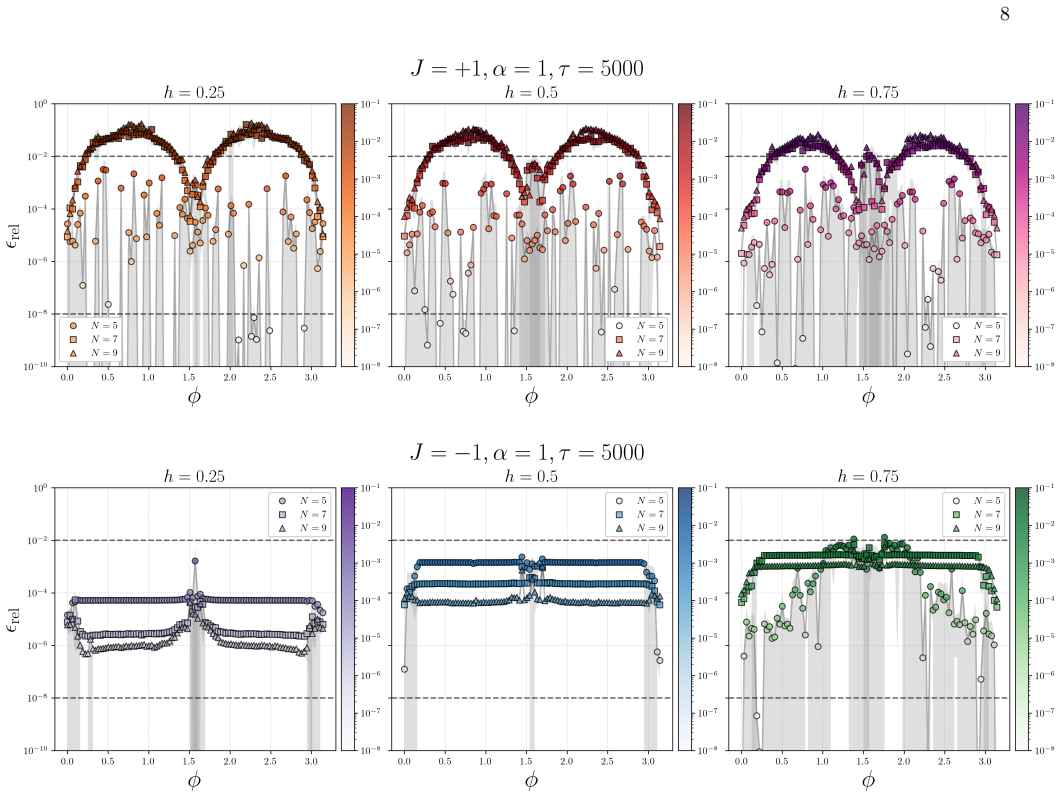


Forward citations
Cited by 2 Pith papers
-
Enhancing Neural-Network Variational Monte Carlo through Basis Transformation
A learnable Gaussian basis transformation lowers variational energies in neural-network variational Monte Carlo for the three-dimensional homogeneous electron gas.
-
Enhancing Neural-Network Variational Monte Carlo through Basis Transformation
A learnable Gaussian-basis locality parameter α lowers NNVMC variational energies on the 3D electron gas and sharpens the Fermi-liquid–Wigner-crystal transition for message-passing ansatze.
Reference graph
Works this paper leans on
-
[1]
Sampling Noise - Although Monte Carlo sampling is common in large-scale NQS, here we avoid it by restricting toN <20, ensuring exact gradient and expectation evaluation
-
[2]
Tuning the hidden-unit ratio (α RBM =M/N) or network depth is crucial, but even well-tuned shallow mod- els can stall when the target lies in a high-curvature region
Architecture Limitations - Shallow RBMs and small FFNNs may lack the expressivity required to represent complex rotated states. Tuning the hidden-unit ratio (α RBM =M/N) or network depth is crucial, but even well-tuned shallow mod- els can stall when the target lies in a high-curvature region
-
[3]
Conversely, minimizing infidelity directly can become trapped near saddles, as optimization steps shrink in high-curvature valleys
Loss-Function Traps - Energy minimization can lead to low-energy states that still have poor fi- delity. Conversely, minimizing infidelity directly can become trapped near saddles, as optimization steps shrink in high-curvature valleys. Figure 1 shows trajectories under both losses, highlighting these challenges
-
[4]
Regularization (ϵI) mitigates this but does not fully eliminate saddle- point trapping
Quantum Natural Gradient Conditioning - The quantum Fisher matrixG(α)can become ill- conditioned in narrow valleys or near saddles, caus- ing updates to stall or oscillate. Regularization (ϵI) mitigates this but does not fully eliminate saddle- point trapping
-
[5]
Without pretraining, different random seeds can yield diverse trajectories
Initialization Bias - Starting from a random initial- izationoftenplacesthemodelneartheequal-weight superposition|W⟩. Without pretraining, different random seeds can yield diverse trajectories. By pretraining to|W⟩, we fix a deterministic initial- ization, isolating the effect of rotated targets on convergence. By addressing these pitfalls we ensure that ...
2022
-
[6]
The power of quantum neural networks
Amira Abbas, David Sutter, Christa Zoufal, Aurelien Lucchi, Alessio Figalli, and Stefan Woerner. The power of quantum neural networks. Nature Computational Science, 1(6):403–409, June 2021. ISSN 2662-8457. doi: 10.1038/s43588-021-00084-1. URLhttp://dx.doi.org/ 10.1038/s43588-021-00084-1
-
[7]
Amari and H
S. Amari and H. Nagaoka. Methods of Information Geometry. Translations of mathematical mono- graphs. American Mathematical Society, 2000. ISBN 9780821843024
2000
-
[8]
Natural gradient works efficiently in learning
Shun-ichi Amari. Natural gradient works efficiently in learning. Neural Computation, 10(2):251–276, 02 1998. ISSN 0899-7667. doi:10.1162/089976698300017746. URL https://doi.org/10.1162/089976698300017746
Show all 38 references
-
[9]
Baxter.Exactly Solved Models in Statistical Mechanics
Rodney J. Baxter.Exactly Solved Models in Statistical Mechanics. Academic Press, London, 1982. doi: 10.1142/9789814415255_0002
1982 doi
-
[10]
Pearlmutter, Alexey An- dreyevich Radul, and Jeffrey Mark Siskind
Atılım Günes Baydin, Barak A. Pearlmutter, Alexey An- dreyevich Radul, and Jeffrey Mark Siskind. Automatic differentiation in machine learning: a survey. J. Mach. Learn. Res., 18(1):5595–5637, January 2017. ISSN 1532- 4435
2017
-
[11]
Quantum Monte Carlo Approaches for Correlated Systems
Federico Becca and Sandro Sorella. Quantum Monte Carlo Approaches for Correlated Systems. Cambridge University Press, 2017. doi:10.1017/9781316417041
2017 doi
-
[12]
Reconciling modern machine-learning practice and the classical bias–variance trade-off
Mikhail Belkin, Daniel Hsu, Siyuan Ma, and Soumik Mandal. Reconciling modern machine-learning practice and the classical bias–variance trade-off. Proceedings of the National Academy of Sciences, 116(32): 15849–15854, July 2019. ISSN 1091-6490. doi: 10.1073/pnas.1903070116. URL...
2019 doi
-
[13]
JAX: com- posable transformations of Python+NumPy programs,
James Bradbury, Roy Frostig, Peter Hawkins, Matthew James Johnson, Chris Leary, Dougal Maclau- rin, George Necula, Adam Paszke, Jake VanderPlas, Skye Wanderman-Milne, and Qiao Zhang. JAX: com- posable transformations of Python+NumPy programs,
-
[14]
can neural quantum states learn volume-law ground states?
Zakari Denis, Alessandro Sinibaldi, and Giuseppe Car- leo. Comment on “can neural quantum states learn volume-law ground states?”. Physical Review Letters, 134(7), February 2025. ISSN 1079-7114. doi: 10.1103/physrevlett.134.079701. URLhttp://dx.doi. org/10.1103/PhysRevLett.134.079701
2025 doi
-
[15]
Solving the quan- tum many-body problem with artificial neural networks
Giuseppe Carleo and Matthias Troyer. Solving the quan- tum many-body problem with artificial neural networks. Science, 355(6325):602–606, February 2017. ISSN 1095-
2017
-
[17]
Empowering deep neural quantum states through efficient optimization
Ao Chen and Markus Heyl. Empowering deep neural quantum states through efficient optimization. Nature Physics, 20(9):1476–1481, July 2024. ISSN 1745-2481. doi:10.1038/s41567-024-02566-1. URLhttp://dx.doi. org/10.1038/s41567-024-02566-1
2024 doi
-
[18]
Shankar, Marcello Dalmonte, Roberto Verdel, and Nils Niggemann
Ronald Santiago Cortes, Aravindh S. Shankar, Marcello Dalmonte, Roberto Verdel, and Nils Niggemann. Basis dependence of neural quantum states for the transverse field ising model, 2025. URLhttps://arxiv.org/abs/ 2512.11632
2025 arXiv
-
[19]
Efficiency of neural quan- tum states in light of the quantum geometric tensor
Sidhartha Dash, Luca Gravina, Filippo Vicentini, Michel Ferrero, and Antoine Georges. Efficiency of neural quan- tum states in light of the quantum geometric tensor. Communications Physics, 8(1), March 2025. ISSN 2399-
2025
-
[20]
Coles, and Marco Cerezo
Martín Larocca, Nathan Ju, Diego García-Martín, Patrick J. Coles, and Marco Cerezo. Theory of over- parametrization in quantum neural networks. Nature Computational Science, 3(6):542–551, June 2023. ISSN 2662-8457. doi:10.1038/s43588-023-00467-6. URLhttp: //dx.doi.org/10.1038/...
2023 doi
-
[21]
Das Sarma
Dong-Ling Deng, Xiaopeng Li, and S. Das Sarma. Quan- tum entanglement in neural network states.Phys. Rev. X, 7:021021, May 2017. doi:10.1103/PhysRevX.7.021021. URLhttps://link.aps.org/doi/10.1103/PhysRevX. 7.021021
2017 doi
-
[22]
A practical introduction to tensor net- works: Matrix product states and projected entangled pair states
Román Orús. A practical introduction to tensor net- works: Matrix product states and projected entangled pair states. Annals of Physics, 349:117–158, 2014. doi: 10.1016/j.aop.2014.06.013
2014 doi
-
[23]
An Introduction to Integrable Techniques for One-Dimensional Quantum Systems
Fabio Franchini. An Introduction to Integrable Techniques for One-Dimensional Quantum Systems. Springer, Cham, 2017. doi:10.1007/978-3-319-48487-7
2017 doi
-
[24]
Sentef, and Dante M
Giacomo Passetti, Damian Hofmann, Pit Neitemeier, Lukas Grunwald, Michael A. Sentef, and Dante M. Kennes. Can neural quantum states learn volume-law ground states? Phys. Rev. Lett., 131:036502, Jul 2023. doi:10.1103/PhysRevLett.131.036502. URLhttps:// link.aps.org/doi/10.1103/...
2023 doi
-
[25]
Kohn and L
W. Kohn and L. J. Sham. Self-consistent equa- tions including exchange and correlation ef- fects. Phys. Rev., 140:A1133–A1138, Nov 1965. doi:10.1103/PhysRev.140.A1133. URLhttps: //link.aps.org/doi/10.1103/PhysRev.140.A1133
1965 doi
-
[26]
Computing quantum resources using tensor cross interpolation, 2025
Sven Benjamin Kožić and Gianpaolo Torre. Computing quantum resources using tensor cross interpolation, 2025. URLhttps://arxiv.org/abs/2502.06956
2025 arXiv
-
[27]
An iteration method for the solution of the eigenvalue problem of linear differential and inte- gral operators
Cornelius Lanczos. An iteration method for the solution of the eigenvalue problem of linear differential and inte- gral operators. J. Res. Natl. Bur. Stand. B, 45:255–282,
-
[29]
NetKet 3: Ma- chine Learning Toolbox for Many-Body Quantum Sys- tems
Filippo Vicentini, Damian Hofmann, Attila Szabó, Dian Wu, Christopher Roth, Clemens Giuliani, Gabriel Pes- cia, Jannes Nys, Vladimir Vargas-Calderón, Nikita As- trakhantsev, and Giuseppe Carleo. NetKet 3: Ma- chine Learning Toolbox for Many-Body Quantum Sys- tems. SciPost Phys...
2022 doi
-
[30]
New insights and perspectives on the natural gradient method
James Martens. New insights and perspectives on the natural gradient method. Journal of Machine Learning Research, 21(146):1–76, 2020. URLhttp://jmlr.org/ papers/v21/17-678.html
2020
-
[31]
When can classical neural net- works represent quantum states?, 2024
Tai-Hsuan Yang, Mehdi Soleimanifar, Thiago Bergam- aschi, and John Preskill. When can classical neural net- works represent quantum states?, 2024. URLhttps: //arxiv.org/abs/2410.23152. 11 FIG. 7: Log-Log plot of averaged relative energy error for10samples forN= 5,7,9with logRB...
2024 arXiv
-
[32]
Revisiting natural gradient for deep networks, 2014
Razvan Pascanu and Yoshua Bengio. Revisiting natural gradient for deep networks, 2014. URLhttps://arxiv. org/abs/1301.3584
2014 arXiv
-
[34]
Pei and Stephen R
Michael Y. Pei and Stephen R. Clark. Neural-network quantum states for spin-1 systems: Spin-basis and pa- rameterization effects on compactness of representations. Entropy, 23(7):879, July 2021. ISSN 1099-4300. doi: 10.3390/e23070879. URLhttp://dx.doi.org/10.3390/ e23070879
2021 doi
-
[35]
Roberts, Sho Yaida, and Boris Hanin
Daniel A. Roberts, Sho Yaida, and Boris Hanin. The principles of deep learning theory: An effective theory approach to understanding neural networks. May 2022. doi:10.1017/9781009023405. URLhttp://dx.doi.org/ 10.1017/9781009023405
2022 doi
-
[36]
Quantum natural gradient
JamesStokes, JoshIzaac, NathanKilloran, andGiuseppe Carleo. Quantum natural gradient. Quantum, 4: 269, May 2020. ISSN 2521-327X. doi:10.22331/q- 2020-05-25-269. URLhttp://dx.doi.org/10.22331/ q-2020-05-25-269
2020 doi
-
[39]
Codebase release 3.4 for NetKet.SciPostPhys.Codebases, pages 7–r3.4, 2022
Filippo Vicentini, Damian Hofmann, Attila Szabó, Dian Wu, Christopher Roth, Clemens Giuliani, Gabriel Pes- cia, Jannes Nys, Vladimir Vargas-Calderón, Nikita As- trakhantsev, and Giuseppe Carleo. Codebase release 3.4 for NetKet.SciPostPhys.Codebases, pages 7–r3.4, 2022. doi:10....
2022 doi
-
[1950]
doi:10.6028/jres.045.026. 10
-
[2018]
URLhttp://github.com/jax-ml/jax. 9 FIG. 6: Shannon entropy of variational state-vector coefficients (Quantum Coherence) of logRBM (α= 1) with SR forτ= 5000iterations,h= 0.5, N= 5,7,9, withJ=−1(top) andJ= +1(bottom) as function of rotation angleϕ
- [3650]
- [9203]
Reviewed August 3, 2026 · model on record in the stance chip above.
Discussion (0). Sign in to comment.