REVIEW 2 major objections 6 minor 125 references
This paper argues that Drell-Yan production of fermionic dark matter in the dynamical scotogenic model could be probed at the High-Luminosity LHC for masses between 100 and 220 GeV, in final states with large missing transverse momentum and
Reviewed by Pith at T0; open to challenge. T0 means a machine referee read the full paper against a public rubric. the ladder, T0–T4 →
T0 review · deepseek-v4-flash
2026-08-03 15:06 UTC pith:WJUAY5TU
load-bearing objection First LHC feasibility scan for the dynamical scotogenic model; the negative results look robust, but the claimed 100-220 GeV DM window rests on an overlay, not a recast. the 2 major comments →
Feasibility to probe the dynamical scotogenic model at the LHC
The pith
A machine-rendered reading of the paper's core claim, the machinery that carries it, and where it could break.
Core claim
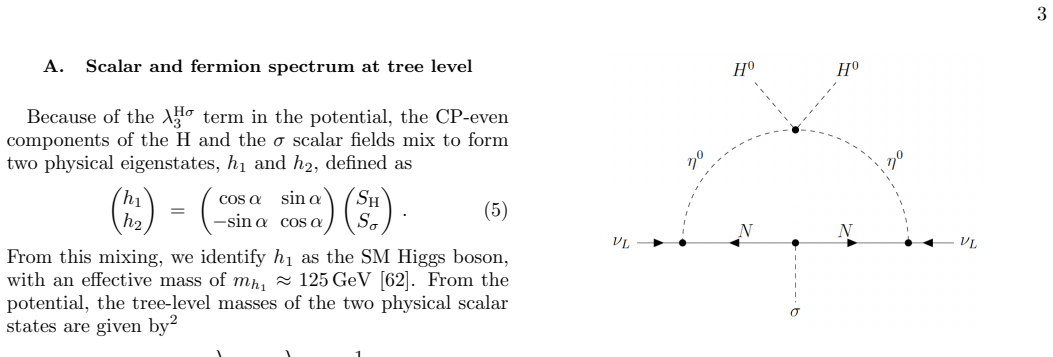
Within the dynamical scotogenic model—an extension of the Standard Model with three Z2-odd Majorana fermions, a Z2-odd inert scalar doublet, and a spontaneously broken global U(1)_L symmetry that yields a massless Majoron—the paper identifies the lightest Majorana fermion N1 as a viable dark-matter candidate whose pair production through Drell-Yan processes (pp → η+η− → N1 ℓ+ N1 ℓ−) can produce observable signals at the High-Luminosity LHC. Under a compressed mass spectrum (mass splitting between the inert scalars and N1 below 30 GeV), the final state consists of large missing transverse energy plus two soft charged leptons. Comparing computed cross-sections with extrapolated limits from an
What carries the argument
The load-bearing mechanism is the compressed mass spectrum: the mass difference between the Z2-odd charged/neutral scalars and the lightest Majorana fermion N1 is forced below 30–50 GeV. This compression keeps the relic density at the observed level through coannihilation and makes the charged scalar decay into a soft lepton plus N1, giving a distinctive soft-dilepton plus large missing transverse momentum signature. The quantitative comparison uses the Drell-Yan process pp → η± η∓ with η± → N1 ℓ±, computed with a leading-order event generator and then confronted with observed and extrapolated limits from an existing LHC compressed-spectrum search. The small coupling λ_Hσ^3 < 10^-5 is what s
Load-bearing premise
The claim's load-bearing premise is that an existing compressed-spectrum LHC search can be extrapolated to 300 and 3000 fb^-1 with unchanged detector performance and a simple luminosity-scaling improvement; if the actual acceptance for the scotogenic decay chain differs from that of the supersymmetric topology used to set the limits, the 100–220 GeV window could disappear.
What would settle it
A detector-level simulation of pp→η+η−→N1 ℓ+ N1 ℓ− at 13.6 TeV, using the same event selection as the compressed-spectrum search but with the exact spin and decay kinematics of this model, would settle the claim: if the resulting 95% confidence exclusion at 139 fb^-1 does not reach the predicted cross-sections in the 100–220 GeV range, the extrapolated High-Luminosity sensitivity is optimistic and the window closes.
If this is right
- If the claim holds, the High-Luminosity LHC can probe fermionic dark matter in this model for masses between 100 and 220 GeV through the soft-dilepton plus missing-energy signature, giving the dynamical scotogenic model its first concrete LHC target.
- Scalar dark matter (the CP-odd inert scalar) is not observable through Drell-Yan production at 137, 300, or 3000 fb^-1, because the predicted cross-sections fall orders of magnitude below expected sensitivity.
- Vector-boson fusion does not provide a viable probe for either dark-matter candidate at the LHC; even for the proposed FCC-hh with 25 ab^-1, scalar VBF rates sit slightly below expected sensitivity.
- Fermionic dark matter in this model is essentially invisible to direct detection, with rescaled spin-independent cross-sections below 10^-53 cm^2, so collider searches are the only near-term experimental handle on this candidate.
Where Pith is reading between the lines
- If the 100–220 GeV window is real, similar Drell-Yan reach may hold for other radiative neutrino-mass models with compressed spectra and a charged scalar decaying to a lepton plus a dark fermion; the strategy is not tied to the Majoron sector specifically.
- The claimed window depends on the small coupling λ_Hσ^3 < 10^-5; a future direct-detection signal from a fermionic dark-matter candidate in this model would contradict that assumption and require the collider interpretation to be revisited.
- A full detector-level recast using the exact spin correlations of the η± → N1 ℓ± chain, rather than the supersymmetric topology used for the extrapolated limits, would likely change the acceptance; quantifying that difference is the paper's most immediate next step.
- The same reasoning implies the model becomes effectively untestable at colliders for fermionic dark-matter masses outside 100–220 GeV, pushing testing to future colliders or indirect searches.
Editorial analysis
A structured set of objections, weighed in public.
Referee Report
Summary. The paper studies the collider prospects of the dynamical scotogenic model, a U(1)_L extension of the standard scotogenic model with a singlet scalar sigma, a Majoron J, an inert doublet eta, and three Majorana fermions N_i. A Markov Chain Monte Carlo scan is performed over the model parameters, imposing neutrino oscillation data, lepton-flavor-violating bounds, Higgs invisible-width constraints, and DM relic density/direct-detection limits, under a compressed-mass condition |m_etaR - M_N1| < 30/50 GeV and a small coupling lambda_Hsigma^3 < 10^-5. Using SARAH/SPheno, micrOMEGAs, and MadGraph, the paper computes Drell-Yan and vector-boson-fusion production cross sections for both scalar (eta_I) and fermionic (N_1) DM candidates. It concludes that fermionic DM produced via Drell-Yan could be probed at the High-Luminosity LHC for DM masses between about 100 and 220 GeV in final states with large missing transverse energy and soft leptons, while scalar DM and VBF production remain out of reach at the LHC and FCC-hh.
Significance. If the 100-220 GeV window were established by a proper collider analysis, this would be the first concrete LHC search target for the dynamical scotogenic model. The paper has real strengths: it is a forward computation from a complete model implementation, it includes a broad set of LFV, Higgs, and DM constraints, and it provides explicit cross-section results for both DM candidates and two production mechanisms. The SARAH/SPheno -> micrOMEGAs -> MadGraph chain is standard and, in principle, reproducible. However, the headline claim is currently based on an inclusive parton-level cross-section overlay, not on a detector-level recast of the ATLAS SUSY search. The model-dependent acceptance of the experimental search is not quantified, and the luminosity extrapolation is not justified. I do not see a circularity problem: the neutrino masses are imposed through the Casas-Ibarra parametrization, and the LHC cross sections are genuine predictions. The main issue is that the central positive result is overstated relative to what the analysis actually computes.
major comments (2)
- [Sec. IV.C.2, Fig. 8] The central claim that fermionic DM 'could be probed' at the HL-LHC is not supported by the analysis as presented. Fig. 8 overlays the inclusive MadGraph cross section for pp -> eta+ eta- -> N1 l+ N1 l- on the ATLAS compressed-SUSY limits [93], but this is not a recast: no ATLAS signal region, trigger requirement, lepton pT/isolation, E_T^miss selection, or acceptance x efficiency is applied to the scotogenic signal. The ATLAS limits are model-dependent for chargino/neutralino production with different kinematics, spin, and decay products. The 300 and 3000 fb^-1 curves are then obtained by 'assuming the same experimental performance holds', which ignores the effect of systematic uncertainties that typically make limits scale more slowly than sqrt(L). A realistic acceptance loss of even a factor of a few could erase the claimed 100-220 GeV window. The paper either needs a proper detector-
- [Secs. II.A, III.B, IV.B] The fermionic DM viability is largely created by two imposed priors: lambda_Hsigma^3 in [10^-7, 10^-5] and the compressed-mass condition Delta m < 30/50 GeV. The text states that the N1 direct-detection rate is suppressed below 10^-53 cm^2 because lambda_Hsigma^3 < 10^-5; this is a direct consequence of the prior, not a prediction of the model. The compressed condition, imposed by hand, produces the coannihilation regime that makes N1 a viable thermal relic. These assumptions are not derived from the model and are not varied to show robustness of the LHC window. If lambda_Hsigma^3 were larger, direct detection would exclude much of the fermionic region; if Delta m were larger, the coannihilation mechanism and the soft-lepton signature would change. The LHC window should be shown to survive, or the conclusions should be explicitly conditioned on these priors.
minor comments (6)
- [Sec. III.B / Figs. 8-9] The compressed condition is quoted as Delta m < 30 GeV (50 GeV) without a clear rule for which value is used in which plot. Fig. 8 uses 30 GeV, Fig. 9 uses 50 GeV, while the text often uses 'Delta m < 30 GeV' generically. Please specify.
- [Sec. IV.C.2] The word 'recast' is used to describe the comparison with the ATLAS SUSY search, but the analysis applies no signal-region selection. Calling it an 'inclusive cross-section overlay' would be more accurate and would avoid implying a detector-level sensitivity study.
- [Sec. IV.C.1, Eq. (18)] The sensitivity estimate for scalar DM uses arbitrary choices: 'background events constitute only 20% of the total expected yield', a 20% systematic uncertainty, and a 10% detector efficiency. These are illustrative, not derived. Since the scalar conclusion is negative, this is not load-bearing, but the assumptions should be labeled as conservative estimates rather than experimental inputs.
- [Sec. IV.D] The statement that 'moderate improvements in integrated luminosity or analysis sensitivity could render these processes detectable' at FCC-hh is speculative, since the predicted cross sections lie below the extrapolated limits and no detector-level study is performed. Please soften this sentence or provide a quantitative projection.
- [Footnote 2 / Sec. III.A] The paper states that all analytical and numerical computations, except for neutrino mass generation, are tree-level. This is an important limitation given the compressed spectra under study; loop corrections to scalar masses could shift the mass-splitting condition. Please state this caveat in the main text.
- [Sec. III.B / Sec. II.A] The paper explicitly defers Majoron astrophysical and Neff constraints to future work. Given that the model contains a massless Majoron coupled to leptons, a sentence quantifying the expected size of these effects, even approximately, would help the reader judge whether the 'viable parameter space' is robust.
Circularity Check
No circularity: LHC cross-sections are forward predictions from externally constrained parameters; the ATLAS-limit overlay is an explicit extrapolation assumption, not a fitted-input reduction.
full rationale
The paper's derivation chain is: (i) define the dynamical scotogenic model; (ii) scan free parameters with an MCMC enforcing external constraints (neutrino oscillation data via Casas-Ibarra, LFV bounds, Higgs-to-invisible, relic density, direct detection); (iii) compute collider cross-sections with MadGraph for the surviving points; (iv) compare to ATLAS/CMS limits. The predicted DY cross-section for pp -> eta+ eta- -> N1 l+ N1 l- is fixed by the scanned Yukawa couplings and masses; it is not fitted to the ATLAS curve. The 100-220 GeV claim is an overlay of inclusive cross-sections on compressed-SUSY limits from Ref. [93], with high-luminosity projections obtained 'assuming the same experimental performance holds at higher luminosities'. That assumption, and the use of inclusive cross-sections rather than a detector-level recast, is a validity/robustness concern (the skeptic's attack is well-taken as a correctness risk), but it is not a circular step: the predicted quantity is not defined in terms of the limit, nor is any fitted parameter renamed as a prediction. The lambda_Hsigma^3 < 1e-5 prior in Table III is a stated model assumption (motivated by Refs. [53,54]) that suppresses direct detection and Majoron constraints; it makes the fermionic scenario viable, but it is an input, not an output, and the later LHC cross-sections remain independent forward computations. Self-citations for the MCMC methodology (Refs. [50,51,78]) and for the model (Refs. [52-54]) are not load-bearing: Metropolis-Hastings is standard, and the central feasibility conclusion does not reduce to those citations. No uniqueness theorem or ansatz is imported from the authors' own prior work to force the result. The paper itself flags Majoron astrophysical/Neff constraints as beyond scope; this is a limitation, not a circularity. Therefore the paper is not circular; weaknesses lie in the experimental extrapolation and acceptance modeling, which are outside the circularity definition.
Axiom & Free-Parameter Ledger
free parameters (9)
- lambda_Hsigma^3 =
[1e-7, 1e-5]
- v_sigma =
[1e3, 1e4] GeV
- m_eta^2 =
[9e4, 2.5e7] GeV^2
- lambda_5 =
[1e-10, 1]
- lambda_2, lambda_3, lambda_4, lambda_eta_sigma_3 =
[0.01, 1]
- kappa_11, kappa_22, kappa_33 =
[0.01, 1]
- m_nu_1 =
[1e-32, 1e-12] GeV
- O matrix angles =
not tabulated
- m_h2 =
246, 500 GeV
axioms (6)
- domain assumption The global U(1)_L symmetry is spontaneously broken by v_sigma, producing a massless Majoron A_sigma.
- standard math Neutrino masses are generated radiatively via the one-loop formula of Eq. (11) (Ma 2006).
- standard math Casas-Ibarra parametrization exactly reproduces the observed neutrino mass-squared differences and mixing matrix.
- ad hoc to paper The compressed mass spectrum Delta m = |m_eta_R - M_N1| < 30/50 GeV is imposed by hand.
- ad hoc to paper lambda_Hsigma^3 is restricted to [1e-7, 1e-5].
- domain assumption Standard thermal freeze-out relic abundance calculation with micrOMEGAs and xi-rescaling for subdominant DM.
invented entities (4)
-
Majoron J
no independent evidence
-
Singlet scalar sigma (S_sigma/A_sigma)
no independent evidence
-
Inert scalar doublet eta (eta_R, eta_I, eta^+-)
no independent evidence
-
Majorana fermions N_i
no independent evidence
read the original abstract
We perform a feasibility study to probe dark matter (DM) production at the LHC within a global $U(1)_L$ scotogenic model. The study is conducted using the Markov Chain Monte Carlo numerical method, considering the viable parameter space of the model allowed by experimental constraints such as neutrino oscillation data, the Higgs to invisible branching fraction, and DM observables. The production of scalar and fermionic DM candidates, predicted by the model, is then studied under the LHC conditions for different luminosity scenarios imposing compressed mass spectra conditions between the lightest fermion and the $\mathbb{Z}_2$ odd scalars. We studied two production mechanisms, Drell-Yan and Vector Boson Fusion. It was found that the Drell-Yan mechanism gives better detection prospects for fermionic DM masses between 100-220~\textrm{GeV} at high luminosity scenarios.
Figures


Reference graph
Works this paper leans on
-
[1]
Scalar DM scenario To estimate the potential to probe the production of pseudo-scalar statesη I at colliders via DY mechanism, we calculate the cross-section values corresponding to a sig- nificance of 1.69σ. This threshold defines our expected exclusion at 90% confidence level and is derived from the condition Sq S+B+δ 2 Sys = 1.69,(18) whereSis the expe...
-
[2]
Fermionic DM scenario In fermionic DM production via DY mechanisms, the visible decay chain considered isη ± →N 1 +ℓ, as depicted in Fig. 2. This process generates two vertices that arise 4 However, as commented in [118], this conservative single-bin ap- proach comes at the cost of reduced sensitivity, since extending the analysis to multiple bins can sig...
2023
-
[3]
Englert and R
F. Englert and R. Brout, Phys. Rev. Lett.13, 321 (1964)
1964
-
[4]
Navaset al.(Particle Data Group), Phys
S. Navaset al.(Particle Data Group), Phys. Rev. D110, 030001 (2024)
2024
-
[6]
D. E. Morrissey and M. J. Ramsey-Musolf, New J. Phys. 14, 125003 (2012), arXiv:1206.2942 [hep-ph]
Pith/arXiv arXiv 2012
-
[7]
P. W. Higgs, Phys. Rev. Lett.13, 508 (1964)
1964
-
[8]
G. S. Guralnik, C. R. Hagen, and T. W. B. Kibble, Phys. Rev. Lett.13, 585 (1964)
1964
-
[9]
Bertone, D
G. Bertone, D. Hooper, and J. Silk, Physics Reports405, 279 (2005)
2005
-
[10]
L. Canetti, M. Drewes, and M. Shaposhnikov, New J. Phys.14, 095012 (2012), arXiv:1204.4186 [hep-ph]
Pith/arXiv arXiv 2012
-
[11]
S. Davidson, E. Nardi, and Y. Nir, Phys. Rept.466, 105 (2008), arXiv:0802.2962 [hep-ph]
Pith/arXiv arXiv 2008
-
[12]
Fukudaet al.(Super-Kamiokande), Phys
Y. Fukudaet al.(Super-Kamiokande), Phys. Rev. Lett. 81, 1562 (1998), arXiv:hep-ex/9807003
Pith/arXiv arXiv 1998
-
[13]
M. R. Buckley and A. H. G. Peter, Phys. Rept.761, 1 (2018), arXiv:1712.06615 [astro-ph.CO]
Pith/arXiv arXiv 2018
-
[14]
K. K. Boddyet al., JHEAp35, 112 (2022), arXiv:2203.06380 [hep-ph]
Pith/arXiv arXiv 2022
-
[15]
G. R. Blumenthal, S. M. Faber, J. R. Primack, and M. J. Rees, Nature311, 517 (1984)
1984
-
[16]
Q. R. Ahmadet al.(SNO), Phys. Rev. Lett.89, 011301 (2002), arXiv:nucl-ex/0204008
Pith/arXiv arXiv 2002
-
[17]
P. J. E. Peebles, Astrophys. J. Lett.263, L1 (1982)
1982
-
[18]
J. G. de Swart, G. Bertone, and J. van Dongen, Nature Astronomy1, 0059 (2017)
2017
-
[19]
G. Steigman, B. Dasgupta, and J. F. Beacom, Phys. Rev. D86, 023506 (2012), arXiv:1204.3622 [hep-ph]
Pith/arXiv arXiv 2012
-
[20]
L. Roszkowski, E. M. Sessolo, and S. Trojanowski, Rept. Prog. Phys.81, 066201 (2018), arXiv:1707.06277 [hep- ph]
Pith/arXiv arXiv 2018
-
[21]
Minkowski, Phys
P. Minkowski, Phys. Lett. B67, 421 (1977)
1977
-
[22]
I. Esteban, M. C. Gonzalez-Garcia, M. Maltoni, T. Schwetz, and A. Zhou, JHEP09, 178 (2020), arXiv:2007.14792 [hep-ph]
Pith/arXiv arXiv 2020
-
[23]
P. F. de Salas, D. V. Forero, S. Gariazzo, P. Mart ´ ınez- Mirav´ e, O. Mena, C. A. Ternes, M. T´ ortola, and J. W. F. Valle, JHEP02, 071 (2021), arXiv:2006.11237 [hep-ph]
Pith/arXiv arXiv 2021
-
[24]
Schechter and J
J. Schechter and J. W. F. Valle, Phys. Rev. D22, 2227 (1980)
1980
-
[25]
Yanagida, Prog
T. Yanagida, Prog. Theor. Phys.64, 1103 (1980)
1980
-
[26]
R. N. Mohapatra, Phys. Rev. Lett.56, 561 (1986)
1986
-
[27]
D. Restrepo, O. Zapata, and C. E. Yaguna, JHEP11, 011 (2013), arXiv:1308.3655 [hep-ph]
Pith/arXiv arXiv 2013
-
[28]
M. Gell-Mann, P. Ramond, and R. Slansky, inSuper- gravity, edited by D. Z. Freedman and P. van Nieuwen- huizen (North-Holland, 1979) pp. 315–321, arXiv:hep- ph/9809459
arXiv 1979
-
[29]
F. Bonnet, M. Hirsch, T. Ota, and W. Winter, JHEP 07, 153 (2012), arXiv:1204.5862 [hep-ph]
Pith/arXiv arXiv 2012
- [30]
-
[31]
These stringent require- ments, however, place tight constraints on the Yukawa cou- plings, often making it challenging to identify compatible solutions. To overcome this, we adopt the Casas-Ibarra parametrization [64], where the Yukawa couplings are ex- pressed in terms of masses and neutrino mixing angles as y= √ Λ−1O q ˆMνU † PMNS .(12) Here,yis the Yu...
-
[32]
S. S. C. Law and K. L. McDonald, JHEP09, 092 (2013), arXiv:1305.6467 [hep-ph]
Pith/arXiv arXiv 2013
- [33]
-
[34]
M. Klasen, C. E. Yaguna, J. D. Ruiz-Alvarez, D. Re- strepo, and O. Zapata, JCAP04, 044 (2013), arXiv:1302.5298 [hep-ph]
Pith/arXiv arXiv 2013
-
[35]
A. Ibarra, C. E. Yaguna, and O. Zapata, Phys. Rev. D 93, 035012 (2016), arXiv:1601.01163 [hep-ph]
Pith/arXiv arXiv 2016
-
[36]
D. Aristizabal Sierra, J. Kubo, D. Restrepo, D. Sue- matsu, and O. Zapata, Phys. Rev. D79, 013011 (2009), arXiv:0808.3340 [hep-ph]
Pith/arXiv arXiv 2009
-
[37]
A. Vicente and C. E. Yaguna, JHEP02, 144 (2015), arXiv:1412.2545 [hep-ph]
Pith/arXiv arXiv 2015
-
[38]
T. Toma and A. Vicente, JHEP01, 160 (2014), arXiv:1312.2840 [hep-ph]
Pith/arXiv arXiv 2014
-
[39]
S. Fraser, E. Ma, and O. Popov, Phys. Lett. B737, 280 (2014), arXiv:1408.4785 [hep-ph]
Pith/arXiv arXiv 2014
-
[40]
S. Baumholzer, V. Brdar, P. Schwaller, and A. Segner, JHEP09, 136 (2020), arXiv:1912.08215 [hep-ph]
Pith/arXiv arXiv 2020
-
[41]
D. Restrepo, A. Rivera, M. S´ anchez-Pel´ aez, O. Zap- ata, and W. Tangarife, Phys. Rev. D92, 013005 (2015), arXiv:1504.07892 [hep-ph]
Pith/arXiv arXiv 2015
-
[42]
E. Molinaro, C. E. Yaguna, and O. Zapata, JCAP07, 015 (2014), arXiv:1405.1259 [hep-ph]
Pith/arXiv arXiv 2014
-
[43]
R. Longas, D. Portillo, D. Restrepo, and O. Zapata, JHEP03, 162 (2016), arXiv:1511.01873 [hep-ph]
Pith/arXiv arXiv 2016
-
[44]
M. Lindner, M. Platscher, C. E. Yaguna, and A. Merle, Phys. Rev. D94, 115027 (2016), arXiv:1608.00577 [hep- ph]
Pith/arXiv arXiv 2016
-
[45]
P. Rocha-Moran and A. Vicente, JHEP07, 078 (2016), arXiv:1605.01915 [hep-ph]
Pith/arXiv arXiv 2016
-
[46]
A. Ahriche, A. Jueid, and S. Nasri, Phys. Rev. D97, 095012 (2018), arXiv:1710.03824 [hep-ph]
Pith/arXiv arXiv 2018
-
[47]
A. Betancur, R. Longas, and O. Zapata, Phys. Rev. D 96, 035011 (2017), arXiv:1704.01162 [hep-ph]
Pith/arXiv arXiv 2017
-
[48]
S. Bhattacharya, N. Sahoo, and N. Sahu, Phys. Rev. D 96, 035010 (2017), arXiv:1704.03417 [hep-ph]. 11
Pith/arXiv arXiv 2017
-
[49]
S. Bhattacharya, P. Ghosh, N. Sahoo, and N. Sahu, Front. in Phys.7, 80 (2019), arXiv:1812.06505 [hep-ph]
Pith/arXiv arXiv 2019
-
[50]
A. Ahriche, A. Arhrib, A. Jueid, S. Nasri, and A. de La Puente, Phys. Rev. D101, 035038 (2020), arXiv:1811.00490 [hep-ph]
Pith/arXiv arXiv 2020
-
[51]
Konar, A
P. Konar, A. Mukherjee, A. K. Saha, and S. Show, Phys. Rev. D102, 015024 (2020)
2020
-
[52]
P. Escribano, M. Reig, and A. Vicente, JHEP07, 097 (2020), arXiv:2004.05172 [hep-ph]
Pith/arXiv arXiv 2020
-
[53]
M. Sarazin, J. Bernigaud, and B. Herrmann, JHEP12, 116 (2021), arXiv:2107.04613 [hep-ph]
Pith/arXiv arXiv 2021
-
[54]
Phe- nomenology of a singlet-doublet-triplet scotogenic frame- work,
U. de Noyers, M. Sarazin, and B. Herrmann, “Phe- nomenology of a singlet-doublet-triplet scotogenic frame- work,” (2024), arXiv:2410.23712 [hep-ph]
Pith/arXiv arXiv 2024
-
[55]
Bonilla, L
C. Bonilla, L. M. de la Vega, J. Lamprea, R. A. Lineros, and E. Peinado, New Journal of Physics22, 033009 (2020)
2020
-
[56]
De Romeri, J
V. De Romeri, J. Nava, M. Puerta, and A. Vicente, Phys. Rev. D107, 095019 (2023)
2023
-
[57]
E. J. Chun, A. Roy, S. Mandal, and M. Mitra, JHEP08, 130 (2023), arXiv:2303.02681 [hep-ph]
Pith/arXiv arXiv 2023
-
[58]
R. N. Mohapatra and G. Senjanovic, Phys. Rev. Lett.44, 912 (1980)
1980
-
[59]
R. N. Mohapatra and G. Senjanovic, Phys. Rev. D23, 165 (1981)
1981
- [60]
-
[61]
V. M. Lozano, G. S. Garcia, and J. W. F. Valle, arXiv preprint arXiv:2502.05270 (2025)
Pith/arXiv arXiv 2025
-
[62]
P. A. C., J. Zamora-Saa, and A. R. Zerwekh, Eur. Phys. J. C84, 1278 (2024), arXiv:2403.04030 [hep-ph]
Pith/arXiv arXiv 2024
-
[63]
F. von der Pahlen, G. Palacio, D. Restrepo, and O. Zapata, Physical Review D94, 033005 (2016), arXiv:1605.01129 [hep-ph]
Pith/arXiv arXiv 2016
-
[64]
I. M. ´Avila, G. Cottin, and M. A. D ´ ıaz, Phys. Rev. D 105, 115018 (2022), arXiv:2108.05103 [hep-ph]
Pith/arXiv arXiv 2022
-
[65]
G. Aadet al.(ATLAS, CMS), Phys. Rev. Lett.114, 191803 (2015), arXiv:1503.07589 [hep-ex]
Pith/arXiv arXiv 2015
-
[66]
P. A. Zylaet al.(Particle Data Group), PTEP2020 (and 2021 update), 083C01 (2020)
2021
-
[67]
J. A. Casas and A. Ibarra, Nucl. Phys. B618, 171 (2001), arXiv:hep-ph/0103065
Pith/arXiv arXiv 2001
-
[68]
F. Staub, Comput. Phys. Commun.181, 1077 (2010), arXiv:0909.2863 [hep-ph]
Pith/arXiv arXiv 2010
-
[69]
F. Staub, Comput. Phys. Commun.182, 808 (2011), arXiv:1002.0840 [hep-ph]
Pith/arXiv arXiv 2011
-
[70]
F. Staub, Comput. Phys. Commun.184, 1792 (2013), arXiv:1207.0906 [hep-ph]
Pith/arXiv arXiv 2013
-
[71]
F. Staub, Comput. Phys. Commun.185, 1773 (2014), arXiv:1309.7223 [hep-ph]
Pith/arXiv arXiv 2014
-
[72]
W. Porod, Comput. Phys. Commun.153, 275 (2003), arXiv:hep-ph/0301101 [hep-ph]
Pith/arXiv arXiv 2003
-
[73]
W. Porod and F. Staub, Comput. Phys. Commun.183, 2458 (2012), arXiv:1104.1573 [hep-ph]
Pith/arXiv arXiv 2012
-
[74]
Staub and W
F. Staub and W. Porod, The European Physical Journal C77, 338 (2017)
2017
-
[75]
G. B´ elanger, F. Boudjema, A. Goudelis, A. Pukhov, and B. Zaldivar, Comput. Phys. Commun.231, 173 (2018), arXiv:1801.03509 [hep-ph]
Pith/arXiv arXiv 2018
-
[76]
A. A. Markov,Extension of the limit theorems of prob- ability theory to a sum of variables connected in a chain (reprinted in Appendix B of: R. Howard,Dynamic Prob- abilistic Systems, volume 1: Markov Chains, John Wiley and Sons, 1971)
1971
-
[77]
Alloul, N
A. Alloul, N. D. Christensen, C. Degrande, C. Duhr, and B. Fuks, Computer Physics Communications185, 2250 (2014)
2014
-
[78]
C. Degrande, C. Duhr, B. Fuks, D. Grellscheid, O. Matte- laer, and T. Reiter, Comput. Phys. Commun.183, 1201 (2012), arXiv:1108.2040 [hep-ph]
Pith/arXiv arXiv 2012
-
[79]
J. Alwall, M. Herquet, F. Maltoni, O. Mattelaer, and T. Stelzer, JHEP06, 128 (2011), arXiv:1106.0522 [hep- ph]
Pith/arXiv arXiv 2011
-
[80]
Staub, Computer Physics Communications241, 132 (2019)
F. Staub, Computer Physics Communications241, 132 (2019)
2019
-
[81]
A. Alvarez, A. Banik, R. Cepedello, B. Herrmann, W. Porod, M. Sarazin, and M. Schnelke, JHEP06, 163 (2023), arXiv:2301.08485 [hep-ph]
Pith/arXiv arXiv 2023
discussion (0)
Sign in with ORCID, Apple, or X to comment. Anyone can read and Pith papers without signing in.