A proof-of-principle experiment on the spontaneous symmetry breaking machine and numerical estimation of its performance on the K₂₀₀₀ benchmark problem
Pith reviewed 2026-05-17 00:47 UTC · model grok-4.3
The pith
The spontaneous symmetry breaking machine explores a single extremely stable state in combinatorial optimization from many different starting points.
A machine-rendered reading of the paper's core claim, the machinery that carries it, and where it could break.
Core claim
In this work we first verify the spontaneous symmetry breaking machine experimentally on a small-scale system. Numerical simulations on the K2000 benchmark then show that the machine can explore a single extremely stable state from 1000 different initial fluctuations. This behavior is rooted in the spontaneous symmetry breaking phenomenon and offers a notable advantage over other simulators for combinatorial optimization.
What carries the argument
The spontaneous symmetry breaking process in the physically implemented simulator, which selects and stabilizes one solution state irrespective of initial conditions.
If this is right
- SSBM demonstrates reliable convergence to a stable state in large-scale benchmark problems like K2000.
- The physical principle allows consistent identification of extremely stable states across varied initial fluctuations.
- This consistency could make SSBM suitable for solving hard combinatorial optimization tasks at scale.
- Experimental validation on small systems supports the extension to larger numerical estimates.
Where Pith is reading between the lines
- Physical realizations of SSBM might tolerate real-world noise better than digital simulations due to the underlying symmetry breaking dynamics.
- Testing SSBM on other standard benchmarks could reveal if the single-state exploration holds generally.
- Scaling the hardware implementation may enable practical applications in logistics or scheduling problems.
Load-bearing premise
That the numerical simulations on K2000 accurately capture how the physical spontaneous symmetry breaking machine behaves at larger scales and that the stable state is the globally optimal solution.
What would settle it
Running the physical SSBM hardware on a scaled-up version of the K2000 problem and checking if it produces the same single stable state as the simulations or instead yields multiple different stable states.
Figures






read the original abstract
In a previous paper, we proposed a unique physically implemented type simulator for combinatorial optimization problems, called the spontaneous symmetry breaking machine (SSBM). In this paper, we first report the results of experimental verification of SSBM using a small-scale benchmark system, and then describe numerical simulations using the benchmark problems (K2000) conducted to confirm its usefulness for large-scale problems. From 1000 samples with different initial fluctuations, it became clear that SSBM can explore a single extremely stable state. This is based on the principle of a phenomenon used in SSBM, and could be a notable advantage over other simulators.
Editorial analysis
A structured set of objections, weighed in public.
Referee Report
Summary. The manuscript reports a proof-of-principle experimental verification of the spontaneous symmetry breaking machine (SSBM) on a small-scale benchmark system, followed by numerical simulations on the K_{2000} benchmark problem. From 1000 samples with different initial fluctuations, the authors conclude that SSBM explores a single extremely stable state, attributing this to the underlying physical principle and positioning it as a potential advantage over other combinatorial optimization simulators.
Significance. If the observed stable state is confirmed to be the global optimum and the numerical model faithfully captures physical SSBM dynamics at scale, the result could indicate a distinctive robustness property of SSBM for large instances. The small-scale experimental verification supplies initial empirical grounding, and the focus on a physically implemented simulator is a constructive contribution to the field of analog or physics-based optimization.
major comments (2)
- [Abstract] Abstract and numerical simulations section: The central claim that the single extremely stable state constitutes a notable advantage rests on the unverified assumption that this state is the global optimum of the K_{2000} instance. Sampling 1000 initial conditions on a 2000-variable combinatorial problem cannot certify optimality; an independent lower bound, comparison against published best-known solutions for K_{2000}, or exhaustive verification on a reduced instance is required to substantiate the advantage.
- [Numerical simulations section] Numerical simulations section: No error bars, baseline comparisons with established solvers (e.g., Gurobi, simulated annealing, or other Ising machines), or quantitative performance metrics (energy, time-to-solution, success probability) are reported, which is load-bearing for the claim of usefulness on large-scale problems.
minor comments (2)
- [Abstract] The abstract refers to 'experimental verification using a small-scale benchmark system' without specifying system size, measured observables, or quantitative results; adding these details would improve clarity.
- Consider including a brief comparison table or reference to known K_{2000} optima from the literature to contextualize the reported stable state.
Simulated Author's Rebuttal
We thank the referee for the constructive comments and address each major point below. Our responses focus on clarifying the manuscript's claims without overstating the results.
read point-by-point responses
-
Referee: [Abstract] Abstract and numerical simulations section: The central claim that the single extremely stable state constitutes a notable advantage rests on the unverified assumption that this state is the global optimum of the K_{2000} instance. Sampling 1000 initial conditions on a 2000-variable combinatorial problem cannot certify optimality; an independent lower bound, comparison against published best-known solutions for K_{2000}, or exhaustive verification on a reduced instance is required to substantiate the advantage.
Authors: We do not claim that the observed stable state is the global optimum of the K_{2000} instance. The manuscript states that SSBM explores a single extremely stable state from 1000 samples with different initial fluctuations, due to the spontaneous symmetry breaking principle, and that this could be a notable advantage over other simulators. The advantage highlighted is the consistent convergence to one state rather than optimality. We agree that 1000 samples do not certify global optimality for a 2000-variable problem. We will revise the abstract and numerical simulations section to explicitly note that we demonstrate reproducible state selection via the physical mechanism, without asserting optimality. revision: yes
-
Referee: [Numerical simulations section] Numerical simulations section: No error bars, baseline comparisons with established solvers (e.g., Gurobi, simulated annealing, or other Ising machines), or quantitative performance metrics (energy, time-to-solution, success probability) are reported, which is load-bearing for the claim of usefulness on large-scale problems.
Authors: The numerical simulations section focuses on showing convergence to a single stable state across initial conditions to illustrate the underlying physical principle. We agree that error bars would improve clarity and will add them to the reported stability measures from the 1000 samples in revision. Comprehensive baselines against Gurobi or other Ising machines are not included, as the work is a proof-of-principle demonstration of the SSBM mechanism rather than a full performance benchmark; such comparisons are planned for follow-up studies. We can include a basic quantitative metric such as the variance in final states if it strengthens the presentation. revision: partial
Circularity Check
Minor self-citation to prior SSBM proposal; verification results remain independent
full rationale
The paper reports new experimental verification on a small-scale system and numerical simulations on the K2000 benchmark, with the key observation of a single stable state drawn from 1000 independent samples with varying initial fluctuations. While the abstract references a previous paper by the same authors to introduce the SSBM concept and its operating principle, this citation serves only to define the device under test; the reported findings and performance estimates are generated from fresh data and do not reduce to the prior proposal by construction or statistical forcing. The central empirical claims therefore retain independent content against external benchmarks.
Axiom & Free-Parameter Ledger
axioms (1)
- domain assumption The spontaneous symmetry breaking phenomenon in the physical implementation behaves as described in the authors' prior proposal.
invented entities (1)
-
Spontaneous symmetry breaking machine (SSBM)
no independent evidence
Lean theorems connected to this paper
-
IndisputableMonolith/Foundation/RealityFromDistinctionreality_from_one_distinction unclear?
unclearRelation between the paper passage and the cited Recognition theorem.
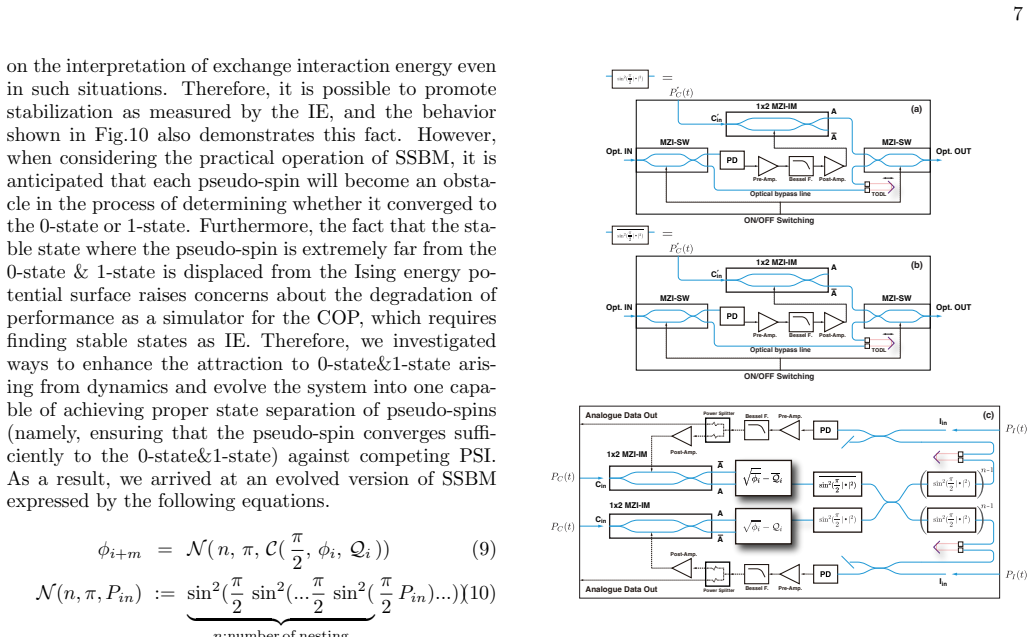
ϕ_{i+m} = sin²(γ/2 ϕ_i + θ_B) ... QF_i and QAF_i pseudo-spin interactions
What do these tags mean?
- matches
- The paper's claim is directly supported by a theorem in the formal canon.
- supports
- The theorem supports part of the paper's argument, but the paper may add assumptions or extra steps.
- extends
- The paper goes beyond the formal theorem; the theorem is a base layer rather than the whole result.
- uses
- The paper appears to rely on the theorem as machinery.
- contradicts
- The paper's claim conflicts with a theorem or certificate in the canon.
- unclear
- Pith found a possible connection, but the passage is too broad, indirect, or ambiguous to say the theorem truly supports the claim.
Reference graph
Works this paper leans on
-
[1]
Figure 4(a) shows a schematic diagram of
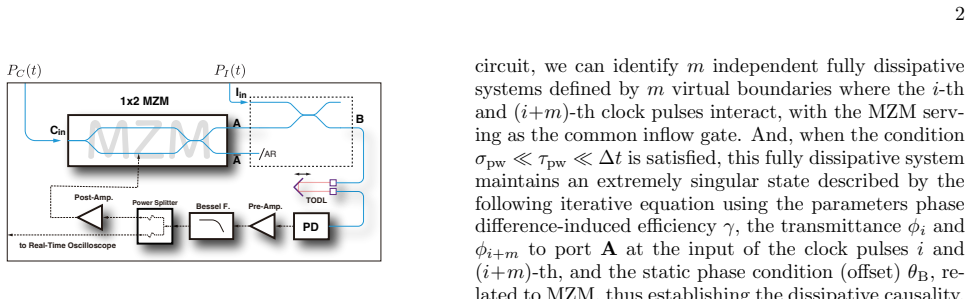
for the physical implementation of pseudo-spin in- teractions. Figure 4(a) shows a schematic diagram of .;. 1x2 MZI-IM PD Bessel F. Pre-Amp. Post-Amp. to Real-Time Oscilloscope A BCin Power Splitter TODL A 7.5GHz 1-$ Anti-ferromagnetic-type PSI implementing PLC type Multiple-delayed-Interferometer 3rd Route / [-1] Main Route / [0: standard delay] 2nd Rout...
-
[2]
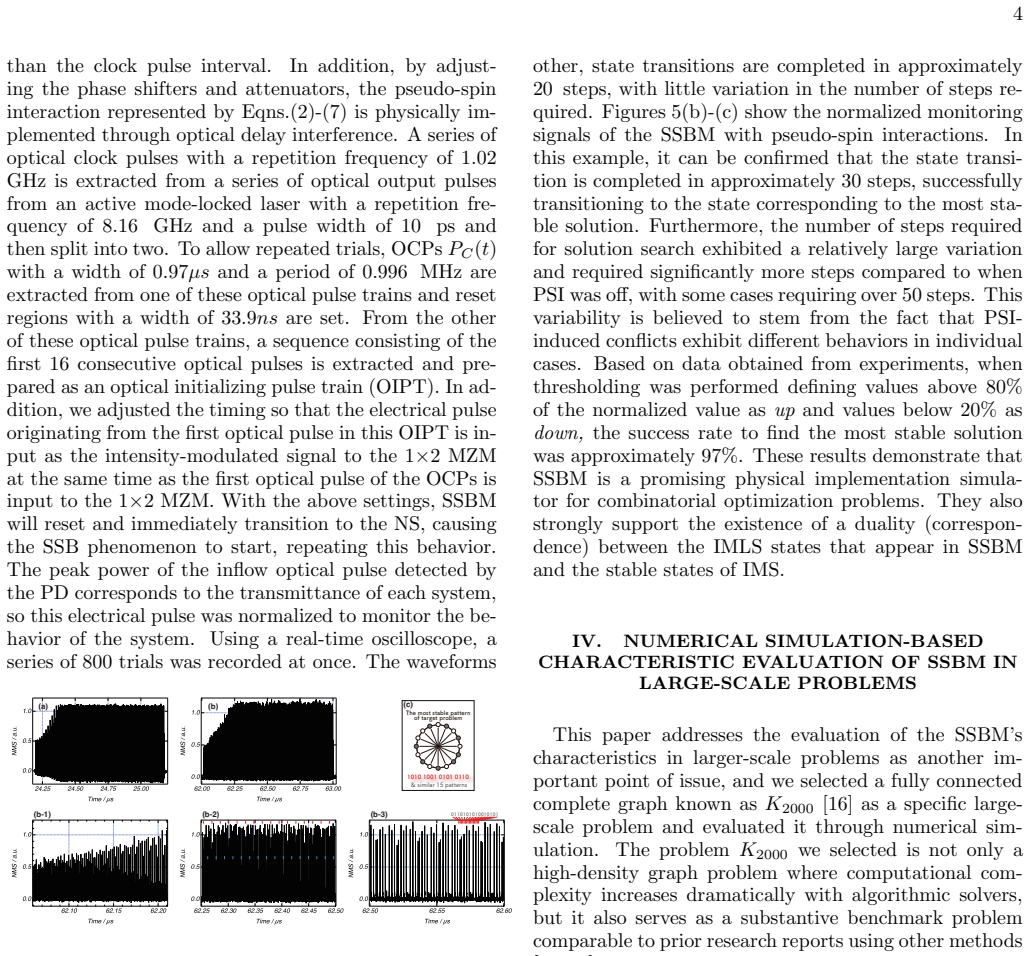
problem system for the SSBM proof-of-principle experi- ment. (a) Optical delay interference circuit (ODIC) for physi- cally implementing the PSI in the target problem (see Fig. 3), (b) Configuration diagram of SSBM physically implementing the PSI using the ODIC. The output from the 1×2 MZM’s output portAand its complementary output port Aare in- put to th...
work page 2000
-
[3]
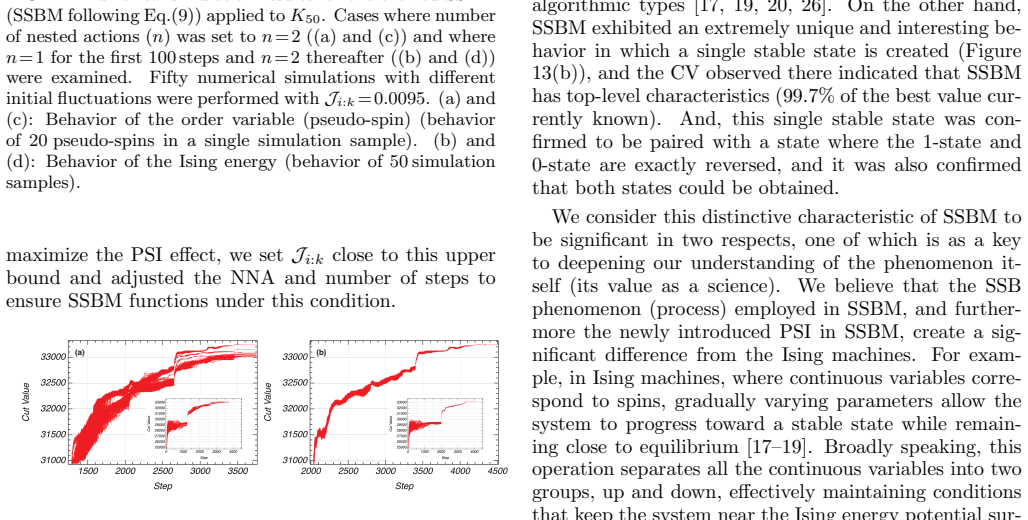
andJ i:k = 0.1 (case-2) - 50 numerical simulations with different initial fluctuations were performed. (a): behavior of the order parameters (pseudo-spins) in case-1 (behavior of 20 pseudo-spins in one simulation sample), (b): behavior of the Ising energies in case-1 (behavior of 50 simulation samples) (c): behavior of order parameters in case-2, (d): beh...
work page 2000
-
[4]
P. W. Anderson, ”More is Different,” Science177(4047), 393-396 (1972)
work page 1972
-
[5]
Crystal Statics. I. A Two-Dimensional Model with an Order-Disorder Transition,
L. Onsager, “Crystal Statics. I. A Two-Dimensional Model with an Order-Disorder Transition,” Phys. Rev., Series II,65(3–4), 117-149 (1944)
work page 1944
-
[6]
Inami, et.al, ”Symmetry breaking in the metal- insulator transition of BaVS3,” Phys
T. Inami, et.al, ”Symmetry breaking in the metal- insulator transition of BaVS3,” Phys. Rev. B.66, 073108 (2002)
work page 2002
-
[7]
G. Nicolis and I. Prigogine, Self-Organization in Non- Equilibrium System, Wiley, New York, (1997)
work page 1997
-
[8]
Haken, Synergetics: An Introduction, Springer- Verlag, Berlin, (1997)
H. Haken, Synergetics: An Introduction, Springer- Verlag, Berlin, (1997)
work page 1997
-
[9]
Higgs, ”Broken Symmetries and the Masses of Gauge Bosons,” Phys
P.W. Higgs, ”Broken Symmetries and the Masses of Gauge Bosons,” Phys. Rev. Lett.13(16), 508-509 (1964)
work page 1964
-
[10]
Y. Nambu and G. Jona-Lasinio, ”Dynamical Model of Elementary Particles Based on an Analogy with Super- conductivity. I,” Phys. Rev.122(1), 345-358 (1961)
work page 1961
-
[11]
Lucas, ”Ising formulations of many NP problems,” Front
A. Lucas, ”Ising formulations of many NP problems,” Front. Phys.2(5), 1-15 (2014)
work page 2014
-
[12]
T. Kadowaki, H. Nishimori, ”Quantum annealing in the transverse Ising model,” Phys. Rev. E58(5), 5355-5363 (1998)
work page 1998
-
[13]
M. W. Johnson, et al., ”A scalable control system for a superconducting adiabatic quantum optimization pro- cessor,” Supercond. Sci. Technol.23(6), 065004 (2010)
work page 2010
-
[14]
Z. Wang, A. Marandi, K. Wen, R. L. Byer, and Y. Ya- mamoto, ”Coherent Ising machine based on degenerate optical parametric oscillators,” Phys. Rev. A88, 063853 (2013)
work page 2013
- [15]
-
[16]
W. H. Unruh, ”Experimental black-hole evaporation ?,” Phys. Rev. Lett.46(21), 1351-1353 (1981)
work page 1981
-
[17]
T. G. Philbin, et.al, ”Fiber-optical analog of the event horizon,” Science319, 1367–1370 (2008)
work page 2008
-
[18]
K. Takata et al., ”A 16-bit Coherent Ising Machine for One-Dimensional Ring and Cubic Graph Problems,” Sci. Rep.6, 34089 (2016)
work page 2016
- [19]
-
[20]
T. Inagaki, et.al, ”A coherent Ising machine for 2000-node optimization problems,” Science354(6312), 603–606 (2016)
work page 2000
-
[21]
H. Goto, K. Tatsumura, A. R. Dixon, ”Combinatorial op- timization by simulating adiabatic bifurcations in nonlin- ear Hamiltonian systems,” Sci. Adv.5, eaav2372 (2019)
work page 2019
-
[22]
Goto, et.al, ”High-performance combinatorial opti- mization based on classical mechanics,” Sci
H. Goto, et.al, ”High-performance combinatorial opti- mization based on classical mechanics,” Sci. Adv.7, eabe7953 (2021)
work page 2021
-
[23]
K. Yamamoto, et.al, ”STATICA: A 512-Spin 0.25M- Weight annealing processor with an all-spin-updates-at- once architecture for combinatorial optimization with complete spin–spin Interactions,” IEEE J. Solid-State CIrcuits,56(1), 165-178 (2021)
work page 2021
-
[24]
each element interacts with the other three elements,
For example, in MaxCut3, since “each element interacts with the other three elements,” the PSI must be kept at approximately one-tenth or less. This is because if the PSI becomes too large, the process by which the pseudo- spin converges to the attractor is significantly hindered, preventing the attainment of a stable state
-
[25]
The virtual boundary referred to here denotes something that cannot be defined solely by spatial conditions. It is set by focusing on the pair of pulses—thei-th pulse and the (i+m)-th pulse—among the supplied clock pulses, where the earlier pulse influences the later pulse via the MZM. In other words, it is a boundary that includes temporal conditions, no...
-
[26]
T. Goh, et.al, ”Low loss and high extinction ratio strictly nonblocking 16×16 thermooptic matrix switch on 6-in wafer silica-based planar lightwave circuit technology ,” J. Lightwave Technol.,19(3), 371-379 (2001)
work page 2001
-
[27]
Recent Progress in Baryogenesis
A. Riotto and M. Trodden, ”Recent progress in baryoge- nesis,” arXiv:hep-ph/9901362
work page internal anchor Pith review Pith/arXiv arXiv
-
[28]
M. Matsumoto and T. Nishimura, ”Mersenne twister: A 623-dimensionally equidistributed uniform pseudo- random number generator.” ACM Trans. Model. Com- put. Simul.8, 3–30 (1998)
work page 1998
-
[29]
F. A. Quinton et.al, ”Quantum annealing applications, challenges and limitations for optimisation problems compared to classical solvers,” Sci Rep15, 12733 (2025)
work page 2025
discussion (0)
Sign in with ORCID, Apple, or X to comment. Anyone can read and Pith papers without signing in.