REVIEW 1 major objections 4 minor 160 references
No gravitational waves were detected from the 2024 Vela glitch, but the new upper limits are the first to beat the indirect energy-scale benchmark from the glitch itself.
Reviewed by Pith at T0; open to challenge. T0 means a machine referee read the full paper against a public rubric. the ladder, T0–T4 →
T0 review · deepseek-v4-flash
2026-08-03 15:06 UTC pith:QMV67CYM
load-bearing objection Solid multi-pipeline null result that finally beats the indirect glitch energy benchmark, but Eq. (17) has the wrong tau scaling and has to be fixed before this is final. the 1 major comments →
Constraints on gravitational waves from the 2024 Vela pulsar glitch
The pith
A machine-rendered reading of the paper's core claim, the machinery that carries it, and where it could break.
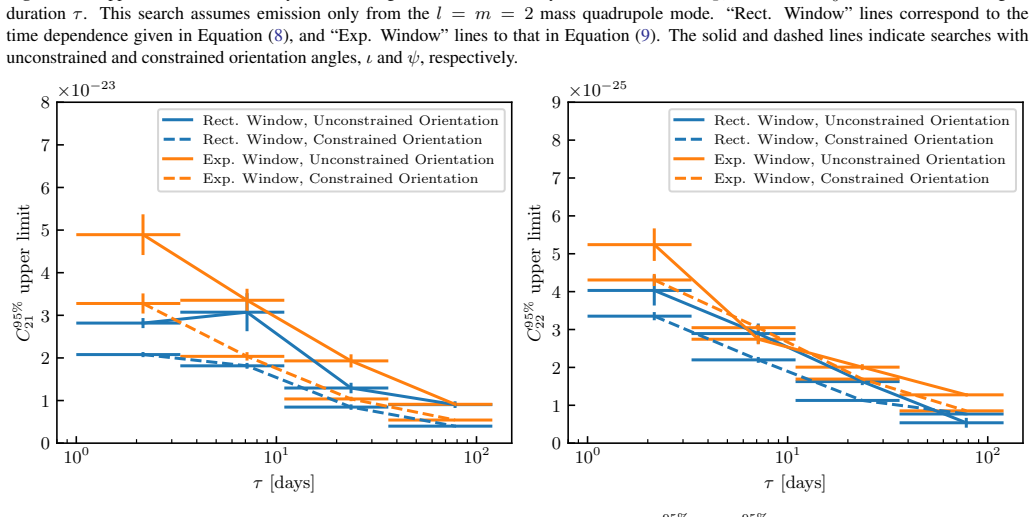
The collaboration ran three independent burst searches for short signals (milliseconds to minutes) and four longer-duration searches for signals lasting up to four months. All targeted Vela's sky position. None found a convincing candidate. The important result is what this excludes: the strain upper limits are, for the first time, smaller than the strain that would be emitted if the glitch's entire spin-down energy went into gravitational waves. This holds for bursts below roughly 800 Hz and for long transients across a wide range of decay times under the tightest assumptions.
The comparison is model-dependent: the 'energy scale' uses a conventional neutron-star moment of inertia, and the long-duration searches assume the signal phase follows the radio spin-down. But the raw strain limits themselves are robust, and with future detector improvements the same methods may detect or rule out specific glitch emission models.
Core claim
For the first time, direct observational upper limits on gravitational-wave strain from a pulsar glitch are stricter than the indirect limit set by the glitch's available spin-down energy. The tightest burst limit is h_rss ≈ 8.6e-23 at 290 Hz, a factor of ≈3 below the characteristic energy scale, and the long-transient searches exclude strain down to factors of ≈3–10 below that scale under the strictest assumptions (Section 7, Figures 4 and 5).
Load-bearing premise
The comparison of measured strain limits to the 'characteristic glitch energy scale' assumes a fiducial moment of inertia I = 10^45 g cm^2 (Eq. 3, Section 4.1). Vela's moment of inertia could vary by a factor of 3–5 among plausible equations of state, shifting the indirect benchmark by ~sqrt(I). If I is near the low end, the margins reported for 'stricter than indirect' shrink for some search configurations, though the raw strain upper limits themselves are unaffected.
Editorial analysis
A structured set of objections, weighed in public.
Referee Report
Summary. The paper reports a targeted search for gravitational-wave transients associated with the 29 April 2024 glitch of the Vela pulsar, using O4 LIGO data. Radio timing from IAR and MPRO provides the pulsar ephemeris and glitch parameters. Three unmodeled burst pipelines (cWB, PySTAMPAS, X-pipeline) cover milliseconds-to-minute signals, and four long-duration quasi-monochromatic searches (CWInPy, transient F-statistic, WPM, HMM) cover exponential and other transients up to ~120 days. No significant candidate is found. The paper's central claim is that, for the first time, direct GW upper limits are stricter than the indirect limit set by the glitch's characteristic spin-down energy scale: the tightest burst limit is h_rss ≈ 8.6e-23 at 290 Hz, about a factor of 3 below that scale, and the long-transient limits are quoted as factors of ~3–10 below it under the strictest assumptions. A joint Bayesian reweighting of burst and long-transient non-detections is also used to constrain the GW energy fraction and, under a particular emission model, the neutron-star mass and radius.
Significance. If the central comparison is correct, the paper reports a genuine milestone: the first observational upper limits on GW strain from a pulsar glitch that are more constraining than the available glitch energy budget. The search program is unusually thorough, with multiple independent pipelines, injection-calibrated sensitivity estimates, empirical background estimation, and an honest and detailed treatment of the one inconclusive WPM outlier. The availability of associated data products and open software is another strength. The result is squarely within the scope of the journal and will be of interest to the pulsar and gravitational-wave communities. However, the quantitative claim of being below the indirect energy scale depends on the correctness of the benchmark formula in Eq. (17), which is internally inconsistent as printed; this must be resolved before the central claim can be accepted.
major comments (1)
- [§6.2, Eq. (17)] Equation (17) is internally inconsistent with Eq. (16) and with the sentence immediately before it. Eq. (16) gives E_gw ∝ h0² τ; setting E_gw = Q ΔE_c therefore requires h0 ∝ τ^{-1/2}, as the text states. The printed Eq. (17), however, has h0 ∝ sqrt(I τ Q Δf_rot/f), i.e. h0 ∝ sqrt(τ), and its dimensions are also inconsistent (in SI units the square root has units of seconds before division by d). The correct expression at f_gw = 2 f_rot is h0 ≈ (1/d) sqrt(5 G I Q Δf_rot/(c³ f_rot τ)). This is load-bearing: the 'factors of 3–10 below the indirect energy scale' claim in Sections 6.2, 7, and Figure 5 is a comparison against this benchmark. Please correct Eq. (17), state explicitly which expression generated the bands in Figures 5, 10, 12, and 14, and recompute the quoted margins if the printed expression was used.
minor comments (4)
- [§4.1 / §6.2] The indirect benchmark inherits a sqrt(I) dependence from Eq. (3). The paper notes that I can vary by factors of 3–5 but does not quantify how this shifts the quoted 'factors of 3–10' margins. Since the raw strain upper limits are independent of I, a short robustness statement (e.g., quoting margins for the low-I end) would make the abstract's claim easier to interpret.
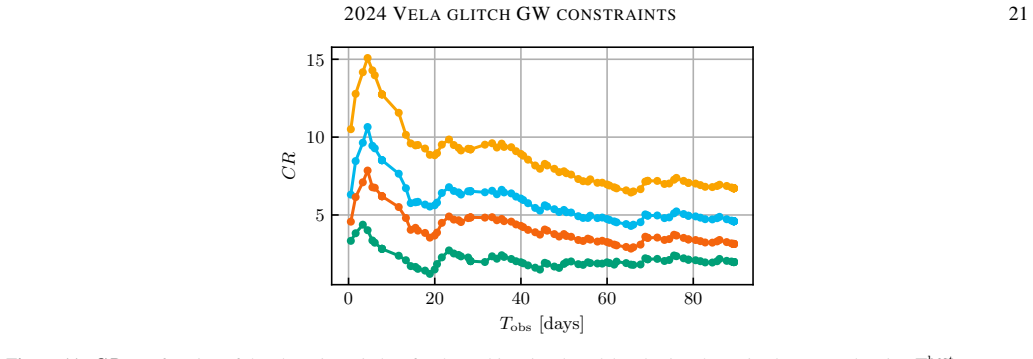
- [Appendix C, Table 5] The WPM upper limits are quoted without uncertainties or a statement of the systematic error associated with the CR threshold and the injection-recovery procedure. The transient F-statistic results in Appendix B quote error bars; the WPM table should do likewise or explain why uncertainties are negligible.
- [§5.4 / Appendix C.2] The inconclusive WPM outlier is handled carefully and honestly. It would be useful to state explicitly whether the quoted WPM upper limits would change if this outlier were treated as a real signal candidate rather than as noise; currently the reader is left to infer that the effect is negligible.
- [General presentation] The draft contains a few formatting artifacts (e.g., the 'DRAFT VERSION' header and some garbled author-list formatting). These do not affect the science but should be cleaned before final submission.
Circularity Check
No significant circularity: the GW upper limits are injection-calibrated and independent of the energy-scale comparison bands.
full rationale
The paper's central claims are the strain upper limits from short burst and long-transient searches. These limits are obtained by injecting simulated signals into real detector data and measuring the amplitude at which 90-95% of injections are recovered by each pipeline (Sections 4.5, 5.2-5.5, and appendices B-D). The energy scale Delta E_c = 4*pi^2*I*f_rot*Delta f_rot (Eq. 3) is a separate, independently defined benchmark constructed from the radio-measured glitch size and a fiducial moment of inertia; it is used only as a comparison curve, not as a prior, likelihood, or injection amplitude. The conversion between strain and energy in Eqs. (10)-(17) is algebraic and does not feed back into the search sensitivity. The joint inference in Section 6.3 reweights prior samples by non-detection likelihoods from X-pipeline and CWInPy; this is standard Bayesian reweighting, not fitting-to-conclusion. Self-citations to LVK pipeline papers and to Keitel et al. (2019), Abbott et al. (2022a), etc. are methodological references; no load-bearing 'uniqueness theorem' or ansatz is imported from the authors' own work. The skeptical note about Eq. (17) having tau in the numerator while Eq. (16) implies h0 ~ tau^{-1/2} is a real internal-consistency/correctness concern that deserves a corrigendum if the printed formula was used to generate Figure 5, but it is not circularity: the upper limits do not reduce to the benchmark by construction. Overall, the derivation chain is self-contained against external detector-noise calibrations, and no prediction is equivalent to its inputs.
Axiom & Free-Parameter Ledger
free parameters (2)
- Fiducial moment of inertia I =
10^45 g cm^2
- F_fmode (f-mode energy fraction in Figure 7) =
0.8
axioms (5)
- domain assumption Pulsar rotation is described by a Taylor series plus exponential glitch recovery terms (Eqs. 1–2)
- domain assumption Glitch-related GW bursts can be modeled as damped sinusoids (f-modes) for injection and sensitivity estimation (Eq. 4)
- domain assumption The entire characteristic glitch energy ΔE_c = 4π^2 I f_rot Δf_rot can in principle be radiated as GWs (Q=1 benchmark)
- domain assumption Universal relations (Yagi & Yunes 2017; Pradhan et al. 2022) connect moment of inertia, f-mode frequency/damping, and mass/radius independent of the equation of state
- domain assumption Detector calibration and data-quality flags accurately represent the strain noise in the GDS-CALIB_STRAIN_CLEAN channel
read the original abstract
Among known neutron stars, the Vela pulsar is one of the best targets for gravitational-wave searches. It is also one of the most prolific in terms of glitches, sudden frequency changes in a pulsar's rotation. Such glitches could cause a variety of transient gravitational-wave signals. Here we search for signals associated with a Vela glitch on 29 April 2024 in data of the two LIGO detectors from the fourth LIGO--Virgo--KAGRA observing run. We search both for seconds-scale burst-like emission, primarily from fundamental (f-)mode oscillations, and for longer quasi-monochromatic transients up to four months in duration, primarily from quasi-static quadrupolar deformations. We find no significant detection candidates, but for the first time we set direct observational upper limits on gravitational strain amplitude that are stricter than what can be indirectly inferred from the overall glitch energy scale. We discuss the short- and long-duration observational constraints in the context of specific emission models. These results demonstrate the potential of gravitational-wave probes of glitching pulsars as detector sensitivity continues to improve.
Figures





Reference graph
Works this paper leans on
-
[1]
Aasi , J., Abbott , B. P., Abbott , R., et al. 2015, CQGra, 32, 074001, 10.1088/0264-9381/32/7/074001
-
[2]
G., Abbott , R., Abouelfettouh , I., et al
Abac , A. G., Abbott , R., Abouelfettouh , I., et al. 2024, , 977, 255, 10.3847/1538-4357/ad8de0
-
[3]
G., Abouelfettouh , I., Acernese , F., et al
Abac , A. G., Abouelfettouh , I., Acernese , F., et al. 2025 a , arXiv e-prints, arXiv:2507.12282, 10.48550/arXiv.2507.12282
-
[4]
2025 b , , 112, 102005, 10.1103/wjdz-jdby
---. 2025 b , , 112, 102005, 10.1103/wjdz-jdby
-
[5]
2025 c , arXiv e-prints, arXiv:2508.18079, 10.48550/arXiv.2508.18079
---. 2025 c , arXiv e-prints, arXiv:2508.18079, 10.48550/arXiv.2508.18079
-
[6]
G., Abbott , R., Abouelfettouh , I., et al
Abac , A. G., Abbott , R., Abouelfettouh , I., et al. 2025 d , Astrophys. J., 985, 183, 10.3847/1538-4357/adc681
-
[7]
2025 e , , 983, 99, 10.3847/1538-4357/adb3a0
---. 2025 e , , 983, 99, 10.3847/1538-4357/adb3a0
-
[8]
Abadie , J., Abbott , B. P., Abbott , R., et al. 2011, , 83, 042001, 10.1103/PhysRevD.83.042001
-
[9]
2017, , 119, 10.1103/physrevlett.119.161101
Abbott, B., Abbott, R., Abbott, T., et al. 2017, , 119, 10.1103/physrevlett.119.161101
-
[10]
2018, , 121, 10.1103/physrevlett.121.161101
---. 2018, , 121, 10.1103/physrevlett.121.161101
-
[11]
Abbott , B. P., Abbott , R., Abbott , T. D., et al. 2017, , 839, 12, 10.3847/1538-4357/aa677f
-
[12]
2019, , 879, 10, 10.3847/1538-4357/ab20cb
---. 2019, , 879, 10, 10.3847/1538-4357/ab20cb
-
[13]
---. 2020, Living Rev. Rel., 23, 3, 10.1007/s41114-020-00026-9
-
[14]
Abbott , R., Abbott , T. D., Acernese , F., et al. 2021 a , , 104, 122004, 10.1103/PhysRevD.104.122004
-
[15]
2021 b , , 104, 102001, 10.1103/PhysRevD.104.102001
---. 2021 b , , 104, 102001, 10.1103/PhysRevD.104.102001
-
[16]
2022 a , , 932, 133, 10.3847/1538-4357/ac6ad0
---. 2022 a , , 932, 133, 10.3847/1538-4357/ac6ad0
-
[17]
2022 b , , 935, 1, 10.3847/1538-4357/ac6acf
Abbott , R., Abe , H., Acernese , F., et al. 2022 b , , 935, 1, 10.3847/1538-4357/ac6acf
-
[18]
Abbott , R., Abbott , T. D., Acernese , F., et al. 2023, PhRvX, 13, 041039, 10.1103/PhysRevX.13.041039
-
[19]
2024, , 966, 137, 10.3847/1538-4357/ad27d3
Abbott , R., Abe , H., Acernese , F., et al. 2024, , 966, 137, 10.3847/1538-4357/ad27d3
-
[20]
2015, CQGra, 32, 024001, 10.1088/0264-9381/32/2/024001
Acernese , F., Agathos , M., Agatsuma , K., et al. 2015, CQGra, 32, 024001, 10.1088/0264-9381/32/2/024001
-
[21]
Akmal, A., Pandharipande, V. R., & Ravenhall, D. G. 1998, , 58, 1804, 10.1103/PhysRevC.58.1804
-
[22]
2021, Progress of Theoretical and Experimental Physics, 2021, 05A101, 10.1093/ptep/ptaa125
Akutsu , T., Ando , M., Arai , K., et al. 2021, Progress of Theoretical and Experimental Physics, 2021, 05A101, 10.1093/ptep/ptaa125
-
[23]
2024, SFT Data Format Version 2--3 Specification, Tech
Allen, B., Goetz, E., Keitel, D., et al. 2024, SFT Data Format Version 2--3 Specification, Tech. Rep. LIGO-T040164-v3, LIGO Laboratory. https://dcc.ligo.org/T040164-v3/public
2024
-
[24]
Andersson , N., & Kokkotas , K. D. 1998, , 299, 1059, 10.1046/j.1365-8711.1998.01840.x
arXiv 1998
-
[25]
Antonopoulou , D., Haskell , B., & Espinoza , C. M. 2022, Reports on Progress in Physics, 85, 126901, 10.1088/1361-6633/ac9ced
-
[26]
2025, PyFstat , v2.2.1, Zenodo, 10.5281/zenodo.14919610
Ashton, G., Keitel, D., Prix, R., Tenorio, R., & Ferrer, M.-A. 2025, PyFstat , v2.2.1, Zenodo, 10.5281/zenodo.14919610
-
[27]
Ashton , G., H \"u bner , M., Lasky , P. D., et al. 2019, , 241, 27, 10.3847/1538-4365/ab06fc
-
[28]
2014, , 90, 042002, 10.1103/PhysRevD.90.042002
Astone, P., Colla, A., D'Antonio, S., Frasca, S., & Palomba, C. 2014, , 90, 042002, 10.1103/PhysRevD.90.042002
-
[29]
2010, CQGra, 27, 194016, 10.1088/0264-9381/27/19/194016
Astone, P., D'Antonio, S., Frasca, S., & Palomba, C. 2010, CQGra, 27, 194016, 10.1088/0264-9381/27/19/194016
-
[30]
2005, CQGra, 22, S1197, 10.1088/0264-9381/22/18/S34
Astone, P., Frasca, S., & Palomba, C. 2005, CQGra, 22, S1197, 10.1088/0264-9381/22/18/S34
-
[31]
Baiko , D. A., & Chugunov , A. I. 2018, , 480, 5511, 10.1093/mnras/sty2259
-
[32]
2025, arXiv e-prints, arXiv:2508.15965, 10.48550/arXiv.2508.15965
Ball, M., & Frey, R. 2025, arXiv e-prints, arXiv:2508.15965, 10.48550/arXiv.2508.15965
-
[33]
Barr, E. D., Dutta, A., Freire, P. C. C., et al. 2024, Science, 383, 275, 10.1126/science.adg3005
-
[34]
2022, , 510, 4049, 10.1093/mnras/stab3336
Basu , A., Shaw , B., Antonopoulou , D., et al. 2022, , 510, 4049, 10.1093/mnras/stab3336
-
[35]
Behnke, B., Papa, M. A., & Prix, R. 2015, , 91, 064007, 10.1103/PhysRevD.91.064007
-
[36]
Bennett , M. F., van Eysden , C. A., & Melatos , A. 2010, , 409, 1705, 10.1111/j.1365-2966.2010.17416.x
arXiv 2010
-
[37]
Bransgrove , A., Beloborodov , A. M., & Levin , Y. 2020, , 897, 173, 10.3847/1538-4357/ab93b7
-
[38]
Brun, R., & Rademakers, F. 1997, Nucl. Instrum. Meth. A, 389, 81, 10.1016/s0168-9002(97)00048-x
-
[39]
2025, , 111, 062002, 10.1103/PhysRevD.111.062002
Capote , E., Jia , W., Aritomi , N., et al. 2025, , 111, 062002, 10.1103/PhysRevD.111.062002
-
[40]
Cheunchitra , T., Melatos , A., Carlin , J. B., & Howitt , G. 2024, , 528, 1360, 10.1093/mnras/stae130
-
[41]
Cordes , J. M., Downs , G. S., & Krause-Polstorff , J. 1988, , 330, 847, 10.1086/166518
-
[42]
Cutler , C., & Schutz , B. F. 2005, , 72, 063006, 10.1103/PhysRevD.72.063006
-
[43]
2023, , 108, 122001, 10.1103/PhysRevD.108.122001
D'Antonio, S., et al. 2023, , 108, 122001, 10.1103/PhysRevD.108.122001
-
[44]
2025, Self-gating of O4a h(t) for use in continuous-wave searches, Tech
Davis, D., Neunzert, A., Goetz, E., et al. 2025, Self-gating of O4a h(t) for use in continuous-wave searches, Tech. Rep. LIGO-T2400003, LIGO Laboratory. https://dcc.ligo.org/T2400003/public
2025
-
[45]
2023, , 107, 102001, 10.1103/PhysRevD.107.102001
De Lillo , F., Suresh , J., Depasse , A., et al. 2023, , 107, 102001, 10.1103/PhysRevD.107.102001
-
[46]
Dodson , R., Legge , D., Reynolds , J. E., & McCulloch , P. M. 2003, , 596, 1137, 10.1086/378089
doi:10.1086/378089 2003
-
[47]
2007, Astrophysics and Space Science, 308, 585, 10.1007/s10509-007-9372-4
Dodson, R., Lewis, D., & McCulloch, P. 2007, Astrophysics and Space Science, 308, 585, 10.1007/s10509-007-9372-4
-
[48]
2001, Astronomy & Astrophysics, 380, 151, 10.1051/0004-6361:20011402
Douchin, F., & Haensel, P. 2001, Astronomy & Astrophysics, 380, 151, 10.1051/0004-6361:20011402
-
[49]
2021, SoftwareX, 14, 100678, 10.1016/j.softx.2021.100678
Drago, M., et al. 2021, SoftwareX, 14, 100678, 10.1016/j.softx.2021.100678
arXiv 2021
-
[50]
2018, , 98, 084058, 10.1103/PhysRevD.98.084058
Dreissigacker, C., Prix, R., & Wette, K. 2018, , 98, 084058, 10.1103/PhysRevD.98.084058
-
[51]
M., Antonopoulou , D., & Dodson , R
Dunn , L., Melatos , A., Espinoza , C. M., Antonopoulou , D., & Dodson , R. 2023, , 522, 5469, 10.1093/mnras/stad1335
-
[52]
Dupuis , R. J., & Woan , G. 2005, , 72, 102002, 10.1103/PhysRevD.72.102002
-
[53]
1989, , 40, 3194, 10.1103/PhysRevD.40.3194
Echeverria, F. 1989, , 40, 3194, 10.1103/PhysRevD.40.3194
-
[55]
M., Antonopoulou , D., Dodson , R., Stepanova , M., & Scherer , A
Espinoza , C. M., Antonopoulou , D., Dodson , R., Stepanova , M., & Scherer , A. 2021, , 649, C2, 10.1051/0004-6361/202039044e
-
[57]
Finn, L. S. 1992, , 46, 5236, 10.1103/PhysRevD.46.5236
-
[58]
Fuentes , J. R., Espinoza , C. M., Reisenegger , A., et al. 2017, , 608, A131, 10.1051/0004-6361/201731519
-
[59]
2023, PhRvX, 13, 041021, 10.1103/PhysRevX.13.041021
Ganapathy , D., Jia , W., Nakano , M., et al. 2023, PhRvX, 13, 041021, 10.1103/PhysRevX.13.041021
-
[60]
Gancio , G., Lousto , C. O., Combi , L., et al. 2020, , 633, A84, 10.1051/0004-6361/201936525
-
[61]
2018, in Astrophysics and Space Science Library, Vol
Glampedakis , K., & Gualtieri , L. 2018, in Astrophysics and Space Science Library, Vol. 457, Astrophysics and Space Science Library, ed. L. Rezzolla , P. Pizzochero , D. I. Jones , N. Rea , & I. Vida \ n a , 673, 10.1007/978-3-319-97616-7_12
-
[62]
2024, Segments used for creating standard SFTs in O4 data, Tech
Goetz, E., & Riles, K. 2024, Segments used for creating standard SFTs in O4 data, Tech. Rep. LIGO-T2400058-v3, LIGO Laboratory. https://dcc.ligo.org/T2400058-v3/public
2024
-
[63]
Harris, C. R., Millman, K. J., van der Walt, S. J., et al. 2020, Nature, 585, 357, 10.1038/s41586-020-2649-2
-
[64]
2018, in Pulsar Astrophysics the Next Fifty Years, ed
Haskell , B. 2018, in Pulsar Astrophysics the Next Fifty Years, ed. P. Weltevrede , B. B. P. Perera , L. L. Preston , & S. Sanidas , Vol. 337, 203--208, 10.1017/S1743921317010663
-
[65]
Haskell , B., & Jones , D. I. 2024, Astroparticle Physics, 157, 102921, 10.1016/j.astropartphys.2023.102921
arXiv 2024
-
[66]
2015, International Journal of Modern Physics D, 24, 1530008, 10.1142/S0218271815300086
Haskell , B., & Melatos , A. 2015, International Journal of Modern Physics D, 24, 1530008, 10.1142/S0218271815300086
-
[67]
Ho , W. C. G., Jones , D. I., Andersson , N., & Espinoza , C. M. 2020, , 101, 103009, 10.1103/PhysRevD.101.103009
-
[68]
Hobbs , G. B., Edwards , R. T., & Manchester , R. N. 2006, , 369, 655, 10.1111/j.1365-2966.2006.10302.x
arXiv 2006
-
[69]
W., van Straten , W., & Manchester , R
Hotan , A. W., van Straten , W., & Manchester , R. N. 2004, , 21, 302, 10.1071/AS04022
doi:10.1071/as04022 2004
-
[70]
Hunter , J. D. 2007, CSE, 9, 90, 10.1109/MCSE.2007.55
-
[71]
2010, CQGra, 27, 194015, 10.1088/0264-9381/27/19/194015
Jaranowski , P., & Kr \'o lak , A. 2010, CQGra, 27, 194015, 10.1088/0264-9381/27/19/194015
-
[72]
Jaranowski , P., Kr \'o lak , A., & Schutz , B. F. 1998, , 58, 063001, 10.1103/PhysRevD.58.063001
-
[73]
2024, Science, 385, 1318, 10.1126/science.ado8069
Jia , W., Xu , V., Kuns , K., et al. 2024, Science, 385, 1318, 10.1126/science.ado8069
-
[74]
Johnson-McDaniel, N. K., & Owen, B. J. 2013, , 88, 044004, 10.1103/PhysRevD.88.044004
-
[75]
Jones , D. I. 2010, , 402, 2503, 10.1111/j.1365-2966.2009.16059.x
arXiv 2010
-
[76]
Jones , D. I., & Andersson , N. 2001, , 324, 811, 10.1046/j.1365-8711.2001.04251.x
arXiv 2001
-
[77]
2002, , 331, 203, 10.1046/j.1365-8711.2002.05180.x
---. 2002, , 331, 203, 10.1046/j.1365-8711.2002.05180.x
arXiv 2002
-
[78]
Keer , L., & Jones , D. I. 2015, , 446, 865, 10.1093/mnras/stu2123
-
[79]
2018, CQGra, 35, 205003, 10.1088/1361-6382/aade34
Keitel , D., & Ashton , G. 2018, CQGra, 35, 205003, 10.1088/1361-6382/aade34
-
[80]
Keitel , D., Singh , N., & Ferrer , M.-A. 2025, tCWip -- transient continuous-wave investigation pipeline , v0.5.5, open source software, 10.5281/zenodo.17989858
-
[81]
2021, The Journal of Open Source Software, 6, 3000, 10.21105/joss.03000
Keitel , D., Tenorio , R., Ashton , G., & Prix , R. 2021, The Journal of Open Source Software, 6, 3000, 10.21105/joss.03000
-
[82]
2019, , 100, 064058, 10.1103/PhysRevD.100.064058
Keitel , D., Woan , G., Pitkin , M., et al. 2019, , 100, 064058, 10.1103/PhysRevD.100.064058
discussion (0)
Sign in with ORCID, Apple, or X to comment. Anyone can read and Pith papers without signing in.