REVIEW 4 major objections 5 minor 1 cited by
The top quark's dead cone can be recovered from momentum spectra by extrapolating the b-quark decay angle to zero, giving parton spectra that match the stable-top control to about 5–12% and hadron spectra that follow the QCD (MLLA) predicti
Reviewed by Pith at T0; open to challenge. T0 means a machine referee read the full paper against a public rubric. the ladder, T0–T4 →
T0 review · deepseek-v4-flash
2026-08-03 14:34 UTC pith:C3IQVP7Z
load-bearing objection A careful Monte Carlo feasibility study with a clever extrapolation method and a real parton-level closure test; the hadron-level MLLA comparison is generator-internal and should be labeled as such. the 4 major comments →
How to identify the dead cone in the top-quark jet
The pith
A machine-rendered reading of the paper's core claim, the machinery that carries it, and where it could break.
Core claim
The paper's central discovery is that the momentum distribution of top-quark fragmentation can be separated from the 'background' of radiation from the b-quark in t→bℓν decays by exploiting the decay angle of the b-quark relative to the top. In the leading-order amplitude, radiation from the decay is described by the tb dipole, whose contribution to the top-hemisphere spectra carries a factor proportional to (1−ββ'cosγ) and thus nearly vanishes when the b-quark is emitted parallel to the top quark. The authors compute ξ=ln(1/x_p) distributions for several intervals of the b-quark decay angle, fit each with a distorted Gaussian, and extrapolate the seven moment parameters to zero decay angle.
What carries the argument
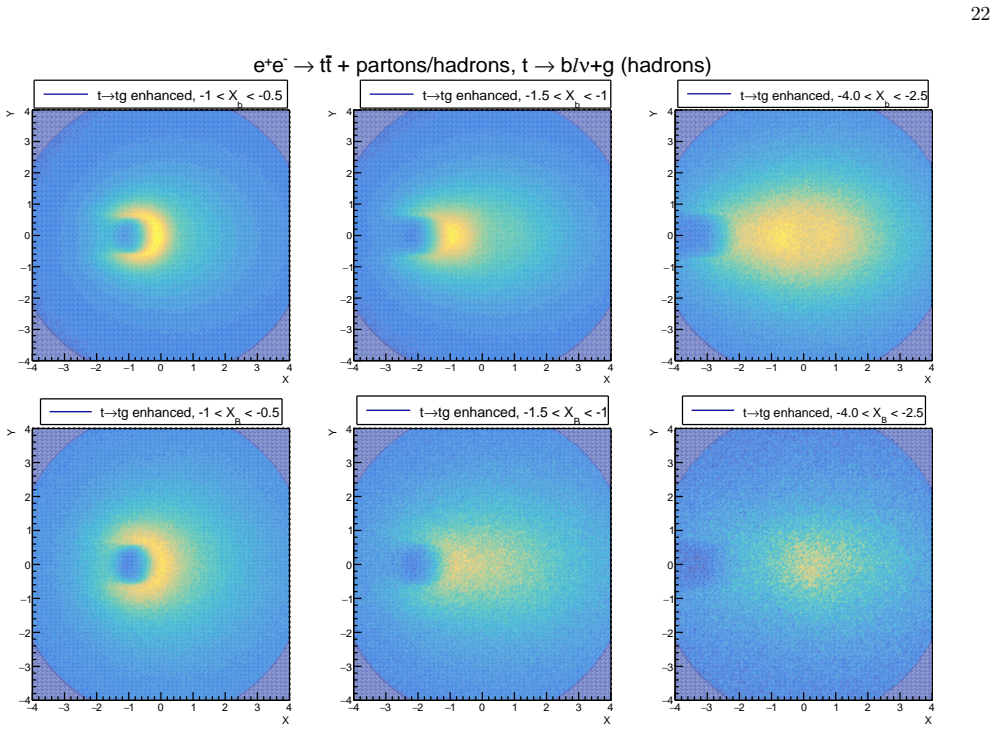
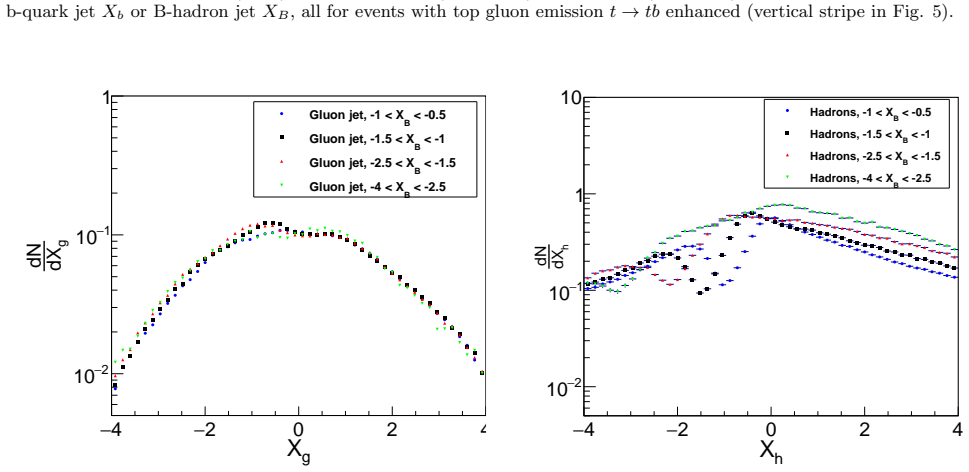
The central object is the extrapolation in the b-quark decay angle X_b, built on the leading-order dipole decomposition of the e+e−→ttbar+g amplitude: the production dipole (amplitude A) carries the dead cone, while the decay dipole (amplitude B1) carries the obscuring radiation. The method works because B1's contribution to the forward hemisphere contains the factor (1−ββ'cosγ), which suppresses decay radiation when the b-quark is collinear with the top; extrapolating spectra to X_b=0 removes the decay contribution. The quantitative tool is the distorted-Gaussian parametrization of the ξ-spectra, whose moment parameters (multiplicity, peak position, width, skewness, kurtosis, and two higher
Load-bearing premise
The entire extraction rests on the assumption that gluon radiation from the b-quark decay vanishes fast enough when the b-quark is emitted parallel to the top quark, and that the distorted-Gaussian shape parameters of the momentum spectra vary linearly with the b-decay angle so that extrapolation to zero angle is trustworthy; only the parton-level comparison with a stable top provides an independent check.
What would settle it
Generate e+e−→ttbar events with a Monte Carlo generator where the b-quark from top decay is forced to be exactly collinear with the top quark (X_b=0) and compare the resulting parton- and hadron-level ξ-spectra to those from a stable top quark. If the collinear-decay spectrum differs from the stable-top spectrum by more than the quoted 5–12% (due to the residual (1−ββ'cosγ) factor), the extrapolation method would miss part of the decay radiation. Alternatively, if the distorted-Gaussian moment parameters show significant curvature as a function of X_b over a wider range, the linear extrapolati
If this is right
- The dead cone effect can in principle be observed in top-quark jets at a future lepton collider using only momentum spectra, without precise knowledge of the top-quark direction.
- The MLLA relation connecting heavy-quark to light-quark fragmentation functions is predicted to hold at the top-mass scale, and this extrapolation method provides a test of that relation.
- For proton–proton collisions, the analysis transfers to wide 'fat jets' with radius about 2–3 times the dead-cone angle, with the comparison formula adjusted for the reduced jet energy scale.
- Effects of the finite top-quark width on the spectra are found to be a few percent or less, too small to be resolved within the systematic uncertainty of the extrapolation, so they do not spoil the dead cone extraction.
- The success of the parton-level extrapolation against the stable-top control indicates a residual systematic uncertainty of the method at the 5–12% level, which can be quoted in future experimental applications.
Where Pith is reading between the lines
- A natural extension would be to apply the same X_b→0 extrapolation to angular distributions of subjets, checking whether the dead cone 'fill' seen in the angular scatter plots disappears as quantitatively as it does for momentum spectra.
- The observed linearity of the distorted-Gaussian moment parameters in X_b suggests an underlying factorization of the decay-dipole contribution; if confirmed on wider X_b ranges, a two- or three-bin subtraction formula could replace the full extrapolation.
- In hadron-collider use, the method relies on identifying the B-hadron jet and the top direction; the impact of pile-up and underlying events could be estimated by embedding the generated top events into realistic minimum-bias events, which the paper does not address.
- The residual (1−ββ'cosγ) factor leaves a small contamination (~6%) at γ=0 because the b-quark is not exactly equal-mass to the top; a dedicated study of this residual, perhaps with lighter quark pairs, could refine the quoted systematic error.
Editorial analysis
A structured set of objections, weighed in public.
Referee Report
Summary. The paper studies the feasibility of observing the dead-cone suppression in high-energy top-quark jets produced in e+e− → t tbar at √s = 1 TeV, using Pythia 8.3. Since the top quark decays to bℓν before hadronization, the b-quark and the additional b-tb dipole radiation partially obscure the dead cone of the primary t-tbar dipole. The authors propose to reconstruct the momentum (ξ) distribution of partons/hadrons for finite b-quark decay angles X_b and extrapolate the distorted-Gaussian parameters to X_b = 0, where the b-tb dipole radiation is argued to vanish. At parton level, the extrapolated spectrum agrees with the stable-top-quark spectrum within 5–12% (Fig. 11). At hadron level, the extrapolated spectrum is compared with the MLLA relation Eq. (13), built from Pythia light-quark spectra, and is reported to agree within ~15% for ξ > 3 (Fig. 13). The paper also investigates finite-width effects (Sec. V) and sketches the extension to pp collisions (Sec. VI).
Significance. If the method is valid, it would extend the existing MLLA dead-cone analyses from c- and b-quark jets to the much heavier top quark, providing a new, high-scale test of the QCD dead-cone picture and of hadronization in the presence of a large forward-suppressed region. The paper's main strength is the parton-level closure test in Fig. 11: it is an internal, falsifiable check that the X_b→0 extrapolation reproduces the known stable-top spectrum. The angular analyses (Sec. III, Figs. 6–8) are also informative and give a concrete understanding of why b-radiation contaminates the top hemisphere. However, the hadron-level central claim is weaker because it lacks an independent control and relies on the same generator both for the extrapolation and for the MLLA reference. Therefore, the significance of the result is real but substantially conditional on the hadronization insensitivity of the extrapolation.
major comments (4)
- [Sec. IV.A, Figs. 10–11] The hadron-level extrapolation to X_b=0 has no independent control. The paper explicitly states that a comparison with a stable top quark is not possible for hadrons, and the only successful closure test is at parton level. Hadronization could introduce a nonlinear X_b dependence that would not be visible in the parton-level check. Please add a hadron-level validation or quantify the sensitivity: e.g., test whether adding a quadratic term to the DG-moment fits is statistically significant, vary the hadronization model/tune, or compare the extrapolated hadron distribution with an analytic (non-Pythia) MLLA input rather than one generated by the same Pythia 8.3 version used for the data.
- [Sec. II.A, Eq. (5)] The claim that the b-tb dipole radiation vanishes at Θ_b=0 is only approximate: for β=0.94 and β′≈1, the factor (1−ββ′cosγ) is about 0.06 at γ=0, not zero. Thus the extrapolation target X_b=0 is not exactly the stable-top spectrum but includes a small residual b-dipole component. The parton-level 5–12% agreement presumably contains this residual, but its magnitude is not quantified. Estimate this residual and show that it is negligible for the hadron-level extrapolated moments, or include it as a systematic uncertainty.
- [Sec. IV.B–C, Eq. (13), Table III] The 'MLLA prediction' used for the hadron-level comparison is constructed from Pythia 8.3 uds-quark spectra at two energy scales, and the Limiting-Spectrum parameters in Table III are adjusted to the same Pythia data. Consequently, the reported ~15% agreement in Fig. 13 is a generator-internal consistency check, not an independent test of the MLLA relation. This limitation should be stated explicitly, and the analysis would be strengthened by testing sensitivity to at least one alternative input (e.g., a different shower tune or an analytic MLLA spectrum for the subtracted term).
- [Abstract and Sec. IV.C] The quoted accuracies ('5–12%', 'around 15%') are not accompanied by a definition of the uncertainty (statistical vs. systematic) or by error bars. Since the hadron-level claim rests on a 15% agreement, please provide the uncertainty on the ratio shown in Fig. 13/14, or at least state the bin-to-bin scatter and the systematic error from the extrapolation procedure.
minor comments (5)
- [Table II] The hadron-level fit for bin 1 (⟨X_B⟩ = -0.728) has χ²/ndf = 10.1, much larger than the other bins. This is the bin most affected by b-radiation leaking into the right hemisphere; its inclusion in the linear extrapolation deserves a comment or a robustness test excluding it.
- [Sec. V and Fig. 15] The text says the finite-width effect is 'rather small of O(10%)', but Fig. 15 shows a reduction of at most about 5% at ξ≈5.8. Please harmonize the wording with the displayed size of the effect.
- [Eq. (5)–(7)] The notation is sometimes confusing: β, β′, Θ′_0 are used in Eq. (5) before being defined in the following sentence, and the equal-mass reduction in Eq. (7) is not applicable to the top/bottom case. A brief clarifying remark would help.
- [Sec. IV.A] The sentence 'below 12% for ξ≳3 within the variation of about 50% within the full extrapolation range' is unclear. Please rephrase to define what quantity has 50% variation and over what range.
- [Throughout] In several places 'X_b' and 'X_B' are used interchangeably for the hadron-level b-quark angle; please use a consistent notation (e.g., X_b for partons and X_B for B-hadron jets, as in Table II).
Circularity Check
No significant circularity: the MLLA comparison uses independent uds inputs and the parton-level closure test is a genuine check.
full rationale
The central derivation chain is not circular. The proposed method extrapolates the b-quark decay angle X_b to 0 using the leading-order dipole result in Eqs. (4)-(6), which is a physical expectation rather than a definition of the target spectrum. The parton-level test compares the extrapolated spectrum with an independently generated Pythia 8.3 stable-top sample (Fig. 11), so the quoted 5-12% agreement is a real closure test, not forced by construction. The hadron-level comparison with Eq. (13) uses Pythia 8.3 uds fragmentation spectra at W and sqrt(e)*m_t as right-hand-side inputs; these do not contain the top-decay radiation or the extrapolated spectrum, so the ~15% agreement is not a fitted-input tautology. The 'Limiting Spectrum' curves in Figs. 12-13 have K and Lambda_QCD adjusted to Pythia 8.3 (Table III), so they should not be treated as parameter-free predictions, but they are auxiliary to the Eq. (13) test and are not the paper's central claim. The self-citation [6] supports Eq. (13) with external e+e- data on c- and b-quark jets and is therefore independent evidence, not a load-bearing circular reference. The manuscript itself admits the hadron-level limitation: 'A comparison of the hadron spectra with the stable top-quark as a check is not possible as there are no hadronic final states with the stable top hadron to be removed. We therefore rely on the successful extrapolation procedure for partons.' Likewise, the factor (1-beta*beta'*cos gamma) in Eq. (5) only nearly vanishes at gamma=0 for the unequal masses considered, an acknowledged approximation. These are limitations on external validity and on the hadron-level control, but they are not circular reductions: no step equates its output to its input by definition or by a fitted parameter renamed as a prediction.
Axiom & Free-Parameter Ledger
free parameters (5)
- ξ_t = ln(1/⟨x_t⟩) =
0.083 (⟨x_t⟩ = 0.92)
- Limiting-spectrum Λ_QCD per energy scale =
175 MeV (91.2, 286 GeV), 200 MeV (1000 GeV)
- Limiting-spectrum normalization K per energy scale =
1.33 (91.2 GeV), 1.15 (286 GeV), 1.105 (1000 GeV)
- Distorted-Gaussian moment parameters per X_b bin =
N, ξ_0, σ, s, k, c_5, c_6 for four bins (Table II)
- Linear slopes of DG moment parameters vs X_b =
Not tabulated explicitly
axioms (6)
- domain assumption Leading-order dipole radiation formula Eq. (1) for a heavy quark
- domain assumption Amplitude decomposition Eq. (2) including the t→b decay dipoles
- domain assumption Angular ordering in the parton cascade
- domain assumption MLLA relation Eq. (13) relating heavy- and light-quark fragmentation functions
- ad hoc to paper Linear dependence of DG moment parameters on X_b
- domain assumption Pythia 8.3 as a reliable model of QCD jet evolution and hadronization
read the original abstract
The gluon emission from an energetic heavy quark is suppressed in the forward direction below the angle $\Theta\lesssim m_Q/E$ for a quark of mass $m_Q$ and energy $E$ according to perturbative Quantum Chromodynamics (QCD) (``dead cone"). Another consequence is the suppression of energetic particles in the jet which has been observed already for c- and b-quark jets. The suppression of the forward particles can be explained by an application of the Modified Leading Logarithmic Approximation (MLLA) of perturbative QCD. In this paper we investigate whether this type of analysis can be carried out also for top-quark jets with the much higher heavy quark mass allowing for QCD tests in this new kinematic regime. The new aspect of this analysis is the finite lifetime of the top quark. We consider for simplicity the decay $t\to b\ell\nu$, where the b-quark radiates gluons as well and partially obscures the dead cone. Guided by the decay amplitude in leading order in $\alpha_s$ for $e^+e^- \to t \bar t$ we propose a method to separate the radiation by the $\widehat{tb}$ dipole in the decay process which is superimposed to the primary radiation from the $\widehat{t \bar t}$ dipole involving the top-quark dead cone effect. The momentum distributions of partons or hadrons are determined for finite decay angles of the b-quark $\Theta_b$ and extrapolated into forward direction $\Theta_b=0$ where the radiation from the decay process is expected to vanish. This method is successfully tested at the parton level and results obtained for hadrons are compatible with the MLLA relation within an accuracy of around 15\%. Our calculations are carried out with the Pythia 8.3 Monte Carlo Event Generator.
Figures



Forward citations
Cited by 1 Pith paper
-
The Dead Cone Effect in Heavy-Quark Jets: A Unified Study from Charm and Bottom to Top
A unified study shows dead-cone suppression in charm, bottom, and top jets, plus a Monte-Carlo method to isolate the top-quark dead cone from decay radiation.
Reference graph
Works this paper leans on
-
[1]
angular ordering
(4) ω2|B1|2 = 8(1−ββ ′ cosγ) (Θ2g + Θ2 0)(Θ′2g + Θ′2 0 ) − 4Θ2 0 (Θ2g + Θ2 0)2 − 4Θ′2 0 (Θ′2g + Θ′2 0 )2 +O(Θ 4 0,Θ ′4 0 ) (5) whereβ, β′ denote the t- and b-quark velocitiesβ=p t/Et,β≈1− 1 2 Q2 0 andβ ′ =p b/Eb,β ′ ≈1− 1 2 Q′2 0 with Θ′ 0 =m b/pb andγdenotes the decay angle of the b-quark with respect to the t-quark direction in thee +e− c.m.s. In the le...
-
[2]
angular ordering
For a primary heavy quark the modified angular distribution as in Eq. (1) has to be inserted under the integral above for the first emission. As an illustration of this production process with angular ordering we show in the upper panels of Fig. 2 the distribution of the final partons over the rescaled angular variables (X, Y) for a few typical events obt...
-
[3]
Y. L. Dokshitzer, V. A. Khoze, and S. I. Troian, Particle spectra in light and heavy quark jets, J. Phys. G17, 1481 (1991)
1991
-
[4]
Y. L. Dokshitzer, V. A. Khoze, and S. I. Troian, On specific QCD properties of heavy quark fragmentation (’dead cone’), J. Phys. G17, 1602 (1991)
1991
-
[5]
B. A. Schumm, Y. L. Dokshitzer, V. A. Khoze, and D. S. Koetke, MLLA and the average charged multiplicity of events containing heavy quarks in e+ e- annihilation, Phys. Rev. Lett.69, 3025 (1992)
1992
-
[6]
Y. L. Dokshitzer, F. Fabbri, V. A. Khoze, and W. Ochs, Multiplicity difference between heavy and light quark jets revisited, Eur. Phys. J. C45, 387 (2006), arXiv:hep-ph/0508074
Pith/arXiv arXiv 2006
-
[7]
S. Acharyaet al.(ALICE Collaboration), Direct observation of the dead-cone effect in quantum chromodynamics, Nature 605, 440 (2022), erratum: Nature607(2022) no.7920, E22, arXiv:2106.05713 [nucl-ex]
Pith/arXiv arXiv 2022
-
[8]
S. Kluth, W. Ochs, and R. Perez Ramos, Observation of the dead cone effect in charm and bottom quark jets and its QCD explanation, Phys. Rev. D107, 094039 (2023), arXiv:2303.13343 [hep-ph]
Pith/arXiv arXiv 2023
-
[9]
Navaset al.(Particle Data Group), Review of particle physics, Phys
S. Navaset al.(Particle Data Group), Review of particle physics, Phys. Rev. D110, 030001 (2024)
2024
-
[10]
G. Aadet al.(ATLAS Collaboration), Measurement of the top quark mass with the template method in thet ¯t→ lepton+jets channel using atlas data, Eur. Phys. J. C72, 2046 (2012), arXiv:1203.5755 [hep-ex]
Pith/arXiv arXiv 2046
-
[11]
A. Tumasyanet al.(CMS Collaboration), Measurement of the top quark mass using a profile likelihood approach with the lepton+jets final states in proton–proton collisions at √s= 13 TeV, Eur. Phys. J. C83, 963 (2023), arXiv:2302.01967 [hep-ex]
Pith/arXiv arXiv 2023
-
[12]
G. Aadet al.(ATLAS Collaboration), Measurement of the top quark mass with the ATLAS detector usingt ¯tevents with a high transverse momentum top quark, Phys. Lett. B867, 139608 (2025), arXiv:2502.18216 [hep-ex]
Pith/arXiv arXiv 2025
-
[13]
G. V. Jikia, Measuring the heavy top quark width by soft gluon radiation ine +e− →t ¯t, Phys. Lett. B257, 196 (1991)
1991
-
[14]
V. A. Khoze, W. J. Stirling, and L. H. Orr, Soft gluon radiation ine +e− →t ¯t, Nucl. Phys. B378, 413 (1992)
1992
-
[15]
F. Maltoni, M. Selvaggi, and J. Thaler, Exposing the dead cone effect with jet substructure techniques, Phys. Rev. D94, 054015 (2016), arXiv:1606.03449 [hep-ph]. 26
Pith/arXiv arXiv 2016
-
[16]
C. Bierlich, S. Chakraborty, N. Desai, L. Gellersen, I. Helenius, P. Ilten, L. L¨ onnblad, S. Mrenna, S. Prestel, C. T. Preuss, T. Sj¨ ostrand, P. Skands, M. Utheim, and R. Verheyen, A comprehensive guide to the physics and usage of PYTHIA 8.3, SciPost Phys. Codebases , 8 (2022), arXiv:2203.11601 [hep-ph]
Pith/arXiv arXiv 2022
-
[17]
T. Sjostrand, S. Ask, J. R. Christiansen, R. Corke, N. Desai, P. Ilten, S. Mrenna, S. Prestel, C. O. Rasmussen, and P. Z. Skands, An Introduction to PYTHIA 8.2, Comput. Phys. Commun.191, 159 (2015), arXiv:1410.3012 [hep-ph]
Pith/arXiv arXiv 2015
-
[18]
Andersson, G
B. Andersson, G. Gustafson, G. Ingelman, and T. Sj¨ ostrand, Parton Fragmentation and String Dynamics, Phys. Rept.97, 31 (1983)
1983
-
[19]
Y. L. Dokshitzer, V. A. Khoze, A. H. Mueller, and S. I. Troyan,Basics of Perturbative QCD(Editions Fronti` eres, Gif-sur- Yvette, France, 1991)
1991
-
[20]
B. I. Ermolaev and V. S. Fadin, Log–log asymptotic form of exclusive cross-sections in quantum chromodynamics, JETP Lett.33, 269 (1981)
1981
-
[21]
A. H. Mueller, On the multiplicity of hadrons in QCD jets, Phys. Lett. B104, 161 (1981)
1981
-
[22]
R. K. Ellis, W. J. Stirling, and B. R. Webber,QCD and Collider Physics(Cambridge University Press, Cambridge, 2011) DOI: 10.1017/CBO9780511628788
-
[23]
P. Mart ´ ın-Ramiro and J. M. Moreno, Improvingt ¯treconstruction in the dilepton channel at future lepton colliders, arXiv:2003.12320 [hep-ph] (2020)
Pith/arXiv arXiv 2003
-
[24]
T. Behnkeet al., The international linear collider technical design report – volume 4: Detectors (2013), arXiv:1306.6329 [physics.ins-det]
Pith/arXiv arXiv 2013
-
[25]
M. Cacciari, G. P. Salam, and G. Soyez, Fastjet user manual, Eur. Phys. J. C72, 1896 (2012), arXiv:1111.6097 [hep-ph]
Pith/arXiv arXiv 2012
-
[26]
M. Cacciari and G. P. Salam, Dispelling the n ˆ(3) myth for the k t jet-finder, Phys. Lett. B641, 57 (2006), arXiv:hep- ph/0512210 [hep-ph]
arXiv 2006
-
[27]
G. Aadet al.(ATLAS Collaboration), Performance ofb-jet identification in the ATLAS experiment, JINST11(04), P04008, arXiv:1512.01094 [hep-ex]
-
[28]
G. Aadet al.(ATLAS Collaboration), Performance of jet substructure techniques for large-Rjets in proton–proton collisions at √s= 7 TeV using the ATLAS detector, JHEP09, 076, arXiv:1306.4945 [hep-ex]
-
[29]
S. Chatrchyanet al.(CMS Collaboration), Identification ofb-quark jets with the CMS experiment, JINST8(04), P04013, arXiv:1211.4462 [hep-ex]
-
[30]
S. Kluth, W. Ochs, and R. Perez-Ramos, Dead cone effect in charm and bottom quark jets, Nucl. Part. Phys. Proc.343, 75 (2024), arXiv:2309.01708 [hep-ph]
Pith/arXiv arXiv 2024
-
[31]
C. P. Fong and B. R. Webber, One and two particle distributions at smallxin QCD jets, Nucl. Phys. B355, 54 (1991)
1991
-
[32]
Y. L. Dokshitzer, V. A. Khoze, and S. I. Troian, Phenomenology of the particle spectra in QCD jets in a modified leading logarithmic approximation, Z. Phys. C55, 107 (1992)
1992
-
[33]
Y. I. Azimov, Y. L. Dokshitzer, V. A. Khoze, and S. I. Troyan, Similarity of Parton and Hadron Spectra in QCD Jets, Z. Phys. C27, 65 (1985)
1985
-
[34]
Y. I. Azimov, Y. L. Dokshitzer, V. A. Khoze, and S. I. Troyan, Humpbacked QCD Plateau in Hadron Spectra, Z. Phys. C 31, 213 (1986)
1986
-
[35]
H. Brooks, P. Skands, and R. Verheyen, Interleaved resonance decays and electroweak radiation in the Vincia parton shower, SciPost Phys.12, 101 (2022), arXiv:2108.10786 [hep-ph]
Pith/arXiv arXiv 2022
-
[36]
H. Brooks and P. Skands, Coherent showers in decays of colored resonances, Phys. Rev. D100, 076006 (2019), arXiv:1907.08980 [hep-ph]
Pith/arXiv arXiv 2019
-
[37]
S. Dittmaier and M. Reyer, Electroweak splitting functions in the standard model and beyond, arXiv:2507.06568 [hep-ph] (2025), arXiv:2507.06568 [hep-ph]
arXiv 2025
-
[38]
M. Aaboudet al.(ATLAS Collaboration), Measurements of top-quark pair differential cross-sections in the lepton+jets channel inppcollisions at √s= 13 TeV using the ATLAS detector, JHEP11, 191, arXiv:1708.00727 [hep-ex]
-
[39]
V. Khachatryanet al.(CMS Collaboration), Measurement of differential cross sections for top quark pair production using the lepton+jets final state in proton–proton collisions at √s= 13 TeV, Phys. Rev. D95, 092001 (2017), arXiv:1610.04191 [hep-ex]
Pith/arXiv arXiv 2017
-
[40]
A. M. Sirunyanet al.(CMS Collaboration), Measurement of the t t production cross section, the top quark mass, and the strong coupling constant using dilepton events inppcollisions at √s= 13 TeV, Eur. Phys. J. C79, 368 (2019), arXiv:1812.10505 [hep-ex]
Pith/arXiv arXiv 2019
-
[41]
G. Aadet al.(ATLAS Collaboration), Measurements of top-quark pair single- and double-differential cross-sections in the all-hadronic channel inppcollisions at √s= 13 TeV using the ATLAS detector, JHEP01, 033, arXiv:2006.09274 [hep-ex]
Pith/arXiv arXiv 2006
-
[42]
D. Acostaet al.(CDF Collaboration), Momentum distribution of charged particles in jets in dijet events inp¯pcollisions at √s= 1.8 TeV and comparisons to perturbative QCD predictions, Phys. Rev. D68, 012003 (2003)
2003
-
[43]
A. Tumasyanet al.(CMS), Measurement of the differential t t production cross section as a function of the jet mass and extraction of the top quark mass in hadronic decays of boosted top quarks, Eur. Phys. J. C83, 560 (2023), arXiv:2211.01456 [hep-ex]
Pith/arXiv arXiv 2023
discussion (0)
Sign in with ORCID, Apple, or X to comment. Anyone can read and Pith papers without signing in.