REVIEW 3 major objections 4 minor 25 references
A holographic AdS/QCD model with a WKB and Langer-corrected potential reproduces the nonlinear Regge trajectory m_n^2 = β(n+c_0)^{2/3}+c_1 for quarkonia, fitting experimental masses to within about 0.7%.
Reviewed by Pith at T0; open to challenge. T0 means a machine referee read the full paper against a public rubric. the ladder, T0–T4 →
T0 review · deepseek-v4-flash
2026-08-03 14:23 UTC pith:MOCUU63B
load-bearing objection A useful bottom-up AdS/QCD model that derives the quarkonia n^(2/3) Regge trajectory with explicit c0 and c1 via Langer-corrected WKB and fits masses extremely well, but the WKB truncation error for the low-n fitted states is uncontrolled and the QSSE mapping is asserted rather than derived. the 3 major comments →
Non linear Regge trajectories of quarkonia from holography
The pith
A machine-rendered reading of the paper's core claim, the machinery that carries it, and where it could break.
Core claim
The central claim is that the holographic potential V(z)=3/(4z^2)+Aκ^2/√(κz)+M_q^2+κ^3 z, treated with first-order WKB and the Langer correction, yields the closed-form spectrum m_n^2 = [(3π/2)(n+1+A/2)]^{2/3} κ^2 + M_q^2 (Eq. 59). This is a nonlinear Regge trajectory with exponent 2/3, an adjustable intercept c_0=1+A/2, and a quark-mass shift M_q^2. The derivation expands the WKB phase integral in powers of 1/m and keeps terms through order m^0; the Langer correction replaces the singular 3/(4z^2) term by 1/z^2, making the quantization condition valid. Fitting to measured states gives NRMSE of 0.71% for charmonium and 0.59% for bottomonium in the two-parameter case (A fixed at −1/2), with κ
What carries the argument
The central object is the Schrödinger-like potential V(z)=3/(4z^2)+Aκ^2/√(κz)+M_q^2+κ^3 z in the holographic radial coordinate z. The WKB quantization condition with the Langer transformation z=e^{x/κ}, ψ=e^{x/2}ψ̃ turns the singular 3/(4z^2) term into 1/z^2, making the phase integral well-defined. The key step is an asymptotic expansion of the phase integral in powers of 1/m, keeping terms through O(m^0); this yields the closed-form mass formula and shows that the 1/√z term controls the intercept c_0=1+A/2.
Load-bearing premise
The derivation expands the WKB phase integral in powers of 1/m and discards all terms beyond m^0 without quantifying their size for the low-n states (n=0–5) used in the fits; if those neglected terms are not small, the closed formula (59) may contain an uncontrolled approximation error absorbed into the fitted parameters.
What would settle it
Numerically solve the one-dimensional Schrödinger equation −ψ''+Vψ=m^2ψ for the potential (52) with the fitted parameters (e.g., κ=1.41 GeV, M_c=2.60 GeV, A_c=−1.71 for charmonium) and compare the exact eigenvalues with the WKB formula (59). If the differences are larger than the reported 0.7% NRMSE, the WKB truncation is the reason.
If this is right
- Quarkonia squared masses are predicted to follow m_n^2 = [(3π/2)(n+1+A/2)]^{2/3} κ^2 + M_q^2 for all radial excitations, with no linear-in-n component—a sharp, testable departure from the linear Regge behavior of light mesons.
- With A fixed at −1/2, the holographic spectrum coincides exactly with the Regge trajectory derived from the quadratic spinless Salpeter equation with a Coulomb-plus-linear potential, giving a direct dictionary between κ, M_q and the constituent quark mass and string tension.
- The model yields decay constants as a byproduct; in the three-parameter fit, bottomonium decay constants have a normalized root-mean-square error around 9% and charmonium around 22%, without spoiling the mass fit.
- The construction demonstrates a practical inverse problem solution: for any desired spectrum of the form β(n+c_0)^{2/3}+c_1, there exists a dilaton background and a corresponding Schrödinger potential that generates it.
Where Pith is reading between the lines
- The same WKB-plus-Langer expansion could be applied to potentials with a z^α term instead of κ^3 z, yielding a family of trajectories m_n^2 ∼ (n+c)^{2α/(2+α)} that interpolate between linear and other powers; the paper only hints at this generalization.
- The truncation at O(m^0) is untested for the low-n states actually fitted; solving the Schrödinger equation numerically with the fitted potential would quantify the missing WKB corrections and could shift the reported 0.6–0.7% errors.
- The parameter dictionary M_q=2m_q and κ=(8m_qσ)^{1/3} suggests a way to translate potential-model string tensions and quark masses into the holographic inputs needed to compute thermal dissociation, connecting the spectrum fit to quark–gluon-plasma phenomenology.
- The fitted values of A (−1.71 for charmonium, −2.14 for bottomonium) differ from the QSSE value −1/2, implying that the effective potential has a larger 1/√z term than the Cornell-inspired form; this could be tested by comparing to lattice-computed potentials.
Editorial analysis
A structured set of objections, weighed in public.
Referee Report
Summary. The paper proposes a bottom-up AdS/QCD model for heavy vector mesons (charmonium and bottomonium). Starting from the soft-wall dilaton background, the authors engineer a Schrödinger potential V(z)=3/(4z^2)+Aκ^2/√(κz)+M_q^2+κ^3z (Eq. 52) and analyze it with a first-order WKB quantization supplemented by the Langer correction. Expanding the WKB phase integral in powers of 1/m and truncating at O(m^0), they derive Eq. (59): m_n^2 = [(3π/2)(n+1+A/2)]^{2/3}κ^2 + M_q^2, which is identified with the QSSE/Cornell trajectory m_n^2 = β(n+c_0)^{2/3}+c_1. The parameters κ, M_q, and A are fitted to experimental masses, yielding NRMSE values around 0.6–0.7% for the mass spectra; decay constants are computed as a secondary result with larger errors. The paper also compares the model with the QSSE result and interprets M_q and κ in terms of constituent quark masses and string tension.
Significance. If the derivation and the numerical fits were fully controlled, the paper would be a useful addition to holographic QCD: it gives an analytic, bottom-up realization of n^{2/3} Regge trajectories, recovers the soft-wall spectrum in the α=2 limit as a nontrivial check, and makes a transparent contact with the QSSE/Cornell approach. The authors are candid that decay constants are a byproduct. However, the central formula rests on an unquantified semiclassical truncation, and the reported parameters do not appear consistent with Eq. (59). The significance is therefore conditional on resolving these issues.
major comments (3)
- [Sec. IV.A, Eqs. (30)–(41) and IV.C, Eqs. (53)–(58)] The WKB phase integral is evaluated by expanding √(1−U/m^2) and discarding all terms beyond O(m^0), with the leading-order selection made 'by inspection' (Eqs. 35, 38, 56, 57). No estimate is given for the neglected O(m^{-1}) terms. For the fitted low-lying states the expansion parameter is not small: e.g., with the three-parameter charmonium fit (κ_c=1.41 GeV, M_c=2.60 GeV, A_c=−1.71), the non-constant part of the ground-state squared mass from Eq. (59) is only about 1.5 GeV^2, and U/m^2 equals unity at the turning points by definition. Omitted terms can enter at the same formal order as the retained −Aπ/2 and −π/2 contributions in Eq. (58). The authors should estimate the truncation error, e.g. by evaluating the full WKB integral numerically or by comparing Eq. (59) with exact eigenvalues of Eq. (7) for the same potential, before using Eq. (60) to identify c0 and c1.
- [Tables I–III and Eq. (59)] Direct substitution of the fitted parameters into Eq. (59) does not reproduce the masses listed in Tables II and III. For bottomonium with A_b=−2.14, κ_b=2.10 GeV, M_b=9.27 GeV, the argument n+1+A/2 at n=0 is −0.07, so Eq. (59) has no real positive solution; yet Table III reports a 1S mass of 9541 MeV. For charmonium with A_c=−1.71, κ_c=1.41 GeV, M_c=2.60 GeV, Eq. (59) gives a ground-state mass of about 2.88 GeV, not the quoted 3125 MeV. This suggests that the numerical masses were obtained from an exact solution of the Schrödinger equation for the potential (52), not from Eq. (59), or that one of the two is misreported. The manuscript must state explicitly which equation generated the values in Tables II and III and reconcile the WKB formula with the fitted parameters.
- [Sec. IV.C and V, Eq. (60)] The parameter A is introduced specifically to make c0 adjustable, but the three-parameter fit returns A_b=−2.14, which gives c0=1+A/2=−0.07. This is incompatible with the Regge form (51) for n=0: the 2/3 power of a negative number is not a standard positive intercept, and Eq. (58) would have a negative left-hand side for n=0. If the exact numerical spectrum is being used for the fit, then Eq. (60) is only an asymptotic large-m identification and should not be presented as an exact consequence. The claimed match to the QSSE value c0=3/4 (Eq. 65) is therefore not established for the actual fitted parameter set.
minor comments (4)
- [Sec. VI.A] Please specify the numerical procedure used to generate the masses and decay constants: is Eq. (7) solved exactly for the potential (52), or is Eq. (59) used for masses and Eq. (72) evaluated with numerical wavefunctions? This is essential for reproducing the results.
- [Sec. VI.B, Tables IV–V] For charmonium the decay-constant NRMSE is 22.4% (three-parameter model) and 37.9% (two-parameter model). Calling this 'reasonable agreement' is an overstatement; the abstract should be tempered, or the fit improved, given that decay constants are presented as a byproduct.
- [Sec. IV.A] The 'by inspection' leading-order selections (Eqs. 35, 38, 56, 57) should be expanded with at least the first correction to each contribution, so the reader can verify that the omitted terms are indeed beyond O(m^0).
- [General] Minor typographical issues: 'reparoduce' in Sec. VI.B; 'the slope of the slope of the Regge trajectory' in Sec. II.B; Eq. (5) has an awkward prime notation. These do not affect the physics.
Circularity Check
No significant circularity: the target trajectory is explicit model input and the mass agreement is a fit, while the WKB derivation is self-contained.
full rationale
Derivation chain checked. The target form (1)/(51), m_n^2 = β(n+c0)^{2/3} + c1, is taken explicitly from the external QSSE paper [2]; the holographic model is built to reproduce it, not to predict its functional form. Each potential term in (52) is a deliberate building block: 3/4z^2 is fixed by the AdS5 conformal term plus the Langer correction; M_q^2 is added in Sec. III to generate c1 by a direct Schrodinger inverse-problem construction; κ^3 z is chosen in Sec. IVB to produce n^{2/3}; and Aκ^2/√(κz) is introduced specifically to promote c0 to a free parameter. The WKB evaluation (53)-(58) is a real calculation: the leading (2/3)m^3/κ^3 term, the -Aπ/2 term, and the -π/2 term are obtained by expanding turning-point contributions, and the α=2 limit reproduces the exact soft-wall spectrum (11), a genuine internal consistency check. Eq. (59) is therefore the exact WKB expression for the engineered potential, with identifications (60) following from comparison with (51); this is model construction, not a hidden identification of input and output. The experimental comparison is presented as a fit: parameters κ, M_q, A are minimized against PDG masses (and in the three-parameter case also decay constants), so the ~0.6-0.7% mass agreement has no independent predictive content by itself—but the paper does not claim otherwise. The decay constants in the two-parameter case are not used in the fit and are genuine outputs (albeit with large errors); in the three-parameter case they partly enter the fit and so their agreement is partly a fit target. Self-citations ([7]-[14]) provide background models, the decay-constant formula, and a technical normalization point; none is load-bearing for Eq. (59), and no uniqueness theorem is invoked. The main caveat, the uncontrolled O(m^0) truncation of the WKB expansion, is an approximation-validity/correctness risk, not a circularity: it does not make Eq. (59) equivalent to Eq. (51) by construction beyond the explicit model-building input. Verdict: no significant circularity.
Axiom & Free-Parameter Ledger
free parameters (6)
- κ_c (charmonium dilaton scale) =
1.47 GeV (2-param) / 1.41 GeV (3-param)
- M_c (charmonium mass shift) =
2.10 GeV (2-param) / 2.60 GeV (3-param)
- κ_b (bottomonium dilaton scale) =
2.21 GeV (2-param) / 2.10 GeV (3-param)
- M_b (bottomonium mass shift) =
8.87 GeV (2-param) / 9.27 GeV (3-param)
- A_c (charmonium c0-adjusting coefficient) =
-1/2 (fixed) / -1.71 (fitted)
- A_b (bottomonium c0-adjusting coefficient) =
-1/2 (fixed) / -2.14 (fitted)
axioms (5)
- domain assumption AdS/QCD vector meson action and AdS5 background (Eq. 2)
- domain assumption WKB approximation with Langer correction and 1/m expansion truncated at O(m^0) is accurate for the states fitted
- ad hoc to paper The potential (52) is the correct effective potential, including the ad hoc 1/√z term
- ad hoc to paper The Airy solution with c2=0 in Eq. (47) is chosen to avoid a null mass state
- domain assumption Decay constant formula (72) and g5 normalization from pQCD matching (73)
invented entities (2)
-
New dilaton background φ_II(z)
independent evidence
-
1/√z term in the potential (coefficient A)
independent evidence
read the original abstract
We propose a holographic model for quarkonia using the WKB approximation with the Langer correction to properly reproduce nonlinear Regge trajectories of the form $m_n^2 = \beta (n + c_0)^{2/3} + c_1$. This form is expected from previous studies involving the solution of Cornell potential for heavy quark-antiquark interactions using a model based on the quadratic form of the spinless Salpeter-type equation (QSSE). The model fits experimental masses with very good accuracy. The corresponding decay constants also show a reasonable agreement with the results obtained from experimental data.
Figures



Reference graph
Works this paper leans on
-
[1]
0.0 0.5 1.0 1.5 2.0 2.5 3.0
0.2 0.4 0.6 0.8 1. 0.0 0.5 1.0 1.5 2.0 2.5 3.0
-
[2]
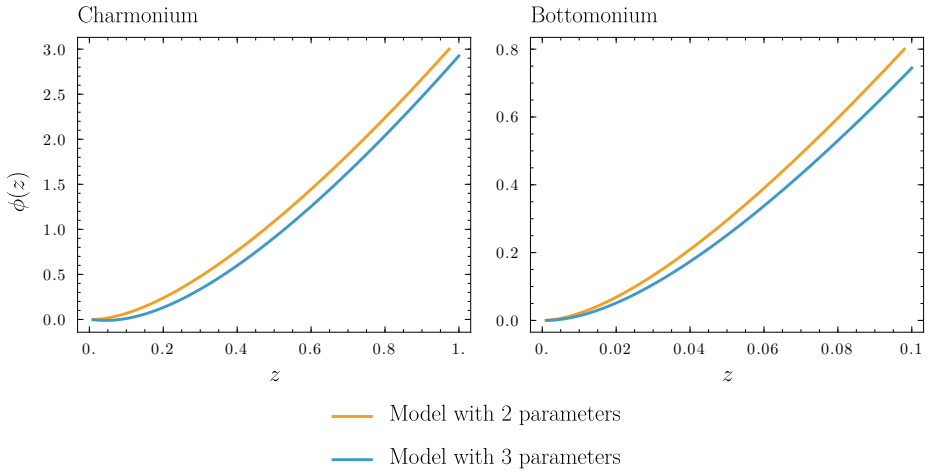
0.02 0.04 0.06 0.08 0.1 0.0 0.2 0.4 0.6 0.8 Figure 3:Dilatons for the model with 2 and 3 parameters with the parameter values presented in Table I
-
[3]
0.5 1. 1.5 2. 2.5 3. 6 8 10 12 14
-
[4]
0.5 1. 1.5 2. 2.5 3. 80 90 100 110 120 Figure 4:Schrödinger-like potentials for the model with 2 and 3 parameters with the parameter values presented in Table I. 23 parameterAto the potential, allowing for a precise reproduction of the formm2 n =β(n+ c0)2/3 +c 1, and the model was shown to fit decay constants with reasonable accuracy. In order to achieve ...
-
[5]
A. C. Irving and R. P. Worden, Regge Phenomenology, Phys. Rept.34, 117 (1977)
1977
-
[6]
Chen, Regge trajectories for heavy quarkonia from the quadratic form of the spinless Salpeter-type equation, Eur
J.-K. Chen, Regge trajectories for heavy quarkonia from the quadratic form of the spinless Salpeter-type equation, Eur. Phys. J. C78, 235 (2018). 24
2018
-
[7]
J. M. Maldacena, Wilson loops in largeNfield theories, Phys. Rev. Lett.80, 4859 (1998), arXiv:hep-th/9803002
Pith/arXiv arXiv 1998
-
[8]
J. Polchinski and M. J. Strassler, Hard scattering and gauge / string duality, Phys. Rev. Lett. 88, 031601 (2002), arXiv:hep-th/0109174
Pith/arXiv arXiv 2002
-
[9]
H. Boschi-Filho and N. R. F. Braga, QCD / string holographic mapping and glueball mass spectrum, Eur. Phys. J. C32, 529 (2004), arXiv:hep-th/0209080
Pith/arXiv arXiv 2004
-
[10]
A. Karch, E. Katz, D. T. Son, and M. A. Stephanov, Linear confinement and AdS/QCD, Phys. Rev. D74, 015005 (2006), arXiv:hep-ph/0602229
Pith/arXiv arXiv 2006
-
[11]
N. R. F. Braga, L. F. Ferreira, and A. Vega, Holographic model for charmonium dissociation, Phys. Lett. B774, 476 481 (2017), arXiv:1709.05326 [hep-ph]
Pith/arXiv arXiv 2017
-
[12]
N. R. F. Braga and L. F. Ferreira, Heavy meson dissociation in a plasma with magnetic fields, Phys. Lett. B783, 186 192 (2018), arXiv:1802.02084 [hep-ph]
Pith/arXiv arXiv 2018
-
[13]
N. R. F. Braga and L. F. Ferreira, Quasinormal modes and dispersion relations for quarkonium in a plasma, JHEP01, 082, arXiv:1810.11872 [hep-ph]
-
[14]
N. R. F. Braga and L. F. Ferreira, Quasinormal modes for quarkonium in a plasma with magnetic fields, Phys. Lett. B795, 462 468 (2019), arXiv:1905.11309 [hep-ph]
Pith/arXiv arXiv 2019
-
[15]
N. R. F. Braga and Y. F. Ferreira, Bottomonium dissociation in a rotating plasma, Phys. Rev. D108, 094017 (2023), arXiv:2309.11643 [hep-ph]
Pith/arXiv arXiv 2023
-
[16]
N. R. F. Braga, Y. F. Ferreira, and W. S. Cunha, Holography and the internal structure of charmonium, Chin. Phys.49, 083105 (2025), arXiv:2410.09091 [hep-ph]
Pith/arXiv arXiv 2025
-
[17]
N. R. F. Braga and L. F. Ferreira, Bottomonium dissociation in a finite density plasma, Phys. Lett. B773, 313 319 (2017), arXiv:1704.05038 [hep-ph]
Pith/arXiv arXiv 2017
-
[18]
N. R. F. Braga, Y. F. Ferreira, and L. F. Ferreira, Configuration entropy and stability of bottomonium radial excitations in a plasma with magnetic fields, Phys. Rev. D105, 114044 (2022), arXiv:2110.04560 [hep-th]
Pith/arXiv arXiv 2022
-
[19]
M. A. Martin Contreras and A. Vega, Nonlinear Regge trajectories with AdS/QCD, Phys. Rev. D102, 046007 (2020), arXiv:2004.10286 [hep-ph]
Pith/arXiv arXiv 2020
-
[20]
M. A. Martin Contreras, S. Diles, and A. Vega, Heavy quarkonia spectroscopy at zero and finite temperature in bottom-up AdS/QCD, Phys. Rev. D103, 086008 (2021), arXiv:2101.06212 [hep-ph]
Pith/arXiv arXiv 2021
-
[21]
M. A. Martin Contreras and A. Vega, Engineering Confining Dilatons: A WKB Inverse Prob- lem in Holographic QCD, (2025), arXiv:2509.04956 [hep-ph]
Pith/arXiv arXiv 2025
-
[22]
R. E. Langer, On the connection formulas and the solutions of the wave equation, Phys. Rev. 51, 669 (1937)
1937
-
[23]
P. A. Zylaet al.(Particle Data Group), Review of Particle Physics, PTEP2020, 083C01 (2020)
2020
-
[24]
V. Kher and A. K. Rai, Spectroscopy and decay properties of charmonium, Chin. Phys. C42, 083101 (2018), arXiv:1805.02534 [hep-ph]. 25
Pith/arXiv arXiv 2018
-
[25]
H. R. Grigoryan and A. V. Radyushkin, Structure of vector mesons in holographic model with linear confinement, Phys. Rev. D76, 095007 (2007), arXiv:0706.1543 [hep-ph]. 26
Pith/arXiv arXiv 2007
discussion (0)
Sign in with ORCID, Apple, or X to comment. Anyone can read and Pith papers without signing in.