Topological Classification of a 4D AdS Black Hole with Non-Minimal Maxwell Coupling
Pith reviewed 2026-05-25 07:27 UTC · model grok-4.3
The pith
Non-minimal Maxwell coupling stabilizes the Hawking-Page topological class W=0 for charged 4D AdS black holes.
A machine-rendered reading of the paper's core claim, the machinery that carries it, and where it could break.
Core claim
The non-minimal coupling lambda stabilizes the Hawking-Page universality class W=0 for black holes with non-zero charge, a phenomenon absent in the standard Reissner-Nordstrom-AdS case. The system exhibits a duality governed by its Maxwell charge Q: for large Q it falls into the class W=1 displaying van der Waals-type behavior with a first-order small-large black hole transition; for small Q it shifts to W=0 characteristic of a Hawking-Page transition. This topological classification provides a model-independent validation of the conventional thermodynamic analysis.
What carries the argument
The global topological invariant W obtained by summing winding numbers of critical points treated as topological defects in thermodynamic parameter space.
If this is right
- For large Maxwell charge Q the black hole exhibits W=1 and first-order van der Waals-type small-large transitions.
- For small Q the system enters the W=0 class of Hawking-Page transitions.
- The non-minimal coupling lambda enables the W=0 class to persist for nonzero charge, unlike the Reissner-Nordstrom-AdS case.
- A direct link is established between the microscopic coupling lambda and the macroscopic topological class W.
Where Pith is reading between the lines
- If the same mapping from critical points to winding numbers works in other modified-gravity models, topological classification could serve as a rapid diagnostic for transition type across theories.
- Varying lambda continuously might locate a critical value at which W switches classes, providing a testable signature in the heat capacity or free-energy landscape.
- The stabilization effect could be checked by repeating the winding-number analysis for the same black-hole solution but with additional higher-curvature terms.
Load-bearing premise
The thermodynamic critical points of the modified black hole can be faithfully mapped onto topological defects whose winding numbers yield a global invariant W whose value directly encodes the transition type without additional model-dependent corrections.
What would settle it
An explicit computation in which varying the non-minimal coupling lambda changes the thermodynamic transition type while leaving the value of W unchanged would falsify the claimed direct link between lambda and the topological class.
Figures


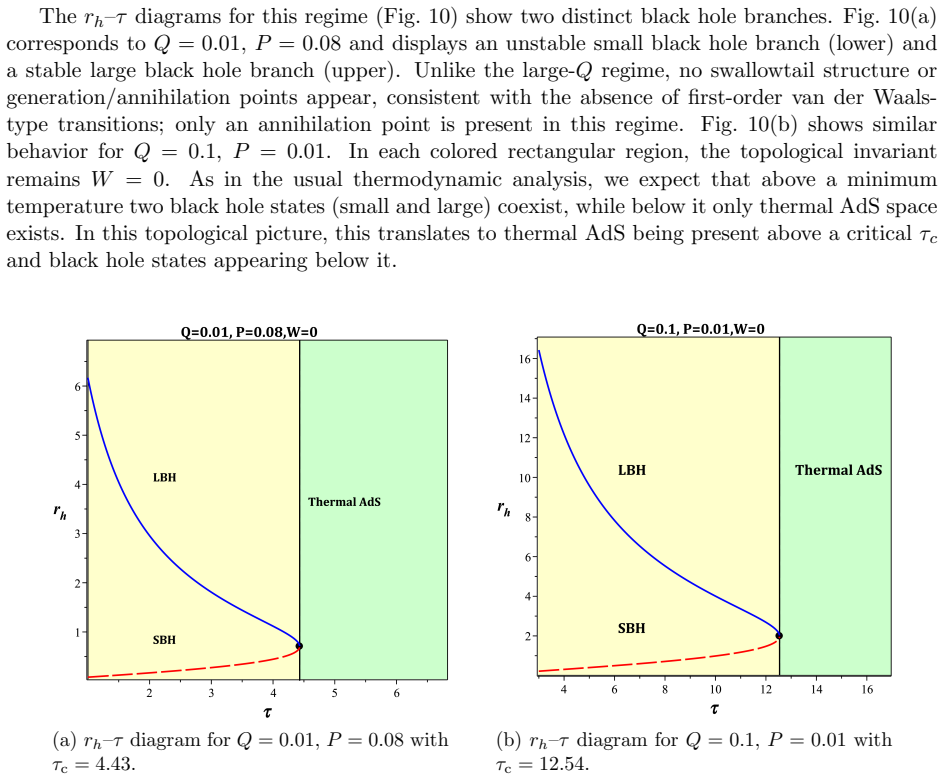

read the original abstract
We perform a topological classification of the phase structure of a four-dimensional AdS black hole with non-minimal Maxwell coupling. Critical points are treated as topological defects, allowing us to assign a winding number to each black hole branch and compute the global topological invariant W. The system exhibits a duality governed by its Maxwell charge Q: for large Q it falls into the class W = 1, displaying van der Waals-type behavior with a first-order small-large black hole transition. For small Q, it shifts to W = 0, characteristic of a Hawking-Page transition. This topological classification provides a model-independent validation of the conventional thermodynamic analysis. Crucially, we find that the non-minimal coupling lambda stabilizes the Hawking-Page universality class W=0 for black holes with non-zero charge, a phenomenon absent in the standard Reissner-Nordstrom-AdS case. This establishes a direct link between the microscopic coupling and the macroscopic topological class, demonstrating the power of topological methods in decoding thermodynamic universality across modified gravity theories.
Editorial analysis
A structured set of objections, weighed in public.
Referee Report
Summary. The manuscript performs a topological classification of the phase structure of a four-dimensional AdS black hole with non-minimal Maxwell coupling (lambda R F^2 term). Critical points in thermodynamic parameter space are treated as topological defects; winding numbers are assigned to each black-hole branch and summed to a global invariant W. The paper reports a Q-dependent duality: large Q yields W=1 (van der Waals-type first-order small-large transition), while small Q yields W=0 (Hawking-Page class). The central new claim is that the non-minimal coupling lambda stabilizes the W=0 class even for non-zero charge, a feature absent in standard RN-AdS; this is presented as model-independent validation of conventional thermodynamics.
Significance. If the mapping from the modified action to the off-shell potential and winding numbers is correctly implemented, the result would establish a direct link between a microscopic coupling and a macroscopic topological invariant, extending topological classification methods to modified gravity. The explicit stabilization of W=0 by lambda would be a concrete, falsifiable prediction distinguishing the theory from Einstein-Maxwell-AdS.
major comments (2)
- [§3, Eq. (12)–(14)] §3 (Thermodynamics), Eq. (12)–(14): the off-shell free energy used to locate critical points and compute winding numbers is written in the standard RN-AdS form F = M − TS − ΦQ without explicit re-derivation from the modified equations of motion that include the λ R F² term. The entropy, temperature, and electric potential receive corrections from the non-minimal coupling; if these are not incorporated, the reported stabilization of W=0 may be an artifact rather than a genuine topological feature.
- [§4, Fig. 3] §4 (Topological classification), Fig. 3 and surrounding text: the winding-number plots for varying λ are shown only for a narrow range of Q; no analytic argument or systematic scan demonstrates that the transition from W=1 to W=0 is driven by λ independently of the specific choice of thermodynamic variables or the branch chosen for the potential.
minor comments (2)
- [§2] Notation for the non-minimal coupling is introduced as λ but later appears as a dimensionless parameter; a single consistent symbol and its dimensions should be stated once in §2.
- [Abstract] The abstract states that the classification provides 'model-independent validation,' yet the method still relies on the specific form of the thermodynamic potential; this phrasing should be qualified.
Simulated Author's Rebuttal
We thank the referee for the careful reading and constructive comments on our manuscript. We address each major comment below and indicate the planned revisions.
read point-by-point responses
-
Referee: [§3, Eq. (12)–(14)] §3 (Thermodynamics), Eq. (12)–(14): the off-shell free energy used to locate critical points and compute winding numbers is written in the standard RN-AdS form F = M − TS − ΦQ without explicit re-derivation from the modified equations of motion that include the λ R F² term. The entropy, temperature, and electric potential receive corrections from the non-minimal coupling; if these are not incorporated, the reported stabilization of W=0 may be an artifact rather than a genuine topological feature.
Authors: We agree that an explicit derivation strengthens the presentation. In the revised manuscript we will add a detailed derivation in §3 starting from the modified action, showing how the λ R F² term corrects T, S and Φ while preserving the off-shell form F = M − T S − Φ Q. We will verify that the reported Q-dependent transition and stabilization of W=0 remain valid with these corrected quantities. revision: yes
-
Referee: [§4, Fig. 3] §4 (Topological classification), Fig. 3 and surrounding text: the winding-number plots for varying λ are shown only for a narrow range of Q; no analytic argument or systematic scan demonstrates that the transition from W=1 to W=0 is driven by λ independently of the specific choice of thermodynamic variables or the branch chosen for the potential.
Authors: We accept that the current Fig. 3 and text are limited in scope. The revised version will expand the figure to a wider Q range across several λ values and add an analytic discussion in §4 demonstrating that the λ-induced stabilization of the W=0 class occurs independently of the thermodynamic variables and branch choice within the standard ensemble. revision: yes
Circularity Check
No circularity: topological classification derived from model-specific thermodynamics without reduction to inputs by construction
full rationale
The paper computes the global invariant W from winding numbers assigned to critical points obtained from the thermodynamic quantities of the specific 4D AdS black hole with non-minimal Maxwell coupling. The abstract states that lambda shifts the system between W=1 and W=0 classes, providing a claimed model-independent validation. No quoted step shows W defined in terms of itself, a fitted parameter renamed as prediction, or a load-bearing self-citation whose content is unverified. The derivation chain remains self-contained because the topological defects are located using the modified equations of motion and free energy of the present model, not presupposed to yield a particular W value. This is the normal case of an independent application of an existing method to new dynamics.
Axiom & Free-Parameter Ledger
free parameters (1)
- lambda
axioms (1)
- domain assumption Critical points of black hole thermodynamics can be treated as topological defects with well-defined winding numbers whose sum yields a global invariant W
Reference graph
Works this paper leans on
-
[1]
The Quantum Theory of the Emission and Absorption of Radiation,
P. A. M. Dirac, “The Quantum Theory of the Emission and Absorption of Radiation,”Proc. R. Soc. Lond. A114, 243–265 (1927)
work page 1927
-
[2]
The Quantum Theory of the Electron,
P. A. M. Dirac, “The Quantum Theory of the Electron,”Proc. R. Soc. Lond. A117, 610–624 (1928)
work page 1928
-
[3]
On a Relativistically Invariant Formulation of the Quantum Theory of Wave Fields,
S. Tomonaga, “On a Relativistically Invariant Formulation of the Quantum Theory of Wave Fields,”Prog. Theor. Phys.1, 27–42 (1946)
work page 1946
-
[4]
Quantum Electrodynamics. I. A Covariant Formulation,
J. Schwinger, “Quantum Electrodynamics. I. A Covariant Formulation,”Phys. Rev.74, 1439– 1461 (1948)
work page 1948
-
[5]
Space-Time Approach to Quantum Electrodynamics,
R. P. Feynman, “Space-Time Approach to Quantum Electrodynamics,”Phys. Rev.76, 769– 789 (1949)
work page 1949
-
[6]
Partial-Symmetries of Weak Interactions,
S. L. Glashow, “Partial-Symmetries of Weak Interactions,”Nucl. Phys.22, 579–588 (1961)
work page 1961
-
[7]
Salam, inElementary Particle Theory, edited by N
A. Salam, inElementary Particle Theory, edited by N. Svartholm (Almquist and Wiksell, Stockholm, 1968), pp. 367–377
work page 1968
-
[8]
S. Weinberg, “A Model of Leptons,”Phys. Rev. Lett.19, 1264–1266 (1967)
work page 1967
-
[9]
Renormalizable Lagrangians for Massive Yang-Mills Fields,
G. ’t Hooft, “Renormalizable Lagrangians for Massive Yang-Mills Fields,”Nucl. Phys. B35, 167–188 (1971)
work page 1971
-
[10]
Regularization and Renormalization of Gauge Fields,
G. ’t Hooft and M. Veltman, “Regularization and Renormalization of Gauge Fields,”Nucl. Phys. B44, 189–213 (1972)
work page 1972
-
[11]
Nonrenormalizability of the Quantized Einstein-Maxwell System,
S. Deser and P. van Nieuwenhuizen, “Nonrenormalizability of the Quantized Einstein-Maxwell System,”Phys. Rev. Lett.32, 245–247 (1974)
work page 1974
-
[12]
One-loop divergencies in the theory of gravitation,
G. ’t Hooft and M. Veltman, “One-loop divergencies in the theory of gravitation,”Ann. Inst. H. Poincar´ e Phys. Th´ eor.20, 69–94 (1974)
work page 1974
-
[13]
Quantum Theory of Gravitation,
M. Veltman, “Quantum Theory of Gravitation,” inMethods in Field Theory, edited by R. Balian and J. Zinn-Justin (North-Holland, Amsterdam, 1975)
work page 1975
-
[14]
The Ultraviolet Behavior of Einstein Gravity,
M. H. Goroff and A. Sagnotti, “The Ultraviolet Behavior of Einstein Gravity,”Nucl. Phys. B 266, 709–736 (1986)
work page 1986
-
[15]
M. B. Green, J. H. Schwarz, and E. Witten,Superstring Theory(Cambridge University Press, 1987), Vols. 1 & 2
work page 1987
-
[16]
Polchinski,String Theory(Cambridge University Press, 1998), Vols
J. Polchinski,String Theory(Cambridge University Press, 1998), Vols. 1 & 2
work page 1998
-
[17]
J. Scherk and J. H. Schwarz, “Dual Models for Non-Hadrons,”Nucl. Phys. B81, 118–144 (1974). 26
work page 1974
-
[18]
The Large-N Limit of Superconformal Field Theories and Supergravity,
J. M. Maldacena, “The Large-N Limit of Superconformal Field Theories and Supergravity,” Int. J. Theor. Phys.38, 1113–1133 (1999)
work page 1999
-
[19]
Rovelli,Quantum Gravity(Cambridge University Press, Cambridge, 2004)
C. Rovelli,Quantum Gravity(Cambridge University Press, Cambridge, 2004)
work page 2004
-
[20]
Background Independent Quantum Gravity: A Status Report,
A. Ashtekar and J. Lewandowski, “Background Independent Quantum Gravity: A Status Report,”Class. Quant. Grav.21, R53–R152 (2004)
work page 2004
-
[21]
Thiemann,Modern Canonical Quantum General Relativity(Cambridge University Press, Cambridge, 2007)
T. Thiemann,Modern Canonical Quantum General Relativity(Cambridge University Press, Cambridge, 2007)
work page 2007
-
[22]
Weaving a Classical Metric with Quantum Threads,
A. Ashtekar, C. Rovelli, and L. Smolin, “Weaving a Classical Metric with Quantum Threads,” Phys. Rev. Lett.69, 237–240 (1992)
work page 1992
-
[23]
Discreteness of Area and Volume in Quantum Gravity,
C. Rovelli and L. Smolin, “Discreteness of Area and Volume in Quantum Gravity,”Nucl. Phys. B442, 593–622 (1995)
work page 1995
-
[24]
Black Hole Entropy from Loop Quantum Gravity,
C. Rovelli, “Black Hole Entropy from Loop Quantum Gravity,”Phys. Rev. Lett.77, 3288–3291 (1996)
work page 1996
-
[25]
Quantum Geometry and Black Hole Entropy,
A. Ashtekar, J. Baez, A. Corichi, and K. Krasnov, “Quantum Geometry and Black Hole Entropy,”Phys. Rev. Lett.80, 904–907 (1998)
work page 1998
-
[26]
String-Generated Gravity Models,
D. G. Boulware and S. Deser, “String-Generated Gravity Models,”Phys. Rev. Lett.55, 2656– 2660 (1985)
work page 1985
-
[27]
Renormalization of Higher-Derivative Quantum Gravity,
K. S. Stelle, “Renormalization of Higher-Derivative Quantum Gravity,”Phys. Rev. D16, 953–969 (1977)
work page 1977
-
[28]
The Einstein Tensor and Its Generalizations,
D. Lovelock, “The Einstein Tensor and Its Generalizations,”J. Math. Phys.12, 498–501 (1971)
work page 1971
-
[29]
The Quartic Effective Action for the Heterotic String,
D. J. Gross and J. H. Sloan, “The Quartic Effective Action for the Heterotic String,”Nucl. Phys. B291, 41–89 (1987)
work page 1987
-
[30]
T. P. Sotiriou and V. Faraoni, “f(R) Theories Of Gravity,”Rev. Mod. Phys.82, 451–497 (2010)
work page 2010
-
[31]
Second-order scalar-tensor field equations in a four-dimensional space,
G. W. Horndeski, “Second-order scalar-tensor field equations in a four-dimensional space,” Int. J. Theor. Phys.10, 363–384 (1974)
work page 1974
-
[32]
Generalized G-inflation: Inflation with the most general second-order field equations,
T. Kobayashi, M. Yamaguchi, and J. Yokoyama, “Generalized G-inflation: Inflation with the most general second-order field equations,”Prog. Theor. Phys.126, 511–529 (2011)
work page 2011
-
[33]
P. Bueno and P. A. Cano, “Einsteinian cubic gravity,”Phys. Rev. D94, 104005 (2016)
work page 2016
-
[34]
C. Charmousis, B. Gout´ eraux, and E. Kiritsis, “Higher-derivative scalar-vector-tensor theories: black holes, Galileons, singularity cloaking, and holography,”J. High Energ. Phys.2012, 85 (2012)
work page 2012
-
[35]
Black Holes in Quasi-topological Gravity,
R. C. Myers and B. Robinson, “Black Holes in Quasi-topological Gravity,”J. High Energ. Phys.2010, 67 (2010). 27
work page 2010
-
[36]
P–Vcriticality in the extended phase space of Gauss-Bonnet black holes in AdS space,
R.-G. Cai, L.-M. Cao, L. Li, and R.-Q. Yang, “P–Vcriticality in the extended phase space of Gauss-Bonnet black holes in AdS space,”J. High Energ. Phys.2013, 5 (2013)
work page 2013
-
[37]
R. Penrose,The Road to Reality: A Complete Guide to the Laws of the Universe(Jonathan Cape, London, 2004)
work page 2004
-
[38]
R. Penrose,Fashion, Faith, and Fantasy in the New Physics of the Universe(Princeton Uni- versity Press, Princeton, 2016)
work page 2016
-
[39]
The Four laws of black hole mechanics,
J. M. Bardeen, B. Carter, and S. W. Hawking, “The Four laws of black hole mechanics,” Commun. Math. Phys.31, 161–170 (1973)
work page 1973
-
[40]
Particle Creation by Black Holes,
S. W. Hawking, “Particle Creation by Black Holes,”Commun. Math. Phys.43, 199–220 (1975)
work page 1975
-
[41]
Thermodynamics of spacetime: The Einstein equation of state,
T. Jacobson, “Thermodynamics of spacetime: The Einstein equation of state,”Phys. Rev. Lett.75, 1260–1263 (1995)
work page 1995
-
[42]
Thermodynamical Aspects of Gravity: New insights,
T. Padmanabhan, “Thermodynamical Aspects of Gravity: New insights,”Rept. Prog. Phys. 73, 046901 (2010)
work page 2010
-
[43]
On the Origin of Gravity and the Laws of Newton,
E. Verlinde, “On the Origin of Gravity and the Laws of Newton,”JHEP04, 029 (2011)
work page 2011
-
[44]
Gauge theory correlators from non-critical string theory,
S. S. Gubser, I. R. Klebanov, and A. M. Polyakov, “Gauge theory correlators from non-critical string theory,”Phys. Lett. B428, 105–114 (1998)
work page 1998
-
[45]
Anti-de Sitter space and holography,
E. Witten, “Anti-de Sitter space and holography,”Adv. Theor. Math. Phys.2, 253–291 (1998)
work page 1998
-
[46]
Thermodynamics of Black Holes in Anti-de Sitter Space,
S. W. Hawking and D. N. Page, “Thermodynamics of Black Holes in Anti-de Sitter Space,” Commun. Math. Phys.87, 577–588 (1983)
work page 1983
-
[47]
The Cosmological Constant and the Black Hole Equation of State,
B. P. Dolan, “The Cosmological Constant and the Black Hole Equation of State,” Class. Quant. Grav.28, 125020 (2011). doi:10.1088/0264-9381/28/12/125020
-
[48]
Enthalpy and the Mechanics of AdS Black Holes,
D. Kastor, S. Ray, and J. Traschen, “Enthalpy and the Mechanics of AdS Black Holes,”Class. Quant. Grav.26, 195011 (2009)
work page 2009
-
[49]
P-V criticality of charged AdS black holes,
D. Kubizˇ n´ ak and R. B. Mann, “P-V criticality of charged AdS black holes,”J. High Energ. Phys.2012, 33 (2012)
work page 2012
-
[50]
S. H. Hendi and A. Dehghani, “Criticality and Extended Phase Space Thermodynamics of AdS Black Holes in Higher Curvature Massive Gravity,” Phys. Rev. D98, 084006 (2018). doi:10.1103/PhysRevD.98.084006
-
[51]
Reentrant phase transitions in rotating anti-de Sitter black holes,
N. Altamirano, D. Kubizˇ n´ ak, and R. B. Mann, “Reentrant phase transitions in rotating anti-de Sitter black holes,”Phys. Rev. D88, 101502 (2013)
work page 2013
-
[52]
Kerr-AdS analogue of triple point and solid/liquid/gas phase transition,
N. Altamirano, D. Kubizˇ n´ ak, R. B. Mann, and Z. Sherkatghanad, “Kerr-AdS analogue of triple point and solid/liquid/gas phase transition,”Class. Quant. Grav.31, 042001 (2014)
work page 2014
-
[53]
S. W. Wei, Y. X. Liu and R. B. Mann, Phys. Rev. Lett.129, no.19, 191101 (2022) doi:10.1103/PhysRevLett.129.191101 [arXiv:2208.01932 [gr-qc]]. 28
-
[54]
S. W. Wei, Y. X. Liu and R. B. Mann, Phys. Rev. D110, no.8, L081501 (2024) doi:10.1103/PhysRevD.110.L081501 [arXiv:2409.09333 [gr-qc]]
-
[55]
Topology of black hole thermodynamics,
S.-W. Wei and Y.-X. Liu, “Topology of black hole thermodynamics,”Phys. Rev. D105, 104003 (2022)
work page 2022
-
[56]
Topology of critical points and Hawking-Page transition,
P. K. Yerra and C. Bhamidipati, “Topology of critical points and Hawking-Page transition,” Phys. Rev. D106, 064059 (2022)
work page 2022
-
[57]
C. Liu and J. Wang, Phys. Rev. D107, no.6, 064023 (2023) doi:10.1103/PhysRevD.107.064023 [arXiv:2211.05524 [gr-qc]]
-
[58]
S. Ryu and T. Takayanagi, “Holographic derivation of entanglement entropy from the anti-de Sitter space/conformal field theory correspondence,”Phys. Rev. Lett.96, 181602 (2006)
work page 2006
-
[59]
Holographic entanglement entropy: an overview,
T. Nishioka, S. Ryu, and T. Takayanagi, “Holographic entanglement entropy: an overview,” J. Phys. A: Math. Theor.42, 504008 (2009)
work page 2009
-
[60]
Complexity and shock wave geometries,
D. Stanford and L. Susskind, “Complexity and shock wave geometries,”Phys. Rev. D90, 126007 (2014)
work page 2014
-
[61]
Holographic complexity equals bulk action?
A. R. Brown, D. A. Roberts, L. Susskind, B. Swingle, and Y. Zhao, “Holographic complexity equals bulk action?”Phys. Rev. Lett.116, 191301 (2016)
work page 2016
-
[62]
Holography and colliding gravitational shock waves in asymp- totically AdS5 spacetime,
P. M. Chesler and L. G. Yaffe, “Holography and colliding gravitational shock waves in asymp- totically AdS5 spacetime,”Phys. Rev. Lett.106, 021601 (2011)
work page 2011
-
[63]
O. DeWolfe, S. S. Gubser, and C. Rosen, “A holographic critical point,”Phys. Rev. D83, 086005 (2011)
work page 2011
-
[64]
Building a holographic superconductor,
S. A. Hartnoll, C. P. Herzog, and G. T. Horowitz, “Building a holographic superconductor,” Phys. Rev. Lett.101, 031601 (2008)
work page 2008
-
[65]
The phase transition of Rastall AdS black hole with cloud of strings and quintessence,
M. Sadeghi and F. Rahmani, “The phase transition of Rastall AdS black hole with cloud of strings and quintessence,” Int. J. Mod. Phys. A38, no.20, 2350102 (2023) doi:10.1142/S0217751X23501026 [arXiv:2301.12411 [hep-th]]
-
[66]
The phase transition of nonminimal Yang-Mills AdS black brane,
M. Sadeghi and F. Rahmani, “The phase transition of nonminimal Yang-Mills AdS black brane,”Int. J. Mod. Phys. A39, 2450010 (2024)
work page 2024
-
[67]
Holographic aspects of non-minimalRF FAdS black brane,
M. Sadeghi, “Holographic aspects of non-minimalRF FAdS black brane,”Class. Quantum Grav.40, 195002 (2023)
work page 2023
-
[68]
The phase transition of 4D Yang-Mills charged GB AdS black hole with cloud of strings,
F. Rahmani and M. Sadeghi, “The phase transition of 4D Yang-Mills charged GB AdS black hole with cloud of strings,”Mod. Phys. Lett. A39, 2450164 (2024)
work page 2024
-
[69]
Thermodynamic behavior of a 4D nonminimal Maxwell-AdS black hole,
M. Sadeghi and F. Rahmani, “Thermodynamic behavior of a 4D nonminimal Maxwell-AdS black hole,”Class. Quantum Grav.42, 215008 (2025)
work page 2025
-
[70]
Non-minimal coupling for the gravitational and electromagnetic fields: A general system of equations
A. B. Balakin and J. P. S. Lemos, “Non-minimal coupling for the gravitational and electro- magnetic fields: A General system of equations,” Class. Quant. Grav.22, 1867–1880 (2005). doi:10.1088/0264-9381/22/9/024, arXiv:gr-qc/0503076. 29
work page internal anchor Pith review Pith/arXiv arXiv doi:10.1088/0264-9381/22/9/024 2005
-
[71]
The structure of the topological current,
Y.-S. Duan, “The structure of the topological current,” SLAC-PUB-3301 (1984)
work page 1984
-
[72]
Action integrals and partition functions in quantum gravity,
G. W. Gibbons and S. W. Hawking, “Action integrals and partition functions in quantum gravity,” Phys. Rev. D15, 2752–2756 (1977)
work page 1977
-
[73]
Black-hole thermodynamics and the Euclidean Einstein action,
J. W. York, “Black-hole thermodynamics and the Euclidean Einstein action,” Phys. Rev. D 33, 2092–2099 (1986). 30
work page 2092
discussion (0)
Sign in with ORCID, Apple, or X to comment. Anyone can read and Pith papers without signing in.