REVIEW 3 major objections 5 minor 4 cited by
A visual place recognition model that fuses 3D scene geometry tokens with 2D texture tokens outperforms single- and multi-view baselines across standard benchmarks, the paper argues.
Reviewed by Pith at T0; open to challenge. T0 means a machine referee read the full paper against a public rubric. the ladder, T0–T4 →
T0 review · deepseek-v4-flash
2026-08-03 14:11 UTC pith:UX2BEFXE
load-bearing objection Solid VPR systems contribution with strong reported numbers, but the 3D-token mechanism is confounded by a larger, fine-tuned backbone and higher-dimensional descriptor. the 3 major comments →
UniPR-3D: Towards Universal Visual Place Recognition with Visual Geometry Grounded Transformer
The pith
A machine-rendered reading of the paper's core claim, the machinery that carries it, and where it could break.
Core claim
UniPR-3D claims that combining 2D and 3D tokens from a VGGT backbone yields a place descriptor that beats existing single-frame and sequence-level baselines. It retains 3D register and patch tokens (dropping the camera token) for viewpoint invariance, aggregates CLS and register tokens with GeM pooling and patch tokens with optimal transport, and concatenates five descriptor components. For sequences, an anchor frame plus support frames is aggregated with GeM+MLP for register tokens and Sinkhorn optimal transport for patch tokens, supporting arbitrary sequence length. The paper reports, for example, single-frame R@1 of 76.2 on Nordland versus 69.6 for DINOv2-SALAD, and sequence R@1 of 93.7/8
What carries the argument
The central object is the VGGT transformer, which, given an image sequence, outputs both 2D tokens (CLS, register, patch) and 3D tokens (camera, register, patch) via alternating frame attention and global attention. The paper's contribution is a routing: drop the 3D camera token, GeM-pool the small CLS and register tokens, and use optimal transport (Sinkhorn) with a dustbin to aggregate patch tokens into local descriptors. Sequence matching adds a GeM+MLP projector that aligns tokens across frames, making the descriptor agnostic to input length.
Load-bearing premise
The reported gains come from VGGT's 3D tokens carrying genuine scene geometry, rather than from simply having a larger backbone and a much longer descriptor than the baselines.
What would settle it
An ablation that fixes backbone architecture (24 layers), descriptor dimension (17,152), and training data, and compares (a) 2D tokens only, (b) 3D tokens only, (c) both. If (a) matches (c) within noise on Nordland and Oxford, the geometry claim is falsified. A second check: feed the model two identical images with artificially swapped camera intrinsics; if 3D tokens change the descriptor significantly, they encode camera parameters rather than stable scene structure.
If this is right
- If the claims hold, a single architecture can serve both frame-to-frame and sequence-to-sequence place recognition without separate temporal post-processing.
- Geometry-grounded tokens should be more robust to appearance changes (season, day/night) than texture-only features, as the Nordland and Oxford results suggest.
- Variable-length sequence retrieval means a robot can query with whatever number of frames it has, without retraining for a fixed window.
- The concatenated descriptor of roughly 17k dimensions trades latency (about 8 ms for a single frame, 140 ms for a sequence) for accuracy.
Where Pith is reading between the lines
- A matched-backbone ablation (same 24-layer ViT, same 17,152-dimensional descriptor, same training data) comparing 2D-tokens-only, 3D-tokens-only, and both would isolate whether the gains come from 3D geometry or from backbone scale and descriptor size; without that ablation, the '3D helps' claim is plausible but unproven.
- The same geometric tokens could benefit other retrieval tasks where appearance changes but structure persists, such as loop closure in SLAM, re-localization, and map-based navigation, though the paper does not test these.
- One could probe the geometric grounding directly by feeding two identical images with artificially swapped camera intrinsics or shuffled viewpoints: if the 3D token descriptor changes significantly, the tokens encode camera parameters rather than stable scene structure.
- The variable-length aggregator points toward lifelong mapping scenarios where a robot's memory grows over time and retrieval uses arbitrarily long egocentric clips, an extension the paper leaves implicit.
Editorial analysis
A structured set of objections, weighed in public.
Referee Report
Summary. UniPR-3D proposes a visual place recognition (VPR) architecture built on VGGT, using both VGGT's multi-view 3D tokens and its intermediate 2D tokens. The 2D CLS/register tokens and 3D register tokens are aggregated with GeM pooling and MLPs, while 2D and 3D patch tokens are aggregated through an optimal-transport / Sinkhorn module, and the five descriptors are concatenated. The method supports both single-frame retrieval and variable-length sequence-level retrieval, with the first frame as anchor. Training is done in two stages: first the aggregation heads, then LoRA fine-tuning of parts of VGGT/DINOv2 and the alternating-attention blocks. The paper reports state-of-the-art results on standard single-frame benchmarks (MSLS, Nordland, Pittsburgh, SPED) and sequence benchmarks (MSLS, Nordland, Oxford1, Oxford2), and ablates the contribution of the different token types.
Significance. If the results hold, this is a useful and timely contribution: it is, to my knowledge, the first VPR method that explicitly leverages VGGT's 3D tokens, and the variable-length sequence aggregation addresses a real limitation of fixed-length multi-frame methods. The paper evaluates on several standard benchmarks and includes ablation of the token types (Tab. 4) and of test-time sequence length (Tab. 5 / Suppl. Tab. 7). The reported single-frame margins over SALAD are often small (0.1–2.4 points on MSLS, 0.4–1.5 on Pitts/SPED) but the Nordland improvement (+6.6 R@1) and the sequence-level improvements over CaseVPR (2.5–7.8 points R@1) are substantial. The main weakness is that the central mechanistic claim — that the gains come from 3D geometry rather than from a larger, fine-tuned backbone and a doubled descriptor size — is not established by the current experimental design.
major comments (3)
- [Sec. 4.2, Tab. 1] The headline single-frame comparison against SALAD is confounded. UniPR-3D LoRA-fine-tunes the VGGT/DINOv2 backbone (Sec. 3.4, Suppl. C), whereas the SALAD baseline uses a frozen DINOv2 with only its head trained. UniPR-3D also uses a 17,152-D descriptor vs. SALAD's 8192+256-D descriptor. Thus the +6.6 R@1 on Nordland and the smaller gains elsewhere cannot be attributed to 3D tokens. A matched control is needed: same LoRA fine-tuning regime and same descriptor dimension, but using only 2D tokens (e.g., 2D patch/cls/register with expanded clusters or duplicated register tokens to match 17,152-D). Without this control, the paper's claim that geometry-grounded tokens are the source of the gains is unsupported.
- [Sec. 4.3, Tab. 4] The ablation of token types is not sufficient to isolate the 3D-geometry contribution. The all-2D row (2D cls + 2D reg + 2D patch) has a descriptor dimension of roughly 8,704, while the full descriptor is 17,152-D; the +4.5 R@1 from adding 3D tokens could be partly a descriptor-size effect. Also, the table's '3D pose' column is never defined in the method and the best row omits it, so the contribution ordering is unclear. Please (i) clarify what '3D pose' refers to, and (ii) add a 2D-only condition with matched descriptor dimension, e.g., by increasing the number of 2D patch clusters or adding a second 2D register stream of equal dimension.
- [Sec. 3.4 / Suppl. C] Training details are insufficient for reproducibility, and no code is currently provided despite the abstract's promise. Please report LoRA rank/alpha, which specific DINOv2/VGGT blocks are fine-tuned, total number of epochs/steps, batch size, Sinkhorn iterations and temperature, dustbin initialization, and the exact two-stage schedule. These details are load-bearing because the method is a complex fine-tuned system and the reported gains are often just a few points.
minor comments (5)
- [Sec. 4.3] The main text says 'The results are presented in Tab. 7' but the table in the main paper is numbered Tab. 5, while Tab. 7 is in the supplementary. Please fix the cross-reference.
- [Eq. (1)] Equation (1) for the 2D CLS descriptor uses 'fp_cam' (camera features) in the GeM formula; this appears to be a typo for the CLS token f_cls. Also, the text says the 3D camera token is discarded, but Fig. 2 and Eq. (3) do not make this distinction clear.
- [Tab. 1] The descriptor size '8192 + 256' for DINOv2 SALAD is ambiguous; clarify whether this is the concatenated dimension of patch and register/cls descriptors or something else.
- [Fig. 2 caption] The caption says 'we use DINOv2 as our visual feature extractor and then utilize alternating attention blocks of VGGT', but the method section describes VGGT as containing a DINOv2 encoder. Please align the wording to avoid implying two separate networks.
- [Sec. 4.2, Tab. 2] The caption for Tab. 2 says 'Oxford datasets, the retrieval distance is set to 2 m', but the main text and Tab. 3 report both 2 m and 25 m. Clarify whether Tab. 2 uses only 2 m.
Circularity Check
No significant circularity: the method is trained and evaluated on external benchmarks, and none of the reported predictions reduce by construction to fitted inputs or self-citations.
full rationale
UniPR-3D is a learned retrieval system whose descriptor is constructed from VGGT/DINOv2 tokens via GeM pooling and optimal-transport aggregation (Eqs. 1-8), trained with a multi-similarity loss on GSV-Cities and MSLS, and then evaluated on held-out public benchmarks (MSLS, Nordland, Pittsburgh250k, SPED, Oxford). No fitted parameter is defined in terms of the target recall, and no claimed 'prediction' is a rewritten version of its training signal. The component ablation in Table 4 is a within-model removal study, not a fit-then-predict cycle, and it does not define the 3D token contribution as the benchmark result. The citations to SALAD (co-authored by J. Civera) and CaseVPR (co-authored by D. Wang) are self-citations, but they are not load-bearing in a circular sense: SALAD supplies an aggregation technique (optimal transport with a dustbin) that is independently published and externally evaluated, and CaseVPR is a baseline whose numbers are compared rather than used to define the method. No uniqueness theorem or ansatz is imported from the authors' prior work to force the architecture. The skeptical concern about a missing matched 2D-only ablation (larger fine-tuned backbone and 17,152-D descriptor versus frozen baselines) is an attribution/confound issue about explaining the gains, not a circularity issue: even if the mechanistic claim that 3D tokens cause the improvements is under-supported, the empirical evaluation remains self-contained against external benchmarks.
Axiom & Free-Parameter Ledger
free parameters (4)
- GeM pooling exponent p =
not reported (learned)
- OT dustbin logit z =
not reported (learned)
- Number of OT clusters m =
64
- Descriptor dimensionalities =
17,152 total; cls/reg 256, patch 8192
axioms (5)
- domain assumption VGGT 3D tokens retain place-discriminative geometric information after LoRA fine-tuning on MSLS
- domain assumption Multi-similarity contrastive training on GSV-Cities/MSLS transfers to Nordland, Pittsburgh, SPED, and Oxford
- domain assumption The 25m/10-frame/2m positive definitions used for training and evaluation approximate true place identity
- standard math Sinkhorn optimal transport converges and yields a valid soft assignment matrix
- domain assumption LoRA fine-tuning of only the last VGGT blocks preserves the pretrained geometry representation
read the original abstract
Visual Place Recognition (VPR) has been traditionally formulated as a single-image retrieval task. Using multiple views offers clear advantages, yet this setting remains relatively underexplored and existing methods often struggle to generalize across diverse environments. In this work we introduce UniPR-3D, the first VPR architecture that effectively integrates information from multiple views. UniPR-3D builds on a VGGT backbone capable of encoding multi-view 3D representations, which we adapt by designing feature aggregators and fine-tune for the place recognition task. To construct our descriptor, we jointly leverage the 3D tokens and intermediate 2D tokens produced by VGGT. Based on their distinct characteristics, we design dedicated aggregation modules for 2D and 3D features, allowing our descriptor to capture fine-grained texture cues while also reasoning across viewpoints. To further enhance generalization, we incorporate both single- and multi-frame aggregation schemes, along with a variable-length sequence retrieval strategy. Our experiments show that UniPR-3D sets a new state of the art, outperforming both single- and multi-view baselines and highlighting the effectiveness of geometry-grounded tokens for VPR. Our code and models will be made publicly available on Github https://github.com/dtc111111/UniPR-3D.
Figures


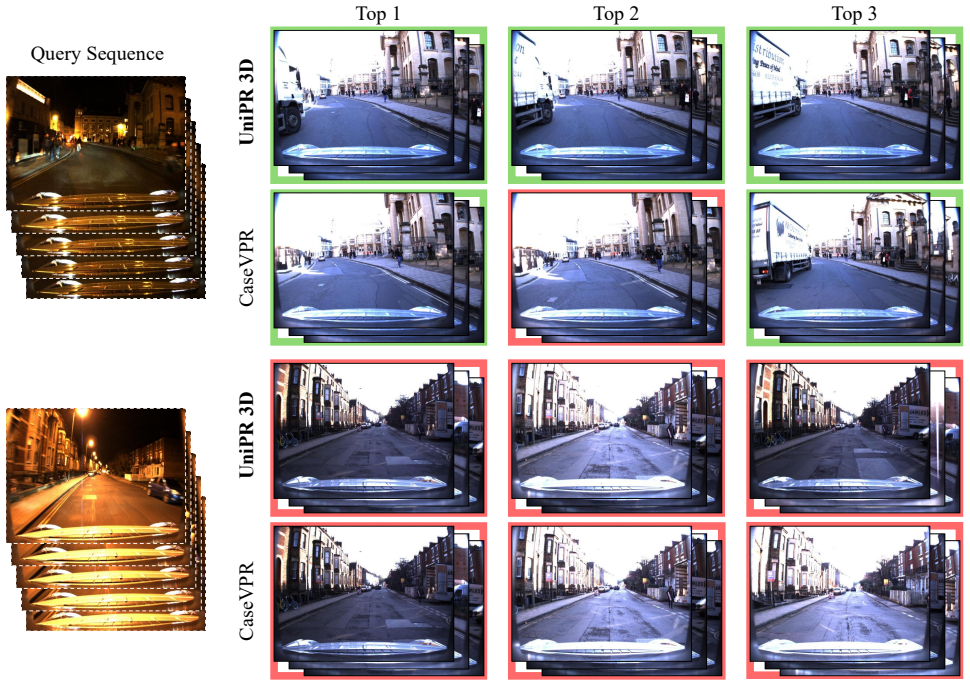


Forward citations
Cited by 4 Pith papers
-
Keep It CALM: Toward Calibration-Free Kilometer-Level SLAM with Visual Geometry Foundation Models via an Assistant Eye
CAL2M achieves calibration-free kilometer-level SLAM by using an assistant eye for scale, epipolar-guided intrinsic correction, and anchor propagation for nonlinear sub-map alignment.
-
From Open Waters to Enclosed Cabins: ProteusVPR for Cross-Scene Visual Place Recognition in Maritime Perception and Cabin Inspection
A geometry-aware second-stage network plus the XHZ ship dataset reduces mean VPR localization error by over 60% across multiple backbones in multi-floor maritime cabins.
-
From Open Waters to Enclosed Cabins: ProteusVPR for Cross-Scene Visual Place Recognition in Maritime Perception and Cabin Inspection
ProteusVPR is a retrieval-plus-geometric-refinement framework that cuts mean localization error by over 60% on average for cross-scene maritime VPR and is evaluated on the new XHZ ship-borne panoramic dataset.
-
VGGT-Occ: Geometry-Grounded and Density-Aware Gated Fusion for 3D Occupancy Prediction
VGGT-Occ embeds geometric tokens via PA-DA and uses sequential coarse-to-fine gated fusion to reach 33.00% IoU and 21.08% mIoU on SurroundOcc-nuScenes while using only ~41M parameters in the occupancy head.
Reference graph
Works this paper leans on
-
[1]
Gsv-cities: Toward appropriate supervised visual place recognition.Neurocomputing, 513:194–203, 2022
Amar Ali-bey, Brahim Chaib-draa, and Philippe Giguere. Gsv-cities: Toward appropriate supervised visual place recognition.Neurocomputing, 513:194–203, 2022. 5, 6
2022
-
[2]
Mixvpr: Feature mixing for visual place recognition
Amar Ali-Bey, Brahim Chaib-Draa, and Philippe Giguere. Mixvpr: Feature mixing for visual place recognition. InPro- ceedings of the IEEE/CVF winter conference on applications of computer vision, pages 2998–3007, 2023. 1, 2, 5, 6, 9
2023
-
[3]
Netvlad: Cnn architecture for weakly supervised place recognition
Relja Arandjelovic, Petr Gronat, Akihiko Torii, Tomas Pa- jdla, and Josef Sivic. Netvlad: Cnn architecture for weakly supervised place recognition. InProceedings of the IEEE conference on computer vision and pattern recognition, pages 5297–5307, 2016. 1, 2, 5, 6
2016
-
[4]
Towards life-long visual localization us- ing an efficient matching of binary sequences from images
Roberto Arroyo, Pablo F Alcantarilla, Luis M Bergasa, and Eduardo Romera. Towards life-long visual localization us- ing an efficient matching of binary sequences from images. In2015 IEEE international conference on robotics and au- tomation (ICRA), pages 6328–6335. IEEE, 2015. 2
2015
-
[5]
Megaloc: One retrieval to place them all
Gabriele Berton and Carlo Masone. Megaloc: One retrieval to place them all. InProceedings of the Computer Vision and Pattern Recognition Conference Workshops, pages 2861– 2867, 2025. 1
2025
-
[6]
Re- thinking visual geo-localization for large-scale applications
Gabriele Berton, Carlo Masone, and Barbara Caputo. Re- thinking visual geo-localization for large-scale applications. InProceedings of the IEEE/CVF Conference on Computer Vision and Pattern Recognition, pages 4878–4888, 2022. 5, 6
2022
-
[7]
Eigenplaces: Training viewpoint robust models for visual place recognition
Gabriele Berton, Gabriele Trivigno, Barbara Caputo, and Carlo Masone. Eigenplaces: Training viewpoint robust models for visual place recognition. InProceedings of the IEEE/CVF International Conference on Computer Vision, pages 11080–11090, 2023. 5, 6
2023
-
[8]
Jist: Joint image and sequence training for sequential visual place recognition.IEEE Robotics and Au- tomation Letters, 9(2):1310–1317, 2023
Gabriele Berton, Gabriele Trivigno, Barbara Caputo, and Carlo Masone. Jist: Joint image and sequence training for sequential visual place recognition.IEEE Robotics and Au- tomation Letters, 9(2):1310–1317, 2023. 6
2023
-
[9]
A survey of optimal trans- port for computer graphics and computer vision
Nicolas Bonneel and Julie Digne. A survey of optimal trans- port for computer graphics and computer vision. InCom- puter Graphics Forum, pages 439–460. Wiley Online Li- brary, 2023. 2
2023
-
[10]
Learning context flexible attention model for long-term visual place recognition.IEEE Robotics and Au- tomation Letters, 3(4):4015–4022, 2018
Zetao Chen, Lingqiao Liu, Inkyu Sa, Zongyuan Ge, and Mar- garita Chli. Learning context flexible attention model for long-term visual place recognition.IEEE Robotics and Au- tomation Letters, 3(4):4015–4022, 2018. 5, 10
2018
-
[11]
Sinkhorn distances: Lightspeed computation of optimal transport.Advances in neural information pro- cessing systems, 26, 2013
Marco Cuturi. Sinkhorn distances: Lightspeed computation of optimal transport.Advances in neural information pro- cessing systems, 26, 2013. 4
2013
-
[12]
Tri Dao. Flashattention-2: Faster attention with bet- ter parallelism and work partitioning.arXiv preprint arXiv:2307.08691, 2023. 5, 9
Pith/arXiv arXiv 2023
-
[13]
Tianchen Deng, Siyang Liu, Xuan Wang, Yejia Liu, Danwei Wang, and Weidong Chen. Prosgnerf: Progressive dynamic neural scene graph with frequency modulated auto-encoder in urban scenes.arXiv preprint arXiv:2312.09076, 2023. 2
Pith/arXiv arXiv 2023
-
[14]
Long-term visual simultaneous localization and map- ping: Using a bayesian persistence filter-based global map prediction.IEEE Robotics & Automation Magazine, 30(1): 36–49, 2023
Tianchen Deng, Hongle Xie, Jingchuan Wang, and Weidong Chen. Long-term visual simultaneous localization and map- ping: Using a bayesian persistence filter-based global map prediction.IEEE Robotics & Automation Magazine, 30(1): 36–49, 2023. 2
2023
-
[15]
Plgslam: Progressive neural scene represenation with local to global bundle adjustment
Tianchen Deng, Guole Shen, Tong Qin, Jianyu Wang, Wen- tao Zhao, Jingchuan Wang, Danwei Wang, and Weidong Chen. Plgslam: Progressive neural scene represenation with local to global bundle adjustment. InProceedings of the IEEE/CVF Conference on Computer Vision and Pattern Recognition, pages 19657–19666, 2024. 1
2024
-
[16]
Tianchen Deng, Yue Pan, Shenghai Yuan, Dong Li, Chen Wang, Mingrui Li, Long Chen, Lihua Xie, Danwei Wang, Jingchuan Wang, Javier Civera, Hesheng Wang, and Wei- dong Chen. What is the best 3d scene representation for robotics? from geometric to foundation models.arXiv preprint arXiv:2512.03422, 2025. 2
arXiv 2025
-
[17]
Tianchen Deng, Guole Shen, Xun Chen, Shenghai Yuan, Hongming Shen, Guohao Peng, Zhenyu Wu, Jingchuan Wang, Lihua Xie, Danwei Wang, Hesheng Wang, and Wei- dong Chen. Mcn-slam: Multi-agent collaborative neural slam with hybrid implicit neural scene representation.arXiv preprint arXiv:2506.18678, 2025. 2
Pith/arXiv arXiv 2025
-
[18]
Mne-slam: Multi-agent neural slam for mobile robots
Tianchen Deng, Guole Shen, Chen Xun, Shenghai Yuan, Tongxin Jin, Hongming Shen, Yanbo Wang, Jingchuan Wang, Hesheng Wang, Danwei Wang, et al. Mne-slam: Multi-agent neural slam for mobile robots. InProceedings of the Computer Vision and Pattern Recognition Conference, pages 1485–1494, 2025. 1
2025
-
[19]
Tianchen Deng, Nailin Wang, Chongdi Wang, Shenghai Yuan, Jingchuan Wang, Hesheng Wang, Danwei Wang, and Weidong Chen. Incremental joint learning of depth, pose and implicit scene representation on monocular camera in large- scale scenes.IEEE Transactions on Automation Science and Engineering, pages 1–1, 2025. 2
2025
-
[20]
Neslam: Neural implicit mapping and self-supervised feature tracking with depth completion and denoising.IEEE Transactions on Automation Science and Engineering, pages 1–1, 2025
Tianchen Deng, Yanbo Wang, Hongle Xie, Hesheng Wang, Rui Guo, Jingchuan Wang, Danwei Wang, and Weidong Chen. Neslam: Neural implicit mapping and self-supervised feature tracking with depth completion and denoising.IEEE Transactions on Automation Science and Engineering, pages 1–1, 2025. 2
2025
-
[21]
Condition-invariant multi-view place recognition
Jose M Facil, Daniel Olid, Luis Montesano, and Javier Civera. Condition-invariant multi-view place recognition. arXiv preprint arXiv:1902.09516, 2019. 2
Pith/arXiv arXiv 1902
-
[22]
Bags of binary words for fast place recognition in image sequences.IEEE Transactions on robotics, 28(5):1188–1197, 2012
Dorian G ´alvez-L´opez and Juan D Tardos. Bags of binary words for fast place recognition in image sequences.IEEE Transactions on robotics, 28(5):1188–1197, 2012. 2
2012
-
[23]
Seqnet: Learning de- scriptors for sequence-based hierarchical place recognition
Sourav Garg and Michael Milford. Seqnet: Learning de- scriptors for sequence-based hierarchical place recognition. IEEE Robotics and Automation Letters, 6(3):4305–4312,
-
[24]
Delta descriptors: Change-based place representa- tion for robust visual localization.IEEE Robotics and Au- tomation Letters, 5(4):5120–5127, 2020
Sourav Garg, Ben Harwood, Gaurangi Anand, and Michael Milford. Delta descriptors: Change-based place representa- tion for robust visual localization.IEEE Robotics and Au- tomation Letters, 5(4):5120–5127, 2020. 6
2020
-
[25]
Where is your place, visual place recognition?arXiv preprint arXiv:2103.06443, 2021
Sourav Garg, Tobias Fischer, and Michael Milford. Where is your place, visual place recognition?arXiv preprint arXiv:2103.06443, 2021. 1
Pith/arXiv arXiv 2021
-
[26]
Seq- matchnet: Contrastive learning with sequence matching for 18 place recognition & relocalization
Sourav Garg, Madhu Vankadari, and Michael Milford. Seq- matchnet: Contrastive learning with sequence matching for 18 place recognition & relocalization. InConference on Robot Learning, pages 429–443. PMLR, 2022. 2, 5, 6
2022
-
[27]
Patch-netvlad: Multi-scale fusion of locally-global descriptors for place recognition
Stephen Hausler, Sourav Garg, Ming Xu, Michael Milford, and Tobias Fischer. Patch-netvlad: Multi-scale fusion of locally-global descriptors for place recognition. InProceed- ings of the IEEE/CVF conference on computer vision and pattern recognition, pages 14141–14152, 2021. 1
2021
-
[28]
Somayeh Hussaini, Tobias Fischer, and Michael Milford. Improving visual place recognition with sequence-matching receptiveness prediction.arXiv preprint arXiv:2503.06840,
-
[29]
Close, but not there: Boosting geographic distance sensitivity in visual place recognition
Sergio Izquierdo and Javier Civera. Close, but not there: Boosting geographic distance sensitivity in visual place recognition. InEuropean Conference on Computer Vision, pages 240–257. Springer, 2024. 1
2024
-
[30]
Optimal transport ag- gregation for visual place recognition
Sergio Izquierdo and Javier Civera. Optimal transport ag- gregation for visual place recognition. InProceedings of the ieee/cvf conference on computer vision and pattern recogni- tion, pages 17658–17668, 2024. 1, 2, 3, 4, 5, 6, 9
2024
-
[31]
Aggregating local descriptors into a compact image representation
Herv ´e J´egou, Matthijs Douze, Cordelia Schmid, and Patrick P´erez. Aggregating local descriptors into a compact image representation. In2010 IEEE computer society conference on computer vision and pattern recognition, pages 3304–
-
[32]
Anyloc: Towards universal visual place recognition.IEEE Robotics and Automation Letters, 9 (2):1286–1293, 2023
Nikhil Keetha, Avneesh Mishra, Jay Karhade, Kr- ishna Murthy Jatavallabhula, Sebastian Scherer, Madhava Krishna, and Sourav Garg. Anyloc: Towards universal visual place recognition.IEEE Robotics and Automation Letters, 9 (2):1286–1293, 2023. 1, 2, 3
2023
-
[33]
Adam: A method for stochastic optimization
Diederik P Kingma and Jimmy Ba. Adam: A method for stochastic optimization. InICLR, 2015. 5
2015
-
[34]
Casevpr: Correlation-aware sequential embedding for sequence-to-frame visual place recognition.IEEE Robotics and Automation Letters, 2025
Heshan Li, Guohao Peng, Jun Zhang, Mingxing Wen, Ying- chong Ma, and Danwei Wang. Casevpr: Correlation-aware sequential embedding for sequence-to-frame visual place recognition.IEEE Robotics and Automation Letters, 2025. 3, 5, 6, 7, 11, 12, 13, 14, 15, 16
2025
-
[35]
To- ward learning-based visuomotor navigation with neural radi- ance fields.IEEE Transactions on Industrial Informatics, 20 (6):8907–8916, 2024
Qiming Liu, Nanxi Chen, Zhe Liu, and Hesheng Wang. To- ward learning-based visuomotor navigation with neural radi- ance fields.IEEE Transactions on Industrial Informatics, 20 (6):8907–8916, 2024. 2
2024
-
[36]
In- tegrating neural radiance fields end-to-end for cognitive vi- suomotor navigation.IEEE Transactions on Pattern Analysis and Machine Intelligence, 46(12):11200–11215, 2024
Qiming Liu, Haoran Xin, Zhe Liu, and Hesheng Wang. In- tegrating neural radiance fields end-to-end for cognitive vi- suomotor navigation.IEEE Transactions on Pattern Analysis and Machine Intelligence, 46(12):11200–11215, 2024. 2
2024
-
[37]
Mg-slam: Structure gaussian splatting slam with manhattan world hy- pothesis.IEEE Transactions on Automation Science and En- gineering, 2025
Shuhong Liu, Tianchen Deng, Heng Zhou, Liuzhuozheng Li, Hongyu Wang, Danwei Wang, and Mingrui Li. Mg-slam: Structure gaussian splatting slam with manhattan world hy- pothesis.IEEE Transactions on Automation Science and En- gineering, 2025. 2
2025
-
[38]
Visual place recognition: A survey.IEEE Transactions on Robotics, 32(1):1–19, 2015
Stephanie Lowry, Niko S ¨underhauf, Paul Newman, John J Leonard, David Cox, Peter Corke, and Michael J Milford. Visual place recognition: A survey.IEEE Transactions on Robotics, 32(1):1–19, 2015. 1
2015
-
[39]
Neural network-based nonconservative predefined-time backstep- ping control for uncertain strict-feedback nonlinear systems
Jixing Lv, Xiaozhe Ju, and Changhong Wang. Neural network-based nonconservative predefined-time backstep- ping control for uncertain strict-feedback nonlinear systems. IEEE Transactions on Neural Networks and Learning Sys- tems, 2023. 2
2023
-
[40]
Adaptive dis- tributed observer design for nonlinear multiagent systems
Jixing Lv, Changhong Wang, and Lihua Xie. Adaptive dis- tributed observer design for nonlinear multiagent systems. Automatica, 183:112625, 2026. 2
2026
-
[41]
1 year, 1000 km: The oxford robotcar dataset
Will Maddern, Geoffrey Pascoe, Chris Linegar, and Paul Newman. 1 year, 1000 km: The oxford robotcar dataset. The International Journal of Robotics Research, 36(1):3–15,
-
[42]
Vggt- slam: Dense rgb slam optimized on the sl (4) manifold.arXiv preprint arXiv:2505.12549, 2025
Dominic Maggio, Hyungtae Lim, and Luca Carlone. Vggt- slam: Dense rgb slam optimized on the sl (4) manifold.arXiv preprint arXiv:2505.12549, 2025. 1
Pith/arXiv arXiv 2025
-
[43]
A survey on deep visual place recognition.IEEE Access, 9:19516–19547, 2021
Carlo Masone and Barbara Caputo. A survey on deep visual place recognition.IEEE Access, 9:19516–19547, 2021. 1
2021
-
[44]
Learning sequential descrip- tors for sequence-based visual place recognition.IEEE Robotics and Automation Letters, 7(4):10383–10390, 2022
Riccardo Mereu, Gabriele Trivigno, Gabriele Berton, Carlo Masone, and Barbara Caputo. Learning sequential descrip- tors for sequence-based visual place recognition.IEEE Robotics and Automation Letters, 7(4):10383–10390, 2022. 2, 6
2022
-
[45]
Going places: Place recognition in artificial and natural systems.Annual Review of Control, Robotics, and Autonomous Systems, 9, 2025
Michael Milford and Tobias Fischer. Going places: Place recognition in artificial and natural systems.Annual Review of Control, Robotics, and Autonomous Systems, 9, 2025. 1
2025
-
[46]
Seqslam: Visual route-based navigation for sunny summer days and stormy winter nights
Michael J Milford and Gordon F Wyeth. Seqslam: Visual route-based navigation for sunny summer days and stormy winter nights. In2012 IEEE international conference on robotics and automation, pages 1643–1649. IEEE, 2012. 2, 6
2012
-
[47]
Localization in urban environments using a panoramic gist descriptor.IEEE Transactions on Robotics, 29(1):146–160, 2012
Ana C Murillo, Gautam Singh, Jana Kosecka, and Jos ´e Jes´us Guerrero. Localization in urban environments using a panoramic gist descriptor.IEEE Transactions on Robotics, 29(1):146–160, 2012. 2
2012
-
[48]
Dinov2: Learning robust visual features without supervision
Maxime Oquab, Timoth ´ee Darcet, Th ´eo Moutakanni, Huy V o, Marc Szafraniec, Vasil Khalidov, Pierre Fernandez, Daniel Haziza, Francisco Massa, Alaaeldin El-Nouby, et al. Dinov2: Learning robust visual features without supervision. arXiv preprint arXiv:2304.07193, 2023. 1, 2, 3
Pith/arXiv arXiv 2023
-
[49]
Fine- tuning cnn image retrieval with no human annotation.IEEE transactions on pattern analysis and machine intelligence, 41(7):1655–1668, 2018
Filip Radenovi ´c, Giorgos Tolias, and Ond ˇrej Chum. Fine- tuning cnn image retrieval with no human annotation.IEEE transactions on pattern analysis and machine intelligence, 41(7):1655–1668, 2018. 1, 2, 4, 5, 6
2018
-
[50]
From coarse to fine: Robust hierarchical localization at large scale
Paul-Edouard Sarlin, Cesar Cadena, Roland Siegwart, and Marcin Dymczyk. From coarse to fine: Robust hierarchical localization at large scale. InProceedings of the IEEE/CVF conference on computer vision and pattern recognition, pages 12716–12725, 2019. 1
2019
-
[51]
Superglue: Learning feature matching with graph neural networks
Paul-Edouard Sarlin, Daniel DeTone, Tomasz Malisiewicz, and Andrew Rabinovich. Superglue: Learning feature matching with graph neural networks. InProceedings of the IEEE/CVF conference on computer vision and pattern recognition, pages 4938–4947, 2020. 4
2020
-
[52]
Fast and memory efficient graph optimization via icm for visual place recognition
Stefan Schubert, Peer Neubert, and Peter Protzel. Fast and memory efficient graph optimization via icm for visual place recognition. InRobotics: Science and Systems, 2021. 2
2021
-
[53]
Visual Place Recognition: A Tuto- rial.IEEE Robotics & Automation Magazine, 2023
Stefan Schubert, Peer Neubert, Sourav Garg, Michael Mil- ford, and Tobias Fischer. Visual Place Recognition: A Tuto- rial.IEEE Robotics & Automation Magazine, 2023. 1
2023
-
[54]
Grs-slam3r: Real-time dense slam with gated recurrent state.arXiv preprint arXiv:2509.23737, 2025
Guole Shen, Tianchen Deng, Yanbo Wang, Yongtao Chen, Yilin Shen, Jiuming Liu, and Jingchuan Wang. Grs-slam3r: Real-time dense slam with gated recurrent state.arXiv preprint arXiv:2509.23737, 2025. 2 19
arXiv 2025
-
[55]
Hongming Shen, Xun Chen, Yulin Hui, Zhenyu Wu, Wei Wang, Qiyang Lyu, Tianchen Deng, and Danwei Wang. Unilgl: Learning uniform place recognition for fov- limited/panoramic lidar global localization.arXiv preprint arXiv:2507.12194, 2025. 2
arXiv 2025
-
[56]
Video google: A text retrieval approach to object matching in videos
Sivic and Zisserman. Video google: A text retrieval approach to object matching in videos. InProceedings ninth IEEE international conference on computer vision, pages 1470–
-
[57]
Brief-gist-closing the loop by simple means
Niko S ¨underhauf and Peter Protzel. Brief-gist-closing the loop by simple means. In2011 IEEE/RSJ International Con- ference on Intelligent Robots and Systems, pages 1234–1241. IEEE, 2011. 2
2011
-
[58]
Are we there yet? challenging seqslam on a 3000 km journey across all four seasons
Niko S ¨underhauf, Peer Neubert, and Peter Protzel. Are we there yet? challenging seqslam on a 3000 km journey across all four seasons. InProc. of workshop on long-term auton- omy, IEEE international conference on robotics and automa- tion (ICRA), page 2013. Citeseer, 2013. 5, 10, 13, 14, 15, 16
2013
-
[59]
Inloc: Indoor visual localization with dense matching and view synthesis
Hajime Taira, Masatoshi Okutomi, Torsten Sattler, Mircea Cimpoi, Marc Pollefeys, Josef Sivic, Tomas Pajdla, and Ak- ihiko Torii. Inloc: Indoor visual localization with dense matching and view synthesis. InProceedings of the IEEE conference on computer vision and pattern recognition, pages 7199–7209, 2018. 1
2018
-
[60]
Visual place recognition with repetitive structures
Akihiko Torii, Josef Sivic, Tomas Pajdla, and Masatoshi Okutomi. Visual place recognition with repetitive structures. InProceedings of the IEEE conference on computer vision and pattern recognition, pages 883–890, 2013. 5, 10
2013
-
[61]
Vggt: Vi- sual geometry grounded transformer
Jianyuan Wang, Minghao Chen, Nikita Karaev, Andrea Vedaldi, Christian Rupprecht, and David Novotny. Vggt: Vi- sual geometry grounded transformer. InProceedings of the Computer Vision and Pattern Recognition Conference, pages 5294–5306, 2025. 2, 3, 5, 9
2025
-
[62]
Transvpr: Transformer-based place recognition with multi-level attention aggregation
Ruotong Wang, Yanqing Shen, Weiliang Zuo, Sanping Zhou, and Nanning Zheng. Transvpr: Transformer-based place recognition with multi-level attention aggregation. InPro- ceedings of the IEEE/CVF Conference on Computer Vision and Pattern Recognition, pages 13648–13657, 2022. 1
2022
-
[63]
Multi-similarity loss with general pair weighting for deep metric learning
Xun Wang, Xintong Han, Weilin Huang, Dengke Dong, and Matthew R Scott. Multi-similarity loss with general pair weighting for deep metric learning. InProceedings of the IEEE/CVF conference on computer vision and pattern recognition, pages 5022–5030, 2019. 5
2019
-
[64]
Sfpnet: Sparse fo- cal point network for semantic segmentation on general lidar point clouds
Yanbo Wang, Wentao Zhao, Chuan Cao, Tianchen Deng, Jingchuan Wang, and Weidong Chen. Sfpnet: Sparse fo- cal point network for semantic segmentation on general lidar point clouds. InEuropean Conference on Computer Vision, pages 403–421. Springer, 2024. 2
2024
-
[65]
Yanbo Wang, Zipeng Fang, Lei Zhao, and Weidong Chen. Learning to tune like an expert: Interpretable and scene- aware navigation via mllm reasoning and cvae-based adapta- tion.arXiv preprint arXiv:2507.11001, 2025. 2
Pith/arXiv arXiv 2025
-
[66]
Mapillary street-level sequences: A dataset for lifelong place recognition
Frederik Warburg, Soren Hauberg, Manuel Lopez- Antequera, Pau Gargallo, Yubin Kuang, and Javier Civera. Mapillary street-level sequences: A dataset for lifelong place recognition. InProceedings of the IEEE/CVF conference on computer vision and pattern recognition, pages 2626–2635, 2020. 5, 10, 11, 12
2020
-
[67]
Stgcnformer: Spatio-temporal dual-stream graph convolutional networks and transformers for traffic forecasting.IEEE Transactions on Vehicular Technology, 74(10):15254–15263, 2025
Changzhi Yang, Huihui Pan, and Jue Wang. Stgcnformer: Spatio-temporal dual-stream graph convolutional networks and transformers for traffic forecasting.IEEE Transactions on Vehicular Technology, 74(10):15254–15263, 2025. 2
2025
-
[68]
Trajdiff: Trajectory prediction with diffusion probabilistic models.IEEE Transactions on Image Processing, pages 1– 14, 2025
Changzhi Yang, Huihui Pan, Jue Wang, and Yuanduo Hong. Trajdiff: Trajectory prediction with diffusion probabilistic models.IEEE Transactions on Image Processing, pages 1– 14, 2025. 2
2025
-
[69]
Visual place recog- nition: A survey from deep learning perspective.Pattern Recognition, 113:107760, 2021
Xiwu Zhang, Lei Wang, and Yan Su. Visual place recog- nition: A survey from deep learning perspective.Pattern Recognition, 113:107760, 2021. 1
2021
-
[70]
Learning sequence descriptor based on spatio-temporal attention for visual place recognition.IEEE Robotics and Automation Let- ters, 9(3):2351–2358, 2024
Junqiao Zhao, Fenglin Zhang, Yingfeng Cai, Gengxuan Tian, Wenjie Mu, Chen Ye, and Tiantian Feng. Learning sequence descriptor based on spatio-temporal attention for visual place recognition.IEEE Robotics and Automation Let- ters, 9(3):2351–2358, 2024. 6
2024
-
[71]
The nerfect match: Exploring nerf features for visual localization
Qunjie Zhou, Maxim Maximov, Or Litany, and Laura Leal- Taix´e. The nerfect match: Exploring nerf features for visual localization. InEuropean Conference on Computer Vision, pages 108–127. Springer, 2024. 1
2024
-
[72]
R2former: Unified retrieval and reranking transformer for place recognition
Sijie Zhu, Linjie Yang, Chen Chen, Mubarak Shah, Xiao- hui Shen, and Heng Wang. R2former: Unified retrieval and reranking transformer for place recognition. InProceedings of the IEEE/CVF Conference on Computer Vision and Pat- tern Recognition, pages 19370–19380, 2023. 1 20
2023
discussion (0)
Sign in with ORCID, Apple, or X to comment. Anyone can read and Pith papers without signing in.