REVIEW 4 major objections 5 minor 89 references
A complete finite-volume chiral pion amplitude changes predicted two-pion energy levels for mπL below about 2 and stays compatible with lattice data.
Reviewed by Pith at T0; open to challenge. T0 means a machine referee read the full paper against a public rubric. the ladder, T0–T4 →
T0 review · deepseek-v4-flash
2026-08-03 13:38 UTC pith:S3RNQF5S
load-bearing objection A potentially load-bearing flaw in the finite-volume tensor reduction, but a serious paper worth refereeing. the 4 major comments →
Pion scattering in finite volume within the Inverse Amplitude Method
The pith
A machine-rendered reading of the paper's core claim, the machinery that carries it, and where it could break.
Core claim
At finite volume, all spatial momenta become discrete, so the one-loop chiral amplitude cannot be written with the same two loop functions as in the continuum. The authors show that t-, u-channel and tadpole sum-integrals carry additional independent structures once the Veltman-Passarino relations are adjusted for broken Lorentz covariance, and that these structures depend separately on incoming and outgoing momentum directions. Projecting onto the octahedral-group irreps produces a finite matrix of partial-wave-like amplitudes; the finite-volume IAM is then the matrix expression TIAM = T2(T2 − T4 + AZ)^{-1}T2, and energy levels are the zeros of det(T2 − T4 + AZ) or equivalently det(1 − ½ V
What carries the argument
The central machinery is the finite-volume, matrix-valued Inverse Amplitude Method built on cubic-shell projections. Its two ingredients are (i) generalized Veltman-Passarino reduction identities for loop sum-integrals in a box, which express all fourth-order loop contributions in terms of the discrete functions JH, Js, Jt, J2t, Ju, and J2u; and (ii) projection onto the ten irreducible representations of the octahedral group, done either with irrep matrix averages over momentum shells or with a cubic-harmonic basis. The output is a determinant quantization condition whose solutions are the interacting two-pion energy levels.
Load-bearing premise
The calculation treats only the single ππ channel, omitting kaon and eta loops; the paper's own results show this is already problematic for the lowest I=1 level at mπ=227 and 315 MeV, so if strange degrees of freedom matter, the claimed lattice compatibility does not extend to those points.
What would settle it
Take a lattice ensemble with two dynamical light quarks plus a strange quark at mπ around 300 MeV and L between 1.5 and 2 fm, and compare the lowest I=1 (T1−) energy level with the single-channel IAM prediction; if the data fall outside the band of the paper's low-energy-constant sets, the missing strange channel is the cause. The same comparison at the physical pion mass and L near 1.5 fm would test the small-volume corrections that are the paper's main new feature.
If this is right
- For mπL below about 2, energy levels computed from only the s-channel discretization receive corrections of the same order as the Lüscher energy shift itself; these corrections must be included to extract phase shifts accurately.
- The same chiral-based amplitude provides a controlled pion-mass extrapolation, so one set of low-energy constants predicts levels at several lattice pion masses.
- The determinant form det(1 − ½ V ΔJ) = 0 gives a practical quantization condition that can be used directly with the octahedral irrep labels of lattice levels.
- For I=0 and I=1, differences relative to Bethe-Salpeter results become visible for L around 2 fm, offering a way to distinguish the two unitarization schemes with small boxes.
- The formalism extends to moving frames and coupled channels, which would cover cases where left-hand cuts or heavier thresholds matter.
Where Pith is reading between the lines
- A likely resolution of the I=1 discrepancy at mπ=227 and 315 MeV is the missing KKbar channel; adding it to the same quantization condition would be the first extension to try.
- Applying the same generalized Veltman-Passarino plus octahedral machinery to πK scattering should amplify the left-hand-cut effects, giving a sharper test of this method.
- The near-threshold P parameter offers a cheap diagnostic: lattice groups could report P-corrected thresholds to see whether the exponential corrections are visible before running the full determinant.
- Because partial waves with l≥3 mix in a finite cube, simple single-wave fits to lattice levels may be biased; the determinant quantization condition automatically includes that mixing, so comparing both approaches would quantify the bias.
Editorial analysis
A structured set of objections, weighed in public.
Referee Report
Summary. The manuscript develops a finite-volume formulation of the O(p^4) ChPT pion-pion scattering amplitude in a cubic box, including discretized s-, t-, u-channel and tadpole loop sum-integrals, along with two projection schemes onto the irreducible representations of the octahedral group. It then embeds this amplitude into a matrix-valued Inverse Amplitude Method and derives a determinant quantization condition (Eq. 62) for two-pion energy levels. Numerical results are presented for several LEC sets, reporting sizable corrections relative to previous Bethe-Salpeter/Lüscher analyses for m_pi L < 2 and comparing with available lattice QCD energy levels.
Significance. If the finite-volume reduction is correct, the paper provides a genuinely missing ingredient in finite-volume EFT calculations: a systematic inclusion of the t/u-channel and tadpole contributions—i.e., the left-hand-cut and exponentially suppressed effects—at O(p^4) within a unitarized framework. The appendices contain detailed derivations, analytic threshold expressions (App. B), and a useful comparison of two cubic-projection methods. The paper also makes a concrete, falsifiable prediction that the energy-level corrections are sizable for m_pi L < 2. These strengths make the work potentially valuable for lattice practitioners. However, as detailed below, a central tensor-reduction identity is not justified under the cubic symmetry, and the numerical 'compatibility with lattice data' is weakened by the partially circular StB comparison and the admitted single-channel failure for I=1.
major comments (4)
- The rank-2 sum-integral reduction q_i q_j -> I2a Q_i Q_j - I2b delta_ij is imported from the finite-temperature analysis of Ref. [66], where spatial O(3) invariance is preserved. In a cubic box only the octahedral group Oh is available. For a generic off-axis momentum transfer Q=(2pi/L)(1,2,0), the stabilizer of Q in Oh is too small to force this two-tensor decomposition; additional Oh-covariant rank-2 tensors (e.g., diagonal tensors such as diag(Q_i^2) built from cubic harmonics) can in principle appear. The vector identity (A5) is protected by the q -> Q-q shift, but the rank-2 identity is not. Since Eqs. (A12)-(A13) and the final finite-volume amplitude (B1)-(B3) rely on (A8), the claim that the amplitude is the 'full' O(p^4) finite-volume ChPT result is not established. The agreement of the two projection methods in Fig. 4 does not test this, because both use the same underlying ampl
- Strategy B ('Lattice data fit') fits the LECs to lattice phase shifts extracted from the same lattice energy levels that are subsequently compared with the IAM energy levels. This is a consistency check, not an independent test, and it does not validate the formalism as a predictor. The abstract's statement that the results are 'compatible with energy levels lattice data' therefore conflates an in-sample reproduction (StB) with the genuinely predictive experimental-fit strategy (StA). The paper should either clearly label Figs. 11-13 as fits/reproductions, or use a train/test split so that the energy-level comparison is not circular.
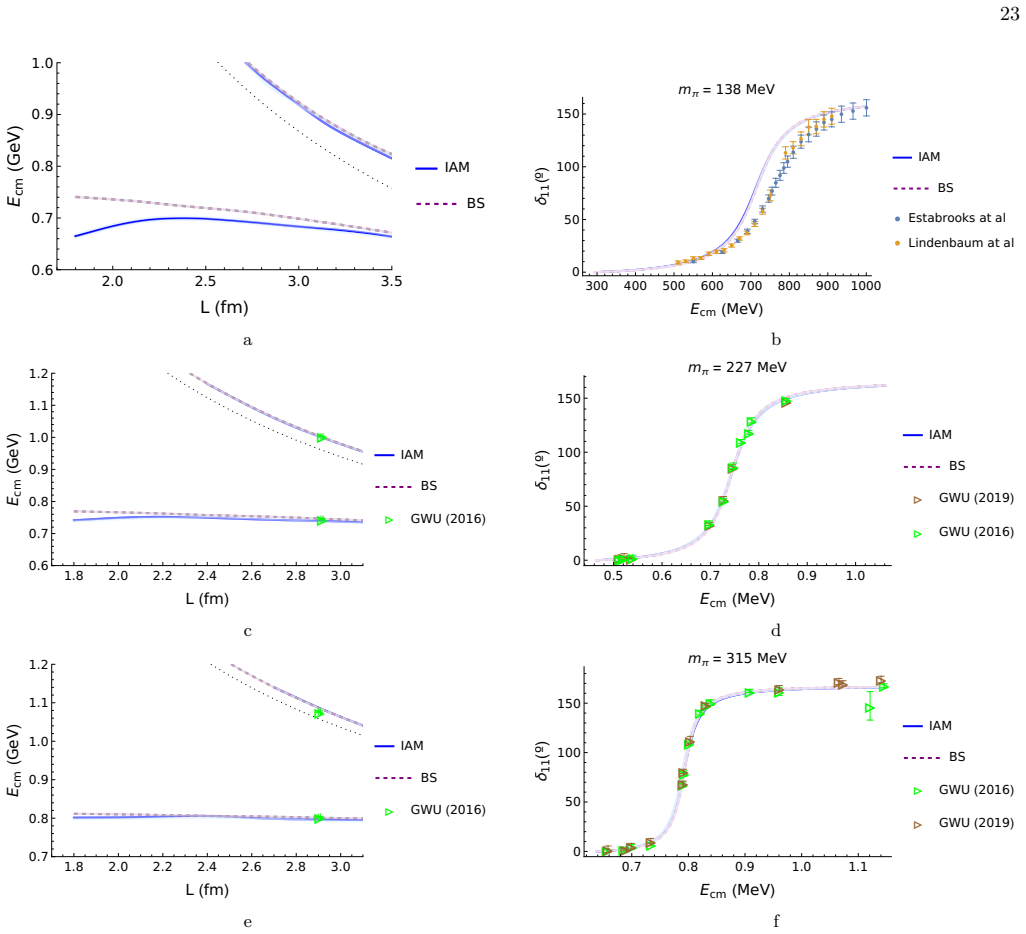
- The text explicitly states that 'both methods fail to describe the LQCD lowest energy level for I=1 and m_pi=227,315 MeV' and attributes this partly to the absence of strange-quark channels. This is a direct counterexample to the unqualified abstract claim of compatibility with lattice energy levels. Moreover, the single-channel restriction means kaon/eta loops are omitted even when the explored energies can reach the K Kbar threshold for the larger pion masses. The qualifications and the failure pattern should be moved into the abstract and conclusions, and the quantitative impact of the omitted channels should be estimated rather than stated only as a possibility.
- The numerical evaluation of the s-channel loop uses a cutoff q_max and a finite number of shells N_max; no systematic study of the dependence of the energy levels on q_max is presented. Since the main quantitative claim is that the new corrections are sizable for m_pi L < 2, a cutoff-convergence plot (e.g., energy levels vs q_max for a fixed L) is needed to ensure that the reported differences are physical and not truncation artifacts.
minor comments (5)
- 'we will follow the sane steps' should read 'same steps'.
- The spelling 'L¨ ushcer' should be 'Lüscher'.
- The index structure in t^{Gamma rr'}_{alpha alpha'} is confusing: earlier equations use beta for a contraction, but (36) drops beta. Please clarify the shell and irrep indices consistently.
- The notation 'lr_3 = 0.8 (3.8) × 10^{-3}' is nonstandard; specify whether the parentheses denote statistical uncertainty or a range of values.
- Panel labels are minimal; the caption should state that this is an internal consistency check and that both curves use the same amplitude, so agreement does not validate the t/u-channel reduction.
Circularity Check
Partially circular: Strategy B fits LECs to lattice phase shifts and then displays agreement with energy levels from the same LQCD ensembles; the claimed lattice compatibility is partly a consistency check. The finite-volume formalism itself is non-circular.
specific steps
-
fitted input called prediction
[Section VI.B ('Lattice data fit (StB)'), Figs. 11-13; cf. Abstract]
"In this section we fit the lattice data forππ phase shifts given in [23, 24, 82] within the full IAM framework and the BS method for comparison. The sets of LECs obtained are given in Tables I and II, that correspond to sets 2 and 4 for the IAM and BS, respectively. The results of these fits for the energy levels and phase shifts are given in Figs. 11, 12 and 13 for I = 0, 1 and 2, respectively. As it is shown, the IAM is able to reproduce reasonably well the phase shifts and energy levels for different pion masses."
The LECs are fitted to ππ phase shifts extracted from the same LQCD data [23,24,82] that provide the lattice energy levels plotted in Figs. 11-13. Since phase shifts and finite-volume energy levels from the same ensembles are related through the quantization condition, reproducing those levels after fitting the phase shifts is not an independent test; it is a consistency check forced by the fit. The abstract's unqualified claim of compatibility with lattice energy levels therefore rests in part on this circular comparison. Strategy A (fit to experiment, compare with lattice) and the mπ=60 MeV predictions remain independent.
full rationale
This is a mostly non-circular paper. The core technical content — the finite-volume ChPT amplitude in Eqs. (B1)-(B3), the generalized VP reduction in App. A, the octahedral projections, and the IAM quantization condition (62) — is derived from ChPT and the standard IAM, not obtained by fitting the targets. The import of the generalized VP identities from Ref. [66] is a technical citation to prior work, and although it is a self-citation by one of the authors, the identities are stated explicitly in Eqs. (A5)-(A11) and are not used as an unverifiable uniqueness argument. The one genuinely circular element is Strategy B (Sec. VI.B): LECs are fitted to lattice ππ phase shifts from Refs. [23,24,82], and the energy levels from the same lattice ensembles are then displayed as agreement in Figs. 11-13. Because phase shifts and energy levels from the same data are connected by the quantization condition, this agreement is a consistency check rather than an independent prediction; the abstract's compatibility claim is therefore partially strengthened by the fit. Strategy A (fit to experimental phase shifts) and the mπ=60 MeV extrapolation provide independent checks. Since the central formal results do not reduce to the fit, the overall circularity is partial, not total.
Axiom & Free-Parameter Ledger
free parameters (4)
- l^r_1 =
-3.95(0.09) (Set 1), -4.38(0.14) (Set 2)
- l^r_2 =
4.17(0.27) (Set 1), 5.31(0.29) (Set 2)
- l^r_3, l^r_4 =
0.8(3.8)e-3, 6.2(5.7)e-3
- qmax =
1.02 GeV for BS; not explicitly stated for IAM
axioms (5)
- domain assumption Poles of the finite-volume scattering amplitude give the same energy levels as the Lüscher quantization condition up to exponential corrections exp(-ML).
- domain assumption ChPT up to O(p^4), unitarized by IAM/mIAM, is a valid description of ππ scattering in the energy and pion-mass range considered.
- domain assumption The generalized Veltman-Passarino identities (A5)-(A11) hold for finite-volume sum-integrals.
- domain assumption A single ππ→ππ channel, with no kaon/eta loops, is sufficient for the numerical comparisons.
- domain assumption Partial waves with l ≤ 2 saturate the relevant energy levels in the rest frame.
read the original abstract
We study the effect of a finite volume for pion-pion scattering within Chiral Perturbation Theory (ChPT) and the Inverse Amplitude Method (IAM) in a $L^3$ box (rest frame). Our full ChPT calculation takes into account the discretization not only in the $s$-channel loops but also in the $t,u$- channels and tadpole contributions. Hence, not only the unitarity right-hand cut but also the left-hand one continuum contributions are calculated in the finite volume. A proper extension of the standard Veltman-Pasarino identities is needed, as well as a suitable projection on the internal space spanned by the irreducible representations (irreps) of the octahedral group, based on either a finite set of cubic harmonics or the matrices which represent the irreps properly. From the ChPT we construct the IAM in the internal space, which provides the full volume dependence of the interacting energy levels of two-pions scattering in the finite volume. Our results for various low-energy constants sets show sizable corrections with respect to previous analyses in the literature for $ m_\pi L \lesssim 2$, being compatible with energy levels lattice data. We expect that our analysis and results will help to optimize the process of determination of energy levels and phase-shifts with higher accuracy.
Figures





Reference graph
Works this paper leans on
-
[1]
Also, there is just one nonzero partial wave in this case, which is t11 00,00(E; L) = t A+ 1 11 11 = T 11(E, 0, 0; L)
r = r′ = 1: In this case, ⃗ p= ⃗ p′ = (0 , 0, 0), ϑ(r) = ϑ(r′) = 1, so that there is only one in- dependent function which can be chosen as [21] χ A+ 1 11 1 = X A+ 1 11 0 = Y00 = 1/ √ 4π, so that the only nonzero coefficient is ˆc A+ 1 11,1 00 = 1. Also, there is just one nonzero partial wave in this case, which is t11 00,00(E; L) = t A+ 1 11 11 = T 11(E,...
-
[2]
r = 1, r′ = 2: Here, ⃗ p= (0, 0, 0) and ⃗ p′ = g (1, 0, 0) with g any group element. The possible irreducible representations contributing to the χu functions in 3 Actually, in [28] it was shown within the finite volume BS ap- proach, that, for generic nonzero total momentum, ⃗P , partial waves with l ̸= l′ do mix, although for ⃗P = ⃗0, tlm,l′m′ is still ...
-
[3]
potential
r = r′ = 2: In this case, ⃗ p= g (1, 0, 0), ⃗ p′ = g′ (1, 0, 0) and Γ = A+ 1 , E+, T− 1 can enter in the sum of Eq. (48). The partial waves contributing are l = 0, 1, 2, which in principle could mix. How- ever, for the shells of type (0 , 0, a), see Eq. (30), the six X Γνα l contributing to the χΓα2 u satisfy that different values of l correspond to diffe...
2019
-
[4]
They are the generaliza- tion of the VP relations in the infinite volume case, aris- ing from Lorentz covariance, to the finite- V case where Lorentz covariance is lost
Reduction rules First, as mentioned in the main text, we will derive for- mal relations between different sum-integrals with powers of momenta in the numerator. They are the generaliza- tion of the VP relations in the infinite volume case, aris- ing from Lorentz covariance, to the finite- V case where Lorentz covariance is lost. In doing so, we will follo...
2016
-
[5]
q0-integration representation As customarily done in finite volume calculations, we perform the q0-integrals in (A1) and (A2) using Cauchy’s residue theorem, so that we are just left with frequency sums. Choosing the contour in q0 complex plane depicted in Fig.15, we pick up one of the two poles of JH at q0 = ±ωq ∓ iϵ with ωq = p | ⃗ q|2 + m2 and obtain J...
-
[6]
θ3 0; e− L2 ˜M 2 (x,E)2 4λ 3 − 1 # (A28) ∆Jt,u(E, ⃗Q; L) = 1 8π2 X ⃗k̸=⃗0 Z 1 0 dx eiL(1−x) ⃗Q·⃗kK0 L ˜mQ(x; Q)|⃗k| = 1 16π2 Z 1 0 dx Z ∞ 0 dλ λ e−λ
Poisson summation formula representation An alternative representation for the sum-integrals comes from the use of the Poisson summation formula: 1 L3 X ⃗ q= 2π⃗ n L f (⃗ q) = X ⃗ q Z dp3 (2π)3 eiL ⃗ n.⃗ pf (x) = Z d3p (2π)3 f (⃗ p) + X ⃗ n̸=0 Z d3p (2π)3 eiL ⃗ n.⃗ pf (⃗ q) (A26) 28 where the first term on the r.h.s. is the L → ∞con- tribution. Using (A26...
-
[7]
R. A. Briceno, J. J. Dudek and R. D. Young, Rev. Mod. Phys. 90, no.2, 025001 (2018)
2018
-
[8]
S. R. Beane, T. C. Luu, K. Orginos, A. Parreno, M. J. Savage, A. Torok and A. Walker-Loud, Phys. Rev. D 77, 014505 (2008)
2008
-
[9]
X. Feng, K. Jansen and D. B. Renner, Phys. Lett. B 684, 268-274 (2010)
2010
-
[10]
S. R. Beane et al. [NPLQCD], Phys. Rev. D 85, 034505 (2012)
2012
-
[11]
Fu, Commun
Z. Fu, Commun. Theor. Phys. 57, 78-84 (2012)
2012
-
[12]
J. J. Dudek et al. [Hadron Spectrum], Phys. Rev. D 88, no.9, 094505 (2013)
2013
-
[13]
J. J. Dudek et al. [Hadron Spectrum], Phys. Rev. Lett. 113, no.18, 182001 (2014)
2014
-
[14]
Culver, M
C. Culver, M. Mai, A. Alexandru, M. D¨ oring and F. X. Lee, Phys. Rev. D 100, no.3, 034509 (2019)
2019
-
[15]
M. Mai, C. Culver, A. Alexandru, M. D¨ oring and F. X. Lee, Phys. Rev. D 100, no.11, 114514 (2019)
2019
-
[16]
Werner et al
M. Werner et al. [Extended Twisted Mass], Eur. Phys. J. A 56, no.2, 61 (2020)
2020
-
[17]
Fischer, B
M. Fischer, B. Kostrzewa, L. Liu, F. Romero-L´ opez, M. Ueding and C. Urbach, Eur. Phys. J. C 81, no.5, 436 (2021)
2021
-
[18]
Mai et al
M. Mai et al. [GWQCD], Phys. Rev. Lett. 127, no.22, 222001 (2021)
2021
-
[19]
Luscher, Commun
M. Luscher, Commun. Math. Phys. 105, 153-188 (1986)
1986
-
[20]
Luscher, Nucl
M. Luscher, Nucl. Phys. B 354, 531-578 (1991)
1991
-
[21]
Polejaeva and A
K. Polejaeva and A. Rusetsky, Eur. Phys. J. A 48, 67 (2012)
2012
-
[22]
R. A. Briceno and Z. Davoudi, Phys. Rev. D 87, no.9, 094507 (2013)
2013
-
[23]
M. T. Hansen and S. R. Sharpe, Phys. Rev. D 90, no.11, 116003 (2014)
2014
-
[24]
M. T. Hansen and S. R. Sharpe, Phys. Rev. D 92, no.11, 114509 (2015)
2015
-
[25]
Mai and M
M. Mai and M. D¨ oring, Eur. Phys. J. A 53, no.12, 240 (2017)
2017
-
[26]
H. W. Hammer, J. Y. Pang and A. Rusetsky, JHEP 10, 115 (2017)
2017
-
[27]
D¨ oring, H
M. D¨ oring, H. W. Hammer, M. Mai, J. Y. Pang, A. Rusetsky and J. Wu, Phys. Rev. D 97, no.11, 114508 (2018)
2018
-
[28]
D. J. Wilson, R. A. Briceno, J. J. Dudek, R. G. Edwards and C. E. Thomas, Phys. Rev. D92, no.9, 094502 (2015)
2015
-
[29]
D. Guo, A. Alexandru, R. Molina and M. D¨ oring, Phys. Rev. D 94, no.3, 034501 (2016)
2016
-
[30]
D. Guo, A. Alexandru, R. Molina, M. Mai and M. D¨ oring, Phys. Rev. D 98, no.1, 014507 (2018)
2018
-
[31]
Sadasivan, A
D. Sadasivan, A. Alexandru, H. Akdag, F. Amorim, R. Brett, C. Culver, M. D¨ oring, F. X. Lee and M. Mai, Phys. Rev. D 105, no.5, 054020 (2022)
2022
-
[32]
M. Mai, M. D¨ oring, C. Culver and A. Alexandru, Phys. Rev. D 101, no.5, 054510 (2020)
2020
-
[33]
M. T. Hansen et al. [Hadron Spectrum], Phys. Rev. Lett. 126, 012001 (2021)
2021
-
[34]
Doring, U
M. Doring, U. G. Meissner, E. Oset and A. Rusetsky, Eur. Phys. J. A 48, 114 (2012)
2012
-
[35]
Sato and P
I. Sato and P. F. Bedaque, Phys. Rev. D 76, 034502 (2007)
2007
-
[36]
Molina and M
R. Molina and M. D¨ oring, Phys. Rev. D94, no.5, 056010 (2016)
2016
-
[37]
B. Hu, R. Molina, M. D¨ oring and A. Alexandru, Phys. Rev. Lett. 117, no.12, 122001 (2016)
2016
-
[38]
Z. Zhuang, R. Molina, J. X. Lu and L. S. Geng, [arXiv:2405.07686 [hep-ph]]
-
[39]
Gil-Dom ´ ınguez and R
F. Gil-Dom ´ ınguez and R. Molina, Phys. Rev. D 109, no.9, 096002 (2024)
2024
-
[40]
F. Gil-Dom ´ ınguez, A. Giachino and R. Molina, [arXiv:2409.15141 [hep-ph]]
-
[41]
M. Mai, M. D¨ oring and A. Rusetsky, Eur. Phys. J. ST 230, 1623-1643 (2021)
2021
-
[42]
Doring, U
M. Doring, U. G. Meissner, E. Oset and A. Rusetsky, Eur. Phys. J. A 47, 139 (2011)
2011
-
[43]
H. X. Chen and E. Oset, Phys. Rev. D 87, no.1, 016014 (2013)
2013
-
[44]
Rummukainen and S
K. Rummukainen and S. A. Gottlieb, Nucl. Phys. B 450, 397-436 (1995)
1995
-
[45]
C. h. Kim, C. T. Sachrajda and S. R. Sharpe, Nucl. Phys. B 727, 218-243 (2005)
2005
-
[46]
S. Bour, S. Koenig, D. Lee, H. W. Hammer and U. G. Meissner, Phys. Rev. D 84, 091503 (2011)
2011
-
[47]
Davoudi and M
Z. Davoudi and M. J. Savage, Phys. Rev. D 84, 114502 (2011)
2011
-
[48]
Weinberg, Physica A 96 (1979) no.1-2, 327-340
S. Weinberg, Physica A 96 (1979) no.1-2, 327-340
1979
-
[49]
Gasser and H
J. Gasser and H. Leutwyler, Annals Phys. 158 (1984), 142 34 Irreducible characters of Oh Irreps I 8C3 6C4 6C ′ 2 3C2 A1 1 1 1 1 1 A2 1 1 −1 −1 1 E 2 −1 0 0 2 T1 3 0 1 −1 −1 T2 3 0 −1 1 −1 θk 2π 2π/3 π/2 π π TABLE IV: Irreducible characters for each Irrep, and corresponding angle of rotation θ per class. Reduction lP 0+ A+ 1 1− T − 1 2+ E+ ⊕ T + 2 3− A− 2 ...
1984
-
[50]
Gasser, H
J. Gasser, H. Leutwyler, Nucl. Phys. B250 (1985) 465– 516
1985
-
[51]
Scherer, Adv
S. Scherer, Adv. Nucl. Phys. 27 (2003), 277
2003
-
[52]
A. B. Raposo, R. A. Brice˜ no, M. T. Hansen and A. W. Jackura, JHEP 06, 186 (2025)
2025
-
[53]
A. B. Raposo and M. T. Hansen, JHEP 08, 075 (2024)
2024
-
[54]
M. T. Hansen, F. Romero-L´ opez and S. R. Sharpe, JHEP 06, 051 (2024)
2024
-
[55]
Nebreda, J
J. Nebreda, J. R. Pelaez and G. Rios, Phys. Rev. D 83, 094011 (2011)
2011
-
[56]
Aoki et al
Y. Aoki et al. [Flavour Lattice Averaging Group (FLAG)], Eur. Phys. J. C 82, no.10, 869 (2022)
2022
-
[57]
P. F. Bedaque, I. Sato and A. Walker-Loud, Phys. Rev. D 73, 074501 (2006)
2006
-
[58]
Albaladejo, J
M. Albaladejo, J. A. Oller, E. Oset, G. Rios and L. Roca, JHEP 08, 071 (2012)
2012
-
[59]
M. Albaladejo, G. Rios, J. A. Oller and L. Roca, [arXiv:1307.5169 [hep-lat]]
-
[60]
T. N. Truong, Phys. Rev. Lett. 61, 2526 (1988)
1988
-
[61]
Dobado, M
A. Dobado, M. J. Herrero and T. N. Truong, Phys. Lett. B 235, 134 (1990)
1990
-
[62]
Dobado and J
A. Dobado and J. R. Pelaez, Phys. Rev. D 47, 4883-4888 (1993)
1993
-
[63]
Dobado and J
A. Dobado and J. R. Pelaez, Phys. Rev. D 56, 3057 (1997)
1997
-
[64]
J. A. Oller and E. Oset, Nucl. Phys. A 620, 438 (1997) Erratum: [Nucl. Phys. A 652, 407 (1999)]
1997
-
[65]
J. A. Oller, E. Oset and J. R. Pelaez, Phys. Rev. D 59, 074001 (1999) Erratum: [Phys. Rev. D 60, 099906 (1999)] Erratum: [Phys. Rev. D 75, 099903 (2007)]
1999
-
[66]
G´ omez Nicola and J
A. G´ omez Nicola and J. R. Pelaez, Phys. Rev. D 65, 054009 (2002)
2002
-
[67]
G´ omez Nicola, J
A. G´ omez Nicola, J. R. Pelaez and G. Rios, Phys. Rev. D 77, 056006 (2008)
2008
-
[68]
Hanhart, J
C. Hanhart, J. R. Pelaez and G. Rios, Phys. Rev. Lett. 100 (2008), 152001
2008
-
[69]
Molina and J
R. Molina and J. Ruiz de Elvira, JHEP 11 (2020), 017
2020
-
[70]
Passarino and M
G. Passarino and M. J. G. Veltman, Nucl. Phys. B 160, 151-207 (1979)
1979
-
[71]
Bijnens, E
J. Bijnens, E. Bostr¨ om and T. A. L¨ ahde, JHEP 01 (2014), 019
2014
-
[72]
G´ omez Nicola, F
A. G´ omez Nicola, F. J. Llanes-Estrada and J. Pelaez, Phys. Lett. B 550, 55-64 (2002)
2002
-
[73]
G´ omez Nicola, J
A. G´ omez Nicola, J. R. de Elvira and A. Vioque- Rodr ´ ıguez, JHEP08, 148 (2023)
2023
-
[74]
G´ omez Nicola, J
A. G´ omez Nicola, J. R. Pel´ aez and G. R ´ ıos, Phys. Rev D 77, 056006 (2008)
2008
-
[75]
Bernard, M
V. Bernard, M. Lage, U. G. Meissner and A. Rusetsky, JHEP 08, 024 (2008)
2008
-
[76]
Gockeler, R
M. Gockeler, R. Horsley, M. Lage, U. G. Meiss- ner, P. E. L. Rakow, A. Rusetsky, G. Schierholz and J. M. Zanotti, Phys. Rev. D 86, 094513 (2012)
2012
-
[77]
Jonhson, Phys
R.C. Jonhson, Phys. Rev. Letter B 114, Issues 2-3 (1982), pages 147 - 151
1982
-
[78]
Estabrooks et al., AIP Conf
P. Estabrooks et al., AIP Conf. Proc. 13(1973) 37
1973
-
[79]
J. R. Batley et al. (NA48/2), Eur. Phys. J. C 54, 411–423 (2008)
2008
-
[80]
C. D. Froggatt and J. L. Petersen, Nucl. Phys. B 129, 35 89–110 (1977)
1977
discussion (0)
Sign in with ORCID, Apple, or X to comment. Anyone can read and Pith papers without signing in.