REVIEW 3 major objections 3 minor 31 references
For RN–AdS black holes, the image size evolves monotonically along isobars but nonmonotonically along isotherms, and a critical reduced temperature splits isothermal evolution into two visually distinct regimes.
Reviewed by Pith at T0; open to challenge. T0 means a machine referee read the full paper against a public rubric. the ladder, T0–T4 →
For charged AdS black holes, shadow and disk image sizes grow monotonically along isobars but are nonmonotonic along isotherms, with a critical temperature separating two qualitatively different image evolutions.
T0 review reviewed 2026-08-03 challenge →
load-bearing objection The paper has a genuinely new idea—image evolution encodes ensemble and temperature—but the printed reduced equations (3.26)–(3.27) don't follow from the substitution, making the universal claims unreproducible as written. the 3 major comments →
Black hole images as probes of thermodynamic evolution
The pith
A machine-rendered reading of the paper's core claim, the machinery that carries it, and where it could break.
The reading
Core claim
The central discovery is that the shadow angle ξ_c(r_h) is governed by the sign of k₁ dM/dr_h + k₂ dP/dr_h with nonnegative coefficients, so monotonicity is decided purely by the ensemble-specific derivatives. Along isobars the first law forces dM/dr_h > 0, making the image grow monotonically; along isotherms dP/dr_h is negative at small radii, producing a dip. Using the Maxwell equal-area construction, the paper proves the image always increases across the phase transition (ξ(r_{h,l}) ≥ ξ(r_{h,s})), and it defines a critical reduced temperature T̃₀,c that separates two evolutionary patterns—monotone-then-increase versus dip-then-increase before the transition.
What carries the argument
The analytic identity dh/dr_h = g/(2U(r_ps)) with h g = k₁ dM/dr_h + k₂ dP/dr_h, where k₁ and k₂ are nonnegative, reduces shadow monotonicity to thermodynamic derivatives. This is supplemented by charge-rescaling reduced variables (r̃_h, M̃, P̃, T̃) that eliminate Q, leaving only the reduced temperature as a control parameter, and by the critical reduced temperature T̃₀,c defined as the intersection of the reduced small-black-hole radius curve and the extremal-radius curve in the (T̃₀, r̃_h) plane.
Load-bearing premise
The paper assumes, from a few numerical examples, that accretion-disk image angles ξ_n always track the shadow angle ξ_c in monotonicity and extremum location (Sec. III: 'These plots reveal a striking feature' and 'The same conclusion is expected to hold'); if a generic disk model breaks this tracking, the observational claim for accretion disks fails even if the shadow result stands.
What would settle it
Compute ξ_n(r_h) for an isothermal RN–AdS black hole with a thin accretion disk at an intermediate emission radius, such as r_e between the ISCO and several times the ISCO, and check whether the extremum of ξ_n in r_h coincides with the shadow's extremum. Any configuration in which the disk-image extremum falls on the opposite side of the small-black-hole transition radius, or in which monotonicity differs from the shadow, would falsify the 'same behavior' assumption on which the disk diagnostic rests.
If this is right
- A time series of the shadow's angular size could in principle distinguish isobaric from isothermal accretion phases around charged AdS black holes.
- A sudden enlargement of the image remains a robust phase-transition signature in both ensembles, but is not by itself sufficient to identify the ensemble.
- Isothermal evolution below the critical reduced temperature shows a monotonically shrinking shadow before the transition, while above it the shadow dips and then rises—two observationally separable patterns.
- Because the reduced variables eliminate the charge Q, the predicted monotonic behaviors and the critical temperature are universal for all RN–AdS black holes.
- If accretion-disk images track the shadow as computed, the same diagnostic works without needing an idealized background light source, potentially easing observational access.
Where Pith is reading between the lines
- The framework could be tested dynamically: if a real accretion phase evolves on timescales accessible to horizon-scale movies, the monotonicity signature might be extracted from a sequence of images, though the paper itself does not address timescales.
- The critical reduced temperature ≈0.89 may be a dimensionless feature that reappears as a universal ordering number in other charged AdS systems with similar van der Waals phase structures—an extension the paper suggests but does not prove.
- An alternative observable that could be more robust to unknown observer distance is the ratio ξ_c/ξ_n between shadow and disk-image angles; the paper does not compute this, but it would inherit the same monotonicity diagnostics.
- The nonmonotonicity criterion is derived for spherically symmetric spacetimes and may not directly transfer to rotating black holes, where the shadow shape varies with inclination; adapting the criterion would require a separate analysis.
Editorial analysis
A structured set of objections, weighed in public.
Referee Report
Summary. The paper studies the evolution of black hole shadow and accretion-disk image angular sizes for the Reissner-Nordström-AdS black hole along isobaric and isothermal thermodynamic paths. It derives a sign criterion (Eqs. 3.9–3.18) showing that the monotonicity of the shadow angle is controlled by dM/dr_h and dP/dr_h. Along isobars the shadow is monotonic; along isotherms it is nonmonotonic. When a small/large black hole phase transition occurs, the paper claims that the image size always jumps upward, and that in the isothermal case a critical reduced temperature separates two qualitatively different evolutions. The same behavior is asserted for accretion-disk images based on numerical examples. The abstract and conclusions present these as proofs.
Significance. If the results are correct, this is a useful conceptual step: it would extend the known phase-transition imprints on black hole images to a distinction between isobaric and isothermal ensembles, and even to temperature discrimination within an isothermal ensemble. The analytic sign argument in Sec. III is elegant, and the idea of eliminating the charge Q by reduced variables is attractive. The paper also makes a falsifiable prediction—a sudden increase in image size across the phase transition—that could in principle be tested against future high-resolution observations. However, because the central reduced-variable formulas appear to be wrong as printed, the universality, the critical temperature, and the isothermal jump claim are not currently reproducible from the manuscript.
major comments (3)
- [Sec. III, Eqs. (3.26)–(3.27)] The reduced equations do not follow from the definitions (3.22)–(3.23). Direct substitution of r_h = sqrt(6)Q x, T_0 = T_c \tilde T_0, M_c = 2sqrt(6)Q/3, P_c = 1/(96πQ^2), T_c = 1/(3sqrt(6)πQ) into (3.5)–(3.6) gives \tilde M = (1 + 3x^2 + 2\tilde T_0 x^3)/(6x) and \tilde P = (1 – 6x^2 + 8\tilde T_0 x^3)/(3x^4), not the printed expressions containing 12√6π and 24π. These equations are the basis for the Maxwell construction, the extremal radius \tilde r_{h,e}, the critical temperature \tilde T_{0,c} in Fig. 7, and the inequality (3.29) in Fig. 10. As written, the paper's main new claims are not reproducible, and a reader reproducing the printed formulas will obtain different transition radii and possibly no critical temperature. This is a load-bearing error that must be fixed and the numerical scans rerun with the correct reduction.
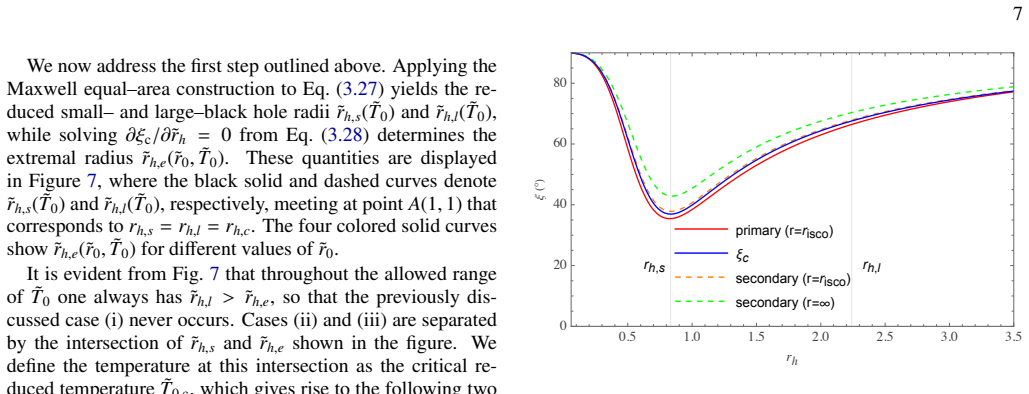
- [Sec. III, Figs. 7 and 10, and Eq. (3.29)] The statement that the isothermal phase transition always yields a sudden increase in the shadow size is presented as a proof, but the support is a numerical scan over \tilde T_0 (Fig. 7 and Fig. 10). The inequality (3.29) is read off from finite numeric data, not derived. Also, \tilde T_{0,c} appears to depend on the observer position \tilde r_0: Fig. 7 shows different intersections for \tilde r_0 = 10, 20, 1000, +∞, yet the text refers to a single 'critical reduced temperature' and uses it without specifying the observer position in Figs. 8–9. This needs to be clarified, and the claim should be explicitly labeled as numerical evidence unless an analytic proof is supplied.
- [Sec. III, 'These plots reveal a striking feature' and 'The same conclusion is expected to hold for accretion-disk images] The paper's title, abstract, and conclusions refer to 'black hole images' generally, including accretion-disk images, but the equal monotonic behavior and identical extrema of ξ_n(r_h) relative to ξ_c(r_h) are asserted without derivation. Only a few numerical configurations are shown (Figs. 3–6, 8–9). If a generic disk model does not track the shadow angle, the claims about disk images as probes of thermodynamic ensemble and temperature would not hold. This should be either proven or explicitly restricted to the shadow, with disk claims presented as numerical observations for the specific disk model used.
minor comments (3)
- [Eq. (3.8)] The notation '√U(r0)pU(rps)' appears garbled; it should be \sqrt{U(r_0)}/\sqrt{U(r_{ps})}, since the subsequent definition of h requires this ratio. Please correct the formula.
- [Eq. (3.25) and Fig. 7] The paper should state explicitly that \tilde r_0 is a free parameter and that the critical reduced temperature \tilde T_{0,c} depends on it. The caption of Fig. 7 uses nonstandard notation for the curves, which should be cleaned up.
- [Conclusions, Sec. IV] Minor wording: 'exhibits qualitatively differences' should read 'exhibits qualitatively different behaviors' or similar. Also, the phrase 'these results show that black hole images can probe ... thermodynamic process and temperature' is stronger than what is demonstrated for accretion-disk images; consider qualifying it.
Circularity Check
No construction-level circularity; the central shadow-size derivation is self-contained, with only a minor non-load-bearing self-citation.
full rationale
Walking the derivation chain, the main claims do not reduce to their inputs. The shadow-size monotonicity analysis is analytic: Eq. (3.17) gives h g = k1 dM/drh + k2 dP/drh with k1,k2 >= 0, and the signs are determined from the thermodynamic derivatives (3.20)-(3.21), not from any fitted quantity. Although drps/drh appears in Eq. (3.13), it cancels identically through the photon-sphere condition (3.14), so the earlier self-cited monotonicity criterion [30] is not load-bearing for the shadow result. The isothermal critical reduced temperature is defined as the intersection of the computed curves rh,s and rh,e (Fig. 7); the split into cases (ii)/(iii) and the inequality (3.29) are evaluated from the same formulas, not assumed. No parameter is fit to data and then renamed a prediction. The accretion-disk extension is supported only by selected numerical configurations and is explicitly labeled as expected, which is an extrapolation rather than a circular inference. A separate correctness caveat: substituting (3.5)-(3.6) into (3.22)-(3.23) yields M~ = (1+3r~h^2+2T~0 r~h^3)/(6 r~h) and P~ = (1-6r~h^2+8T~0 r~h^3)/(3 r~h^4), not the printed (3.26)-(3.27); this threatens reproducibility of the universal scan but is an algebraic error, not a construction-level equivalence. The only self-citation, [30] for the r_ps monotonicity criterion, is motivational rather than the basis of the central proof; hence score 2 with no circular step identified.
Axiom & Free-Parameter Ledger
free parameters (1)
- observer position r0 (or r̃0) =
r̃0 = 10, 20, 1000, ∞ in numerics
axioms (6)
- domain assumption Extended phase-space thermodynamics: Λ (or ℓ) treated as thermodynamic pressure P and black hole mass M as enthalpy
- domain assumption First law dM = T dS (isobaric) and dM = T dS + V dP (isothermal) with T>0; along isobar the physical branch is cut at dM/dr_h=0
- domain assumption Photon-sphere monotonicity criterion dr_ps/dr_h = -(1/Γ0)(dM/dr_h) ∂_M Φ0 with Γ0<0 and ∂_M Φ0>0, imported from companion paper [30]
- domain assumption Only photons with impact parameter b<ℓ contribute to the image; observer placed outside the photon sphere so that r0>r_A
- domain assumption Accretion disk modeled as equatorial thin disk with emitters at r_e = r_ISCO and r_e → ∞; observer at north pole; only primary/secondary images n=1,2
- standard math Maxwell equal-area construction selects coexisting small/large black hole radii r_h,s and r_h,l
Cite this review
Pith. "Pith review of Black hole images as probes of thermodynamic evolution." pith.science (2026). https://pith.science/paper/7SISVX3E
@misc{pith2026251224174,
  author       = {Pith},
  title        = {Pith review of: Black hole images as probes of thermodynamic evolution},
  year         = {2026},
  howpublished = {\url{https://pith.science/paper/7SISVX3E}},
  note         = {Machine review of arXiv:2512.24174}
}
read the original abstract
Observable signatures of black hole thermodynamics remain far from fully explored. Previous works have suggested that thermodynamic phase transitions of black holes could leave imprints on their images. In this work, we demonstrate that richer black hole thermodynamic information can also leave imprints on the resulting images. Using the charged anti-de Sitter black hole as an example, we study the evolution of its images (shadow and accretion-disk images) along isobaric and isothermal processes. We find that the image size evolves monotonically along isobars but becomes nonmonotonic along isotherms. After further considering phase transitions, the image size exhibits a sudden increase in both thermodynamic processes. More importantly, in the isothermal process, the phase transition further results in the emergence of a critical reduced temperature that separates two qualitatively distinct image evolutions. These results show that black hole images can probe not only phase transitions, but also thermodynamic process and temperature.
Figures




Reference graph
Works this paper leans on
-
[1]
Akiyamaet al.(Event Horizon Telescope Collaboration), First M87 Event Horizon Telescope results
K. Akiyamaet al.(Event Horizon Telescope Collaboration), First M87 Event Horizon Telescope results. VI. The shadow and mass of the central black hole, Astrophys. J. Lett.875, L6 (2019)
2019
-
[2]
P. V . P. Cunha, N. A. Eir´o, C. A. R. Herdeiro, and J. P. S. Lemos, Lensing and shadow of a black hole surrounded by a heavy ac- cretion disk, J. Cosmol. Astropart. Phys. 03 (2020) 035
2020
-
[3]
Naveena Kumara, C
A. Naveena Kumara, C. L. Ahmed Rizwan, S. Punacha, K. M. Ajith, and M. S. Ali, Photon orbits and thermodynamic phase transition of regular AdS black holes, Phys. Rev. D102, 084059 (2020)
2020
-
[4]
Xu, H.-M
Y .-M. Xu, H.-M. Wang, Y .-X. Liu, and S.-W. Wei, Photon sphere and reentrant phase transition of charged Born-Infeld- AdS black holes, Phys. Rev. D100, 104044 (2019)
2019
-
[5]
Chabab, H
M. Chabab, H. El Moumni, S. Iraoui, and K. Masmar, Prob- ing correlation between photon orbits and phase structure of charged AdS black hole in massive gravity background, Int. J. Mod. Phys. A34, 1950231 (2020). 9
2020
-
[6]
Guerrero, G
M. Guerrero, G. J. Olmo, D. Rubiera-Garcia, and D. S.- C. G ´omez, Shadows and optical appearance of black bounces illuminated by a thin accretion disk, J. Cosmol. Astropart. Phys. 08 (2021) 036
2021
-
[7]
Bronzwaer and H
T. Bronzwaer and H. Falcke, The nature of black hole shadows, Astrophys. J.920, 155 (2021)
2021
-
[8]
Du, H.-F
Y .-Z. Du, H.-F. Li, F. Liu, and L.-C. Zhang, Photon orbits and phase transition for non-linear charged anti-de Sitter black holes, J. High Energy Phys. 01 (2023) 137
2023
-
[9]
J. Yang, C. Zhang, and Y . Ma, Shadow and stability of quantum- corrected black holes, Eur. Phys. J. C83, 619 (2023)
2023
-
[10]
You, Y .-H
L. You, Y .-H. Feng, R.-B. Wang, X.-R. Hu, and J.-B. Deng, De- coding quantum gravity information with black hole accretion disk, Universe10, 393 (2024)
2024
-
[11]
L. You, R.-b. Wang, S.-J. Ma, J.-B. Deng, and X.-R. Hu, Opti- cal properties of Euler-Heisenberg black hole in the Cold Dark Matter Halo, arXiv:2403.12840
-
[12]
S. W. Hawking and D. N. Page, Thermodynamics of black holes in anti-de Sitter space, Commun. Math. Phys.87, 577 (1983)
1983
-
[13]
Kastor, S
D. Kastor, S. Ray, and J. Traschen, Enthalpy and the mechan- ics of AdS black holes, Classical Quantum Gravity26, 195011 (2009)
2009
-
[14]
B. P. Dolan, The cosmological constant and black-hole ther- modynamic potentials, Classical Quantum Gravity28, 125020 (2011)
2011
-
[15]
Cvetic, G
M. Cvetic, G. W. Gibbons, D. Kubiznak, and C. N. Pope, Black hole enthalpy and an entropy inequality for the thermodynamic volume, Phys. Rev. D84, 024037 (2011)
2011
-
[16]
Banerjee and D
R. Banerjee and D. Roychowdhury, Thermodynamics of phase transition in higher dimensional AdS black holes, J. High En- ergy Phys. 11 (2011) 004
2011
-
[17]
Banerjee, S
R. Banerjee, S. K. Modak, and D. Roychowdhury, A unified picture of phase transition: From liquid-vapour systems to AdS black holes, J. High Energy Phys. 10 (2012) 125
2012
-
[18]
Kubiznak and R
D. Kubiznak and R. B. Mann, P-V criticality of charged AdS black holes, J. High Energy Phys. 07 (2012) 033
2012
-
[19]
Wei and Y .-X
S.-W. Wei and Y .-X. Liu, Critical phenomena and thermody- namic geometry of charged Gauss-Bonnet AdS black holes, Phys. Rev. D87, 044014 (2013)
2013
-
[20]
Cai, L.-M
R.-G. Cai, L.-M. Cao, L. Li, and R.-Q. Yang, P-V criticality in the extended phase space of Gauss-Bonnet black holes in AdS space, J. High Energy Phys. 09 (2013) 005
2013
-
[21]
Altamirano, D
N. Altamirano, D. Kubiz ˇn´ak, R. B. Mann, and Z. Sherkat- ghanad, Kerr-AdS analogue of triple point and solid/liquid/gas phase transition, Classical Quantum Gravity31, 042001 (2014)
2014
-
[22]
Altamirano, D
N. Altamirano, D. Kubiznak, and R. B. Mann, Reentrant phase transitions in rotating anti-de Sitter black holes, Phys. Rev. D 88, 101502 (2013)
2013
-
[23]
A. M. Frassino, D. Kubiznak, R. B. Mann, and F. Simovic, Mul- tiple reentrant phase transitions and triple points in Lovelock thermodynamics, J. High Energy Phys. 09 (2014) 080
2014
-
[24]
Wei and Y .-X
S.-W. Wei and Y .-X. Liu, Triple points and phase diagrams in the extended phase space of charged Gauss-Bonnet black holes in AdS space, Phys. Rev. D90, 044057 (2014)
2014
-
[25]
Kubiznak, R
D. Kubiznak, R. B. Mann, and M. Teo, Black hole chemistry: Thermodynamics with Lambda, Classical Quantum Gravity34, 063001 (2017)
2017
-
[26]
Wei and Y .-X
S.-W. Wei and Y .-X. Liu, Photon orbits and thermodynamic phase transition ofd-dimensional charged AdS black holes, Phys. Rev. D97, 104027 (2018)
2018
-
[27]
Wei, Y .-X
S.-W. Wei, Y .-X. Liu, and Y .-Q. Wang, Probing the relationship between the null geodesics and thermodynamic phase transition for rotating Kerr-AdS black holes, Phys. Rev. D99, 044013 (2019)
2019
-
[28]
Zhang, S.-Z
M. Zhang, S.-Z. Han, J. Jiang, and W.-B. Liu, Circular orbit of a test particle and phase transition of a black hole, Phys. Rev. D 99, 065016 (2019)
2019
-
[29]
Zhang and M
M. Zhang and M. Guo, Can shadows reflect phase structures of black holes?, Eur. Phys. J. C80, 790 (2020)
2020
-
[30]
L. You and J. Yang, Revisiting particle circular orbits as probes of black hole thermodynamics, arXiv:2512.17642
-
[31]
Perlick and O
V . Perlick and O. Y . Tsupko, Calculating black hole shadows: Review of analytical studies, Phys. Rept.947, 1 (2022)
2022
This paper was first reviewed by deepseek-v4-flash on August 3, 2026.
discussion (0)
Sign in with ORCID, Apple, or X to comment. Anyone can read and Pith papers without signing in.