REVIEW 3 major objections 4 minor 39 references
Spectral and Spatial Graph Learning for Multispectral Solar Image Compression
T0 review · 3 major / 4 minor · reviewed 2026-08-03 · deepseek-v4-flash
Pith's one-line read Treating solar wavelength bands as graph nodes lets a learned compressor cut spectral divergence by 20.15% while sharpening spatial detail at the same bitrate.
desk verdict A coherent graph-based multispectral compressor with a real architectural novelty, but the headline gains are measured against the authors' own ablations, not against an external state of the art. read the letter →
The pith
A machine-rendered reading of the paper's core claim, the machinery that carries it, and where it could break.
The reading
What carries the argument
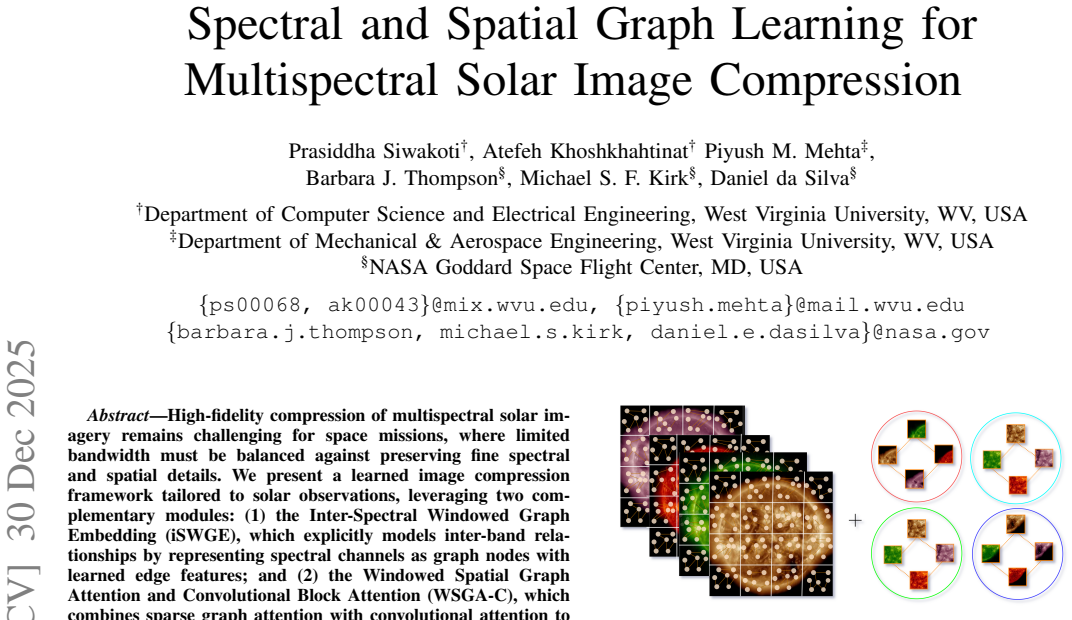
Two modules named iSWGE and WSGA-C. iSWGE groups bands into nodes, forms a static cyclic graph over adjacent bands, encodes edge features as absolute differences of pooled band descriptors, and refines node/edge embeddings jointly; WSGA-C sparsifies local self-attention via k-nearest-neighbor graphs and adds a windowed convolutional attention branch. The two are concatenated through a 1x1 convolution, and the whole sits inside a standard learned transform codec with a channel-wise autoregressive entropy model.
What would settle it
Run the identical six-channel, same-bitrate evaluation with the excluded published multispectral transformer compressor included; if that model matches or exceeds the reported PSNR and MSID at the same bits-per-pixel, the claimed improvement over current learned compression does not stand. A second check: retrain on all ten AIA channels and see if the 20.15% MSID gain persists or reverses, as the paper's own preliminary tests predict degradation.
Extended reading notes
Core claim
On the paper's terms: a graph representation of spectral channels, with nodes as bands and edges encoding local spectral contrast between adjacent bands, is refined through a co-embedding mechanism so that node and edge features update each other; concatenating these spectral embeddings with CNN spatial features, and then passing the mix through a sparsified windowed graph-attention plus convolutional-attention block, yields a latent representation that entropy-codes more efficiently. The authors show on the SDOML six-EUV-channel subset that this architecture dominates both a per-channel baseline and a jointly-encoded multi-channel baseline built from the same attention-based codec, at match
Load-bearing premise
The reported superiority rests on the comparison baselines being strong representatives of current learned multispectral compression; the baselines are the authors' own CNN-attention model variants, and the most directly relevant published transformer-based multispectral compressor is excluded from the comparison.
Editorial extensions
If this is right
- If correct, the spectral graph module is a drop-in front-end for multispectral learned codecs: it cuts MSID by 20.15% at higher bitrates with modest FLOP and memory overhead (Table I).
- The static cyclic spectral topology is cheap enough for onboard use: added encode/decode time is about 19 ms / 21 ms over the jointly-encoded baseline.
- Per the ablation, WSGA-C alone does not beat the baseline in PSNR; the reported gain comes from the combination, so the spatial module's value is in structural and perceptual quality rather than raw pixel fidelity.
- Because 3D-SPIHT, a classical multispectral codec, is included as a traditional baseline, the paper expects the same graph architecture to generalize to other multispectral scientific imagery, not just solar EUV.
Reading between the lines
- The paper's preliminary note that adding more than six AIA channels reduces cross-channel correlation and hurts compression suggests the static adjacent-band graph may not scale to the full ten-band set; a learnable or data-driven spectral topology is an obvious extension the authors do not pursue.
- If the explicit spectral graph transfers, the same mechanism could benefit hyperspectral remote-sensing archives, where dozens to hundreds of bands make explicit cross-band modeling even more informative than in the six-band case.
- The evaluation excludes the most directly comparable published transformer-based multispectral compressor; a head-to-head against that system is the natural next test before adopting this for mission planning.
Editorial analysis
A structured set of objections, weighed in public.
Referee Report
Summary. The paper proposes a learned multispectral image compression framework for solar EUV imagery, combining an Inter-Spectral Windowed Graph Embedding (iSWGE) module that models spectral bands as graph nodes with learned edge embeddings, and a Windowed Spatial Graph Attention with CBAM (WSGA-C) module for spatial redundancy reduction. The encoder/decoder follow a standard transform-coding architecture with a channel-wise autoregressive entropy model, trained with a rate-distortion objective. On six AIA channels from SDOML, the authors report a 20.15% reduction in MSID, up to 1.09% PSNR improvement, and up to 1.62% MS-SSIM gain relative to their CNN-attention baselines BL1 and BL2. An ablation study attributes the spectral-fidelity gains mainly to iSWGE, while WSGA-C improves perceptual measures; the combined model also adds only modest computational cost.
Significance. If the empirical claims are substantiated, the work would be a useful contribution to learned compression of scientific multispectral imagery: the explicit graph-based modeling of inter-band correlations is an under-explored direction, the ablation is informative, the forward equations are internally consistent, and the public code release is a strength. However, the central practical claim—that the method 'consistently surpasses strong attention-based baselines'—currently rests on comparisons to the authors' own ablations of their prior architecture [34], with the most relevant published multispectral solar compressor [35] excluded. Until that evaluation gap is closed, the significance is conditional: the paper demonstrates that adding graph modules to a known base architecture improves that architecture, not that it advances the state of the art.
major comments (3)
- [Section V (Rate-Distortion Performance) and Abstract] The headline claim of surpassing 'strong attention-based baselines' is undermined by the baseline construction. BL1 and BL2 are derived by removing the proposed graph modules from the authors' own architecture [34], and the most directly relevant prior multispectral solar compressor [35] is explicitly excluded because 'it targets nine AIA channels and employs a distinct entropy coding scheme.' These reasons do not force exclusion: [35] could be retrained on the same six-channel 512×512 setup, or reimplemented with the same entropy model to isolate the transform architecture. As reported, the comparison establishes only that adding iSWGE/WSGA-C to the authors' base network improves that network. I request either an independent published baseline (at minimum [35] with a compatible entropy model, plus a standard learned multispectral codec) or a re-scoping of all claims to 'ablations over t
- [Section V, Figs. 5-6 and Section I] No numerical tables or error bars are provided for the rate-distortion results. The claimed 20.15% MSID reduction, up to 1.09% PSNR, and 1.62% MS-SSIM are stated as 'up to' values without per-bitrate numbers, test-set standard errors, or a definition of 'consistently.' R-D curves in figures are useful for visualization but are not sufficient to verify the quantitative claims, especially since the paper emphasizes gains at 'identical bitrates' while the plotted curves are continuous. Please include a table with mean and standard error for PSNR, MS-SSIM, and MSID at matched bitrates, and state how equal-bitrate points were obtained (e.g., interpolation).
- [Section V (Ablation Study, Fig. 5a)] The ablation shows that WSGA-C alone does not improve PSNR over the BL2 baseline ('WSGA-C performs comparably to the baseline in terms of PSNR but does not exceed it'). Yet the paper lists WSGA-C as a contribution that 'enhances spatial representation efficiency' and the combined method is said to yield the highest PSNR. The interaction effect should be analyzed more carefully: is the full-model PSNR gain purely additive from iSWGE, or does WSGA-C improve the way iSWGE features are used? Without this analysis, the claimed synergy is not demonstrated, and the role of WSGA-C in the central PSNR claim is unclear.
minor comments (4)
- [Section IV.A.1 (Dataset)] The statement 'Preliminary tests also showed that including additional wavelength bands reduced cross-channel correlations and degraded compression performance' is unsupported. If additional bands hurt, this is an empirical claim relevant to the method's generalizability. Please report those tests or remove the claim.
- [Section V (MSID)] MSID is not reported for BL1 because it is 'not meaningful' for independently compressed channels. Since BL1 is one of the two main baselines, the spectral-fidelity comparison is therefore limited to BL2. Please justify the exclusion or provide a per-channel spectral distortion metric for BL1.
- [Section III.B, Eq. (6)] The dimensions of the node embeddings H_v, edge embeddings H_e, projection vectors P_v/P_e, and the diagonalization operator Φ are not specified. Define these to make the co-embedding update reproducible.
- [Table I] Timing and memory numbers are reported without confidence intervals or hardware/version details. State whether the times are averaged over multiple runs and on which hardware.
Circularity Check
No derivation-level circularity; headline gains are empirical, but learned baselines are drawn from the authors' prior work and the most relevant same-group multispectral compressor is excluded.
full rationale
The proposed iSWGE and WSGA-C modules are defined structurally (Eqs. 4-9) and trained with a standard rate-distortion objective (Eq. 3); they do not encode the reported PSNR, MS-SSIM, or MSID numbers as inputs. Evaluation uses a held-out temporal split of SDOML, so the gains are not fitted predictions. The only self-citation concern is benchmarking: Section V states 'Baselines are adapted from the CNN-attention hybrid model in [34]' and 'the multispectral framework in [35] is excluded,' and [34]/[35] share authors with this paper. That makes the 'strong learned baselines' comparison partly internal and the exclusion of [35] a limitation for external validity, but it is not an equation-level reduction or a fitted parameter renamed as a prediction. Since the central architecture and its empirical claims are independently testable, there is no significant circularity; score 1 reflects the minor self-citation in baseline construction, not a circular derivation.
Assumptions & free parameters
free parameters (5)
- Rate-distortion tradeoff lambda values =
[0.0018, 0.0048, 0.0085, 0.0150, 0.1000, 0.5000]
- k-NN neighborhood size k in WSGA-C =
9
- Number of iSWGE spatial windows =
16
- Number of co-embedding graph layers =
3
- Grouped convolution group size g and channels per group f =
not specified
assumptions (5)
- standard math CensNet co-embedding update (Eq. 6) correctly models node/edge co-evolution for the proposed compression graph.
- domain assumption GABIC-style windowed graph attention (Eqs. 7-8) transfers effectively to latent features in a rate-distortion autoencoder.
- ad hoc to paper The six selected AIA EUV channels carry the scientifically relevant cross-band correlations, and dropping the other channels is valid.
- domain assumption MSID is a meaningful measure of spectral fidelity for compression evaluation.
- standard math The Gaussian-plus-uniform quantization entropy model (Eq. 2) accurately estimates true bitrates.
Cite this review
Pith. "Pith review of Spectral and Spatial Graph Learning for Multispectral Solar Image Compression." pith.science (2026). https://pith.science/paper/WHOWGLAU
@misc{pith2026251224463,
  author       = {Pith},
  title        = {Pith review of: Spectral and Spatial Graph Learning for Multispectral Solar Image Compression},
  year         = {2026},
  howpublished = {\url{https://pith.science/paper/WHOWGLAU}},
  note         = {Machine review of arXiv:2512.24463}
}
read the original abstract
High-fidelity compression of multispectral solar imagery remains challenging for space missions, where limited bandwidth must be balanced against preserving fine spectral and spatial details. We present a learned image compression framework tailored to solar observations, leveraging two complementary modules: (1) the Inter-Spectral Windowed Graph Embedding (iSWGE), which explicitly models inter-band relationships by representing spectral channels as graph nodes with learned edge features; and (2) the Windowed Spatial Graph Attention and Convolutional Block Attention (WSGA-C), which combines sparse graph attention with convolutional attention to reduce spatial redundancy and emphasize fine-scale structures. Evaluations on the SDOML dataset across six extreme ultraviolet (EUV) channels show that our approach achieves a 20.15%reduction in Mean Spectral Information Divergence (MSID), up to 1.09% PSNR improvement, and a 1.62% log transformed MS-SSIM gain over strong learned baselines, delivering sharper and spectrally faithful reconstructions at comparable bits-per-pixel rates. The code is publicly available at https://github.com/agyat4/sgraph .
Figures


Figures from the paper (3 more)


Reference graph
Works this paper leans on
-
[34]
Neural-based compression scheme for solar image data,
A. Zafari, A. Khoshkhahtinat, J. A. Grajeda, P. M. Mehta, N. M. Nasrabadi, L. E. Boucheron, B. J. Thompson, M. S. F. Kirk, and D. E. da Silva, “Neural-based compression scheme for solar image data,”IEEE Trans- actions on Aerospace and Electronic Systems, vol. 60, no. 1, pp. 918–933, 2024
2024
-
[35]
Multi-spectral entropy constrained neural com- pression of solar imagery,
A. Zafari, A. Khoshkhahtinat, P. M. Mehta, N. M. Nasrabadi, B. J. Thompson, M. S. F. Kirk, and D. Da Silva, “Multi-spectral entropy constrained neural com- pression of solar imagery,” in2023 International Con- ference on Machine Learning and Applications (ICMLA). IEEE, 2023, pp. 1181–1188
2023
-
[1]
The at- mospheric imaging assembly (aia) on the solar dynamics observatory (sdo),
J. R. Lemen, A. M. Title, and et al. D. J. Akin, “The at- mospheric imaging assembly (aia) on the solar dynamics observatory (sdo),”Solar Physics, vol. 275, no. 1-2, pp. 17–40, jan 2012
2012
-
[2]
The JPEG still picture compression standard,
G. K. Wallace, “The JPEG still picture compression standard,”IEEE Transactions on Consumer Electronics, vol. 38, no. 1, pp. xviii–xxxiv, 1992
1992
-
[3]
D. S. Taubman and M. W. Marcellin,JPEG2000: Image Compression Fundamentals, Standards and Prac- tice, The Kluwer International Series in Engineering and Computer Science. Kluwer, 2002
2002
-
[4]
End-to-end optimization of nonlinear transform codes for perceptual quality,
J. Ball ´e, V . Laparra, and E. P. Simoncelli, “End-to-end optimization of nonlinear transform codes for perceptual quality,” in2016 Picture Coding Symposium (PCS). IEEE, 2016, pp. 1–5
2016
-
[5]
Variational image compression with a scale hyperprior,
J. Ball ´e, D. Minnen, S. Singh, S. J. Hwang, and N. John- ston, “Variational image compression with a scale hyperprior,”arXiv preprint arXiv:1802.01436, 2018
arXiv 2018
-
[6]
Joint autore- gressive and hierarchical priors for learned image com- pression,
D. Minnen, J. Ball ´e, and G. D. Toderici, “Joint autore- gressive and hierarchical priors for learned image com- pression,”Advances in Neural Information Processing Systems, vol. 31, 2018
2018
Show all 39 references
-
[7]
Learned image compression with discretized gaussian mixture likelihoods and attention modules,
Z. Cheng, H. Sun, M. Takeuchi, and J. Katto, “Learned image compression with discretized gaussian mixture likelihoods and attention modules,” inProceedings of the IEEE/CVF Conference on Computer Vision and Pattern Recognition, 2020, pp. 7939–7948
2020
-
[8]
The devil is in the de- tails: Window-based attention for image compression,
R. Zou, C. Song, and Z. Zhang, “The devil is in the de- tails: Window-based attention for image compression,” in Proceedings of the IEEE/CVF Conference on Computer Vision and Pattern Recognition, 2022, pp. 17492–17501
2022
-
[9]
Tang and W
X. Tang and W. A. Pearlman,Three-Dimensional Wavelet-Based Compression of Hyperspectral Images, pp. 273–308, Springer US, Boston, MA, 2006
2006
-
[10]
Com- pression of multispectral images by three-dimensional SPIHT algorithm,
P. L. Dragotti, G. Poggi, and A. R. P. Ragozini, “Com- pression of multispectral images by three-dimensional SPIHT algorithm,”IEEE Transactions on Geoscience and Remote Sensing, vol. 38, no. 1, pp. 416–428, 2000
2000
-
[11]
Learning-based hyper- spectral imagery compression through generative neural networks,
C. Deng, Y . Cen, and L. Zhang, “Learning-based hyper- spectral imagery compression through generative neural networks,”Remote Sensing, vol. 12, no. 21, pp. 3657, 2020
2020
-
[12]
Learned image compression with mixed transformer-CNN architectures,
J. Liu, H. Sun, and J. Katto, “Learned image compression with mixed transformer-CNN architectures,” inProceed- ings of the IEEE/CVF Conference on Computer Vision and Pattern Recognition, 2023, pp. 14388–14397
2023
-
[13]
Swin transformer: Hierarchical vision transformer using shifted windows,
Z. Liu, Y . Lin, Y . Cao, H. Hu, Y . Wei, Z. Zhang, S. Lin, and B. Guo, “Swin transformer: Hierarchical vision transformer using shifted windows,” in2021 IEEE/CVF International Conference on Computer Vision (ICCV), 2021, pp. 9992–10002
2021
-
[14]
An introduction to neural data compression,
Y . Yang, S. Mandt, L. Theis, and et al., “An introduction to neural data compression,”Foundations and Trends in Computer Graphics and Vision, vol. 15, no. 2, pp. 113– 200, 2023
2023
-
[15]
Involution: Inverting the inherence of convolution for visual recognition,
D. Li, J. Hu, C. Wang, X. Li, Q. She, L. Zhu, T. Zhang, and Q. Chen, “Involution: Inverting the inherence of convolution for visual recognition,” inProceedings of the IEEE/CVF Conference on Computer Vision and Pattern Recognition, 2021, pp. 12321–12330
2021
-
[16]
An image is worth 16x16 words: Transformers for image recognition at scale,
A. Dosovitskiy, “An image is worth 16x16 words: Transformers for image recognition at scale,”arXiv preprint arXiv:2010.11929, 2020
2010 arXiv
-
[17]
Transformer-based transform coding,
Y . Zhu, Y . Yang, and T. Cohen, “Transformer-based transform coding,” inInternational Conference on Learn- ing Representations, 2022
2022
-
[18]
Towards end-to-end image compression and analysis with transformers,
Y . Bai, X. Yang, X. Liu, J. Jiang, Y . Wang, X. Ji, and W. Gao, “Towards end-to-end image compression and analysis with transformers,” inProceedings of the AAAI Conference on Artificial Intelligence, 2022, vol. 36, pp. 104–112
2022
-
[19]
Learned image compression with mixed transformer-cnn architectures,
J. Liu, H. Sun, and J. Katto, “Learned image compression with mixed transformer-cnn architectures,” inProceed- ings of the IEEE/CVF Conference on Computer Vision and Pattern Recognition (CVPR), 2023, pp. 14388– 14397
2023
-
[20]
Graph neural networks: A review of methods and applications,
J. Zhou, G. Cui, S. Hu, Z. Zhang, C. Yang, Z. Liu, L. Wang, C. Li, and M. Sun, “Graph neural networks: A review of methods and applications,”AI Open, vol. 1, pp. 57–81, 2020
2020
-
[21]
Vision gnn: An image is worth graph of nodes,
K. Han, Y . Wang, J. Guo, Y . Tang, and E. Wu, “Vision gnn: An image is worth graph of nodes,” 2022
2022
-
[22]
GABIC: Graph-based attention block for image compression,
G. Spadaro, A. Presta, E. Tartaglione, J. H. Giraldo, M. Grangetto, and A. Fiandrotti, “GABIC: Graph-based attention block for image compression,” in2024 IEEE International Conference on Image Processing (ICIP). IEEE, 2024, pp. 1802–1808
2024
-
[23]
Elic: Efficient learned image compression with unevenly grouped space-channel contextual adaptive coding,
D. He, Z. Yang, W. Peng, R. Ma, H. Qin, and Y . Wang, “Elic: Efficient learned image compression with unevenly grouped space-channel contextual adaptive coding,” in Proceedings of the IEEE/CVF Conference on Computer Vision and Pattern Recognition, 2022, pp. 5718–5727
2022
-
[24]
Mlic: Multi-reference entropy model for learned image compression,
W. Jiang, J. Yang, Y . Zhai, P. Ning, F. Gao, and R. Wang, “Mlic: Multi-reference entropy model for learned image compression,” inProceedings of the 31st ACM Interna- tional Conference on Multimedia, 2023, pp. 7618–7627
2023
-
[25]
Entro- former: A transformer-based entropy model for learned image compression,
Y . Qian, M. Lin, X. Sun, Z. Tan, and R. Jin, “Entro- former: A transformer-based entropy model for learned image compression,”arXiv preprint arXiv:2202.05492, 2022
2022 arXiv
-
[26]
A spectral-spatial feature extraction method with polydirec- tional cnn for multispectral image compression,
F. Kong, K. Hu, Y . Li, D. Li, X. Liu, and T. Durrani, “A spectral-spatial feature extraction method with polydirec- tional cnn for multispectral image compression,”IEEE J. Sel. Top. Appl. Earth Observ. Remote Sens., vol. 15, pp. 1–1, 2022
2022
-
[27]
Multi-scale spatial-spectral attention network for multispectral image compression based on variational autoencoder,
F. Kong, T. Cao, Y . Li, D. Li, and K. Hu, “Multi-scale spatial-spectral attention network for multispectral image compression based on variational autoencoder,”Signal Process., vol. 198, 2022
2022
-
[28]
The solar dynamics observatory (SDO),
W. D. Pesnell, B. J. Thompson, and P. C. Chamberlin, “The solar dynamics observatory (SDO),”Solar Physics, vol. 275, no. 1-2, pp. 3–15, 2012
2012
-
[29]
A machine-learning data set prepared from the NASA solar dynamics observatory mission,
R. Galvez, D. F. Fouhey, M. Jin, A. Szenicer, A. Mu ˜noz- Jaramillo, M. C. M. Cheung, P. J. Wright, M. G. Bobra, Y . Liu, J. Mason, et al., “A machine-learning data set prepared from the NASA solar dynamics observatory mission,”The Astrophysical Journal Supplement Series, vol....
2019
-
[30]
Attention-based machine vision models and techniques for solar wind speed forecasting using solar euv images,
E. J. E. Brown, F. Svoboda, N. P. Meredith, N. Lane, and R. B. Horne, “Attention-based machine vision models and techniques for solar wind speed forecasting using solar euv images,”Space Weather, vol. 20, no. 3, pp. e2021SW002976, 2022
2022
-
[31]
Attention- based deep learning model for image desaturation of sdo/aia,
X. Zhang, L. Xu, Z. Ren, X. Yu, and J. Li, “Attention- based deep learning model for image desaturation of sdo/aia,”Research in Astronomy and Astrophysics, vol. 23, 2023
2023
-
[32]
An experimental study on euv-to-magnetogram image translation using conditional generative adversarial networks,
M. Dannehl, V . Delouille, and V . Barra, “An experimental study on euv-to-magnetogram image translation using conditional generative adversarial networks,”Earth and Space Science, vol. 11, no. 4, pp. e2023EA002974, 2024
2024
-
[33]
JPEG2000 image compression on solar EUV images,
C. E. Fischer, D. M ¨uller, and I. De Moortel, “JPEG2000 image compression on solar EUV images,”Solar Physics, vol. 292, no. 1, pp. 16, 2017
2017
-
[36]
Co-embedding of nodes and edges with graph neural networks,
X. Jiang, R. Zhu, S. Li, and P. Ji, “Co-embedding of nodes and edges with graph neural networks,”IEEE Transactions on Pattern Analysis and Machine Intelli- gence, 2020
2020
-
[37]
Using u-nets to create high-fidelity virtual observations of the solar corona,
V . Salvatelli, S. Bose, B. Neuberg, L. F. G. dos Santos, M. Cheung, M. Janvier, A. G. Baydin, Y . Gal, and M. Jin, “Using u-nets to create high-fidelity virtual observations of the solar corona,”arXiv preprint arXiv:1911.04006, 2019
1911 arXiv
-
[38]
Multiscale structural similarity for image quality assessment,
Z. Wang, E.P. Simoncelli, and A.C. Bovik, “Multiscale structural similarity for image quality assessment,” inThe Thrity-Seventh Asilomar Conference on Signals, Systems & Computers, 2003, 2003, vol. 2, pp. 1398–1402 V ol.2
2003
-
[39]
An information-theoretic approach to spectral variability, similarity, and discrimination for hyperspectral image analysis,
C.-I. Chang, “An information-theoretic approach to spectral variability, similarity, and discrimination for hyperspectral image analysis,”IEEE Transactions on Information Theory, vol. 46, no. 5, pp. 1927–1932, 2000
1927
Reviewed August 3, 2026 · model on record in the stance chip above.
Discussion (0). Sign in to comment.