REVIEW 3 major objections 3 minor 157 references
In the non-adiabatic regime of a two-parabola electron-transfer model, the microscopic crossing time can be a non-negligible fraction of the overall reaction time, challenging the usual 'instantaneous transfer' assumption.
Reviewed by Pith at T0; open to challenge. T0 means a machine referee read the full paper against a public rubric. the ladder, T0–T4 →
T0 review · deepseek-v4-flash
2026-08-01 01:48 UTC pith:25UQ2RKC
load-bearing objection The paper is a clean computational study of transition path times in a two-parabola model, but the central quantitative claim that the microscopic ET event can take >5% of the macroscopic time rests on a coordinate-only TPT definition that may count non-reactive barrier excursions as transfers. the 3 major comments →
On transition path times for condensed-phase non-adiabatic electron transfer reactions under a two-parabola model
The pith
A machine-rendered reading of the paper's core claim, the machinery that carries it, and where it could break.
Core claim
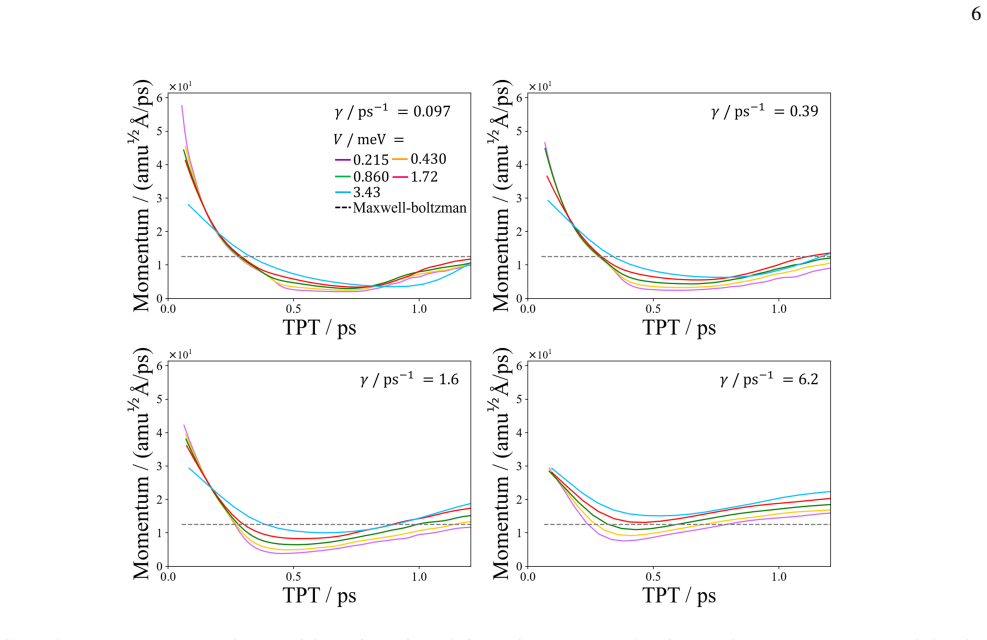
The central claim is that, even in the non-adiabatic regime where individual electronic transitions are fast, the time a trajectory spends inside the barrier region can be a non-negligible fraction of the mean first-passage time. The numerical evidence shows that the mean transition path time scales mainly with solvent friction γ and depends only weakly on the diabatic coupling V, whereas the macroscopic reaction time τ decreases strongly with V (roughly k ∝ V²). As a consequence, the ratio mTPT/τ can reach values above 5% when V is large, so the conventional picture in which the microscopic transfer is effectively instantaneous may not be quantitatively valid in this parameter range.
What carries the argument
The central object is the transition path time (TPT), defined as the duration of a trajectory's first passage from a point -x0 on the reactant side to a symmetric point x0 on the product side, excluding trajectories that return to -x0. The dynamical model is a symmetric two-parabola diabatic surface pair with a constant coupling V, propagated by Langevin dynamics with friction γ and Gaussian noise, with non-adiabatic transitions decided by an exact curve-crossing hopping probability at the avoided crossing. Comparing the TPT distribution and its mean with the population-decay time constant τ obtained by exponential fitting is what carries the argument.
Load-bearing premise
The quantitative conclusion that mTPT is a non-negligible fraction of τ depends on the arbitrary choice of the reaction-coordinate boundaries ±x0 that define a transition path; with a smaller x0 the crossing region narrows and the measured mTPT may shrink, potentially dropping below the quoted 5% threshold.
What would settle it
Run the same Langevin curve-crossing hopping simulation with a substantially smaller x0 (e.g., 0.1 amu^1/2 Å) and recompute mTPT/τ for V = 3.43 meV; if the ratio falls below 1% across the γ range, the central 'non-negligible' claim would not survive the boundary choice. Alternatively, compare with a full quantum-mechanical simulation of the two-parabola model to see whether the classical hopping treatment overestimates the microscopic crossing time.
If this is right
- For large diabatic couplings, rate theories that treat the electronic transition as instantaneous may underestimate the actual time spent in the transition region by an order of magnitude.
- Because mTPT and τ are controlled by different parameters (γ vs V), friction and electronic coupling affect different stages of the reaction; tuning solvent friction can change the microscopic crossing time without proportionally changing the rate.
- The TPT distribution shifts to shorter times as V increases, so non-adiabatic transitions preferentially select high-momentum crossing trajectories, shortening the individual microscopic event even as the overall reaction accelerates.
- The similarity between the simulated mTPT and the analytical no-hopping (P_hop=0) results indicates that the two-parabola barrier shape, not the hopping probability itself, dominates the average crossing time.
- The ratio mTPT/τ provides a concrete, computable diagnostic for when the instantaneous-transfer assumption is acceptable in a given electron-transfer model.
Where Pith is reading between the lines
- The quantitative 'non-negligible' claim is defined with respect to an arbitrary boundary x0; because the paper chooses the smallest of six tested values and the TPT distribution lengthens with increasing x0, the claim is a conservative lower bound for the tested model, but it should be verified for even smaller x0 before being used as a universal statement.
- The same TPT machinery could be applied to asymmetric (finite driving force) electron transfer, where the crossing point is displaced and the TPT distribution may become skewed; how the ratio mTPT/τ behaves there is untested.
- One could connect mTPT/τ to experimentally accessible coherence or time-resolved spectral signatures of the transition state, providing a link between this trajectory-based quantity and observable electron-transfer dynamics.
- The finding that mTPT is governed mainly by γ suggests that in high-friction solvents the 'instantaneous' assumption fails more easily; this gives a testable prediction: increasing solvent friction should increase the microscopic transfer time even if the overall rate is unchanged.
Editorial analysis
A structured set of objections, weighed in public.
Referee Report
Summary. The paper studies a symmetric two-parabola model of condensed-phase non-adiabatic electron transfer, propagating nuclear dynamics with Langevin equations and electronic transitions via Zhu–Nakamura hopping probabilities. It defines a transition path as any coordinate-space segment from -x0 to +x0 that does not return to -x0, and computes the mean transition path time (mTPT) and the macroscopic reaction time tau from the reactant population decay. The main finding is that mTPT depends primarily on the friction parameter gamma, tau depends primarily on the diabatic coupling V, and for V=3.43 meV the mTPT exceeds 5% of tau, suggesting that the microscopic electron-transfer event is not always negligible compared with the overall reaction timescale.
Significance. If the central claim is robust, the paper provides a concrete counterexample to the common assumption that microscopic ET events are instantaneous relative to macroscopic reaction times in the non-adiabatic regime. The study combines a well-established non-adiabatic transition theory (Zhu–Nakamura) with Kramers-like Langevin dynamics and performs systematic scans over V and gamma, which is a useful methodology. The comparison with the analytical P_hop=0 TPT distribution also helps to interpret the non-adiabatic effects. However, the quantitative claim (mTPT > 5% of tau) rests on a coordinate-only definition of a transition path that does not condition on the electronic state being the product state, and the lack of statistical error bars on the reported mean values weakens the quantitative conclusions. The qualitative separation of timescales (gamma controls mTPT, V controls tau) is supported by the figures, but the specific ratio claims require further analysis.
major comments (3)
- [§II.C.2, §III.D, Fig. 8] The transition path is defined purely by reaching +x0 in the coordinate, with no condition on the electronic state. In the non-adiabatic regime (small V), the upper adiabatic surface has predominantly reactant diabatic character at positive x (Eq. 6 gives |c_r,2|^2 ~ 1 for small V), so a trajectory can reach +x0 on the upper adiabat without undergoing electron transfer. Figure 8 shows multiple recrossings within a TPT but does not distinguish reactive from non-reactive segments. The central claim (e.g., mTPT > 5% of tau at V=3.43 meV) may therefore be inflated by non-reactive barrier excursions. Please re-analyze TPTs conditioned on the final state being the product (e.g., |c_p|^2 > 1/2 at +x0) or at least report the fraction of coordinate-only TPTs that are non-reactive in the parameter range where the ratio exceeds 5%.
- [§II.C.2, §V.B] The mTPT depends on the arbitrarily chosen boundary x0. The paper states that results "did not vary significantly" with x0, but Appendix B explicitly says the TPT distribution shifts to longer durations as x0 increases when gamma is large. Since the central quantitative claim is the ratio mTPT/tau, a robustness analysis showing the ratio across the six tested x0 values is needed. Without it, the reader cannot assess how much of the >5% figure is due to the specific choice x0=2.06 amu^(1/2) Å.
- [§III (Figs. 4-10)] No statistical error bars are reported for tau or mTPT. For a quantitative claim such as "the mTPT is greater than 5% of tau," standard errors or confidence intervals are necessary to determine whether the difference is significant. With 10,000 trajectories for population dynamics and 100,000 for TPT analysis, the estimates may be precise, but correlated events (multiple TPTs from one trajectory) could reduce the effective sample size. Please include error estimates, especially for the mTPT/tau ratio.
minor comments (3)
- [§II.D] Typographical error: "out scope" should be "our scope". Also, "logistic scale" in several figure captions (Figs. 5, 6, 9, 10, 11) should be "logarithmic scale" (or "log scale").
- [§II.C.1, Eq. (14)] The identification of tau=1/k with the mean first-passage time is reasonable for a two-state Markov process, but the phrase "time constant" is ambiguous because the exponential decay in Eq. (14) has time constant 1/(2k). Since tau=1/k is larger than 1/(2k), the ratio mTPT/tau is conservative; please clarify the definition in the text.
- [Eq. (9)] The sentence "because the sign after b^4 is minus" is unclear. Please spell out the formula for the case of opposite-slope crossings; the Zhu–Nakamura formula contains both plus and minus variants, and the reader should not have to infer the sign convention.
Circularity Check
No circularity: mTPT and τ are independent simulation outputs; the central claim is read from trajectory statistics, not from fitted inputs or self-citation.
full rationale
The paper's derivation chain is simulation-based and self-contained. The macroscopic time constant τ is obtained by exponential fitting of the reactant population [R](t) from Eq. (14), while mTPT is computed directly from transition path segments defined in Sec. II.C.2. Neither quantity is fitted to the other, and the comparison in Sec. III.D (e.g., mTPT > 5% of τ for V = 3.43 meV) is a measured ratio of two independently simulated observables. The hopping probabilities come from Zhu-Nakamura theory with stated parameters (Eqs. 9–11), and the analytical TPT from Ref. 29 is used as an external benchmark, not as an input that forces the conclusion. The arbitrariness of x0 is acknowledged in the paper and examined in Appendix B, but this is a modeling-choice limitation, not a circular reduction: the reported mTPT is a direct function of the trajectories and the chosen boundary, not of the conclusion. There are no load-bearing self-citations, no fitted parameters renamed as predictions, and no definitions that presuppose the target result. The claimed non-negligible mTPT/τ ratio is therefore a genuine numerical finding for the stated model and parameter set.
Axiom & Free-Parameter Ledger
free parameters (2)
- x0 (transition path boundary) =
2.06 amu^1/2 Å
- ω' (inverted-parabola frequency in analytical TPT reference) =
= ω = 1.81 ps^-1
axioms (5)
- domain assumption Zhu-Nakamura theory (Eqs. 9-11) gives exact non-adiabatic transition probabilities for the one-dimensional two-state curve-crossing problem.
- domain assumption Langevin dynamics with Markovian friction and Gaussian white noise (Eqs. 7-8) captures condensed-phase solvent effects.
- domain assumption Symmetric two-parabola Hamiltonian (Eq. 1) with zero driving force is an adequate representation of condensed-phase ET.
- domain assumption Reactant population obeys single-exponential relaxation (Eq. 14) from Markov two-state kinetics.
- domain assumption Initial conditions are sampled from Boltzmann/Maxwell-Boltzmann distributions on the reactant state.
read the original abstract
Condensed-phase non-adiabatic electron transfer (ET) reactions play an important role in various areas of science. The characteristics of the microscopic transition processes involved in these reactions and their dynamic behavior remain poorly understood. In this study, we performed non-adiabatic simulations based on the Zhu-Nakamura theory, combining the two-parabola model with Kramers-like Langevin dynamics. We numerically analyzed the dependence of the macroscopic reaction time and the timescale of the microscopic transition process on the diabatic coupling between the diabatic states and on the friction parameter in Langevin dynamics. Although the microscopic transfer process is generally regarded as instantaneous in the non-adiabatic regime, we found that the timescale of the microscopic transition process can still be a non-negligible fraction of the macroscopic reaction time.
Figures




Reference graph
Works this paper leans on
-
[1]
Aguilera-Porta, Neus and Corral, Inés and Munoz-Muriedas, Jordi and Granucci, Giovanni , year =. Excited State Dynamics of Some Nonsteroidal Anti-Inflammatory Drugs: a Surface-Hopping Investigation , volume =. doi:10.1016/j.comptc.2019.02.009 , journal =
-
[2]
Akimov, Alexey V. and Prezhdo, Oleg V. , year =. The PYXAID Program for Non-Adiabatic Molecular Dynamics in Condensed Matter Systems , volume =. J. Chem. Theory Comput. , publisher =. doi:10.1021/ct400641n , number =
-
[3]
Akimov, Alexey V. , year =. A Simple Phase Correction Makes a Big Difference in Nonadiabatic Molecular Dynamics , volume =. J. Phys. Chem. Lett. , publisher =. doi:10.1021/acs.jpclett.8b02826 , number =
-
[4]
Ando, Koji and Kato, Shigeki , year =. Dielectric relaxation dynamics of water and methanol solutions associated with the ionization of <i>N</i>, <i>N</i>-dimethylaniline: Theoretical analyses , volume =. The Journal of Chemical Physics , publisher =. doi:10.1063/1.461618 , number =
-
[5]
Aoki, Risa and Toyoda, Ryojun and K\". Bis(Dipyrrinato)Zinc(II) Complex Chiroptical Wires: Exfoliation into Single Strands and Intensification of Circularly Polarized Luminescence , volume =. J. Am. Chem. Soc. , publisher =. 2017 , month = nov, pages =. doi:10.1021/jacs.7b07077 , number =
-
[6]
Dynamics of the Excitonic Coupling in Organic Crystals , volume =
Aragó, Juan and Troisi, Alessandro , year =. Dynamics of the Excitonic Coupling in Organic Crystals , volume =. Phys. Rev. Lett. , publisher =. doi:10.1103/physrevlett.114.026402 , number =
-
[7]
Azzouz, H. and Borgis, D. , year =. A Quantum Molecular-Dynamics Study of Proton-Transfer Reactions Along Asymmetrical H Bonds in Solution , volume =. J. Chem. Phys. , publisher =. doi:10.1063/1.464727 , number =
-
[8]
The Effects of Interstitial Iodine in Hybrid Perovskite Hot Carrier Cooling: a Non-Adiabatic Molecular Dynamics Study , volume =
Banerjee, Swastika and Kang, Jun and Zhang, Xiuwen and Wang, Lin-Wang , year =. The Effects of Interstitial Iodine in Hybrid Perovskite Hot Carrier Cooling: a Non-Adiabatic Molecular Dynamics Study , volume =. J. Chem. Phys. , publisher =
-
[9]
Extended <scp>tight-Binding</Scp> Quantum Chemistry Methods , volume =
Bannwarth, Christoph and Caldeweyher, Eike and Ehlert, Sebastian and Hansen, Andreas and Pracht, Philipp and Seibert, Jakob and Spicher, Sebastian and Grimme, Stefan , year =. Extended <scp>tight-Binding</Scp> Quantum Chemistry Methods , volume =. WIREs Computational Molecular Science , publisher =. doi:10.1002/wcms.1493 , number =
-
[10]
Barbatti, Mario and Bondanza, Mattia and Crespo-Otero, Rachel and Demoulin, Baptiste and Dral, Pavlo O. and Granucci, Giovanni and Kossoski, Fábris and Lischka, Hans and Mennucci, Benedetta and Mukherjee, Saikat and Pederzoli, Marek and Persico, Maurizio and Pinheiro Jr, Max and Pittner, Jiří and Plasser, Felix and Sangiogo Gil, Eduarda and Stojanovic, Lj...
-
[11]
Becke, Axel D. , year =. Density-Functional Thermochemistry. III. the Role of Exact Exchange , volume =. J. Chem. Phys. , publisher =. doi:10.1063/1.464913 , number =
-
[12]
Benkó, Tímea and Lukács, Dávid and Li, Mingtao and Pap, József S. , year =. Redox-active ligands in artificial photosynthesis: a review , volume =. Environmental Chemistry Letters , publisher =. doi:10.1007/s10311-022-01448-3 , number =
-
[13]
Ben‐Nun, Michal and Martínez, Todd J. , year =. A Continuous Spawning Method for Nonadiabatic Dynamics and Validation for the Zero‐Temperature Spin‐Boson Problem , volume =. Israel Journal of Chemistry , publisher =. doi:10.1560/ijc.47.1.75 , number =
-
[14]
Blumberger, Jochen , year =. Recent Advances in the Theory and Molecular Simulation of Biological Electron Transfer Reactions , volume =. Chemical Reviews , publisher =. doi:10.1021/acs.chemrev.5b00298 , number =
-
[15]
Brinkman, H.C. , year =. Brownian motion in a field of force and the diffusion theory of chemical reactions. II , volume =. Physica , publisher =. doi:10.1016/s0031-8914(56)80019-0 , number =
-
[16]
Car, R. and Parrinello, M. , year =. Unified Approach for Molecular Dynamics and Density-Functional Theory , volume =. Phys. Rev. Lett. , publisher =. doi:10.1103/physrevlett.55.2471 , number =
-
[17]
and Berggren, Gustav and Tian, Haining , year =
Cai, Bin and Pavliuk, Mariia V. and Berggren, Gustav and Tian, Haining , year =. Bio-hybrid photoelectrochemical catalysis for solar fuels and chemicals conversion , volume =. Nature Communications , publisher =. doi:10.1038/s41467-025-64931-9 , number =
-
[18]
Castro, Alberto and Marques, Miguel A. L. and Rubio, Angel , year =. Propagators for the Time-Dependent Kohn–Sham Equations , volume =. J. Chem. Phys. , publisher =. doi:10.1063/1.1774980 , number =
-
[19]
Chen, Hsing-Ta and Reichman, David R. , year =. On the Accuracy of Surface Hopping Dynamics in Condensed Phase Non-Adiabatic Problems , volume =. J. Chem. Phys. , publisher =. doi:10.1063/1.4942867 , number =
-
[20]
Recent Advances in Solid Oxide Electrolysis Cells for Solar Energy Conversion , volume =
Chen, Chen-Ge and Xu, Chenyu and Sui, Peng-Fei and Deng, Guangyu and Wang, Yi-Cheng and Mei, Jinhao and Zhang, Entao and Zhang, Yanwei and Luo, Jing-Li , year =. Recent Advances in Solid Oxide Electrolysis Cells for Solar Energy Conversion , volume =. Electrochemical Energy Reviews , publisher =. doi:10.1007/s41918-025-00246-z , number =
-
[21]
Recent Advances and Perspectives on Nonadiabatic Mixed Quantum–Classical Dynamics , volume =
Crespo-Otero, Rachel and Barbatti, Mario , year =. Recent Advances and Perspectives on Nonadiabatic Mixed Quantum–Classical Dynamics , volume =. Chem. Rev. , publisher =. doi:10.1021/acs.chemrev.7b00577 , number =
-
[22]
Unusual Temperature Dependence of Proton Transfer 3
Cohen, Boiko and Leiderman, Pavel and Huppert, Dan , year =. Unusual Temperature Dependence of Proton Transfer 3. Classical Kramers’ Theory versus the Landau−Zener Curve-Crossing Formulation , volume =. The Journal of Physical Chemistry A , publisher =. doi:10.1021/jp026415j , number =
-
[23]
Damjanovi\'. Excitons in a Photosynthetic Light-Harvesting System: a Combined Molecular Dynamics, Quantum Chemistry, and Polaron Model Study , volume =. Physical Review E , publisher =. doi:10.1103/physreve.65.031919 , number =
-
[24]
A Perspective on Next-Generation Hyperfluorescent Organic Light-Emitting Diodes , volume =
Deori, Upasana and Nanda, Gyana Prakash and Murawski, Caroline and Rajamalli, Pachaiyappan , year =. A Perspective on Next-Generation Hyperfluorescent Organic Light-Emitting Diodes , volume =. Chemical Science , publisher =. doi:10.1039/d4sc05489j , number =
-
[25]
Localized Atomic and Molecular Orbitals , volume =
Edmiston, Clyde and Ruedenberg, Klaus , year =. Localized Atomic and Molecular Orbitals , volume =. Reviews of Modern Physics , publisher =. doi:10.1103/revmodphys.35.457 , number =
-
[26]
Elstner, M. and Porezag, D. and Jungnickel, G. and Elsner, J. and Haugk, M. and Frauenheim, Th. and Suhai, S. and Seifert, G. , year =. Self-Consistent-Charge Density-Functional Tight-Binding Method for Simulations of Complex Materials Properties , volume =. Phys. Rev. B: Condens. Matter Mater. Phys. , publisher =. doi:10.1103/physrevb.58.7260 , number =
-
[27]
Foster, J. M. and Boys, S. F. , year =. Canonical Configurational Interaction Procedure , volume =. Reviews of Modern Physics , publisher =. doi:10.1103/revmodphys.32.300 , number =
-
[28]
A Molecular Orbital Theory of Reactivity in Aromatic Hydrocarbons , volume =
Fukui, Kenichi and Yonezawa, Teijiro and Shingu, Haruo , year =. A Molecular Orbital Theory of Reactivity in Aromatic Hydrocarbons , volume =. J. Chem. Phys. , publisher =. doi:10.1063/1.1700523 , number =
-
[29]
Formulation of the Reaction Coordinate , volume =
Fukui, Kenichi , year =. Formulation of the Reaction Coordinate , volume =. J. Phys. Chem. , publisher =. doi:10.1021/j100717a029 , number =
-
[30]
M. J. Frisch and G. W. Trucks and H. B. Schlegel and G. E. Scuseria and M. A. Robb and J. R. Cheeseman and G. Scalmani and V. Barone and G. A. Petersson and H. Nakatsuji and X. Li and M. Caricato and A. V. Marenich and J. Bloino and B. G. Janesko and R. Gomperts and B. Mennucci and H. P. Hratchian and J. V. Ortiz and A. F. Izmaylov and J. L. Sonnenberg an...
-
[31]
Recent Developments in the General Atomic and Molecular Electronic Structure System , volume =. J. Chem. Phys. , author =. 2020 , pages =. doi:10.1063/5.0005188 , language =
-
[32]
Giannini, Samuele and Peng, Wei-Tao and Cupellini, Lorenzo and Padula, Daniele and Carof, Antoine and Blumberger, Jochen , year =. Publisher Correction: Exciton Transport in Molecular Organic Semiconductors Boosted by Transient Quantum Delocalization , volume =. Nat. Commun. , publisher =. doi:10.1038/s41467-024-47500-4 , number =
-
[33]
Surface Hopping Dynamics with the Frenkel Exciton Model in a Semiempirical Framework , volume =
Gil, Eduarda Sangiogo and Granucci, Giovanni and Persico, Maurizio , year =. Surface Hopping Dynamics with the Frenkel Exciton Model in a Semiempirical Framework , volume =. J. Chem. Theory Comput. , publisher =. doi:10.1021/acs.jctc.1c00942 , number =
-
[34]
Gómez Pueyo, Adrián and Marques, Miguel A. L. and Rubio, Angel and Castro, Alberto , year =. Propagators for the Time-Dependent Kohn–Sham Equations: Multistep, Runge–Kutta, Exponential Runge–Kutta, and Commutator Free Magnus Methods , volume =. J. Chem. Theory Comput. , publisher =. doi:10.1021/acs.jctc.8b00197 , number =
-
[35]
Critical Appraisal of the Fewest Switches Algorithm for Surface Hopping , volume =
Granucci, Giovanni and Persico, Maurizio , year =. Critical Appraisal of the Fewest Switches Algorithm for Surface Hopping , volume =. J. Chem. Phys. , publisher =. doi:10.1063/1.2715585 , number =
-
[36]
A simple and effective Verlet-type algorithm for simulating Langevin dynamics , volume =
Grønbech-Jensen, Niels and Farago, Oded , year =. A simple and effective Verlet-type algorithm for simulating Langevin dynamics , volume =. Molecular Physics , publisher =. doi:10.1080/00268976.2012.760055 , number =
arXiv 2012
-
[37]
Guan, Yafu and Xie, Changjian and Yarkony, David R. and Guo, Hua , year =. High-Fidelity First Principles Nonadiabaticity: Diabatization, Analytic Representation of Global Diabatic Potential Energy Matrices, and Quantum Dynamics , volume =. Phys. Chem. Chem. Phys. , publisher =. doi:10.1039/d1cp03008f , number =
-
[38]
Haldar, Ritesh and Mazel, Antoine and Krstić, Marjan and Zhang, Qiang and Jakoby, Marius and Howard, Ian A. and Richards, Bryce S. and Jung, Nicole and Jacquemin, Denis and Diring, Stéphane and Wenzel, Wolfgang and Odobel, Fabrice and W\". A De Novo Strategy for Predictive Crystal Engineering to Tune Excitonic Coupling , volume =. Nat. Commun. , publisher...
-
[39]
Hammes-Schiffer, Sharon and Tully, John C. , year =. Proton Transfer in Solution: Molecular Dynamics with Quantum Transitions , volume =. J. Chem. Phys. , publisher =. doi:10.1063/1.467455 , number =
-
[40]
Hammes-Schiffer, Sharon and Stuchebrukhov, Alexei A. , year =. Theory of Coupled Electron and Proton Transfer Reactions , volume =. Chem. Rev. , publisher =. doi:10.1021/cr1001436 , number =
-
[41]
Han, Daeho and Ha, Jong-Kwon and Min, Seung Kyu , year =. Real-Space and Real-Time Propagation for Correlated Electron–Nuclear Dynamics Based on Exact Factorization , volume =. J. Chem. Theory Comput. , publisher =. doi:10.1021/acs.jctc.2c00939 , number =
-
[42]
Hassaan, Mohamed A. and El-Nemr, Mohamed A. and Elkatory, Marwa R. and Ragab, Safaa and Niculescu, Violeta-Carolina and El Nemr, Ahmed , year =. Principles of Photocatalysts and Their Different Applications: A Review , volume =. Topics in Current Chemistry , publisher =. doi:10.1007/s41061-023-00444-7 , number =
-
[43]
and Hammes-Schiffer, Sharon , year =
Hazra, Anirban and Soudackov, Alexander V. and Hammes-Schiffer, Sharon , year =. Role of Solvent Dynamics in Ultrafast Photoinduced Proton-Coupled Electron Transfer Reactions in Solution , volume =. The Journal of Physical Chemistry B , publisher =. doi:10.1021/jp1051547 , number =
-
[44]
and Maurice, David and White, Christopher A
Head-Gordon, Martin and Grana, Ana M. and Maurice, David and White, Christopher A. , year =. Analysis of Electronic Transitions as the Difference of Electron Attachment and Detachment Densities , volume =. J. Phys. Chem. , publisher =. doi:10.1021/j100039a012 , number =
-
[45]
Herbert, John M. , year =. Visualizing and Characterizing Excited States from Time-Dependent Density Functional Theory , volume =. Phys. Chem. Chem. Phys. , publisher =. doi:10.1039/d3cp04226j , number =
-
[46]
Hohenberg, P. and Kohn, W. , year =. Inhomogeneous Electron Gas , volume =. Physical Review , publisher =. doi:10.1103/physrev.136.b864 , number =
-
[47]
Hoover, William G. , year =. Canonical Dynamics: Equilibrium Phase-Space Distributions , volume =. Physical Review A , publisher =. doi:10.1103/physreva.31.1695 , number =
-
[48]
and Aradi, B
Hourahine, B. and Aradi, B. and Blum, V. and Bonafé, F. and Buccheri, A. and Camacho, C. and Cevallos, C. and Deshaye, M. Y. and Dumitrică, T. and Dominguez, A. and Ehlert, S. and Elstner, M. and van der Heide, T. and Hermann, J. and Irle, S. and Kranz, J. J. and K\". DFTB+, a Software Package for Efficient Approximate Density Functional Theory Based Atom...
-
[49]
Characterization of the Short-Range Couplings in Excitation Energy Transfer , volume =
Hsu, Chao-Ping and You, Zhi-Qiang and Chen, Hung-Cheng , year =. Characterization of the Short-Range Couplings in Excitation Energy Transfer , volume =. J. Phys. Chem. C , publisher =. doi:10.1021/jp076512i , number =
-
[50]
Iikura, Hisayoshi and Tsuneda, Takao and Yanai, Takeshi and Hirao, Kimihiko , year =. A Long-Range Correction Scheme for Generalized-Gradient-Approximation Exchange Functionals , volume =. J. Chem. Phys. , publisher =. doi:10.1063/1.1383587 , number =
-
[51]
Imahori, Hiroshi and Kobori, Yasuhiro and Kaji, Hironori , year =. Manipulation of Charge-Transfer States by Molecular Design: Perspective from “Dynamic Exciton” , volume =. Accounts of Materials Research , publisher =. doi:10.1021/accountsmr.1c00045 , number =
-
[52]
and Fischer, Sean and Prezhdo, Oleg V
Jaeger, Heather M. and Fischer, Sean and Prezhdo, Oleg V. , year =. Decoherence-Induced Surface Hopping , volume =. J. Chem. Phys. , publisher =
-
[53]
Jankowska, Joanna and Long, Run and Prezhdo, Oleg V. , year =. Quantum Dynamics of Photogenerated Charge Carriers in Hybrid Perovskites: Dopants, Grain Boundaries, Electric Order, and Other Realistic Aspects , volume =. ACS Energy Lett. , publisher =. doi:10.1021/acsenergylett.7b00198 , number =
-
[54]
Kasha, M. and Rawls, H. R. and Ashraf El-Bayoumi, M. , year =. The Exciton Model in Molecular Spectroscopy , volume =. Pure and Applied Chemistry , publisher =. doi:10.1351/pac196511030371 , number =
-
[55]
Kim, Hyung J. and Hynes, James T. , year =. Equilibrium and nonequilibrium solvation and solute electronic structure. II. Strong coupling limit , volume =. The Journal of Chemical Physics , publisher =. doi:10.1063/1.459666 , number =
-
[56]
Kim, Hyung J. and Hynes, James T. , year =. Equilibrium and nonequilibrium solvation and solute electronic structure. III. Quantum theory , volume =. The Journal of Chemical Physics , publisher =. doi:10.1063/1.462752 , number =
-
[57]
Kitoh-Nishioka, Hirotaka and Welke, Kai and Nishimoto, Yoshio and Fedorov, Dmitri G. and Irle, Stephan , year =. Multiscale Simulations on Charge Transport in Covalent Organic Frameworks Including Dynamics of Transfer Integrals from the FMO-DFTB/LCMO Approach , volume =. J. Phys. Chem. C , publisher =. doi:10.1021/acs.jpcc.7b05779 , number =
-
[58]
Kohn, W. and Sham, L. J. , year =. Self-Consistent Equations Including Exchange and Correlation Effects , volume =. Physical Review , publisher =. doi:10.1103/physrev.140.a1133 , number =
-
[59]
Kramers, H.A. , year =. Brownian motion in a field of force and the diffusion model of chemical reactions , volume =. Physica , publisher =. doi:10.1016/s0031-8914(40)90098-2 , number =
-
[60]
Krueger, Brent P. and Scholes, Gregory D. and Fleming, Graham R. , year =. Calculation of Couplings and Energy-Transfer Pathways Between the Pigments of LH2 by the ab Initio Transition Density Cube Method , volume =. J. Phys. Chem. B , publisher =. doi:10.1021/jp9811171 , number =
-
[61]
Laleman, M. and Carlon, E. and Orland, H. , year =. Transition path time distributions , volume =. The Journal of Chemical Physics , publisher =. doi:10.1063/1.5000423 , number =
-
[62]
Landry, Brian R. and Subotnik, Joseph E. , year =. How to Recover Marcus Theory with Fewest Switches Surface Hopping: Add Just a Touch of Decoherence , volume =. J. Chem. Phys. , publisher =. doi:10.1063/1.4733675 , number =
-
[63]
doi:10.1103/RevModPhys.59.1 , url =
Dynamics of the Dissipative Two-State System , author =. doi:10.1103/RevModPhys.59.1 , url =
-
[64]
Combining Long-Range Configuration Interaction with Short-Range Density Functionals , volume =
Leininger, Thierry and Stoll, Hermann and Werner, Hans-Joachim and Savin, Andreas , year =. Combining Long-Range Configuration Interaction with Short-Range Density Functionals , volume =. Chem. Phys. Lett. , publisher =. doi:10.1016/s0009-2614(97)00758-6 , number =
-
[65]
Leo, Tanner M. and Robbins, Megan and Sullivan, Alana and Thornes, Henry and Fitzsimmons, Garrett and Goodey, Alyssa and Kowalczyk, Tim , year =. Simulation of Interlayer Coupling for Electroactive Covalent Organic Framework Design , volume =. J. Chem. Phys. , publisher =. doi:10.1063/5.0206246 , number =
-
[66]
and Schlegel, H
Li, Xiaosong and Tully, John C. and Schlegel, H. Bernhard and Frisch, Michael J. , year =. Ab InitioEhrenfest Dynamics , volume =. J. Chem. Phys. , publisher =
-
[67]
Recent Advances in C–O Bond Cleavage of Aryl, Vinyl, and Benzylic Ethers , volume =
Li, Pengfei and Zhang, Mingyu and Zhang, Lei , year =. Recent Advances in C–O Bond Cleavage of Aryl, Vinyl, and Benzylic Ethers , volume =. Topics in Current Chemistry , publisher =. doi:10.1007/s41061-024-00484-7 , number =
-
[68]
and Liu, Tiegen and Hou, Lili , year =
Liu, Jiayi and Zhang, Shuai and Xi, Lin and Liu, Jiawei and He, Yuxin and Wang, Rui and Qu, Da-Hui and Feringa, Ben L. and Liu, Tiegen and Hou, Lili , year =. Powering Molecular Motors with Light Across the Rainbow Using Quantum Dots , volume =. J. Am. Chem. Soc. , publisher =. doi:10.1021/jacs.5c05548 , number =
-
[69]
Surface-Hopping Dynamics of a Spin-Boson System , author =. doi:10.1063/1.1433502 , url =
-
[70]
Makarov, Dmitrii E. and Makri, Nancy , year =. Tunneling dynamics in dissipative curve-crossing problems , volume =. Physical Review A , publisher =. doi:10.1103/physreva.48.3626 , number =
-
[71]
Mandal, Arkajit and Sandoval C., Juan S. and Shakib, Farnaz A. and Huo, Pengfei , year =. Quasi-Diabatic Propagation Scheme for Direct Simulation of Proton-Coupled Electron Transfer Reaction , volume =. J. Phys. Chem. A , publisher =. doi:10.1021/acs.jpca.9b00077 , number =
-
[72]
R. A Marcus , title =. 1956 , journal =. doi:10.1063/1.1742724 , number =
-
[73]
Marcus, R. A. , year =. On the Theory of Oxidation-Reduction Reactions Involving Electron Transfer. II. Applications to Data on the Rates of Isotopic Exchange Reactions , volume =. The Journal of Chemical Physics , publisher =. doi:10.1063/1.1743423 , number =
-
[74]
R. A Marcus , title =. 1956 , journal =. doi:10.1063/1.1742723 , number =
-
[75]
Marcus, R. A. , year =. ON THE THEORY OF OXIDATION—REDUCTION REACTIONS INVOLVING ELECTRON TRANSFER. V. COMPARISON AND PROPERTIES OF ELECTROCHEMICAL AND CHEMICAL RATE CONSTANTS<sup>1</sup> , volume =. The Journal of Physical Chemistry , publisher =. doi:10.1021/j100798a033 , number =
-
[76]
Marcus, R. A. , year =. On the Theory of Electron-Transfer Reactions. VI. Unified Treatment for Homogeneous and Electrode Reactions , volume =. The Journal of Chemical Physics , publisher =. doi:10.1063/1.1696792 , number =
-
[77]
Martin, Richard L. , year =. Natural Transition Orbitals , volume =. J. Chem. Phys. , publisher =. doi:10.1063/1.1558471 , number =
-
[78]
Matsuoka, Ryota and Toyoda, Ryojun and Sakamoto, Ryota and Tsuchiya, Mizuho and Hoshiko, Ken and Nagayama, Tatsuhiro and Nonoguchi, Yoshiyuki and Sugimoto, Kunihisa and Nishibori, Eiji and Kawai, Tsuyoshi and Nishihara, Hiroshi , year =. Bis(Dipyrrinato)Metal(<scp>ii</Scp>) Coordination Polymers: Crystallization, Exfoliation into Single Wires, and Electri...
-
[79]
Mead, C. Alden and Truhlar, Donald G. , year =. Conditions for the Definition of a Strictly Diabatic Electronic Basis for Molecular Systems , volume =. J. Chem. Phys. , publisher =. doi:10.1063/1.443853 , number =
-
[80]
Medina, Eduardo and Satija, Rohit and Makarov, Dmitrii E. , year =. Transition Path Times in Non-Markovian Activated Rate Processes , volume =. The Journal of Physical Chemistry B , publisher =. doi:10.1021/acs.jpcb.8b07361 , number =
discussion (0)
Sign in with ORCID, Apple, or X to comment. Anyone can read and Pith papers without signing in.