Application Research of a Deep Learning Model Integrating CycleGAN and YOLO in PCB Infrared Defect Detection
Pith reviewed 2026-05-16 18:27 UTC · model grok-4.3
The pith
CycleGAN translates visible PCB images into synthetic infrared ones to train YOLOv8 detectors that nearly match fully supervised performance despite scarce real IR data.
A machine-rendered reading of the paper's core claim, the machinery that carries it, and where it could break.
Core claim
By performing unpaired image-to-image translation with CycleGAN, the method produces high-fidelity pseudo-IR PCB samples that preserve defect structural semantics and simulate thermal distributions; fusing these generated samples with limited real IR images then trains a YOLOv8 detector whose performance surpasses training on real data alone and approaches that of fully supervised models.
What carries the argument
CycleGAN unpaired visible-to-infrared translation that generates pseudo-IR training samples for a YOLOv8 defect detector.
If this is right
- The detector achieves higher defect detection accuracy under infrared imaging when real training data is limited.
- Pseudo-IR synthesis provides a scalable augmentation strategy for industrial vision systems.
- Performance nears that of models trained on abundant real infrared samples.
- The approach lowers the expense of gathering and labeling large real IR defect datasets.
Where Pith is reading between the lines
- The same unpaired translation tactic could transfer to other domains where visible images are plentiful but infrared or thermal data remain scarce.
- Refining the translation step to capture finer thermal gradients might further narrow the remaining gap to full supervision.
- Applying the pipeline to additional electronic components or defect classes would test its generality beyond standard PCBs.
Load-bearing premise
CycleGAN can translate visible PCB images to infrared while keeping defect structures intact and producing realistic thermal patterns.
What would settle it
If a YOLOv8 model trained on the mixed pseudo-plus-real set shows no accuracy gain over one trained only on the limited real IR data, or if generated images visibly distort defect locations or heat signatures, the central claim would be falsified.
Figures



read the original abstract
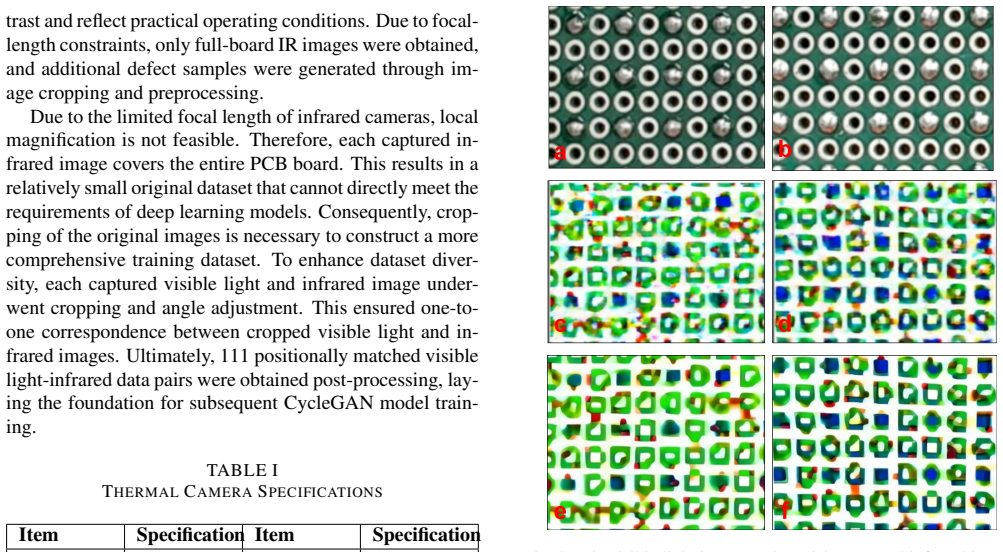
This paper addresses the critical bottleneck of infrared (IR) data scarcity in Printed Circuit Board (PCB) defect detection by proposing a cross-modal data augmentation framework integrating CycleGAN and YOLOv8. Unlike conventional methods relying on paired supervision, we leverage CycleGAN to perform unpaired image-to-image translation, mapping abundant visible-light PCB images into the infrared domain. This generative process synthesizes high-fidelity pseudo-IR samples that preserve the structural semantics of defects while accurately simulating thermal distribution patterns. Subsequently, we construct a heterogeneous training strategy that fuses generated pseudo-IR data with limited real IR samples to train a lightweight YOLOv8 detector. Experimental results demonstrate that this method effectively enhances feature learning under low-data conditions. The augmented detector significantly outperforms models trained on limited real data alone and approaches the performance benchmarks of fully supervised training, proving the efficacy of pseudo-IR synthesis as a robust augmentation strategy for industrial inspection.
Editorial analysis
A structured set of objections, weighed in public.
Referee Report
Summary. The paper proposes a cross-modal data augmentation framework that uses CycleGAN for unpaired translation of visible-light PCB images into pseudo-infrared samples, which are then combined with limited real IR data to train a YOLOv8 detector for defect detection. It claims that this approach enhances feature learning under low-data conditions, significantly outperforms models trained only on limited real IR data, and approaches the performance of fully supervised training.
Significance. If the experimental claims hold, the work would offer a practical solution to IR data scarcity in industrial PCB inspection by leveraging abundant visible images via unpaired translation. This could reduce reliance on costly paired IR datasets and improve detector robustness, with potential applicability to other thermal imaging domains where semantic preservation during translation is feasible.
major comments (3)
- [Abstract] Abstract: The abstract asserts that the augmented detector 'significantly outperforms models trained on limited real data alone' and 'approaches the performance benchmarks of fully supervised training,' yet provides no quantitative metrics (e.g., mAP, precision, recall), dataset sizes, ablation studies, or experimental protocols to support these claims.
- [Method] Method/Experiments: The central assumption that CycleGAN produces high-fidelity pseudo-IR samples preserving exact defect locations and types requires validation, but the manuscript supplies no quantitative fidelity checks such as FID scores, SSIM, cycle-consistency loss on held-out data, or expert agreement on defect labels in generated images.
- [Experiments] Experiments: No ablation isolating the contribution of generated pseudo-IR data quality versus simple data-volume increase is reported, making it impossible to confirm that performance gains stem from semantic preservation rather than generic augmentation effects.
minor comments (1)
- [Method] The heterogeneous training strategy description lacks details on the fusion ratio between pseudo-IR and real IR samples or any regularization to mitigate domain shift.
Simulated Author's Rebuttal
We thank the referee for the constructive feedback on our manuscript. We address each major comment below and will revise the paper to strengthen the presentation of results and validation.
read point-by-point responses
-
Referee: [Abstract] Abstract: The abstract asserts that the augmented detector 'significantly outperforms models trained on limited real data alone' and 'approaches the performance benchmarks of fully supervised training,' yet provides no quantitative metrics (e.g., mAP, precision, recall), dataset sizes, ablation studies, or experimental protocols to support these claims.
Authors: We agree that the abstract should include quantitative support for the claims. In the revised manuscript we will add specific metrics (mAP@0.5, precision, recall) for the proposed method versus the limited-real-IR baseline and the fully supervised upper bound, together with the exact counts of real IR images and generated pseudo-IR samples used in each training regime. revision: yes
-
Referee: [Method] Method/Experiments: The central assumption that CycleGAN produces high-fidelity pseudo-IR samples preserving exact defect locations and types requires validation, but the manuscript supplies no quantitative fidelity checks such as FID scores, SSIM, cycle-consistency loss on held-out data, or expert agreement on defect labels in generated images.
Authors: We accept that quantitative fidelity validation is needed. We will add FID and SSIM scores computed between generated pseudo-IR images and a held-out set of real IR images, report the cycle-consistency loss on that set, and include a brief qualitative analysis confirming that defect locations and types remain consistent after translation. revision: yes
-
Referee: [Experiments] Experiments: No ablation isolating the contribution of generated pseudo-IR data quality versus simple data-volume increase is reported, making it impossible to confirm that performance gains stem from semantic preservation rather than generic augmentation effects.
Authors: We agree that an ablation isolating the effect of semantic preservation is required. We will add an ablation study comparing three settings on the same limited real IR base: (i) limited real IR only, (ii) limited real IR plus an equal number of images augmented with standard geometric transforms, and (iii) limited real IR plus the CycleGAN-generated pseudo-IR samples. The results will be reported in a new table. revision: yes
Circularity Check
No circularity: standard external models applied without self-referential reduction
full rationale
The paper applies off-the-shelf CycleGAN for unpaired visible-to-IR translation and YOLOv8 for detection. No equations define outputs in terms of fitted inputs, no predictions reduce to training subsets by construction, and no load-bearing self-citations or uniqueness theorems are invoked. The augmentation strategy is presented as an empirical engineering choice whose efficacy is tested against external benchmarks (limited real data vs. full supervision), with no renaming of known results or ansatz smuggling. The derivation chain is self-contained against standard external components.
Axiom & Free-Parameter Ledger
axioms (1)
- domain assumption Unpaired CycleGAN translation can map visible PCB images to infrared while preserving defect semantics and simulating thermal patterns
Reference graph
Works this paper leans on
-
[1]
Deep learning-based pcb defect detec- tion,
P. H. Huang, “Deep learning-based pcb defect detec- tion,” PhD thesis, University of Electronic Science and Technology of China, 2024
work page 2024
-
[2]
Study on ac- tive infrared thermal imaging method for solder ball defect detection,
X. N. Lu, Z. Z. He, N. N. Huet al., “Study on ac- tive infrared thermal imaging method for solder ball defect detection,”Transactions of the Chinese Society for Mechanical Engineering, vol. 52, no. 10, pp. 17– 24, 2016
work page 2016
-
[3]
Active thermal excitation-based infrared thermal imaging for deep detection of pipeline defects,
Z. Wang, Y . Zhang, Y . Yuet al., “Active thermal excitation-based infrared thermal imaging for deep detection of pipeline defects,”Acta Optica Sinica, vol. 38, no. 09, pp. 201–208, 2018
work page 2018
-
[4]
X. Chen, C. Yin, M. Xuet al., “Research on pore de- fect identification in metallic materials based on in- 7 frared thermal imaging,”Heat Treatment Technology, vol. 49, no. 12, pp. 66–70, 2020
work page 2020
-
[5]
Unpaired image-to-image translation using cycle-consistent ad- versarial networks,
J.-Y . Zhu, T. Park, P. Isola, and A. A. Efros, “Unpaired image-to-image translation using cycle-consistent ad- versarial networks,” inIEEE International Conference on Computer Vision (ICCV), 2017, pp. 2223–2232
work page 2017
-
[6]
Unpaired image-to-image translation based on an improved cyclegan model,
J. He, F. Long, and X. Zhu, “Unpaired image-to-image translation based on an improved cyclegan model,” Journal of Yulin Normal University, vol. 39, no. 02, pp. 122–126, 2018
work page 2018
-
[7]
Image style transfer based on an improved cyclegan,
Z. Du, H. Shen, G. Song, and X. Li, “Image style transfer based on an improved cyclegan,”Optical Pre- cision Engineering, vol. 27, no. 08, pp. 1836–1844, 2019
work page 2019
-
[8]
Asymmetric cyclegan for unpaired nir-to-rgb face image transla- tion,
H. Dou, C. Chen, X. Hu, and S. Peng, “Asymmetric cyclegan for unpaired nir-to-rgb face image transla- tion,” inICASSP 2019 - 2019 IEEE International Con- ference on Acoustics, Speech and Signal Processing (ICASSP), 2019, pp. 1757–1761
work page 2019
-
[9]
F. Luo, “Implementation and research on mutual con- version between face sketches and photographs based on cyclegan,” PhD thesis, Chengdu University of Technology, 2021
work page 2021
-
[10]
J. Yin, Z. Li, L. Cui, W. Zhang, Q. Wang, and G. Si, “Cyclegan-based visible-infrared image enhancement method for infrared power equipment object detec- tion,” in2023 IEEE 5th International Conference on Power, Intelligent Computing and Systems (ICPICS), 2023, pp. 411–416
work page 2023
-
[11]
H. Guo, Z. Xiao, and P. Ji, “Research on cyclegan- based style transfer technology applied to face mask detection in facial images,”Journal of Qilu University of Technology, vol. 37, no. 01, pp. 15–20, 2023
work page 2023
-
[12]
Fuzzy-cycle: Visible to infrared ship image translation based on cyclegan,
L. Heet al., “Fuzzy-cycle: Visible to infrared ship image translation based on cyclegan,” in2024 6th In- ternational Conference on Industrial Artificial Intelli- gence (IAI), 2024, pp. 1–6. 8
work page 2024
discussion (0)
Sign in with ORCID, Apple, or X to comment. Anyone can read and Pith papers without signing in.