Tiling by Near Coincidence
Pith reviewed 2026-05-16 18:09 UTC · model grok-4.3
The pith
Selecting nearly coincident points from superimposed layers generates rigorous quasiperiodic tilings equivalent to cut-and-project constructions.
A machine-rendered reading of the paper's core claim, the machinery that carries it, and where it could break.
Core claim
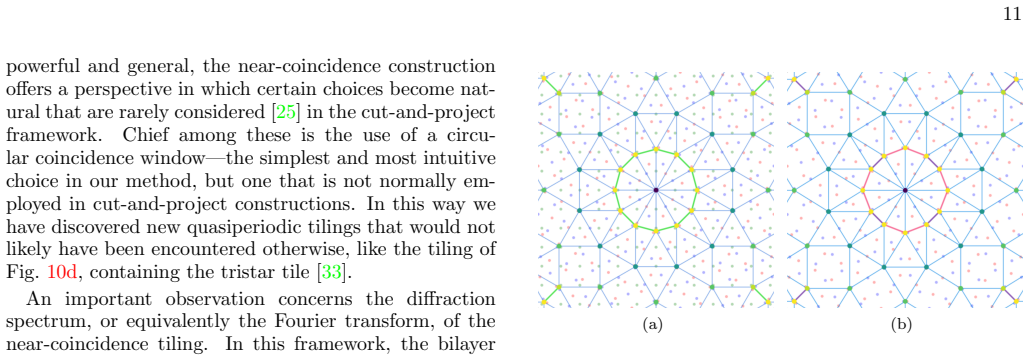
The near-coincidence method constructs quasiperiodic point sets by admitting pairs of nearly coincident points from two superimposed layers; this selection rule is equivalent to the cut-and-project formalism and therefore produces valid quasiperiodic tilings, including the classical Ammann-Beenker, Niizeki-Gähler, and Fibonacci examples as well as previously unknown ones.
What carries the argument
The near-coincidence method, which selects pairs of nearly coincident points from superimposed layers to serve as the vertices of the tiling.
If this is right
- The method reproduces the Ammann-Beenker tiling, the Niizeki-Gähler tiling, and square and hexagonal Fibonacci tilings.
- It generates new tilings that are unlikely to be found by conventional cut-and-project or substitution constructions.
- The procedure is algorithmically simple and has been implemented in a web-based generator that takes layer twist, scale, and coincidence conditions as inputs.
- Preliminary extensions to trilayer stacks produce dodecagonal order when square layers are used, and the method can address very small twist angles that create giant moiré patterns in bilayer and trilayer graphene.
Where Pith is reading between the lines
- The intuitive visual rule may help experimentalists design and interpret moiré superlattices in real 2D materials without first solving the full higher-dimensional cut-and-project model.
- The same selection logic could be tested on discrete lattices or finite patches to see whether it still produces long-range quasiperiodic order when the layers are finite or contain defects.
- Because the method is parameter-driven, systematic scans over twist angle and scale factor could map out families of tilings and identify which combinations yield previously unlisted symmetries.
Load-bearing premise
That pairs of nearly coincident points chosen from superimposed layers will systematically produce valid quasiperiodic point sets equivalent to those from the cut-and-project method without additional constraints or post-selection.
What would settle it
Apply the near-coincidence rule to a specific pair of layer parameters, generate the point set, and compare its diffraction spectrum or Fourier module directly against the spectrum obtained from an independent cut-and-project construction with the same parameters; mismatch would falsify equivalence.
Figures


read the original abstract
Moir\'e patterns of twisted and scaled bilayers have recently emerged as a fertile source of quasiperiodic order in two-dimensional materials. Inspired by these systems, we introduce the \emph{near-coincidence method} for generating quasiperiodic tilings of the plane. The method is intuitive -- admitting pairs of nearly coincident points from superimposed layers -- yet rigorous, as it maps naturally to the well-established cut-and-project formalism. It reproduces classical tilings, including the Ammann--Beenker, the Niizeki--G\"ahler, and the square and hexagonal Fibonacci tilings, and also reveals new tilings that are unlikely to arise from conventional constructions. The near-coincidence method is algorithmically simple and already realized in a web-based application that generates tilings from specified layer parameters and coincidence conditions. Future extensions include trilayer systems, where preliminary results yield dodecagonal order with square layers, and very small twist angles, where the method may capture the giant moir\'e patterns of bilayer and trilayer graphene.
Editorial analysis
A structured set of objections, weighed in public.
Referee Report
Summary. The manuscript introduces the near-coincidence method for generating quasiperiodic tilings of the plane by selecting pairs of nearly coincident points from superimposed layers of twisted and scaled bilayers. It asserts that this intuitive approach maps rigorously to the cut-and-project formalism, reproduces several classical tilings including Ammann-Beenker, Niizeki-Gähler, and Fibonacci tilings, and uncovers new tilings. The method is implemented in a web application, with extensions suggested for trilayer systems and small twist angles in graphene.
Significance. If the central mapping and discreteness claims hold, the work supplies an algorithmically simple, materials-inspired route to quasiperiodic point sets that reproduces known tilings and generates new ones unlikely to arise from standard constructions. The explicit web-based implementation and the grounding in the independently established cut-and-project formalism are concrete strengths that would make the technique immediately usable for exploring moiré-derived quasicrystals.
major comments (2)
- [Abstract and method definition] The abstract and the description of the method assert that near-coincidence selection 'maps naturally' to cut-and-project and yields uniformly discrete quasiperiodic sets, yet no explicit tolerance criterion, irrationality condition on the rotation matrix, or proof of uniform discreteness for generic twist/scale parameters is supplied. This is load-bearing for the central claim that the procedure is parameter-free and automatic.
- [Results on classical tilings] Reproduction of the Ammann-Beenker and Niizeki-Gähler tilings is stated, but the manuscript provides neither a side-by-side comparison of the generated point sets with the standard cut-and-project constructions nor a demonstration that the near-coincidence step enforces the same higher-dimensional lattice embedding without post-selection.
minor comments (2)
- [Introduction and method] Notation for the bilayer superposition (rotation matrix, scaling factor, and coincidence threshold) should be introduced with a single consistent set of symbols and an accompanying diagram.
- [Implementation] The web-application description mentions 'specified layer parameters and coincidence conditions' but does not list the exact input fields or output formats, which would aid reproducibility.
Simulated Author's Rebuttal
We thank the referee for their thorough review and insightful comments on our manuscript. We address each of the major comments below and have made revisions to strengthen the presentation of the method and its validation.
read point-by-point responses
-
Referee: [Abstract and method definition] The abstract and the description of the method assert that near-coincidence selection 'maps naturally' to cut-and-project and yields uniformly discrete quasiperiodic sets, yet no explicit tolerance criterion, irrationality condition on the rotation matrix, or proof of uniform discreteness for generic twist/scale parameters is supplied. This is load-bearing for the central claim that the procedure is parameter-free and automatic.
Authors: We agree that additional explicit details are necessary to fully substantiate the mapping and the discreteness claim. In the revised version, we have expanded the Methods section to include: (i) a precise definition of the tolerance criterion, where a point pair is admitted if their distance is less than a parameter ε chosen based on the minimal lattice spacing and the twist/scale factors; (ii) the condition that the rotation angle must yield an irrational rotation matrix with respect to the lattice vectors to guarantee quasiperiodicity; and (iii) a brief argument for uniform discreteness, showing that the selected points correspond to a bounded window in the perpendicular space of the cut-and-project scheme, ensuring no accumulation points. These additions make the procedure's rigor explicit without altering its intuitive nature. revision: yes
-
Referee: [Results on classical tilings] Reproduction of the Ammann-Beenker and Niizeki-Gähler tilings is stated, but the manuscript provides neither a side-by-side comparison of the generated point sets with the standard cut-and-project constructions nor a demonstration that the near-coincidence step enforces the same higher-dimensional lattice embedding without post-selection.
Authors: We concur that visual and explicit verification would enhance the results section. We have added a new figure comparing the point sets obtained via near-coincidence with those from the standard cut-and-project method for both the Ammann-Beenker and Niizeki-Gähler tilings, confirming they match exactly. Furthermore, we have included a paragraph demonstrating that the near-coincidence selection inherently selects points whose perpendicular coordinates fall within the acceptance window of the higher-dimensional lattice, thus enforcing the embedding without any post-selection step. revision: yes
Circularity Check
No circularity: method explicitly anchored in independent cut-and-project formalism with external reproduction of known tilings
full rationale
The paper defines the near-coincidence method by selecting pairs of nearly coincident points from superimposed layers and asserts that this maps naturally to the established cut-and-project formalism while reproducing classical tilings (Ammann-Beenker, Niizeki-Gähler, Fibonacci). No load-bearing step reduces by construction to a fitted parameter, self-definition, or self-citation chain; the validity claim rests on the external, independently established cut-and-project method rather than internal equivalence. The abstract and description provide no equations or definitions where a prediction is forced by the input selection itself. This is the common honest case of a self-contained construction grounded outside the paper.
Axiom & Free-Parameter Ledger
axioms (1)
- domain assumption Quasiperiodic tilings of the plane can be obtained via the cut-and-project method from higher-dimensional periodic lattices
Lean theorems connected to this paper
-
IndisputableMonolith/Constants.leanphi_golden_ratio echoes?
echoesECHOES: this paper passage has the same mathematical shape or conceptual pattern as the Recognition theorem, but is not a direct formal dependency.
reproduces classical tilings, including the Ammann–Beenker... square and hexagonal Fibonacci tilings... scaled by the golden mean τ=(1+√5)/2
-
IndisputableMonolith/Foundation/AlexanderDuality.leanalexander_duality_circle_linking echoes?
echoesECHOES: this paper passage has the same mathematical shape or conceptual pattern as the Recognition theorem, but is not a direct formal dependency.
octagonal (8-fold) Ammann–Beenker tiling... N=8... star map... silver-mean τ_S=1+√2
What do these tags mean?
- matches
- The paper's claim is directly supported by a theorem in the formal canon.
- supports
- The theorem supports part of the paper's argument, but the paper may add assumptions or extra steps.
- extends
- The paper goes beyond the formal theorem; the theorem is a base layer rather than the whole result.
- uses
- The paper appears to rely on the theorem as machinery.
- contradicts
- The paper's claim conflicts with a theorem or certificate in the canon.
- unclear
- Pith found a possible connection, but the passage is too broad, indirect, or ambiguous to say the theorem truly supports the claim.
Reference graph
Works this paper leans on
-
[1]
Edges are drawn between vertices at permitted distances. (b) A larger patch of the constructed tiling, with the section in panel (a) outlined at the bottom-left corner, after removal of the original red and blue points, showing apparent defects consisting of nearby pairs of vertices, and leading to overlapping tiles and crossing edges. which may be influe...
-
[2]
This is demon- strated in Fig. 7a showing the original tiling in thin blue edges, a second tiling in thicker purple edges scaled by a factor ofτ S, and a third in thick black edges, scaled by a factor ofτ 2 S. (a) (b) FIG. 7. Scaling the octagonal coincidence window twice by the silver-meanτ S = 1 + √ 2 generates (a) a sequence of three self-similar Amman...
work page 2023
-
[3]
F. P. M. Beenker,Algebraic theory of non-periodic tilings of the plane by two simple building blocks: a square and a rhombus, EUT report 82-WSK-04 (Eindhoven Univer- sity of Technology, Dept. of Mathematics and Computing Science, 1982)
work page 1982
- [4]
-
[5]
Penrose, The role of aesthetics in pure and applied mathematical research, Bull
R. Penrose, The role of aesthetics in pure and applied mathematical research, Bull. Inst. Math. Appl.10, 266 (1974)
work page 1974
-
[6]
Stampfli, A dodecagonal quasiperiodic lattice in 2 di- mensions, Helv
P. Stampfli, A dodecagonal quasiperiodic lattice in 2 di- mensions, Helv. Phys. Acta59, 1260 (1986)
work page 1986
-
[7]
N. Niizeki and H. Mitani, Two-dimensional dodecagonal quasilattices, J. Phys. A: Math. Gen.20, L405 (1987)
work page 1987
-
[8]
F. G¨ ahler, Crystallography of dodecagonal quasicrys- tals, OPUS - Online Publications of University Stuttgart (1988)
work page 1988
-
[9]
Senechal,Quasicrystals and geometry(Cambridge University Press, 1995)
M. Senechal,Quasicrystals and geometry(Cambridge University Press, 1995)
work page 1995
-
[10]
M. Baake and U. Grimm,Aperiodic order, Vol. 1 (Cam- bridge University Press, 2013)
work page 2013
-
[11]
E. Y. Andrei and A. H. MacDonald, Graphene bilayers with a twist, Nat. Mater.19, 1265 (2020)
work page 2020
-
[12]
X. Lai, G. Li, A. M. Coe, J. H. Pixley, K. Watanabe, T. Taniguchi, and E. Y. Andrei, Moir´ e periodic and quasiperiodic crystals in heterostructures of twisted bi- layer graphene on hexagonal boron nitride, Nature Ma- terials24, 1019 (2025)
work page 2025
-
[13]
S. J. Ahn, P. Moon, T.-H. Kim, H.-W. Kim, H.-C. Shin, E. H. Kim, H. W. Cha, S.-J. Kahng, P. Kim, M. Koshino, Y.-W. Son, C.-W. Yang, and J. R. Ahn, Dirac electrons in a dodecagonal graphene quasicrystal, Science361, 782 (2018)
work page 2018
-
[14]
R. Bistritzer and A. H. MacDonald, Moir´ e bands in twisted double-layer graphene, Proc. Natl. Acad. Sci. U.S.A108, 12233 (2011)
work page 2011
-
[15]
Y. Cao, V. Fatemi, S. Fang, K. Watanabe, T. Taniguchi, E. Kaxiras, and P. Jarillo-Herrero, Unconventional super- conductivity in magic-angle graphene superlattices, Na- ture556, 43 (2018)
work page 2018
-
[16]
L. A. Gonzalez-Arraga, J. L. Lado, F. Guinea, and P. San-Jose, Electrically controllable magnetism in twisted bilayer graphene, Phys. Rev. Lett.119, 107201 (2017)
work page 2017
-
[17]
M. V. Stern, Y. Waschitz, W. Cao, I. Nevo, K. Watanabe, T. Taniguchi, E. Sela, M. Urbakh, O. Hod, and M. Ben Shalom, Interfacial ferroelectricity by van der Waals slid- ing, Science372, 1462 (2021)
work page 2021
-
[18]
A. Uri, S. C. de la Barrera, M. T. Randeria, D. Rodan- Legrain, T. Devakul, P. J. D. Crowley, N. Paul, K. Watanabe, T. Taniguchi, R. Lifshitz, L. Fu, R. C. Ashoori, and P. Jarillo-Herrero, Superconductivity and strong interactions in a tunable moir´ e quasicrystal, Na- ture620, 762 (2023)
work page 2023
-
[19]
D. Gratias and M. Quiquandon, Crystallography of ho- mophase twisted bilayers: coincidence, union lattices and space groups, Acta Crystallogr. A79, 301 (2023)
work page 2023
-
[20]
M. Quiquandon and D. Gratias, Crystallography of quasiperiodic moir´ e patterns in homophase twisted bi- layers, Acta Crystallogr. A81, 94 (2025)
work page 2025
-
[21]
Lifshitz, The square Fibonacci tiling, J
R. Lifshitz, The square Fibonacci tiling, J. Alloys Compd.342, 186 (2002)
work page 2002
- [22]
-
[23]
We note that the latter two steps appear in other tiling constructions, most commonly when one starts with a smooth quasiperiodic field and then identifies a discrete tiling by (A) selecting maxima as potential vertices; (B) connecting them with edges; and (C) resolving local am- biguities. See, for example, [36–38]
-
[24]
Lifshitz, Symmetry breaking and order in the age of quasicrystals, Isr
R. Lifshitz, Symmetry breaking and order in the age of quasicrystals, Isr. J. Chem51, 1156 (2011)
work page 2011
-
[25]
K. Edagawa, K. Suzuki, and S. Takeuchi, High reso- lution transmission electron microscopy observation of thermally fluctuating phasons in decagonal Al-Cu-Co, Phys. Rev. Lett.85, 1674 (2000)
work page 2000
-
[26]
J. E. S. Socolar, Simple octagonal and dodecagonal qua- sicrystals, Phys. Rev. B39, 10519 (1989)
work page 1989
-
[27]
Z. Mas´ akov´ a, J. Patera, and J. Zich, Classification of voronoi and delone tiles of quasicrystals: Ii. circular ac- ceptance window of arbitrary size, Journal of Physics A: Mathematical and General36, 1895 (2003)
work page 2003
-
[28]
M. Oxborrow and C. L. Henley, Random square-triangle tilings: A model for twelvefold-symmetric quasicrystals, Phys. Rev. B48, 6966 (1993)
work page 1993
-
[29]
J.-F. Sadoc and M. Imp´ eror-Clerc, Some examples of quasiperiodic tilings obtained with a simple grid method, Europhysics Letters (EPL)144, 66002 (2023)
work page 2023
- [30]
-
[31]
Jagannathan, The Fibonacci quasicrystal: Case study of hidden dimensions and multifractality, Rev
A. Jagannathan, The Fibonacci quasicrystal: Case study of hidden dimensions and multifractality, Rev. Mod. Phys.93, 045001 (2021)
work page 2021
-
[32]
See, for example, the discussion of metallic-mean sequences in Baake and Grimm [8, Sec
Alternative, or conjugate, substitution rules that define the same tiling are discussed elsewhere. See, for example, the discussion of metallic-mean sequences in Baake and Grimm [8, Sec. 4.4]
-
[33]
J.-F. Sadoc and R. Mosseri, A new method to generate quasicrystalline structures: examples in 2d tilings, Jour- nal de Physique51, 205 (1990)
work page 1990
-
[34]
Stampfli, An easy way to quasiperiodic tilings (2012), Geometry in Color WordPress Blog
P. Stampfli, An easy way to quasiperiodic tilings (2012), Geometry in Color WordPress Blog
work page 2012
-
[35]
See the last row in the triangular bilayer section of Tab
A similar tristar tiling is obtained by using a larger do- decagonal coincidence window. See the last row in the triangular bilayer section of Tab. I
-
[36]
Ochana, Near-Coincidence Tiling App (2025), version 1.0; Accessed Sep
M. Ochana, Near-Coincidence Tiling App (2025), version 1.0; Accessed Sep. 15, 2025; Cite the current article if using this software
work page 2025
-
[37]
M. Ochana and R. Lifshitz, Tiling by near coincidence (2023), Program of the 15th Int. Conf. on Quasicrystals, (Tel Aviv University) pp. P–21. 13
work page 2023
-
[38]
Barak,Dislocation dynamics in quasiperiodic patterns, Master’s thesis, Tel Aviv University (2005)
G. Barak,Dislocation dynamics in quasiperiodic patterns, Master’s thesis, Tel Aviv University (2005)
work page 2005
-
[39]
A. Jagannathan and M. Duneau, An eightfold optical quasicrystal with cold atoms, Euro. Phys. Lett.104, 66003 (2013); N. Mac´ e, A. Jagannathan, and M. Duneau, Quantum simulation of a 2d quasicrystal with cold atoms, Crytals6, 124 (2016)
work page 2013
-
[40]
A. J. Archer, T. Dotera, and A. M. Rucklidge, Rectangle- triangle soft-matter quasicrystals with hexagonal symme- try, Phys. Rev. E106, 044602 (2022)
work page 2022
-
[41]
Google Deepmind, Gemini: A family of multimodal large language models,https://deepmind.google/discover/ blog/introducing-gemini(2023). Appendix A: Parameter values for producing the tilings displayed in this article Table I provides parameter values for different quasiperiodic tilings obtained by the near-coincidence method. For each bilayer type, we list...
work page 2023
discussion (0)
Sign in with ORCID, Apple, or X to comment. Anyone can read and Pith papers without signing in.