REVIEW 1 cited by
Collisionless shocks in black hole coronae efficiently accelerate protons to the energies that produce IceCube neutrinos.
Reviewed by Pith at T0; open to challenge. T0 means a machine referee read the full paper against a public rubric. the ladder, T0–T4 →
T0 review · deepseek-v4-flash
2026-08-03 12:37 UTC pith:GLZZZTRZ
load-bearing objection A serious PIC survey makes a plausible case for ~10% ion acceleration efficiency in coronal-like quasi-parallel shocks, but the 'universal' rate rests on 1D reduced-mass runs and should be treated as provisional until convergence is shown.
Proton Acceleration by Collisionless Shocks in Supermassive Black Hole Coronae: Implications for High-Energy Neutrinos
The pith
A machine-rendered reading of the paper's core claim, the machinery that carries it, and where it could break.
Core claim
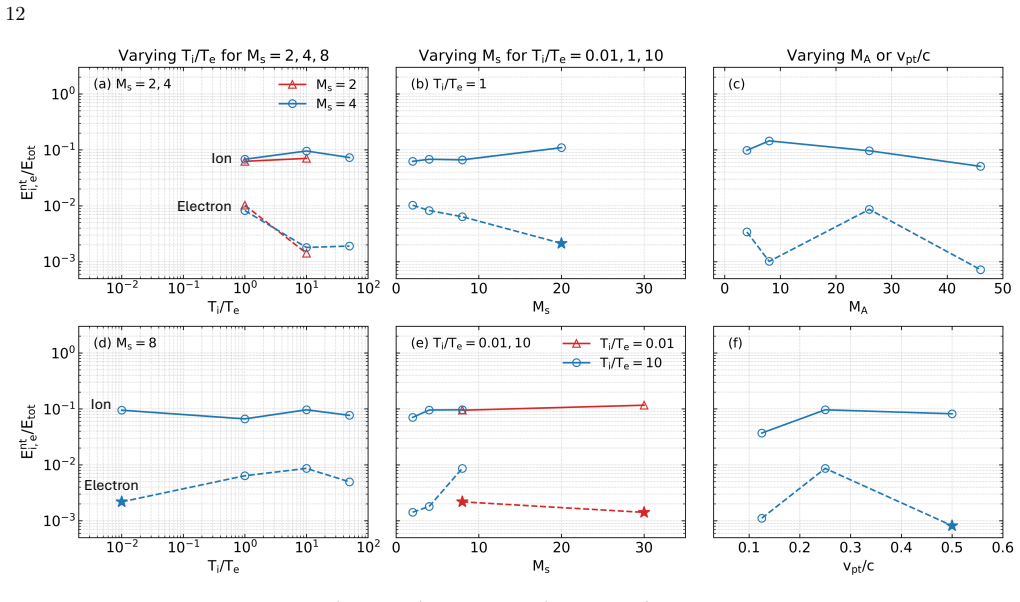
The central discovery is that quasi-parallel collisionless shocks in black-hole-corona conditions consistently channel about 10% of the shock kinetic energy into non-thermal ions, with a normalized acceleration rate C^{-1} ≈ 0.1 that varies by less than a factor of two across all surveyed parameters. This persists even at sonic Mach number M_s ≈ 2, previously considered too weak for efficient acceleration. Electron acceleration is subdominant and variable. From these values, the authors derive an acceleration timescale for NGC 1068 shorter than all cooling timescales up to ~1 PeV and an energy budget requiring only ~3% of the shock power to match the observed neutrino luminosity.
What carries the argument
The load-bearing mechanism is diffusive shock acceleration (DSA) operating in quasi-parallel shocks: back-streaming protons excite upstream magnetic turbulence (predominantly the non-resonant Bell instability), which scatters particles so they repeatedly cross the shock and gain energy. The quantitative anchors are the normalized acceleration coefficient C^{-1} ≈ 0.1 and the ~10% non-thermal ion energy fraction, both extracted from the downstream spectra and used to scale the acceleration timescale t_acc ≈ 11.1 s (E_p/100 TeV)(C^{-1}/0.1)^{-1}(β_sh/0.32)^{-2}(B_0/100 G)^{-1}.
Load-bearing premise
The quantitative transfer of the 10% efficiency and C^{-1} ≈ 0.1 to real coronae rests on the unverified premise that 1D3V particle-in-cell simulations with a reduced ion-to-electron mass ratio of 100 and fixed 30° magnetic obliquity reproduce the true diffusive shock acceleration efficiency and rate of a 3D, full-mass coronal shock.
What would settle it
A single 3D or full-mass-ratio PIC simulation of a quasi-parallel coronal shock in which the downstream non-thermal ion energy fraction deviates strongly from ~10% (e.g., below a few percent) would falsify the claimed universality; alternatively, a future measurement showing that the neutrino spectrum of NGC 1068 requires a proton luminosity exceeding 10% of the shock power, or a proton cutoff below ~30 TeV contradicting the derived acceleration timescale, would falsify the application to NGC 1068.
If this is right
- Even weak shocks with sonic Mach number ~2 convert about 10% of shock energy into non-thermal protons, so low-Mach coronal shocks remain viable hadronic accelerators.
- The normalized acceleration rate C^{-1} ≈ 0.1 gives a concrete, simulation-calibrated timescale; at B0 = 100 G and β_sh = 0.32, protons reach 100 TeV in about 11 seconds, shorter than cooling and free-fall times.
- The required non-thermal proton luminosity for NGC 1068's neutrino signal is ~2×10^43 erg/s, only ~3% of the shock power, within the measured 10% efficiency.
- Because electrons receive <1% of the energy and even less for high T_i/T_e, primary lepton emission is weak; the observed gamma-ray deficit can be explained by pair-production opacity rather than by a lack of hadronic acceleration.
- The nearly parameter-independent C^{-1} allows hadronic models to replace arbitrary acceleration-efficiency assumptions with a physically derived value.
Where Pith is reading between the lines
- A direct multi-dimensional, full-mass-ratio PIC simulation would test whether the 10% ion efficiency and C^{-1} ≈ 0.1 survive outside 1D geometry and reduced mass ratio; if they do, the same scaling could be applied to other Seyferts with coronal shocks, predicting their neutrino fluxes from measured coronal parameters.
- The predicted proton spectrum with slope ~2 and a Hillas-limited cutoff near 0.1–1 PeV implies a spectral softening in the neutrino flux above ~10 TeV, which future high-energy neutrino detectors could observe.
- If the electron acceleration suppression at high T_i/T_e holds, radio/millimeter synchrotron from primary electrons in these coronae should be subdominant; upcoming millimeter observations could distinguish this DSA scenario from reconnection or stochastic-acceleration models that predict stronger leptonic emission.
- The acceleration timescale scaling could be applied to coronal shocks in other AGN classes (e.g., radio-loud or changing-look AGN) to assess whether they also contribute to the diffuse neutrino background.
Editorial analysis
A structured set of objections, weighed in public.
Circularity Check
No significant circularity: simulated C^-1 and ion efficiency are measured from first-principles PIC runs, and the NGC 1068 application is a consistency check, not a fit to the target result.
full rationale
Walked the derivation chain. The central quantities, the normalized proton acceleration rate C^-1 and the non-thermal ion energy fraction, are measured directly from 1D3V PIC simulations with SMILEI (Section 3, 4.2, 4.3). C^-1 is obtained as the late-time slope of the simulated mean ion energy (Figs. 5-7), and the non-thermal ion fraction is an integral over the simulated downstream spectrum (Eq. 8, Fig. 8). Neither is fitted to the IceCube neutrino flux. The NGC 1068 application (Section 5.1) uses these measured values in Eq. (10) for t_acc and Eq. (13) for L_nt_p, then compares L_nt_p/L_sh ≈ 0.03 with the simulated efficiency ≈0.1. This is a consistency check, not a derivation that assumes the neutrino luminosity. The paper explicitly labels the application an 'order-of-magnitude assessment' (Section 5.1.2: 'The estimation presented here should be regarded as an order-of-magnitude assessment'), which is an honest limitation. Self-citations to Y. Inoue et al. (2019, 2020, 2024) motivate coronal parameters and cooling-time procedures, but they do not supply the simulated efficiency or acceleration rate, so they are not load-bearing. The reduced mass ratio m_R=100 and fixed obliquity θ=30° (Section 3: 'We use a reduced ion-to-electron mass ratio of m_R = m_i/m_e = 100 to make the simulations computationally feasible') raise a legitimate external-validity concern, but that is a robustness/correctness risk, not circularity: no equation in the paper reduces the claimed prediction to a fit or to a self-citation chain. Therefore no circular step can be exhibited.
Axiom & Free-Parameter Ledger
free parameters (5)
- Reduced ion-to-electron mass ratio m_R =
100
- Magnetic obliquity theta =
30 degrees
- Thermal/non-thermal break factors =
gamma_br,i = 10 E_sh; gamma_br,e = 10 T_de
- Normalized acceleration coefficient C =
C^-1 ~ 0.1 (C ~ 10)
- Coronal magnetic field B0 =
100 G
axioms (9)
- domain assumption SMILEI's PIC implementation correctly evolves 1D3V collisionless plasma with relativistic Maxwell-Juttner initial conditions
- domain assumption 1D3V geometry with m_R = 100 preserves the DSA efficiency relevant to real 3D coronal shocks
- domain assumption Quasi-parallel shocks with theta = 30 deg represent the shocks that accelerate protons in SMBH coronae
- domain assumption Coronal shock parameters derived in Section 2: v_sh ~ 0.14c, M_s ~ 2-10, M_A ~ 30, T_i/T_e ~ 10, B0 ~ 100 G
- standard math DSA acceleration timescale follows t ~ C gamma beta_sh^-2 Omega_ci^-1 with Bohm-like diffusion
- standard math Hillas / DSA confinement limit E_max <= e B R_c beta_sh
- domain assumption Cooling timescale calculations for pp, p-gamma, and Bethe-Heitler processes follow Inoue et al. (2019)
- domain assumption Neutrino production fraction f_nu ~ 1/6 and spectral-shape factor S >= 4
- domain assumption Coronal plasma is proton-electron with negligible positrons
Cite this review
Pith. "Pith review of Proton Acceleration by Collisionless Shocks in Supermassive Black Hole Coronae: Implications for High-Energy Neutrinos." pith.science (2026). https://pith.science/paper/GLZZZTRZ
@misc{pith2026260101999,
  author       = {Pith},
  title        = {Pith review of: Proton Acceleration by Collisionless Shocks in Supermassive Black Hole Coronae: Implications for High-Energy Neutrinos},
  year         = {2026},
  howpublished = {\url{https://pith.science/paper/GLZZZTRZ}},
  note         = {Machine review of arXiv:2601.01999}
}
read the original abstract
Recent observations by the IceCube Neutrino Observatory have revealed a significant excess of high-energy neutrinos from nearby Seyfert galaxies, such as NGC~1068, without a corresponding flux of high-energy gamma-rays. This suggests that neutrinos are produced via hadronic interactions in a region opaque to gamma-rays, likely a hot corona surrounding the central supermassive black hole. However, the mechanism responsible for accelerating the parent protons to the required energies ($\sim 100$ TeV) remains an open question. In this study, we investigate diffusive shock acceleration (DSA) in active galactic nucleus (AGN) coronae using a suite of one-dimensional Particle-in-cell (PIC) simulations spanning a broad range of plasma parameters. We find that DSA is a robust and efficient mechanism for proton acceleration, consistently channeling approximately 10\% of the shock's kinetic energy into non-thermal ions, even for shocks with sonic Mach number as low as $ M_s \approx 2$. In contrast, the efficiency of electron acceleration is highly variable and less efficient ($<1\%$) in our parameter survey. These findings provide strong, first-principles support for the hadronic models of neutrino production in AGN and offer quantitative constraints that can explain the observed gamma-ray deficit.
Figures




Forward citations
Cited by 1 Pith paper
-
Self-Consistent Modelling of Neutrino Production in Turbulent Black Hole Coronae
A new hybrid simulation code models proton acceleration in turbulent black hole coronae and reproduces the IceCube neutrino signal of NGC 1068 and other Seyferts with standard coronal parameters.
Reference graph
Works this paper leans on
-
[1]
, " * write output.state after.block = add.period write newline
ENTRY address archivePrefix author booktitle chapter doi edition editor eprint howpublished institution journal key month number organization pages publisher school series title misctitle type volume year version url label extra.label sort.label short.list INTEGERS output.state before.all mid.sentence after.sentence after.block FUNCTION init.state.consts ...
-
[2]
write newline
" write newline "" before.all 'output.state := FUNCTION format.url url empty "" new.block "" url * "" * if FUNCTION format.eprint eprint empty "" archivePrefix empty "" archivePrefix "arXiv" = new.block " " eprint * " " * new.block " " eprint * " " * if if if FUNCTION format.doi doi empty "" " " doi * " " * if FUNCTION format.pid doi empty eprint empty ur...
-
[3]
thebibliography [1] 20pt to REFERENCES 6pt =0pt \@twocolumntrue 12pt -12pt 10pt plus 3pt =0pt =0pt =1pt plus 1pt =0pt =0pt -12pt =13pt plus 1pt =20pt =13pt plus 1pt \@M =10000 =-1.0em =0pt =0pt 0pt =0pt =1.0em @enumiv\@empty 10000 10000 `\.\@m \@noitemerr \@latex@warning Empty `thebibliography' environment \@ifnextchar \@reference \@latexerr Missing key o...
discussion (0)
Sign in with ORCID, Apple, or X to comment. Anyone can read and Pith papers without signing in.