REVIEW 4 major objections 5 minor 2 cited by
Self-consistent turbulent corona model reproduces the IceCube neutrino flux of NGC 1068
Reviewed by Pith at T0; open to challenge. T0 means a machine referee read the full paper against a public rubric. the ladder, T0–T4 →
T0 review · deepseek-v4-flash
2026-08-02 17:08 UTC pith:GPI7YLM2
load-bearing objection A genuinely new modeling framework with a physical self-regulation loop, but the IceCube 'reproduction' leans on an imposed X-ray field and no code is out yet — worth refereeing, not worth taking as a hard prediction. the 4 major comments →
Self-Consistent Modelling of Neutrino Production in Turbulent Black Hole Coronae
The pith
A machine-rendered reading of the paper's core claim, the machinery that carries it, and where it could break.
Core claim
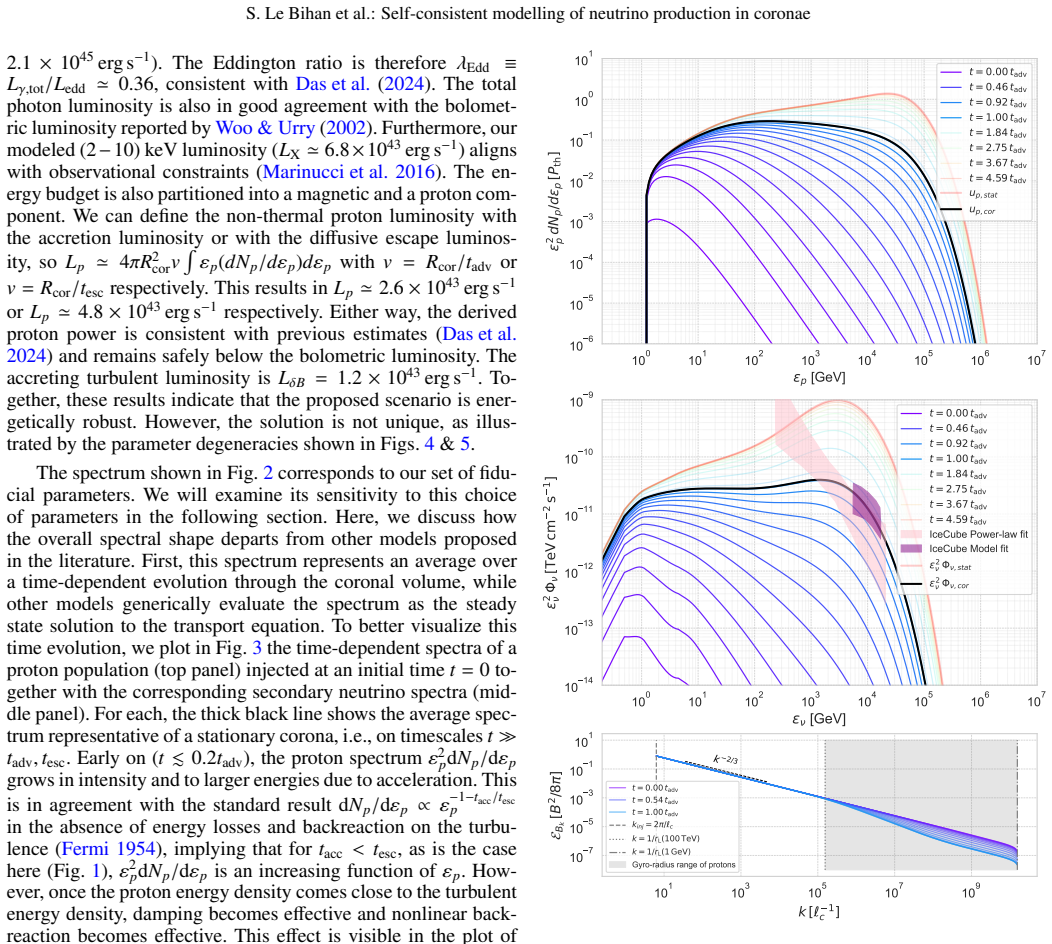
The central claim is that stochastic proton acceleration in the magnetized corona of NGC 1068, treated self-consistently with the damping of turbulence by the accelerated protons, reproduces the IceCube neutrino flux for R_cor ~ 15 r_g, v_A = 0.25c, B ~ 1e3 G, and L_d = 5e44 erg/s, while remaining consistent with gamma-ray upper limits. When the non-thermal proton fraction xi_p is at least about 1e-2, the system self-regulates and the proton spectrum converges to a near-universal shape with equal energy per decade, cut off at a few tens of TeV by photohadronic losses; the resulting neutrino spectrum has a broad peak around 1-10 TeV with a flat low-energy extension from pp interactions. The s
What carries the argument
Turb-AM3, a hybrid code coupling the time-dependent lepto-hadronic radiative solver AM3 with a stochastic acceleration module. The proton transport equation uses either a Fokker-Planck diffusion operator or a generalized Fermi (master) operator, and is solved together with a turbulent cascade equation that includes a damping kernel phi(k,p) transferring turbulent energy from wavenumber k to protons of momentum p. This coupling makes the acceleration rate time-dependent: as protons extract energy from the cascade, the turbulence is quenched at small scales, which automatically limits the non-thermal proton energy density.
Load-bearing premise
The corona is treated as a single, uniform, one-zone region with a constant size, constant advection speed, and a fixed thermal electron population; if the real corona is strongly stratified or has a non-thermal electron component, the target photon field and hence the p-gamma neutrino spectrum could change substantially.
What would settle it
A firm IceCube detection of neutrinos from NGC 1068 above ~100 TeV at a level exceeding the model's sharp cutoff, or a precise measurement of the <1 TeV neutrino flux that does not match the predicted flat pp component, would show that the mechanism or the assumed coronal parameters are wrong.
If this is right
- If the claim holds, standard corona parameters (R_cor ~ 15 r_g, v_A ~ 0.25c, B ~ 1e3 G, L_d ~ 5e44 erg/s) are sufficient to explain the IceCube neutrino signal from NGC 1068.
- For xi_p greater than roughly 1e-2, the neutrino flux normalization becomes insensitive to the exact injection fraction, because turbulent damping self-regulates the proton energy density.
- The neutrino spectrum follows a universal template: broad peak near 1-10 TeV, flat low-energy extension from pp interactions, and a sharp cutoff around tens of TeV set by photohadronic losses.
- Detections near ~100 TeV (as hinted for NGC 7469) are accommodated by varying X-ray luminosity, while emission above ~100 TeV is suppressed.
- The sub-TeV pp component is a diagnostic of proton density and hence of the pair-loading factor in the corona.
Where Pith is reading between the lines
- If the universal template is correct, the neutrino spectral shape alone cannot pin down the proton injection fraction xi_p; the main observable discriminators are the low-energy pp component and the exact cutoff energy.
- The model implies a tight relation between X-ray luminosity and neutrino peak energy: brighter coronae produce more neutrinos but at lower energies; this can be tested with IceCube's growing sample of Seyfert galaxies.
- Extended to other compact environments (X-ray binaries, tidal disruption events), the same code would predict neutrino spectra whose shape is set by the same self-regulation mechanism, giving a way to test the generality of the picture.
- Because the electron distribution is imposed rather than solved, a fuller test of the scenario requires coupling to a thermal Comptonization model, which the authors flag as future work.
Editorial analysis
A structured set of objections, weighed in public.
Referee Report
Summary. The paper introduces Turb-AM3, a hybrid code coupling the AM3 lepto-hadronic radiative solver with a stochastic proton acceleration module that includes turbulent damping by accelerated particles. After presenting the code and physical setup in §2, the authors apply it to a one-zone model of the NGC 1068 corona in §3.1. They claim that a standard parameter set (R_cor ≈ 15 rg, v_A ≈ 0.25c, B ≈ 10^3 G, L_d ≈ 5e44 erg/s, ξ_p = 0.1) reproduces the IceCube neutrino flux while remaining compatible with gamma-ray upper limits, and that for ξ_p ≳ 10^-2 the proton–turbulence system self-regulates, producing a universal neutrino spectral template. The paper also extends the model to NGC 4151 and NGC 7469 by varying only the disk luminosity, and explores sensitivities to ξ_p, t_esc/t_acc, and t_adv/t_acc.
Significance. If the central claim holds, the paper would provide a concrete physical mechanism—turbulent acceleration with self-consistent back-reaction—that explains both the normalization and shape of the IceCube neutrino signal from AGN coronae, while keeping the gamma-ray flux suppressed via electromagnetic cascades. The prediction of a universal neutrino template and the explicit energy-budget consistency checks are useful and falsifiable. However, the significance is conditional: the 'self-consistent' result explicitly relies on an imposed, fixed Maxwellian electron distribution and on an X-ray photon field that is therefore an input assumption rather than a solved outcome. The paper also does not ship code or data, and it does not provide convergence tests, which weakens the reproducibility of the numerical claims. These issues are correctable within the paper's scope, so I regard the work as promising but not yet ready for acceptance as is.
major comments (4)
- [§2.1, §2.4, §3.1] The neutrino flux normalization and peak are driven by pγ interactions whose target photons are the coronal X-ray field. That field is computed from an assumed, fixed Maxwellian electron distribution at Θ_e = 0.2, not solved self-consistently. The paper itself states in §3.1 that 'the electron distribution around the thermal peak is not finely resolved' and postpones electron energization to future work. The headline 'self-consistent' reproduction of the IceCube flux is therefore conditional on an input assumption. The authors should quantify the sensitivity: e.g., vary Θ_e around 0.2 or add a modest nonthermal electron tail and recompute the neutrino spectrum, to show how much the normalization and peak move.
- [§3.2, Fig. 4] The comparison procedure in Fig. 4 tunes v_A to a fixed pivot point (Eν = 10 TeV, E²Φν = 1.4e-11 erg/cm²/s). Since v_A controls both the acceleration rate and, through Eq. (3), B and the coronal magnetic energy, this tuning strongly influences the predicted neutrino flux. The fiducial set in §3.1 is not tested against a quantitative goodness-of-fit statistic; the claim of 'satisfactorily reproduced' rests on visual overlap. The authors should present untuned predictions and a statistical measure (e.g., chi-square or likelihood) for the fiducial and tuned cases, given the degeneracies displayed in Figs. 4–6.
- [§2.7, §3.1, §3.3] No convergence tests are presented for the numerical method: no resolution study in momentum space, no timestep convergence, no comparison of the coupled acceleration–cascade solver against an analytic limit. The universal spectral shape and saturation behavior claimed in §3.2–3.3 could be numerical artifacts if the grid does not resolve the acceleration–loss balance near the TeV cutoff. The authors should add convergence tests and ideally release the code or a reproducible input/output package, as this is central to validating the new Turb-AM3 framework.
- [§3.2, §3.3] The 'universal' spectral shape is asserted on the basis of visual inspection of Figs. 4, 5, and A.1. No quantitative definition or metric is given for convergence to this template (e.g., a fractional deviation of the peak energy or spectral slope across ξ_p and t_esc/t_acc). Since the universality is a central new result, the authors should define and compute a shape-difference measure for the neutrino spectrum in the self-regulated regime.
minor comments (5)
- [Abstract, passim] Typographical errors: 'excape' in §2.1, 'respectivly' in the Introduction, and 'articially' in §3.2. The manuscript would benefit from a careful proofread.
- [Fig. 2] The figure contains many curves and labels; the color/line assignments are complex. A table of components (or a simplified version separating photon and neutrino panels) would improve readability.
- [§2.5, Eq. (10)] The footnote about Eq. (10) is helpful, but the limiting case t_adv ≫ t_esc is stated only verbally; it would be clearer to write the explicit limiting form.
- [§2.6, Eq. (11)] The kernel φ(k,p) is said to be 'normalized to unity' but the precise normalization variable in the Gaussian is ambiguous (ln k vs k). Clarify the argument of the Gaussian and the normalization measure.
- [References] Several 2026 references are cited as 'arXiv e-prints' with no journal page numbers; if any have since been published, the bibliographic entries should be updated.
Circularity Check
Parameter-space neutrino 'reproduction' is partly enforced by tuning v_A to the IceCube pivot, but the fiducial NGC 1068 model is a genuine forward calculation.
specific steps
-
fitted input called prediction
[Section 3.2, Fig. 4 (parameter exploration)]
"In order to obtain a meaningful comparison to observations, we slightly tune the Alfvénic velocity vA to match the observed neutrino flux at a pivot point defined by Eν =10 TeV and (all-flavour) flux E 2 ν Φν =1.4×10 −11 erg/cm2s ... The model reliably reproduces the IceCube neutrino flux, independently of the precise value of ξp, shaping a neutrino spectral shape with a turn-over at energies below the peak (Eν∼3 TeV here)."
The Fig. 4 curves are normalized by construction: v_A is adjusted so that every neutrino spectrum passes through the observed E²Φ=1.4e-11 erg/cm²/s point at 10 TeV. The subsequent statement that the model 'reliably reproduces the IceCube neutrino flux' therefore holds at the pivot because the parameter was fitted to that datum, not because the model predicted it. The spectral shape away from the pivot (pp plateau, pγ cutoff) is not forced, which limits the circularity; the fiducial Sec. 3.1 model is also not pivot-tuned.
full rationale
The central fiducial calculation (Sec. 3.1, Fig. 2) is a forward model: inputs are the observed disk luminosity, coronal size, Thomson depth, an assumed Maxwellian electron distribution (Θe=0.2), ξp=0.1, and vA=0.25c; the neutrino spectrum is obtained by solving coupled proton transport and radiative losses in Turb-AM3. The agreement with IceCube at 1-30 TeV is therefore not circular in the fiducial case, and the model also reproduces X-ray and gamma-ray constraints. The main circularity risk is confined to Sec. 3.2/Fig. 4, where v_A is explicitly tuned to the 10 TeV IceCube flux before the model is said to 'reproduce' the flux; that is a fitted-input-called-prediction at the pivot. I also considered the imposed electron/X-ray field: the pγ neutrino flux is conditional on the assumed Maxwellian electron population and on not modeling electron energization, as the authors acknowledge in Secs. 2.1 and 4. But this is an assumption about the environment, not an equivalence between input and output, so it is a robustness/self-consistency limitation rather than a circular reduction. Self-citations (Lemoine 2022; Lemoine et al. 2024; Lemoine & Rieger 2025) are used for the acceleration/damping operators, but the formalism is benchmarked on MHD/PIC simulations and Appendix A shows insensitivity to the acceleration scheme, so the self-citations are not load-bearing. Overall: one partial, transparent pivot fit in the parameter study; the headline forward calculation retains independent content.
Axiom & Free-Parameter Ledger
free parameters (8)
- Turbulent dissipation coefficient f_diss =
0.1
- Non-thermal proton injection fraction ξ_p =
0.1 (explored 1e-4…0.33)
- Corona size R_cor =
15 r_g (explored 5-20 r_g)
- Alfvén velocity v_A (or magnetization σ) =
0.25c fiducial; tuned in parameter scans to match neutrino pivot flux
- Turbulence coherence length l_c =
4 r_g fiducial; varied in scans
- Advection velocity v_adv =
0.03c fiducial; varied
- Corona covering fraction f_cor =
0.2
- X-ray luminosity normalization =
L_X(2-10 keV) = 6.8e43 erg/s for NGC 1068; L_X adjusted to observed values for NGC 4151/7469
axioms (6)
- domain assumption Corona is a one-zone spherical, uniform region with constant size R_cor and constant advection velocity
- ad hoc to paper Electron distribution is a fixed thermal Maxwellian with Θ_e = 0.2 at all times
- ad hoc to paper Protons are continuously injected at the outer edge of the corona with a power-law spectrum p^-4 and a free normalization ξ_p
- domain assumption The turbulence is isotropic with Kolmogorov spectrum S_k ∝ k^-5/3 and a damping kernel φ(k,p) that maps wavenumber to proton gyroradius k ~ eB/pc
- domain assumption Quasi-linear / generalized-Fermi transport prescription captured by either L_FP or L_GF with acceleration coefficient D_pp = 0.3 σ_δB p^2 c/l_c
- domain assumption Protons are the only species that undergo stochastic acceleration; pions, muons, leptons do not
Cite this review
Pith. "Pith review of Self-Consistent Modelling of Neutrino Production in Turbulent Black Hole Coronae." pith.science (2026). https://pith.science/paper/GPI7YLM2
@misc{pith2026260327749,
  author       = {Pith},
  title        = {Pith review of: Self-Consistent Modelling of Neutrino Production in Turbulent Black Hole Coronae},
  year         = {2026},
  howpublished = {\url{https://pith.science/paper/GPI7YLM2}},
  note         = {Machine review of arXiv:2603.27749}
}
read the original abstract
Stochastic particle acceleration in magnetized turbulent plasmas has emerged as a key mechanism to explain multi-messenger signals from compact astrophysical environments. Self-consistent modelling remains challenging because it requires to treat simultaneously several non-linear kinetic processes, especially turbulence-driven acceleration and its feedback on the turbulent cascade, as well as the radiative and hadronic losses, including the reprocessing of electromagnetic radiation in radiatively dense environments. The present paper introduces the hybrid numerical code Turb-AM3 designed to this effect. This hybrid numerical code couples the state-of-the-art time-dependent lepto-hadronic radiative solver AM3 with a stochastic acceleration module that incorporates recent theoretical advances in turbulent acceleration and accounts for the dynamical damping of turbulence by accelerated particles. In the second part of the paper, we use this code to provide self-consistent time-dependent models of proton acceleration in the turbulent black hole corona of NGC~1068. We find that the IceCube neutrino signal is well reproduced for a standard set of physical parameters describing the black hole corona. The same template model accounts in a satisfactory way for IceCube observations of other active galactic nuclei. Furthermore, our exploration of parameter space allows us to predict detailed template spectral shapes for the TeV neutrino spectrum, which in turn help understand how future neutrino observations can constrain the properties of turbulent AGN coronae and the underlying acceleration mechanism. This Turb-AM3 framework provides a powerful tool to model multi-messenger emission in a broad variety of compact astrophysical environments.
Figures




Forward citations
Cited by 2 Pith papers
-
Particle Acceleration, Coronal Neutrino Production, and the Diffuse Extragalactic Neutrino Background from Supermassive Black Holes
The cosmologically integrated neutrino emission from supermassive black hole coronae in Seyfert galaxies can account for the sub-PeV diffuse extragalactic neutrino flux observed by IceCube.
-
On the Blueprint of Active Galaxies Producing Neutrinos
Neutrinos from active galaxies are produced in compact X-ray-bright coronae within about ten Schwarzschild radii of the black hole, and such sources may supply the diffuse neutrino flux.
Reference graph
Works this paper leans on
-
[1]
G., Ackermann, M., Adams, J., et al
Aartsen, M. G., Ackermann, M., Adams, J., et al. 2020, Phys. Rev. Lett., 124, 051103
2020
-
[2]
2026, Astrophys
Abbasi, R., Ackermann, M., Adams, J., et al. 2026, Astrophys. J. Lett., 1000, L26
2026
-
[3]
2023, Astrophys
Ajello, M., Murase, K., & McDaniel, A. 2023, Astrophys. J. Lett., 954, L49
2023
-
[4]
Ambrosone, A. 2024, J. Cosmol. Astropart. Phys., 2024, 075
2024
-
[5]
2008, Astron
Belmont, R., Malzac, J., & Marcowith, A. 2008, Astron. Astrophys., 491, 617
2008
-
[6]
Beloborodov, A. M. 2017, Astrophys. J., 850, 141
2017
-
[7]
S., Bulanov, S
Berezinskii, V . S., Bulanov, S. V ., Dogiel, V . A., & Ptuskin, V . S. 1990, Astron. Nachr. North-Holland, Amsterdam, 312, 413
1990
-
[8]
2022, Phys
Bresci, V ., Lemoine, M., Gremillet, L., et al. 2022, Phys. Rev. D, 106, 023028
2022
-
[9]
2026, Astrophys
Cerruti, M., Rudolph, A., Petropoulou, M., et al. 2026, Astrophys. J. Suppl. Ser., 282, 22
2026
-
[10]
H., & Giommi, P
Chang, Y .-L., Brandt, C. H., & Giommi, P. 2020, Astron. Comput., 30, 100350
2020
-
[11]
& Sironi, L
Comisso, L. & Sironi, L. 2019, Astrophys. J., 886, 122
2019
-
[12]
& Sironi, L
Comisso, L. & Sironi, L. 2022, Astrophys. J. Lett., 936, L27
2022
-
[13]
Coppi, P. S. 1992, Mon. Not. R. Astron. Soc., 258, 657
1992
-
[14]
T., & Murase, K
Das, A., Zhang, B. T., & Murase, K. 2024, Astrophys. J., 972, 44
2024
-
[15]
2025, arXiv e-prints, arXiv:2506.04212
Das, S., Xu, S., & Nättilä, J. 2025, arXiv e-prints, arXiv:2506.04212
Pith/arXiv arXiv 2025
-
[16]
2020, Phys
Demidem, C., Lemoine, M., & Casse, F. 2020, Phys. Rev. D, 102, 023003
2020
-
[17]
2026, arXiv e-prints, arXiv:2603.09394 Dovˇciak, M., Papadakis, I
Dmytriiev, A., van der Merwe, F., & Böttcher, M. 2026, arXiv e-prints, arXiv:2603.09394 Dovˇciak, M., Papadakis, I. E., Kammoun, E. S., & Zhang, W. 2022, Astron. Astrophys., 661, A135
arXiv 2026
-
[18]
Eichmann, B., Oikonomou, F., Salvatore, S., Dettmar, R.-J., & Tjus, J. B. 2022, Astrophys. J., 939, 43
2022
-
[19]
C., Lohfink, A., Belmont, R., Malzac, J., & Coppi, P
Fabian, A. C., Lohfink, A., Belmont, R., Malzac, J., & Coppi, P. 2017, Mon. Not. R. Astron. Soc., 467, 2566
2017
-
[20]
C., Lohfink, A., Kara, E., et al
Fabian, A. C., Lohfink, A., Kara, E., et al. 2015, Mon. Not. R. Astron. Soc., 451, 4375
2015
-
[21]
L., Halzen, F., & Gallagher, J
Fang, K., Rodriguez, E. L., Halzen, F., & Gallagher, J. S. 2023, Astrophys. J., 956, 8
2023
-
[22]
1954, Astrophys
Fermi, E. 1954, Astrophys. J., 119, 1
1954
-
[23]
Fiorillo, D. F. G., Comisso, L., Peretti, E., Petropoulou, M., & Sironi, L. 2025, Astrophys. J., 989, 215
2025
-
[24]
Frank, J., King, A., & Raine, D. J. 2002, Accretion Power in Astrophysics, 398
2002
-
[25]
A., Rosner, R., & Vaiana, G
Galeev, A. A., Rosner, R., & Vaiana, G. S. 1979, Astrophys. J., 229, 318
1979
-
[26]
& Tavecchio, F
Ghisellini, G. & Tavecchio, F. 2009, Mon Not R Astron Soc, 397, 985
2009
-
[27]
2025, Astro- phys
Gong, X.-W., Liu, R.-Y ., Zhang, Z.-L., Asano, K., & Lemoine, M. 2025, Astro- phys. J., 989, 99
2025
-
[28]
A., Grošelj, D., & Bacchini, F
Gorbunov, E. A., Grošelj, D., & Bacchini, F. 2025, Phys. Rev. Lett., 135, 065201
2025
-
[29]
M., Sironi, L., & Philippov, A
Groselj, D., Hakobyan, H., Beloborodov, A. M., Sironi, L., & Philippov, A. 2024, Phys. Rev. Lett., 132, 085202
2024
-
[30]
Groselj, D., Philippov, A., Beloborodov, A. M., & Mushotzky, R. 2026, arXiv e-prints, arXiv:2601.00518
Pith/arXiv arXiv 2026
-
[31]
2025, Phys
Herrera, G. 2025, Phys. Dark Univ., 50, 102156
2025
-
[32]
Hinkle, J. T. & Mushotzky, R. 2021, Mon. Not. R. Astron. Soc., 506, 4960
2021
-
[33]
2018, Science, 361, eaat1378 IceCube Collaboration, Aartsen, M
IceCube, T., Fermi-LAT, MAGIC, et al. 2018, Science, 361, eaat1378 IceCube Collaboration, Aartsen, M. G., Ackermann, M., et al. 2018, Science, 361, 147 IceCube Collaboration, Abbasi, R., M. Ackermann, et al. 2022, Science, 378, 538
2018
-
[34]
2019, Astrophys
Inoue, Y ., Khangulyan, D., Inoue, S., & Doi, A. 2019, Astrophys. J., 880, 40
2019
-
[35]
Jaffe, W., Meisenheimer, K., Röttgering, H. J. A., et al. 2004, Nature, 429, 47
2004
-
[36]
2016, Astrophys
Kakuwa, J. 2016, Astrophys. J., 816, 24
2016
-
[37]
M., Masterson, M., et al
Kammoun, E., Lohfink, A. M., Masterson, M., et al. 2024, Front. Astron. Space Sci., 10, 1308056
2024
-
[38]
J., et al
Kantzas, D., Markoff, S., Cooper, A. J., et al. 2023, Mon. Not. R. Astron. Soc., 524, 1326
2023
-
[39]
Karavola, D., Petropoulou, M., Fiorillo, D. F. G., Comisso, L., & Sironi, L. 2025, J. Cosmol. Astropart. Phys., 2025, 075
2025
-
[40]
B., Quataert, E., et al
Kempski, P., Fielding, D. B., Quataert, E., et al. 2023, Mon. Not. R. Astron. Soc., 525, 4985
2023
-
[41]
Kheirandish, A., Murase, K., & Kimura, S. S. 2021, Astrophys. J., 922, 45
2021
-
[42]
S., Tomida, K., & Murase, K
Kimura, S. S., Tomida, K., & Murase, K. 2019, Mon. Not. R. Astron. Soc., 485, 163
2019
-
[43]
2024, Astrophys
Klinger, M., Rudolph, A., Rodrigues, X., et al. 2024, Astrophys. J. Suppl. Ser., 275, 4
2024
-
[44]
C., Gandhi, P., et al
Kumar, S., Dewangan, G. C., Gandhi, P., et al. 2024, Astrophys. J., 975, 73
2024
-
[45]
2019, Phys
Lemoine, M. 2019, Phys. Rev. D, 99, 083006
2019
-
[46]
2021, Phys
Lemoine, M. 2021, Phys. Rev. D, 104, 063020
2021
-
[47]
2022, Phys
Lemoine, M. 2022, Phys. Rev. Lett., 129, 215101 Article number, page 13 A&A proofs:manuscript no. Article_NGC1068_SLB_ML_FR
2022
-
[48]
Lemoine, M. 2023, J. Plasma Phys., 89, 175890501
2023
-
[49]
2025, Phys
Lemoine, M. 2025, Phys. Rev. E, 112, 015205
2025
-
[50]
& Malkov, M
Lemoine, M. & Malkov, M. A. 2020, Mon. Not. R. Astron. Soc., 499, 4972
2020
-
[51]
2024, Phys
Lemoine, M., Murase, K., & Rieger, F. 2024, Phys. Rev. D, 109, 063006
2024
-
[52]
& Rieger, F
Lemoine, M. & Rieger, F. 2025, Astron. Astrophys., 697, A124
2025
-
[53]
A., Lehnert, M., & Karczewski, O
Lianou, S., Barmby, P., Mosenkov, A. A., Lehnert, M., & Karczewski, O. 2019, Astron. Astrophys., 631, A38
2019
-
[54]
2018, Astrophys
Lopez-Rodriguez, E., Fuller, L., Alonso-Herrero, A., et al. 2018, Astrophys. J., 859, 99
2018
-
[55]
2025, arXiv e-prints, arXiv:2503.09426
Lu, M.-X., Liang, Y .-F., Wang, X.-G., & Ouyang, X.-R. 2025, arXiv e-prints, arXiv:2503.09426
Pith/arXiv arXiv 2025
-
[56]
W., Quataert, E., Chandran, B
Lynn, J. W., Quataert, E., Chandran, B. D. G., & Parrish, I. J. 2014, Astrophys. J., 791, 71 MAGIC Collaboration, Acciari, V . A., Ansoldi, S., et al. 2019, Astrophys. J., 883, 135
2014
-
[57]
2016, Mon
Marinucci, A., Bianchi, S., Matt, G., et al. 2016, Mon. Not. R. Astron. Soc., 456, L94
2016
-
[58]
2024, Phys
Mbarek, R., Philippov, A., Chernoglazov, A., Levinson, A., & Mushotzky, R. 2024, Phys. Rev. D, 109, L101306
2024
-
[59]
2023, Astrophys
Meringolo, C., Cruz-Osorio, A., Rezzolla, L., & Servidio, S. 2023, Astrophys. J., 944, 122
2023
-
[60]
2022, Astrophys
Murase, K. 2022, Astrophys. J. Lett., 941, L17
2022
-
[61]
M., Kimura, S
Murase, K., Karwin, C. M., Kimura, S. S., Ajello, M., & Buson, S. 2024, Astro- phys. J. Lett., 961, L34
2024
-
[62]
S., & Mészáros, P
Murase, K., Kimura, S. S., & Mészáros, P. 2020, Phys. Rev. Lett., 125, 011101
2020
-
[63]
S., Mukhopadhyay, M., & Bhattacharya, M
Murase, K., Kimura, S. S., Mukhopadhyay, M., & Bhattacharya, M. 2026, arXiv e-prints, arXiv:2602.20145 Nättilä, J. 2024, Nature Comm., 15, 7026
arXiv 2026
-
[64]
Neronov, A., Savchenko, D., & Semikoz, D. V . 2024, Phys. Rev. Lett., 132, 101002 Nhat Ly, M., Inoue, Y ., Sentoku, Y ., & Sano, T. 2026, arXiv e-prints, arXiv:2601.01999
Pith/arXiv arXiv 2024
-
[65]
2024, Nat
Padovani, P., Resconi, E., Ajello, M., et al. 2024, Nat. Astron., 8, 1077
2024
-
[66]
Pezzi, O., Blasi, P., & Matthaeus, W. H. 2022, Astrophys. J., 928, 25
2022
-
[67]
& Svensson, R
Poutanen, J. & Svensson, R. 1996, Astrophys. J., 470, 249
1996
-
[68]
V ., Horne, K., et al
Prince, R., Hernández Santisteban, J. V ., Horne, K., et al. 2025, Mon. Not. R. Astron. Soc., 541, 642
2025
-
[69]
2023, Astrophys
Pugliese, F., Brodiano, M., Andrés, N., & Dmitruk, P. 2023, Astrophys. J., 959, 28
2023
-
[70]
2022, Phys
Reusch, S., Stein, R., Kowalski, M., et al. 2022, Phys. Rev. Lett., 128
2022
-
[71]
C., Fabian, A
Ricci, C., Ho, L. C., Fabian, A. C., et al. 2018, Mon. Not. R. Astron. Soc., 480, 1819
2018
-
[72]
S., Garrappa, S., et al
Rodrigues, X., Paliya, V . S., Garrappa, S., et al. 2024, Astron. Astrophys., 681, A119
2024
-
[73]
Rybicki, G. B. & Lightman, A. P. 1979, A Wiley-Interscience Publication
1979
-
[74]
2002, Cosmic Ray Astrophysics (Springer, Berlin)
Schlickeiser, R. 2002, Cosmic Ray Astrophysics (Springer, Berlin)
2002
-
[75]
& Tavecchio, F
Sciaccaluga, A. & Tavecchio, F. 2022, Mon. Not. R. Astron. Soc., 517, 2502
2022
-
[76]
Shakura, N. I. & Sunyaev, R. A. 1973, Astron. Astrophys., 24, 337
1973
-
[77]
& Beloborodov, A
Sironi, L. & Beloborodov, A. M. 2020, Astrophys. J., 899, 52
2020
-
[78]
Sridhar, N., Ripperda, B., Sironi, L., Davelaar, J., & Beloborodov, A. M. 2025, Astrophys. J., 979, 199
2025
-
[79]
v., Kowalski, M., et al
Stein, R., Velzen, S. v., Kowalski, M., et al. 2021, Nat. Astron., 5, 510–518
2021
-
[80]
E., Poutanen, J., Svensson, R., Sikora, M., & Begelman, M
Stern, B. E., Poutanen, J., Svensson, R., Sikora, M., & Begelman, M. C. 1995, Astrophys. J. Lett., 449, L13
1995
discussion (0)
Sign in with ORCID, Apple, or X to comment. Anyone can read and Pith papers without signing in.