Recognition: 1 theorem link
· Lean TheoremProbing the nature of Einstein nonlinear Maxwell Yukawa black hole through gravitational wave forms from periodic orbits and quasiperiodic oscillations
Pith reviewed 2026-05-16 17:19 UTC · model grok-4.3
The pith
The parameters of Einstein nonlinear Maxwell Yukawa black holes are constrained using gravitational waveforms from periodic orbits and quasiperiodic oscillations in microquasars.
A machine-rendered reading of the paper's core claim, the machinery that carries it, and where it could break.
Core claim
The Einstein nonlinear Maxwell Yukawa black hole supports periodic orbits labeled by integer triplets that display zoom-whirl behavior; the corresponding gravitational wave polarizations are derived from the geodesic motion, and Markov Chain Monte Carlo analysis of quasiperiodic oscillations in the relativistic precession model constrains the Yukawa screening parameter and electric charge for microquasars and the galactic center.
What carries the argument
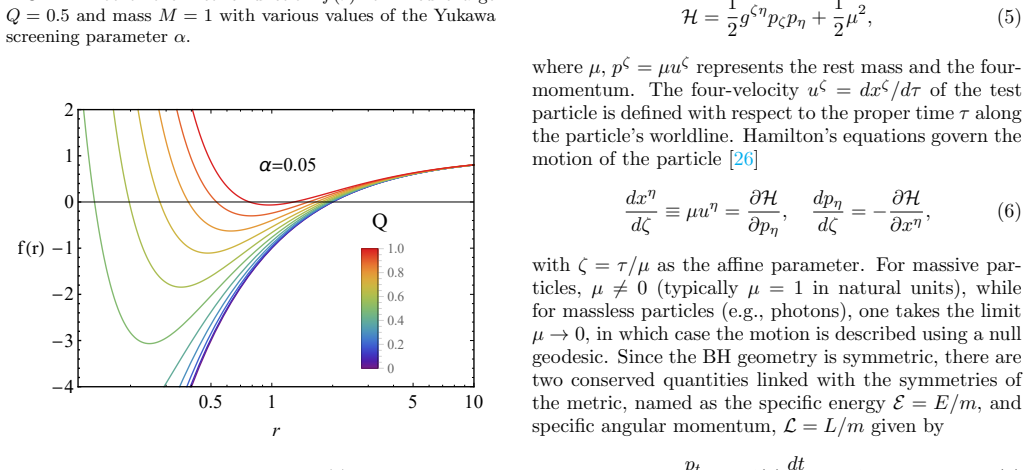
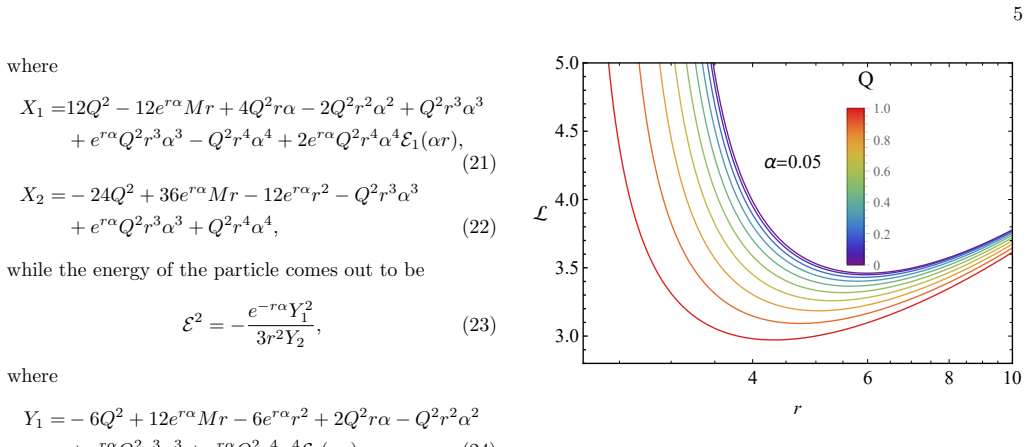
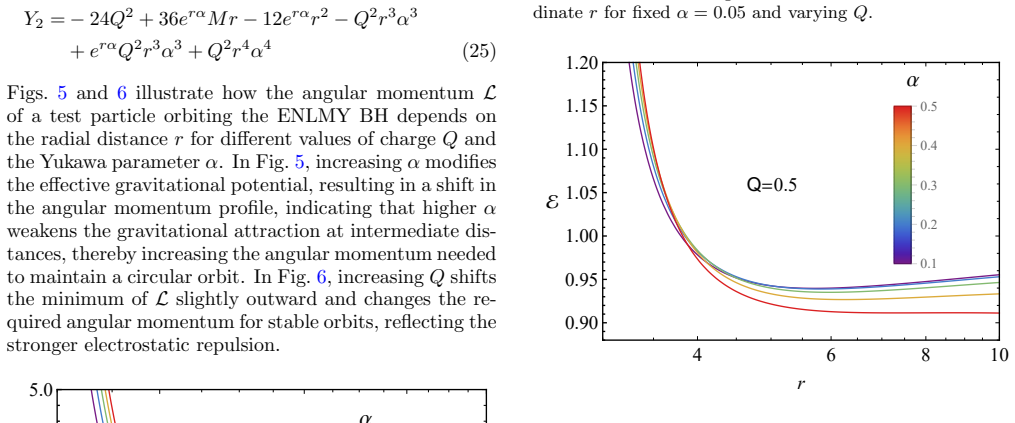
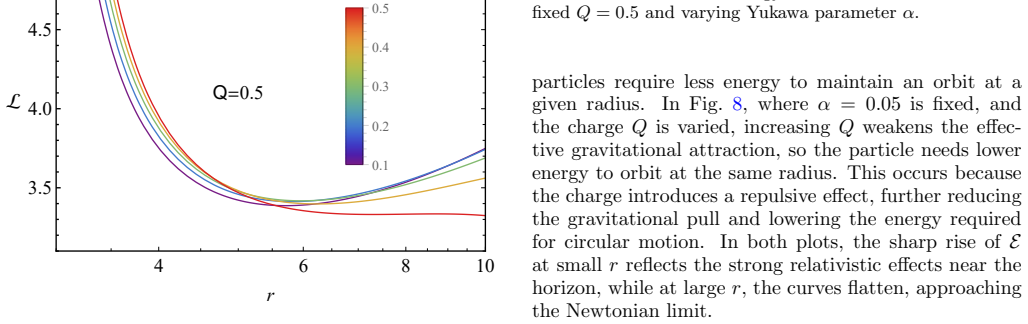
The effective potential for geodesic motion in the ENLMY spacetime, obtained via the Hamiltonian approach, which governs the stability of circular orbits and the characteristics of periodic orbits as functions of the Yukawa parameter and charge Q.
Load-bearing premise
The relativistic precession model maps the observed quasiperiodic oscillation frequencies directly to the geodesic orbital frequencies without needing additional corrections from the nonlinear Maxwell or Yukawa contributions.
What would settle it
Detection of quasiperiodic oscillation frequencies in a microquasar that lie outside the range producible by any combination of Yukawa parameter and charge Q in the MCMC posterior distribution would falsify the model for that source.
Figures





read the original abstract
In this work, we study gravitational wave emission from periodic orbits of test particles, analyze quasi periodic oscillations, and constrain the parameters of the static, spherically symmetric Einstein nonlinear Maxwell Yukawa black hole. Using the Hamiltonian approach, we calculate the equations of motion of the particles. We analyze the effective potential to determine the innermost stable circular orbit and innermost bound circular orbit, illustrating how the Yukawa screening parameter and electric charge Q affect orbital stability and energy requirements. Periodic orbits are classified by integer triplets and exhibit characteristic zoom whirl behavior. Based on these orbits we compute the corresponding GW signals in both the polarizations. Finally, we perform Monte Carlo Markov Chain MCMC simulations to constrain the parameters of the ENLMY BH for four microquasars and the galactic center within the relativistic precession model.
Editorial analysis
A structured set of objections, weighed in public.
Referee Report
Summary. The manuscript studies test-particle dynamics in the static spherically symmetric Einstein nonlinear Maxwell Yukawa black hole, computes gravitational-wave signals from periodic orbits classified by integer triplets, analyzes quasi-periodic oscillations via the relativistic precession model, and performs MCMC fits to constrain the Yukawa screening parameter and electric charge Q using data from four microquasars and the galactic center.
Significance. If the central assumptions hold, the explicit computation of GW polarizations from zoom-whirl periodic orbits and the effective-potential analysis of ISCO/IBCO stability add concrete results to the literature on modified black-hole spacetimes. The MCMC constraints, if robust, would provide observational bounds on this particular nonlinear electrodynamics plus Yukawa model.
major comments (2)
- [QPO and MCMC analysis section] The section describing the QPO analysis and MCMC fitting assumes that observed frequencies can be directly identified with the orbital, periastron-precession, and nodal-precession frequencies obtained from geodesic motion in the ENLMY metric. The nonlinear Maxwell and Yukawa terms modify the effective potential; without a derivation or numerical test showing that non-geodesic corrections to disk dynamics remain negligible, the resulting posteriors for the Yukawa parameter and Q may be systematically biased.
- [MCMC analysis section] The parameter constraints are obtained by fitting the model to observational QPO data via MCMC; the manuscript should explicitly discuss that these are not independent predictions and should include a sensitivity test to the RPM frequency-mapping assumption.
minor comments (3)
- [Abstract] The abstract summarizes the workflow at high level but supplies no numerical results, error budgets, or constrained parameter values.
- [Introduction and metric section] The explicit form of the ENLMY metric and the definitions of the Yukawa screening parameter and charge Q should be stated at the beginning of the manuscript with consistent notation.
- [GW waveforms section] Clarify whether the GW waveforms are computed in the quadrupole approximation and how the two polarizations are extracted from the periodic-orbit trajectories.
Simulated Author's Rebuttal
We thank the referee for the careful reading and constructive comments on our manuscript. We address each major comment below and have revised the manuscript to incorporate additional discussion and analysis where appropriate.
read point-by-point responses
-
Referee: [QPO and MCMC analysis section] The section describing the QPO analysis and MCMC fitting assumes that observed frequencies can be directly identified with the orbital, periastron-precession, and nodal-precession frequencies obtained from geodesic motion in the ENLMY metric. The nonlinear Maxwell and Yukawa terms modify the effective potential; without a derivation or numerical test showing that non-geodesic corrections to disk dynamics remain negligible, the resulting posteriors for the Yukawa parameter and Q may be systematically biased.
Authors: We appreciate the referee's point regarding potential non-geodesic effects. Our work follows the standard test-particle geodesic approximation in the ENLMY metric, which already incorporates the nonlinear Maxwell and Yukawa contributions into the spacetime geometry. For neutral particles, motion is geodesic by definition, and we have used the effective potential to determine ISCO and IBCO locations. We acknowledge that a complete treatment of charged fluid dynamics could introduce corrections. In the revised manuscript, we have added a dedicated paragraph in the QPO section discussing this assumption, citing that such effects are typically subdominant in similar literature studies, and noting the limitation for future work. revision: partial
-
Referee: [MCMC analysis section] The parameter constraints are obtained by fitting the model to observational QPO data via MCMC; the manuscript should explicitly discuss that these are not independent predictions and should include a sensitivity test to the RPM frequency-mapping assumption.
Authors: We agree that the MCMC results are model-dependent constraints within the relativistic precession model (RPM) rather than independent predictions. The revised manuscript now includes an explicit statement clarifying this point in the MCMC section. Additionally, we have performed and reported a sensitivity test by varying the frequency-mapping assumptions (e.g., small perturbations to the orbital, periastron, and nodal frequencies) and showing the impact on the posterior distributions for the Yukawa parameter and charge Q. revision: yes
Circularity Check
No significant circularity in derivation chain
full rationale
The paper derives equations of motion via Hamiltonian formalism, effective potential, ISCO/IBCO locations, periodic orbit classification by integer triplets, and GW polarizations directly from the ENLMY metric. These steps are independent of the later MCMC fitting. The MCMC step constrains parameters by matching computed geodesic frequencies (under the relativistic precession model) to observed QPO data for microquasars; this is standard parameter estimation and is not presented as an independent prediction that reduces to the inputs by construction. No self-definitional loops, fitted quantities renamed as predictions, load-bearing self-citations, or ansatz smuggling appear in the abstract or described chain. The derivation remains self-contained against external observational benchmarks.
Axiom & Free-Parameter Ledger
free parameters (2)
- Yukawa screening parameter
- electric charge Q
axioms (3)
- domain assumption Spacetime is described by the static spherically symmetric Einstein nonlinear Maxwell Yukawa metric
- standard math Test-particle motion obeys the Hamiltonian geodesic equations
- domain assumption Relativistic precession model correctly relates QPO frequencies to orbital frequencies
invented entities (1)
-
Einstein nonlinear Maxwell Yukawa black hole
no independent evidence
Lean theorems connected to this paper
-
IndisputableMonolith/Cost/FunctionalEquation.lean; IndisputableMonolith/Foundation/RealityFromDistinction.leanwashburn_uniqueness_aczel; reality_from_one_distinction unclear?
unclearRelation between the paper passage and the cited Recognition theorem.
We analyze the effective potential to determine the ISCO and IBCO... Periodic orbits are classified by integer triplets... MCMC simulations to constrain the parameters of the ENLMY BH... within the relativistic precession model.
What do these tags mean?
- matches
- The paper's claim is directly supported by a theorem in the formal canon.
- supports
- The theorem supports part of the paper's argument, but the paper may add assumptions or extra steps.
- extends
- The paper goes beyond the formal theorem; the theorem is a base layer rather than the whole result.
- uses
- The paper appears to rely on the theorem as machinery.
- contradicts
- The paper's claim conflicts with a theorem or certificate in the canon.
- unclear
- Pith found a possible connection, but the passage is too broad, indirect, or ambiguous to say the theorem truly supports the claim.
Reference graph
Works this paper leans on
-
[1]
First M87 Event Horizon Telescope Results. I. The Shadow of the Supermassive Black Hole
Event Horizon Telescope Collaboration, K. Akiyama, et al., The Astrophysical Journal Letters875, L1 (2019), arXiv:1906.11238 [astro-ph.GA]
work page internal anchor Pith review Pith/arXiv arXiv 2019
-
[2]
M. Born and L. Infeld, Proceedings of the Royal Society of London Series A144, 425 (1934)
work page 1934
-
[3]
YUKAWA, Proceedings of the Physico-Mathematical Society of Japan
H. YUKAWA, Proceedings of the Physico-Mathematical Society of Japan. 3rd Series17, 48 (1935)
work page 1935
-
[4]
T. Zahra, O. Shabbir, B. Majeed, M. Jamil, J. Rayim- baev, and A. Shermatov, European Physical Journal C 85, 1340 (2025), arXiv:2510.22761 [gr-qc]
-
[5]
A. Cruz-Osorio, S. Gimeno-Soler, J. A. Font, M. De Lau- rentis, and S. Mendoza, Phys. Rev. D103, 124009 (2021)
work page 2021
-
[6]
I. De Martino, M. De Laurentis, F. Atrio- Barandela, and S. Capozziello, Monthly No- tices of the Royal Astronomical Society442, 921 (2014), https://academic.oup.com/mnras/article- pdf/442/2/921/5729104/stu903.pdf
work page 2014
-
[7]
Analysis of the Yukawa gravitational potential in $f(R)$ gravity II: relativistic periastron advance
M. De Laurentis, I. De Martino, and R. Lazkoz, Phys. Rev. D97, 104068 (2018), arXiv:1801.08136 [gr-qc]
work page internal anchor Pith review Pith/arXiv arXiv 2018
-
[8]
The Newtonian Limit of F(R) gravity
S. Capozziello, A. Stabile, and A. Troisi, Phys. Rev. D 76, 104019 (2007), arXiv:0708.0723 [gr-qc]
work page internal anchor Pith review Pith/arXiv arXiv 2007
-
[9]
S. H. Mazharimousavi and M. Halilsoy, Int. J. Mod. Phys. D28, 1950120 (2019), arXiv:1901.05449 [gr-qc]
work page internal anchor Pith review Pith/arXiv arXiv 2019
- [10]
- [11]
-
[12]
A. ˇCadeˇ z, M. Calvani, and U. Kosti´ c, Astron. Astrophys. 487, 527 (2008)
work page 2008
-
[13]
Twin peaks kHz QPOs: mathematics of the 3:2 orbital resonance
P. Rebusco, Publ. Astron. Soc. Jpn.56, 553 (2004), arXiv:astro-ph/0403341
work page internal anchor Pith review Pith/arXiv arXiv 2004
-
[14]
Lense-Thirring Precession and QPOs in Low Mass X-Ray Binaries
L. Stella and M. Vietri, Astrophys. J. Lett.492, L59 (1998), arXiv:astro-ph/9709085
work page internal anchor Pith review Pith/arXiv arXiv 1998
-
[15]
S. Shaymatov, M. Jamil, K. Jusufi, and K. Bamba, The European Physical Journal C82(2022), 10.1140/epjc/s10052-022-10560-1
-
[16]
J. Rayimbaev, B. Majeed, M. Jamil, K. Jusufi, and A. Wang, Physics of the Dark Universe35, 100930 (2022)
work page 2022
-
[17]
M. Ghasemi-Nodehi, M. Azreg-A¨ ınou, K. Jusufi, and M. Jamil, Physical Review D102(2020), 10.1103/phys- revd.102.104032
-
[18]
K. Jusufi, M. Azreg-A¨ ınou, M. Jamil, S.-W. Wei, Q. Wu, and A. Wang, Physical Review D103(2021), 10.1103/physrevd.103.024013
-
[19]
M. Azreg-A¨ ınou, Z. Chen, B. Deng, M. Jamil, T. Zhu, Q. Wu, and Y.-K. Lim, Physical Review D102(2020), 10.1103/physrevd.102.044028
-
[20]
D. Foreman-Mackey, D. W. Hogg, D. Lang, and J. Good- man, PASP125, 306 (2013), arXiv:1202.3665 [astro- ph.IM]
work page internal anchor Pith review Pith/arXiv arXiv 2013
-
[21]
S. Motta, T. Belloni, L. Stella, T. Mu˜ noz-Darias, and R. Fender, MNRAS437, 2554 (2014), arXiv:1309.3652 [astro-ph.HE]
work page internal anchor Pith review Pith/arXiv arXiv 2014
- [22]
-
[23]
Black hole spin measurements through the relativistic precession model: XTE J1550-564
S. Motta, T. Munoz-Darias, A. Sanna, R. Fender, T. Bel- loni, and L. Stella, MNRAS Letters439, 65 (2014), arXiv:1312.3114 [astro-ph.HE]
work page internal anchor Pith review Pith/arXiv arXiv 2014
- [24]
- [25]
- [26]
-
[27]
Bambi,Black Holes: A Laboratory for Testing Strong Gravity(2017)
C. Bambi,Black Holes: A Laboratory for Testing Strong Gravity(2017)
work page 2017
-
[28]
O. Shabbir, M. Jamil, and M. Azreg-A¨ ınou, Physics of the Dark Universe47, 101816 (2025), arXiv:2501.04367 [gr-qc]
-
[29]
Zoom-Whirl Orbits in Black Hole Binaries
J. Healy, J. Levin, and D. Shoemaker, Phys. Rev. Lett. 103, 131101 (2009), arXiv:0907.0671 [gr-qc]
work page internal anchor Pith review Pith/arXiv arXiv 2009
-
[30]
A Periodic Table for Black Hole Orbits
J. Levin and G. Perez-Giz, Phys. Rev. D77, 103005 (2008), arXiv:0802.0459 [gr-qc]
work page internal anchor Pith review Pith/arXiv arXiv 2008
- [31]
-
[32]
A. Maselli, N. Franchini, L. Gualtieri, T. P. Sotiriou, S. Barsanti, and P. Pani, Nature Astronomy6, 464 (2022), arXiv:2106.11325 [gr-qc]
- [33]
-
[34]
J. Rayimbaev, P. Tadjimuratov, A. Abdujabbarov, B. Ahmedov, and M. Khudoyberdieva, Galaxies9, 75 (2021), arXiv:2010.12863 [gr-qc]
-
[35]
A physical interpretation of the variability power spectral components in accreting neutron stars
A. Ingram and C. Done, Mon.Not.R.Astron.Soc405, 2447 (2010), arXiv:0907.5485 [astro-ph.SR]
work page internal anchor Pith review Pith/arXiv arXiv 2010
-
[36]
J. L. Zdunik, P. Haensel, D. Gondek-Rosi´ nska, and E. Gourgoulhon, Astron.Astrophys.356, 612 (2000), arXiv:astro-ph/0002394 [astro-ph]
work page internal anchor Pith review Pith/arXiv arXiv 2000
-
[37]
C. Schaab and M. K. Weigel, Mon. Not. R. Astron. Soc. 308, 718 (1999), arXiv:astro-ph/9904211 [astro-ph]
work page internal anchor Pith review Pith/arXiv arXiv 1999
-
[38]
Timescale of twin-peak quasi-periodic oscillations and mass of accreting neutron stars
G. T¨ or¨ ok, K. Goluchov´ a, E.ˇSr´ amkov´ a, M. Urbanec, and O. Straub, Mon. Not. R. Astron. Soc.488, 3896 (2019), arXiv:1907.05174 [astro-ph.HE]
work page internal anchor Pith review Pith/arXiv arXiv 2019
-
[39]
Millisecond Oscillations in X-Ray Binaries
M. van der Klis, Annu. Rev. Astron. Astrophys38, 717 (2000), arXiv:astro-ph/0001167 [astro-ph]
work page internal anchor Pith review Pith/arXiv arXiv 2000
-
[40]
Correlations in the QPO Frequencies of Low Mass X-Ray Binaries and the Relativistic Precession Model
L. Stella, M. Vietri, and S. M. Morsink, The Astrophys- ical Journal524, L63 (1999), arXiv:astro-ph/9907346 [astro-ph]
work page internal anchor Pith review Pith/arXiv arXiv 1999
-
[41]
Excitation of Disk Oscillations by Warps: A Model of kHz QPOs
S. Kato, Publications of the Astronomical Society of Japan56, 905 (2004), arXiv:astro-ph/0409051 [astro-ph]
work page internal anchor Pith review Pith/arXiv arXiv 2004
-
[42]
Frequency Correlation of QPOs Based on a Resonantly-Excited Disk-Oscillation Model
S. Kato, Publications of the Astronomical Society of Japan60, 889 (2008), arXiv:0803.2384 [astro-ph]
work page internal anchor Pith review Pith/arXiv arXiv 2008
-
[43]
J. Rayimbaev, R. C. Pantig, A. ¨Ovg¨ un, A. Abdujab- barov, and D. Demir, Annals of Physics454, 169335 (2023), arXiv:2206.06599 [gr-qc]
-
[44]
J. Rayimbaev, B. Ahmedov, and A. H. Bokhari, Inter- national Journal of Modern Physics D31, 2240004-726 (2022)
work page 2022
-
[45]
D. R. Pasham, T. E. Strohmayer, and R. F. Mushotzky, 19 Nature513, 74 (2014)
work page 2014
-
[46]
Weighing the black holes in ultraluminous X-ray sources through timing
P. Casella, G. Ponti, A. Patruno, T. Belloni, G. Mini- utti, and L. Zampieri, MNRAS387, 1707 (2008), arXiv:0804.3378 [astro-ph]
work page internal anchor Pith review Pith/arXiv arXiv 2008
- [47]
-
[48]
P. Mucciarelli, P. Casella, T. Belloni, L. Zampieri, and P. Ranalli, MNRAS365, 1123 (2006), arXiv:astro- ph/0509796 [astro-ph]
-
[49]
Identification of the X-Ray Thermal Dominant State in an Ultraluminous X-Ray Source in M82
H. Feng and P. Kaaret, The Astrophysical Journal Let- ters712, L169 (2010), arXiv:1003.0283 [astro-ph.HE]
work page internal anchor Pith review Pith/arXiv arXiv 2010
-
[50]
The ultra-luminous X-ray source in M82: an intermediate mass black hole with a giant companion
A. Patruno, S. Portegies Zwart, J. Dewi, and C. Hop- man, MNRAS370, L6 (2006), arXiv:astro-ph/0602230 [astro-ph]
work page internal anchor Pith review Pith/arXiv arXiv 2006
-
[51]
X.-L. Zhou, S.-N. Zhang, D.-X. Wang, and L. Zhu, The Astrophysical Journal710, 16 (2010), arXiv:0912.2636 [astro-ph.HE]
work page internal anchor Pith review Pith/arXiv arXiv 2010
-
[52]
J. A. Orosz, J. F. Steiner, J. E. McClintock, M. A. P. Tor- res, R. A. Remillard, C. D. Bailyn, and J. M. Miller, The Astrophysical Journal730, 75 (2011), arXiv:1101.2499 [astro-ph.SR]
work page internal anchor Pith review Pith/arXiv arXiv 2011
-
[53]
T. E. Strohmayer, Astrophys. J552, L49 (2001)
work page 2001
-
[54]
J. M. Miller, A. C. Fabian, J. Kaastra, T. Kallman, A. L. King, D. Proga, J. Raymond, and C. S. Reynolds, The Astrophysical Journal814, 87 (2015), arXiv:1510.01177 [astro-ph.HE]
work page internal anchor Pith review Pith/arXiv arXiv 2015
-
[55]
C. Bambi, European Physical Journal C75, 162 (2015), arXiv:1312.2228 [gr-qc]
work page internal anchor Pith review Pith/arXiv arXiv 2015
- [56]
-
[57]
S. Jumaniyozov, M. Zahid, M. Alloqulov, I. Ibragimov, J. Rayimbaev, and S. Murodov, European Physical Jour- nal C85, 126 (2025)
work page 2025
-
[58]
S. Jumaniyozov, S. U. Khan, J. Rayimbaev, A. Abdujab- barov, S. Urinbaev, and S. Murodov, European Physical Journal C84, 964 (2024)
work page 2024
-
[59]
B. Rahmatov, M. Zahid, J. Rayimbaev, R. Rahim, and S. Murodov, Chinese Journal of Physics92, 143 (2024)
work page 2024
-
[60]
J. Rayimbaev, S. Murodov, A. Shermatov, and A. Yusupov, European Physical Journal C84, 1114 (2024)
work page 2024
-
[61]
S. Murodov, J. Rayimbaev, B. Ahmedov, and E. Karim- baev, Universe9, 391 (2023)
work page 2023
-
[62]
J. Rayimbaev, N. Juraeva, M. Khudoyberdiyeva, A. Ab- dujabbarov, and M. Abdullaev, Galaxies11, 113 (2023)
work page 2023
-
[63]
J. Rayimbaev, U. Eshimbetov, B. Majeed, A. Ab- dujabbarov, A. Abduvokhidov, B. Abdulazizov, and A. Xalmirzayev, Chinese Physics C48, 055104 (2024)
work page 2024
-
[64]
A. Caliskan, G. Mustafa, T. Naseer, S. K. Maurya, E. G¨ udekli, S. Murodov, and F. Atamurotov, Journal of High Energy Astrophysics44, 99 (2024)
work page 2024
-
[65]
G. Mustafa, E. Demir, F. Javed, S. K. Maurya, E. G¨ udekli, S. Murodov, and F. Atamurotov, Physics of the Dark Universe46, 101708 (2024)
work page 2024
- [66]
discussion (0)
Sign in with ORCID, Apple, or X to comment. Anyone can read and Pith papers without signing in.