REVIEW 3 major objections 6 minor 1 cited by
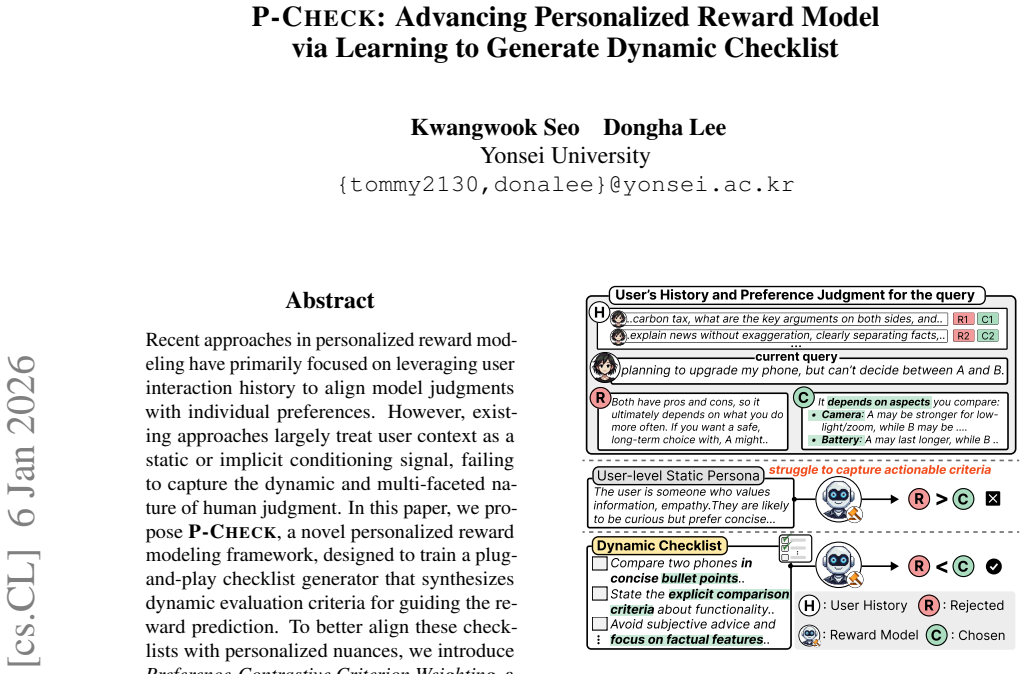
P-Check claims that personalized reward prediction improves when an LLM judge is guided by a dynamically generated, query-specific checklist of weighted evaluation criteria, rather than by a static persona or implicit user context.
Reviewed by Pith at T0; open to challenge. T0 means a machine referee read the full paper against a public rubric. the ladder, T0–T4 →
T0 review · deepseek-v4-flash
2026-08-03 12:24 UTC pith:MDYTKY3S
load-bearing objection Solid plug-and-play checklist layer for personalized reward modeling; the main idea works, but the saliency-scoring shortcut and the same-group OOD benchmark need scrutiny. the 3 major comments →
P-Check: Advancing Personalized Reward Model via Learning to Generate Dynamic Checklist
The pith
A machine-rendered reading of the paper's core claim, the machinery that carries it, and where it could break.
Core claim
The central claim is that the bottleneck in personalized reward modeling is not the judge's capacity but the specification of what to evaluate: LLM judges fail to infer the right criteria from raw user history, but perform much better when given explicit criteria. P-Check therefore trains a checklist generator to produce query-level evaluation criteria from a user's general-preference summary and the current query, with each criterion carrying a weight reflecting its discriminative power. The weights come from Preference-Contrastive Criterion Weighting: for each preference pair, responses from users with distant preference directions are added as extra negatives, and a criterion's saliency i
What carries the argument
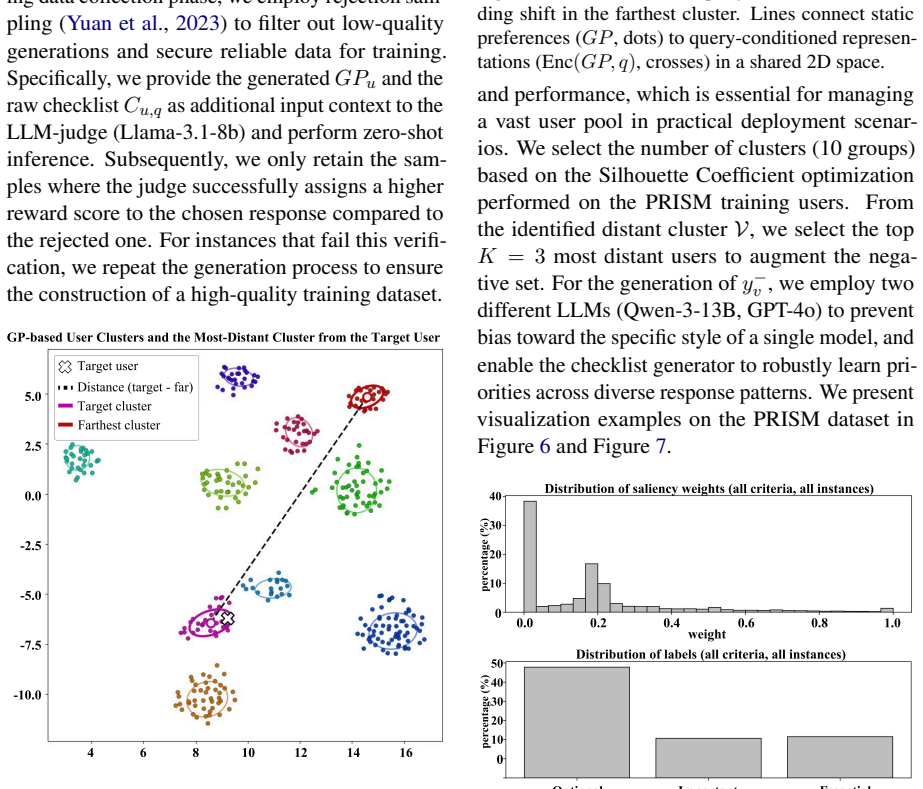
The central object is the personalized checklist: a candidate-agnostic, query-specific set of natural-language evaluation criteria, each tagged as Essential, Important, or Optional. It carries the argument because it converts raw user context into actionable guidance for the reward model. The load-bearing mechanism is Preference-Contrastive Criterion Weighting, which (1) builds inter-user contrastive negative sets from users with distant preference directions, and (2) computes each criterion's saliency via ablation — the marginal increase in the ratio of the negative-pool checklist score to the chosen-response score when that criterion is removed (the paper's Eq. 3-5). This saliency signal i
Load-bearing premise
The paper assumes that a user's decision basis can be adequately represented as a discrete set of natural-language criteria, and that the saliency scores computed by ablating criteria from an additive LLM scoring function capture each criterion's true discriminative power — an assumption the authors themselves concede in the Limitations section as only partially capturing subtle tone, style, pacing, and 'feel.'
What would settle it
On a benchmark whose test users hold preferences that are primarily stylistic — tone, pacing, or 'feel' with no verbalizable content differences — P-Check should fall to or below the accuracy of a static-persona baseline; demonstrating such a case would refute the discrete-checklist premise. A second test: if P-Check's labeled saliency is replaced by the same Essential/Important/Optional labels assigned at random, and reward accuracy does not drop toward the no-saliency ablation level, then the saliency signal carries no information and the reported gains come from the checklist format alone.
If this is right
- If the central claim holds, LLM-as-a-judge personalization can be improved in a plug-and-play way: a small 3B generator can boost much larger judges, and no retraining of the judge is needed.
- The checklist acts as an inspectable record of why a reward was assigned, making personalized reward predictions more auditable and debuggable than scalar or latent-embedding methods.
- Checklist-grounded rewards transfer to both inference-time selection (Best-of-N) and parameter-level optimization (DPO), and even serve as verbal feedback to refine a policy without weight updates.
- Robustness on out-of-distribution and sparse-history users suggests the method learns the logic of preference judgment rather than overfitting to particular user distributions.
- Competing methods that rely on static personas or implicit user embeddings are, per these results, leaving a substantial share of personalization accuracy on the table.
Where Pith is reading between the lines
- A natural extension is to test whether checklist-generated weights can be learned end-to-end instead of via a separate saliency-scoring pass, which would remove a reliance on an auxiliary LLM scorer.
- If the failure mode shown in the appendix (misapplying a 'facts' prior to a metaphysical query) is systematic, then the method's accuracy may be bounded by how well the generator can override established user priors when the query warrants it; a query-intent-aware gating mechanism would be a concrete improvement to try.
- The discrete-checklist premise suggests a testable boundary: for preferences that are primarily tonal or embodied (e.g., humor, pacing, 'feel'), explicit criteria may underperform implicit methods; evaluating P-Check on such domains would map where verbalization helps and where it hurts.
- Because the final reward is a weighted sum of criterion scores, the framework also yields per-criterion explanations that could support interactive personalization — asking the user which criteria they actually care about — in a way that scalar reward models cannot.
Editorial analysis
A structured set of objections, weighed in public.
Referee Report
Summary. The paper presents P-Check, a personalized reward modeling framework that trains a plug-and-play checklist generator to synthesize query-specific, user-conditioned evaluation criteria. Checklists are collected from preference pairs, weighted via Preference-Contrastive Criterion Weighting (PCCW) using inter-user contrastive sampling and saliency scoring, and verbalized into Essential/Important/Optional labels. At inference, the generated checklist guides an off-the-shelf LLM judge, whose criterion scores are linearly combined with label-derived weights. Experiments on PRISM (ID), ChatbotArena and BESPOKE (OOD) report consistent reward-accuracy gains (63.62% vs. 53.19% for Default), along with improvements in Best-of-N/DPO alignment and feedback-based refinement.
Significance. If corroborated, the result is significant: it demonstrates that explicit, query-dependent checklists can improve personalized reward prediction and OOD transfer while remaining interpretable. The paper's strengths include multi-benchmark evaluation with strict user-level splits, ablations of the two PCCW components, hyperparameter grids, a cost analysis, complete prompts, and an honest limitations section. The headline accuracy metric is grounded in external human preference labels, so the main claim is not circular. However, the paper's distinctive weighting mechanism rests on an additivity assumption about LLM scoring that is not tested; this is the main risk to the internal-validity claim that PCCW, rather than the raw checklist text, drives the gains.
major comments (3)
- [§3.3, Eq. (3)–(5)] The saliency definition assumes that the LLM scoring function f is additive across criteria: s(C^{-k}, y) is obtained from a single scoring pass by dropping the k-th entry of the same score vector. This is only valid if the score for one criterion is unaffected by the presence or interpretation of the other criteria. LLM judges are context-sensitive, and order/anchoring effects are known. If saliency rankings are unstable under true ablation (re-scoring each ablated checklist as a fresh prompt), then the E/I/O supervision in Eq. (6) and the reported contribution of Saliency Scoring in Table 4 do not establish the claimed benefit of PCCW. Please compare Eq. (5) with independently re-scored ablated checklists and/or validate a sample of E/I/O labels against human judgment. The Appendix A.3.3 failure case, where specious 'Scientific Consensus' and 'Empirical Data' criteria receive Essential
- [§1, §4.2, Appendix A.3.3] The paper motivates P-Check as capturing dynamic, query-specific shifts in a user's decision basis, but the experiments do not directly measure this dynamic property. All evaluations use user-level splits and aggregate accuracy; there is no analysis showing that the generated checklist changes with the query for a given user, nor an ablation against a static user-level checklist. The failure case in A.3.3 is an instance of over-reliance on static user priors. Please add a quantitative analysis of checklist diversity across queries for the same user, or compare P-Check against a static personalized checklist, to substantiate the 'dynamic' central claim.
- [Table 5, §3.4, Appendix A.2.2] Several pipeline hyperparameters—number of clusters, top-K, cumulative thresholds (tau1, tau2), and the E/I/O weight map—are selected using validation performance. Table 5 shows that PRISM test accuracy varies from 61.10% to 65.20% across the weight-map grid, so the final reported number is sensitive to this choice. The paper states that the result is 'not significantly sensitive,' but no statistical test is given, and the OOD results are only reported for the selected configuration. Please provide a sensitivity analysis or a nested validation procedure to quantify selection bias and confirm that the ID gains are not inflated by validation-set tuning.
minor comments (6)
- [§2] Typo: 'Anaylsis 2' should be 'Analysis 2'. Also, the percentages in Figure 2 are difficult to read at reproduction size; please increase font sizes or use a table.
- [Appendix A.2.4] The CoT-distill baseline is described as using 'the same backbone model (Llama-3.1-8B-Instruct) as our checklist generator,' but §4.1 and Appendix A.2.2 state that the P-Check generator is Llama-3.2-3B-Instruct. Please correct this inconsistency and ensure the baseline is matched in parameter count.
- [Table 7] The evaluator is labeled 'GPT-5' in the table header, but there is no reference or version clarification. Please specify the exact evaluator and prompting setup.
- [Ethical Consideration] Typos: 'outpus' should be 'outputs' and 'annoatation' should be 'annotation'.
- [Throughout] Naming is inconsistent: 'Qwen3-Embedding-0.6B' vs. 'Qwen-3-embedding 0.6B', 'Llama-3-8B-It.' vs. 'Llama-3-8B', and 'BESPOKE-MetaEval' vs. 'BESPOKE-Meta.' in Table 1. Please unify notation.
- [Limitations] The limitations section appropriately concedes that subtle tone, style, pacing, and 'feel' may be only partially captured by a checklist interface. This concession should be more visibly reflected in the abstract/conclusion, which currently claims the framework captures 'dynamic and multi-faceted' human judgment without this caveat.
Circularity Check
No significant circularity: the central reward-accuracy claim is evaluated against held-out human labels; self-referential training components do not make the prediction equivalent to its inputs.
full rationale
The main evaluation (Table 1) compares binary preference prediction on held-out users against human-annotated chosen/rejected pairs in PRISM, ChatbotArena, and BESPOKE-MetaEval. The checklist generator and saliency labels are produced from LLM-generated artifacts (GP_u, checklists, f-scores), and the DPO experiment labels synthetic pairs with the reward model under evaluation; however, none of these steps defines the final metric in terms of the fitted model. Eq. 3-5 define saliency via a single-pass additive ablation of an LLM score vector, which is a heuristic approximation and a validity risk, but it is not a construction that forces the held-out accuracy. The paper's Limitations explicitly acknowledge the checklist-interface assumption and the risk of generated-criteria distortion, which are correctness concerns rather than circular reductions. Self-citations (e.g., BESPOKE) provide evaluation benchmarks/metrics and related work, not load-bearing uniqueness or ansatz arguments. No quoted step exhibits Eq. X = Eq. Y by construction or a fitted parameter renamed as a prediction.
Axiom & Free-Parameter Ledger
free parameters (5)
- E/I/O criterion weight map =
Essential=1.0, Important=0.7, Optional=0.3
- Cumulative thresholds tau1, tau2 =
0.4, 0.9
- Number of user clusters =
10
- Top-K distant users =
3
- Rejection-sampling judge threshold =
Pass if Llama-3.1-8B scores chosen higher than rejected
axioms (4)
- domain assumption A user's decision basis can be represented as a discrete set of natural-language criteria with relative weights.
- ad hoc to paper Ablating a criterion from an additive LLM score isolates that criterion's marginal contribution to separating chosen from rejected responses.
- ad hoc to paper Users whose GP embeddings fall in the farthest cluster and farthest query-conditioned top-3 are useful contrastive negatives for the target query.
- domain assumption GPT-4o-mini can generate reliable user summaries from interaction history, and these summaries transfer to unseen test users.
Cite this review
Pith. "Pith review of P-Check: Advancing Personalized Reward Model via Learning to Generate Dynamic Checklist." pith.science (2026). https://pith.science/paper/MDYTKY3S
@misc{pith2026260102986,
  author       = {Pith},
  title        = {Pith review of: P-Check: Advancing Personalized Reward Model via Learning to Generate Dynamic Checklist},
  year         = {2026},
  howpublished = {\url{https://pith.science/paper/MDYTKY3S}},
  note         = {Machine review of arXiv:2601.02986}
}
read the original abstract
Recent approaches in personalized reward modeling have primarily focused on leveraging user interaction history to align model judgments with individual preferences. However, existing approaches largely treat user context as a static or implicit conditioning signal, failing to capture the dynamic and multi-faceted nature of human judgment. In this paper, we propose P-Check, a novel personalized reward modeling framework, designed to train a plug-and-play checklist generator that synthesizes dynamic evaluation criteria for guiding the reward prediction. To better align these checklists with personalized nuances, we introduce Preference-Contrastive Criterion Weighting, a training strategy that assigns saliency scores to criteria based on their discriminative power for personalized judgment. We conduct extensive experiments and demonstrate that P-Check not only improves reward accuracy but also enhances downstream personalized generation, and remains robust in OOD scenarios.
Figures


Forward citations
Cited by 1 Pith paper
-
Reward Hacking in the Era of Large Models: Mechanisms, Emergent Misalignment, Challenges
The paper introduces the Proxy Compression Hypothesis as a unifying framework explaining reward hacking in RLHF as an emergent result of compressing high-dimensional human objectives into proxy reward signals under op...
Reference graph
Works this paper leans on
-
[2]
[Initial Model Response]
-
[3]
Use the checklist as feedback: incorporate relevant criteria while preserving correct and helpful content
A [Personalized Checklist] that describes what the response should do or improve. Use the checklist as feedback: incorporate relevant criteria while preserving correct and helpful content. Do NOT explicitly mention the checklist, or describe your reasoning process in the final [Rewritten Personalized Response]. Make the final response tailored to the user...
-
[5]
MT-RAIG: Novel benchmark and evaluation framework for retrieval-augmented insight genera- tion over multiple tables. InProceedings of the 63rd Annual Meeting of the Association for Computational Linguistics (Volume 1: Long Papers), pages 23142– 23172, Vienna, Austria. Association for Computa- tional Linguistics. Paul Slovic. 1995. The construction of pref...
Pith/arXiv arXiv 1995
-
[6]
prototypical preference points
R.i.p.: Better models by survival of the fittest prompts. InInternational Conference on Machine Learning (ICML). Zheng Yuan, Hongyi Yuan, Chengpeng Li, Guanting Dong, Keming Lu, Chuanqi Tan, Chang Zhou, and Jingren Zhou. 2023. Scaling relationship on learning mathematical reasoning with large language models. Preprint, arXiv:2308.01825. Lunjun Zhang, Aria...
Pith/arXiv arXiv 2023
-
[1993]
Anisha Gunjal, Anthony Wang, Elaine Lau, Vaskar Nath, Yunzhong He, Bing Liu, and Sean Hendryx
Valuing environmental resources: a construc- tive approach.Journal of Risk and Uncertainty, 7(2):177–197. Anisha Gunjal, Anthony Wang, Elaine Lau, Vaskar Nath, Yunzhong He, Bing Liu, and Sean Hendryx
-
[2023]
Hyunseo Kim, Sangam Lee, Kwangwook Seo, and Dongha Lee
Personalized soups: Personalized large lan- guage model alignment via post-hoc parameter merg- ing.Preprint, arXiv:2310.11564. Hyunseo Kim, Sangam Lee, Kwangwook Seo, and Dongha Lee. 2025a. Bespoke: Benchmark for search-augmented large language model per- sonalization via diagnostic feedback.Preprint, arXiv:2509.21106. Jaehyung Kim and Yiming Yang. 2025. ...
Pith/arXiv arXiv 2025
-
[2024]
The PRISM alignment dataset: What partici- patory, representative and individualised human feed- back reveals about the subjective and multicultural alignment of large language models. InThe Thirty- eight Conference on Neural Information Processing Systems Datasets and Benchmarks Track. Woosuk Kwon, Zhuohan Li, Siyuan Zhuang, Ying Sheng, Lianmin Zheng, Co...
Pith/arXiv arXiv 2023
-
[2025]
Chrisopher K Hsee, George F Loewenstein, Sally Blount, and Max H Bazerman
Rubrics as rewards: Reinforcement learning beyond verifiable domains.Preprint, arXiv:2507.17746. Chrisopher K Hsee, George F Loewenstein, Sally Blount, and Max H Bazerman. 1999. Preference reversals between joint and separate evaluations of options: A review and theoretical analysis.Psycho- logical bulletin, 125(5):576. Cheng-Yu Hsieh, Chun-Liang Li, Chih...
Pith/arXiv arXiv 1999
discussion (0)
Sign in with ORCID, Apple, or X to comment. Anyone can read and Pith papers without signing in.