REVIEW 3 major objections 6 minor 1 cited by
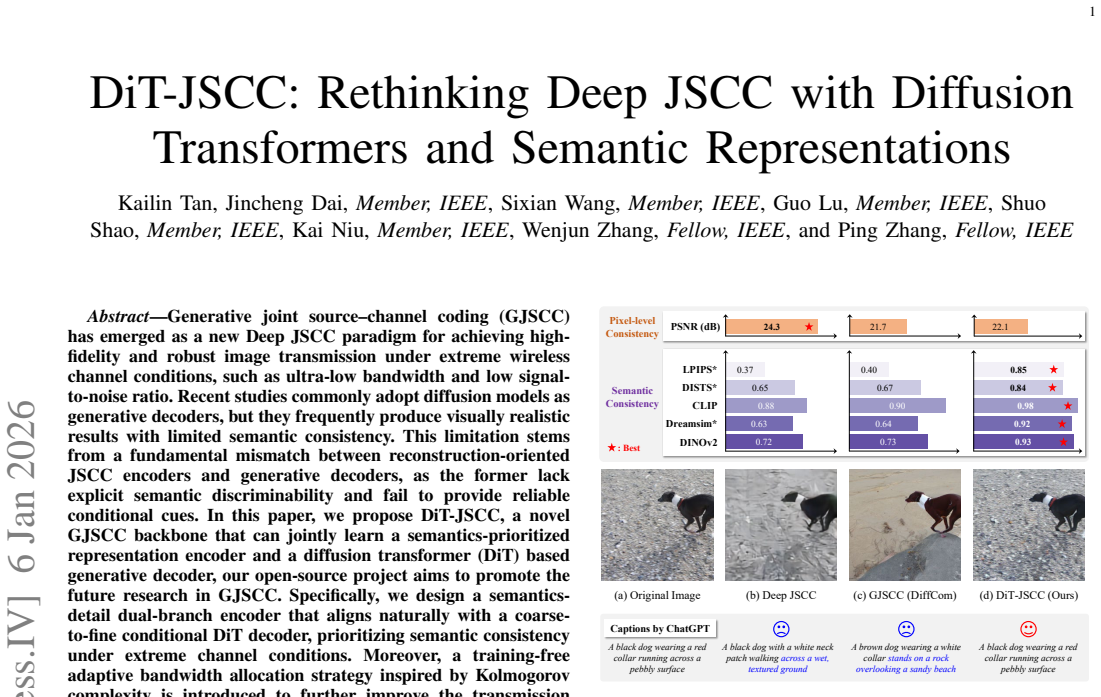
DiT-JSCC: Rethinking Deep JSCC with Diffusion Transformers and Semantic Representations
T0 review · 3 major / 6 minor · reviewed 2026-08-03 · deepseek-v4-flash
Pith's one-line read A semantics-first transmitter–decoder pair lets images survive extreme wireless compression with far better semantic fidelity than pixel-oriented JSCC.
desk verdict The dual-branch DiT design is a real step forward for generative JSCC; the adaptive KC bandwidth-allocation claim is test-set-tuned and should not be taken at face value until properly validated. read the letter →
The pith
A machine-rendered reading of the paper's core claim, the machinery that carries it, and where it could break.
The reading
What carries the argument
The key mechanism is the dual-branch encoder plus coarse-to-fine conditional diffusion transformer decoder: a frozen self-supervised vision model (DINOv2) supplies a compact semantic latent that is compressed and sent as the primary signal; a pixel-domain branch sends residual high-frequency detail; and the DiT decoder injects semantic conditions into early blocks and detail conditions into later blocks. Around this sits a training-free, instance-adaptive bandwidth allocation that uses a captioning model's word count, lexical diversity, and syntactic complexity to approximate Kolmogorov complexity and set the semantic/detail symbol split.
What would settle it
Evaluate KC-based allocation on images where the caption is deliberately short and simple but the visual scene is semantically dense (e.g., one word for a cluttered, unusual scene). If per-image allocation does not outperform a fixed ratio on a held-out set, the caption proxy is not tracking generative difficulty.
Extended reading notes
Core claim
The central discovery is that explicit semantic separation at the encoder, with semantic features treated as the primary conditional signal, resolves the semantic-consistency failure of generative JSCC. Using a frozen self-supervised vision model (DINOv2) followed by a latent-domain JSCC encoder for semantics, plus a pixel-domain encoder for residual detail, and a coarse-to-fine conditional diffusion transformer that receives semantic guidance in shallow layers and detail guidance in deeper layers, the system matches or beats existing JSCC baselines on LPIPS, DISTS, CLIP, DreamSim, DINOv2, and FID at extreme channel bandwidth ratios and low SNR. The paper also claims that a caption-complexit
Load-bearing premise
The bandwidth allocation is only as good as the assumption that caption statistics (word count, lexical diversity, sentence complexity) measure how much semantic bandwidth an image needs, and that the hand-set combination weights and scaling factor hold across images without being tuned on the test set.
Editorial extensions
If this is right
- If semantics are prioritized, extremely low channel bandwidth can still produce semantically faithful images: the semantic branch alone suffices at the lowest rates, with detail only adding texture.
- Joint optimization of encoder and decoder against a diffusion objective yields conditions that are robust to channel noise, avoiding the performance collapse seen when conditioning signals must be transmitted losslessly.
- The coarse-to-fine conditioning strategy is a template for how to inject non-textual, fine-grained conditions into diffusion decoders, applicable beyond joint source-channel coding.
- Caption-complexity-based bandwidth allocation outperforms both fixed ratios and learned entropy-based allocation, indicating that generative systems should budget bits by semantic generative difficulty, not statistical entropy.
Reading between the lines
- Inference: the caption-proxy step could be eliminated by training a small network to predict the complexity score directly from the transmitted semantic features, removing the need for a captioning model at the transmitter.
- Inference: the dual-branch design suggests a graceful-degradation property: as bandwidth shrinks, a system can progressively drop the detail branch first, a testable operational rule for adaptive transmission.
- Inference: the semantic-priority principle should transfer to other generative decoders (flow matching, GANs); if it does, the architectural lesson—condition on meaning first, appearance second—is more general than the specific diffusion implementation.
Editorial analysis
A structured set of objections, weighed in public.
Referee Report
Summary. The paper proposes DiT-JSCC, a generative joint source-channel coding (GJSCC) scheme for image transmission under extreme bandwidth and low-SNR conditions. The transmitter uses a dual-branch encoder: a frozen DINOv2 semantic branch that extracts high-level semantic features and a trainable pixel-domain detail branch. The receiver uses a coarse-to-fine conditional Diffusion Transformer (CDiT) decoder that fuses the received semantic and detail signals at different depths. The paper also introduces a training-free, 'Kolmogorov-complexity-inspired' adaptive bandwidth allocation (KC-BA) based on BLIPv2 captions and three hand-set caption-complexity features. Experiments on ImageNet 256x256 and 512x512 under AWGN and Rayleigh channels compare against BPG/VTM+LDPC, SwinJSCC, DiffCom, DiffJSCC, PerCo, and DiffEIC, reporting substantial gains in LPIPS, DISTS, CLIP, Dreamsim, DINOv2, and FID. Ablations support the complementarity of the two branches and show the proposed KC-BA outperforming fixed and entropy-based allocation.
Significance. If the results hold, the paper makes a useful architectural contribution: it demonstrates that a semantics-prioritized representation, rather than a pixel-reconstruction-oriented one, is an effective conditioning signal for generative JSCC decoders. The dual-branch encoder with frozen DINOv2 features, the coarse-to-fine CDiT conditioning, and the joint training protocol are well motivated, and the ablations (Fig. 13) provide credible evidence that both branches contribute. The commitment to open-source code and the detailed training settings are strengths. However, the headline adaptive bandwidth allocation claim is not yet supported: the KC-BA constants are not reported, no validation split is described, and the normalization in Eq. (15) uses the evaluation set. The significance of the work hinges on whether the reported gains are attributable to a generalizable adaptive rule or to test-set-tuned heuristics.
major comments (3)
- [III-C, Eqs. (15)-(16), Fig. 14] The adaptive KC-BA rule is not validated as a generalizable, causal allocation method. The weights δ_wc, δ_ld, δ_sc and the scaling factor η are never reported, and no procedure for choosing them is given. More seriously, the min-max normalization in Eq. (15) is explicitly performed 'across all captions in the evaluation set', so the bandwidth allocated to one image depends on the captions of all other test images; this is not a per-image rule and is not deployable in a streaming setting. The fixed anchor k̄_s is also chosen by exhaustive search on the same 100-image test protocol (Fig. 7). The gains in Fig. 14 could therefore be fitting artifacts of the test set. Please report all constants, use a properly separated validation set for anchor/weight selection, and replace the evaluation-set normalization with a causal or fitted normalization scheme.
- [III-C, caption-complexity assumption] The central assumption of KC-BA — that word count, lexical diversity, and syntactic complexity of a BLIPv2 caption are a surrogate for how much semantic bandwidth an image needs — is never tested. No correlation analysis between the KC score and any measure of per-image optimal bandwidth is provided, and no ablation investigates the sensitivity to the hand-set weights δ_wc, δ_ld, δ_sc. Without such evidence, 'Kolmogorov-complexity-inspired' is an unjustified label. A simple control experiment — e.g., comparing KC-BA against a random allocation with the same average semantic bandwidth, or against an oracle that allocates k_s to maximize LPIPS per image — would establish whether the mechanism is actually content-adaptive.
- [IV.B, Tables I-II, Figs. 9-10] The main performance comparisons appear to be generated with the full system including KC-BA. Because KC-BA uses evaluation-set statistics and test-set-selected constants (as above), the reported improvements over baselines may not reflect a fair comparison: the proposed method has access to aggregate test information, while the fixed-allocation baselines do not. The architecture-level contribution would be more convincingly demonstrated by reporting results with a fixed bandwidth split tuned only on a training/validation split, in addition to the adaptive rule evaluated on a true held-out set. This is required to support the abstract's claim that DiT-JSCC 'consistently outperforms existing JSCC methods'.
minor comments (6)
- [Eq. (12)] The indexing of the second case has an overlap: 'i = N_s, · · ·, N_s + N_d' should presumably start at N_s + 1. Please fix the range notation.
- [Eq. (16)] The adaptive allocation does not enforce 0 ≤ k_s ≤ k. For images with very large or small KC scores, k_s could exceed the total symbol budget, making k_d negative. Add an explicit clipping or normalization step.
- [IV.A.3] The text says 'DiffJSCC [6]' when comparing methods; reference [6] is NTSCC, not DiffJSCC. The correct citation for DiffJSCC appears to be [20]. Please correct the reference.
- [III.C / Algorithm 1] The CFG scale φ is said to be fixed to 0.1 during training, but the value used at inference (Tables/Figures) is not reported. As φ is a user-specified parameter in Algorithm 1, specify the evaluation value and whether it was tuned.
- [Fig. 13] The axis labels contain typos: 'channel band idth ratio' and 'channel bandwid h ra io' should be 'channel bandwidth ratio'. Section III-A heading also has 'Drived' instead of 'Driven'.
- [IV.A.1] The evaluation uses only 100 images for FID computation, which is known to have high variance. Reporting confidence intervals or using a larger evaluation set would strengthen the quantitative claims.
Circularity Check
Main architecture is self-contained, but the KC-BA adaptive-allocation subclaim is evaluated in-sample: its anchor and normalization come from the same 100-image test set.
-
self definitional
[Section III-C, Eqs. (15)-(16) and Fig. 7; Section IV.C.2, Fig. 14]
"we conduct exploratory experiments, as shown in Fig. 7, by exhaustively searching for near-optimal fixed bandwidth proportions ... The normalization is performed across all captions in the evaluation set to ensure comparability. ... Following Fig. 7, an optimal fixed allocation scheme is available, i.e., k_s = \bar{k}_s, k_d = \bar{k}_d."
Eq. (16) computes each image's semantic bandwidth from an anchor k̄_s chosen by exhaustive search on the same 100-image evaluation protocol (Fig. 7) and from a KC score I that is min-max normalized across all captions in the evaluation set (Eq. 15). The KC-BA-vs-fixed comparison in Fig. 14 is then run on that same evaluation set, so the reported gains of KC-BA are in-sample reallocations rather than out-of-sample predictions. No validation split or fitting procedure for δ_wc, δ_ld, δ_sc, or η is given, so the adaptive-efficiency component is not independently tested.
full rationale
The core DiT-JSCC contribution—the VFM-driven dual-branch encoder plus coarse-to-fine conditional DiT decoder—is supported by ablations and by external benchmarks (BPG, VTM, PerCo, DiffEIC, DiffJSCC, and DiffCom) that do not depend on the KC-BA rule, so the central architectural claim is not circular. Self-citations (DiffCom, NTSCC) are used only as baselines and are not load-bearing for the derivation. The paper itself concedes in Section V that it 'can not directly estimate the semantic information value' and frames KC-BA as a practical direction, consistent with treating it as a heuristic. The one significant circularity-burden step is isolated to the KC-inspired bandwidth allocation: the anchor k̄_s is selected by exhaustive search on the same 100-image test set, and the KC score is normalized over the evaluation set, after which the adaptive rule is evaluated on that same set. This makes the Fig. 14 KC-BA-vs-fixed comparison in-sample and leaves the claimed generalizable adaptive-efficiency advantage unsupported. Because this affects a secondary subclaim and not the main architecture, the overall circularity score is moderate rather than severe.
Assumptions & free parameters
free parameters (4)
- bandwidth scaling factor η in Eq. (16)
- weights δ_wc, δ_ld, δ_sc in Eq. (15)
- fixed semantic bandwidth anchor k̄_s (the 'optimal' fixed allocation from Fig. 7) =
reported only as percentages along the red dashed line in Fig. 7; exact k̄_s values not given
- CFG guidance scale φ (fixed to 0.1 during training; inference value used for Table/Figures) =
0.1 (training) / inference value not specified
assumptions (3)
- domain assumption Frozen DINOv2 semantic features are a sufficient and reliable conditioning signal for semantic consistency in generative decoding.
- ad hoc to paper The caption-based LC score (BLIPv2 caption + word count + lexical diversity + syntactic complexity) correlates with how much semantic bandwidth a diffusion decoder needs.
- domain assumption Transmitting DINOv2 features through a learned latent-domain JSCC encoder preserves enough semantic information after channel noise to condition the decoder.
Cite this review
Pith. "Pith review of DiT-JSCC: Rethinking Deep JSCC with Diffusion Transformers and Semantic Representations." pith.science (2026). https://pith.science/paper/P3W2CT4U
@misc{pith2026260103112,
  author       = {Pith},
  title        = {Pith review of: DiT-JSCC: Rethinking Deep JSCC with Diffusion Transformers and Semantic Representations},
  year         = {2026},
  howpublished = {\url{https://pith.science/paper/P3W2CT4U}},
  note         = {Machine review of arXiv:2601.03112}
}
read the original abstract
Generative joint source-channel coding (GJSCC) has emerged as a new Deep JSCC paradigm for achieving high-fidelity and robust image transmission under extreme wireless channel conditions, such as ultra-low bandwidth and low signal-to-noise ratio. Recent studies commonly adopt diffusion models as generative decoders, but they frequently produce visually realistic results with limited semantic consistency. This limitation stems from a fundamental mismatch between reconstruction-oriented JSCC encoders and generative decoders, as the former lack explicit semantic discriminability and fail to provide reliable conditional cues. In this paper, we propose DiT-JSCC, a novel GJSCC backbone that can jointly learn a semantics-prioritized representation encoder and a diffusion transformer (DiT) based generative decoder, our open-source project aims to promote the future research in GJSCC. Specifically, we design a semantics-detail dual-branch encoder that aligns naturally with a coarse-to-fine conditional DiT decoder, prioritizing semantic consistency under extreme channel conditions. Moreover, a training-free adaptive bandwidth allocation strategy inspired by Kolmogorov complexity is introduced to further improve the transmission efficiency, thereby indeed redefining the notion of information value in the era of generative decoding. Extensive experiments demonstrate that DiT-JSCC consistently outperforms existing JSCC methods in both semantic consistency and visual quality, particularly in extreme regimes.
Figures


Figures from the paper (9 more)


Forward citations
Cited by 1 Pith paper
-
Adapting Diffusion Language Models for Lossless Pixel-Level Image Transmission
DDM-SSCC adapts diffusion language models for separate source-channel coding to enable lossless pixel-level image transmission with improved exact recovery on standard datasets.
Reference graph
Works this paper leans on
-
[1]
Joint source and channel coding,
M. Fresia, F. Per ´ez-Cruz, H. V . Poor, and S. Verd ´u, “Joint source and channel coding,”IEEE Signal Processing Magazine, vol. 27, no. 6, pp. 104–113, 2010
2010
-
[2]
Deep joint source- channel coding for wireless image transmission,
E. Bourtsoulatze, D. B. Kurka, and D. G ¨und¨uz, “Deep joint source- channel coding for wireless image transmission,”IEEE Transactions on Cognitive Communications and Networking, vol. 5, no. 3, pp. 567–579, 2019
2019
-
[3]
Deepjscc-f: Deep joint source-channel coding of images with feedback,
D. B. Kurka and D. G ¨und¨uz, “Deepjscc-f: Deep joint source-channel coding of images with feedback,”IEEE Journal on Selected Areas in Information Theory, vol. 1, no. 1, pp. 178–193, 2020
2020
-
[4]
Bandwidth-agile image transmission with deep joint source- channel coding,
——, “Bandwidth-agile image transmission with deep joint source- channel coding,”IEEE Transactions on Wireless Communications, vol. 20, no. 12, pp. 8081–8095, 2021
2021
-
[5]
Swinjscc: taming swin transformer for deep joint source-channel coding,
K. Yang, S. Wang, J. Dai, X. Qin, K. Niu, and P. Zhang, “Swinjscc: taming swin transformer for deep joint source-channel coding,”IEEE Transactions on Cognitive Communications and Networking, vol. 11, no. 1, pp. 90–104, 2025
2025
-
[6]
Nonlinear transform source-channel coding for semantic communications,
J. Dai, S. Wang, K. Tan, Z. Si, X. Qin, K. Niu, and P. Zhang, “Nonlinear transform source-channel coding for semantic communications,”IEEE Journal on Selected Areas in Communications, vol. 40, no. 8, pp. 2300– 2316, 2022
2022
-
[7]
Improved nonlinear transform source-channel coding to catalyze semantic com- munications,
S. Wang, J. Dai, X. Qin, Z. Si, K. Niu, and P. Zhang, “Improved nonlinear transform source-channel coding to catalyze semantic com- munications,”IEEE Journal of Selected Topics in Signal Processing, vol. 17, no. 5, pp. 1022–1037, 2023
2023
-
[8]
Ofdm-guided deep joint source channel coding for wireless multipath fading channels,
M. Yang, C. Bian, and H.-S. Kim, “Ofdm-guided deep joint source channel coding for wireless multipath fading channels,”IEEE Transac- tions on Cognitive Communications and Networking, vol. 8, no. 2, pp. 584–599, 2022
2022
Show all 47 references
-
[9]
Generative joint source-channel coding for semantic image transmission,
E. Erdemir, T.-Y . Tung, P. L. Dragotti, and D. G¨und¨uz, “Generative joint source-channel coding for semantic image transmission,”IEEE Journal on Selected Areas in Communications, vol. 41, no. 8, pp. 2645–2657, 2023
2023
-
[10]
Rate-distortion-perception controllable joint source-channel coding for high-fidelity generative semantic communications,
K. Tan, J. Dai, Z. Liu, S. Wang, X. Qin, W. Xu, K. Niu, and P. Zhang, “Rate-distortion-perception controllable joint source-channel coding for high-fidelity generative semantic communications,”IEEE Transactions on Cognitive Communications and Networking, vol. 11, no. 2, pp. 67...
2025
-
[11]
The unreasonable effectiveness of deep features as a perceptual metric,
R. Zhang, P. Isola, A. A. Efros, E. Shechtman, and O. Wang, “The unreasonable effectiveness of deep features as a perceptual metric,” in Proceedings of the IEEE Conference on Computer Vision and Pattern Recognition, 2018, pp. 586–595
2018
-
[12]
Image quality assess- ment: Unifying structure and texture similarity,
K. Ding, K. Ma, S. Wang, and E. P. Simoncelli, “Image quality assess- ment: Unifying structure and texture similarity,”IEEE Transactions on Pattern Analysis and Machine Intelligence, vol. 44, no. 5, pp. 2567– 2581, 2020
2020
-
[13]
Learning new dimensions of human visual similarity using syn- thetic data,
S. Fu, “Learning new dimensions of human visual similarity using syn- thetic data,” Ph.D. dissertation, Massachusetts Institute of Technology, 2023
2023
-
[14]
Learning transferable visual models from natural language supervision,
A. Radford, J. W. Kim, C. Hallacy, A. Ramesh, G. Goh, S. Agarwal, G. Sastry, A. Askell, P. Mishkin, J. Clarket al., “Learning transferable visual models from natural language supervision,” inProceedings of International Conference on Machine Learning. PmLR, 2021, pp. 8748–8763
2021
-
[15]
Dinov2: Learning robust visual features without supervision,
M. Oquab, T. Darcet, T. Moutakanni, H. V o, M. Szafraniec, V . Khalidov, P. Fernandez, D. Haziza, F. Massa, A. El-Noubyet al., “Dinov2: Learning robust visual features without supervision,”Transactions on Machine Learning Research Journal, pp. 1–31, 2024
2024
-
[16]
Denoising diffusion probabilistic models,
J. Ho, A. Jain, and P. Abbeel, “Denoising diffusion probabilistic models,” Advances in Neural Information Processing Systems, vol. 33, pp. 6840– 6851, 2020
2020
-
[17]
A hybrid wireless image transmission scheme with diffusion,
X. Niu, X. Wang, D. G ¨und¨uz, B. Bai, W. Chen, and G. Zhou, “A hybrid wireless image transmission scheme with diffusion,” inProceedings of 2023 IEEE 24th International Workshop on Signal Processing Advances in Wireless Communications (SPAWC). IEEE, 2023, pp. 86–90
2023
-
[18]
Cddm: Channel denoising diffusion models for wireless semantic communica- tions,
T. Wu, Z. Chen, D. He, L. Qian, Y . Xu, M. Tao, and W. Zhang, “Cddm: Channel denoising diffusion models for wireless semantic communica- tions,”IEEE Transactions on Wireless Communications, vol. 23, no. 9, pp. 11 168–11 183, 2024
2024
-
[19]
Semantics- guided diffusion for deep joint source-channel coding in wireless image transmission,
M. Zhang, H. Wu, G. Zhu, R. Jin, X. Chen, and D. G ¨und¨uz, “Semantics- guided diffusion for deep joint source-channel coding in wireless image transmission,”IEEE Transactions on Wireless Communications, pp. 1–1, 2025
2025
-
[20]
Diffusion-aided joint source channel coding for high realism wireless image transmission,
M. Yang, B. Liu, B. Wang, and H.-S. Kim, “Diffusion-aided joint source channel coding for high realism wireless image transmission,”arXiv preprint arXiv:2404.17736, 2024
2024 arXiv
-
[21]
Diffcom: Channel received signal is a natural condition to guide diffusion posterior sampling,
S. Wang, J. Dai, K. Tan, X. Qin, K. Niu, and P. Zhang, “Diffcom: Channel received signal is a natural condition to guide diffusion posterior sampling,”IEEE Journal on Selected Areas in Communications, vol. 43, no. 7, pp. 2651–2666, 2025
2025
-
[22]
Adding conditional control to text-to-image diffusion models,
L. Zhang, A. Rao, and M. Agrawala, “Adding conditional control to text-to-image diffusion models,” inProceedings of the IEEE/CVF International Conference on Computer Vision, 2023, pp. 3836–3847
2023
-
[23]
Pixart-δ: Fast and controllable image generation with latent consistency models,
J. Chen, S. Luo, and E. Xie, “Pixart-δ: Fast and controllable image generation with latent consistency models,” inProceedings of ICML 2024 Workshop on Theoretical Foundations of Foundation Models
2024
-
[24]
Masked au- toencoders are scalable vision learners,
K. He, X. Chen, S. Xie, Y . Li, P. Doll ´ar, and R. Girshick, “Masked au- toencoders are scalable vision learners,” inProceedings of the IEEE/CVF Conference on Computer Vision and Pattern Recognition, 2022, pp. 16 000–16 009
2022
-
[25]
Self-supervised learning from images with a joint-embedding predictive architecture,
M. Assran, Q. Duval, I. Misra, P. Bojanowski, P. Vincent, M. Rab- bat, Y . LeCun, and N. Ballas, “Self-supervised learning from images with a joint-embedding predictive architecture,” inProceedings of the IEEE/CVF Conference on Computer Vision and Pattern Recognition, 2023, pp...
2023
-
[26]
What matters for representation alignment: Global information or spatial structure?
J. Singh, X. Leng, Z. Wu, L. Zheng, R. Zhang, E. Shechtman, and S. Xie, “What matters for representation alignment: Global information or spatial structure?”arXiv preprint arXiv:2512.10794, 2025
2025
-
[27]
Rep- resentation alignment for generation: Training diffusion transformers is easier than you think,
S. Yu, S. Kwak, H. Chang, H. Zhang, J. Shin, and D. Krishnan, “Rep- resentation alignment for generation: Training diffusion transformers is easier than you think,” inProceedings of International Conference on Learning Representations, 2025
2025
-
[28]
Repa-e: Unlocking vae for end-to-end tuning of latent diffusion transformers,
X. Leng, J. Singh, Y . Hou, Z. Xing, S. Xie, and L. Zheng, “Repa-e: Unlocking vae for end-to-end tuning of latent diffusion transformers,” inProceedings of the IEEE/CVF International Conference on Computer Vision, October 2025, pp. 18 262–18 272
2025
-
[29]
Reconstruction vs. generation: Taming optimization dilemma in latent diffusion models,
J. Yao, B. Yang, and X. Wang, “Reconstruction vs. generation: Taming optimization dilemma in latent diffusion models,” inProceedings of the Computer Vision and Pattern Recognition Conference, 2025, pp. 15 703– 15 712
2025
-
[30]
M. Li, P. Vit ´anyiet al.,An introduction to Kolmogorov complexity and its applications. Springer, 2008, vol. 3
2008
-
[31]
All are worth words: A vit backbone for diffusion models,
F. Bao, S. Nie, K. Xue, Y . Cao, C. Li, H. Su, and J. Zhu, “All are worth words: A vit backbone for diffusion models,” inProceedings of 14 the IEEE/CVF Conference on Computer Vision and Pattern Recognition, 2023, pp. 22 669–22 679
2023
-
[32]
Sit: Exploring flow and diffusion-based generative models with scalable interpolant transformers,
N. Ma, M. Goldstein, M. S. Albergo, N. M. Boffi, E. Vanden-Eijnden, and S. Xie, “Sit: Exploring flow and diffusion-based generative models with scalable interpolant transformers,” inEuropean Conference on Computer Vision. Springer, 2024, pp. 23–40
2024
-
[33]
Scalable diffusion models with transformers,
W. Peebles and S. Xie, “Scalable diffusion models with transformers,” inProceedings of the IEEE/CVF International Conference on Computer Vision, 2023, pp. 4195–4205
2023
-
[34]
Rethinking lossy compression: The rate- distortion-perception tradeoff,
Y . Blau and T. Michaeli, “Rethinking lossy compression: The rate- distortion-perception tradeoff,” inProceedings of International Confer- ence on Machine Learning. PMLR, 2019, pp. 675–685
2019
-
[35]
Gans trained by a two time-scale update rule converge to a local nash equilibrium,
M. Heusel, H. Ramsauer, T. Unterthiner, B. Nessler, and S. Hochreiter, “Gans trained by a two time-scale update rule converge to a local nash equilibrium,”Advances in Neural Information Processing Systems, vol. 30, 2017
2017
-
[36]
High- resolution image synthesis with latent diffusion models,
R. Rombach, A. Blattmann, D. Lorenz, P. Esser, and B. Ommer, “High- resolution image synthesis with latent diffusion models,” inProceedings of the IEEE/CVF Conference on Computer Vision and Pattern Recogni- tion, 2022, pp. 10 684–10 695
2022
-
[37]
An image is worth 16x16 words: Trans- formers for image recognition at scale,
A. Dosovitskiy, L. Beyer, A. Kolesnikov, D. Weissenborn, X. Zhai, T. Unterthiner, M. Dehghani, M. Minderer, G. Heigold, S. Gelly, J. Uszkoreit, and N. Houlsby, “An image is worth 16x16 words: Trans- formers for image recognition at scale,” inProceedings of International Confer...
2021
-
[38]
Universal rate-distortion- perception representations for lossy compression,
G. Zhang, J. Qian, J. Chen, and A. Khisti, “Universal rate-distortion- perception representations for lossy compression,”Advances in Neural Information Processing Systems, vol. 34, pp. 11 517–11 529, 2021
2021
-
[39]
Blip-2: Bootstrapping language- image pre-training with frozen image encoders and large language mod- els,
J. Li, D. Li, S. Savarese, and S. Hoi, “Blip-2: Bootstrapping language- image pre-training with frozen image encoders and large language mod- els,” inProceedings of International Conference on Machine Learning. PMLR, 2023, pp. 19 730–19 742
2023
-
[40]
Imagenet: A large-scale hierarchical image database,
J. Deng, W. Dong, R. Socher, L.-J. Li, K. Li, and L. Fei-Fei, “Imagenet: A large-scale hierarchical image database,” in2009 IEEE Conference on Computer Vision and Pattern Recognition, 2009, pp. 248–255
2009
-
[41]
Design of low-density parity check codes for 5g new radio,
T. Richardson and S. Kudekar, “Design of low-density parity check codes for 5g new radio,”IEEE Communications Magazine, vol. 56, no. 3, pp. 28–34, 2018
2018
-
[42]
BPG image format
F. Bellard, “BPG image format.”URL: https://bellard.org/bpg/
-
[43]
Devel- opments in international video coding standardization after avc, with an overview of versatile video coding (vvc),
B. Bross, J. Chen, J.-R. Ohm, G. J. Sullivan, and Y .-K. Wang, “Devel- opments in international video coding standardization after avc, with an overview of versatile video coding (vvc),”Proceedings of the IEEE, vol. 109, no. 9, pp. 1463–1493, 2021
2021
-
[44]
Towards image compression with perfect realism at ultra-low bitrates,
M. Careil, M. J. Muckley, J. Verbeek, and S. Lathuili`ere, “Towards image compression with perfect realism at ultra-low bitrates,” inProceedings of the Twelfth International Conference on Learning Representations, 2023
2023
-
[45]
Towards extreme image compression with latent feature guidance and diffusion prior,
Z. Li, Y . Zhou, H. Wei, C. Ge, and J. Jiang, “Towards extreme image compression with latent feature guidance and diffusion prior,”IEEE Transactions on Circuits and Systems for Video Technology, 2024
2024
-
[46]
Seeing what a gan cannot generate,
D. Bau, J.-Y . Zhu, J. Wulff, W. Peebles, H. Strobelt, B. Zhou, and A. Torralba, “Seeing what a gan cannot generate,” inProceedings of the IEEE/CVF International Conference on Computer Vision, 2019
2019
-
[47]
Sim ´eoni, H
O. Sim ´eoni, H. V . V o, M. Seitzer, F. Baldassarre, M. Oquab, C. Jose, V . Khalidov, M. Szafraniec, S. Yi, M. Ramamonjisoaet al., “Dinov3,” arXiv preprint arXiv:2508.10104, 2025
2025 arXiv
Reviewed August 3, 2026 · model on record in the stance chip above.
Discussion (0). Sign in to comment.