C-EQ-ALINEA: Distributed, Coordinated, and Equitable Ramp Metering Strategy for Sustainable Freeway Operations
Pith reviewed 2026-05-16 14:56 UTC · model grok-4.3
The pith
C-EQ-ALINEA adds neighbor information exchange to the classic ALINEA controller to balance ramp delays more fairly while keeping overall freeway flow efficient.
A machine-rendered reading of the paper's core claim, the machinery that carries it, and where it could break.
Core claim
C-EQ-ALINEA extends the classical ALINEA feedback controller with decentralized coordination via lightweight neighbor information exchange. This enables local balancing of congestion impacts and addresses Harsanyian, Egalitarian, Rawlsian, and Aristotelian fairness perspectives without centralized optimization, detailed traffic models, or extra infrastructure. In a calibrated 24-hour SUMO microsimulation of the A10 ring road, the method substantially improves equity in delay distributions while maintaining or surpassing the efficiency of METALINE.
What carries the argument
C-EQ-ALINEA, the decentralized ALINEA extension that performs local coordination through minimal neighbor information exchange to enforce multiple fairness criteria on ramp metering rates.
If this is right
- Delay distributions across ramps become substantially more equitable for users.
- Overall freeway efficiency is preserved or improved compared with METALINE in multiple tested configurations.
- The strategy runs on existing ALINEA hardware without new sensors or central computers.
- Multiple fairness definitions can be satisfied through the same lightweight local updates.
- Sustainable operations become feasible for networks that already use legacy ramp controllers.
Where Pith is reading between the lines
- Similar neighbor-exchange logic could be added to other local traffic controllers facing equity complaints.
- Driver compliance with metering might rise if waiting times feel more consistent across ramps.
- Networks with different geometries or driver populations may require only small retuning of the exchange weights to retain the equity benefit.
- The method offers a low-cost upgrade path for cities already running ALINEA at scale.
Load-bearing premise
Lightweight neighbor data exchange alone is enough to produce both coordination and equity gains without central optimization or accurate full-scale traffic models.
What would settle it
A controlled field trial on an instrumented freeway segment that measures total vehicle-hours of delay and the variance of ramp waiting times under C-EQ-ALINEA versus METALINE would show whether the equity improvement appears in real traffic.
Figures

read the original abstract
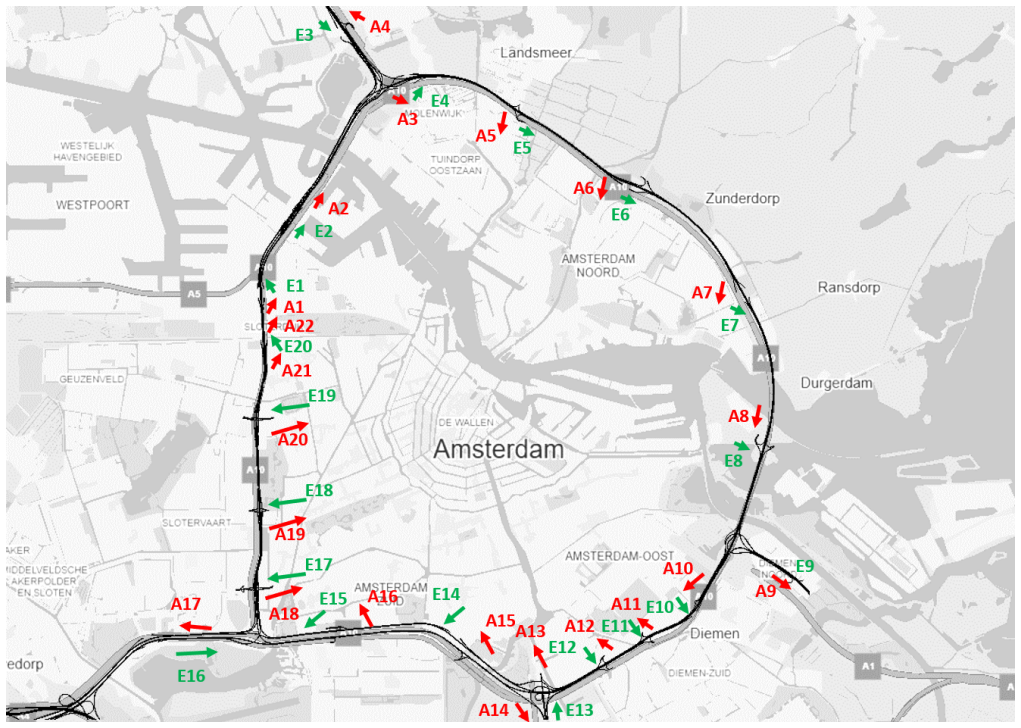
Ramp metering is a widely deployed traffic management strategy for improving freeway efficiency, yet conventional approaches often lead to highly uneven delay distributions across on-ramps, undermining user acceptance and long-term sustainability. While existing fairness-aware ramp metering methods can mitigate such disparities, they typically rely on centralized optimization, detailed traffic models, or data-intensive learning frameworks, limiting their real-world applicability, particularly in networks operating legacy ALINEA-based systems. This paper proposes C-EQ-ALINEA, a decentralized, coordinated, and equity-aware extension of the classical ALINEA feedback controller. The approach introduces lightweight information exchange among neighbouring ramps, enabling local coordination that balances congestion impacts without centralized control, additional infrastructure, or complex optimization. C-EQ-ALINEA preserves the simplicity and robustness of ALINEA while explicitly addressing multiple notions of fairness, including Harsanyian, Egalitarian, Rawlsian, and Aristotelian perspectives. The method is evaluated in a calibrated 24-hour microsimulation of Amsterdam's A10 ring road using SUMO. Results demonstrate that C-EQ-ALINEA substantially improves the equity of delay distributions across ramps and users, while maintaining (in several configurations surpassing) the efficiency of established coordinated strategies such as METALINE. These findings indicate that meaningful fairness gains can be achieved through minimal algorithmic extensions to widely deployed controllers, offering a practical and scalable pathway toward sustainable and socially acceptable freeway operations. Open source implementation available on GitHub.
Editorial analysis
A structured set of objections, weighed in public.
Referee Report
Summary. The manuscript proposes C-EQ-ALINEA, a decentralized extension of the classical ALINEA ramp-metering controller. Lightweight neighbor-to-neighbor information exchange is used to achieve local coordination while explicitly incorporating multiple equity notions (Harsanyian, Egalitarian, Rawlsian, Aristotelian). The method is evaluated in a single calibrated 24-hour SUMO microsimulation of Amsterdam’s A10 ring road and is reported to improve delay equity across ramps and users while maintaining or surpassing the efficiency of METALINE.
Significance. If the simulation results prove robust, the work would supply a low-overhead, deployable upgrade path for legacy ALINEA installations that directly addresses equity concerns without centralized optimization or new infrastructure. The open-source release is a clear strength that supports reproducibility and further testing.
major comments (2)
- [Evaluation] Evaluation section: all quantitative claims rest on a single 24-hour calibrated SUMO microsimulation of the A10 network. No sensitivity analysis with respect to car-following parameters, compliance rates, demand variability, or transfer to a second topology is reported; consequently the reported equity gains (Harsanyian/Egalitarian/etc.) cannot yet be distinguished from artifacts of the particular calibration and network geometry.
- [Methodology] Methodology: the precise local update rules that combine the ALINEA feedback law with the neighbor-exchange terms and the chosen fairness functions are not stated in closed form. Without these equations it is impossible to verify that the controller remains parameter-light and to reproduce the exact metering rates that produced the reported delay distributions.
minor comments (2)
- [Abstract] The abstract states that the method “addresses multiple notions of fairness” but does not indicate how the local controller selects or weights among them; a short clarifying sentence would help readers.
- [Figures] Figure captions should explicitly state the number of simulation replications and any statistical tests performed on the equity metrics.
Simulated Author's Rebuttal
We thank the referee for the constructive and detailed feedback on our manuscript. We address each major comment below and will revise the paper to incorporate the suggested improvements.
read point-by-point responses
-
Referee: [Evaluation] Evaluation section: all quantitative claims rest on a single 24-hour calibrated SUMO microsimulation of the A10 network. No sensitivity analysis with respect to car-following parameters, compliance rates, demand variability, or transfer to a second topology is reported; consequently the reported equity gains (Harsanyian/Egalitarian/etc.) cannot yet be distinguished from artifacts of the particular calibration and network geometry.
Authors: We acknowledge that the evaluation is based on a single calibrated 24-hour SUMO simulation of the A10 network, which limits the ability to fully distinguish the equity gains from potential artifacts of the specific setup. In the revised manuscript, we will add a sensitivity analysis varying car-following parameters, compliance rates, and demand levels, along with results from at least one additional network topology. These extensions will provide stronger evidence for the robustness of the reported improvements. revision: yes
-
Referee: [Methodology] Methodology: the precise local update rules that combine the ALINEA feedback law with the neighbor-exchange terms and the chosen fairness functions are not stated in closed form. Without these equations it is impossible to verify that the controller remains parameter-light and to reproduce the exact metering rates that produced the reported delay distributions.
Authors: We agree that the closed-form local update rules should be explicitly stated to ensure reproducibility and to confirm the parameter-light nature of the controller. The revised manuscript will include the precise mathematical expressions for the C-EQ-ALINEA update rules, detailing how the classical ALINEA feedback law is augmented with the neighbor-exchange terms and the specific fairness functions (Harsanyian, Egalitarian, Rawlsian, and Aristotelian). This will enable exact reproduction of the metering rates and verification of the approach. revision: yes
Circularity Check
No circularity: controller extends ALINEA by explicit rules; results are simulation outputs
full rationale
The paper defines C-EQ-ALINEA directly as an extension of the classical ALINEA feedback controller augmented with neighbor information exchange and explicit fairness functions (Harsanyian, Egalitarian, Rawlsian, Aristotelian). Performance metrics are generated as outputs of an independent calibrated SUMO microsimulation on the A10 network rather than any parameter fitted inside the controller equations or any self-referential prediction. No load-bearing self-citations, uniqueness theorems, or ansatzes imported from prior author work appear in the derivation; the central claims rest on the simulation results themselves, which are externally falsifiable against the model.
Axiom & Free-Parameter Ledger
axioms (1)
- domain assumption Lightweight neighbor information exchange is sufficient to achieve coordination and equity improvements
Reference graph
Works this paper leans on
-
[1]
Ramp meters on trial: Evidence from the twin cities metering holiday,
L. Zhang and D. Levinson, “Ramp meters on trial: Evidence from the twin cities metering holiday,”Transportation Research Part A: Policy and Practice, vol. 40, no. 10, pp. 810–828, 2006
work page 2006
-
[2]
Towards fair roads–why we should & how to improve the fairness in traffic engineering,
K. Riehl, A. Kouvelas, and M. Makridis, “Towards fair roads–why we should & how to improve the fairness in traffic engineering,”arXiv preprint arXiv:2408.01309, 2024
-
[3]
Quantitative fairness – a framework for the design of equitable cybernetic societies,
K. Riehl, A. Kouvelas, and M. A. Makridis, “Quantitative fairness – a framework for the design of equitable cybernetic societies,”Computers in Human Behavior: Artificial Humans, p. 100236, 2025
work page 2025
-
[4]
Alinea: A local feedback control law for on-ramp metering,
M. Papageorgiou, H. Hadj-Salem, and J.-M. Blosseville, “Alinea: A local feedback control law for on-ramp metering,”Transportation Research Record, vol. 1320, pp. 58–67, 1991
work page 1991
-
[5]
M. Papageorgiou, J.-M. Blosseville, and H. Haj-Salem, “Modelling and real-time control of traffic flow on the southern part of boulevard p´eriph´erique in paris: Part ii: Coordinated on-ramp metering,”Trans- portation Research Part A: Policy and Practice, vol. 24, no. 5, pp. 361–370, 1990
work page 1990
-
[6]
Co- ordinated ramp metering for freeway networks–a model-predictive hi- erarchical control approach,
I. Papamichail, A. Kotsialos, I. Margonis, and M. Papageorgiou, “Co- ordinated ramp metering for freeway networks–a model-predictive hi- erarchical control approach,”Transportation Research Part C: Emerg- ing Technologies, vol. 18, no. 3, pp. 311–331, 2010
work page 2010
-
[7]
Efficiency and equity properties of freeway network-wide ramp metering with amoc,
A. Kotsialos and M. Papageorgiou, “Efficiency and equity properties of freeway network-wide ramp metering with amoc,”Transportation Research Part C: Emerging Technologies, vol. 12, no. 6, pp. 401–420, 2004
work page 2004
-
[8]
Balancing efficiency and equity of ramp meters,
L. Zhang and D. Levinson, “Balancing efficiency and equity of ramp meters,”Journal of Transportation Engineering, vol. 131, no. 6, pp. 477–481, 2005
work page 2005
-
[9]
Efficiency versus fairness in network-wide ramp metering,
A. Kotsialos and M. Papageorgiou, “Efficiency versus fairness in network-wide ramp metering,” inProceedings of the IEEE Intelligent Transportation Systems Conference. Oakland, CA: IEEE, 2001, pp. 1189–1194
work page 2001
-
[10]
An analysis on efficiency and equity of fixed-time ramp metering,
A. S. Kesten, M. Ergun, and T. Yai, “An analysis on efficiency and equity of fixed-time ramp metering,”Journal of Transportation Technologies, vol. 3, no. 2, pp. 95–104, 2013
work page 2013
-
[11]
A pareto-optimization approach for a fair ramp metering,
M. Qiang and L. K. Hooi, “A pareto-optimization approach for a fair ramp metering,”Transportation Research Part C: Emerging Technologies, vol. 62, pp. 135–146, 2010
work page 2010
-
[12]
Sustainable ramp metering for freeway traffic control,
C. Pasquale, S. Sacone, S. Siri, and B. De Schutter, “Sustainable ramp metering for freeway traffic control,” inIntelligent Freeway Transportation Systems. Springer, 2017, pp. 213–238
work page 2017
-
[13]
H. Seiran and K. Lina, “Ramp metering control under stochastic ca- pacity in a connected environment: A dynamic bargaining game theory approach,”Transportation Research Part C: Emerging Technologies, vol. 130, p. 103302, 2021
work page 2021
-
[14]
Y . Han, M. Wang, and L. Leclercq, “A non-linear programming optimization model for ramp metering with efficiency and equity con- siderations,”Transportation Research Part C: Emerging Technologies, vol. 123, p. 102968, 2021
work page 2021
-
[15]
A physics-informed reinforcement learning-based strategy for local and coordinated ramp metering,
H. Yu, W. Meng, L. Linghui, R. Claudio, G. Jinda, and L. Pan, “A physics-informed reinforcement learning-based strategy for local and coordinated ramp metering,”Transportation Research Part C: Emerging Technologies, vol. 137, p. 103584, 2022
work page 2022
-
[16]
Efficiency and equity of ramp control and capacity allocation mechanisms in a freeway corridor,
T. Qiong, H. Haijun, Y . Hai, and G. Ziyou, “Efficiency and equity of ramp control and capacity allocation mechanisms in a freeway corridor,”Transportation Research Part C: Emerging Technologies, vol. 19, no. 3, pp. 126–143, 2011
work page 2011
-
[17]
Alinea: a local feedback control law for on-ramp metering; a real-life study,
H. Hadj-Salem, J.-M. Blosseville, and M. Papageorgiou, “Alinea: a local feedback control law for on-ramp metering; a real-life study,” in IEE International Conference on Road Traffic Control, London, UK, 1990, pp. 194–198
work page 1990
-
[18]
Can the maximin principle serve as a basis for morality? a critique of john rawls’s theory,
J. C. Harsanyi, “Can the maximin principle serve as a basis for morality? a critique of john rawls’s theory,”American political science review, vol. 69, no. 2, pp. 594–606, 1975
work page 1975
- [19]
- [20]
discussion (0)
Sign in with ORCID, Apple, or X to comment. Anyone can read and Pith papers without signing in.