REVIEW 4 major objections 5 minor 36 references
This paper claims that training large language models with rewards that mirror the logical structure of instructions—parallel, sequential, or conditional—improves how faithfully they follow complex instructions, and that this improvement tr
Reviewed by Pith at T0; open to challenge. T0 means a machine referee read the full paper against a public rubric. the ladder, T0–T4 →
Logic-structured rewards—averaging parallel constraints, decaying rewards after sequential failures, rewarding only the active conditional branch—improve instruction-following and transfer to reasoning.
T0 review reviewed 2026-08-03 challenge →
load-bearing objection Solid incremental RLVR recipe with a real conditional-reward bug in Eq. (4) that needs fixing before the conditional branch gains are believable. the 4 major comments →
LsrIF: Enhancing Logic-Structured Instruction Following of Large Language Models
The pith
A machine-rendered reading of the paper's core claim, the machinery that carries it, and where it could break.
The reading
Core claim
The central discovery claimed is that structure-aware reward aggregation—penalty propagation for sequential constraints and branch selection for conditionals—yields better instruction-following behaviour than flat averaging, and that training with such rewards redirects the model’s attention toward logical connectors and constraint tokens. The authors show that removing the structure-aware reward component degrades performance more than removing any single data structure, and that the gains survive on nested structures never seen in training, which they take as evidence that the model learns the logic, not just the surface forms.
What carries the argument
The key machinery is the reward aggregation function R. For parallel constraints it is the mean of per-constraint binary verifications (Eq. 1). For sequential constraints each reward is multiplied by a decay factor γ for every failed earlier constraint, so downstream rewards shrink when an early step fails (Eqs. 2–3, γ = 0.5). For conditional constraints only the branch whose trigger was satisfied is scored (Eq. 4). These functions are plugged into GRPO, so policy gradient updates receive credit that respects the instruction’s execution order.
Load-bearing premise
The method's advantage rests on the reward model genuinely measuring each atomic constraint—including conditional triggers that describe the input, not the output—because the structure-aware aggregation has no way to correct a bad underlying score.
What would settle it
Run LSRIF on a conditional-instruction set where the trigger is unambiguously a property of the input (e.g., 'if the prompt contains the word X'), using a reward model trained only on output-property tasks; if the branch reward cannot be meaningfully computed and performance collapses relative to flat averaging, the central claim fails for that class.
If this is right
- LSRIF improves instruction-following scores on in-domain and out-of-domain benchmarks across models from 1.5B to 14B parameters, in some cases surpassing much larger general-purpose models on the same benchmark.
- Removing the structure-aware reward component (LSRM) causes the largest performance drop in ablations, indicating reward aggregation is the critical component.
- Training on non-nested logical structures transfers to nested structures at depths up to 3, suggesting the learned logic generalizes compositionally.
- Improvements transfer to logical reasoning and arithmetic (e.g., large gains on a verifiable puzzle benchmark) and to general capability benchmarks.
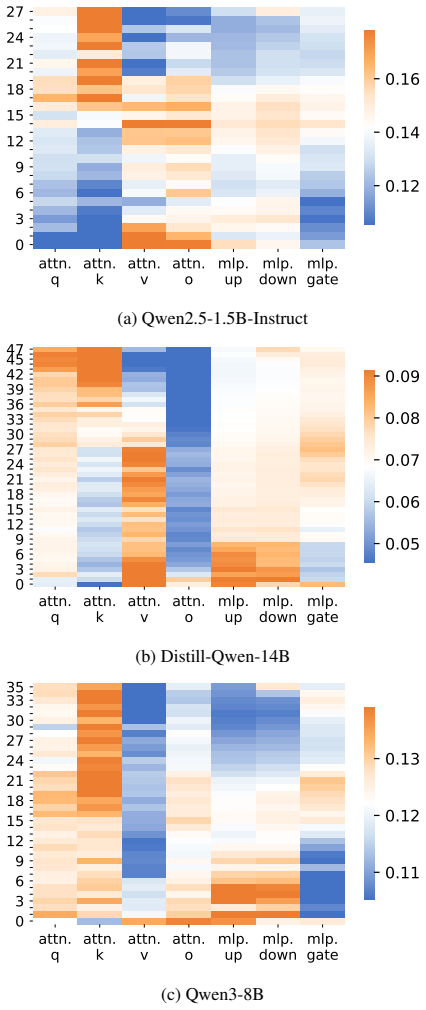
- Analysis shows training shifts parameter updates into attention query/key projections and increases token-level attention to logical connectors and constraint tokens.
Where Pith is reading between the lines
- If the reward-truthfulness premise holds, the framework gives a recipe that could be applied to any domain with decomposable constraints: the main design choice becomes how to define the structure type, not how to engineer the reward.
- The conditional trigger scoring issue (Eq. 4 scores as if the condition were a property of the output, while examples define conditions on the input) suggests a test: rewrite conditional instructions so the trigger is unambiguously input-side and check whether LSRM still gives a correct training signal; the method's generality depends on resolving this.
- The observed attention shift suggests a cheaper evaluation: a model trained with LSRM might be diagnosable by measuring attention on logical connectors, giving a proxy metric for instruction-logic comprehension without full benchmark evaluation.
- The stated limitations (no 70B+ evaluation, English-only data) can be read as the next test: whether the gains persist at frontier scale and in multilingual/agentic settings.
Editorial analysis
A structured set of objections, weighed in public.
Referee Report
Summary. The paper proposes LSRIF, a training framework for logic-structured instruction following. It constructs LSRINSTRUCT, a dataset of multi-constraint instructions organized into parallel, sequential, and conditional structures, and introduces LSRM, a structure-aware reward model that aggregates constraint-level rewards according to the logical structure: averaging for parallel, penalty propagation with a decay coefficient for sequential (Eq. 2–3), and branch selection for conditional (Eq. 4). The method is evaluated with GRPO on several Qwen/Llama/Distill models across instruction-following benchmarks (IFEval, CFBench, FollowBench, ComplexBench, WritingBench, Collie, AgentIF, MultiChallenge) and reasoning benchmarks (Enigmata, AIME, GPQA, MT-Bench, AlpacaEval), reporting consistent gains over base and SFT baselines. Ablations show that removing the structured reward modeling or the sequential/conditional data degrades performance. The paper also presents parameter-change and token-level saliency analyses to explain the improvements.
Significance. If the reported results are reproducible, the paper makes a useful contribution: explicitly modeling logical structure in both data construction and reward aggregation is a plausible and relatively underexplored direction for improving multi-constraint instruction following, with potential transfer to reasoning. The evaluation relies on external programmatic verifiers for many benchmarks, which reduces circularity, and the ablation structure is informative. However, the central claim of 'consistent, significant improvements' is weakened by an internal inconsistency in the conditional-reward formulation, the absence of any statistical grounding (single runs, no error bars), and an unsupported hyperparameter choice (gamma=0.5). These issues must be resolved before the claimed gains can be taken at face value.
major comments (4)
- [Sec. 3.2, Eq. (4)] The branch-selection reward uses r(o, c_p), where r(o,c) is defined in Sec. 3.2 as a binary output-constraint satisfaction function. However, Sec. 3.1 defines the conditional trigger c_p as an input-side condition, with examples like 'If the input text contains code...' and 'if the painting has an animal...'. For such triggers, whether c_p holds is determined by the input, not the output, so r(o,c_p) will evaluate whether the output itself satisfies a paraphrase of the trigger rather than whether the input does. This affects all 10,574 conditional instances in Table 1, and Table 4 shows removing conditional data causes drops (IFEval -1.8, CFBench -3.0, AIME2024 -3.5), so this mechanism is central. If the implementation actually evaluates the input condition, Eq. (4) and the claim 'rewards only active branches' must be rewritten to make the input-side evaluation explicit; otherwise the tr
- [Tables 2–4] All experimental results are single-run numbers with no error bars, confidence intervals, or significance tests. Several improvements are small in absolute terms (e.g., Llama-3.1-8B: ComplexBench +0.3, WritingBench +0.5; Qwen3-8B: IFEval +2.4 on a base of 87.8). The abstract and Sec. 4.2 repeatedly use the word 'significant' without statistical support. GRPO rollouts are stochastic, and even a fixed evaluation can vary with the random seed. The central claim requires at least three runs with mean and standard deviation, or bootstrap intervals, for the main comparisons.
- [Appx. A.4.1, Eq. (2)–(3)] The decay coefficient gamma in the sequential reward is set to 0.5, with the statement that this 'provides stable training dynamics,' but no sensitivity analysis is reported. The sequential aggregation is a core contribution, and its behavior changes qualitatively as gamma approaches 0 or 1. Without varying gamma (e.g., 0.1, 0.3, 0.5, 0.7, 0.9) or providing a principled derivation, the claim that penalty propagation is beneficial is not robustly supported.
- [Appx. A.2 and Eq. (4)] Soft constraints are scored by a trained reward model (Qwen2.5-7B-Instruct, fine-tuned following Ren et al. 2025), but no accuracy, precision, or agreement numbers for this reward model are reported. This is especially important for the conditional structure, where the RM must reliably decide whether the trigger condition holds and whether the branch constraint is satisfied. If the RM is biased, the structure-aware aggregation in Eq. (4) will amplify that bias. Please report RM accuracy on a held-out validation set, ideally broken down by constraint type.
minor comments (5)
- [Sec. 5.2, Eq. (7)–(9)] The quantity in Eq. (7) is a gradient-based input saliency, not an attention weight. Calling it 'attention importance' in Fig. 6 is misleading; please rename or clarify.
- [Table 2] Abbreviations such as 'Pr.(L)', 'ISR', and 'HSR' are not expanded in the caption. Please add full metric names or a pointer to Appx. A.4.3.
- [Sec. 4.1 / Abstract] The paper states 'We will release our data and code,' but no repository link or availability statement appears. Add a URL or specify where the release will be made.
- [Fig. 3] The figure has no error bars or statistical comparison across reward forms. Also, the prompt used for 'LLM-as-a-Judge' is not specified; please include it or cite the source.
- [Sec. 4.1 / Tab. 5–6] LSRINSTRUCT uses constraint taxonomies directly from IFEval (Tab. 5) and CFBench (Tab. 6). Since those are the in-domain evaluation benchmarks, the in-domain gains partly reflect training on the evaluator's own constraint categories. This should be acknowledged explicitly.
Circularity Check
No significant circularity: LSRIF's central gains are verified on external benchmarks; the only self-citation (Ren et al. 2025 for RM training) is not load-bearing.
full rationale
The paper's claimed improvements are measured by external programmatic/benchmark evaluators (IFEval, CFBench, FollowBench, ComplexBench, WritingBench, Collie, AgentIF, MultiChallenge, Enigmata, AIME, GPQA, MT-Bench, AlpacaEval), none of which are derived from LSRM or LSRINSTRUCT. The reward model is used only to produce training signals for soft constraints (Sec. 3.2, Appx. A.2); the final evaluation does not invoke this RM. Structure-aware reward aggregation (Eqs. 1-4) is defined from logical execution semantics, not fitted to the evaluation targets. The paper's only self-citation is to Ren et al. (2025) for the binary-classification RM training recipe; this is not load-bearing because Sec. 4.4.1 shows the method is robust to alternative reward forms (LLM-as-a-Judge, instruction-level RM), and the main results are reproduced across six open models. No fitted parameter is relabeled as a prediction, no uniqueness theorem is imported from the authors' prior work, and no ansatz is smuggled via citation. The conditional-branch reward in Eq. (4) has an internal consistency issue with input-side triggers (Sec. 3.1 examples are input-side, while r(o,c) is defined on outputs), but this is a correctness/implementation risk, not a circular derivation: the reward formula is not defined in terms of the benchmark outcomes. Therefore the derivation chain is self-contained; score reflects only a minor, non-load-bearing self-citation.
Axiom & Free-Parameter Ledger
free parameters (1)
- γ (sequential decay coefficient) =
0.5
axioms (5)
- domain assumption Complex instructions can be decomposed into atomic constraints organized by exactly three logic structures (parallel, sequential, conditional).
- ad hoc to paper Sequential reward should be a multiplicative decay of later rewards by previous failures.
- domain assumption Soft-constraint reward model approximates human judgment.
- ad hoc to paper Conditional trigger satisfaction can be evaluated as an output constraint r(o,c_p).
- domain assumption GRPO with a binary reward is a sound optimization backbone.
Cite this review
Pith. "Pith review of LsrIF: Enhancing Logic-Structured Instruction Following of Large Language Models." pith.science (2026). https://pith.science/paper/EQVTBAFH
@misc{pith2026260106431,
  author       = {Pith},
  title        = {Pith review of: LsrIF: Enhancing Logic-Structured Instruction Following of Large Language Models},
  year         = {2026},
  howpublished = {\url{https://pith.science/paper/EQVTBAFH}},
  note         = {Machine review of arXiv:2601.06431}
}
read the original abstract
Instruction following is critical for large language models, yet real-world instructions often involve multiple constraints with logical structures, such as parallel composition, sequential dependencies, and conditional branching. Existing methods typically construct data by simply combining constraints and aggregate rewards by averaging individual constraint scores during training, overlooking logical dependencies and introducing noisy signals. We propose LsrIF, a training framework for logic-structured instruction following. LsrIF constructs data by organizing atomic constraints into parallel, sequential, conditional, and nested structures, and applies structure-aware reward aggregation aligned with their execution semantics: averaging rewards for parallel constraints, decaying later rewards after early failures in sequential structures, and rewarding only active branches in conditional structures. Experiments show that LsrIF improves instruction following in both in-domain and out-of-domain settings while also benefiting logic reasoning. Further analysis indicates that logic-structured training increases attention to constraint-related tokens and logical connectors, suggesting improved modeling of instruction logic. We will release our data and code for future research.
Figures



Reference graph
Works this paper leans on
-
[1]
To make the instructions more complex, I want you to identify and return three composition constraints that can be added to the seed question
I currently have a seed question, but the seed questions are relatively simple. To make the instructions more complex, I want you to identify and return three composition constraints that can be added to the seed question
-
[2]
Infinity instruct: Scaling instruction selection and synthesis to enhance language models.arXiv preprint arXiv:2506.11116. Ke-Han Lu, Zhehuai Chen, Szu-Wei Fu, Chao- Han Huck Yang, Jagadeesh Balam, Boris Gins- burg, Yu-Chiang Frank Wang, and Hung-yi Lee
-
[3]
Developing instruction-following speech lan- guage model without speech instruction-tuning data. InICASSP 2025-2025 IEEE International Confer- ence on Acoustics, Speech and Signal Processing (ICASSP), pages 1–5. IEEE. MAA. 2024. American invitational mathematics exami- nation - aime. Accessed in February 2024. MAA. 2025. American invitational mathematics ...
Pith/arXiv arXiv 2025
-
[4]
Your task is only to generate the newcomposite constraintthat can be added to it
Do not modify or rewrite the seed question. Your task is only to generate the newcomposite constraintthat can be added to it
-
[5]
Return the added constraint(s) in the JSON format described below, including all sub-constraints and their logical composition types
-
[6]
Mona Lisa
Do not return anything else. No explanation, no reformulated question, no analysis—only the JSON structure. /* Logical Composition Types */ And: The output is required to satisfy multiple constraints simultaneously. Template:C1 and C2 and C3. Example: summarize the news in bullet points and within 100 words. Chain: The output is required to complete multi...
-
[7]
I will provide[Seed Question] and[Constraint References], and you can use these references to propose the composition constraint that would increase the difficulty of the seed question
-
[8]
You may choose one or more constraints from the[Constraint References]list, andcombine them using the following composition rules
-
[9]
Form and style: use specified stylistic form and perception
-
[10]
Audience-specific: tailored to a specific audience group
-
[11]
Authorial style: emulate specific authors’ styles
-
[12]
Lexical content constraint: must include specific terms or symbols with precise placement
-
[13]
Element constraint: include specific entities or scenarios
-
[14]
Semantic constraint: focus on themes, tone, or stance
-
[15]
Word Count: limit the number of words
-
[16]
Sentence Count: limit the number of sentences
-
[17]
Paragraph Count: limit the number of paragraphs
-
[18]
Document Count: limit the number of documents
-
[19]
Tone and emotion: conform to specific emotional tone
-
[20]
Task-specific constraint: address a defined situational task
-
[21]
Complex context constraint: involve multi-faceted and nested reasoning
-
[22]
Example constraint: conform to patterns from example pairs
-
[23]
Fundamental format: follow standard formats like JSON, HTML, etc
-
[24]
Bespoke format: use custom formatting protocols
-
[25]
Specialized format: tailored for specific applications or domains
-
[26]
Pragmatic constraint: adapt to context like dialects or language policy
-
[27]
Syntactic constraint: follow specific phrase and clause structures
-
[28]
Morphological constraint: control over affixes, roots, and word formation
-
[29]
Phonological constraint: focus on sounds, tone, and intonation
-
[30]
Role-based constraint: respond with specific role identity
-
[34]
Inverse constraint: narrow response space via exclusions
-
[35]
Contradictory constraint: combine requirements that are hard to satisfy simultaneously
-
[36]
Include keywords ’afternoon’ and ’distressed’ in the response. Don’t use any commas in your answer. Think:Alright, I need to create a riddle about embroidery where the answer is
Rule constraint: follow symbolic or logical operation rules. /* Seed Question */ [Seed Question]: {} /* Modified Question */ [Modified Question]:(the seed question plus one of the generated composite constraints). Table 7: Prompt template for constructing logically structured multi-constraint instructions. Case Content Before Training Input:Write a riddle...
-
[2023]
Judging llm-as-a-judge with mt-bench and chatbot arena.Advances in neural information pro- cessing systems, 36:46595–46623. Yaowei Zheng, Richong Zhang, Junhao Zhang, Yan- han Ye, Zheyan Luo, Zhangchi Feng, and Yongqiang Ma. 2024. Llamafactory: Unified efficient fine- tuning of 100+ language models.arXiv preprint arXiv:2403.13372. Jeffrey Zhou, Tianjian L...
Pith/arXiv arXiv 2024
-
[2024]
Cfbench: A comprehensive constraints- following benchmark for llms.arXiv preprint arXiv:2408.01122. Lianmin Zheng, Wei-Lin Chiang, Ying Sheng, Siyuan Zhuang, Zhanghao Wu, Yonghao Zhuang, Zi Lin, Zhuohan Li, Dacheng Li, Eric Xing, and 1 others
-
[2025]
arXiv preprint arXiv:2502.11541
Musc: Improving complex instruction follow- ing with multi-granularity self-contrastive training. arXiv preprint arXiv:2502.11541. Yuxin Jiang, Yufei Wang, Xingshan Zeng, Wanjun Zhong, Liangyou Li, Fei Mi, Lifeng Shang, Xin Jiang, Qun Liu, and Wei Wang. 2023. Follow- bench: A multi-level fine-grained constraints follow- ing benchmark for large language mo...
Pith/arXiv arXiv 2023
This paper was first reviewed by deepseek-v4-flash on August 3, 2026.
discussion (0)
Sign in with ORCID, Apple, or X to comment. Anyone can read and Pith papers without signing in.