REVIEW 3 major objections 6 minor 1 cited by
Coordinated multi-agent damping control increases wave-energy array capture by 23.8% in 2D regular waves and 21.5% in 3D irregular waves, compared with constant PTO damping.
Reviewed by Pith at T0; open to challenge. T0 means a machine referee read the full paper against a public rubric. the ladder, T0–T4 →
T0 review · deepseek-v4-flash
2026-08-03 11:22 UTC pith:EKRTTT2B
load-bearing objection A real step forward for SPH-coupled multi-agent RL in WEC arrays, but the headline efficiency gains rest on a baseline that is not properly verified in 3D and for multi-device layouts. the 3 major comments →
Coupling Smoothed Particle Hydrodynamics with Multi-Agent Deep Reinforcement Learning for Cooperative Control of Point Absorbers
The pith
A machine-rendered reading of the paper's core claim, the machinery that carries it, and where it could break.
Core claim
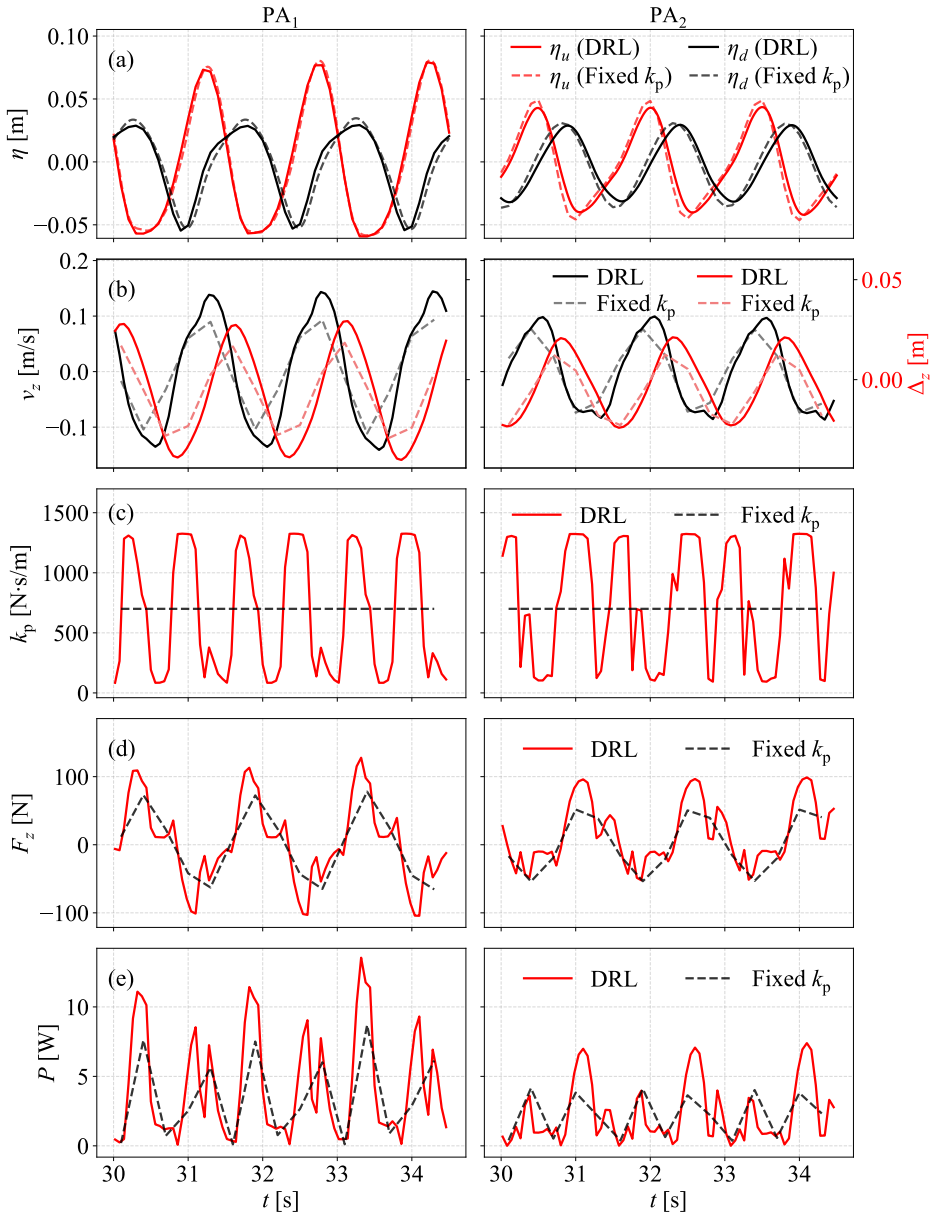
The central discovery is that a learnable, per-device damping policy, trained inside the SPH simulation itself, can beat the best constant damping coefficient for point-absorber arrays. Agents receive local wave elevations and their derivatives plus the heave motion of their own device, and output a continuous adjustment to the PTO damping coefficient. The trained policy tends to raise damping just before wave crests and troughs, when heave velocity is high, and lower it between, yielding larger heave velocities and lower downstream wave energy. Quantitatively, in the 2D regular-wave three-device array the policy raises total energy capture by 23.8% over the constant baseline, and in the 3D
What carries the argument
The central mechanism is the two-way coupling loop between the SPH solver and the multi-agent soft actor-critic controller. Each agent builds its local observation from four wave-gauge elevations and their time derivatives, plus heave displacement, velocity, and acceleration; the policy outputs a normalized action mapped to a damping coefficient by k_p,i = k_base + o_i·Δk_max, with Δk_max = 0.9·k_base and k_base set to the best constant value. The reward mixes each device's instantaneous power with the array-averaged power, using γ_p = 0.7, so agents learn to sacrifice individual gains for total array output. Training uses centralised critics that see joint actions while execution relies onl
Load-bearing premise
The comparison assumes the fixed PTO damping coefficient used as the baseline is the right reference: in 2D it is verified by a parameter sweep, but in 3D it is taken from earlier studies without checking that it is optimal for this geometry, water depth, and wave spectrum; if the 3D baseline is suboptimal, part of the reported 21.5% gain is an artifact of the baseline choice.
What would settle it
Re-run the 3D irregular-wave three-device case with a sweep of constant PTO damping coefficients (for example 200-1200 Ns/m) and find the true best fixed k0. If the best fixed coefficient yields total absorbed energy close to or above the 168.42 J achieved by the learned policy over the same 40 s evaluation window, then the claim that learned coordination beats constant damping fails; if the learned policy still wins by a wide margin, the claim survives.
If this is right
- If the central claim holds, constant-damping point-absorber arrays leave substantial energy on the table; coordinated adaptive damping is a practical way to increase array output without changing device geometry.
- The improvement grows with array size in the 2D regular-wave tests (9.2%, 18.9%, 23.8%), suggesting that cooperative policies become more valuable as hydrodynamic interactions between devices intensify.
- In the 3D irregular-wave case, most of the gain comes from upstream devices, with the downstream device losing 4.0% of its individual energy; array-level reward shaping can intentionally redistribute absorption away from the last device.
- Because the controller uses only each device's local observations at execution time, the trained policies can in principle be deployed on distributed hardware without a central communication channel.
- The unified GPU-accelerated implementation makes the SPH-MADRL loop fast enough for three-dimensional training and could be extended to other real-time multi-body fluid-structure control problems.
Where Pith is reading between the lines
- The reported 21.5% gain in 3D may be sensitive to the choice of the constant-damping baseline; if the 3D baseline coefficient is not optimal for this exact geometry and spectrum, a re-optimized baseline would shrink the measured advantage. A fairer comparison would sweep constant damping in 3D, as was done in 2D.
- The reward's global-sum weighting (γ_p = 0.7) is the likely driver of the downstream device's -4.0% individual result; an alternative per-device fairness term or a constraint on minimum individual energy might yield a different distribution of array output, possibly with higher total if unused downstream energy can be exploited.
- The two-peak-per-wave-period damping pattern resembles phase-matched damping control; a direct comparison against latching or bang-bang damping in the same SPH environment could isolate how much of the gain comes from continuous adaptation versus simple phase alignment.
- Because SPH resolves nonlinear and viscous effects, a plausible next test is to train under larger wave heights or broader spectra to see whether the learned policy transfers to conditions beyond those in the training distribution.
Editorial analysis
A structured set of objections, weighed in public.
Referee Report
Summary. The paper presents a coupled SPH–MADRL framework for adaptive PTO damping control of point-absorber arrays. The SPH solver (an extended DualSPHysics+ code) is linked in a unified C++/CUDA environment to LibTorch, and MASAC with CTDE is used to train agents that output continuous PTO damping adjustments based on local wave-elevation and heave-kinematic observations. The SPH model is validated against experimental single-body heave data for three constant damping values and against theoretical wave generation. The RL framework is then applied to 1–3 point absorbers in 2D regular waves and to a 3-PA array in 3D irregular waves. Headline results are energy gains of 9.2% (one PA, 2D), 18.9% (two PAs), 23.8% (three PAs) in 2D regular waves, and 21.5% total in the 3D irregular-wave case, all relative to a constant-PTO-damping baseline.
Significance. If the quantitative claims hold, this is a useful contribution: it is, to my knowledge, the first fully integrated, GPU-accelerated 3D SPH–MADRL platform with two-way coupling, and it extends prior single-agent CFD-DRL work to cooperative multi-body array control. The SPH validation against Zang et al. (2018) at three damping values is reasonable, the 2D constant-damping baseline is at least established by a single-PA sweep, and the decision to train each configuration three times is good practice. The authors also honestly report the decrease in PA3 output in the 3D case and attribute it to the global reward design, which lends credibility. However, the headline percentages are only meaningful if the constant-damping baselines are representative, and the absence of any reported variability across the three training runs makes the quantitative claims impossible to assess statistically. The significance of the paper rests on the integration and the 3D demonstration, not on algorithmic novelty in either SPH or RL.
major comments (3)
- [§3.2, Table 4] The 3D irregular-wave baseline k0 = 400 Ns/m is 'adopted based on existing numerical studies' (Ropero-Giralda et al., 2020; Manawadu et al., 2024) without a sweep for the present geometry, water depth, flume width, or JONSWAP spectrum. Since the 21.5% headline gain is measured against this constant-damping reference, a suboptimal reference would inflate the reported improvement. Please add a 3D constant-kp sweep (at least for the single PA, ideally for the three-PA array) or provide quantitative evidence that 400 Ns/m is near-optimal for the present configuration, and temper the headline claim if the evidence is not available.
- [§3.2, Tables 3 and 4] The text states that each configuration is trained three independent times ('following a standard practice'), but the tables report only single-point energy values with no mean, standard deviation, or per-seed spread. The abstract's 23.8%/21.5% figures are therefore not accompanied by any measure of variability, despite the visibly shaded standard deviations in Figs. 7 and 14. Report E_DRL (and ideally E0 and the improvement percentage) as mean±std over the three seeds, state which seed is shown in the time-history figures, and indicate whether the improvements are stable relative to seed-to-seed variation.
- [§3.2, Fig. 6, Table 3] The 2D baseline k0 = 700 Ns/m is obtained from a single-PA parametric sweep, but it is then applied as a uniform constant damping to the two- and three-PA arrays. Hydrodynamic interactions (wave shadowing, radiation, re-reflection) can shift the optimal constant damping per device and per array; the non-monotonic per-PA gains in Table 3 (33.7%, 8.9%, 19.1%) suggest the baseline may be better matched for some devices than others. Please justify transferring the single-PA optimum to the array configurations, or run a coarse array-level sweep (uniform and per-PA constant k0) to confirm the baseline is representative.
minor comments (6)
- [Table A.6] The table labels the last row '3-D regular wave', but Section 3.2.2 describes the 3D case as irregular waves generated with a JONSWAP spectrum. Please correct the label (or clarify if a different 3D case is meant).
- [§3.2.2] The text says the comparison covers 'the total captured energy within 50 s', while the Table 4 caption says 'over a 40 s simulation' and Fig. 17 shows the interval 10–50 s. Unify the time interval statement.
- [§2.3] The control frequency is not specified: the text says actions are fed back to the SPH solver but does not state the interval between successive agent decisions, nor the meaning of 'between two consecutive training intervals' in the kp interpolation. State whether actions are taken every SPH step, every Δt, or every fixed number of steps.
- [§1 and §4] The introduction describes the platform as 'open-source', but the text only says the code 'will be released'. Please add a code/data availability statement with a repository link or a clear statement of availability; this matters for the reproducibility promise.
- [Throughout] Minor language issues: 'term β denotes' (p. 3), 'reward entropy maximisations' (p. 6), 'reproduces with accuracy' (p. 27), and 'by how the DRL-trained policy enhances ... in this 2-D cases' (p. 16). Please copyedit.
- [§3.2 §3.2.2] The relation to DRLinSPH (Ye et al., 2025a) should be clarified: if DRLinSPH already couples SPH and DRL in a single-agent 2D setting, the 'first' claim should be specifically about the multi-agent, 3D, unified-C++/CUDA integration, not about SPH–DRL coupling in general.
Circularity Check
No significant circularity: the DRL gains are measured training outcomes against a fixed damping baseline; the only concerns (3D baseline optimality) are correctness risks, not circular reductions.
full rationale
The energy-improvement claim is a measured outcome of RL training, not a fit renamed as a prediction. The reward (Eq. 34) sums absorbed power, the policy is trained with MASAC to maximize it, and the improvement is evaluated by comparing accumulated energy in Tables 3 and 4. The 2D baseline k0=700 Ns/m is found by an explicit parametric sweep (Section 3.2, Fig. 6) and then held fixed; this is a benchmark choice, and the learned policy's admissible range [0.1k0, 1.9k0] does not force the reported 23.8% gain. The 3D baseline k0=400 is adopted from prior numerical studies (Ropero-Giralda et al., 2020; Manawadu et al., 2024); if that value is not optimal for the present geometry/spectrum, part of the +21.5% gain could be an artifact of comparing against a weak baseline, but this is an experimental-design/correctness risk, not a circular reduction: no equation in the paper defines the output in terms of the fitted baseline. The self-citations (DualSPHysics+; Zhan et al., 2025; and Ropero-Giralda et al., 2020, which shares an author) supply the numerical solver and a baseline constant, respectively; the solver is independently validated against the experiments of Zang et al. (2018), and the baseline value is not used to prove the framework's core mechanism. No 'prediction' equals an input by construction.
Axiom & Free-Parameter Ledger
free parameters (4)
- k0 (constant PTO damping baseline, 2D) =
700 Ns/m
- k0 (constant PTO damping baseline, 3D) =
400 Ns/m
- Reward cooperation weight gamma_p =
0.7
- Action range multiplier Delta k_max / k_base =
0.9
axioms (5)
- domain assumption deltaR-SPH with weakly compressible equation of state (beta=7) accurately captures nonlinear wave-structure interaction and PTO loads relevant to point absorber arrays.
- domain assumption Instantaneous absorbed power equals P_i = kp,i v_z,i^2 (Eqs. 33/35) and the linear damper F_t = -kp v (Eq. 13) represents a real PTO.
- domain assumption CTDE multi-agent SAC with centralized critics conditioned on joint actions stabilizes learning and the learned decentralized policies cooperate in deployment.
- domain assumption Resetting the SPH domain to the particle configuration at te at each episode reproduces identical incident waves and allows fair policy evaluation.
- domain assumption 2D narrow-flume results and periodic regular-wave policies carry over to 3D irregular ocean conditions.
read the original abstract
Wave Energy Converters, particularly point absorbers, have emerged as one of the most promising technologies for harvesting ocean wave energy. Nevertheless, achieving high conversion efficiency remains challenging due to the inherently complex and nonlinear interactions between incident waves and device motion dynamics. This study develops an optimal adaptive damping control model for the power take-off (PTO) system by coupling Smoothed Particle Hydrodynamics (SPH) with multi-agent deep reinforcement learning. The proposed framework enables real-time communication between high-fidelity SPH simulations and intelligent control agents that learn coordinated policies to maximise energy capture. In each training episode, the SPH-based environment provides instantaneous hydrodynamic states to the agents, which output continuous damping actions and receive rewards reflecting power absorption. The Multi-Agent Soft Actor Critic algorithm is employed within a centralised-training and decentralised-execution scheme to ensure stable learning in continuous, multi-body systems. The entire platform is implemented in a unified GPU-accelerated C++ environment, allowing long-horizon training and large-scale three-dimensional simulations. The approach is validated through a series of two-dimensional and three-dimensional benchmark cases under regular and irregular wave conditions. Compared with constant PTO damping, the learned control policy increases overall energy capture by 23.8% and 21.5%, respectively, demonstrating the strong potential of intelligent control for improving the performance of wave energy converter arrays. The developed three-dimensional GPU-accelerated multi-agent platform in computational hydrodynamics, is extendable to other fluid-structure interaction engineering problem that require real-time, multi-body coordinated control.
Figures




Forward citations
Cited by 1 Pith paper
-
Agentic AI for Particle-Based Simulation: Automating SPH Workflows for Debris Flow Modeling
An agentic AI workflow automates end-to-end SPH debris flow simulations via tool orchestration, multimodal inputs, and human-in-the-loop, demonstrating viability for meshless computational mechanics.
Reference graph
Works this paper leans on
-
[1]
write newline
" write newline "" before.all 'output.state := FUNCTION n.dashify 't := "" t empty not t #1 #1 substring "-" = t #1 #2 substring "--" = not "--" * t #2 global.max substring 't := t #1 #1 substring "-" = "-" * t #2 global.max substring 't := while if t #1 #1 substring * t #2 global.max substring 't := if while FUNCTION word.in bbl.in ":" * " " * FUNCTION f...
-
[2]
author Adami, S. , author Hu, X.Y. , author Adams, N.A. , year 2012 . title A generalized wall boundary condition for smoothed particle hydrodynamics . journal Journal of Computational Physics volume 231 , pages 7057--7075 . :10.1016/j.jcp.2012.05.005
-
[3]
author Altomare, C. , author Dom \'i nguez, J.M. , author Crespo, A.J.C. , author Gonz \'a lez-Cao , J. , author Suzuki, T. , author G \'o mez-Gesteira , M. , author Troch, P. , year 2017 . title Long-crested wave generation and absorption for SPH-based DualSPHysics model . journal Coastal Engineering volume 127 , pages 37--54 . :10.1016/j.coastaleng.2017.06.004
-
[4]
author Amato, C. , year 2024 . title An Introduction to Centralized Training for Decentralized Execution in Cooperative Multi-Agent Reinforcement Learning . :10.48550/arXiv.2409.03052, http://arxiv.org/abs/2409.03052 arXiv:2409.03052
-
[5]
author Anderlini, E. , author Forehand, D.I.M. , author Stansell, P. , author Xiao, Q. , author Abusara, M. , year 2016 . title Control of a Point Absorber Using Reinforcement Learning . journal IEEE Transactions on Sustainable Energy volume 7 , pages 1681--1690 . :10.1109/TSTE.2016.2568754
arXiv 2016
-
[6]
author Anderlini, E. , author Husain, S. , author Parker, G.G. , author Abusara, M. , author Thomas, G. , year 2020 . title Towards Real-Time Reinforcement Learning Control of a Wave Energy Converter . journal Journal of Marine Science and Engineering volume 8 , pages 845 . :10.3390/jmse8110845
-
[7]
author Antuono, M. , author Colagrossi, A. , author Marrone, S. , author Molteni, D. , year 2010 . title Free-surface flows solved by means of SPH schemes with numerical diffusive terms . journal Computer Physics Communications volume 181 , pages 532--549 . :10.1016/j.cpc.2009.11.002
-
[8]
author Babarit, A. , author Cl \'e ment, A.H. , year 2006 . title Optimal latching control of a wave energy device in regular and irregular waves . journal Applied Ocean Research volume 28 , pages 77--91 . :10.1016/j.apor.2006.05.002
-
[9]
author Baird, L. , year 1995 . title Residual Algorithms : Reinforcement Learning with Function Approximation , in: booktitle Machine Learning Proceedings 1995 . publisher Elsevier , pp. pages 30--37 . :10.1016/B978-1-55860-377-6.50013-X
-
[10]
author Batchelor, G.K. , author Young, A.D. , year 1968 . title An Introduction to Fluid Mechanics . journal Journal of Applied Mechanics volume 35 , pages 624 . :10.1115/1.3601282
-
[11]
author Bowes, B.D. , author Wang, C. , author Ercan, M.B. , author Culver, T.B. , author Beling, P.A. , author Goodall, J.L. , year 2022 . title Reinforcement learning-based real-time control of coastal urban stormwater systems to mitigate flooding and improve water quality . journal Environmental Science: Water Research & Technology volume 8 , pages 2065...
-
[12]
author Bu s oniu, L. , author Babu s ka, R. , author De Schutter, B. , year 2010 . title Multi-agent Reinforcement Learning : An Overview , in: editor Srinivasan, D. , editor Jain, L.C. (Eds.), booktitle Innovations in Multi-Agent Systems and Applications - 1 . publisher Springer , address Berlin, Heidelberg , pp. pages 183--221 . :10.1007/978-3-642-14435-6_7
-
[13]
author Crespo, A. , author Dom \'i nguez, J. , author Rogers, B. , author G \'o mez-Gesteira , M. , author Longshaw, S. , author Canelas, R. , author Vacondio, R. , author Barreiro, A. , author Garc \'i a-Feal , O. , year 2015 . title DualSPHysics : Open-source parallel CFD solver based on Smoothed Particle Hydrodynamics ( SPH ) . journal Computer Physics...
-
[14]
author Cui, Z. , author Guan, W. , author Zhang, X. , year 2025 . title Gated transformer-based proximal policy optimization for multiple marine autonomous surface ships collision avoidance decision-making strategy . journal Engineering Applications of Artificial Intelligence volume 156 , pages 111242 . :10.1016/j.engappai.2025.111242
arXiv 2025
-
[15]
author Dom \'i nguez, J.M. , author Fourtakas, G. , author Altomare, C. , author Canelas, R.B. , author Tafuni, A. , author Garc \'i a-Feal , O. , author Mart \'i nez-Est \'e vez , I. , author Mokos, A. , author Vacondio, R. , author Crespo, A.J.C. , author Rogers, B.D. , author Stansby, P.K. , author G \'o mez-Gesteira , M. , year 2022 . title DualSPHysi...
-
[16]
author Edwards, E.C. , author Whitlam, C. , author Chapman, J. , author Hughes, J. , author Redfearn, B. , author Brown, S. , author Draper, S. , author Borthwick, A.G.L. , author Foster, G. , author Yue, D.K.P. , author Hann, M. , author Greaves, D. , year 2025 . title The effect of device geometry on the performance of a wave energy converter . journal ...
-
[17]
author Faedo, N. , author Olaya, S. , author Ringwood, J.V. , year 2017 . title Optimal control, MPC and MPC-like algorithms for wave energy systems: An overview . journal IFAC Journal of Systems and Control volume 1 , pages 37--56 . :10.1016/j.ifacsc.2017.07.001
-
[18]
author Fan, D. , author Yang, L. , author Wang, Z. , author Triantafyllou, M.S. , author Karniadakis, G.E. , year 2020 . title Reinforcement learning for bluff body active flow control in experiments and simulations . journal Proceedings of the National Academy of Sciences volume 117 , pages 26091--26098 . :10.1073/pnas.2004939117
-
[19]
author Fourtakas, G. , author Dominguez, J.M. , author Vacondio, R. , author Rogers, B.D. , year 2019 . title Local uniform stencil ( LUST ) boundary condition for arbitrary 3- D boundaries in parallel smoothed particle hydrodynamics ( SPH ) models . journal Computers & Fluids volume 190 , pages 346--361 . :10.1016/j.compfluid.2019.06.009
-
[20]
author Fourtakas, G. , author Vacondio, R. , author Rogers, B. , year 2025 . title Divergence cleaning for weakly compressible smoothed particle hydrodynamics . journal Computers & Fluids volume 295 , pages 106638 . :10.1016/j.compfluid.2025.106638
arXiv 2025
-
[21]
, author Zhou, A
author Haarnoja, T. , author Zhou, A. , author Abbeel, P. , author Levine, S. , year 2018 . title Soft Actor-Critic : Off-Policy Maximum Entropy Deep Reinforcement Learning with a Stochastic Actor , in: booktitle Proceedings of the 35th International Conference on Machine Learning , publisher PMLR . pp. pages 1861--1870
2018
-
[22]
author Haarnoja, T. , author Zhou, A. , author Hartikainen, K. , author Tucker, G. , author Ha, S. , author Tan, J. , author Kumar, V. , author Zhu, H. , author Gupta, A. , author Abbeel, P. , author Levine, S. , year 2019 . title Soft Actor-Critic Algorithms and Applications . :10.48550/arXiv.1812.05905, http://arxiv.org/abs/1812.05905 arXiv:1812.05905
-
[23]
author Haraguchi, R. , author Asai, T. , year 2020 . title Enhanced power absorption of a point absorber wave energy converter using a tuned inertial mass . journal Energy volume 202 , pages 117740 . :10.1016/j.energy.2020.117740
arXiv 2020
-
[24]
author Hasselmann, D.E. , author Dunckel, M. , author Ewing, J.A. , year 1980 . title Directional Wave Spectra Observed during JONSWAP 1973 . journal Journal of Physical Oceanography volume 10 , pages 1264--1280 . :10.1175/1520-0485(1980)010<1264:DWSODJ>2.0.CO;2
-
[25]
author He, G. , author Luan, Z. , author Zhang, W. , author He, R. , author Liu, C. , author Yang, K. , author Yang, C. , author Jing, P. , author Zhang, Z. , year 2023 . title Review on research approaches for multi-point absorber wave energy converters . journal Renewable Energy volume 218 , pages 119237 . :10.1016/j.renene.2023.119237
arXiv 2023
-
[26]
author Henriques, J.C.C. , author Gato, L.M.C. , author Falc \ a o, A.F.O. , author Robles, E. , author Fa \"y , F.X. , year 2016 . title Latching control of a floating oscillating-water-column wave energy converter . journal Renewable Energy volume 90 , pages 229--241 . :10.1016/j.renene.2015.12.065
-
[27]
author Jia, W. , author Xu, H. , year 2025 . title Strategies for energy-efficient flow control leveraging deep reinforcement learning . journal Engineering Applications of Artificial Intelligence volume 156 , pages 111125 . :10.1016/j.engappai.2025.111125
arXiv 2025
-
[28]
author Khayyer, A. , author Shimizu, Y. , author Gotoh, T. , author Gotoh, H. , year 2023 . title Enhanced resolution of the continuity equation in explicit weakly compressible SPH simulations of incompressible free-surface fluid flows . journal Applied Mathematical Modelling volume 116 , pages 84--121 . :10.1016/j.apm.2022.10.037
-
[29]
author Kolios, A. , author Di Maio, L.F. , author Wang, L. , author Cui, L. , author Sheng, Q. , year 2018 . title Reliability assessment of point-absorber wave energy converters . journal Ocean Engineering volume 163 , pages 40--50 . :10.1016/j.oceaneng.2018.05.048
-
[30]
author Kouzehgar, M. , author Meghjani, M. , author Bouffanais, R. , year 2020 . title Multi- Agent Reinforcement Learning for Dynamic Ocean Monitoring by a Swarm of Buoys , in: booktitle Global Oceans 2020: Singapore -- U . S . Gulf Coast , pp. pages 1--8 . :10.1109/IEEECONF38699.2020.9389128, http://arxiv.org/abs/2012.11641 arXiv:2012.11641
arXiv 2020
-
[31]
author Leimkuhler, B.J. , author Reich, S. , author Skeel, R.D. , year 1996 . title Integration Methods for Molecular Dynamics , in: editor Friedman, A. , editor Gulliver, R. , editor Mesirov, J.P. , editor Schulten, K. , editor Sumners, D.W. (Eds.), booktitle Mathematical Approaches to Biomolecular Structure and Dynamics . publisher Springer New York , a...
-
[32]
author Liang, H. , author Qin, H. , author Su, H. , author Wen, Z. , author Mu, L. , year 2024 . title Environmental- Sensing and adaptive optimization of wave energy converter based on deep reinforcement learning and computational fluid dynamics . journal Energy volume 297 , pages 131254 . :10.1016/j.energy.2024.131254
arXiv 2024
-
[33]
author Lowe, R. , author Wu, Y. , author Tamar, A. , author Harb, J. , author Abbeel, P. , author Mordatch, I. , year 2017 . title Multi- Agent Actor-Critic for Mixed Cooperative-Competitive Environments . journal Advances in neural information processing systems volume 30 . :10.48550/arXiv.1706.02275, http://arxiv.org/abs/1706.02275 arXiv:1706.02275
-
[34]
author Manawadu, N. , author Nissanka, I. , author Karunasena, H. , year 2024 . title SPH-based numerical modelling and performance analysis of a heaving point absorber type wave energy converter with a novel buoy geometry . journal Renewable Energy volume 228 , pages 120595 . :10.1016/j.renene.2024.120595
arXiv 2024
-
[35]
, author Guy, A
author Mania, H. , author Guy, A. , author Recht, B. , year 2018 . title Simple random search of static linear policies is competitive for reinforcement learning . journal Advances in neural information processing systems volume 31
2018
-
[36]
author Mart \'i nez-Est \'e vez , I. , author Tagliafierro, B. , author El Rahi, J. , author Dom \'i nguez, J. , author Crespo, A. , author Troch, P. , author G \'o mez-Gesteira , M. , year 2023 . title Coupling an SPH-based solver with an FEA structural solver to simulate free surface flows interacting with flexible structures . journal Computer Methods ...
arXiv 2023
-
[37]
, author Gross, S
author Paszke, A. , author Gross, S. , author Massa, F. , author Lerer, A. , author Bradbury, J. , author Chanan, G. , author Killeen, T. , author Lin, Z. , author Gimelshein, N. , author Antiga, L. , author Desmaison, A. , author Kopf, A. , author Yang, E. , author DeVito, Z. , author Raison, M. , author Tejani, A. , author Chilamkurthy, S. , author Stei...
2019
-
[38]
author Piscopo, V. , author Benassai, G. , author Cozzolino, L. , author Della Morte, R. , author Scamardella, A. , year 2016 . title A new optimization procedure of heaving point absorber hydrodynamic performances . journal Ocean Engineering volume 116 , pages 242--259 . :10.1016/j.oceaneng.2016.03.004
-
[39]
author Qin, H. , author Su, H. , author Wen, Z. , author Liang, H. , year 2025 . title Latching control of a point absorber wave energy converter in irregular wave environments coupling computational fluid dynamics and deep reinforcement learning . journal Applied Energy volume 396 , pages 126282 . :10.1016/j.apenergy.2025.126282
arXiv 2025
-
[40]
author Ropero-Giralda , P. , author Crespo, A.J.C. , author Tagliafierro, B. , author Altomare, C. , author Dom \'i nguez, J.M. , author G \'o mez-Gesteira , M. , author Viccione, G. , year 2020 . title Efficiency and survivability analysis of a point-absorber wave energy converter using DualSPHysics . journal Renewable Energy volume 162 , pages 1763--177...
-
[41]
author Sarkar, S. , author Gundecha, V. , author Shmakov, A. , author Ghorbanpour, S. , author Babu, A.R. , author Faraboschi, P. , author Cocho, M. , author Pichard, A. , author Fievez, J. , year 2022 . title Multi- Agent Reinforcement Learning Controller to Maximize Energy Efficiency for Multi-Generator Industrial Wave Energy Converter . journal Proceed...
-
[42]
author Son, D. , author Yeung, R.W. , year 2017 . title Optimizing ocean-wave energy extraction of a dual coaxial-cylinder WEC using nonlinear model predictive control . journal Applied Energy volume 187 , pages 746--757 . :10.1016/j.apenergy.2016.11.068
-
[43]
, author Barto, A
author Sutton, R.S. , author Barto, A. , year 2014 . title Reinforcement Learning: An Introduction . Adaptive Computation and Machine Learning. edition nachdruck ed., publisher The MIT Press , address Cambridge, Massachusetts
2014
-
[44]
author Tricco, T.S. , author Price, D.J. , author Bate, M.R. , year 2016 . title Constrained hyperbolic divergence cleaning in smoothed particle magnetohydrodynamics with variable cleaning speeds . journal Journal of Computational Physics volume 322 , pages 326--344 . :10.1016/j.jcp.2016.06.053
-
[45]
author Wang, H. , author Wijaya, V. , author Zeng, T. , author Zhang, Y. , year 2024 . title Deep reinforcement learning-based non-causal control for wave energy conversion . journal Ocean Engineering volume 311 , pages 118860 . :10.1016/j.oceaneng.2024.118860
arXiv 2024
-
[46]
author Wendland, H. , year 1995 . title Piecewise polynomial, positive definite and compactly supported radial functions of minimal degree . journal Advances in Computational Mathematics volume 4 , pages 389--396 . :10.1007/BF02123482
-
[47]
author Xie, Y. , author Zhao, X. , year 2021 . title Sloshing suppression with active controlled baffles through deep reinforcement learning--expert demonstrations--behavior cloning process . journal Physics of Fluids volume 33 , pages 017115 . :10.1063/5.0037334
-
[48]
author Xie, Y. , author Zhao, X. , author Liu, Z. , year 2023 . title A simple approach for wave absorbing control of plunger wavemakers using machine learning: Numerical study . journal Coastal Engineering volume 179 , pages 104253 . :10.1016/j.coastaleng.2022.104253
arXiv 2023
-
[49]
author Xue, B. , author Wang, S. , author Peng, Y. , author Zhang, A. , year 2022 . title A novel coupled Riemann SPH -- RKPM model for the simulation of weakly compressible fluid--structure interaction problems . journal Ocean Engineering volume 266 , pages 112447 . :10.1016/j.oceaneng.2022.112447
arXiv 2022
-
[50]
author Ye, M. , author Ma, H. , author Ren, Y. , author Zhang, C. , author Haidn, O.J. , author Hu, X. , year 2025 a. title DRLinSPH : An open-source platform using deep reinforcement learning and SPHinXsys for fluid-structure-interaction problems . journal Engineering Applications of Computational Fluid Mechanics volume 19 , pages 2460677 . :10.1080/1994...
arXiv 2025
-
[51]
author Ye, M. , author Zhang, C. , author Ren, Y. , author Liu, Z. , author Haidn, O.J. , author Hu, X. , year 2025 b. title Adaptive optimization of wave energy conversion in oscillatory wave surge converters via SPH simulation and deep reinforcement learning . journal Renewable Energy volume 246 , pages 122887 . :10.1016/j.renene.2025.122887
arXiv 2025
-
[52]
author Zang, Z. , author Zhang, Q. , author Qi, Y. , author Fu, X. , year 2018 . title Hydrodynamic responses and efficiency analyses of a heaving-buoy wave energy converter with PTO damping in regular and irregular waves . journal Renewable Energy volume 116 , pages 527--542 . :10.1016/j.renene.2017.09.057
-
[53]
author Zhan, S. , author Ringwood, J.V. , year 2024 . title Model- Free Linear Noncausal Optimal Control of Wave Energy Converters via Reinforcement Learning . journal IEEE Transactions on Control Systems Technology volume 32 , pages 2164--2177 . :10.1109/TCST.2024.3401863
arXiv 2024
-
[54]
author Zhan, Y. , author Luo, M. , author Khayyer, A. , year 2025 . title DualSPHysics +: An enhanced DualSPHysics with improvements in accuracy, energy conservation and resolution of the continuity equation . journal Computer Physics Communications volume 306 , pages 109389 . :10.1016/j.cpc.2024.109389
arXiv 2025
-
[55]
author Zhang, C. , author Hu, X. , author Adams, N. , year 2017 . title A weakly compressible SPH method based on a low-dissipation Riemann solver . journal Journal of Computational Physics volume 335 , pages 605--620 . :10.1016/j.jcp.2017.01.027
-
[56]
author Zhang, K. , author Xu, Y. , author Zhao, M. , author Jiang, Y. , year 2025 . title Sample-efficient planning-control framework for autonomous underwater vehicle docking using lightweight Cross Q-Learning . journal Engineering Applications of Artificial Intelligence volume 161 , pages 112293 . :10.1016/j.engappai.2025.112293
arXiv 2025
-
[57]
author Zou, S. , author Zhou, X. , author Khan, I. , author Weaver, W.W. , author Rahman, S. , year 2022 . title Optimization of the electricity generation of a wave energy converter using deep reinforcement learning . journal Ocean Engineering volume 244 , pages 110363 . :10.1016/j.oceaneng.2021.110363
arXiv 2022
discussion (0)
Sign in with ORCID, Apple, or X to comment. Anyone can read and Pith papers without signing in.