REVIEW 4 major objections 6 minor 53 references
The paper claims that a retrieval-augmented language-model pipeline can read U.S. climate equity plans, extract their policies, strategies, and actions, and recommend similar cities so planners can spot what their own plans are missing.
Reviewed by Pith at T0; open to challenge. T0 means a machine referee read the full paper against a public rubric. the ladder, T0–T4 →
T0 review · deepseek-v4-flash
2026-08-03 11:18 UTC pith:P5ZRCBQX
load-bearing objection A useful proof-of-concept for LLM-based policy comparison, but the similarity and sentiment results are computed on unvalidated ChatGPT outputs, so treat it as a demonstration pending human validation. the 4 major comments →
Mapping and Comparing Climate Equity Policy Practices Using RAG LLM-Based Semantic Analysis and Recommendation Systems
The pith
A machine-rendered reading of the paper's core claim, the machinery that carries it, and where it could break.
Core claim
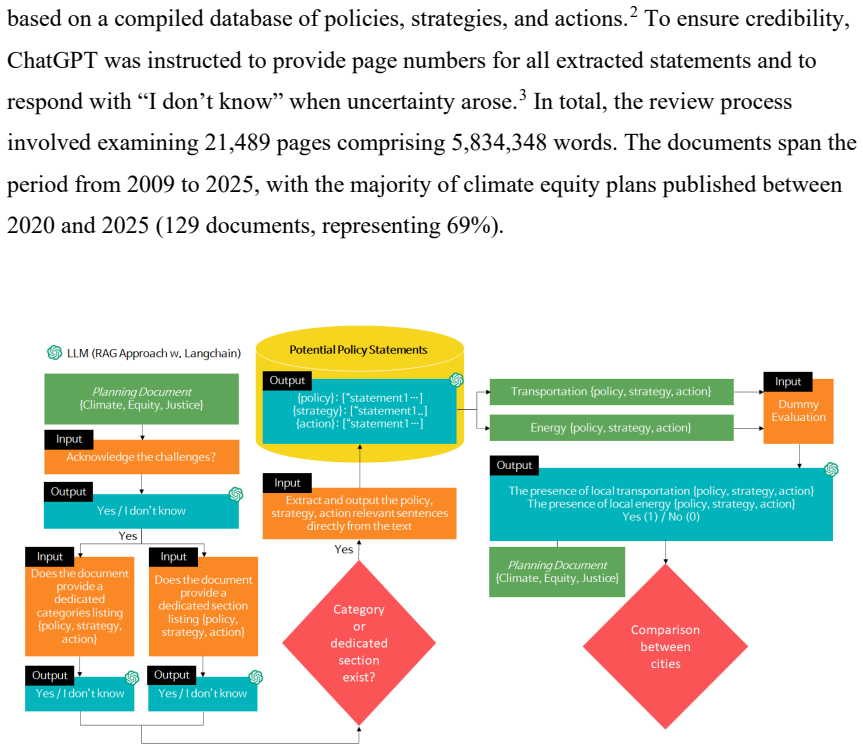
On its own terms, the paper's central claim is that similar policy practices can be automatically matched and policy gaps identified through a recommendation system. The mechanism is a retrieval-augmented generation (RAG) pipeline that chunks and embeds the full text of climate equity plans, retrieves relevant passages, and uses a large language model at zero temperature to extract policies, strategies, and actions related to transportation and energy, with page citations and an "I don't know" fallback. Each extracted element is then evaluated for presence or absence across 20 thematic categories, producing a binary vector per city. Cosine similarity over the action vectors yields top-five c
What carries the argument
The load-bearing mechanism is the policy–strategy–action hierarchy coupled to a content-based recommendation system. Documents are split into overlapping chunks, embedded into a vector index, and retrieved with a relevance-and-diversity balance; a language model constrained to the retrieved context and run with a zero temperature setting extracts and classifies policy, strategy, and action items, then answers structured binary-presence questions across 20 thematic categories. These binary answers become city profiles, and cosine similarity between profiles is used to return the top-five most similar cities and to compute adoption rates for each policy element. The hierarchy matters because a
Load-bearing premise
The whole comparison rests on the language model's yes/no judgments about whether each of the 20 transportation and energy categories appears in a plan, and the paper's own limitations section concedes those judgments are never validated against human auditing.
What would settle it
Take a random sample of the 192 climate equity plans, have two independent human coders mark whether each of the 20 transportation and energy categories is present or absent, and compute agreement between the coders and with the language model's binary presence vectors. If human–model agreement is low, the cosine-similarity rankings and gap diagnoses, which are computed from those vectors, would lose their evidentiary support.
If this is right
- Planners can turn a single query city into a short list of peer cities with similar action profiles, then read only the gaps—actions peers have and the target lacks—instead of reviewing every plan.
- The presence/absence scores double as a diagnostic map of the field: electric-vehicle charging infrastructure is a common action while energy impact assessments appear in only one city, pointing to systematic blind spots.
- Geographic patterning, such as a Las Vegas match pulling several California cities, suggests that regional context shapes policy adoption; the matching tool makes this pattern inspectable rather than assumed.
- Because the extraction categories are defined semantically, the same pipeline can be re-run as cities update plans, giving a living comparative view rather than a one-time snapshot.
- The system already distinguishes policies, strategies, and actions, so users can match on any of the three levels independently, depending on the policy question at hand.
Where Pith is reading between the lines
- The absence of a validation study against human coding means the similarity rankings and gap lists should be treated as searchable hypotheses, not measurements; a replication with human raters on a sample of plans would establish how much trust the binary presence scores deserve.
- The same extraction-plus-matching recipe transfers naturally to other policy domains—housing, land use, public health—where the policy–strategy–action structure and cross-city learning questions are similar.
- Because the data are cross-sectional, the geographic clusters could reflect policy borrowing, shared state or federal requirements, or independent convergence; linking matches to adoption dates and program funding would let a follow-up study separate those mechanisms.
Editorial analysis
A structured set of objections, weighed in public.
Referee Report
Summary. The paper builds an LLM-based workflow for comparing climate equity plans in U.S. cities. It first analyzes 83 planning job postings with TF-IDF/LSA to characterize planning roles in an era of AI, then uses a LangChain RAG pipeline with GPT-4o-mini to extract policy, strategy, and action items from climate equity plans, evaluates presence over 20 thematic categories, applies BERT sentiment to generated responses, and builds a content-based recommendation system using cosine similarity over binary presence vectors. The stated central objective is to demonstrate automated matching of similar policy practices and identification of policy gaps. The results claim that planning jobs retain traditional emphases, that climate equity plans predominantly use affirmative language, and that recommendation outputs exhibit geographic patterning.
Significance. The application is timely and the pipeline is described in unusually explicit detail, including chunk size, retrieval parameters, and temperature settings; this transparency is a definite strength. If validated, the recommendation system could be a practical aid for cross-city policy learning and gap identification. The paper is appropriately framed as a demonstration rather than an effectiveness comparison. However, the evidentiary value of the empirical claims is currently conditional: all downstream outputs inherit the accuracy of the LLM's unvalidated extraction and binary presence judgments, and several analyses are applied to LLM-generated text rather than to source documents. The contribution is therefore promising but not yet established.
major comments (4)
- [§3.2, §4.3, §6] The central similarity and gap results are computed from binary presence scores produced by GPT-4o-mini, but the pipeline is not validated against human coding. Footnote 5's citation of Deng et al.'s recall of 0.795 is for a different task and model and does not transfer; footnote 3 itself concedes interpretive uncertainty. Additionally, retrieval includes 'random sampling' (§3.2), so temperature=0 does not guarantee reproducibility. A human audit of a random sample of plans, or a comparison with an independent coding method, is required before cosine similarities and top-5 recommendations can support the paper's central claim.
- [§3.2, Tables 1–2] The 20 thematic categories are identified by ChatGPT and the same model later evaluates their presence. This creates circularity: the presence scores are not independent measurements but internal consistency checks of the model's own taxonomy. Claims that certain themes are 'common' or 'missing' therefore reflect the model's category scheme. The categories should be derived from human content analysis or an independent coding protocol, and inter-coder reliability should be reported for presence judgments.
- [§4.2, Tables 4–5] The affirmative-language finding is computed from BERT scores applied to LLM-generated responses, not to the original plan text. The 'negative' Brownsville example in Table 5 contains directive affirmative commitments ('will be paid,' 'would require'), and its negative label appears to be an artifact of the generated meta-response framing rather than the plan's language. The conclusion that 'policy texts predominantly employ affirmative language' is unsupported. Sentiment analysis should be re-run on verbatim source sentences or on clearly identified source excerpts.
- [§3.1] The job-posting analysis drops from 69,116 postings to 199 and then 83 after 'reviewing all entries,' but no screening criteria or examples of excluded postings are given. Since Section 5's first finding claims that planning jobs retain traditional domain emphases, this opaque filter is load-bearing. Report the inclusion/exclusion protocol—keywords, whether screening used titles or descriptions, location and date filters, and deduplication rules—with counts at each stage.
minor comments (6)
- [§3.2] The number of LSA topics is not justified; results may depend on this choice. Please report the selection criterion or a robustness check across different topic counts.
- [§4.3, Figures 6–7] No similarity scores or thresholds are shown for the 'top five' recommendations. Reporting the cosine values and the underlying binary vectors for the examples would make the demonstration assessable.
- [Table 3] Typo 'dispariteis' should be 'disparities.' The entry labeled 'Westminster Sustainability Plan' appears without a source citation.
- [Tables 4–5] The excerpts are RAG-LLM outputs, not verbatim plan text. The tables should state this explicitly and, where possible, include the page numbers cited by the model.
- [General] No data or code availability statement is provided. For a reproducibility-oriented methods paper, the authors should include prompts, model versions, and the extracted dataset, or provide a link to a repository.
- [§5, third finding] The statement that policy practices 'often exhibit geographically patterned similarities' is based on two illustrative queries with five neighbors each and no statistical test. Please soften the claim or support it with a systematic analysis.
Circularity Check
No significant circularity: the recommendation examples are descriptive transformations of extracted presence vectors, not fitted predictions or self-justifying derivations.
full rationale
The paper's central demonstration—matching cities via cosine similarity on binary presence vectors over 20 thematic categories—is an explicit, transparent computation from the extracted/evaluated data, not a prediction that is forced by a fitted parameter or by a self-citation. The 20 categories are outputs of the LLM extraction, and the paper does not claim these categories validate the system against an external benchmark; footnote 3 acknowledges interpretive uncertainty and footnote 5 explicitly states "We do not claim equivalence to human auditing." The sentiment analysis is applied to LLM-generated responses, which is a validity/measurement concern, but the paper frames it as a diagnostic of the extracted responses rather than as a model fitted to the target conclusion. Self-citations (Choi and Jiao 2024; Choi 2025) appear only in the literature review and are not load-bearing for the recommendation-system derivation. No uniqueness theorem, ansatz-by-citation, or renamed known result is used. Thus, while the lack of human-coding validation is a substantive correctness risk, it is not circularity under the specified criteria.
Axiom & Free-Parameter Ledger
free parameters (6)
- RAG chunk size / overlap =
1000 words / 200 words
- Retrieval parameters k, fetch_k, λ =
k=5, fetch_k=20, λ=0.7
- Temperature =
0
- Number of LSA topics =
5
- Job posting screening criteria =
83 postings retained from 69,116 scraped
- 20 thematic categories =
policy/strategy/action themes in Tables 1-2
axioms (6)
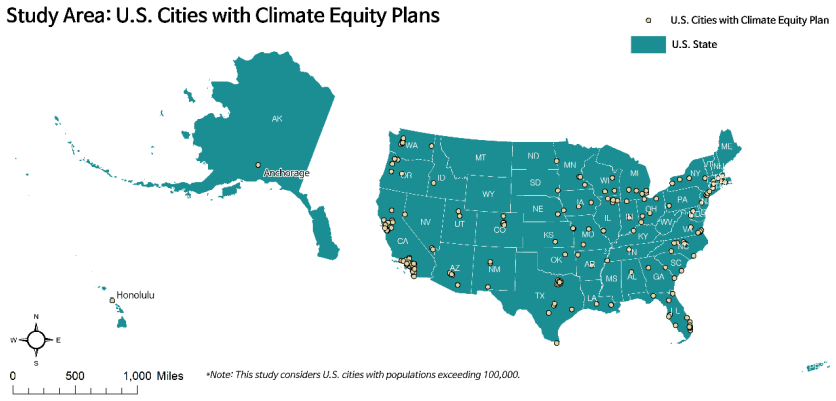
- domain assumption Wikipedia's list of U.S. cities and climate equity plan availability is complete and accurate.
- domain assumption The collected PDFs are authoritative representations of each city's climate equity planning.
- domain assumption LLM semantic interpretation can reliably identify policies, strategies, and actions and their presence.
- domain assumption The BERT sentiment classifier's labels on LLM-generated responses reflect the language of the original plans.
- domain assumption Cosine similarity of binary presence vectors measures meaningful policy-practice similarity.
- domain assumption The retained job postings (83) represent the planning labor market.
read the original abstract
This study investigates the use of large language models to enhance the policymaking process. We first analyze planning-related job postings to revisit the evolving roles of planners in the era of AI. We then examine climate equity plans across the U.S. and apply ChatGPT to conduct semantic analysis, extracting policy, strategy, and action items related to transportation and energy. The methodological framework relied on a LangChain-native retrieval-augmented generation pipeline. Based on these extracted elements and their evaluated presence, we develop a content-based recommendation system to support cross-city policy comparison. The results indicate that, despite growing attention to AI, planning jobs largely retain their traditional domain emphases in transportation, environmental planning, housing, and land use. Communicative responsibilities remain central to planning practice. Climate equity plans commonly address transportation, environmental, and energy-related measures aimed at reducing greenhouse gas emissions and predominantly employ affirmative language. The demonstration of the recommendation system illustrates how planners can efficiently identify cities with similar policy practices, revealing patterns of geographic similarity in policy adoption. The study concludes by envisioning localized yet personalized AI-assisted systems that can be adapted within urban systems.
Figures
Reference graph
Works this paper leans on
-
[1]
Urban climate adaptation and mitigation action plans: A critical review
Aboagye, P.D., Sharifi, A., 2024. Urban climate adaptation and mitigation action plans: A critical review. Renewable and Sustainable Energy Reviews 189, 113886. https://doi.org/10.1016/j.rser.2023.113886
arXiv 2024
-
[2]
Llm based generation of item-description for recommendation system
Acharya, A., Singh, B., Onoe, N., 2023. Llm based generation of item-description for recommendation system. Presented at the Proceedings of the 17th ACM conference on recommender systems, pp. 1204–1207
2023
-
[3]
Grid modernization: challenges and opportunities
Agüero, J.R., Takayesu, E., Novosel, D., Masiello, R., 2017. Grid modernization: challenges and opportunities. The Electricity Journal 30, 1–6
2017
-
[4]
An analytical review of environmental justice research: what do we really know? Environmental management 29, 3–15
Bowen, W., 2002. An analytical review of environmental justice research: what do we really know? Environmental management 29, 3–15
2002
-
[5]
Planning Theory for Practitioners
Brooks, M., 2002. Planning Theory for Practitioners. Routledge, New York. https://doi.org/10.4324/9781351179454
-
[6]
Canaries in the coal mine? six facts about the recent employment effects of artificial intelligence
Brynjolfsson, E., Chandar, B., Chen, R., 2025. Canaries in the coal mine? six facts about the recent employment effects of artificial intelligence. Digital Economy
2025
-
[7]
Why does urban Artificial Intelligence (AI) matter for urban studies? Developing research directions in urban AI research
Caprotti, F., Cugurullo, F., Cook, M., Karvonen, A., Marvin, S., McGuirk, P., Valdez, A.-M., 2024. Why does urban Artificial Intelligence (AI) matter for urban studies? Developing research directions in urban AI research. Urban Geography 45, 883–894
2024
-
[8]
Chiu, H., Hachiuma, R., Wang, C.-Y., Smith, S.F., Wang, Y.-C.F., Chen, M.-H.,
-
[9]
AI-in-the-Loop Planning for Transportation Electrification: Case Studies from Austin, Texas
Choi, S.J., 2025. AI-in-the-Loop Planning for Transportation Electrification: Case Studies from Austin, Texas. arXiv preprint arXiv:2504.21185
Pith/arXiv arXiv 2025
-
[10]
Developing a transit desert interactive dashboard: Supervised modeling for forecasting transit deserts
Choi, S.J., Jiao, J., 2024. Developing a transit desert interactive dashboard: Supervised modeling for forecasting transit deserts. PLoS One 19, e0306782
2024
-
[11]
Who owns Electric Vehicles (EVs)? The relationship between EV adoption and socio-demographic characteristics across different price segments and brands in the Texas triangle
Choi, S.J., Jiao, J., Mendez, T., 2024. Who owns Electric Vehicles (EVs)? The relationship between EV adoption and socio-demographic characteristics across different price segments and brands in the Texas triangle. Research in Transportation Business & Management 57, 101225
2024
-
[12]
Local climate action plans in climate change mitigation–examining the case of Denmark
Damsø, T., Kjær, T., Christensen, T.B., 2016. Local climate action plans in climate change mitigation–examining the case of Denmark. Energy Policy 89, 74– 83
2016
-
[13]
The YouTube video recommendation system
Davidson, J., Liebald, B., Liu, J., Nandy, P., Van Vleet, T., Gargi, U., Gupta, S., He, Y., Lambert, M., Livingston, B., 2010. The YouTube video recommendation system. Presented at the Proceedings of the fourth ACM conference on Recommender systems, pp. 293–296
2010
-
[14]
Review of climate action plans in 29 major US cities: Comparing current policies to research recommendations
Deetjen, T.A., Conger, J.P., Leibowicz, B.D., Webber, M.E., 2018. Review of climate action plans in 29 major US cities: Comparing current policies to research recommendations. Sustainable Cities and Society 41, 711–727
2018
-
[15]
Automating urban policy extraction: A large language model-based framework for extracting local heat policies from planning documents
Deng, Z., Fu, X., Li, C., 2025. Automating urban policy extraction: A large language model-based framework for extracting local heat policies from planning documents. Environment and Planning B: Urban Analytics and City Science 23998083251382381
2025
-
[16]
Constructing Equity in Urban Climate Mitigation Planning
Elmallah, S., 2025. Constructing Equity in Urban Climate Mitigation Planning. Journal of Planning Education and Research 0739456X241310196. 30
2025
-
[17]
Planning in the Face of Power
Forester, J., 1982. Planning in the Face of Power. Journal of the american planning association 48, 67–80
1982
-
[18]
Evidence on local climate policies achieving emission reduction targets by 2030
Franco, C., Melica, G., Palermo, V., Bertoldi, P., 2025. Evidence on local climate policies achieving emission reduction targets by 2030. Urban Climate 59, 102242. https://doi.org/10.1016/j.uclim.2024.102242
arXiv 2025
-
[19]
Connecting climate action with other Sustainable Development Goals
Fuso Nerini, F., Sovacool, B., Hughes, N., Cozzi, L., Cosgrave, E., Howells, M., Tavoni, M., Tomei, J., Zerriffi, H., Milligan, B., 2019. Connecting climate action with other Sustainable Development Goals. Nature Sustainability 2, 674–680
2019
-
[20]
Levelling the playing field through GenAI: Harnessing artificial intelligence to bridge educational gaps for equity and disadvantaged students
James, T., Andrews, G., 2024. Levelling the playing field through GenAI: Harnessing artificial intelligence to bridge educational gaps for equity and disadvantaged students. Widening Participation and Lifelong Learning 26, 250–260
2024
-
[21]
LLM Agents for Smart City Management: Enhancing Decision Support Through Multi- Agent AI Systems
Kalyuzhnaya, A., Mityagin, S., Lutsenko, E., Getmanov, A., Aksenkin, Y., Fatkhiev, K., Fedorin, K., Nikitin, N.O., Chichkova, N., Vorona, V., 2025. LLM Agents for Smart City Management: Enhancing Decision Support Through Multi- Agent AI Systems. Smart Cities (2624-6511) 8
2025
-
[22]
From transportation equity to transportation justice: within, through, and beyond the state
Karner, A., London, J., Rowangould, D., Manaugh, K., 2020. From transportation equity to transportation justice: within, through, and beyond the state. Journal of planning literature 35, 440–459
2020
-
[23]
Karner, A., Niemeier, D., 2013. Civil rights guidance and equity analysis methods for regional transportation plans: a critical review of literature and practice. Journal of Transport Geography 33, 126–134. https://doi.org/10.1016/j.jtrangeo.2013.09.017
-
[24]
Advances and pitfalls in measuring transportation equity
Karner, A., Pereira, R.H., Farber, S., 2025. Advances and pitfalls in measuring transportation equity. Transportation 52, 1399–1427
2025
-
[25]
AI4Policy: AI-Enabled Scenario Planning for Policy-Making in the Age of AI
Kgomo, J., Song, Z., 2025. AI4Policy: AI-Enabled Scenario Planning for Policy-Making in the Age of AI. Available at SSRN 5710143
2025
-
[26]
Measuring nuanced walkability: Leveraging ChatGPT’s vision reasoning with multisource spatial data
Ki, D., Lee, H., Park, K., Ha, J., Lee, S., 2025. Measuring nuanced walkability: Leveraging ChatGPT’s vision reasoning with multisource spatial data. Computers, Environment and Urban Systems 121, 102319
2025
-
[27]
Trust and reliance on AI—An experimental study on the extent and costs of overreliance on AI
Klingbeil, A., Grützner, C., Schreck, P., 2024. Trust and reliance on AI—An experimental study on the extent and costs of overreliance on AI. Computers in Human Behavior 160, 108352
2024
-
[28]
Analyzing patient perspectives with large language models: a cross-sectional study of sentiment and thematic classification on exception from informed consent
Kornblith, A.E., Singh, C., Innes, J.C., Chang, T.P., Adelgais, K.M., Holsti, M., Kim, J., McClain, B., Nishijima, D.K., Rodgers, S., 2025. Analyzing patient perspectives with large language models: a cross-sectional study of sentiment and thematic classification on exception from informed consent. Scientific reports 15, 6179
2025
-
[29]
Llmlight: Large language models as traffic signal control agents
Lai, S., Xu, Z., Zhang, W., Liu, H., Xiong, H., 2025. Llmlight: Large language models as traffic signal control agents. Presented at the Proceedings of the 31st ACM SIGKDD Conference on Knowledge Discovery and Data Mining V. 1, pp. 2335–2346
2025
-
[30]
WeBuildAI: Participatory framework for algorithmic governance
Lee, M.K., Kusbit, D., Kahng, A., Kim, J.T., Yuan, X., Chan, A., See, D., Noothigattu, R., Lee, S., Psomas, A., 2019. WeBuildAI: Participatory framework for algorithmic governance. Proceedings of the ACM on human-computer interaction 3, 1–35
2019
-
[31]
Urban 31 Planning in the Age of Agentic AI: Emerging Paradigms and Prospects
Liu, R., Zhe, T., Peng, Z.-R., Catbas, N., Ye, X., Wang, D., Fu, Y., 2025. Urban 31 Planning in the Age of Agentic AI: Emerging Paradigms and Prospects. ACM SIGKDD Explorations Newsletter 27, 35–42
2025
-
[32]
Are we planning for equity? Equity goals and recommendations in local comprehensive plans
Loh, C.G., Kim, R., 2021. Are we planning for equity? Equity goals and recommendations in local comprehensive plans. Journal of the American Planning Association 87, 181–196
2021
-
[33]
A data-driven risk assessment of cybersecurity challenges posed by generative AI
Mohawesh, R., Ottom, M.A., Salameh, H.B., 2025. A data-driven risk assessment of cybersecurity challenges posed by generative AI. Decision Analytics Journal 15, 100580. https://doi.org/10.1016/j.dajour.2025.100580
arXiv 2025
-
[34]
Is temperature the creativity parameter of large language models? arXiv preprint arXiv:2405.00492
Peeperkorn, M., Kouwenhoven, T., Brown, D., Jordanous, A., 2024. Is temperature the creativity parameter of large language models? arXiv preprint arXiv:2405.00492
Pith/arXiv arXiv 2024
-
[35]
Dynamic life cycle assessment (LCA) of renewable energy technologies
Pehnt, M., 2006. Dynamic life cycle assessment (LCA) of renewable energy technologies. Renewable energy 31, 55–71
2006
-
[36]
ASHABot: an LLM-powered chatbot to support the informational needs of community health workers
Ramjee, P., Chhokar, M., Sachdeva, B., Meena, M., Abdullah, H., Vashistha, A., Nagar, R., Jain, M., 2025. ASHABot: an LLM-powered chatbot to support the informational needs of community health workers. Presented at the Proceedings of the 2025 CHI Conference on Human Factors in Computing Systems, pp. 1–22
2025
-
[37]
Environmental justice and climate change policies
Resnik, D.B., 2022. Environmental justice and climate change policies. Bioethics 36, 735–741
2022
-
[38]
Communicative planning, in: The Routledge Handbook of Planning Theory
Sager, T., 2017. Communicative planning, in: The Routledge Handbook of Planning Theory. Routledge, pp. 93–104
2017
-
[39]
From environmental to climate justice: climate change and the discourse of environmental justice
Schlosberg, D., Collins, L.B., 2014. From environmental to climate justice: climate change and the discourse of environmental justice. Wiley Interdisciplinary Reviews: Climate Change 5, 359–374
2014
-
[40]
Weather and climate extreme events in a changing climate
Seneviratne, S.I., Zhang, X., Adnan, M., Badi, W., Dereczynski, C., Luca, A.D., Ghosh, S., Iskandar, I., Kossin, J., Lewis, S., 2021. Weather and climate extreme events in a changing climate
2021
-
[41]
Managing climate change in cities: Will climate action plans work? Landscape and urban planning 107, 263–271
Stone, B., Vargo, J., Habeeb, D., 2012. Managing climate change in cities: Will climate action plans work? Landscape and urban planning 107, 263–271
2012
-
[42]
Suh, S., Chen, M., Min, B., Li, T.J.-J., Xia, H., 2023. Structured generation and exploration of design space with large language models for human-ai co-creation. arXiv preprint arXiv:2310.12953 3
Pith/arXiv arXiv 2023
-
[43]
AI-native interconnect framework for integration of large language model technologies in 6G systems
Tarkoma, S., Morabito, R., Sauvola, J., 2023. AI-native interconnect framework for integration of large language model technologies in 6G systems. arXiv preprint arXiv:2311.05842
Pith/arXiv arXiv 2023
-
[44]
Geographies of Policy Mobilities
Temenos, C., McCann, E., 2013. Geographies of Policy Mobilities. Geography Compass 7, 344–357. https://doi.org/10.1111/gec3.12063
-
[45]
Attribution of climate extreme events
Trenberth, K.E., Fasullo, J.T., Shepherd, T.G., 2015. Attribution of climate extreme events. Nature climate change 5, 725–730
2015
-
[46]
The Climate Emergency [WWW Document]
UN Environment, 2022. The Climate Emergency [WWW Document]. URL https://www.unep.org/climate-emergency (accessed 1.3.26)
2022
-
[47]
Empirical study of llm fine-tuning for text classification in legal document review
Wei, F., Keeling, R., Huber-Fliflet, N., Zhang, J., Dabrowski, A., Yang, J., Mao, Q., Qin, H., 2023. Empirical study of llm fine-tuning for text classification in legal document review. Presented at the 2023 IEEE international conference on big data (BigData), IEEE, pp. 2786–2792
2023
-
[48]
A systematic review of climate policies in China: Evolution, 32 effectiveness, and challenges
Wu, S., 2023. A systematic review of climate policies in China: Evolution, 32 effectiveness, and challenges. Environmental Impact Assessment Review 99, 107030. https://doi.org/10.1016/j.eiar.2022.107030
arXiv 2023
-
[49]
Equity planning revisited
Zapata, M.A., Bates, L.K., 2015. Equity planning revisited. Journal of Planning Education and Research 35, 245–248
2015
-
[50]
Llm-powered user simulator for recommender system
Zhang, Z., Liu, S., Liu, Z., Zhong, R., Cai, Q., Zhao, X., Zhang, C., Liu, Q., Jiang, P., 2025. Llm-powered user simulator for recommender system. Presented at the Proceedings of the AAAI Conference on Artificial Intelligence, pp. 13339– 13347
2025
-
[51]
Towards understanding retrieval accuracy and prompt quality in rag systems
Zhao, S., Huang, Y., Song, J., Wang, Z., Wan, C., Ma, L., 2024. Towards understanding retrieval accuracy and prompt quality in rag systems. arXiv preprint arXiv:2411.19463
Pith/arXiv arXiv 2024
-
[52]
Urban planning in the era of large language models
Zheng, Y., Xu, F., Lin, Y., Santi, P., Ratti, C., Wang, Q.R., Li, Y., 2025. Urban planning in the era of large language models. Nature computational science 1–10
2025
-
[2025]
arXiv preprint arXiv:2502.09980
V2v-llm: Vehicle-to-vehicle cooperative autonomous driving with multi- modal large language models. arXiv preprint arXiv:2502.09980
discussion (0)
Sign in with ORCID, Apple, or X to comment. Anyone can read and Pith papers without signing in.