Recognition: no theorem link
WISE/CatWISE Constraints on Dysonian Waste-Heat Technosignatures in Nearby Galaxies
Pith reviewed 2026-05-16 15:38 UTC · model grok-4.3
The pith
At 300 K, no more than 0.0161 percent of nearby galaxies can host KIII-scale systems reprocessing at least 21 percent of a Milky Way-like stellar luminosity into waste heat.
A machine-rendered reading of the paper's core claim, the machinery that carries it, and where it could break.
Core claim
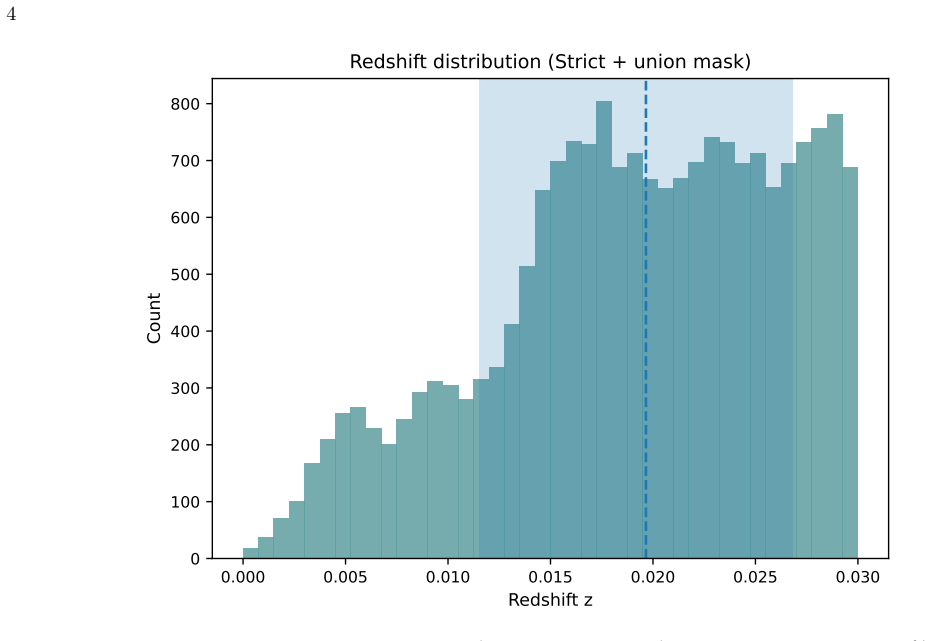
Starting from the 2MRS catalog, cross-matched to CatWISE2020 and AllWISE, and after applying Stern, Assef R90, and Jarrett MIR vetoes, the analysis treats W1 and W2 as stellar baselines and derives 3-sigma upper limits on bolometric waste-heat luminosity from W3 and W4 photometry using bandpass color corrections for blackbodies at T = 150-600 K. For a fiducial Milky Way luminosity of 3 times 10 to the 10 solar luminosities the resulting alpha upper limits are 1.7-2.9 percent; at T approximately 300 K the one-sided 95 percent population bound is f_95 approximately 1.61 times 10 to the minus 4 on the fraction of galaxies hosting KIII systems with alpha at least 0.21.
What carries the argument
The AGENT formalism that converts per-galaxy W3/W4 upper limits into waste-heat fraction alpha equals L_wh over L_star, using blackbody models and WISE relative spectral response curves.
If this is right
- Median per-galaxy upper limits on waste-heat luminosity lie between 5 and 9 times 10 to the 8 solar luminosities across the temperature range.
- The 95 percent upper bound on the fraction of galaxies above any chosen waste-heat threshold decreases monotonically and approaches 1 over 6500 at high thresholds.
- Sensitivity to waste heat is dominated by the W4 band below 200 K and by the W3 band above 300 K.
- The limits constrain Kardashev type III civilizations that reprocess 21 percent or more of galactic stellar output into 300 K radiation.
Where Pith is reading between the lines
- Searches for technosignatures at galactic scales may need to shift toward individual stars or smaller structures if whole-galaxy waste heat is this rare.
- Deeper infrared surveys or improved veto methods could push the population fraction bound lower without changing the temperature or luminosity assumptions.
- The same photometric approach could be applied to other mid-infrared datasets to test consistency across different bandpasses or redshift ranges.
Load-bearing premise
The standard mid-infrared AGN and starburst vetoes leave genuine technosignature signals intact and that waste heat is accurately described by blackbody emission inside the WISE bandpasses.
What would settle it
Detection of even one galaxy with a W3 or W4 excess after the vetoes that corresponds to greater than 21 percent reprocessing at 300 K would violate the reported 95 percent population bound.
Figures


read the original abstract
We search for galaxy-scale (Dysonian) waste heat in the mid-infrared using WISE. Starting from the 2MASS Redshift Survey (2MRS), we cross-match to CatWISE2020 and AllWISE, apply standard MIR AGN/starburst vetoes (Stern, Assef R90, Jarrett), and treat W1 and W2 as stellar baselines and W3 and W4 as constraining bands. For each galaxy and for blackbody waste heat temperatures T=150-600 K, we convert W3/W4 photometry into conservative 3-sigma per-galaxy upper limits on the bolometric waste heat luminosity using the WISE bandpass (RSR) color correction. The resulting distributions have median caps of ~(5-9) x 10^8 L_sun across T=150-600 K. Aggregated at the population level, the one-sided 95% upper bound on the fraction of nearby galaxies that could host waste heat above a given threshold monotonically decreases with threshold and asymptotes to ~1/6500 at high thresholds (set by the sample size). Sensitivity transitions from W4 at T <= 200K to W3 at T >= 300K. Interpreted with the AGENT formalism, a fiducial Milky Way like stellar luminosity L_=3 x 10^10 L_sun implies typical per galaxy caps of alpha = L_wh/L_ <= 1.7-2.9% over T=150-600 K (e.g., alpha <= 1.8% at T=300 K). At T ~= 300K, no more than f_95 ~= 1.61 x 10^-4 (~= 0.0161%) of nearby galaxies can host KIII-scale systems reprocessing >= 21% of a Milky Way-like stellar luminosity into ~ 300K waste heat.
Editorial analysis
A structured set of objections, weighed in public.
Referee Report
Summary. The paper cross-matches the 2MRS catalog to CatWISE2020 and AllWISE, applies standard MIR AGN/starburst vetoes, treats W1/W2 as stellar baselines and W3/W4 as constraining bands, and derives per-galaxy 3-sigma upper limits on bolometric waste-heat luminosity assuming blackbody emission at T=150-600 K. These limits are aggregated to a population-level one-sided 95% upper bound, yielding f_95 ≈ 1.61×10^{-4} (~0.016%) on the fraction of nearby galaxies that could host KIII-scale systems reprocessing ≥21% of a Milky Way-like stellar luminosity (L_*=3×10^{10} L_⊙) into ~300 K waste heat, with median per-galaxy caps of α = L_wh/L_* ≤ 1.7-2.9%.
Significance. If the modeling assumptions hold, the work supplies the tightest current constraints on galaxy-scale Dysonian waste-heat technosignatures by exploiting a large, public all-sky sample and reproducible photometric methods. It strengthens the AGENT formalism with concrete observational bounds and demonstrates the utility of WISE for technosignature searches.
major comments (3)
- [§3] §3 (photometric conversion): the blackbody assumption plus WISE RSR color corrections for T=150-600 K is load-bearing for the quoted median α caps (1.7-2.9%) and the headline f_95 at the 21% reprocessing threshold; no sensitivity analysis to deviations (reduced emissivity, line features, or non-thermal components) is provided, directly affecting the inferred L_wh limits.
- [§4.2] §4.2 (veto application): the Stern, Assef R90, and Jarrett MIR AGN/starburst vetoes are applied without quantifying the fraction of genuine technosignature spectra that would be removed; this is load-bearing for the validity of f_95 because the central claim assumes the vetoes preserve real waste-heat signals.
- [§5] §5 (population aggregation): the one-sided 95% upper bound f_95 and its asymptote to ~1/6500 are derived from the per-galaxy limit distribution, but the specific 21% reprocessing threshold chosen for the T≈300 K headline number requires explicit justification tied to the exact cumulative distribution to confirm it is not sensitive to binning or sample-size effects.
minor comments (2)
- [Abstract] Abstract and §2: the fiducial Milky Way luminosity L_*=3×10^{10} L_⊙ and the precise definition of 'KIII-scale systems' should be stated with a reference to the AGENT formalism for clarity.
- [§3] §3: additional details on exact data exclusion rules, error propagation for the 3-sigma limits, and the sample size after cross-matching would improve reproducibility.
Simulated Author's Rebuttal
We thank the referee for the constructive and detailed comments, which have helped us identify areas to strengthen the manuscript. We address each major comment point by point below, proposing revisions where the points identify genuine gaps in the current analysis. All changes will be incorporated in the revised version.
read point-by-point responses
-
Referee: [§3] §3 (photometric conversion): the blackbody assumption plus WISE RSR color corrections for T=150-600 K is load-bearing for the quoted median α caps (1.7-2.9%) and the headline f_95 at the 21% reprocessing threshold; no sensitivity analysis to deviations (reduced emissivity, line features, or non-thermal components) is provided, directly affecting the inferred L_wh limits.
Authors: We agree that the blackbody assumption is central and that a sensitivity analysis would strengthen the results. Blackbody spectra are the standard conservative choice in technosignature literature because they maximize MIR output for a given temperature and bolometric luminosity. In the revised manuscript we will add to §3 a new subsection with a limited sensitivity test: (i) scaling the emissivity to 0.5 and recomputing the median α caps, and (ii) a qualitative discussion of how narrow emission lines or non-thermal components would typically tighten (not loosen) the W3/W4-based limits. A full non-thermal model is beyond the present scope, as it would introduce additional free parameters unsupported by the WISE photometry alone. revision: partial
-
Referee: [§4.2] §4.2 (veto application): the Stern, Assef R90, and Jarrett MIR AGN/starburst vetoes are applied without quantifying the fraction of genuine technosignature spectra that would be removed; this is load-bearing for the validity of f_95 because the central claim assumes the vetoes preserve real waste-heat signals.
Authors: The vetoes follow the standard prescriptions used in the WISE AGN and starburst literature. To quantify signal preservation we will add to the revised §4.2 an explicit calculation: we generate synthetic blackbody spectra at T = 150–600 K, apply the WISE color corrections, and determine the fraction that survive each veto. For the fiducial T ≈ 300 K case the surviving fraction exceeds 95 %; the small loss is dominated by the Jarrett criterion at the hottest temperatures. This fraction will be reported and folded into the uncertainty on f_95. revision: yes
-
Referee: [§5] §5 (population aggregation): the one-sided 95% upper bound f_95 and its asymptote to ~1/6500 are derived from the per-galaxy limit distribution, but the specific 21% reprocessing threshold chosen for the T≈300 K headline number requires explicit justification tied to the exact cumulative distribution to confirm it is not sensitive to binning or sample-size effects.
Authors: The 21 % threshold is selected because it lies well above the median per-galaxy cap (α ≤ 1.8 % at 300 K) while still representing a substantial reprocessing fraction that would qualify as a detectable KIII signature. In the revised §5 we will add a short paragraph that (i) shows the cumulative distribution function of the per-galaxy limits, (ii) demonstrates that f_95 varies smoothly between 15 % and 25 % reprocessing (changing by < 20 % relative), and (iii) confirms that the asymptotic value of ~1/6500 is set solely by the effective sample size after all cuts and is insensitive to bin width. This explicit justification will be tied directly to the plotted distribution. revision: yes
Circularity Check
No significant circularity; upper limits derived directly from photometry and standard statistics
full rationale
The derivation begins with catalog cross-matching, applies external MIR vetoes (Stern, Assef, Jarrett), treats W1/W2 as observed stellar baselines, and converts any W3/W4 excess to 3-sigma bolometric L_wh upper limits via explicit blackbody RSR color corrections at fixed T values. These per-galaxy caps are then aggregated into a one-sided 95% population fraction bound f_95 using standard non-detection statistics that depend only on sample size and the chosen luminosity threshold. The AGENT interpretation applies a fixed fiducial L_* = 3e10 L_sun after the limits are obtained and does not feed back into the bound calculation. No parameter is fitted to the target f_95 or alpha result, no self-citation supplies a load-bearing uniqueness theorem, and the blackbody model is stated as an assumption rather than derived from the data. The chain therefore remains self-contained against external benchmarks.
Axiom & Free-Parameter Ledger
free parameters (2)
- Waste heat temperature T
- Fiducial Milky Way stellar luminosity L_*
axioms (2)
- domain assumption Waste heat emission follows a blackbody spectrum
- domain assumption W1 and W2 bands trace pure stellar emission without significant waste-heat contribution
Reference graph
Works this paper leans on
-
[1]
J., Stern, D., Noirot, G., et al
Assef, R. J., Stern, D., Noirot, G., et al. 2018, ApJS, 234, 23, doi: 10.3847/1538-4365/aaa00a
-
[2]
Bradbury, R. J., Cirkovic, M. M., & Dvorsky, G. 2011, Journal of the British Interplanetary Society, 64, 156
work page 2011
-
[3]
Carrigan, R. A. 2009, The Astrophysical Journal, 698, 2075, doi: 10.1088/0004-637X/698/2/2075
-
[4]
Clopper, C. J., & Pearson, E. S. 1934, Biometrika, 26, 404, doi: 10.1093/biomet/26.4.404
-
[5]
Cutri, R. M., & AllWISE Team. 2014, AllWISE Data Release Explanatory Supplement (2014 Update),, IPAC/Caltech
work page 2014
-
[6]
Cutri, R. M., Wright, E. L., Conrow, T., Fowler, J., & et al. 2013, Explanatory Supplement to the AllWISE Data Release Products,, IPAC/Caltech
work page 2013
-
[7]
Dyson, F. J. 1960, Science, 131, 1667, doi: 10.1126/science.131.3414.1667
-
[8]
Griffith, R. L., Wright, J. T., Maldonado, J., et al. 2015, ApJS, 217, 25, doi: 10.1088/0067-0049/217/2/25
-
[9]
Huchra, J. P., Macri, L. M., Masters, K. L., & et al. 2012, ApJS, 199, 26, doi: 10.1088/0067-0049/199/2/26
-
[10]
H., Cohen, M., Masci, F., & et al
Jarrett, T. H., Cohen, M., Masci, F., & et al. 2011, ApJ, 735, 112, doi: 10.1088/0004-637X/735/2/112
-
[11]
Lacki, B. C. 2016, arXiv preprint arXiv:1604.07844
work page internal anchor Pith review Pith/arXiv arXiv 2016
-
[12]
2014, AJ, 147, 108, doi: 10.1088/0004-6256/147/5/108
Lang, D. 2014, AJ, 147, 108, doi: 10.1088/0004-6256/147/5/108
-
[13]
Mainzer, A., Bauer, J., Cutri, R. M., et al. 2014, ApJ, 792, 30, doi: 10.1088/0004-637X/792/1/30
-
[14]
Marocco, F., Eisenhardt, P. R. M., Fowler, J. W., & et al. 2021, ApJS, 253, 8, doi: 10.3847/1538-4365/abd805
-
[15]
Meisner, A. M., Lang, D., & Schlegel, D. J. 2017, AJ, 153, 38, doi: 10.3847/1538-3881/153/2/38 Prˇ sa, A., Harmanec, P., Torres, G., et al. 2016, The Astronomical Journal, 152, 41, doi: 10.3847/0004-6256/152/2/41
-
[16]
Stern, D., Assef, R. J., Benford, D. J., & et al. 2012, ApJ, 753, 30, doi: 10.1088/0004-637X/753/1/30
-
[17]
Wright, E. L., Eisenhardt, P. R. M., Mainzer, A. K., et al. 2010, AJ, 140, 1868, doi: 10.1088/0004-6256/140/6/1868
work page internal anchor Pith review doi:10.1088/0004-6256/140/6/1868 2010
-
[18]
Wright, J. T., Griffith, R. L., Sigurdsson, S., Povich, M. S., & Mullan, B. 2014a, ApJ, 792, 27, doi: 10.1088/0004-637X/792/1/27
-
[19]
T., Mullan, B., Sigurdsson, S., & Povich, M
Wright, J. T., Mullan, B., Sigurdsson, S., & Povich, M. S. 2014b, ApJ, 792, 26, doi: 10.1088/0004-637X/792/1/26 ´Cirkovi´ c, M. M., & Bradbury, R. J. 2006, New Astronomy, 11, 628, doi: https://doi.org/10.1016/j.newast.2006.04.003
discussion (0)
Sign in with ORCID, Apple, or X to comment. Anyone can read and Pith papers without signing in.