REVIEW 1 major objections 5 minor 79 references
Fine-tuning a universal machine-learning potential on harmonic phonon data cuts error fourfold and enables temperature-dependent phonon prediction for 4,669 compounds, showing alkali metals and perovskites dominate anharmonic shifts.
Reviewed by Pith at T0; open to challenge. T0 means a machine referee read the full paper against a public rubric. the ladder, T0–T4 →
T0 review · deepseek-v4-flash
2026-08-03 10:40 UTC pith:PQVA6G7E
load-bearing objection A useful high-throughput APRN screening dataset with a solid 12-material validation, but the harmonic-only fine-tuning assumption on anharmonic PES is asserted, not shown, and no artifacts are released. the 1 major comments →
Data-Driven Exploration and Insights into Temperature-Dependent Phonons in Inorganic Materials
The pith
A machine-rendered reading of the paper's core claim, the machinery that carries it, and where it could break.
Core claim
On its own terms, the paper's central claim is that a fine-tuned machine-learning interatomic potential, trained only on small-displacement force data generated from harmonic force constants, becomes accurate enough for anharmonic lattice dynamics. The fine-tuned M3GNet potential reduces the phonon frequency mean absolute error from 1.09 THz to 0.28 THz, and a single-shot stochastic self-consistent harmonic approximation using this potential reproduces measured phonons in SrTiO3 while yielding renormalized phonons for 4,669 compounds. The dataset reveals strong anharmonic shifts in alkali metals and perovskite-related frameworks, concentrated in weakly bonded, oversized coordination sites. F
What carries the argument
The central object is the fine-tuned M3GNet potential—a graph-neural-network interatomic potential pre-trained across the periodic table—used as the potential energy surface inside a streamlined stochastic self-consistent harmonic approximation (SSCHA). SSCHA computes temperature-dependent effective harmonic force constants by averaging the Hessian of the potential over configurations sampled from a quantum covariance matrix; the authors run it in a single shot without self-consistent iteration and use space-group symmetry to average only symmetry-inequivalent atom pairs. Two metrics, R_full and R_onsite, quantify the relative change in the full and onsite force-constant matrices after renor
Load-bearing premise
The entire screening rests on the assumption that fine-tuning a neural-network potential on small-displacement harmonic data (0.01–0.05 Å) implicitly corrects its anharmonic potential-energy surface, an assumption validated directly on only a dozen compounds out of 4,669.
What would settle it
Measure 300 K phonon dispersions by inelastic neutron or X-ray scattering for a high-R_onsite compound such as Cs2RbGaF6; if the observed low-frequency shifts deviate substantially from the fine-tuned-potential SSCHA predictions while matching harmonic DFT, the screening pipeline's anharmonic accuracy on unvalidated compounds is refuted.
If this is right
- A fourfold reduction in phonon error means the fine-tuned potential can replace DFT for initial phonon screening in this database, cutting the cost of temperature-dependent phonon calculations by orders of magnitude.
- Strong anharmonic renormalization concentrates in alkali metals and perovskite-derived structures, so those families are the natural candidates for low-thermal-conductivity thermoelectrics and for materials whose stability changes with temperature.
- Random-forest feature rankings single out weak bonding, large atomic radii, and unfilled orbital counts as practical descriptors for predicting anharmonicity without running lattice-dynamics calculations.
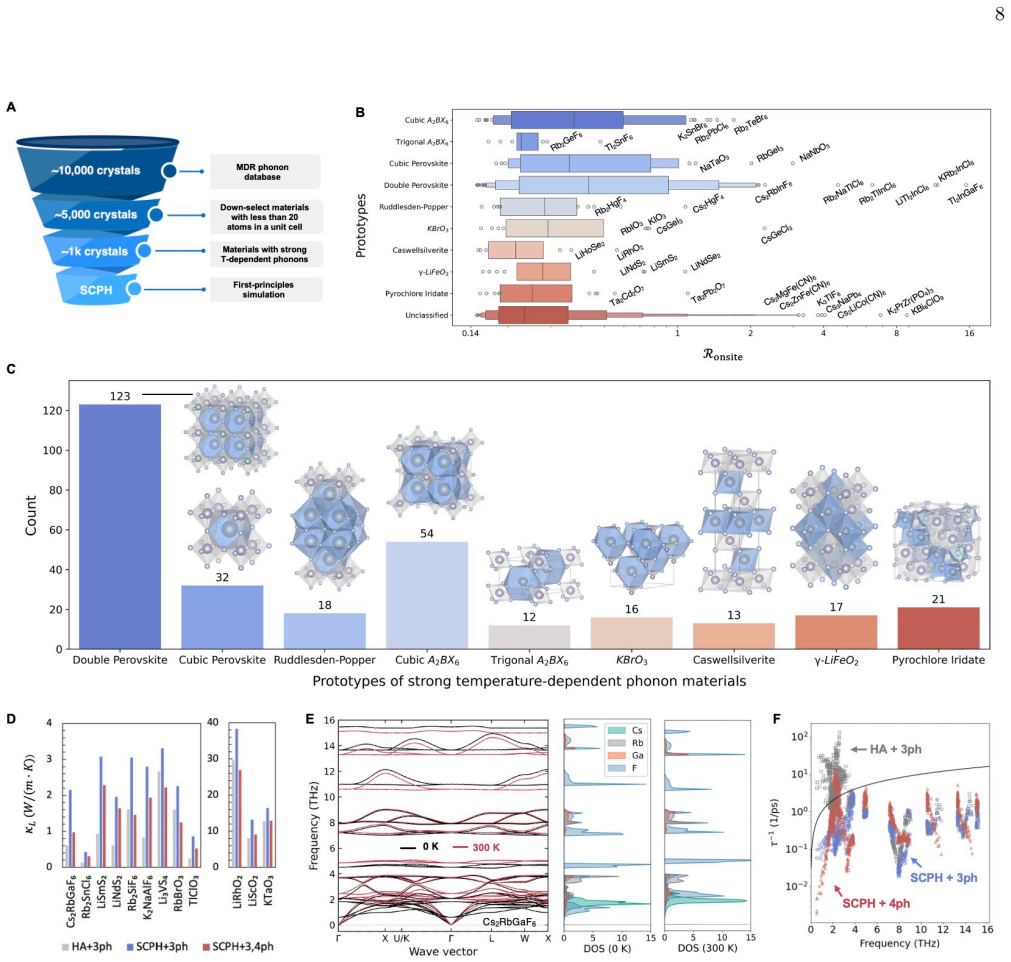
- First-principles checks on twelve materials show that ignoring anharmonic renormalization can change predicted lattice thermal conductivity by factors of two to four, implying that harmonic-only database predictions for strongly anharmonic compounds are unreliable.
- Because the streamlined SSCHA produces auxiliary phonons that still match measured trends, the same pipeline can be extended to phonon linewidths, broader temperatures, and full self-consistency when higher accuracy is needed.
Where Pith is reading between the lines
- The paper leaves untested whether fine-tuning on harmonic data alone repairs anharmonicity in general, since only twelve compounds receive direct DFT/SCPH validation. A decisive extension would run the same single-shot SSCHA with other universal potentials and compare the distribution of R_onsite across all 4,669 compounds.
- The R_onsite heatmap could serve as an 'anharmonicity map' of the periodic table for materials design, but the paper stops at qualitative trends; converting it into a quantitative predictive descriptor would require propagating uncertainties from the potential into the force-constant ratios.
- Because R_onsite measures force-constant changes rather than observable frequency shifts, some flagged materials may show weak phonon renormalization; pairing the metric with mode-resolved frequency shifts would sharpen screening.
- The Cs2RbGaF6 case shows that four-phonon scattering can offset the three-phonon enhancement of thermal conductivity, implying that screening on APRN shifts alone may mispredict transport; coupling screening with higher-order scattering estimates would make thermal-conductivity predictions more reliable.
Editorial analysis
A structured set of objections, weighed in public.
Referee Report
Summary. The manuscript describes a high-throughput workflow for temperature-dependent phonon renormalization (APRN) in inorganic materials. The authors fine-tune the M3GNet machine-learning interatomic potential on displacement–force data generated from harmonic force constants in the MDR phonon database, then use a streamlined, single-shot stochastic self-consistent harmonic approximation (SSCHA) to compute 300 K renormalized force constants for 4,669 compounds. From this dataset they extract elemental and structural trends, train random-forest models to predict APRN from composition and local-structure features, and perform first-principles SCPH validation on 12 strongly anharmonic materials, including lattice thermal conductivity calculations. The paper claims a fourfold improvement in harmonic phonon prediction accuracy and a new capability to screen temperature-dependent phonon behavior across thousands of materials.
Significance. If the central transferability assumption is validated, the work would provide a valuable screening resource: a large APRN dataset, element/space-group trends, and ML-interpretability-derived descriptors for strongly anharmonic materials. The authors are commendably explicit about the single-shot nature of their SSCHA implementation and about the auxiliary-phonon interpretation. The 12-material SCPH validation and the SrTiO3 test are useful proof-of-concept exercises, and the commitment to release codes, data, and models is a strength. However, the screening claims and downstream trends rest on an anharmonic-transferability premise that is asserted rather than demonstrated, and the current validation strategy does not directly test the ML model's APRN predictions on a representative sample. The manuscript is therefore not yet at the level of a standard accept; the main claims are defensible but need additional load-bearing evidence.
major comments (1)
- [§II.A and §IV.A] The fine-tuning and the screening population both come from the same MDR database, making the harmonic baseline partly self-referential. The reported fourfold MAE reduction and the 0.28 THz accuracy are computed on a test set derived from the same harmonic force-constant database used for training, but with no demonstration that the improvement transfers to independent DFT phonon calculations for a broad set of materials. Please clarify whether the train/test split is by compound or by configuration, and provide an out-of-distribution validation on a small independent DFT-phonon set not used in fine-tuning.
minor comments (5)
- [§IV.B] Please specify whether the random train/test split is at the compound level or the configuration level. If configurations of the same compound appear in both training and test sets, the reported force MAE and phonon MAE may be optimistic.
- [Eq. (4)] R_onsite is defined with an absolute value, so the sign of the APRN shift (hardening vs. softening) is not retained. The heatmap in Fig. 3A therefore mixes positive and negative shifts; the authors should state whether the sign is analyzed anywhere, and whether the interpretation changes if signed ratios are used.
- [Fig. 3B / §II.C] The text first lists space groups 128, 107, 221, 87, and 225 as strongly anharmonic, then later refers to space groups 221 and 255 for perovskite structures. Please reconcile whether 255 or 225 is intended, and ensure the space-group numbering is consistent throughout.
- [§II.A] There is a typo: 'Perdew-Burke-Ernzerhof exchange-correlation functiional' should read 'functional.' Also, in the Fig. 4F caption, 'Mott-loffe-Regel' should be 'Mott-Ioffe-Regel.'
- [§IV.A] The statement that 'codes, data sets, and machine learning models will be made available via public repository upon acceptance' is appreciated, but for a data-driven manuscript of this type, providing a reviewer-accessible repository or at least a detailed data/feature table for the RF models would aid reproducibility.
Circularity Check
No significant circularity: APRN values are model outputs with independent DFT/experimental benchmarks, not fits to the reported trends.
full rationale
The derivation chain is not circular. Harmonic fine-tuning targets are displacement-force data generated from MDR harmonic IFCs (Methods IV.A), but the APRN values are not fit to those targets; they are obtained by evaluating the fine-tuned potential at SSCHA-displaced configurations (Eqs. 1-2) and comparing force constants before and after renormalization (Eqs. 3-4). The claimed accuracy improvement is measured on a held-out 5% split (Methods IV.A), so it is a genuine predictive benchmark rather than a fit renamed as prediction. The SrTiO3 comparison uses experimental data, and the 12-material lattice thermal conductivity study is carried out with independent DFT/SCPH calculations (Methods IV.C), providing external benchmarks. The random-forest feature-importance results are learned from the screening model's own R_full/R_onsite outputs; this makes them descriptive of the model/data pipeline rather than independent physical measurements, but it is not circular because the target variables are not composed of the input features. The statement that fine-tuning 'implicitly adjusts anharmonic components' is explicitly flagged as a posit (Section II.A) and is a validation-coverage limitation, not a circular reduction. Self-citations [21,79] are code/method citations for SCPH and 3/4-phonon calculations, not load-bearing uniqueness or ansatz assumptions.
Axiom & Free-Parameter Ledger
free parameters (5)
- Fine-tuned M3GNet model weights =
force MAE 0.0269 eV/Å
- R_onsite screening threshold =
0.15
- Random forest outlier filters =
20% phonon error; 40% APRN frequency change
- Fine-tuning displacement amplitude =
0.01–0.05 Å
- Box-Cox lambda for R_onsite =
0.074
axioms (7)
- standard math Born-Oppenheimer potential energy surface and phonon quasiparticle picture
- standard math Gibbs-Bogoliubov variational principle underlying SSCHA
- domain assumption MDR phonon database is an accurate ground truth for harmonic IFCs
- domain assumption Pre-trained M3GNet provides a reasonable universal PES
- ad hoc to paper Single-shot (non-self-consistent) SSCHA is sufficient for semiquantitative APRN
- ad hoc to paper Fine-tuning on harmonic-only data implicitly corrects anharmonic components of the PES
- domain assumption Auxiliary SSCHA phonons correspond to experimental phonon dispersions
read the original abstract
Phonons, quantized vibrations of the atomic lattice, are fundamental to understanding thermal transport, structural stability, and phase behavior in crystalline solids. Despite advances in computational materials science, most predictions of vibrational properties in large materials databases rely on the harmonic approximation and overlook crucial temperature-dependent anharmonic effects. Here, we present a scalable computational framework that combines machine learning interatomic potentials, anharmonic lattice dynamics, and high-throughput calculations to investigate temperature-dependent phonons across thousands of materials. By fine-tuning the universal M3GNet interatomic potential using high-quality phonon data, we improve phonon prediction accuracy by a factor of four while preserving computational efficiency. Integrating this refined model into a high-throughput implementation of the stochastic self-consistent harmonic approximation, we compute temperature-dependent phonons for 4,669 inorganic compounds. Our analysis identifies systematic elemental and structural trends governing anharmonic phonon renormalization, with particularly strong manifestations in alkali metals, perovskite-derived frameworks, and related systems. Machine learning models trained on this dataset identify key atomic-scale features driving strong anharmonicity, including weak bonding, large atomic radii, and specific coordination motifs. First-principles validation confirms that anharmonic effects can dramatically alter lattice thermal conductivity by factors of two to four in some materials. This work establishes a robust and efficient data-driven approach for predicting finite-temperature phonon behavior, offering new pathways for the design and discovery of materials with tailored thermal and vibrational properties.
Figures


Reference graph
Works this paper leans on
-
[1]
N. W. Ashcroft and N. D. Mermin, Solid state, Physics (New York: Holt, Rinehart and Winston) Appendix C1 (1976)
1976
-
[2]
Wallace,Thermodynamics of Crystals, Dover Books on Physics (Dover Publications, 1998)
D. Wallace,Thermodynamics of Crystals, Dover Books on Physics (Dover Publications, 1998)
1998
-
[3]
Parlinski, Z
K. Parlinski, Z. Li, and Y. Kawazoe, First-principles de- termination of the soft mode in cubic zro 2, Physical Review Letters78, 4063 (1997)
1997
-
[4]
Grimvall, B
G. Grimvall, B. Magyari-K¨ ope, V. Ozoli¸ nˇ s, and K. A. Persson, Lattice instabilities in metallic elements, Re- views of Modern Physics84, 945 (2012)
2012
-
[5]
K. W. B¨ oer and U. W. Pohl, Elasticity and phonons, in Semiconductor physics(Springer, 2023) pp. 113–155
2023
-
[6]
P. B. Allen, Zero-point and isotope shifts: relation to thermal shifts, Philosophical Magazine B70, 527 (1994)
1994
-
[7]
Cowley, The lattice dynamics of an anharmonic crys- tal, Advances in Physics12, 421 (1963)
R. Cowley, The lattice dynamics of an anharmonic crys- tal, Advances in Physics12, 421 (1963)
1963
-
[8]
Monacelli, R
L. Monacelli, R. Bianco, M. Cherubini, M. Calandra, I. Errea, and F. Mauri, The stochastic self-consistent har- monic approximation: calculating vibrational properties of materials with full quantum and anharmonic effects, Journal of Physics: Condensed Matter33, 363001 (2021)
2021
-
[9]
Hellman, I
O. Hellman, I. A. Abrikosov, and S. I. Simak, Lattice dynamics of anharmonic solids from first principles, Phys. Rev. B84, 180301 (2011)
2011
-
[10]
Tadano and S
T. Tadano and S. Tsuneyuki, Self-consistent phonon cal- culations of lattice dynamical properties in cubic srtio 3 with first-principles anharmonic force constants, Phys. Rev. B92, 054301 (2015)
2015
-
[11]
Y. Xia, Revisiting lattice thermal transport in pbte: The crucial role of quartic anharmonic- ity, Applied Physics Letters113, 073901 (2018), https://doi.org/10.1063/1.5040887
-
[12]
Hohenberg and W
P. Hohenberg and W. Kohn, Inhomogeneous electron gas, Physical review136, B864 (1964)
1964
-
[13]
Kohn and L
W. Kohn and L. J. Sham, Self-consistent equations in- cluding exchange and correlation effects, Physical review 140, A1133 (1965)
1965
-
[14]
Delaire, Orbitally driven giant phonon anharmonicity in snse, Nature Physics11, 1063 (2015)
O. Delaire, Orbitally driven giant phonon anharmonicity in snse, Nature Physics11, 1063 (2015)
2015
-
[15]
J. D. Budai, J. Hong, M. E. Manley, E. D. Specht, C. W. Li, J. Z. Tischler, D. L. Abernathy, A. H. Said, B. M. Leu, L. A. Boatner,et al., Metallization of vanadium dioxide driven by large phonon entropy, Nature515, 535 (2014)
2014
-
[16]
C. Li, A. May, H. Cao, X. Chen, A. Christianson, G. Ehlers, D. Singh, B. Sales,et al., Phonon self-energy and origin of anomalous neutron scattering spectra in snte and pbte thermoelectrics, Physical review letters 112, 175501 (2014)
2014
-
[17]
Hellman, J
O. Hellman, J. Herriman, H. Smith, J. Lin, N. Shulumba, J. Niedziela, C. Li, D. Abernathy, and B. Fultz, Nuclear quantum effect with pure anharmonicity and the anoma- lous thermal expansion of silicon, Proceedings of the Na- tional Academy of Sciences115, 1992 (2018)
1992
-
[18]
Errea, F
I. Errea, F. Belli, L. Monacelli, A. Sanna, T. Koretsune, T. Tadano, R. Bianco, M. Calandra, R. Arita, F. Mauri, et al., Quantum crystal structure in the 250-kelvin super- conducting lanthanum hydride, Nature578, 66 (2020)
2020
-
[19]
K. Kim, E. Vetter, L. Yan, C. Yang, Z. Wang, R. Sun, Y. Yang, A. H. Comstock, X. Li, J. Zhou,et al., Chiral- phonon-activated spin seebeck effect, Nature Materials 22, 322 (2023)
2023
-
[20]
T. Feng, L. Lindsay, and X. Ruan, Four-phonon scatter- ing significantly reduces intrinsic thermal conductivity of solids, Phys. Rev. B96, 161201 (2017)
2017
-
[21]
Y. Xia, V. I. Hegde, K. Pal, X. Hua, D. Gaines, S. Pa- tel, J. He, M. Aykol, and C. Wolverton, High-throughput study of lattice thermal conductivity in binary rocksalt and zinc blende compounds including higher-order an- harmonicity, Phys. Rev. X10, 041029 (2020)
2020
-
[22]
Tadano and W
T. Tadano and W. A. Saidi, First-principles phonon quasiparticle theory applied to a strongly anharmonic halide perovskite, Phys. Rev. Lett.129, 185901 (2022)
2022
-
[23]
Tadano, Y
T. Tadano, Y. Gohda, and S. Tsuneyuki, Impact of rattlers on thermal conductivity of a thermoelectric clathrate: a first-principles study, Physical review letters 114, 095501 (2015)
2015
-
[24]
Y. Xia, V. Ozoli¸ nˇ s, and C. Wolverton, Microscopic mech- anisms of glasslike lattice thermal transport in cubic cu12sb4s13 tetrahedrites, Phys. Rev. Lett.125, 085901 (2020)
2020
-
[25]
Verdi, L
C. Verdi, L. Ranalli, C. Franchini, and G. Kresse, Quan- tum paraelectricity and structural phase transitions in strontium titanate beyond density functional theory, Phys. Rev. Mater.7, L030801 (2023)
2023
-
[26]
B. Peng, Y. Hu, S. Murakami, T. Zhang, and B. Mon- serrat, Topological phonons in oxide perovskites controlled by light, Science Advances6, eabd1618 (2020), https://www.science.org/doi/pdf/10.1126/sciadv.abd1618
-
[27]
L. E. Bell, Cooling, heating, generating power, and re- covering waste heat with thermoelectric systems, Science 321, 1457 (2008)
2008
-
[28]
Bianco, I
R. Bianco, I. Errea, L. Paulatto, M. Calandra, and F. Mauri, Second-order structural phase transitions, free energy curvature, and temperature-dependent anhar- monic phonons in the self-consistent harmonic approxi- mation: Theory and stochastic implementation, Physical Review B96, 014111 (2017)
2017
-
[29]
O. T. Unke, S. Chmiela, H. E. Sauceda, M. Gastegger, I. Poltavsky, K. T. Schutt, A. Tkatchenko, and K.-R. Muller, Machine learning force fields, Chemical Reviews 121, 10142 (2021). 12
2021
-
[30]
Chen and S
C. Chen and S. P. Ong, A universal graph deep learn- ing interatomic potential for the periodic table, Nature Computational Science2, 718 (2022)
2022
-
[31]
I. Batatia, P. Benner, Y. Chiang, A. M. Elena, D. P. Kov´ acs, J. Riebesell, X. R. Advincula, M. Asta, M. Avaylon, W. J. Baldwin,et al., A foundation model for atomistic materials chemistry, arXiv preprint arXiv:2401.00096 (2023)
Pith/arXiv arXiv 2023
-
[32]
B. Deng, P. Zhong, K. Jun, J. Riebesell, K. Han, C. J. Bartel, and G. Ceder, Chgnet as a pretrained universal neural network potential for charge-informed atomistic modelling, Nature Machine Intelligence5, 1031 (2023)
2023
-
[33]
Togo, Mdr phonon calculation database (2018)
A. Togo, Mdr phonon calculation database (2018)
2018
-
[34]
B. Deng, Y. Choi, P. Zhong, J. Riebesell, S. Anand, Z. Li, K. Jun, K. A. Persson, and G. Ceder, Systematic soften- ing in universal machine learning interatomic potentials, npj Computational Materials11, 1 (2025)
2025
-
[35]
J. P. Perdew, K. Burke, and M. Ernzerhof, Generalized gradient approximation made simple, Phys. Rev. Lett. 77, 3865 (1996)
1996
-
[36]
J. P. Perdew, A. Ruzsinszky, G. I. Csonka, O. A. Vydrov, G. E. Scuseria, L. A. Constantin, X. Zhou, and K. Burke, Restoring the density-gradient expansion for exchange in solids and surfaces, Phys. Rev. Lett.100, 136406 (2008)
2008
-
[37]
Stirling, Neutron inelastic scattering study of the lat- tice dynamics of strontium titanate: harmonic models, Journal of Physics C: Solid State Physics5, 2711 (1972)
W. Stirling, Neutron inelastic scattering study of the lat- tice dynamics of strontium titanate: harmonic models, Journal of Physics C: Solid State Physics5, 2711 (1972)
1972
-
[38]
Cowley, W
R. Cowley, W. Buyers, and G. Dolling, Relationship of normal modes of vibration of strontium titanate and its antiferroelectric phase transition at 110 k, Solid State Communications7, 181 (1969)
1969
-
[39]
Errea, M
I. Errea, M. Calandra, and F. Mauri, Anharmonic free energies and phonon dispersions from the stochastic self- consistent harmonic approximation: Application to plat- inum and palladium hydrides, Phys. Rev. B89, 064302 (2014)
2014
-
[40]
van Roekeghem, J
A. van Roekeghem, J. Carrete, and N. Mingo, Anomalous thermal conductivity and suppression of negative thermal expansion in scf 3, Phys. Rev. B94, 020303 (2016)
2016
-
[41]
Hedin, New method for calculating the one-particle green’s function with application to the electron-gas problem, Physical Review139, A796 (1965)
L. Hedin, New method for calculating the one-particle green’s function with application to the electron-gas problem, Physical Review139, A796 (1965)
1965
-
[42]
M. S. Hybertsen and S. G. Louie, Electron correlation in semiconductors and insulators: Band gaps and quasipar- ticle energies, Physical Review B34, 5390 (1986)
1986
-
[43]
Mahan, Many-body physics (2000)
G. Mahan, Many-body physics (2000)
2000
-
[44]
D. B. Straus, S. Guo, A. M. Abeykoon, and R. J. Cava, Understanding the instability of the halide perovskite cspbi3 through temperature-dependent structural anal- ysis, Advanced Materials32, 2001069 (2020)
2020
-
[45]
Lav´ en, E
R. Lav´ en, E. Fransson, P. Erhart, F. Juranyi, G. E. Granroth, and M. Karlsson, Unraveling the nature of vi- brational dynamics in cspbi3 by inelastic neutron scat- tering and molecular dynamics simulations, The Journal of Physical Chemistry Letters16, 4812 (2025)
2025
-
[46]
Mukhopadhyay, D
S. Mukhopadhyay, D. S. Parker, B. C. Sales, A. A. Puret- zky, M. A. McGuire, and L. Lindsay, Two-channel model for ultralow thermal conductivity of crystalline tl3vse4, Science360, 1455 (2018)
2018
-
[47]
Z. Zeng, X. Shen, R. Cheng, O. Perez, N. Ouyang, Z. Fan, P. Lemoine, B. Raveau, E. Guilmeau, and Y. Chen, Push- ing thermal conductivity to its lower limit in crystals with simple structures, Nature Communications15, 3007 (2024)
2024
-
[48]
Y. Xia, K. Pal, J. He, V. Ozoli¸ nˇ s, and C. Wolverton, Par- ticlelike phonon propagation dominates ultralow lattice thermal conductivity in crystalline tl 3vse4, Phys. Rev. Lett.124, 065901 (2020)
2020
-
[49]
Dutta, S
M. Dutta, S. Matteppanavar, M. V. Prasad, J. Pandey, A. Warankar, P. Mandal, A. Soni, U. V. Waghmare, and K. Biswas, Ultralow thermal conductivity in chain-like tlse due to inherent tl+ rattling, Journal of the American Chemical Society141, 20293 (2019)
2019
-
[50]
K. Pal, Y. Xia, and C. Wolverton, Microscopic mecha- nism of unusual lattice thermal transport in tlinte2, npj Computational Materials7, 5 (2021)
2021
-
[51]
M. K. Jana, K. Pal, A. Warankar, P. Mandal, U. V. Waghmare, and K. Biswas, Intrinsic rattler-induced low thermal conductivity in zintl type tlinte2, Journal of the American Chemical Society139, 4350 (2017)
2017
-
[52]
Errea, M
I. Errea, M. Calandra, and F. Mauri, Anharmonic free energies and phonon dispersions from the stochastic self- consistent harmonic approximation: Application to plat- inum and palladium hydrides, Physical Review B89, 064302 (2014)
2014
-
[53]
Ceriotti, W
M. Ceriotti, W. Fang, P. G. Kusalik, R. H. McKenzie, A. Michaelides, M. A. Morales, and T. E. Markland, Nu- clear quantum effects in water and aqueous systems: Ex- periment, theory, and current challenges, Chemical re- views116, 7529 (2016)
2016
-
[54]
E. L. Da Silva, J. M. Skelton, S. C. Parker, and A. Walsh, Phase stability and transformations in the halide per- ovskite cssni 3, Physical Review B91, 144107 (2015)
2015
-
[55]
R. X. Yang, J. M. Skelton, E. L. da Silva, J. M. Frost, and A. Walsh, Spontaneous octahedral tilting in the cubic inorganic cesium halide perovskites cssnx3 and cspbx3 (x = f, cl, br, i), The Journal of Physical Chemistry Letters 8, 4720 (2017)
2017
-
[56]
A. E. Hoffman, R. A. Saha, S. Borgmans, P. Puech, T. Braeckevelt, M. B. Roeffaers, J. A. Steele, J. Hofkens, and V. Van Speybroeck, Understanding the phase tran- sition mechanism in the lead halide perovskite cspbbr3 via theoretical and experimental giwaxs and raman spec- troscopy, Apl Materials11(2023)
2023
-
[57]
Klarbring, O
J. Klarbring, O. Hellman, I. A. Abrikosov, and S. I. Simak, Anharmonicity and ultralow thermal conductiv- ity in lead-free halide double perovskites, Physical review letters125, 045701 (2020)
2020
-
[58]
L. Ward, A. Dunn, A. Faghaninia, N. E. Zimmermann, S. Bajaj, Q. Wang, J. Montoya, J. Chen, K. Bystrom, M. Dylla,et al., Matminer: An open source toolkit for materials data mining, Computational Materials Science 152, 60 (2018)
2018
-
[59]
M. J. Mehl, D. Hicks, C. Toher, O. Levy, R. M. Hanson, G. Hart, and S. Curtarolo, The aflow library of crystal- lographic prototypes: part 1, Computational Materials Science136, S1 (2017)
2017
-
[60]
Hicks, M
D. Hicks, M. J. Mehl, E. Gossett, C. Toher, O. Levy, R. M. Hanson, G. Hart, and S. Curtarolo, The aflow li- brary of crystallographic prototypes: part 2, Computa- tional Materials Science161, S1 (2019)
2019
-
[61]
Hicks, M
D. Hicks, M. J. Mehl, M. Esters, C. Oses, O. Levy, G. L. Hart, C. Toher, and S. Curtarolo, The aflow library of crystallographic prototypes: part 3, Computational Ma- terials Science199, 110450 (2021)
2021
-
[62]
Eckert, S
H. Eckert, S. Divilov, M. J. Mehl, D. Hicks, A. C. Zettel, M. Esters, X. Campilongo, and S. Curtarolo, The aflow library of crystallographic prototypes: Part 4, Computa- 13 tional Materials Science240, 112988 (2024)
2024
-
[63]
S.-P. Guo, Z. Ma, J.-C. Li, and H.-G. Xue, First inves- tigation of the electrochemical performance ofγ-lifeo 2 micro-cubes as promising anode material for lithium-ion batteries, Journal of Materials Science52, 1469 (2017)
2017
-
[64]
A. Jain, S. P. Ong, G. Hautier, W. Chen, W. D. Richards, S. Dacek, S. Cholia, D. Gunter, D. Skinner, G. Ceder, et al., Commentary: The materials project: A materials genome approach to accelerating materials innovation, APL materials1(2013)
2013
-
[65]
Jong, C.-J
U.-G. Jong, C.-J. Yu, Y.-H. Kye, S.-H. Choe, J.-S. Kim, and Y.-G. Choe, Anharmonic phonons and phase transi- tions in the vacancy-ordered double perovskite cs 2 sni 6 from first-principles predictions, Physical Review B99, 184105 (2019)
2019
-
[66]
Bhumla, M
P. Bhumla, M. Jain, S. Sheoran, and S. Bhattacharya, Vacancy-ordered double perovskites cs2bi6 (b= pt, pd, te, sn): an emerging class of thermoelectric materials, The Journal of Physical Chemistry Letters13, 11655 (2022)
2022
-
[67]
K. Ueda, R. Kaneko, A. Subedi, M. Minola, B. Kim, J. Fujioka, Y. Tokura, and B. Keimer, Phonon anoma- lies in pyrochlore iridates studied by raman spectroscopy, Physical Review B100, 115157 (2019)
2019
-
[68]
Kumar, V
H. Kumar, V. Sathe, and A. Pramanik, Spin–phonon and electron–phonon coupling in pyrochlore iridates (y1–x pr x) 2ir2o7: An investigation with raman spectroscopy, The Journal of Physical Chemistry C127, 13178 (2023)
2023
-
[69]
Kresse and J
G. Kresse and J. Hafner,Ab initiomolecular dynamics for liquid metals, Phys. Rev. B47, 558 (1993)
1993
-
[70]
Kresse and J
G. Kresse and J. Hafner,Ab initiomolecular-dynamics simulation of the liquid-metal˘amorphous-semiconductor transition in germanium, Phys. Rev. B49, 14251 (1994)
1994
-
[71]
Kresse and J
G. Kresse and J. Furthm¨ uller, Comput. Mater. Sci.6, 15 (1996)
1996
-
[72]
Kresse and J
G. Kresse and J. Furthm¨ uller, Efficient iterative schemes forab initiototal-energy calculations using a plane-wave basis set, Phys. Rev. B54, 11169 (1996)
1996
-
[73]
P. E. Bl¨ ochl, Projector augmented-wave method, Phys. Rev. B50, 17953 (1994)
1994
-
[74]
J. P. Perdew, K. Burke, and Y. Wang, Generalized gra- dient approximation for the exchange-correlation hole of a many-electron system, Phys. Rev. B54, 16533 (1996)
1996
-
[75]
Hohenberg and W
P. Hohenberg and W. Kohn, Inhomogeneous electron gas, Phys. Rev.136, B864 (1964)
1964
-
[76]
Togo and I
A. Togo and I. Tanaka, First principles phonon calcu- lations in materials science, Scripta Materialia108, 1 (2015)
2015
-
[77]
F. Zhou, W. Nielson, Y. Xia, and V. Ozoli¸ nˇ s, Lattice an- harmonicity and thermal conductivity from compressive sensing of first-principles calculations, Phys. Rev. Lett. 113, 185501 (2014)
2014
-
[78]
F. Zhou, W. Nielson, Y. Xia, and V. Ozolins, Compres- sive sensing lattice dynamics. i. general formalism, Phys. Rev. B100, 184308 (2019)
2019
-
[79]
Xia, Revisiting lattice thermal transport in pbte: The crucial role of quartic anharmonicity, Applied Physics Letters113(2018)
Y. Xia, Revisiting lattice thermal transport in pbte: The crucial role of quartic anharmonicity, Applied Physics Letters113(2018)
2018
discussion (0)
Sign in with ORCID, Apple, or X to comment. Anyone can read and Pith papers without signing in.