Recognition: 2 theorem links
· Lean TheoremA Robust Launching Mechanism for Freely-Floating Planets from Host Stars with Close-in Planets
Pith reviewed 2026-05-16 13:59 UTC · model grok-4.3
The pith
Gravitational scattering between cold planets and close-in super-Earths can eject some planets into interstellar space.
A machine-rendered reading of the paper's core claim, the machinery that carries it, and where it could break.
Core claim
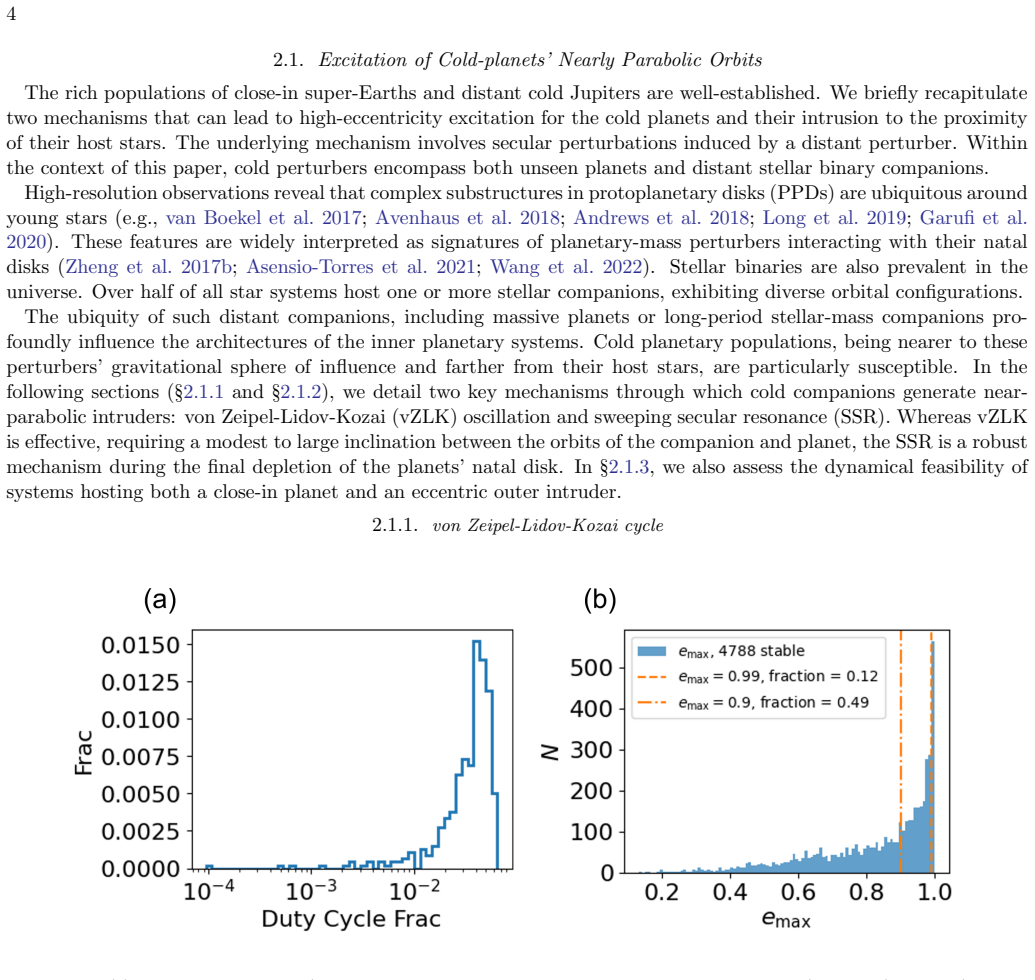
Secular perturbations from binary stars or distant massive planets drive cold planets onto nearly parabolic orbits with pericenter passages extremely close to their host stars. Gravitational scattering between these intruders and the frequently observed short-period super-Earths produces substantial orbital energy exchange, liberating some of the cold planets from their host systems and thereby providing a robust formation channel for a subset of the free-floating planet population.
What carries the argument
Gravitational scattering between cold planets on nearly parabolic orbits and inner short-period super-Earths, which exchanges orbital energy to unbind the cold planets.
If this is right
- The original orbits of close-in planets can be significantly perturbed by the encounters.
- Some close-in planets may be driven onto collisional trajectories with their host stars.
- The dynamical evolution of cold planets toward close stellar encounters can be disrupted.
Where Pith is reading between the lines
- The mechanism predicts that free-floating planets should be more common around stars that once hosted both close-in super-Earths and outer planets.
- Remaining close-in planets in such systems may show a wider range of orbital eccentricities and inclinations than in systems without outer planets.
Load-bearing premise
Secular perturbations must reliably place cold planets on orbits that reach pericenters close enough to the star for strong scattering with inner super-Earths before other processes eject or destroy them.
What would settle it
N-body simulations of realistic multi-planet systems that include both close-in super-Earths and outer cold planets showing an ejection fraction too small to explain observed free-floating planet numbers would falsify the mechanism.
Figures



read the original abstract
Secular perturbations from binary stars and distant massive planets can drive cold planets onto nearly parabolic orbits with pericenter passages extremely close to their host stars. Meanwhile, short-period super-Earths are frequently observed around nearby stars. Gravitational scattering between these two distinct populations can lead to substantial orbital energy exchange, liberating some intruders from the gravitational confinement of their host systems. This process offers a robust formation channel for a subset of the abundant freely floating planet population. It may also significantly perturb the original orbits of close-in planets, induce collisional trajectories between close-in planets and their host stars, and disrupt the dynamical evolution of cold planets toward close stellar encounters.
Editorial analysis
A structured set of objections, weighed in public.
Referee Report
Summary. The manuscript proposes that secular perturbations from binary stars or distant massive planets drive outer cold planets onto nearly parabolic orbits with pericenters close enough to the star for strong gravitational scattering with inner short-period super-Earths. This scattering exchanges orbital energy and ejects some outer planets as freely floating planets, offering a robust formation channel for a subset of the observed FFP population. The process may also perturb close-in planet orbits, induce star-grazing trajectories, and disrupt cold-planet evolution.
Significance. If the efficiency can be shown to be non-negligible across realistic system parameters, the mechanism would provide a new dynamical channel linking inner and outer planet populations and help account for the abundance of free-floating planets. It also predicts observable consequences for the survival and orbital evolution of close-in super-Earths in systems with outer perturbers.
major comments (2)
- [Abstract and §3] Abstract and §3: The claim that the process 'offers a robust formation channel' rests on the unquantified assumption that secular forcing produces pericenter distances ≲0.1 AU on timescales shorter than competing removal channels (binary ejection, stellar encounters, or inner-planet instability). No N-body integrations, analytic timescale comparisons, or ejection-fraction estimates are supplied to support this.
- [§4] §4 (Scattering outcomes): The manuscript does not demonstrate that the inner super-Earth population survives long enough for the scattering to occur; the same secular forcing or the intruder itself could destabilize the close-in planets before ejection of the outer body is realized.
minor comments (2)
- The introduction would benefit from explicit comparison to existing FFP formation channels (planet-planet scattering, stellar flybys) with quantitative estimates of relative contributions.
- Notation for 'cold planets' versus 'intruders' should be defined once at first use and used consistently.
Simulated Author's Rebuttal
We thank the referee for their careful reading and constructive comments, which have helped us clarify the scope and limitations of our proposed mechanism. We address each major comment below and have revised the manuscript to incorporate additional analytic support and discussion where feasible.
read point-by-point responses
-
Referee: [Abstract and §3] Abstract and §3: The claim that the process 'offers a robust formation channel' rests on the unquantified assumption that secular forcing produces pericenter distances ≲0.1 AU on timescales shorter than competing removal channels (binary ejection, stellar encounters, or inner-planet instability). No N-body integrations, analytic timescale comparisons, or ejection-fraction estimates are supplied to support this.
Authors: We acknowledge that the original manuscript presented the robustness claim largely on qualitative grounds. In the revised version we have added a new subsection in §3 that supplies analytic timescale comparisons using the standard linear secular theory for hierarchical triples. For representative binary parameters (e.g., 0.5 M⊙ companion at 100–500 AU) and distant-planet perturbers (1–5 M_Jup at 10–50 AU), the secular forcing drives pericenter distances below 0.1 AU on timescales of 10^6–10^8 yr. These intervals are shorter than typical binary-disruption or stellar-encounter timescales in the field and in moderate-density clusters. We also include an order-of-magnitude estimate of the ejection fraction based on the geometric scattering cross-section between the intruder and the inner super-Earth population. Full N-body integrations remain outside the present scope but are noted as desirable follow-up work. revision: yes
-
Referee: [§4] §4 (Scattering outcomes): The manuscript does not demonstrate that the inner super-Earth population survives long enough for the scattering to occur; the same secular forcing or the intruder itself could destabilize the close-in planets before ejection of the outer body is realized.
Authors: This is a legitimate dynamical concern. The revised §4 now contains an explicit stability analysis showing that the secular forcing amplitude on the inner super-Earths is suppressed by a factor of (a_inner/a_outer)^2 relative to the outer body, rendering their orbits essentially unperturbed on the secular timescale. In addition, the scattering event itself is impulsive (a single close encounter lasting ≪ orbital period of the inner planets), so there is insufficient time for cumulative destabilization. We have added a short paragraph quantifying the survival probability of the inner population under these conditions and noting that any residual perturbations are expected to be modest. revision: yes
Circularity Check
No circularity: mechanism applies known secular and scattering physics without self-referential reduction
full rationale
The paper frames its central claim as an application of established secular perturbation theory (Kozai-Lidov or similar) driving outer planets to high-eccentricity orbits, followed by gravitational scattering with inner super-Earths. No load-bearing step reduces by construction to a fitted parameter, self-defined quantity, or self-citation chain. The abstract and described derivation invoke standard dynamical processes without renaming known results or smuggling ansatzes via prior work by the same authors. The derivation chain remains externally falsifiable against N-body simulations and observed exoplanet statistics, qualifying as self-contained.
Axiom & Free-Parameter Ledger
Lean theorems connected to this paper
-
IndisputableMonolith/Foundation/AbsoluteFloorClosure.lean (distinction forcing)reality_from_one_distinction unclear?
unclearRelation between the paper passage and the cited Recognition theorem.
Numerical integrations... KozaiPy... REBOUND IAS15... ejection fraction f_eje (Figs. 4-7)
What do these tags mean?
- matches
- The paper's claim is directly supported by a theorem in the formal canon.
- supports
- The theorem supports part of the paper's argument, but the paper may add assumptions or extra steps.
- extends
- The paper goes beyond the formal theorem; the theorem is a base layer rather than the whole result.
- uses
- The paper appears to rely on the theorem as machinery.
- contradicts
- The paper's claim conflicts with a theorem or certificate in the canon.
- unclear
- Pith found a possible connection, but the passage is too broad, indirect, or ambiguous to say the theorem truly supports the claim.
Reference graph
Works this paper leans on
-
[1]
Adams, F. C., Anderson, K. R., & Bloch, A. M. 2013, MNRAS, 432, 438, doi: 10.1093/mnras/stt479
-
[2]
Andrews, S. M., Huang, J., P´ erez, L. M., et al. 2018, ApJL, 869, L41, doi: 10.3847/2041-8213/aaf741
work page internal anchor Pith review doi:10.3847/2041-8213/aaf741 2018
-
[3]
2021, A&A, 652, A101, doi: 10.1051/0004-6361/202140325
Asensio-Torres, R., Henning, T., Cantalloube, F., et al. 2021, A&A, 652, A101, doi: 10.1051/0004-6361/202140325
-
[4]
Avenhaus, H., Quanz, S. P., Garufi, A., et al. 2018, ApJ, 863, 44, doi: 10.3847/1538-4357/aab846
-
[5]
A., Ferich, N., Tamayo, D., & Steffen, J
Baronett, S. A., Ferich, N., Tamayo, D., & Steffen, J. H. 2022, Monthly Notices of the Royal Astronomical Society, 510, 6001, doi: 10.1093/mnras/stac043 Barrado y Navascu´ es, D., Zapatero Osorio, M. R., B´ ejar, V., et al. 2002, in The Origin of Stars and Planets: The VLT View, ed. J. F. Alves & M. J. McCaughrean, 195, doi: 10.1007/10856518 24 B´ ejar, V...
-
[6]
Bhaskar, H., Li, G., Hadden, S., Payne, M. J., & Holman, M. J. 2021, AJ, 161, 48, doi: 10.3847/1538-3881/abcbfc
-
[7]
Bryan, M. L., Knutson, H. A., Lee, E. J., et al. 2019, AJ, 157, 52, doi: 10.3847/1538-3881/aaf57f
-
[8]
Clanton, C., & Gaudi, B. S. 2014, ApJ, 791, 91, doi: 10.1088/0004-637X/791/2/91
-
[9]
Coleman, G. A. L., & DeRocco, W. 2025, MNRAS, 537, 2303, doi: 10.1093/mnras/staf138
-
[10]
Coleman, G. A. L., Nelson, R. P., & Triaud, A. H. M. J. 2023, MNRAS, 522, 4352, doi: 10.1093/mnras/stad833
-
[11]
2024, AJ, 168, 239, doi: 10.3847/1538-3881/ad83a6
Dai, F., Goldberg, M., Batygin, K., et al. 2024, AJ, 168, 239, doi: 10.3847/1538-3881/ad83a6
-
[12]
2013, ApJ, 778, 53, doi: 10.1088/0004-637X/778/1/53
Dong, S., & Zhu, Z. 2013, ApJ, 778, 53, doi: 10.1088/0004-637X/778/1/53
-
[13]
Eggleton, P. P., Kiseleva, L. G., & Hut, P. 1998, ApJ, 499, 853, doi: 10.1086/305670
-
[14]
1985, in Astrophysics and Space Science
Everhart, E. 1985, in Astrophysics and Space Science
work page 1985
-
[15]
Library, Vol. 115, IAU Colloq. 83: Dynamics of Comets: Their Origin and Evolution, ed. A. Carusi & G. B. Valsecchi, 185, doi: 10.1007/978-94-009-5400-7 17
-
[16]
2007, ApJ, 669, 1298, doi: 10.1086/521702
Fabrycky, D., & Tremaine, S. 2007, ApJ, 669, 1298, doi: 10.1086/521702
-
[17]
Fabrycky, D. C., Lissauer, J. J., Ragozzine, D., et al. 2014, ApJ, 790, 146, doi: 10.1088/0004-637X/790/2/146
-
[18]
2016, A&A, 594, A63, doi: 10.1051/0004-6361/201527828
Galicher, R., Marois, C., Macintosh, B., et al. 2016, A&A, 594, A63, doi: 10.1051/0004-6361/201527828
-
[19]
2024, ApJ, 967, 74, doi: 10.3847/1538-4357/ad3deb
Gan, T., Guo, K., Liu, B., et al. 2024, ApJ, 967, 74, doi: 10.3847/1538-4357/ad3deb
-
[20]
Gan, T., Wang, S. X., Wang, S., et al. 2023, AJ, 165, 17, doi: 10.3847/1538-3881/ac9b12
-
[21]
2020, A&A, 633, A82, doi: 10.1051/0004-6361/201936946 Gonz´ alez Hern´ andez, J
Garufi, A., Avenhaus, H., P´ erez, S., et al. 2020, A&A, 633, A82, doi: 10.1051/0004-6361/201936946 Gonz´ alez Hern´ andez, J. I., Delgado-Mena, E., Sousa, S. G., et al. 2013, A&A, 552, A6, doi: 10.1051/0004-6361/201220165
-
[22]
Gould, A., Dong, S., Gaudi, B. S., et al. 2010, ApJ, 720, 1073, doi: 10.1088/0004-637X/720/2/1073
-
[23]
Gould, A., Jung, Y. K., Hwang, K.-H., et al. 2022, Journal of Korean Astronomical Society, 55, 173, doi: 10.5303/JKAS.2022.55.5.173
-
[24]
Gu, P.-G., Lin, D. N. C., & Bodenheimer, P. H. 2003, ApJ, 588, 509, doi: 10.1086/373920 25
-
[25]
2025, arXiv e-prints, arXiv:2511.03246, doi: 10.48550/arXiv.2511.03246
Guo, K., Ida, S., & Ogihara, M. 2025, arXiv e-prints, arXiv:2511.03246, doi: 10.48550/arXiv.2511.03246
-
[26]
Howard, A. W., Marcy, G. W., Johnson, J. A., et al. 2010, Science, 330, 653, doi: 10.1126/science.1194854
-
[27]
Howard, A. W., Marcy, G. W., Bryson, S. T., et al. 2012, ApJS, 201, 15, doi: 10.1088/0067-0049/201/2/15
-
[28]
Ida, S., & Lin, D. N. C. 2004, ApJ, 604, 388, doi: 10.1086/381724
-
[29]
Ida, S., Lin, D. N. C., & Nagasawa, M. 2013, ApJ, 775, 42, doi: 10.1088/0004-637X/775/1/42
-
[30]
1962, AJ, 67, 591, doi: 10.1086/108790
Kozai, Y. 1962, AJ, 67, 591, doi: 10.1086/108790
-
[31]
Lidov, M. L. 1962, Planet. Space Sci., 9, 719, doi: 10.1016/0032-0633(62)90129-0
-
[32]
Lin, D. N. C., Bodenheimer, P., & Richardson, D. C. 1996, Nature, 380, 606, doi: 10.1038/380606a0
-
[33]
Lin, D. N. C., & Ida, S. 1997, ApJ, 477, 781, doi: 10.1086/303738
-
[34]
2014, MNRAS, 442, L51, doi: 10.1093/mnrasl/slu055
Liu, F., Asplund, M., Ramirez, I., Yong, D., & Melendez, J. 2014, MNRAS, 442, L51, doi: 10.1093/mnrasl/slu055
-
[35]
Liu, S.-F., Agnor, C. B., Lin, D. N. C., & Li, S.-L. 2015, MNRAS, 446, 1685, doi: 10.1093/mnras/stu2205
-
[36]
Liu, S.-F., Guillochon, J., Lin, D. N. C., & Ramirez-Ruiz, E. 2013, ApJ, 762, 37, doi: 10.1088/0004-637X/762/1/37
-
[37]
2019, Nature, 572, 355, doi: 10.1038/s41586-019-1470-2
Liu, S.-F., Hori, Y., M¨ uller, S., et al. 2019, Nature, 572, 355, doi: 10.1038/s41586-019-1470-2
-
[38]
Long, F., Herczeg, G. J., Harsono, D., et al. 2019, ApJ, 882, 49, doi: 10.3847/1538-4357/ab2d2d
-
[39]
Lucas, P. W., & Roche, P. F. 2000, MNRAS, 314, 858, doi: 10.1046/j.1365-8711.2000.03515.x
-
[40]
Luhman, K. L. 2012, ARA&A, 50, 65, doi: 10.1146/annurev-astro-081811-125528
-
[41]
Ma, S., Mao, S., Ida, S., Zhu, W., & Lin, D. N. C. 2016, MNRAS, 461, L107, doi: 10.1093/mnrasl/slw110
- [42]
-
[43]
2013, ApJ, 767, 129, doi: 10.1088/0004-637X/767/2/129
Matsumura, S., Ida, S., & Nagasawa, M. 2013, ApJ, 767, 129, doi: 10.1088/0004-637X/767/2/129
-
[44]
2010, in Exoplanets Rising: Astronomy and Planetary Science at the Crossroads, 4
Mayor, M. 2010, in Exoplanets Rising: Astronomy and Planetary Science at the Crossroads, 4
work page 2010
-
[45]
2009, A&A, 493, 639, doi: 10.1051/0004-6361:200810451
Mayor, M., Udry, S., Lovis, C., et al. 2009, A&A, 493, 639, doi: 10.1051/0004-6361:200810451
-
[46]
Montet, B. T., Crepp, J. R., Johnson, J. A., Howard, A. W., & Marcy, G. W. 2014, ApJ, 781, 28, doi: 10.1088/0004-637X/781/1/28 Mr´ oz, P., Poleski, R., Gould, A., et al. 2020, ApJL, 903, L11, doi: 10.3847/2041-8213/abbfad Mr´ oz, P., Udalski, A., Skowron, J., et al. 2017, Nature, 548, 183, doi: 10.1038/nature23276
-
[47]
Murray, C. D., & Dermott, S. F. 1999, Solar System Dynamics, doi: 10.1017/CBO9781139174817
-
[48]
2000, AJ, 120, 3311, doi: 10.1086/316856 —
Nagasawa, M., & Ida, S. 2000, AJ, 120, 3311, doi: 10.1086/316856 —. 2011, ApJ, 742, 72, doi: 10.1088/0004-637X/742/2/72
-
[49]
2008, ApJ, 678, 498, doi: 10.1086/529369
Nagasawa, M., Ida, S., & Bessho, T. 2008, ApJ, 678, 498, doi: 10.1086/529369
-
[50]
Nagasawa, M., & Lin, D. N. C. 2005, ApJ, 632, 1140, doi: 10.1086/433162
-
[51]
Nagasawa, M., Lin, D. N. C., & Ida, S. 2003, ApJ, 586, 1374, doi: 10.1086/367884
-
[52]
2000, AJ, 119, 1480, doi: 10.1086/301246
Nagasawa, M., Tanaka, H., & Ida, S. 2000, AJ, 119, 1480, doi: 10.1086/301246
-
[53]
2016, ARA&A, 54, 441, doi: 10.1146/annurev-astro-081915-023315
Naoz, S. 2016, ARA&A, 54, 441, doi: 10.1146/annurev-astro-081915-023315
-
[54]
1999, ApJ, 526, 336, doi: 10.1086/307964
Oasa, Y., Tamura, M., & Sugitani, K. 1999, ApJ, 526, 336, doi: 10.1086/307964
-
[55]
2014, ApJ, 790, 92, doi: 10.1088/0004-637X/790/2/92
Ochiai, H., Nagasawa, M., & Ida, S. 2014, ApJ, 790, 92, doi: 10.1088/0004-637X/790/2/92
-
[56]
Offner, S. S. R., Moe, M., Kratter, K. M., et al. 2023, in Astronomical Society of the Pacific Conference Series, Vol. 534, Protostars and Planets VII, ed. S. Inutsuka, Y. Aikawa, T. Muto, K. Tomida, & M. Tamura, 275, doi: 10.48550/arXiv.2203.10066
work page internal anchor Pith review Pith/arXiv arXiv doi:10.48550/arxiv.2203.10066 2023
-
[57]
Ogilvie, G. I. 2014, Annual Review of Astronomy and Astrophysics, 52, 171, doi: https: //doi.org/10.1146/annurev-astro-081913-035941
-
[58]
Ogilvie, G. I., & Lin, D. N. C. 2004, ApJ, 610, 477, doi: 10.1086/421454
-
[59]
Pearson, S. G., & McCaughrean, M. J. 2023, arXiv e-prints, arXiv:2310.01231, doi: 10.48550/arXiv.2310.01231
- [60]
-
[61]
Rasio, F. A., & Ford, E. B. 1996, Science, 274, 954, doi: 10.1126/science.274.5289.954
-
[62]
2011, 128, 1, doi: 10.1051/0004-6361/201118085
Rein, H., & Liu, S.-F. 2011, 128, 1, doi: 10.1051/0004-6361/201118085
work page internal anchor Pith review doi:10.1051/0004-6361/201118085 2011
-
[63]
Rein, H., & Spiegel, D. S. 2015, MNRAS, 446, 1424, doi: 10.1093/mnras/stu2164
-
[64]
Remus, F., Mathis, S., Zahn, J. P., & Lainey, V. 2012, A&A, 541, A165, doi: 10.1051/0004-6361/201118595
-
[65]
2019, A&A, 625, A39, doi: 10.1051/0004-6361/201935352
Saffe, C., Jofr´ e, E., Miquelarena, P., et al. 2019, A&A, 625, A39, doi: 10.1051/0004-6361/201935352
-
[66]
Safronov, V. S. 1972, Evolution of the protoplanetary cloud and formation of the earth and planets
work page 1972
-
[67]
2016, A&A, 587, A64, doi: 10.1051/0004-6361/201527329
Santerne, A., Moutou, C., Tsantaki, M., et al. 2016, A&A, 587, A64, doi: 10.1051/0004-6361/201527329
-
[68]
Shen, Z. X., Jones, B., Lin, D. N. C., Liu, X. W., & Li, S. L. 2005, ApJ, 635, 608, doi: 10.1086/497264
-
[69]
Spurzem, R., Giersz, M., Heggie, D. C., & Lin, D. N. C. 2009, ApJ, 697, 458, doi: 10.1088/0004-637X/697/1/458 26
-
[70]
1992, Icarus, 95, 86, doi: 10.1016/0019-1035(92)90193-B
Sridhar, S., & Tremaine, S. 1992, Icarus, 95, 86, doi: 10.1016/0019-1035(92)90193-B
-
[71]
Sumi, T., Kamiya, K., Bennett, D. P., et al. 2011, Nature, 473, 349, doi: 10.1038/nature10092
-
[72]
Sumi, T., Koshimoto, N., Bennett, D. P., et al. 2023, AJ, 166, 108, doi: 10.3847/1538-3881/ace688
-
[73]
Tamayo, D., Rein, H., Shi, P., & Hernandez, D. M. 2020, MNRAS, 491, 2885, doi: 10.1093/mnras/stz2870
-
[74]
Tamura, M., Itoh, Y., Oasa, Y., & Nakajima, T. 1998, Science, 282, 1095, doi: 10.1126/science.282.5391.1095 van Boekel, R., Henning, T., Menu, J., et al. 2017, ApJ, 837, 132, doi: 10.3847/1538-4357/aa5d68
-
[75]
Veras, D., & Armitage, P. J. 2005, ApJL, 620, L111, doi: 10.1086/428831 von Zeipel, H. 1910, Astronomische Nachrichten, 183, 345, doi: 10.1002/asna.19091832202
-
[76]
Wang, S., Kanagawa, K. D., & Suto, Y. 2022, ApJ, 932, 31, doi: 10.3847/1538-4357/ac68de
-
[77]
Weidenschilling, S. J., & Marzari, F. 1996, Nature, 384, 619, doi: 10.1038/384619a0
-
[78]
A., Wang, S., Horner, J., et al
Wittenmyer, R. A., Wang, S., Horner, J., et al. 2020, MNRAS, 492, 377, doi: 10.1093/mnras/stz3436
-
[79]
2003, ApJ, 589, 605, doi: 10.1086/374598
Wu, Y., & Murray, N. 2003, ApJ, 589, 605, doi: 10.1086/374598
-
[80]
Zang, W., Jung, Y. K., Yee, J. C., et al. 2025, Science, 388, 400, doi: 10.1126/science.adn6088
discussion (0)
Sign in with ORCID, Apple, or X to comment. Anyone can read and Pith papers without signing in.