REVIEW 2 major objections 5 minor 67 references
A single diffusion model can edit any intrinsic attribute of an object—color, texture, material, or shape—while preserving identity, and outperforms existing editors.
Reviewed by Pith at T0; open to challenge. T0 means a machine referee read the full paper against a public rubric. the ladder, T0–T4 →
T0 review · deepseek-v4-flash
2026-08-03 10:14 UTC pith:TKM7FNMI
load-bearing objection Serious contribution with strong user-study evidence; needs a clearer treatment of the in-place ablation and a few disclosure fixes before acceptance. the 2 major comments →
Alterbute: Editing Intrinsic Attributes of Objects in Images
The pith
A machine-rendered reading of the paper's core claim, the machinery that carries it, and where it could break.
Core claim
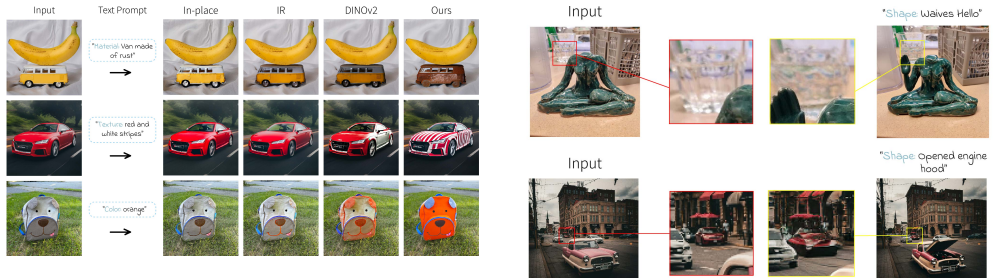
On the paper's own terms, Alterbute establishes that a single unified diffusion model can edit any intrinsic object attribute—color, texture, material, and shape—while preserving the object's perceived identity and the scene context. The method defines identity not at the coarse category level (too loose) or the instance level (too restrictive), but through Visual Named Entities, fine-grained visual identity categories automatically extracted by a vision-language model from a large public dataset. Training pairs come from objects sharing the same VNE label, with the model conditioned on an identity reference image, a text prompt describing target attributes, a background image, and a mask; t
What carries the argument
The central mechanism is the pairing of a relaxed training objective with Visual Named Entity (VNE) identity conditioning. VNEs are fine-grained identity categories (e.g., "Porsche 911 Carrera") that group objects sharing identity-defining visual features while permitting variation in intrinsic attributes; they are extracted automatically by prompting a vision-language model, yielding tens of thousands of clusters with over a million labeled images. The relaxed objective trains the diffusion model to edit both intrinsic and extrinsic attributes, conditioned on an identity reference from the same VNE cluster, a text prompt, a background, and a mask; because loosely matched pairs are far more
Load-bearing premise
The load-bearing premise is that Visual Named Entity labels—automatically assigned by a vision-language model—capture the identity a human would perceive, so a model trained to preserve the VNE label will preserve the object's perceived identity during attribute edits.
What would settle it
A concrete check: take a sample of products whose identity labels were assigned by the automatic pipeline, edit each one's color or material with Alterbute, and ask independent human raters whether the output is still the same product as the input. If human "same identity" judgments agree with the automatic labels far less often than the paper's preference rates suggest, the identity definition—not the editing capability—is the failing part.
If this is right
- One photo, one mask, and a short prompt such as "material: wood" suffice for a photorealistic edit; no per-object optimization or test-time tuning is required.
- The same single model handles color, texture, material, and shape edits, so practitioners no longer need separate attribute-specific tools.
- Identity-preserving supervision scales without manual annotation: automatically extracted VNE clusters provide thousands of identities with enough intrinsic variation to learn from.
- Because training allows extrinsic changes too, the same model can also insert an object into a new scene while applying an intrinsic change, a byproduct the paper demonstrates with an empty prompt.
- Multi-attribute edits are possible when the requested attributes are compatible, and the model avoids contradictory combinations (e.g., it will not make a golden object black) because such correlations are learned from data.
Where Pith is reading between the lines
- Inference: The relaxed objective suggests a general recipe for counterfactual editing tasks where perfectly paired data does not exist—any edit that changes an intrinsic factor while reusing the same scene context could be trained the same way; the paper does not explore other factors such as lighting or pose with this mechanism.
- Inference: The method's dependence on a vision-language model for labeling means the identity taxonomy inherits that model's biases: products that are easy for the VLM to name will be over-represented, and long-tailed clusters will limit edits for rare or less brandable objects. An audit of cluster purity per object class would reveal where the approach works best.
- Inference: Because the paper does not report a human agreement study on the VNE labels themselves, an immediate next test is to have people sort images into the same identity clusters and compare with the automatic ones; if agreement is high, the identity premise is solid, if low, the supervision is weaker than claimed.
- Inference: Standard identity metrics (embedding cosine similarity) are poor for this task, as the paper itself notes; a useful extension would be a benchmark that separates "same product" judgments from "attribute changed" judgments, so future methods can be compared without the metrics confounding the two.
Editorial analysis
A structured set of objections, weighed in public.
Referee Report
Summary. The paper introduces Alterbute, a diffusion-based method for editing intrinsic object attributes (color, texture, material, shape) in images while preserving perceived identity and scene context. The method is trained with a relaxed objective: a single SDXL-based model is conditioned on an identity reference image, a text prompt describing the target intrinsic attributes, and a background image plus object mask that define the extrinsic context. The identity reference is defined through Visual Named Entities (VNEs), fine-grained visual categories extracted automatically by a vision-language model (Gemini) from OpenImages. At inference, the original background and mask are reused to restrict changes to intrinsic attributes, and the identity reference is the masked crop of the input object itself. The paper reports strong preference results over seven baselines in a user study and VLM evaluations, and provides ablations comparing VNE-based identity references with DINOv2, instance-retrieval, and in-place references.
Significance. If the central claim holds, this is a significant contribution: a single unified model that edits arbitrary intrinsic attributes with identity preservation, enabled by a scalable VLM-based supervision pipeline. The strengths are substantial: the automatic VNE/attribute extraction pipeline from 9M images is an impressive engineering contribution; the preference evidence is strong (166 users, 3,320 pairwise responses, p<1e-10 for users and p<1e-12 for VLMs, with three independent VLMs agreeing directionally); and the identity-definition ablation (VNE vs DINOv2 vs IR vs in-place) is a genuine and informative control. The paper is clearly written and the supplementary material includes the exact prompts used for VNE and attribute extraction, which supports reproducibility of the data pipeline. However, a load-bearing tension between the inference-time protocol and the in-place ablation, together with the lack of human validation of the VNE construct, currently prevents the central claim from being fully supported.
major comments (2)
- [Sec. 4.3 vs. Sec. 3.5] The in-place ablation contradicts the inference-time protocol. Sec. 3.5 states that at inference the identity reference is the input object itself: 'crop o and mask its background to form the reference image id.' In Sec. 4.3, the 'In-place editing' ablation uses the target image as its identity reference during training and is described as 'mirrors inference-time editing'; the same paragraph concludes that this setting 'fails to decouple identity from attributes and cannot generalize to attribute editing.' These statements are in direct tension. If the ablation truly mirrors inference, the method as described should fail at inference; if it does not (because training with target==reference removes the paired-variation signal that the VNE-based supervision provides), then the stated conclusion is misleading and no experiment actually tests whether a model trained with VNE pairs can genera
- [Sec. 3.3, Sec. 4.3] The VNE identity definition is not validated against human perception. The paper defines identity through VNE clusters extracted by Gemini (Sec. 3.3) and uses these clusters as the sole supervision signal for identity preservation in training (Sec. 3.4). Although the user study anchors on the input image (an external ground truth), there is no human-agreement study on the VNE labels themselves: no cluster-purity audit, no pairwise human agreement that two images in the same cluster share a VNE, and no sensitivity analysis of the confidence threshold ('High' only, SM F). If VNE clusters are noisy or disagree with how humans recognize objects, the training supervision is compromised, and the 'identity-preserving' property of the final model may be an artifact of the specific Gemini prompt rather than a generalizable principle. The paper should provide a human evaluation of VNE cluster qual
minor comments (5)
- [Table 1] Clarify sample sizes: the main text says each sample received five ratings, resulting in 500 total ratings per general-purpose baseline and 410 per attribute-specific method. This implies attribute-specific baselines (MimicBrush, MaterialFusion) were evaluated on 410/5 = 82 cases, not the full 100. Please state this explicitly so readers do not assume all baselines were compared on the same number of samples.
- [Sec. 5] The explanation of 'Single attribute editing at inference time' is confusing. Training prompts contain all intrinsic attributes as key-value pairs, while inference uses a single key-value prompt. The role of the 10% text-drop is unclear: does the model infer unspecified attributes from the reference? Please provide a clearer description of the training and inference prompt formats and how the model selects which attribute to edit.
- [Fig. 2] The overview figure is dense; the grid layout, channel concatenation, and the distinction between training and inference left/right halves are difficult to parse. A simplified schematic or a separate inference diagram would improve readability.
- [Sec. 4.2 / SM Table SM.2] The user study question asks about prompt match and object similarity, but does not explicitly ask about background/scene preservation, which is part of the claimed contribution. Reporting a quantitative background-preservation metric (e.g., LPIPS on the background region) would strengthen the scene-context claim.
- [Abstract / Sec. 4.2] The claim that Alterbute is 'the first published method' for editing any intrinsic attribute is strong. While the comparison set is reasonable, a more exhaustive comparison with recent attribute-specific methods (e.g., Zest for material, Alchemist for material properties) would make this claim more defensible. Consider softening the wording or expanding the related-work discussion.
Circularity Check
No derivation-level circularity: the editing output is not equivalent to its inputs by construction, and identity preservation is anchored to external user judgments rather than to the paper's own VNE construct.
full rationale
The paper's core prediction is the edited image y' produced by a diffusion model from (id, p, bg, m). This is a learned mapping, not an algebraic identity with its inputs. The relaxed training objective (Sec. 3.2) and loss (Eq. 4) use paired images from the same VNE cluster, where the reference is a different instance than the target; at inference the reference is a masked crop of the input object itself. That is a train/inference distribution shift and a possible correctness risk, but it is not a circular reduction: the output is not defined as the reference, and the model is trained to decouple identity from attributes using varied references. The VNE definition of identity (Sec. 3.3) is used to construct training supervision, but the paper's identity-preservation evaluation is external: the user study asks whether the object 'still looks similar to the one in the input image' (Sec. 4.2), so the claim is not self-validating by VNE membership. Gemini generates the VNE labels/attribute descriptions (SM F) and is also one of several evaluators (Tab. 1), but the central quantitative evidence is the independent 166-participant user study, with GPT-4o and Claude as corroborating VLMs; the Gemini-as-evaluator loop is therefore not load-bearing. The Sec. 4.3 statement that the in-place baseline 'mirrors inference-time editing' while also concluding that using the same image as target and reference 'cannot generalize to attribute editing' is an internal tension worth clarifying: the main model is trained with same-VNE different-instance references, so self-reference at inference is not the same training distribution as the in-place ablation. This is an experimental-support concern, not a circular derivation. Self-citations to ObjectDrop/ObjectMate appear only as related work or a suggested remedy and do not carry the central argument. Overall, no step in the claimed derivation chain reduces to its own inputs by construction.
Axiom & Free-Parameter Ledger
free parameters (4)
- VNE confidence threshold (High only) =
None (categorical filter)
- Singleton-cluster discard threshold =
cluster size >= 2
- Classifier-free guidance scales =
7.5 (text) / 2.0 (image)
- Conditional drop probabilities =
10% identity-drop, 10% text-drop
axioms (5)
- domain assumption VNE clusters group objects that humans perceive as sharing identity while permitting intrinsic-attribute variation
- domain assumption Conditioning on the original background and mask at inference pins all extrinsic factors, so only intrinsic attributes change
- domain assumption Gemini 2.0 Flash's VNE and attribute annotations are accurate enough to serve as large-scale training supervision
- domain assumption Same-VNE different-instance image pairs provide supervision that decouples identity from intrinsic attributes
- standard math Standard diffusion denoising objective and pretrained SDXL generate the target distribution
invented entities (1)
-
Visual Named Entity (VNE)
no independent evidence
read the original abstract
We introduce Alterbute, a diffusion-based method for editing an object's intrinsic attributes in an image. We allow changing color, texture, material, and even the shape of an object, while preserving its perceived identity and scene context. Existing approaches either rely on unsupervised priors that often fail to preserve identity or use overly restrictive supervision that prevents meaningful intrinsic variations. Our method relies on: (i) a relaxed training objective that allows the model to change both intrinsic and extrinsic attributes conditioned on an identity reference image, a textual prompt describing the target intrinsic attributes, and a background image and object mask defining the extrinsic context. At inference, we restrict extrinsic changes by reusing the original background and object mask, thereby ensuring that only the desired intrinsic attributes are altered; (ii) Visual Named Entities (VNEs) - fine-grained visual identity categories (e.g., ''Porsche 911 Carrera'') that group objects sharing identity-defining features while allowing variation in intrinsic attributes. We use a vision-language model to automatically extract VNE labels and intrinsic attribute descriptions from a large public image dataset, enabling scalable, identity-preserving supervision. Alterbute outperforms existing methods on identity-preserving object intrinsic attribute editing.
Figures



Reference graph
Works this paper leans on
-
[1]
Gpt-4 technical report.arXiv preprint arXiv:2303.08774,
Josh Achiam, Steven Adler, Sandhini Agarwal, Lama Ah- mad, Ilge Akkaya, Florencia Leoni Aleman, Diogo Almeida, Janko Altenschmidt, Sam Altman, Shyamal Anadkat, et al. Gpt-4 technical report.arXiv preprint arXiv:2303.08774,
-
[2]
Claude 3.7 sonnet, 2025
Anthropic. Claude 3.7 sonnet, 2025. 7, 1
2025
-
[3]
Palp: prompt aligned personalization of text-to- image models
Moab Arar, Andrey V oynov, Amir Hertz, Omri Avrahami, Shlomi Fruchter, Yael Pritch, Daniel Cohen-Or, and Ariel Shamir. Palp: prompt aligned personalization of text-to- image models. InSIGGRAPH Asia 2024 Conference Papers, pages 1–11, 2024. 2
2024
-
[4]
In- structpix2pix: Learning to follow image editing instructions
Tim Brooks, Aleksander Holynski, and Alexei A Efros. In- structpix2pix: Learning to follow image editing instructions. InProceedings of the IEEE/CVF conference on computer vi- sion and pattern recognition, pages 18392–18402, 2023. 2, 5, 6, 1, 3
2023
-
[5]
Unifying deep local and global features for image search
Bingyi Cao, Andre Araujo, and Jack Sim. Unifying deep local and global features for image search. InComputer Vision–ECCV 2020: 16th European Conference, Glasgow, UK, August 23–28, 2020, Proceedings, Part XX 16, pages 726–743. Springer, 2020. 2
2020
-
[6]
Emerg- ing properties in self-supervised vision transformers
Mathilde Caron, Hugo Touvron, Ishan Misra, Herv ´e J´egou, Julien Mairal, Piotr Bojanowski, and Armand Joulin. Emerg- ing properties in self-supervised vision transformers. InPro- ceedings of the International Conference on Computer Vi- sion (ICCV), 2021. 2
2021
-
[7]
Text2tex: Text-driven texture synthesis via diffusion models
Dave Zhenyu Chen, Yawar Siddiqui, Hsin-Ying Lee, Sergey Tulyakov, and Matthias Nießner. Text2tex: Text-driven texture synthesis via diffusion models. InProceedings of the IEEE/CVF international conference on computer vision, pages 18558–18568, 2023. 3
2023
-
[8]
Disenbooth: Identity- preserving disentangled tuning for subject-driven text-to- image generation
Hong Chen, Yipeng Zhang, Simin Wu, Xin Wang, Xuguang Duan, Yuwei Zhou, and Wenwu Zhu. Disenbooth: Identity- preserving disentangled tuning for subject-driven text-to- image generation. InThe Twelfth International Conference on Learning Representations, 2024. 2
2024
-
[9]
Zero-shot image editing with reference imitation.Advances in Neural Information Processing Systems, 37:84010–84032,
Xi Chen, Yutong Feng, Mengting Chen, Yiyang Wang, Shi- long Zhang, Yu Liu, Yujun Shen, and Hengshuang Zhao. Zero-shot image editing with reference imitation.Advances in Neural Information Processing Systems, 37:84010–84032,
-
[10]
Anydoor: Zero-shot object-level im- age customization
Xi Chen, Lianghua Huang, Yu Liu, Yujun Shen, Deli Zhao, and Hengshuang Zhao. Anydoor: Zero-shot object-level im- age customization. InProceedings of the IEEE/CVF con- ference on computer vision and pattern recognition, pages 6593–6602, 2024. 2
2024
-
[11]
Zest: Zero-shot material trans- fer from a single image
Ta-Ying Cheng, Prafull Sharma, Andrew Markham, Niki Trigoni, and Varun Jampani. Zest: Zero-shot material trans- fer from a single image. InEuropean Conference on Com- puter Vision, pages 370–386. Springer, 2024. 3
2024
-
[12]
Scaling recti- fied flow transformers for high-resolution image synthesis
Patrick Esser, Sumith Kulal, Andreas Blattmann, Rahim Entezari, Jonas M ¨uller, Harry Saini, Yam Levi, Dominik Lorenz, Axel Sauer, Frederic Boesel, et al. Scaling recti- fied flow transformers for high-resolution image synthesis. InForty-first international conference on machine learning,
-
[13]
Implicit style-content separation using b-lora
Yarden Frenkel, Yael Vinker, Ariel Shamir, and Daniel Cohen-Or. Implicit style-content separation using b-lora. In European Conference on Computer Vision, pages 181–198. Springer, 2024. 2
2024
-
[14]
An image is worth one word: Personalizing text-to-image gener- ation using textual inversion
Rinon Gal, Yuval Alaluf, Yuval Atzmon, Or Patashnik, Amit Haim Bermano, Gal Chechik, and Daniel Cohen-or. An image is worth one word: Personalizing text-to-image gener- ation using textual inversion. InThe Eleventh International Conference on Learning Representations, 2023. 2, 6
2023
-
[15]
Renoise: Real image inversion through iterative noising
Daniel Garibi, Or Patashnik, Andrey V oynov, Hadar Averbuch-Elor, and Daniel Cohen-Or. Renoise: Real image inversion through iterative noising. InEuropean Conference on Computer Vision, pages 395–413. Springer, 2024. 2
2024
-
[16]
Materialfusion: High-quality, zero-shot, and controllable material transfer with diffusion models
Kamil Garifullin, Maxim Nikolaev, Andrey Kuznetsov, and Aibek Alanov. Materialfusion: High-quality, zero-shot, and controllable material transfer with diffusion models. InPro- ceedings of the IEEE/CVF Conference on Computer Vision and Pattern Recognition (CVPR), 2025. 3, 6, 1
2025
-
[17]
Prompt-to-prompt im- age editing with cross attention control.arXiv preprint arXiv:2208.01626, 2022
Amir Hertz, Ron Mokady, Jay Tenenbaum, Kfir Aberman, Yael Pritch, and Daniel Cohen-Or. Prompt-to-prompt im- age editing with cross attention control.arXiv preprint arXiv:2208.01626, 2022. 2
Pith/arXiv arXiv 2022
-
[18]
Style aligned image generation via shared atten- tion
Amir Hertz, Andrey V oynov, Shlomi Fruchter, and Daniel Cohen-Or. Style aligned image generation via shared atten- tion. InProceedings of the IEEE/CVF Conference on Com- puter Vision and Pattern Recognition, pages 4775–4785,
-
[19]
Classifier-free diffusion guidance.arXiv preprint arXiv:2207.12598, 2022
Jonathan Ho and Tim Salimans. Classifier-free diffusion guidance.arXiv preprint arXiv:2207.12598, 2022. 5
Pith/arXiv arXiv 2022
-
[20]
Instruct-imagen: Image gen- eration with multi-modal instruction
Hexiang Hu, Kelvin CK Chan, Yu-Chuan Su, Wenhu Chen, Yandong Li, Kihyuk Sohn, Yang Zhao, Xue Ben, Boqing Gong, William Cohen, et al. Instruct-imagen: Image gen- eration with multi-modal instruction. InProceedings of the IEEE/CVF conference on computer vision and pattern recognition, pages 4754–4763, 2024. 2 9
2024
-
[21]
Imagic: Text-based real image editing with diffusion models
Bahjat Kawar, Shiran Zada, Oran Lang, Omer Tov, Huiwen Chang, Tali Dekel, Inbar Mosseri, and Michal Irani. Imagic: Text-based real image editing with diffusion models. InPro- ceedings of the IEEE/CVF conference on computer vision and pattern recognition, pages 6007–6017, 2023. 2
2023
-
[22]
Flowedit: Inversion- free text-based editing using pre-trained flow models
Vladimir Kulikov, Matan Kleiner, Inbar Huberman- Spiegelglas, and Tomer Michaeli. Flowedit: Inversion- free text-based editing using pre-trained flow models. In Proceedings of the IEEE/CVF International Conference on Computer Vision (ICCV), pages 19721–19730, 2025. 6, 1, 3
2025
-
[23]
Multi-concept customization of text-to-image diffusion
Nupur Kumari, Bingliang Zhang, Richard Zhang, Eli Shechtman, and Jun-Yan Zhu. Multi-concept customization of text-to-image diffusion. InProceedings of the IEEE/CVF conference on computer vision and pattern recognition, pages 1931–1941, 2023. 2
1931
-
[24]
Alina Kuznetsova, Hassan Rom, Neil Alldrin, Jasper Ui- jlings, Ivan Krasin, Jordi Pont-Tuset, Shahab Kamali, Stefan Popov, Matteo Malloci, Alexander Kolesnikov, et al. The open images dataset v4: Unified image classification, object detection, and visual relationship detection at scale.Interna- tional journal of computer vision, 128(7):1956–1981, 2020. 4
1956
-
[25]
Flux.https://github.com/ black-forest-labs/flux, 2024
Black Forest Labs. Flux.https://github.com/ black-forest-labs/flux, 2024. 3, 1
2024
-
[26]
Generative om- nimatte: Learning to decompose video into layers
Yao-Chih Lee, Erika Lu, Sarah Rumbley, Michal Geyer, Jia- Bin Huang, Tali Dekel, and Forrester Cole. Generative om- nimatte: Learning to decompose video into layers. InPro- ceedings of the IEEE/CVF Conference on Computer Vision and Pattern Recognition (CVPR), 2025. 2
2025
-
[27]
Blip-diffusion: Pre- trained subject representation for controllable text-to-image generation and editing.Advances in Neural Information Pro- cessing Systems, 36:30146–30166, 2023
Dongxu Li, Junnan Li, and Steven Hoi. Blip-diffusion: Pre- trained subject representation for controllable text-to-image generation and editing.Advances in Neural Information Pro- cessing Systems, 36:30146–30166, 2023. 2
2023
-
[28]
Subject- diffusion: Open domain personalized text-to-image genera- tion without test-time fine-tuning
Jian Ma, Junhao Liang, Chen Chen, and Haonan Lu. Subject- diffusion: Open domain personalized text-to-image genera- tion without test-time fine-tuning. InACM SIGGRAPH 2024 Conference Papers, pages 1–12, 2024. 2
2024
-
[29]
Lightlab: Controlling light sources in images with diffusion models
Nadav Magar, Amir Hertz, Eric Tabellion, Yael Pritch, Alex Rav-Acha, Ariel Shamir, and Yedid Hoshen. Lightlab: Controlling light sources in images with diffusion models. InProceedings of the Special Interest Group on Computer Graphics and Interactive Techniques Conference Conference Papers, pages 1–11, 2025. 2
2025
-
[30]
Chenlin Meng, Yutong He, Yang Song, Jiaming Song, Jia- jun Wu, Jun-Yan Zhu, and Stefano Ermon. Sdedit: Guided image synthesis and editing with stochastic differential equa- tions.arXiv preprint arXiv:2108.01073, 2021. 2
Pith/arXiv arXiv 2021
-
[31]
Null-text inversion for editing real im- ages using guided diffusion models
Ron Mokady, Amir Hertz, Kfir Aberman, Yael Pritch, and Daniel Cohen-Or. Null-text inversion for editing real im- ages using guided diffusion models. InProceedings of the IEEE/CVF conference on computer vision and pattern recognition, pages 6038–6047, 2023. 2
2023
-
[32]
Dinov2: Learning robust visual features without supervision
Maxime Oquab, Timoth ´ee Darcet, Th ´eo Moutakanni, Huy V o, Marc Szafraniec, Vasil Khalidov, Pierre Fernandez, Daniel Haziza, Francisco Massa, Alaaeldin El-Nouby, et al. Dinov2: Learning robust visual features without supervision. arXiv preprint arXiv:2304.07193, 2023. 2, 7, 3
Pith/arXiv arXiv 2023
-
[33]
Dustin Podell, Zion English, Kyle Lacey, Andreas Blattmann, Tim Dockhorn, Jonas M ¨uller, Joe Penna, and Robin Rombach. Sdxl: Improving latent diffusion mod- els for high-resolution image synthesis.arXiv preprint arXiv:2307.01952, 2023. 3, 5
Pith/arXiv arXiv 2023
-
[34]
Aditya Ramesh, Prafulla Dhariwal, Alex Nichol, Casey Chu, and Mark Chen. Hierarchical text-conditional image gener- ation with clip latents.arXiv preprint arXiv:2204.06125, 1 (2):3, 2022. 2, 4
Pith/arXiv arXiv 2022
-
[35]
Sam 2: Segment anything in images and videos.arXiv preprint arXiv:2408.00714, 2024
Nikhila Ravi, Valentin Gabeur, Yuan-Ting Hu, Ronghang Hu, Chaitanya Ryali, Tengyu Ma, Haitham Khedr, Roman R¨adle, Chloe Rolland, Laura Gustafson, et al. Sam 2: Segment anything in images and videos.arXiv preprint arXiv:2408.00714, 2024. 5
Pith/arXiv arXiv 2024
-
[36]
pops: Photo-inspired diffusion operators
Elad Richardson, Yuval Alaluf, Ali Mahdavi-Amiri, and Daniel Cohen-Or. pops: Photo-inspired diffusion operators. arXiv preprint arXiv:2406.01300, 2024. 3
Pith/arXiv arXiv 2024
-
[37]
High-resolution image synthesis with latent diffusion models
Robin Rombach, Andreas Blattmann, Dominik Lorenz, Patrick Esser, and Bj ¨orn Ommer. High-resolution image synthesis with latent diffusion models. InProceedings of the IEEE/CVF conference on computer vision and pattern recognition, pages 10684–10695, 2022. 2, 4
2022
-
[38]
Dreambooth: Fine tuning text-to-image diffusion models for subject-driven generation
Nataniel Ruiz, Yuanzhen Li, Varun Jampani, Yael Pritch, Michael Rubinstein, and Kfir Aberman. Dreambooth: Fine tuning text-to-image diffusion models for subject-driven generation. InProceedings of the IEEE/CVF conference on computer vision and pattern recognition, pages 22500– 22510, 2023. 2, 6
2023
-
[39]
Photorealistic text-to-image diffusion models with deep language understanding.Advances in neural information processing systems, 35:36479–36494, 2022
Chitwan Saharia, William Chan, Saurabh Saxena, Lala Li, Jay Whang, Emily L Denton, Kamyar Ghasemipour, Raphael Gontijo Lopes, Burcu Karagol Ayan, Tim Salimans, et al. Photorealistic text-to-image diffusion models with deep language understanding.Advances in neural information processing systems, 35:36479–36494, 2022. 4
2022
-
[40]
1st place solution in google universal images embedding.arXiv preprint arXiv:2210.08473, 2022
Shihao Shao and Qinghua Cui. 1st place solution in google universal images embedding.arXiv preprint arXiv:2210.08473, 2022. 2, 7, 3
Pith/arXiv arXiv 2022
-
[41]
Alchemist: Parametric control of material proper- ties with diffusion models
Prafull Sharma, Varun Jampani, Yuanzhen Li, Xuhui Jia, Dmitry Lagun, Fredo Durand, Bill Freeman, and Mark Matthews. Alchemist: Parametric control of material proper- ties with diffusion models. InProceedings of the IEEE/CVF Conference on Computer Vision and Pattern Recognition, pages 24130–24141, 2024. 3
2024
-
[42]
Emu edit: Precise image editing via recognition and gen- eration tasks
Shelly Sheynin, Adam Polyak, Uriel Singer, Yuval Kirstain, Amit Zohar, Oron Ashual, Devi Parikh, and Yaniv Taigman. Emu edit: Precise image editing via recognition and gen- eration tasks. InProceedings of the IEEE/CVF Conference on Computer Vision and Pattern Recognition, pages 8871– 8879, 2024. 2
2024
-
[43]
In- stantbooth: Personalized text-to-image generation without test-time finetuning
Jing Shi, Wei Xiong, Zhe Lin, and Hyun Joon Jung. In- stantbooth: Personalized text-to-image generation without test-time finetuning. InProceedings of the IEEE/CVF con- ference on computer vision and pattern recognition, pages 8543–8552, 2024. 2
2024
-
[44]
Large-scale text-to-image model with inpainting is a zero-shot subject-driven image generator
Chaehun Shin, Jooyoung Choi, Heeseung Kim, and Sungroh Yoon. Large-scale text-to-image model with inpainting is a zero-shot subject-driven image generator. InProceedings 10 of the Computer Vision and Pattern Recognition Conference, pages 7986–7996, 2025. 3, 6, 1
2025
-
[45]
Object- stitch: Object compositing with diffusion model
Yizhi Song, Zhifei Zhang, Zhe Lin, Scott Cohen, Brian Price, Jianming Zhang, Soo Ye Kim, and Daniel Aliaga. Object- stitch: Object compositing with diffusion model. InPro- ceedings of the IEEE/CVF Conference on Computer Vision and Pattern Recognition, pages 18310–18319, 2023. 2
2023
-
[46]
Imprint: Generative object compositing by learning identity-preserving representation
Yizhi Song, Zhifei Zhang, Zhe Lin, Scott Cohen, Brian Price, Jianming Zhang, Soo Ye Kim, He Zhang, Wei Xiong, and Daniel Aliaga. Imprint: Generative object compositing by learning identity-preserving representation. InProceedings of the IEEE/CVF Conference on Computer Vision and Pat- tern Recognition, pages 8048–8058, 2024. 2
2024
-
[47]
The bitter lesson.Incomplete Ideas (blog), 13(1):38, 2019
Richard Sutton. The bitter lesson.Incomplete Ideas (blog), 13(1):38, 2019. 2
2019
-
[48]
Gemini: a family of highly capable multimodal models.arXiv preprint arXiv:2312.11805, 2023
Gemini Team, Rohan Anil, Sebastian Borgeaud, Jean- Baptiste Alayrac, Jiahui Yu, Radu Soricut, Johan Schalkwyk, Andrew M Dai, Anja Hauth, Katie Millican, et al. Gemini: a family of highly capable multimodal models.arXiv preprint arXiv:2312.11805, 2023. 2, 4, 7, 1
Pith/arXiv arXiv 2023
-
[49]
Key-locked rank one editing for text-to-image personaliza- tion
Yoad Tewel, Rinon Gal, Gal Chechik, and Yuval Atzmon. Key-locked rank one editing for text-to-image personaliza- tion. InACM SIGGRAPH 2023 conference proceedings, pages 1–11, 2023. 2
2023
-
[50]
p+: Extended textual conditioning in text-to- image generation.arXiv preprint arXiv:2303.09522, 2023
Andrey V oynov, Qinghao Chu, Daniel Cohen-Or, and Kfir Aberman. p+: Extended textual conditioning in text-to- image generation.arXiv preprint arXiv:2303.09522, 2023. 2
Pith/arXiv arXiv 2023
-
[51]
Elite: Encoding visual con- cepts into textual embeddings for customized text-to-image generation
Yuxiang Wei, Yabo Zhang, Zhilong Ji, Jinfeng Bai, Lei Zhang, and Wangmeng Zuo. Elite: Encoding visual con- cepts into textual embeddings for customized text-to-image generation. InProceedings of the IEEE/CVF International Conference on Computer Vision, pages 15943–15953, 2023. 2
2023
-
[52]
Objectdrop: Bootstrap- ping counterfactuals for photorealistic object removal and in- sertion
Daniel Winter, Matan Cohen, Shlomi Fruchter, Yael Pritch, Alex Rav-Acha, and Yedid Hoshen. Objectdrop: Bootstrap- ping counterfactuals for photorealistic object removal and in- sertion. InEuropean Conference on Computer Vision, pages 112–129. Springer, 2024. 8
2024
-
[53]
Objectmate: A recurrence prior for object insertion and subject-driven gen- eration
Daniel Winter, Asaf Shul, Matan Cohen, Dana Berman, Yael Pritch, Alex Rav-Acha, and Yedid Hoshen. Objectmate: A recurrence prior for object insertion and subject-driven gen- eration. InProceedings of the IEEE/CVF International Con- ference on Computer Vision (ICCV), pages 16281–16291,
-
[54]
Fastcomposer: Tuning-free multi- subject image generation with localized attention.Interna- tional Journal of Computer Vision, pages 1–20, 2024
Guangxuan Xiao, Tianwei Yin, William T Freeman, Fr ´edo Durand, and Song Han. Fastcomposer: Tuning-free multi- subject image generation with localized attention.Interna- tional Journal of Computer Vision, pages 1–20, 2024. 2
2024
-
[55]
Omnigen: Unified image genera- tion
Shitao Xiao, Yueze Wang, Junjie Zhou, Huaying Yuan, Xin- grun Xing, Ruiran Yan, Chaofan Li, Shuting Wang, Tiejun Huang, and Zheng Liu. Omnigen: Unified image genera- tion. InProceedings of the Computer Vision and Pattern Recognition Conference, pages 13294–13304, 2025. 6, 1, 3
2025
-
[56]
Paint by example: Exemplar-based image editing with diffusion mod- els
Binxin Yang, Shuyang Gu, Bo Zhang, Ting Zhang, Xuejin Chen, Xiaoyan Sun, Dong Chen, and Fang Wen. Paint by example: Exemplar-based image editing with diffusion mod- els. InProceedings of the IEEE/CVF conference on com- puter vision and pattern recognition, pages 18381–18391,
-
[57]
Generative image layer decomposition with visual effects
Jinrui Yang, Qing Liu, Yijun Li, Soo Ye Kim, Daniil Pakho- mov, Mengwei Ren, Jianming Zhang, Zhe Lin, Cihang Xie, and Yuyin Zhou. Generative image layer decomposition with visual effects. InProceedings of the IEEE/CVF Conference on Computer Vision and Pattern Recognition (CVPR), 2025. 2
2025
-
[58]
Hu Ye, Jun Zhang, Sibo Liu, Xiao Han, and Wei Yang. Ip- adapter: Text compatible image prompt adapter for text-to- image diffusion models.arXiv preprint arXiv:2308.06721,
-
[59]
manufacturing line
Haozhe Zhao, Xiaojian Shawn Ma, Liang Chen, Shuzheng Si, Rujie Wu, Kaikai An, Peiyu Yu, Minjia Zhang, Qing Li, and Baobao Chang. Ultraedit: Instruction-based fine-grained image editing at scale.Advances in Neural Information Pro- cessing Systems, 37:3058–3093, 2024. 2, 6, 1, 3 11 Alterbute: Editing Intrinsic Attributes of Objects in Images Supplementary M...
2024
-
[60]
Generic items are not VNEs
*Focus Exclusively on Mass-Produced, Branded Products: * Your task is ONLY about identifying items that are manufactured at scale and carry a recognizable brand identity. Generic items are not VNEs
-
[61]
Manufacturing Line
*Actively Consider Product Variations Within the Same VNE "Manufacturing Line": * Acknowledge and expect variations that are *intrinsic* to the VNE’s definition. This *includes*: * * Model Variations: * Different models within the same product line (e.g., iPhone 13 Pro, iPhone 13). * * Design Iterations: * Minor design changes across different releases of...
-
[62]
This *includes*: * Lighting conditions (bright, dim, natural, artificial)
*Explicitly Disregard Irrelevant Image Factors: * Ignore elements that are *external* to the VNE’s core visual identity. This *includes*: * Lighting conditions (bright, dim, natural, artificial). * Background clutter or complexity. * Image quality (blurriness, resolution, compression artifacts)
-
[63]
*Concentrate on Core and Persistent Visual Identifiers: * Analyze the fundamental visual features that reliably distinguish the VNE, features that *persist* across all permissible variations within its manufacturing line
-
[64]
None" When Uncertain: * It is better to admit uncertainty than to make an incorrect identification. If you cannot confidently identify a VNE, you *MUST* return
*Prioritize Accuracy and Return "None" When Uncertain: * It is better to admit uncertainty than to make an incorrect identification. If you cannot confidently identify a VNE, you *MUST* return "None". *Key Output Instructions - Deliverables: *
-
[65]
Apple iPhone 14 Pro Max
*Product Identification (Required): * Provide the most specific product identification possible, including both the brand and the precise model name. For example: "Apple iPhone 14 Pro Max", not just "iPhone" or "Apple Phone"
-
[66]
High", "Medium
*Confidence Level (Evaluative): * Assign a confidence level of "High", "Medium", or "Low". Base this level on the *clarity and distinctiveness of the VNE’s visual identifiers * in the image. "High" indicates very clear and unambiguous identifiers; "Low" suggests weaker or less distinct identifiers
-
[67]
None" Output (Conditional): * If, after careful analysis, you cannot confidently identify a VNE, your
*"None" Output (Conditional): * If, after careful analysis, you cannot confidently identify a VNE, your " product_identification" *MUST* be "None". *Illustrative Examples (Refer to these for guidance): * * * Product Category: Smartphones * * * iPhone 15 Pro: * "Apple iPhone 15 Pro" * * Samsung Galaxy S23 Ultra: * "Samsung Galaxy S23 Ultra" * * Unclear Pho...
discussion (0)
Sign in with ORCID, Apple, or X to comment. Anyone can read and Pith papers without signing in.