Recognition: 2 theorem links
· Lean TheoremSurface Functional Renormalization Group for Layered Quantum Materials
Pith reviewed 2026-05-16 13:57 UTC · model grok-4.3
The pith
Extending functional renormalization group to surfaces splits the superconducting phase with a narrow incommensurate magnetic window at moderate interlayer hopping.
A machine-rendered reading of the paper's core claim, the machinery that carries it, and where it could break.
Core claim
The central claim is that an SSH-like interlayer coupling added to the surface Hubbard model leaves the two-dimensional physics intact for wide parameter ranges but, at intermediate interlayer hopping, inserts a small region of incommensurate spin-density-wave and spin-bond order that divides the superconducting state into two regimes, thereby opening a possible route to chiral spin-bond order.
What carries the argument
The surface functional renormalization group flow, obtained by extending the standard two-dimensional fRG equations to include interlayer hopping terms while keeping the interaction vertex on the surface layer.
If this is right
- Antiferromagnetic, d-wave superconducting, and ferromagnetic correlations remain the dominant instabilities for most values of interlayer hopping.
- The superconducting state at intermediate interaction strengths is interrupted only in a limited window of interlayer couplings.
- Incommensurate spin-density-wave and spin-bond order appear together in that narrow window.
- The spin-bond order inside the window can in principle take a chiral form.
Where Pith is reading between the lines
- The method could be used to study interfaces in other van-der-Waals heterostructures where only the top layer carries strong correlations.
- The incommensurate window might be located experimentally by tuning interlayer distance in a layered material or by applying pressure.
- If the chiral spin-bond order is realized, it would break time-reversal symmetry and could produce detectable edge currents or anomalous Hall signals.
Load-bearing premise
The truncation and discretization used in the functional renormalization group flow remain accurate once interlayer hopping is added to the surface Hubbard model.
What would settle it
A calculation with finer momentum discretization or a higher-order truncation that either eliminates the narrow incommensurate region or moves its location substantially would falsify the reported splitting of the superconducting dome.
Figures


read the original abstract
We present an extension to the two-dimensional functional renormalization group to efficiently treat interactions on the surface or at interfaces of three-dimensional systems. As an application, we consider a semi-infinite stack of two-dimensional square lattices, including a Hubbard interaction on the surface layer and an alternating interlayer coupling. We investigate how strongly correlated states of the decoupled two-dimensional Hubbard model on the surface evolve under inclusion of such an SSH-like interlayer coupling. For large parts of the phase diagram as a function of the interlayer hopping parameters, the physics of the two-dimensional system prevails, with antiferromagnetic, superconducting $d$-wave, and ferromagnetic correlations taking center stage. However, for intermediate interlayer couplings the superconducting state at intermediate interaction strengths separates into two regimes by a small region of incommensurate spin-density-wave and spin-bond order, enabling the potential realization of chiral spin-bond order.
Editorial analysis
A structured set of objections, weighed in public.
Referee Report
Summary. The paper introduces an extension of the two-dimensional functional renormalization group (fRG) to surfaces and interfaces of three-dimensional layered systems. Applied to a semi-infinite stack of square lattices with on-site Hubbard repulsion confined to the surface layer and an alternating (SSH-like) interlayer hopping, the work maps the evolution of the 2D Hubbard-model phases (antiferromagnetism, d-wave superconductivity, ferromagnetism) as interlayer coupling is turned on. The central claim is that, for intermediate interlayer hoppings and interaction strengths, the d-wave superconducting regime is interrupted by a narrow window of incommensurate spin-density-wave plus spin-bond order, potentially allowing chiral spin-bond order.
Significance. If the reported narrow incommensurate window is robust, the result would provide a concrete route to stabilize chiral spin-bond order at surfaces of layered materials and would demonstrate how weak interlayer coupling can qualitatively reorganize the 2D Hubbard phase diagram. The methodological extension itself is a useful technical step for treating surface correlations in quasi-2D systems.
major comments (2)
- [Numerical implementation and results section] The headline result—a small incommensurate SDW/spin-bond region that splits the d-wave superconducting dome for intermediate t_perp—rests on the accuracy of the momentum and frequency discretization of the extended fRG flow. No convergence tests with respect to patch number, grid density, or frequency mesh are reported once finite interlayer hopping is introduced, even though the location of incommensurate instabilities is known to be sensitive to nesting-vector resolution and to the opening of new interlayer scattering channels.
- [Method and truncation discussion] The truncation to the two-particle vertex (standard in fRG) is retained without additional justification or error estimates when the interlayer term couples momenta along the stacking direction. Because the claimed window is narrow, it is essential to demonstrate that the truncation does not artificially stabilize or shift the incommensurate instabilities relative to the t_perp = 0 limit.
minor comments (1)
- [Abstract and introduction] The abstract and introduction would benefit from a brief statement of the discretization parameters (number of patches, frequency points) used for the surface fRG flow.
Simulated Author's Rebuttal
We thank the referee for the detailed and constructive report. We appreciate the emphasis on numerical convergence and the validity of the truncation scheme. Below we address the major comments point by point. We will incorporate revisions to strengthen the presentation of our results.
read point-by-point responses
-
Referee: [Numerical implementation and results section] The headline result—a small incommensurate SDW/spin-bond region that splits the d-wave superconducting dome for intermediate t_perp—rests on the accuracy of the momentum and frequency discretization of the extended fRG flow. No convergence tests with respect to patch number, grid density, or frequency mesh are reported once finite interlayer hopping is introduced, even though the location of incommensurate instabilities is known to be sensitive to nesting-vector resolution and to the opening of new interlayer scattering channels.
Authors: We agree that additional convergence tests are important to establish the robustness of the narrow incommensurate window. In our previous work on the pure 2D Hubbard model, we have verified convergence with respect to the number of patches (typically 24-48) and frequency discretization. For the extended model with finite t_perp, the discretization scheme is identical, with the interlayer hopping incorporated into the propagator. To address this concern, we will include in the revised manuscript a dedicated paragraph or appendix showing results for different patch numbers (e.g., 16, 24, 32) at representative intermediate t_perp values, confirming that the position of the incommensurate instability remains stable within the resolution. revision: yes
-
Referee: [Method and truncation discussion] The truncation to the two-particle vertex (standard in fRG) is retained without additional justification or error estimates when the interlayer term couples momenta along the stacking direction. Because the claimed window is narrow, it is essential to demonstrate that the truncation does not artificially stabilize or shift the incommensurate instabilities relative to the t_perp = 0 limit.
Authors: The truncation to the two-particle vertex is the standard approximation in fRG applications to the Hubbard model, justified by the hierarchy of scales in the flow and the fact that higher-order vertices are generated but often remain small in the relevant regimes. The interlayer hopping enters primarily through the single-particle dispersion and the loop integrals, without altering the vertex truncation itself. We note that for small t_perp the perturbation is weak, and the instabilities evolve continuously from the 2D case. However, we acknowledge the referee's point regarding the narrowness of the window and the lack of explicit error estimates. In the revision, we will add a discussion in the methods section elaborating on the truncation and its expected validity for the interlayer coupling, including a qualitative argument why higher vertices are unlikely to shift the narrow region significantly. Full error estimates would require a different methodological approach beyond the scope of this work. revision: partial
Circularity Check
No circularity: standard fRG flow applied to extended surface geometry
full rationale
The paper defines an extension of the two-dimensional functional renormalization group to semi-infinite layered systems by adding an alternating interlayer hopping term to the surface Hubbard model and integrates the standard flow equations numerically. The central claim of a narrow incommensurate SDW/spin-bond window splitting the d-wave superconducting regime is obtained as an output of that integration rather than being presupposed by any self-definition, fitted-parameter renaming, or load-bearing self-citation. No equation or result reduces to its own input by construction; the truncation and discretization choices are methodological assumptions whose accuracy is external to the derivation itself.
Axiom & Free-Parameter Ledger
axioms (1)
- domain assumption The functional renormalization group flow equations with standard truncation approximate the many-body physics of the Hubbard model on the surface layer
Lean theorems connected to this paper
-
IndisputableMonolith/Cost/FunctionalEquation.leanwashburn_uniqueness_aczel unclear?
unclearRelation between the paper passage and the cited Recognition theorem.
dV^Λ/dΛ = d/dΛ (P^{-1}[P^Λ] + C^{-1}[C^Λ] + D^{-1}[D^Λ]) with sharp-frequency cutoff loop integrals
-
IndisputableMonolith/Foundation/RealityFromDistinction.leanreality_from_one_distinction unclear?
unclearRelation between the paper passage and the cited Recognition theorem.
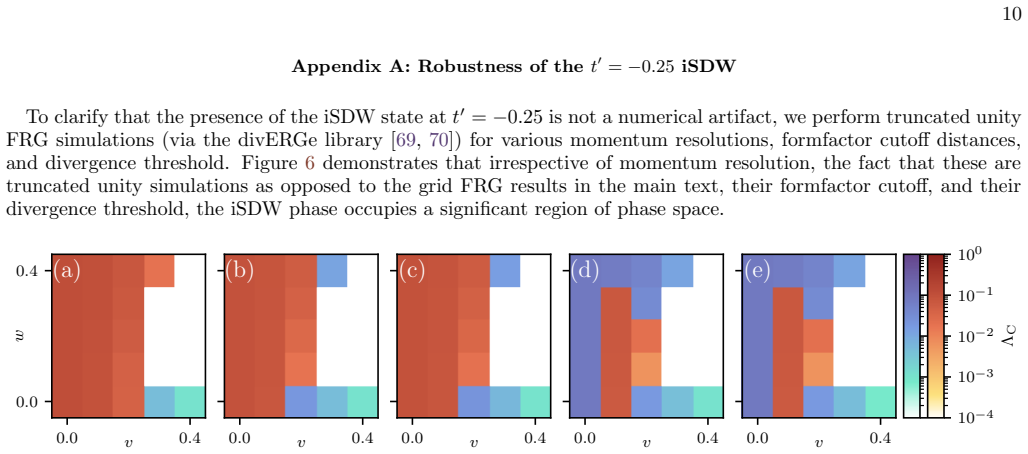
phase diagram in (v,w) for t' = -0.25, U=5 showing narrow iSDW window splitting dSC
What do these tags mean?
- matches
- The paper's claim is directly supported by a theorem in the formal canon.
- supports
- The theorem supports part of the paper's argument, but the paper may add assumptions or extra steps.
- extends
- The paper goes beyond the formal theorem; the theorem is a base layer rather than the whole result.
- uses
- The paper appears to rely on the theorem as machinery.
- contradicts
- The paper's claim conflicts with a theorem or certificate in the canon.
- unclear
- Pith found a possible connection, but the passage is too broad, indirect, or ambiguous to say the theorem truly supports the claim.
Reference graph
Works this paper leans on
-
[1]
Hubbard, Electron correlations in narrow energy bands, Proceedings of the Royal Society of London
J. Hubbard, Electron correlations in narrow energy bands, Proceedings of the Royal Society of London. A. Mathematical and Physical Sciences276, 238 (1963)
work page 1963
-
[2]
P. W. Anderson, The Resonating Valence Bond State in La2CuO4 and Superconductivity, Science235, 1196 (1987)
work page 1987
-
[3]
V. J. Emery, Theory of high-t c superconductivity in ox- ides, Phys. Rev. Lett.58, 2794 (1987). 7
work page 1987
-
[4]
D. P. Arovas, E. Berg, S. A. Kivelson, and S. Raghu, The hubbard model, Annual Review of Condensed Mat- ter Physics13, 239 (2022)
work page 2022
- [5]
-
[6]
T. Sch¨ afer, N. Wentzell, F.ˇSimkovic, Y.-Y. He, C. Hille, M. Klett, C. J. Eckhardt, B. Arzhang, V. Harkov, F. m. c.-M. Le R´ egent, A. Kirsch, Y. Wang, A. J. Kim, E. Kozik, E. A. Stepanov, A. Kauch, S. Andergassen, P. Hansmann, D. Rohe, Y. M. Vilk, J. P. F. LeBlanc, S. Zhang, A.-M. S. Tremblay, M. Ferrero, O. Parcollet, and A. Georges, Tracking the foot...
work page 2021
-
[7]
M. Qin, T. Sch¨ afer, S. Andergassen, P. Corboz, and E. Gull, The hubbard model: A computational perspec- tive, Annual Review of Condensed Matter Physics13, 275 (2022)
work page 2022
-
[8]
Exact evolution equation for the effective potential
C. Wetterich, Exact evolution equation for the effective potential, Physics Letters B301, 90 (1993), 1710.05815
work page internal anchor Pith review Pith/arXiv arXiv 1993
-
[9]
T. R. Morris, The exact renormalization group and ap- proximate solutions, International Journal of Modern Physics A09, 2411 (1994)
work page 1994
-
[10]
M. Salmhofer and C. Honerkamp, Fermionic renormal- ization group flows: Technique and theory, Progress of Theoretical Physics105, 1 (2001)
work page 2001
-
[11]
W. Metzner, M. Salmhofer, C. Honerkamp, V. Meden, and K. Sch¨ onhammer, Functional renormalization group approach to correlated fermion systems, Reviews of Mod- ern Physics84, 299 (2012)
work page 2012
-
[12]
W.-S. Wang, Y.-Y. Xiang, Q.-H. Wang, F. Wang, F. Yang, and D.-H. Lee, Functional renormalization group and variational monte carlo studies of the elec- tronic instabilities in graphene near 1 4 doping, Phys. Rev. B85, 035414 (2012)
work page 2012
- [13]
-
[14]
D. M. Kennes, J. Lischner, and C. Karrasch, Strong cor- relations andd+idsuperconductivity in twisted bilayer graphene, Phys. Rev. B98, 241407 (2018)
work page 2018
-
[15]
L. Classen, C. Honerkamp, and M. M. Scherer, Com- peting phases of interacting electrons on triangular lat- tices in moir´ e heterostructures, Phys. Rev. B99, 195120 (2019)
work page 2019
- [16]
-
[17]
M. L. Kiesel, C. Platt, and R. Thomale, Unconventional fermi surface instabilities in the kagome hubbard model, Phys. Rev. Lett.110, 126405 (2013)
work page 2013
-
[18]
D. S´ anchez de la Pe˜ na,Competing orders in honeycomb Hubbard models with nonlocal Coulomb interactions: A functional renormalization group approach, Ph.D. thesis, RWTH Aachen University, Aachen (2018)
work page 2018
- [19]
- [20]
-
[21]
W. Qin, C. Huang, T. Wolf, N. Wei, I. Blinov, and A. H. MacDonald, Functional renormalization group study of superconductivity in rhombohedral trilayer graphene, Phys. Rev. Lett.130, 146001 (2023)
work page 2023
- [22]
- [23]
-
[24]
Y. He, K. Yang, J. B. Profe, E. J. Bergholtz, and D. M. Kennes, Superconductivity of repulsive spinless fermions with sublattice potentials, Phys. Rev. Res.5, L012009 (2023)
work page 2023
-
[25]
J. B. Profe, L. Klebl, F. Grandi, H. Hohmann, M. D¨ urrnagel, T. Schwemmer, R. Thomale, and D. M. Kennes, Kagome hubbard model from a functional renor- malization group perspective, Phys. Rev. Res.6, 043078 (2024)
work page 2024
-
[26]
J. B. Profe, L. C. Rhodes, M. D¨ urrnagel, R. Bisset, C. A. Marques, S. Chi, T. Schwemmer, R. Thomale, D. M. Kennes, C. A. Hooley, and P. Wahl, Magic angle of sr 2ruo4: Optimizing correlation-driven superconduc- tivity, Phys. Rev. Res.6, 043057 (2024)
work page 2024
-
[27]
A. Fischer, L. Klebl, V. Cr´ epel, S. Ryee, A. Rubio, L. Xian, T. O. Wehling, A. Georges, D. M. Kennes, and A. J. Millis, Theory of intervalley-coherent afm order and topological superconductivity in twse2, Phys. Rev. X15, 041055 (2025)
work page 2025
-
[28]
J. Beck, J. Bodky, M. D¨ urrnagel, R. Thomale, J. Ingham, L. Klebl, and H. Hohmann, Kekul´ e Order from Diffuse Nesting near Higher-Order Van Hove Points, Physical Review Letters136, 106503 (2026)
work page 2026
-
[29]
M. D¨ urrnagel, H. Hohmann, A. Maity, J. Seufert, M. Klett, L. Klebl, and R. Thomale, Altermagnetic phase transition in a lieb metal, Phys. Rev. Lett.135, 036502 (2025)
work page 2025
-
[30]
Y. Guo, J. Cenker, A. Fischer, D. Mu˜ noz-Segovia, J. Pack, L. Holtzman, L. Klebl, K. Watanabe, T. Taniguchi, K. Barmak, J. Hone, A. Rubio, D. M. Kennes, A. J. Millis, A. Pasupathy, and C. R. Dean, An- gle evolution of the superconducting phase diagram in twisted bilayer wse2, arXiv:2512.06265, accepted in Na- ture (2025)
work page internal anchor Pith review Pith/arXiv arXiv 2025
-
[31]
J. Ehrlich and C. Honerkamp, Functional renormaliza- tion group for fermion lattice models in three dimensions: Application to the hubbard model on the cubic lattice, Phys. Rev. B102, 195108 (2020)
work page 2020
-
[32]
J. B. Profe, S. Beck, D. M. Kennes, A. Georges, and O. Gingras, Competition between d-wave superconduc- tivity and magnetism in uniaxially strained Sr2RuO4, npj Quantum Materials9, 53 (2024)
work page 2024
-
[33]
C. Bigi, M. D¨ urrnagel, L. Klebl, A. Consiglio, G. Pokharel, M. Zonno, F. Bertran, P. Le F` evre, T. Jaouen, H. C. Tchouekem, P. Turban, A. De Vita, J. A. Miwa, J. W. Wells, D. Oh, R. Comin, R. Thomale, 8 I. Zeljkovic, B. R. Ortiz, S. D. Wilson, G. Sangiovanni, F. Mazzola, and D. Di Sante, Pomeranchuk instability from electronic correlations in CsTi3Bi5 ...
work page 2025
-
[34]
P. A. Lee, From high temperature superconductivity to quantum spin liquid: Progress in strong correla- tion physics, Reports on Progress in Physics71, 012501 (2007)
work page 2007
-
[35]
S. Rachel, Interacting topological insulators: A review, Reports on Progress in Physics81, 116501 (2018)
work page 2018
-
[36]
W. P. Su, J. R. Schrieffer, and A. J. Heeger, Solitons in polyacetylene, Phys. Rev. Lett.42, 1698 (1979)
work page 1979
-
[37]
C. Honerkamp and M. Salmhofer, Temperature-flow renormalization group and the competition between su- perconductivity and ferromagnetism, Phys. Rev. B64, 184516 (2001)
work page 2001
-
[38]
D. Kalkstein and P. Soven, A green’s function theory of surface states, Surface Science26, 85 (1971)
work page 1971
-
[39]
M. P. L. Sancho, J. M. L. Sancho, J. M. L. Sancho, and J. Rubio, Highly convergent schemes for the calculation of bulk and surface green functions, Journal of Physics F: Metal Physics15, 851 (1985)
work page 1985
-
[40]
C. Husemann and M. Salmhofer, Efficient parametriza- tion of the vertex function, Ω scheme, and thet, t ′ hub- bard model at van hove filling, Phys. Rev. B79, 195125 (2009)
work page 2009
-
[41]
J. Lichtenstein, D. S´ anchez de la Pe˜ na, D. Rohe, E. Di Napoli, C. Honerkamp, and S. Maier, High-performance functional Renormalization Group calculations for in- teracting fermions, Computer Physics Communications 213, 100 (2017)
work page 2017
-
[42]
C. Honerkamp, Efficient vertex parametrization for the constrained functional renormalization group for effective low-energy interactions in multiband systems, Phys. Rev. B98, 155132 (2018)
work page 2018
-
[43]
C. Honerkamp, H. Shinaoka, F. F. Assaad, and P. Werner, Limitations of constrained random phase approximation downfolding, Phys. Rev. B98, 235151 (2018)
work page 2018
-
[44]
C. J. Eckhardt, C. Honerkamp, K. Held, and A. Kauch, Truncated unity parquet solver, Phys. Rev. B101, 155104 (2020)
work page 2020
- [45]
- [46]
-
[47]
J. B. Profe, C. Honerkamp, S. Achilles, and D. M. Kennes, Electronic instabilities in penrose quasicrystals: Competition, coexistence, and collaboration of order, Phys. Rev. Res.3, 023180 (2021)
work page 2021
-
[48]
J. B. Profe and D. M. Kennes, TU 2FRG: A scalable approach for truncated unity functional renormalization group in generic fermionic models, The European Phys- ical Journal B95, 60 (2022)
work page 2022
-
[49]
C. Honerkamp, M. Salmhofer, N. Furukawa, and T. M. Rice, Breakdown of the landau-fermi liquid in two di- mensions due to umklapp scattering, Phys. Rev. B63, 035109 (2001)
work page 2001
-
[50]
C. Honerkamp, Electron-doping versus hole-doping in the 2D t-t’ Hubbard model, The European Physical Jour- nal B - Condensed Matter and Complex Systems21, 81 (2001)
work page 2001
- [51]
-
[52]
C. Karrasch,The functional renormalization group for zero-dimensional quantum systems in and out of equilib- rium, Ph.D. thesis, RWTH Aachen University, Aachen (2010)
work page 2010
-
[53]
Q. Wu, S. Zhang, H.-F. Song, M. Troyer, and A. A. Soluyanov, Wanniertools: An open-source software pack- age for novel topological materials, Computer Physics Communications224, 405 (2018)
work page 2018
-
[54]
[53] not only provides surface Green’s functions, but at the same time local bulk Green’s functions
In fact, the implementation provided in Ref. [53] not only provides surface Green’s functions, but at the same time local bulk Green’s functions. The bulk Green’s function can be used in the same manner as the surface Green’s function without further modifications to the FRG equa- tions to study intralayer interactions
-
[55]
For details on the numerical methods see Ref. [51]. The open-source implementation of the Hubbard-SSH model FRG [68] makes use of the publicly available divERGe library [69, 70]
-
[56]
M. Laubach, C. Platt, R. Thomale, T. Neupert, and S. Rachel, Density wave instabilities and surface state evolution in interacting weyl semimetals, Phys. Rev. B 94, 241102 (2016)
work page 2016
-
[57]
N. P. Armitage, E. J. Mele, and A. Vishwanath, Weyl and dirac semimetals in three-dimensional solids, Rev. Mod. Phys.90, 015001 (2018)
work page 2018
- [58]
- [59]
- [60]
-
[61]
T. Neupert, S. Rachel, R. Thomale, and M. Greiter, In- teracting surface states of three-dimensional topological insulators, Phys. Rev. Lett.115, 017001 (2015)
work page 2015
-
[62]
R. Lundgren, H. Yerzhakov, and J. Maciejko, Nematic order on the surface of a three-dimensional topological insulator, Phys. Rev. B96, 235140 (2017)
work page 2017
- [63]
-
[64]
Mechanism for Nodal Topological Superconductivity on PtBi$_2$ Surface
K. Mæland, G. Sangiovanni, and B. Trauzettel, Mecha- nism for Nodal Topological Superconductivity on PtBi 2 Surface, arXiv:2512.09994 (2025)
work page internal anchor Pith review Pith/arXiv arXiv 2025
-
[65]
S. Gariglio, A. Fˆ ete, and J.-M. Triscone, Electron con- finement at the LaAlO3/SrTiO3 interface, Journal of Physics: Condensed Matter27, 283201 (2015)
work page 2015
-
[66]
M. S. Scheurer and J. Schmalian, Topological supercon- ductivity and unconventional pairing in oxide interfaces, Nature Communications6, 6005 (2015)
work page 2015
-
[67]
P. Th¨ ornig, JURECA: Data Centric and Booster Mod- ules implementing the Modular Supercomputing Archi- tecture at J¨ ulich Supercomputing Centre, Journal of large-scale research facilities JLSRF7, A182 (2021)
work page 2021
-
[68]
Klebl, Surface FRG for a cubic lattice,https:// 9 github.com/alcubierre-drive/surface-frg(2025)
L. Klebl, Surface FRG for a cubic lattice,https:// 9 github.com/alcubierre-drive/surface-frg(2025)
work page 2025
-
[69]
J. B. Profe, D. M. Kennes, and L. Klebl, divERGe imple- ments various Exact Renormalization Group examples, SciPost Phys. Codebases , 26 (2024)
work page 2024
-
[70]
J. B. Profe, D. M. Kennes, and L. Klebl, Codebase release 0.5 for divERGe, SciPost Phys. Codebases , 26 (2024). 10 Appendix A: Robustness of thet ′ =−0.25iSDW To clarify that the presence of the iSDW state att ′ =−0.25 is not a numerical artifact, we perform truncated unity FRG simulations (via the divERGe library [69, 70]) for various momentum resolution...
work page 2024
discussion (0)
Sign in with ORCID, Apple, or X to comment. Anyone can read and Pith papers without signing in.