REVIEW 2 major objections 4 minor 42 references
Heat, work, and fluctuations in a driven quantum resonator
T0 review · 2 major / 4 minor · reviewed 2026-08-03 · deepseek-v4-flash
Pith's one-line read This paper claims that in a driven quantum resonator coupled to a thermal bath, the full counting statistics of photon exchanges can be computed from a closed pair of differential equations for the cumulant generating function and the occup
desk verdict The FCS objection that triggered the reject verdict doesn't survive contact with the model — the thermal ansatz is exact here — so the central result stands; what remains is a presentation gap, not a fatal flaw. read the letter →
The pith
A machine-rendered reading of the paper's core claim, the machinery that carries it, and where it could break.
The reading
What carries the argument
The central object is the tilted Lindblad operator L(s) = L₀ + e^s Je + e^{-s} Ja, where Je and Ja are emission and absorption jump operators proportional to γ(1+nB) and γ nB. The load-bearing assumption is that the characteristic function of the s-dependent state remains the thermal Gaussian χ(λ,s)=M(s)e^{-|λ|²(n(s)+1/2)} with only n(s) modified. Substituting this ansatz into the equation of motion for χ yields the closed pair of equations (43)-(44) for the cumulant generating function C(s) and the occupation n(s). These equations carry the whole calculation: cumulants follow by Taylor expansion, linear-response predictions by linearizing around equilibrium, and the full distribution by int
What would settle it
Exact numerical integration of the s-dependent Lindblad equation (33) in a truncated Fock basis, without the thermal-state ansatz, for a large-amplitude harmonic drive with Δω₀ = 0.6 ω̄₀, γ = 0.1 ω̄₀, kBTe = 4 ħω̄₀; if the resulting second, third, and fourth cumulants deviate from the predictions of Eqs. (43)-(44) and Figure 5 by more than a few percent, the closure assumption is false.
Extended reading notes
Core claim
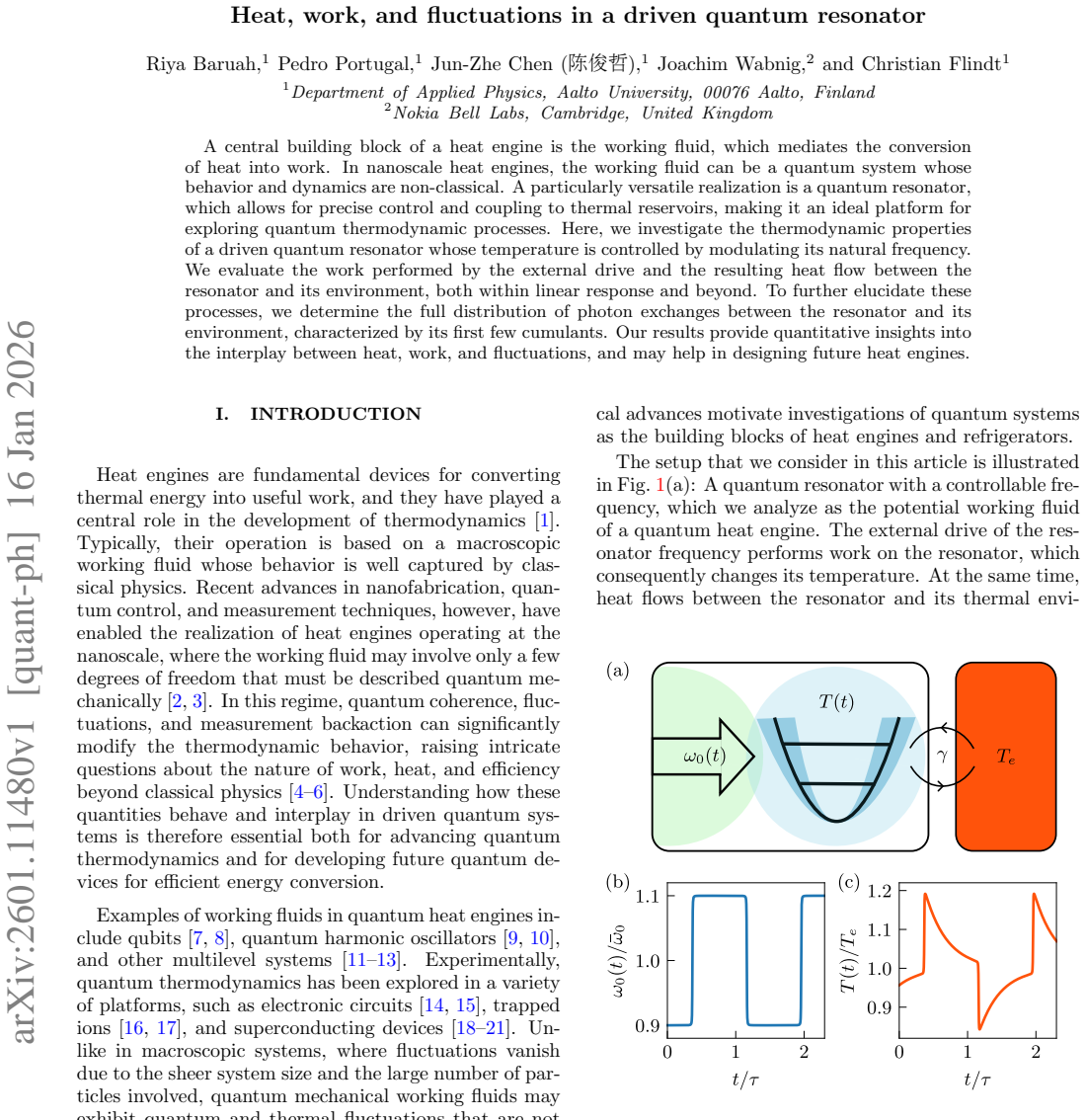
For a harmonic oscillator with Hamiltonian ħω₀(t)(a†a+1/2) weakly coupled to a thermal bath, the paper shows that frequency modulation alone can control the resonator temperature: in the fast-driving limit the temperature follows the ratio T(t)/ω₀(t) = const, and with finite coupling it obeys the rate equation ∂t n = γ(nB - n). It then writes the photon-exchange counting statistics in terms of a tilted Lindblad operator and assumes the s-dependent density matrix retains the thermal form χ(λ,s) = M(s) exp(-|λ|²(n(s)+1/2)). This assumption closes the equations: the cumulant generating function and s-dependent occupation obey Eqs. (43)-(44). From these, the first four cumulants are obtained ord
Load-bearing premise
The s-dependent density matrix is assumed to remain in the family of thermal (circular Gaussian) states with only the occupation number modified; if the tilted evolution produces phase-sensitive or otherwise non-thermal correlations, the equations for C(s) and n(s) do not close and the predicted cumulants would be wrong.
Editorial extensions
If this is right
- The closed pair of equations allows the full photon-counting distribution to be computed for arbitrary time-dependent frequency protocols, not just square, sawtooth, or harmonic drives.
- The linear-response formulas (23), (25), (27), and (57) give direct frequency-domain relations between the drive and the temperature, power, heat, and each cumulant, valid for small driving amplitudes.
- The results imply that in a driven resonator, heat and work fluctuations are generically non-Gaussian and can be predicted from the same two coupled equations, enabling estimates of fluctuation-induced corrections to efficiency.
- The equilibrium distribution (59) provides an exact closed-form benchmark for zero-drive photon statistics, against which driven distributions can be compared.
- The formalism extends naturally to setups where only emitted photons are detected, by keeping only the e^s Je term in the tilted operator.
Reading between the lines
- If the thermal-state ansatz fails for strong drives, the first signature would appear as a nontrivial phase-space covariance (squeezing) in the s-dependent state; measuring the third or fourth cumulant as a function of driving phase could detect this because the ansatz predicts a specific, sign-definite phase relation among cumulants.
- The same closure strategy — assuming a one-parameter manifold of states under the tilted Lindblad evolution — could be applied to other Gaussian systems (e.g., multimode cavities or optomechanical resonators) to obtain full counting statistics with modest effort.
- A direct experimental test would be to compare the predicted time-dependence of the third cumulant (skewness) of the photon-number distribution in a superconducting microwave resonator with calorimetric measurements; a mismatch would signal the need for a non-thermal ansatz.
- The connection between cumulants in Eq. (57) suggests a universal scaling of all higher-order fluctuations with the first cumulant in linear response; verifying this scaling experimentally would confirm the closure assumption in the perturbative regime.
Editorial analysis
A structured set of objections, weighed in public.
Referee Report
Summary. This paper studies a driven quantum resonator (a harmonic oscillator with time-dependent frequency) coupled to a thermal bath. It derives the time-dependent temperature, power, and heat through a Lindblad master equation, develops a linear-response approximation for these quantities, and extends the analysis to the full counting statistics of net photon exchanges using a tilted Lindblad operator. The central claims are that frequency modulation controls the resonator temperature, and that the photon-exchange statistics are fully captured by a one-parameter thermal ansatz, yielding closed equations for the cumulant generating function and its cumulants. Numerical results for square-wave, sawtooth, and harmonic drives are compared with the analytic expressions.
Significance. If the derivations are completed as intended, the paper provides a largely analytic treatment of a minimal quantum thermodynamic working fluid, including fluctuation statistics beyond linear response. The model is simple and experimentally relevant, and the predictions are parameter-free in the sense that all inputs are stated rather than fitted. The linear-response results are transparent, and the numerical checks strengthen the presentation. The main caveat is that the full-counting-statistics derivation rests on an unproven invariance assertion; this is fixable, and the result appears correct. The paper would be a useful contribution to quantum thermodynamics once that gap is closed and a notational inconsistency in Section V is resolved.
major comments (2)
- [VI, Eq. (40); also III] The statement that the (tilted) density matrix remains in the one-parameter thermal family is the key assumption behind Eqs. (43)-(44) and behind the temperature definition in Section III. It is asserted without proof. This is not trivial because the tilted Lindblad operator is not Hermitian; one must show that the fractional-linear form of the Fock-space generating function is an invariant manifold. A short derivation is available: the diagonal populations obey a birth-death-immigration process, and substituting F(z,s)=M(s)/(1+n(s)-n(s)z) into the first-order PDE for F(z,s)=Σ p_n(s) z^n yields exactly Eqs. (43)-(44). Please add this derivation (or an equivalent symmetry argument) to justify the ansatz and the analogous statement for the untitled dynamics in Section III.
- [V, Eqs. (19)-(20) and (27)] The derivative n'_B(ω̄0) is never defined. In Eqs. (19)-(20) the prefactor ℏ/kBTe implies that n'_B is a derivative with respect to the dimensionless variable ℏω0/(kBTe). In Eq. (27), however, the same symbol appears without such a prefactor, making the expression dimensionally inconsistent (units of power times frequency rather than power). Either define n'_B as dnB/dω0 and remove the ℏ/kBTe from Eqs. (19)-(20), or define n'_B as the derivative with respect to the dimensionless argument and insert ℏ/kBTe in Eq. (27). The linearized population calculation gives Eq. (27) under the first convention; please make the notation consistent across all three equations.
minor comments (4)
- [IX, Eq. (59)] The text says 'We then expand it in the counting field' when referring to obtaining the distribution from the moment generating function. The correct operation is an inversion, not an expansion; please rephrase.
- [Figures 5-7 captions] The captions write 'γ=0.1ω0' where the bar over ω0 is missing; use ω̄0 consistently with the text and Fig. 4.
- [VI-IX] For a net photon count on a system with bounded occupation, the cumulant generating function saturates at long times rather than growing linearly. It would help the reader to state explicitly that m(t)=n(0)-n(t), so the finite long-time limit in Eq. (50) is expected, and to indicate the domain of s for which the equilibrium generating function converges.
- [III, Eq. (11)] The derivation of the population equation (11) from the Lindblad master equation is not shown; a one-line demonstration or a more precise pointer to Ref. [35] would make the temperature analysis self-contained.
Circularity Check
No significant circularity; the derivations are self-contained and the s-dependent thermal ansatz is an exact invariant manifold, not a fitted or imported result.
full rationale
The paper's central derivation chain starts from a stated Hamiltonian and Lindblad dissipator (Eqs. (1)-(3)) with explicit parameters γ, ω0(t), Te; no parameter is fitted to the target output. The temperature, power, and heat results (Eqs. (10), (15), (16)) follow algebraically from the model. The full counting statistics result is derived through the tilted-Lindblad formalism (Eqs. (29)-(33)); the only non-trivial step is the s-dependent thermal ansatz (Eq. (40)), asserted without a proof in the text. This is an assumption about the invariant manifold of the tilted generator, not a circular reduction: for the Fock-diagonal dynamics generated by L(s) with an a†a Hamiltonian, the fractional-linear generating function F(z,s)=M(s)/(1+n(s)(1-z)) closes under the tilted generator and yields exactly Eqs. (43)-(44). The equilibrium expression (Eq. (50)) follows from integrating those equations, and the distribution (Eq. (59)) is the difference of two independent thermal occupations. Self-citations (Refs. [31-36]) are used for the master-equation derivation and for context on photon-counting statistics, but the cited master equation is parameter-free with stated assumptions (weak coupling, H(t) commuting at different times) and does not assume the target results; the present fluctuation equations are derived in text. Therefore no prediction reduces by construction to an input, and no self-citation chain forces the conclusions.
Assumptions & free parameters
free parameters (1)
- none
assumptions (3)
- domain assumption The Lindblad master equation (Eq. 2) with the dissipator (Eq. 3) is valid on all relevant timescales; it is taken from Ref. [35].
- domain assumption The resonator remains in a thermal state throughout the evolution, so its temperature can be defined through the mean occupation n(ω0) via Eq. (12).
- ad hoc to paper The s-dependent density matrix ρ(s) remains a one-parameter thermal state with characteristic function χ(λ,s)=M(s) exp(−|λ|²(n(s)+1/2)).
invented entities (1)
-
none
Cite this review
Pith. "Pith review of Heat, work, and fluctuations in a driven quantum resonator." pith.science (2026). https://pith.science/paper/2DP2SE2K
@misc{pith2026260111480,
  author       = {Pith},
  title        = {Pith review of: Heat, work, and fluctuations in a driven quantum resonator},
  year         = {2026},
  howpublished = {\url{https://pith.science/paper/2DP2SE2K}},
  note         = {Machine review of arXiv:2601.11480}
}
read the original abstract
A central building block of a heat engine is the working fluid, which mediates the conversion of heat into work. In nanoscale heat engines, the working fluid can be a quantum system whose behavior and dynamics are non-classical. A particularly versatile realization is a quantum resonator, which allows for precise control and coupling to thermal reservoirs, making it an ideal platform for exploring quantum thermodynamic processes. Here, we investigate the thermodynamic properties of a driven quantum resonator whose temperature is controlled by modulating its natural frequency. We evaluate the work performed by the external drive and the resulting heat flow between the resonator and its environment, both within linear response and beyond. To further elucidate these processes, we determine the full distribution of photon exchanges between the resonator and its environment, characterized by its first few cumulants. Our results provide quantitative insights into the interplay between heat, work, and fluctuations, and may help in designing future heat engines.
Figures


Figures from the paper (4 more)


Reference graph
Works this paper leans on
-
[1]
H. B. Callen,Thermodynamics and an Introduction to Thermostatistics, 2nd ed. (John Wiley & Sons, New York, 1985)
1985
-
[2]
Vinjanampathy and J
S. Vinjanampathy and J. Anders, Quantum thermody- namics, Contemp. Phys.57, 545 (2016)
2016
-
[3]
Strasberg,Quantum Stochastic Thermodynamics(Ox- ford University Press, Oxford, 2022)
P. Strasberg,Quantum Stochastic Thermodynamics(Ox- ford University Press, Oxford, 2022)
2022
-
[4]
Giazotto, T
F. Giazotto, T. T. Heikkil¨ a, A. Luukanen, A. M. Savin, and J. P. Pekola, Opportunities for mesoscopics in ther- mometry and refrigeration: Physics and applications, Rev. Mod. Phys.78, 217 (2006)
2006
-
[5]
H. T. Quan, Y.-x. Liu, C. P. Sun, and F. Nori, Quantum thermodynamic cycles and quantum heat engines, Phys. Rev. E76, 031105 (2007)
2007
-
[6]
L. M. Cangemi, C. Bhadra, and A. Levy, Quantum en- gines and refrigerators, Phys. Rep.1087, 1 (2024)
2024
-
[7]
K. Ono, S. N. Shevchenko, T. Mori, S. Moriyama, and F. Nori, Analog of a Quantum Heat Engine Using a Single-Spin Qubit, Phys. Rev. Lett.125, 166802 (2020)
2020
-
[8]
Kamimura, H
S. Kamimura, H. Hakoshima, Y. Matsuzaki, K. Yoshida, and Y. Tokura, Quantum-Enhanced Heat Engine Based on Superabsorption, Phys. Rev. Lett.128, 180602 (2022)
2022
Show all 42 references
-
[9]
Leitch, N
H. Leitch, N. Piccione, B. Bellomo, and G. De Chiara, Driven quantum harmonic oscillators: A working medium for thermal machines, A VS Quantum Sci.4, 012001 (2022)
2022
-
[10]
Insinga, B
A. Insinga, B. Andresen, and P. Salamon, Thermody- namical analysis of a quantum heat engine based on har- monic oscillators, Phys. Rev. E94, 012119 (2016)
2016
-
[11]
H. E. D. Scovil and E. O. Schulz-DuBois, Three-Level Masers as Heat Engines, Phys. Rev. Lett.2, 262 (1959)
1959
-
[12]
H. T. Quan, P. Zhang, and C. P. Sun, Quantum heat engine with multilevel quantum systems, Phys. Rev. E 72, 056110 (2005)
2005
-
[13]
M. F. Anka, T. R. de Oliveira, and D. Jonathan, Measurement-based quantum heat engine in a multilevel system, Phys. Rev. E104, 054128 (2021)
2021
-
[14]
J. P. Pekola, Towards quantum thermodynamics in elec- tronic circuits, Nat. Phys.11, 118 (2015)
2015
-
[15]
Hofmann, V
A. Hofmann, V. F. Maisi, J. Basset, C. Reichl, W. Wegscheider, T. Ihn, K. Ensslin, and C. Jarzynski, Heat dissipation and fluctuations in a driven quantum dot, Phys. Status Solidi B254, 1600546 (2017)
2017
-
[16]
An, J.-N
S. An, J.-N. Zhang, M. Um, D. Lv, Y. Lu, J. Zhang, Z.-Q. Yin, H. T. Quan, and K. Kim, Experimental test of the quantum Jarzynski equality with a trapped-ion system, Nat. Phys.11, 193 (2014)
2014
-
[17]
Roßnagel, S
J. Roßnagel, S. T. Dawkins, K. N. Tolazzi, O. Abah, E. Lutz, F. Schmidt-Kaler, and K. Singer, A single-atom heat engine, Science352, 325 (2016)
2016
-
[18]
Masuyama, K
Y. Masuyama, K. Funo, Y. Murashita, A. Noguchi, 10 S. Kono, Y. Tabuchi, R. Yamazaki, M. Ueda, and Y. Nakamura, Information-to-work conversion by Maxwell's demon in a superconducting circuit quantum electrodynamical system, Nat. Commun.9, 1291 (2018)
2018
-
[19]
J. P. Pekola, P. Solinas, A. Shnirman, and D. V. Averin, Calorimetric measurement of work in a quantum system, New J. Phys.15, 115006 (2013)
2013
-
[20]
Ronzani, B
A. Ronzani, B. Karimi, J. Senior, Y.-C. Chang, J. T. Peltonen, C. D. Chen, and J. P. Pekola, Tunable photonic heat transport in a quantum heat valve, Nat. Phys.14, 991 (2018)
2018
-
[21]
M. A. Aamir, P. Jamet Suria, J. A. Mar ´ ın Guzm´ an, C. Castillo-Moreno, J. M. Epstein, N. Yunger Halpern, and S. Gasparinetti, Thermally driven quantum refriger- ator autonomously resets a superconducting qubit, Nat. Phys.21, 318 (2025)
2025
-
[22]
Anders and V
J. Anders and V. Giovannetti, Thermodynamics of dis- crete quantum processes, New J. Phys.15, 033022 (2013)
2013
-
[23]
Brange, P
F. Brange, P. Samuelsson, B. Karimi, and J. P. Pekola, Nanoscale quantum calorimetry with electronic temper- ature fluctuations, Phys. Rev. B98, 205414 (2018)
2018
-
[24]
Karimi, F
B. Karimi, F. Brange, P. Samuelsson, and J. P. Pekola, Reaching the ultimate energy resolution of a quantum detector, Nat. Commun.11, 367 (2020)
2020
-
[25]
Karimi and J
B. Karimi and J. P. Pekola, Quantum trajectory analysis of single microwave photon detection by nanocalorimetry, Phys. Rev. Lett.124, 170601 (2020)
2020
-
[26]
Silaev, T
M. Silaev, T. T. Heikkil¨ a, and P. Virtanen, Lindblad- equation approach for the full counting statistics of work and heat in driven quantum systems, Phys. Rev. E90, 022103 (2014)
2014
-
[27]
Gasparinetti, P
S. Gasparinetti, P. Solinas, A. Braggio, and M. Sassetti, Heat-exchange statistics in driven open quantum sys- tems, New J. Phys.16, 115001 (2014)
2014
-
[28]
A. A. Clerk and D. W. Utami, Using a qubit to measure photon-number statistics of a driven thermal oscillator, Phys. Rev. A75, 042302 (2007)
2007
-
[29]
A. A. Clerk, Full counting statistics of energy fluctuations in a driven quantum resonator, Phys. Rev. A84, 043824 (2011)
2011
-
[30]
P. P. Hofer and A. A. Clerk, Negative Full Counting Statistics Arise from Interference Effects, Phys. Rev. Lett.116, 013603 (2016)
2016
-
[31]
Brange, P
F. Brange, P. Menczel, and C. Flindt, Photon counting statistics of a microwave cavity, Phys. Rev. B99, 085418 (2019)
2019
-
[32]
Menczel, E
P. Menczel, E. Loisa, K. Brandner, and C. Flindt, Ther- modynamic uncertainty relations for coherently driven open quantum systems, J. Phys. A: Math. Theor.54, 314002 (2021)
2021
-
[33]
Portugal, F
P. Portugal, F. Brange, K. S. U. Kansanen, P. Samuels- son, and C. Flindt, Photon emission statistics of a driven microwave cavity, Phys. Rev. Res.5, 033091 (2023)
2023
-
[34]
K. S. U. Kansanen, P. Portugal, C. Flindt, and P. Samuelsson, Photon counting statistics in Gaussian bosonic networks, SciPost Phys.18, 116 (2025)
2025
-
[35]
Portugal, F
P. Portugal, F. Brange, and C. Flindt, Effective temper- ature pulses in open quantum systems, Phys. Rev. Res. 4, 043112 (2022)
2022
-
[36]
Baruah, P
R. Baruah, P. Portugal, J. Wabnig, and C. Flindt, Fast, accurate, and local temperature control using qubits, Phys. Rev. B111, 125406 (2025)
2025
-
[37]
Deffner and E
S. Deffner and E. Lutz, Nonequilibrium work distribu- tion of a quantum harmonic oscillator, Phys. Rev. E77, 021128 (2008)
2008
-
[38]
Deffner, O
S. Deffner, O. Abah, and E. Lutz, Quantum work statis- tics of linear and nonlinear parametric oscillators, Chem. Phys.375, 200 (2010)
2010
-
[39]
Denzler and E
T. Denzler and E. Lutz, Heat distribution of a quantum harmonic oscillator, Phys. Rev. E98, 052106 (2018)
2018
-
[40]
P. C. L´ opez V´ azquez, Driving a dissipative quantum os- cillator, Phys. Rev. A98, 042128 (2018)
2018
-
[41]
M. B. Plenio and P. L. Knight, The quantum-jump ap- proach to dissipative dynamics in quantum optics, Rev. Mod. Phys.70, 101 (1998)
1998
-
[42]
G. T. Landi, M. J. Kewming, M. T. Mitchison, and P. P. Potts, Current Fluctuations in Open Quantum Systems: Bridging the Gap Between Quantum Continuous Mea- surements and Full Counting Statistics, PRX Quantum 5, 020201 (2024)
2024
Reviewed August 3, 2026 · model on record in the stance chip above.
Discussion (0). Sign in to comment.